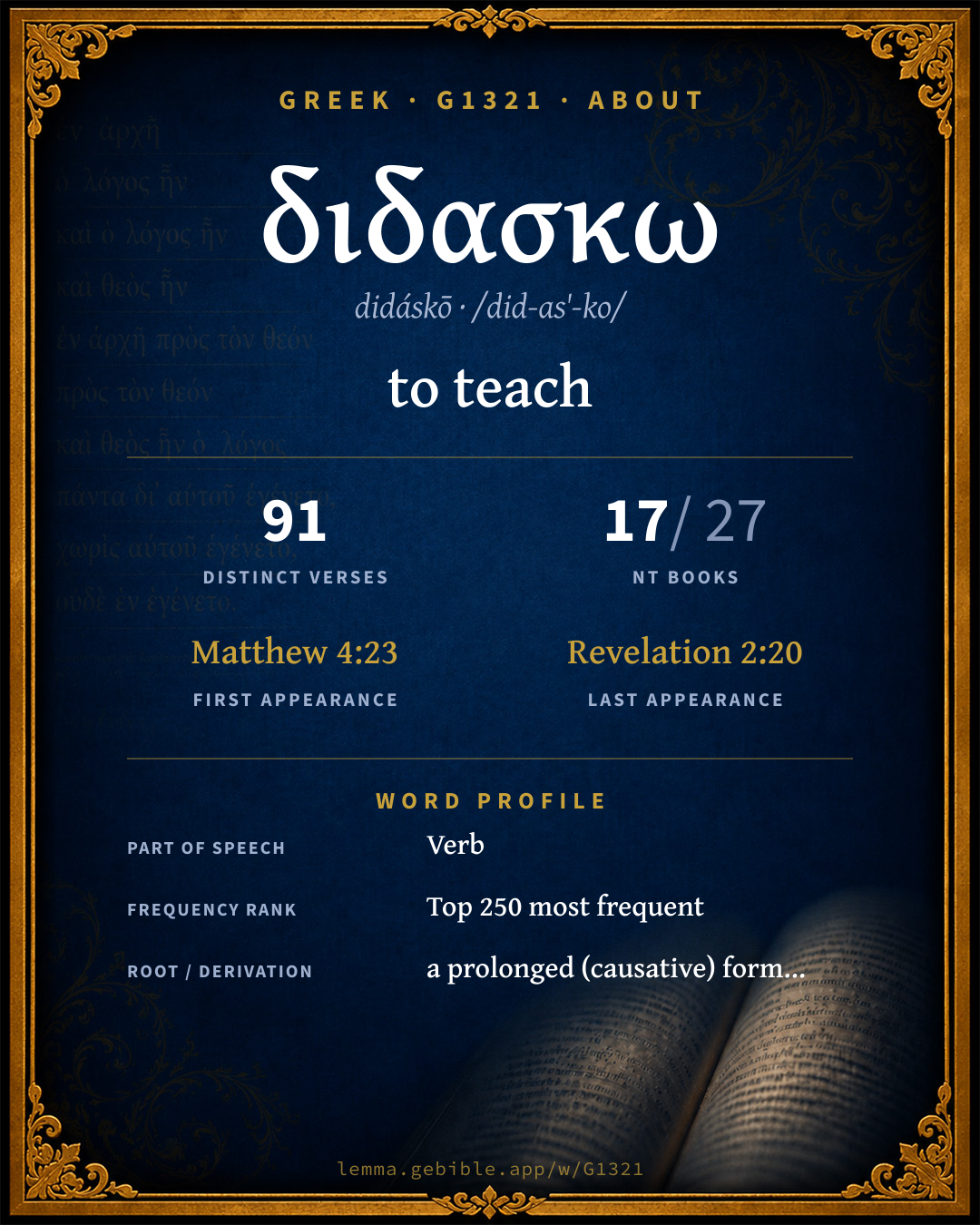
διδάσκω
to teach
‘to teach’ is one of 8 main senses fuller range ↓
Full lexicon entry — Thayer's Greek Lexicon
From Thayer's Greek Lexicon
Where this word appears
See every Present-tense verb in the Greek New Testament →
Grammar key — what these labels mean
Part of speech
- Verb
- An action or state-of-being word.
Tense
- Present
- Ongoing or general action in present time (imperfective aspect).
- Imperfect
- Continuous or repeated action in past time (“was writing”).
- Aorist
- Action viewed as a simple whole, without regard to duration — often past (perfective aspect).
- Future
- Action expected in future time.
Voice
- Active
- The subject performs the action.
- Passive
- The subject receives the action.
Mood
- Participle
- A verbal adjective (“writing,” “having written”).
- Indicative
- States a fact or asks a factual question (the mood of reality).
- Infinitive
- A verbal noun (“to write”), unmarked for person or number.
- Subjunctive
- Expresses probability, purpose, or possibility (the mood of contingency).
- Imperative
- Expresses a command or request.
Case
- Nominative
- The case of the subject (and the predicate nominative).
- Dative
- The case of the indirect object, means, or location — “to / for / with / in.”
- Genitive
- The case of source, possession, or “of” — answers “whose / from what.”
Person
- 3rd person
- The one spoken about (“he / she / it / they”).
- 2nd person
- The one addressed (“you”).
- 1st person
- The speaker (“I / we”).
Gender
- Masculine
- Grammatically masculine.
Number
- Singular
- One.
- Plural
- More than one.
2 verses where G1321 appears in the Imperfect tense in the Book of John. Filtered view — show all forms. Click any verse to open its interlinear word-by-word view. Verse text shown in the World English Bible for context — . Each verse’s Greek form is shown with its reference; the English is not keyword-highlighted, since the data carries no word-level English alignment. Use “Compare translations” on any verse to read it across multiple English versions. This concordance covers the Greek New Testament; Septuagint (Greek Old Testament) occurrences of this word are not indexed here.
John
About this entry
At a glance — auto-summarized from this page’s data, not written by a person. Every figure links to its source below. This summary describes the numbers; it doesn’t interpret them.
At its core, διδασκω (didáskō) means “to teach.” Catalogued under 8 senses, its meaning is not single-sense. It turns up in 91 verses across 17 books, a moderately common footprint. Scripture first uses it in Matthew 4:23. It shares a root with διδακτος, διδασκαλος and διδαχη. Each statement above links to its evidence; the full detail follows below.
Gloss history
Strong's 1890 vs modern scholarship
About this word
Strong's G1321 catalogs a Greek word from the Greek New Testament.
These counts are not copied from any lexicon or concordance. They are computed here, from the morphology-tagged Greek New Testament. What Lemma adds →
- 91
- distinct verses
- The word appears in 91 distinct verses.
- 17 / 27
- NT books
- The word appears in 17 of 27 New Testament books.
- #174
- by frequency
- Top 250 most frequent Greek words (rank 174 of 5,347 Greek words by occurrence).
View all 91 occurrences in the concordance →
By section of the New Testament
By traditional corpus
Conventional, traditional groupings — biblical authorship is debated, so this is a traditional corpus grouping, not an authorship claim. Some books belong to more than one corpus (Luke is in both the Gospels and the Lukan corpus, and so on), so these shares overlap and need not total 100%. Each figure is a share of the word’s 91 distinct verses.
- Gospels 55 verses · 60%
- Lukan (Luke–Acts) 31 verses · 34%
- Pauline corpus 15 verses · 16%
- Johannine 13 verses · 14%
- Hebrews 2 verses · 2%
- Revelation 2 verses · 2%
- General (Catholic) Epistles 1 verse · 1%
How translations render this word
Counts come from each version’s own published word-to-Strong’s tagging or interlinear alignment — an approximate guide to how each version renders this word, not a word-level alignment the data otherwise carries. Because each total is that version’s own tagged count, the per-version totals vary from one another and need not match the appearance or distinct-verse counts above. These counts may also differ from a printed concordance because Lemma counts each distinctly tagged rendering and does not collapse phrase taggings into a single head-word total. This is a fixed set of word-tagged versions (KJV, ASV, BSB, ULT) and does not change with the reading translation you choose elsewhere. Each version’s license is shown beside its name below (and on Sources).
- King James Version: Teach 21×, Teaching 20×, Taught 16×
- American Standard Version: Teaching 22×, Teach 20×, Taught 19×
- Berean Standard Bible: Teach 26×, Teaching 20×, Taught 10×
- unfoldingWord Literal Text: Teaching 34×, Teach 19×, He was teaching 7×
King James Version Public Domain
Renders G1321 across 97 tagged occurrences — most commonly:
Plus 14 renderings that appear only once — usually multi-word phrases or single function words the recovered tagging swept in, not distinct renderings. Not rendered by a distinct English word in 2 further occurrences.
American Standard Version Public Domain
Renders G1321 across 96 tagged occurrences — most commonly:
Plus 14 renderings that appear only once — usually multi-word phrases or single function words the recovered tagging swept in, not distinct renderings.
Berean Standard Bible Public Domain
Renders G1321 across 97 tagged occurrences — most commonly:
Plus 15 renderings that appear only once — usually multi-word phrases or single function words the recovered tagging swept in, not distinct renderings.
unfoldingWord Literal Text CC BY-SA 4.0
Renders G1321 across 102 tagged occurrences — most commonly:
Plus 18 renderings that appear only once — usually multi-word phrases or single function words the recovered tagging swept in, not distinct renderings.
8 senses in Thayer's, in lexicon order
The 8 senses Thayer's distinguishes for this word, in lexicon order (not ranked by frequency or importance). The full entry — with sub-senses — is in the Lexicon Entry tab.
- to hold discourse with others in order to instruct them, deliver didactic discourses
- to be a teacher
- to discharge the office of a teacher, conduct one's self as a teacher
- to impart instruction
- instill doctrine into one
- the thing taught or enjoined
- to explain or expound a thing
- to teach one something
Word origin
Origin: a prolonged (causative) form of a primary verb dao (to learn)
A prolonged (causative) form of a primary verb δάω daō (to learn ); to teach (in the same broad application): - teach.
— Strong’s Exhaustive Concordance (1890), public domain.
Forms in the corpus
The 25 distinct written forms G1321 takes in the Greek New Testament, most frequent first — each parse links to that tense’s occurrences in the concordance.
Same root — word family
Other Thayer's entries built from the same root as G1321, grouped by Strong’s listed origin. These share a root / origin per the lexicon — not necessarily a shared meaning. Each links to that word’s own entry.
Derived from this word
Compare all same-root words → They share a root, not necessarily a meaning.
Septuagint usage
The same Greek word διδασκω appears 79 times in the Greek Old Testament (Septuagint), across 77 verses in 16 books.
- 79
- LXX occurrences
- Tagged occurrences of this Greek word in the Septuagint.
- 77
- verses
- Distinct Septuagint verses containing this word.
- 16 / 39
- OT books
- The word appears in 16 of the 39 Old Testament books.
Sample Septuagint occurrences
- Deuteronomy 4:1 διδάσκω
- Judges 3:2 διδάσκω
- 2 Samuel 1:18 διδάσκω
- 1 Chronicles 5:18 διδάσκω
- 2 Chronicles 17:7 διδάσκω
- Ezra 7:10 διδάσκω
- Job 6:24 διδάσκω
- Psalms 17:35 διδάσκω
- Proverbs 1:23 διδάσκω
- Ecclesiastes 12:9 διδάσκω
- Song of Solomon 3:8 διδάσκω
- Isaiah 9:14 διδάσκω
Septuagint occurrences (same lexeme)
Every verse where the same Strong’s number (G1321) appears in the Greek Septuagint — showing the first 50 of 77. Verse text shown in the World English Bible for context; the Greek form is the matched word — the English is not keyword-highlighted.
- Deuteronomy 4:1 διδάσκω Now, Israel, listen to the statutes and to the ordinances, which I teach you, to do them; that you may live, and go in and possess the land which Yahweh, the God of your fathers, gives you.
- Deuteronomy 4:10 διδάσκω the day that you stood before Yahweh your God in Horeb, when Yahweh said to me, Assemble me the people, and I will make them hear my words, that they may learn to fear me all the days that they live on the earth, and that they may teach their children.
- Deuteronomy 4:14 διδάσκω Yahweh commanded me at that time to teach you statutes and ordinances, that you might do them in the land where you go over to possess it.
- Deuteronomy 5:31 διδάσκω But as for you, stand you here by me, and I will speak to you all the commandment, and the statutes, and the ordinances, which you shall teach them, that they may do them in the land which I give them to possess it.
- Deuteronomy 6:1 διδάσκω Now this is the commandment, the statutes, and the ordinances, which Yahweh your God commanded to teach you, that you might do them in the land where you go over to possess it;
- Deuteronomy 11:19 διδάσκω You shall teach them your children, talking of them, when you sit in your house, and when you walk by the way, and when you lie down, and when you rise up.
- Deuteronomy 20:18 διδάσκω that they not teach you to do after all their abominations, which they have done to their gods; so would you sin against Yahweh your God.
- Deuteronomy 31:19 διδάσκω Now therefore write you this song for you, and teach you it the children of Israel: put it in their mouths, that this song may be a witness for me against the children of Israel.
- Deuteronomy 31:22 διδάσκω So Moses wrote this song the same day, and taught it the children of Israel.
- Deuteronomy 32:44 διδάσκω Moses came and spoke all the words of this song in the ears of the people, he and Joshua the son of Nun.
- Judges 3:2 διδάσκω only that the generations of the children of Israel might know, to teach them war, at the least such as before knew nothing of it:
- 2 Samuel 1:18 διδάσκω (and he bade them teach the children of Judah [the song of] the bow: behold, it is written in the book of Jashar):
- 2 Samuel 22:35 διδάσκω He teaches my hands to war, So that my arms do bend a bow of brass.
- 1 Chronicles 5:18 διδάσκω The sons of Reuben, and the Gadites, and the half-tribe of Manasseh, of valiant men, men able to bear buckler and sword, and to shoot with bow, and skillful in war, were forty-four thousand seven hundred and sixty, that were able to go forth to war.
- 1 Chronicles 25:7 διδάσκω The number of them, with their brothers who were instructed in singing to Yahweh, even all who were skillful, was two hundred eighty-eight.
- 2 Chronicles 17:7 διδάσκω Also in the third year of his reign he sent his princes, even Ben Hail, and Obadiah, and Zechariah, and Nethanel, and Micaiah, to teach in the cities of Judah;
- 2 Chronicles 17:9 διδάσκω They taught in Judah, having the book of the law of Yahweh with them; and they went about throughout all the cities of Judah, and taught among the people.
- Ezra 7:10 διδάσκω For Ezra had set his heart to seek the law of Yahweh, and to do it, and to teach in Israel statutes and ordinances.
- Ezra 18:8 διδάσκω
- Job 6:24 διδάσκω "Teach me, and I will hold my peace; Cause me to understand wherein I have erred.
- Job 8:10 διδάσκω Shall they not teach you, tell you, And utter words out of their heart?
- Job 10:2 διδάσκω I will tell God, 'Do not condemn me, Show me why you contend with me.
- Job 13:23 διδάσκω How many are my iniquities and sins? Make me know my disobedience and my sin.
- Job 21:22 διδάσκω "Shall any teach God knowledge, Seeing he judges those who are high?
- Job 22:2 διδάσκω "Can a man be profitable to God? Surely he who is wise is profitable to himself.
- Job 32:8 διδάσκω But there is a spirit in man, And the breath of the Almighty gives them understanding.
- Job 33:4 διδάσκω The Spirit of God has made me, And the breath of the Almighty gives me life.
- Job 33:33 διδάσκω If not, listen to me: Hold your peace, and I will teach you wisdom."
- Job 36:2 διδάσκω "Bear with me a little, and I will show you; For I still have something to say on God's behalf.
- Job 37:19 διδάσκω Teach us what we shall tell him; For we can't make our case by reason of darkness.
- Job 42:4 διδάσκω You said, 'Listen, now, and I will speak; I will question you, and you will answer me.'
- Psalms 17:35 διδάσκω
- Psalms 17:36 διδάσκω
- Psalms 24:4 διδάσκω He who has clean hands and a pure heart; Who has not lifted up his soul to falsehood, And has not sworn deceitfully.
- Psalms 24:5 διδάσκω He shall receive a blessing from Yahweh, Righteousness from the God of his salvation.
- Psalms 24:9 διδάσκω Lift up your heads, you gates; Yes, lift them up, you everlasting doors: The King of glory will come in.
- Psalms 33:12 διδάσκω Blessed is the nation whose God is Yahweh, The people whom he has chosen for his own inheritance.
- Psalms 50:15 διδάσκω Call on me in the day of trouble. I will deliver you, and you will honor me."
- Psalms 70:17 διδάσκω
- Psalms 93:10 διδάσκω
- Psalms 93:12 διδάσκω
- Psalms 118:12 διδάσκω They surrounded me like bees. They are quenched like the burning thorns. In the name of Yahweh I cut them off.
- Psalms 118:26 διδάσκω Blessed is he who comes in the name of Yahweh! We have blessed you out of the house of Yahweh.
- Psalms 118:64 διδάσκω
- Psalms 118:66 διδάσκω
- Psalms 118:68 διδάσκω
- Psalms 118:99 διδάσκω
- Psalms 118:108 διδάσκω
- Psalms 118:124 διδάσκω
- Psalms 118:135 διδάσκω
These are occurrences of the same Greek lexeme (G1321) in the Septuagint — not a translation of any one Hebrew word. The store carries no word-level Hebrew↔Greek alignment, so no Hebrew original is asserted here. Counts come from the recovered LXX Strong's tagging — high-frequency vocabulary is well covered, while rare or late forms may be untagged — so they reflect tagged occurrences and may slightly undercount.