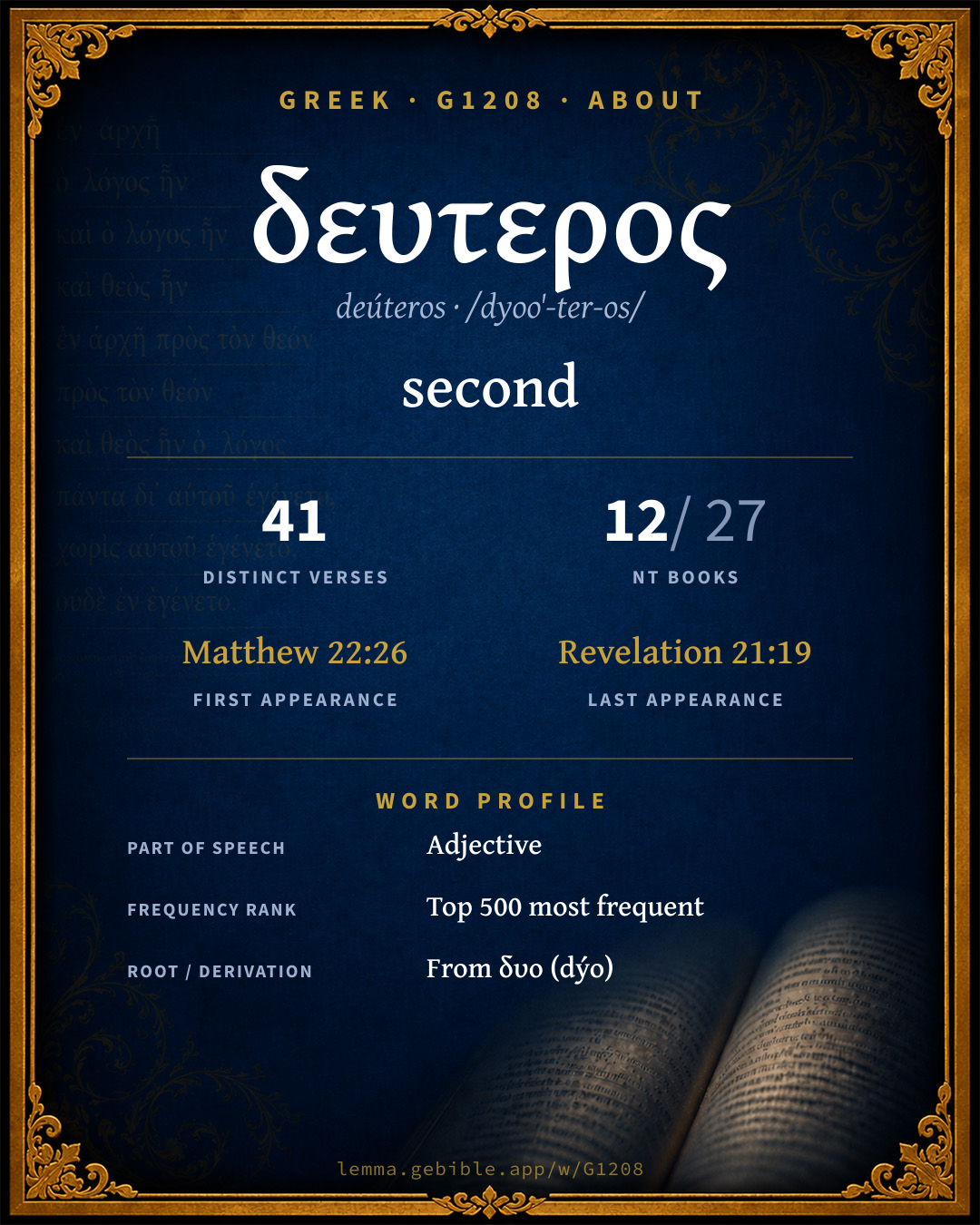
δεύτερος
second
Full lexicon entry — Thayer's Greek Lexicon
From Thayer's Greek Lexicon
Where this word appears
See every Nominative-case word in the Greek New Testament →
Grammar key — what these labels mean
Part of speech
- Adjective
- A word that describes or qualifies a noun.
- Adverb
- A word that modifies a verb, adjective, or other adverb.
Case
- Nominative
- The case of the subject (and the predicate nominative).
- Genitive
- The case of source, possession, or “of” — answers “whose / from what.”
- Accusative
- The case of the direct object and of extent.
- Dative
- The case of the indirect object, means, or location — “to / for / with / in.”
Gender
- Masculine
- Grammatically masculine.
- Neuter
- Grammatically neuter.
- Feminine
- Grammatically feminine.
Number
- Singular
- One.
Every verse where G1208 appears in the Book of Luke — 3 distinct verses. Click any verse to open its interlinear word-by-word view. Verse text shown in the World English Bible for context — . Each verse’s Greek form is shown with its reference; the English is not keyword-highlighted, since the data carries no word-level English alignment. Use “Compare translations” on any verse to read it across multiple English versions. This concordance covers the Greek New Testament; Septuagint (Greek Old Testament) occurrences of this word are not indexed here.
Luke
- Luke 12:38 δευτέρᾳ adj dat sg fem They will be blessed if he comes in the second or third watch, and finds them so.
- Luke 19:18 δεύτερος adj nom sg masc "The second came, saying, 'Your mina, Lord, has made five minas.'
- Luke 20:30 δεύτερος adj nom sg masc The second took her as wife, and he died childless.
About this entry
At a glance — auto-summarized from this page’s data, not written by a person. Every figure links to its source below. This summary describes the numbers; it doesn’t interpret them.
At its core, δευτερος (deúteros) means “second.” It first appears in Matthew 22:26. Spanning 41 verses in 12 books, it ranks among the moderately common words of the Greek New Testament. Its uses concentrate in Revelation (29% of all occurrences). Sharing its root, it stands alongside δυο, δις and δωδεκα. Each statement above links to its evidence; the full detail follows below.
Gloss history
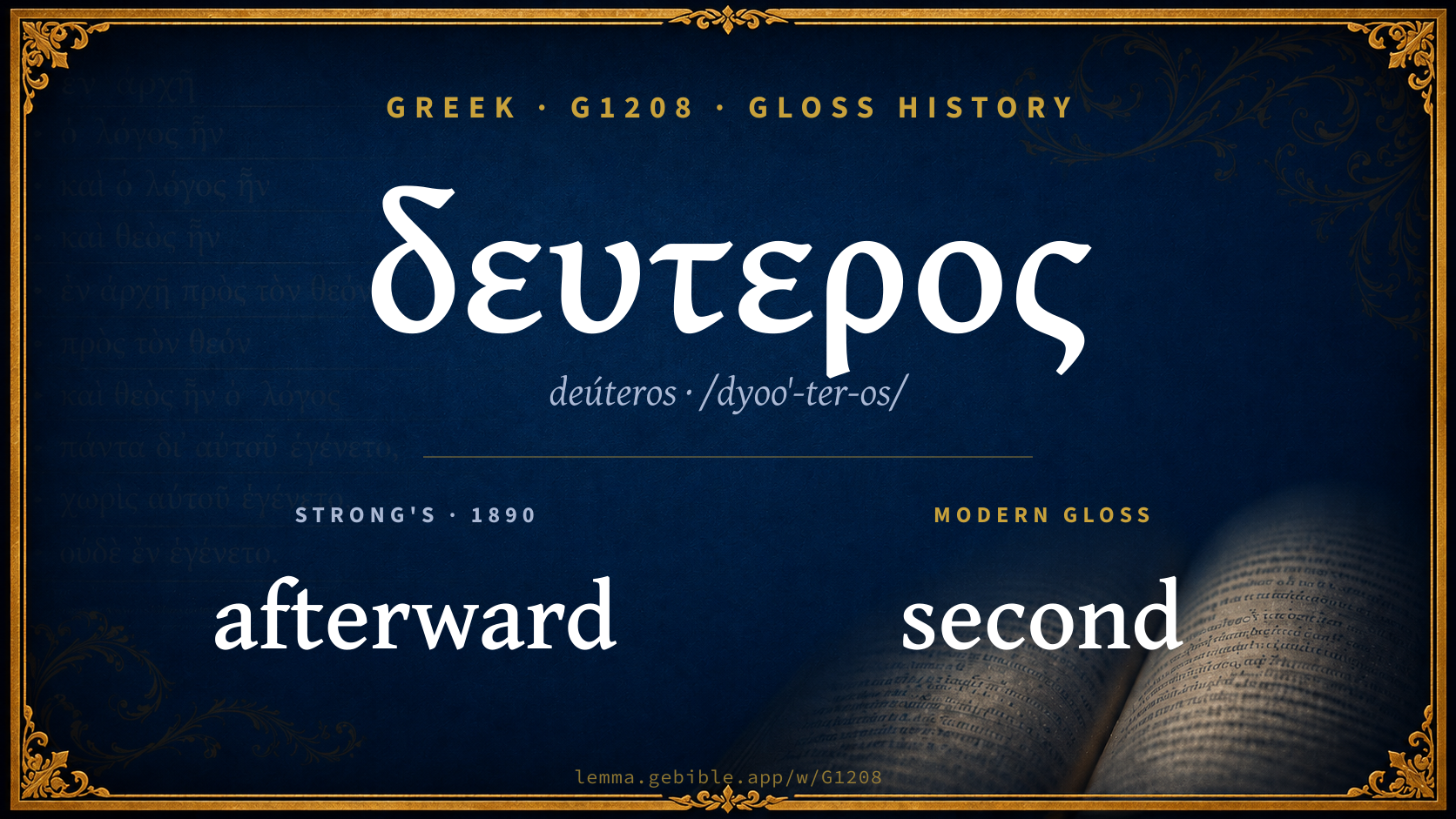
Strong's 1890 vs modern scholarship
About this word
Strong's G1208 catalogs a Greek word from the Greek New Testament.
These counts are not copied from any lexicon or concordance. They are computed here, from the morphology-tagged Greek New Testament. What Lemma adds →
- 41
- distinct verses
- The word appears in 41 distinct verses.
- 12 / 27
- NT books
- The word appears in 12 of 27 New Testament books.
- #356
- by frequency
- Top 500 most frequent Greek words (rank 356 of 5,347 Greek words by occurrence).
View all 41 occurrences in the concordance →
Most concentrated in
- Revelation 12 verses 29%
- Hebrews 5 verses 12%
- John 4 verses 10%
By section of the New Testament
By traditional corpus
Conventional, traditional groupings — biblical authorship is debated, so this is a traditional corpus grouping, not an authorship claim. Some books belong to more than one corpus (Luke is in both the Gospels and the Lukan corpus, and so on), so these shares overlap and need not total 100%. Each figure is a share of the word’s 41 distinct verses.
- Johannine 16 verses · 39%
- Gospels 13 verses · 32%
- Revelation 12 verses · 29%
- Lukan (Luke–Acts) 7 verses · 17%
- Pauline corpus 5 verses · 12%
- Hebrews 5 verses · 12%
- General (Catholic) Epistles 2 verses · 5%
How translations render this word
Counts come from each version’s own published word-to-Strong’s tagging or interlinear alignment — an approximate guide to how each version renders this word, not a word-level alignment the data otherwise carries. Because each total is that version’s own tagged count, the per-version totals vary from one another and need not match the appearance or distinct-verse counts above. These counts may also differ from a printed concordance because Lemma counts each distinctly tagged rendering and does not collapse phrase taggings into a single head-word total. This is a fixed set of word-tagged versions (KJV, ASV, BSB, ULT) and does not change with the reading translation you choose elsewhere. Each version’s license is shown beside its name below (and on Sources).
- King James Version: Second 32×, Second time 6×, Again 2×
- American Standard Version: Second 31×, Second time 5×
- Berean Standard Bible: Second 33×, Second time 9×
- unfoldingWord Literal Text: Second 32×, Second time 4×, Time 4×
King James Version Public Domain
Renders G1208 across 42 tagged occurrences — most commonly:
Plus 2 renderings that appear only once — usually multi-word phrases or single function words the recovered tagging swept in, not distinct renderings. Not rendered by a distinct English word in 1 further occurrence.
American Standard Version Public Domain
Renders G1208 across 42 tagged occurrences — most commonly:
Plus 6 renderings that appear only once — usually multi-word phrases or single function words the recovered tagging swept in, not distinct renderings.
Berean Standard Bible Public Domain
Renders G1208 across 44 tagged occurrences — most commonly:
Plus 2 renderings that appear only once — usually multi-word phrases or single function words the recovered tagging swept in, not distinct renderings.
unfoldingWord Literal Text CC BY-SA 4.0
Renders G1208 across 44 tagged occurrences — most commonly:
Plus 4 renderings that appear only once — usually multi-word phrases or single function words the recovered tagging swept in, not distinct renderings.
Senses in Thayer's
The 1 sense Thayer's distinguishes for this word, in lexicon order (not ranked by frequency or importance). The full entry — with sub-senses — is in the Lexicon Entry tab.
- the second, the other of two
Word origin
Derived from δυο (dýo) (G1417) — two.
As the compound of G1417 ; (ordinal) second (in time place or rank; also adverbially): - afterward again second (-arily time).
— Strong’s Exhaustive Concordance (1890), public domain.
Forms in the corpus
The 9 distinct written forms G1208 takes in the Greek New Testament, most frequent first — each parse links to that case’s occurrences in the concordance.
| Form | Parsing | Example | Uses |
|---|---|---|---|
| δεύτερος deúteros | Adjective, Nominative, Singular, Masculine | Matthew 22:26 | 11 |
| δεύτερον deúteron | Adjective, Accusative, Singular, Neuter | John 4:54 | 10 |
| δευτέρου deutérou | Adjective, Genitive, Singular, Neuter | Matthew 26:42 | 8 |
| δευτέραν deutéran | Adjective, Accusative, Singular, Feminine | Acts 12:10 | 6 |
| δευτέρα deutéra | Adjective, Nominative, Singular, Feminine | Matthew 22:39 | 3 |
| δευτέρας deutéras | Adjective, Genitive, Singular, Feminine | Hebrews 8:7 | 1 |
| δευτέρᾳ deutéra | Adjective, Dative, Singular, Feminine | Luke 12:38 | 1 |
| δευτέρῳ deutérō | Adjective, Dative, Singular, Masculine | Acts 7:13 | 1 |
| δεύτερός deúterós | Adjective, Nominative, Singular, Masculine | Revelation 20:14 | 1 |
Same root — word family
Other Thayer's entries built from the same root as G1208, grouped by Strong’s listed origin. These share a root / origin per the lexicon — not necessarily a shared meaning. Each links to that word’s own entry.
Derives from
Shares the same root
Derived from this word
Compare all same-root words → Showing 4 of 6 — not the complete family. They share a root, not necessarily a meaning.
Septuagint usage
The same Greek word δευτερος appears 188 times in the Greek Old Testament (Septuagint), across 184 verses in 27 books.
- 188
- LXX occurrences
- Tagged occurrences of this Greek word in the Septuagint.
- 184
- verses
- Distinct Septuagint verses containing this word.
- 27 / 39
- OT books
- The word appears in 27 of the 39 Old Testament books.
Sample Septuagint occurrences
- Genesis 1:8 δεύτερος
- Exodus 1:15 δεύτερος
- Leviticus 5:10 δεύτερος
- Numbers 1:1 δεύτερος
- Deuteronomy 9:18 δεύτερος
- Joshua 6:12 δεύτερος
- Judges 6:25 δεύτερος
- Ruth 1:4 δεύτερος
- 1 Samuel 1:2 δεύτερος
- 2 Samuel 3:3 δεύτερος
- 1 Kings 6:1 δεύτερος
- 2 Kings 6:29 δεύτερος
Septuagint occurrences (same lexeme)
Every verse where the same Strong’s number (G1208) appears in the Greek Septuagint — showing the first 50 of 184. Verse text shown in the World English Bible for context; the Greek form is the matched word — the English is not keyword-highlighted.
- Genesis 1:8 δεύτερος God called the expanse sky. There was evening and there was morning, a second day.
- Genesis 2:13 δεύτερος The name of the second river is Gihon: the same river that flows through the whole land of Cush.
- Genesis 4:19 δεύτερος Lamech took two wives: the name of the one was Adah, and the name of the other Zillah.
- Genesis 7:11 δεύτερος In the six hundredth year of Noah's life, in the second month, on the seventeenth day of the month, on the same day all the fountains of the great deep were burst open, and the sky's windows were opened.
- Genesis 8:14 δεύτερος In the second month, on the twenty-seventh day of the month, the earth was dry.
- Genesis 11:10 δεύτερος This is the history of the generations of Shem. Shem was one hundred years old, and became the father of Arpachshad two years after the flood.
- Genesis 22:15 δεύτερος The angel of Yahweh called to Abraham a second time out of the sky,
- Genesis 27:36 δεύτερος He said, "Isn't he rightly named Jacob? For he has supplanted me these two times. He took away my birthright. See, now he has taken away my blessing." He said, "Haven't you reserved a blessing for me?"
- Genesis 29:33 δεύτερος She conceived again, and bare a son, and said, "Because Yahweh has heard that I am hated, he has therefore given me this son also." She named him Simeon.
- Genesis 30:7 δεύτερος Bilhah, Rachel's handmaid, conceived again, and bore Jacob a second son.
- Genesis 30:12 δεύτερος Zilpah, Leah's handmaid, bore Jacob a second son.
- Genesis 32:9 δεύτερος Jacob said, "God of my father Abraham, and God of my father Isaac, Yahweh, who said to me, 'Return to your country, and to your relatives, and I will do you good.'
- Genesis 32:20 δεύτερος You shall say, 'Not only that, but behold, your servant, Jacob, is behind us.'" For, he said, "I will appease him with the present that goes before me, and afterward I will see his face. Perhaps he will accept me."
- Genesis 41:5 δεύτερος He slept and dreamed a second time: and, behold, seven heads of grain came up on one stalk, healthy and good.
- Genesis 41:43 δεύτερος and he made him to ride in the second chariot which he had. They cried before him, "Bow the knee!" He set him over all the land of Egypt.
- Genesis 41:52 δεύτερος The name of the second, he called Ephraim: "For God has made me fruitful in the land of my affliction."
- Genesis 45:6 δεύτερος For these two years the famine has been in the land, and there are yet five years, in which there will be neither plowing nor harvest.
- Genesis 47:18 δεύτερος When that year was ended, they came to him the second year, and said to him, "We will not hide from my lord how our money is all spent, and the herds of cattle are my lord's. There is nothing left in the sight of my lord, but our bodies, and our lands.
- Exodus 1:15 δεύτερος The king of Egypt spoke to the Hebrew midwives, of whom the name of the one was Shiphrah, and the name of the other Puah,
- Exodus 2:13 δεύτερος He went out the second day, and, behold, two men of the Hebrews were fighting with each other. He said to him who did the wrong, "Why do you strike your fellow?"
- Exodus 16:1 δεύτερος They took their journey from Elim, and all the congregation of the children of Israel came to the wilderness of Sin, which is between Elim and Sinai, on the fifteenth day of the second month after their departing out of the land of Egypt.
- Exodus 18:4 δεύτερος The name of the other was Eliezer, for he said, "My father's God was my help and delivered me from Pharaoh's sword."
- Exodus 25:12 δεύτερος You shall cast four rings of gold for it, and put them in its four feet. Two rings shall be on the one side of it, and two rings on the other side of it.
- Exodus 25:19 δεύτερος Make one cherub at the one end, and one cherub at the other end. You shall make the cherubim on its two ends of one piece with the mercy seat.
- Exodus 25:32 δεύτερος There shall be six branches going out of its sides: three branches of the lampstand out of its one side, and three branches of the lampstand out of its other side;
- Exodus 26:4 δεύτερος You shall make loops of blue on the edge of the one curtain from the edge in the coupling; and likewise shall you make in the edge of the curtain that is outmost in the second coupling.
- Exodus 26:5 δεύτερος You shall make fifty loops in the one curtain, and you shall make fifty loops in the edge of the curtain that is in the second coupling. The loops shall be opposite one to another.
- Exodus 26:10 δεύτερος You shall make fifty loops on the edge of the one curtain that is outmost in the coupling, and fifty loops on the edge of the curtain which is outmost in the second coupling.
- Exodus 26:20 δεύτερος For the second side of the tent, on the north side, twenty boards,
- Exodus 26:27 δεύτερος and five bars for the boards of the other side of the tent, and five bars for the boards of the side of the tent, for the far part westward.
- Exodus 27:15 δεύτερος For the other side shall be hangings of fifteen cubits; their pillars three, and their sockets three.
- Exodus 28:10 δεύτερος six of their names on the one stone, and the names of the six that remain on the other stone, in the order of their birth.
- Exodus 28:18 δεύτερος and the second row a turquoise, a sapphire, and an emerald;
- Exodus 29:19 δεύτερος "You shall take the other ram; and Aaron and his sons shall lay their hands on the head of the ram.
- Exodus 29:39 δεύτερος The one lamb you shall offer in the morning; and the other lamb you shall offer at evening:
- Exodus 29:41 δεύτερος The other lamb you shall offer at evening, and shall do to it according to the meal-offering of the morning, and according to its drink-offering, for a sweet savor, an offering made by fire to Yahweh.
- Exodus 36:18 δεύτερος He made fifty clasps of brass to couple the tent together, that it might be a unit.
- Exodus 37:13 δεύτερος He cast four rings of gold for it, and put the rings in the four corners that were on its four feet.
- Exodus 38:3 δεύτερος He made all the vessels of the altar, the pots, the shovels, the basins, the flesh-hooks, and the fire pans. He made all its vessels of brass.
- Exodus 38:7 δεύτερος He put the poles into the rings on the sides of the altar, with which to carry it. He made it hollow with planks.
- Exodus 38:10 δεύτερος their pillars were twenty, and their sockets twenty, of brass; the hooks of the pillars and their fillets were of silver.
- Exodus 40:17 δεύτερος It happened in the first month in the second year, on the first day of the month, that the tent was raised up.
- Leviticus 5:10 δεύτερος He shall offer the second for a burnt offering, according to the ordinance; and the priest shall make atonement for him concerning his sin which he has sinned, and he shall be forgiven.
- Leviticus 8:22 δεύτερος He presented the other ram, the ram of consecration: and Aaron and his sons laid their hands on the head of the ram.
- Leviticus 13:5 δεύτερος The priest shall examine him on the seventh day, and, behold, if in his eyes the plague is arrested, and the plague hasn't spread in the skin, then the priest shall isolate him for seven more days.
- Leviticus 13:6 δεύτερος The priest shall examine him again on the seventh day; and, behold, if the plague has faded, and the plague hasn't spread in the skin, then the priest shall pronounce him clean. It is a scab. He shall wash his clothes, and be clean.
- Leviticus 13:7 δεύτερος But if the scab spreads on the skin, after he has shown himself to the priest for his cleansing, he shall show himself to the priest again.
- Leviticus 13:33 δεύτερος then he shall be shaved, but he shall not shave the itch; and the priest shall shut him up who has the itch seven more days.
- Leviticus 13:54 δεύτερος then the priest shall command that they wash the thing in which the plague is, and he shall isolate it seven more days.
- Leviticus 13:58 δεύτερος The garment, either the warp, or the woof, or whatever thing of skin it is, which you shall wash, if the plague has departed from them, then it shall be washed the second time, and it will be clean."
These are occurrences of the same Greek lexeme (G1208) in the Septuagint — not a translation of any one Hebrew word. The store carries no word-level Hebrew↔Greek alignment, so no Hebrew original is asserted here. Counts come from the recovered LXX Strong's tagging — high-frequency vocabulary is well covered, while rare or late forms may be untagged — so they reflect tagged occurrences and may slightly undercount.