
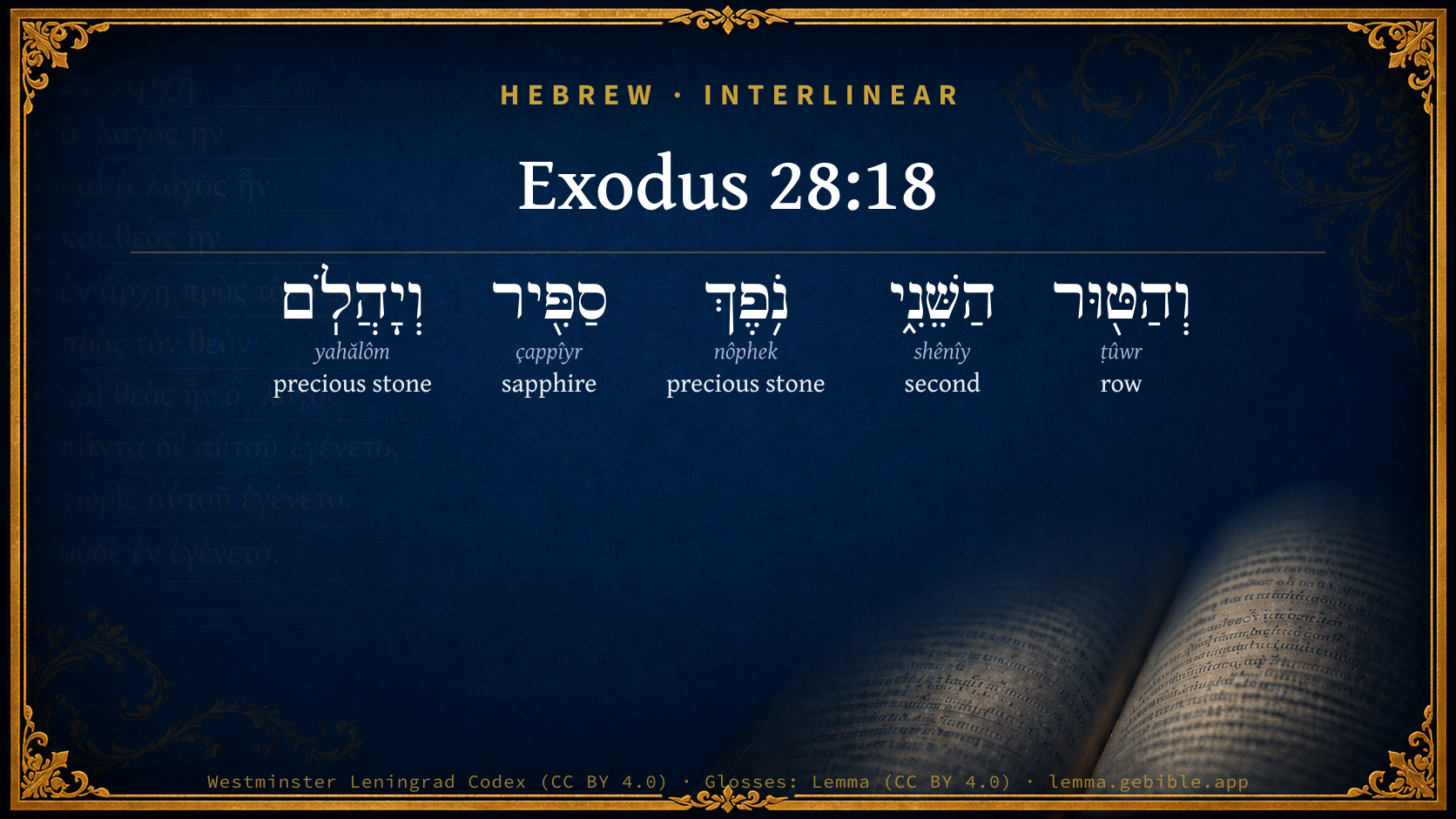
Exodus 28:18

Hebrew (Westminster Leningrad Codex) Exodus 28:18 appears in the Hebrew Old Testament. The text above is from the Westminster Leningrad Codex. Each word links to its Strong’s number, a concise gloss, and parsing drawn from the Open Scriptures Hebrew Bible morphology. Click any word for its full Brown-Driver-Briggs (BDB) entry.
Download image
Cite this verse

Exodus 28:18 (World English Bible). Public Domain. Lemma interlinear Bible study tool, https://lemma.gebible.app/v/exodus/28/18.

Show BibTeX & RIS
BibTeX
RIS
English Translation
and the second row a turquoise, a sapphire, and an emerald;
World English Bible · Public Domain
Highlights
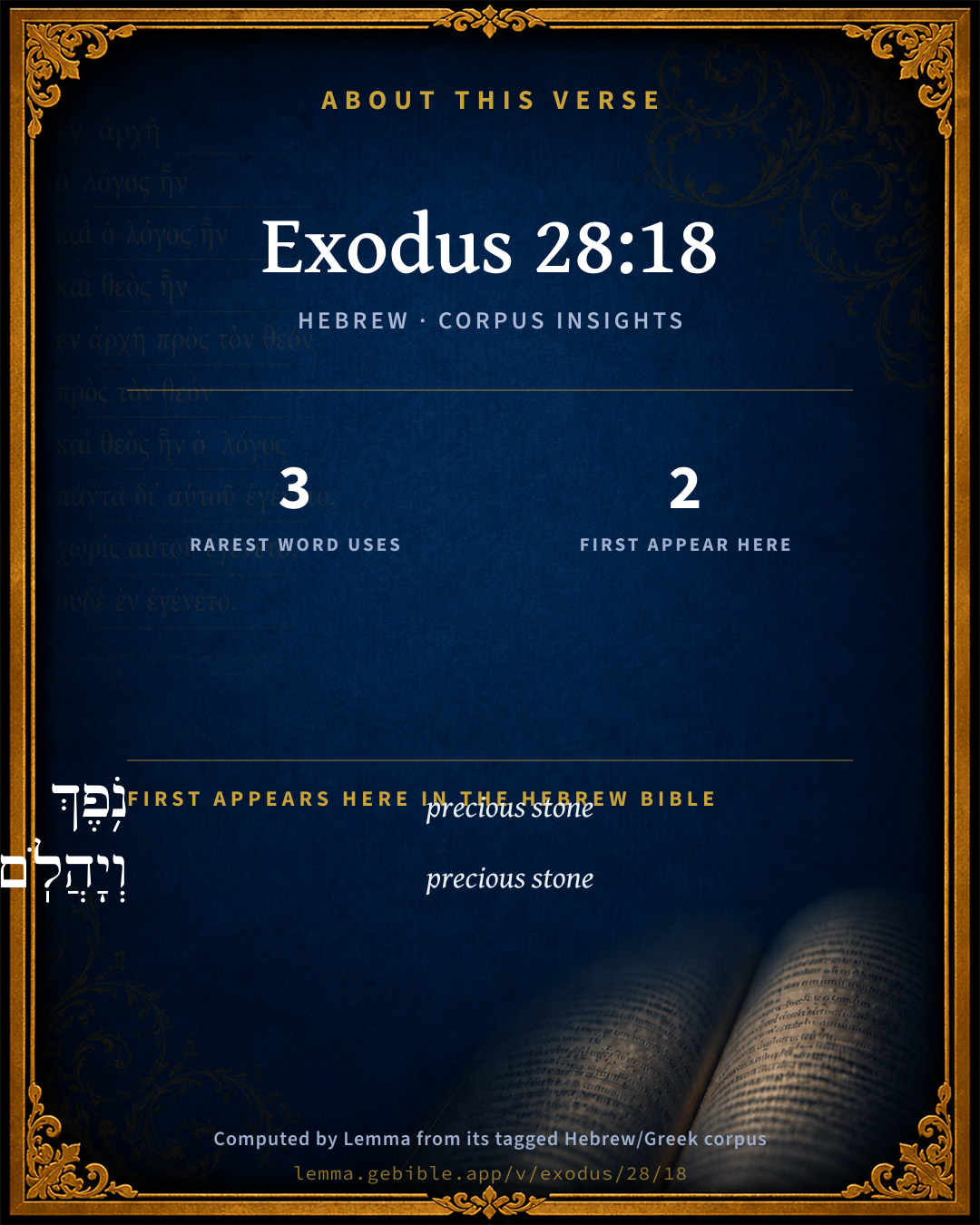
  • 2 first appearances in the Hebrew Bible
Full analysis ↓
Download a study sheet

One document with this verse’s original text, its word-by-word gloss line, the meaning frame, cross-references with their text, attributed commentary, and full source and license credits — printable, and it pastes into notes with its structure intact.

This verse Autodidact and up

Study sheet (.html) Plain text (.txt)

A passage Seminary Student

Up to 50 verses in one chapter. A passage sheet keeps up to 6 commentary sources and 12 cross-references per verse, in the order this page ranks them, and says so on the sheet whenever that leaves anything out. Ask for a single verse and you get the Autodidact verse sheet above.

Everything on this page stays free to read, with no account — the sheet is a download of what is already on screen, not access to it.

Want to remove ads? Support Godless Engineer
Compare translations 3

The same verse in 3 English versions, stacked beneath the original-language interlinear above. Click any original word for its lexicon entry.

Each is an independent rendering of the whole verse — the interlinear is not word-aligned to these translations.

Highlighted words mark where these versions differ — a whole-verse word diff, not a word-by-word alignment.

  • World English Bible Public Domain
    and the second row a turquoise, a sapphire, and an emerald;
  • King James Version Public Domain
    And the second row shall be an emerald, a sapphire, and a diamond.
  • unfoldingWord Literal Text CC BY-SA 4.0
    And the second row: an emerald, a sapphire, and a diamond.

unfoldingWord Literal Text — © unfoldingWord, licensed CC BY-SA 4.0. Word-aligned USFM3 via Door43 (git.door43.org/unfoldingWord/en_ult).

Versions to compare (up to 4)

3 of 4 selected

Show all 18 translations

Every available English version of this verse, each an independent rendering of the whole verse.

  • World English Bible Public Domain
    and the second row a turquoise, a sapphire, and an emerald;
  • Berean Standard Bible Public Domain
    in the second row a turquoise, a sapphire, and a diamond;
  • Majority Standard Bible Public Domain
    in the second row a turquoise, a sapphire, and a diamond;
  • King James Version Public Domain
    And the second row shall be an emerald, a sapphire, and a diamond.
  • American Standard Version (1901) Public Domain
    and the second row an emerald, a sapphire, and a diamond;
  • Revised Version (1885) Public Domain
    and the second row an emerald, a sapphire, and a diamond;
  • Geneva Bible (1599) Public Domain
    And in the seconde rowe thou shalt set an emeraude, a saphir, and a diamonde.
  • Douay-Rheims (1899) Public Domain
    In the second a carbuncle, a sapphire and a jasper.
  • Young's Literal Translation Public Domain
    and the second row `is' emerald, sapphire, and diamond;
  • Literal Standard Version CC BY-SA 4.0
    and the second row [is] emerald, sapphire, and diamond;
  • Unlocked Literal Bible CC BY-SA 4.0
    The second row must have an emerald, a sapphire, and a diamond.
  • unfoldingWord Literal Text CC BY-SA 4.0
    And the second row: an emerald, a sapphire, and a diamond.
  • Darby Bible Public Domain
    and the second row, a carbuncle, a sapphire, and a diamond;
  • World Messianic Bible Public Domain
    and the second row a turquoise, a sapphire, and an emerald;
  • Webster's Bible Public Domain
    And the second row shall be an emerald, a sapphire, and a diamond.
  • Free Bible Version CC BY-SA 4.0
    In the second row turquoise, lapis lazuli, and sardonyx.
  • Bible in Basic English Public Domain
    The second, a ruby, a sapphire, and an onyx;
  • JPS Tanakh (1917) Public Domain
    and the second row a carbuncle, a sapphire, and an emerald;

Literal Standard Version (2020), Covenant Press — licensed CC BY-SA 4.0. Text via the HelloAO Bible API (eBible.org). Unlocked Literal Bible (unfoldingWord) — licensed CC BY-SA 4.0. Text via the HelloAO Bible API (eBible.org). unfoldingWord Literal Text — © unfoldingWord, licensed CC BY-SA 4.0. Word-aligned USFM3 via Door43 (git.door43.org/unfoldingWord/en_ult). Free Bible Version, Dr. Jonathan Gallagher — licensed CC BY-SA 4.0. Text via the HelloAO Bible API (eBible.org).

Word by word

More ways to search: Search by grammar → Find every occurrence → Compare this word →

Practice this passage: Drill this verse → Learn its vocabulary →

About this verse

These counts appear in no published source. They are computed here, from the morphology-tagged text and Lemma’s own curated glosses. What Lemma adds →

5
words
5
distinct lemmas
Pentateuch
section

Notable vocabulary

The rarest word here is וְיָהֲלֹֽם precious stone H3095 — appearing just 3 times in the whole Hebrew Bible.

First appearance in Scripture

These words make their first canonical appearance in the Hebrew Bible here:

  • נֹ֥פֶךְ precious stone H5306
  • וְיָהֲלֹֽם precious stone H3095

Shared distinctive vocabulary

וְיָהֲלֹֽם precious stone H3095 occurs in 3 verses of the Hebrew Bible. Also found in:

Grammatical profile

  • 4 nouns
  • 1 adjective

Hebrew & Septuagint length

In English translation the verse runs 11 words from the Hebrew and 11 from the Septuagint (LXX English) — the same length.

A rough comparison of the two English renderings, which tokenize alike — not a word-level alignment.

Word counts can differ between the Hebrew and the Greek without any difference in meaning — e.g. the Hebrew direct-object marker אֵת has no separate Greek word, and Greek often adds the article ὁ.

Cross-references

11

Topical passages linked to Exodus 28:18 in the Treasury of Scripture Knowledge — connected by theme and wording, ordered by reader-vote popularity; previews shown in the World English Bible.

  • Exodus 24:10 They saw the God of Israel. Under his feet was like a paved work of sapphire stone, like the skies for clearness.
  • Exodus 39:11 and the second row, a turquoise, a sapphire, and an emerald;
  • Job 28:6 Sapphires come from its rocks. It has dust of gold.
  • Job 28:16 It can't be valued with the gold of Ophir, With the precious onyx, or the sapphire.
  • Song of Solomon 5:14 His hands are like rings of gold set with beryl. His body is like ivory work overlaid with sapphires.
  • Jeremiah 17:1 The sin of Judah is written with a pen of iron, [and] with the point of a diamond: it is engraved on the tablet of their heart, and on the horns of your altars;
  • Ezekiel 1:26 Above the expanse that was over their heads was the likeness of a throne, as the appearance of a sapphire stone; and on the likeness of the throne was a likeness as the appearance of a man on it above.
  • Ezekiel 10:1 Then I looked, and see, in the expanse that was over the head of the cherubim there appeared above them as it were a sapphire stone, as the appearance of the likeness of a throne.
  • Ezekiel 27:16 Syria was your merchant by reason of the multitude of your handiworks: they traded for your wares with emeralds, purple, and embroidered work, and fine linen, and coral, and rubies.
  • Ezekiel 28:13 You were in Eden, the garden of God; every precious stone adorned you: ruby, topaz, emerald, chrysolite, onx, jasper, sapphire, turquoise, and beryl. Gold work of tambourines and of pipes was in you. In the day that you were created they were prepared.
  • Revelation 4:3 that looked like a jasper stone and a sardius. There was a rainbow around the throne, like an emerald to look at.

Cross-references courtesy of OpenBible.info (CC BY 4.0).

Hebrew and Greek witnesses Masoretic Hebrew ↔ Greek Septuagint

The same verse in the two great witnesses to the Old Testament, shown verse-for-verse.

These are two independent witnesses, not word-aligned to each other, and the Septuagint is shown in lemma (dictionary) form.

Hebrew Exodus 28:18 Masoretic · Westminster Leningrad Codex

וְהַטּ֖וּר הַשֵּׁנִ֑י נֹ֥פֶךְ סַפִּ֖יר וְיָהֲלֹֽם

and the second row a turquoise, a sapphire, and an emerald;

World English Bible · Public Domain

Greek LXX Exodus 28:18 Septuagint · lemma form

καί ὁ στίχος ὁ δεύτερος ἄνθραξ καί σάπφειρος καί ἴασπις

And the second row, a carbuncle, a sapphire, and a jasper.

LXX2012 (modern English Septuagint) · Public Domain

Hebrew: Westminster Leningrad Codex (CC BY 4.0). Greek: Septuagint (public domain); English from LXX2012 (modern English Septuagint) (Public Domain). How the Septuagint differs from the Hebrew →

Targum (Aramaic paraphrase)

2

The Targum is the ancient Jewish Aramaic paraphrase of the Hebrew Scriptures — an interpretive translation, not the Hebrew text itself. Onkelos (literal) and Pseudo-Jonathan (expansive) render the Torah, and Jonathan the Prophets. Coverage is partial: where no permissively-licensed English translation exists for a verse, only the Aramaic is shown. This is verse-level text, not a word-by-word alignment to the Hebrew.

  1. Targum Onkelos Torah (Genesis–Deuteronomy)
    וְסִדְרָא תִּנְיָנָא אִזְמָרַגְדִין וְשַׁבְזִיז וְסִבְהֲלוֹם:

    (no public-domain English translation for this verse)

    Targum Onkelos — Aramaic: “Onkelos Genesis” (public domain); “Onkelos Exodus” (public domain); “Onkelos Leviticus” (public domain); “Onkelos Numbers” (public domain); “Onkelos Deuteronomy” (public domain). English: “Sefaria Community Translation” (CC0 1.0 (public-domain dedication)); “J.W. Etheridge. The Targums of Onkelos and Jonathan Ben Uzziel on the Pentateuch. London: Longmans, Green, 1862” (public domain). Text via Sefaria.

  2. Targum Pseudo-Jonathan Torah (Genesis–Deuteronomy)
    וְשׁוּם סִדְרָא תִּנְיָנָא אִיזְמוֹרַד וְסַפִּירִינוּן וְכַדְכוֹדֵי וַעֲלֵיהוֹן חָקִיק וּמְפָרַשׁ שְׁמָהַת תְּלָתָא שִׁבְטַיָא יְהוּדָה דָּן וְנַפְתָּלִי

    And the name of the second row, smaragd, and sapphire and chalcedony; and upon them shall be engraven and expressed the names of the three tribes, Jehuda, Dan, and Naphtali.

    Targum Pseudo-Jonathan — Aramaic: “Targum Jonathan on Genesis” (public domain); “Targum Jonathan on Exodus” (public domain); “Targum Jonathan on Leviticus” (public domain); “Targum Jonathan on Numbers” (public domain); “Targum Jonathan on Deuteronomy” (public domain). English: “The Targum of Jonathan ben Uzziel, trans. J. W. Etheridge, London, 1862” (public domain). Text via Sefaria.

Commentary

Notes on Exodus 28:18 from classic Christian and Jewish commentators (each source and its license shown beneath its notes). The classic Christian expositions comment on the surrounding passage and are grouped to its opening verse, so a note may address several verses; the Jewish commentaries on the Tanakh (Rashi and others) are per-verse, so they appear only where the commentator wrote on this verse.

Lemma curates 59 commentaries, every one of them public domain or Creative Commons licensed, each selected and text-cleaned for this edition rather than reprinted as found. About our sources →

Geneva Bible (1599)

Geneva Bible translators

Or, Jasper.

Or, Carbuncle.

Geneva Bible (1599) marginal notes — public domain. Text via Bolls.life.

The Cambridge Bible for Schools and Colleges

gen. ed. J. J. S. Perowne

18. an emerald] Heb. nôphek, ἄνθραξ, carbunculus [a red stone, called ἄνθραξ and carbunculus because in the sun-light it flashes like a burning ‘coal,’ Theophr. de Lap. 18]: Eze_27:16; Eze_28:13. As is generally agreed, the red garnet, a species of carbuncle.

a sapphire] Heb. sappir, σάπφειρος, sapphirus: Exo_24:10, Eze_1:26; Eze_10:1; Eze_28:13, Job_28:6; Job_28:16, Son_5:14, Isa_54:11, Lam_4:7, Rev_21:19. Not, however, our ‘sapphire,’ which was ‘almost unknown before Roman imperial times,’ but the opaque blue lapis lazuli (so Rev_21:19 RVm.), as is shewn by the description of the Greek and Roman ‘sapphire’ by Theophrastus and Pliny as sprinkled with gold dust (ὥσπερ χρυσόπαστος, ‘inest ei et aureus pulvis’), with allusion to the particles of iron pyrites, easily mistaken by their colour and lustre for gold, frequently found in the lapis lazuli (cf. Sapphire in DB. and EB.; and Job_28:6 ‘And it hath dust of gold’).

a diamond] Heb. yahâlôm, ἴασπις, jaspis: Eze_28:13. Ἴασπις, jaspis, seem so naturally to correspond to Heb. yâshepheh in v. 20, that many suppose an accidental transposition to have taken place in either the Heb. or the Greek text: if this be granted, yahãlôm will be represented by ὀνύχιον here and Eze_28:13, and by βηρύλλιον in Exo_39:13. What the yashãlôm was, is, however, uncertain. ‘Diamond’ has nothing to recommend it: there is no evidence that this stone was known to the ancients. RVm. sardonyx (cf. Rev_21:20), a stratified stone, consisting of layers of red and white (hence the name, the ‘sard’ being red, and the ‘onyx’ whitish), and in ancient times often with a layer of dark brown as well; well adapted for engraving, on account of the variety produced by the different strata (EB. Sardonyx). For the symbolism attached to the three colours, see the quaint verses quoted in DB. s.v. Onyx.

The Cambridge Bible for Schools and Colleges (gen. ed. J. J. S. Perowne; Cambridge University Press, 1878–1918) — public domain. Text from a community e-Sword module.

John Gill's Exposition

And the third row, a ligure, an agate, and an amethyst. The first of these stones, the ligure or lyncurius, is said to be so called from the congealed urine of the lynx (n), but rather from the spots of that creature; for, according to Danaeus (o), it is the same stone with that called "stellina", from having many specks like stars spread about in it. Braunius (p) takes the "jacinth" stone to be here meant, and so does Ainsworth; see Rev 21:20, the second stone, the agate, is well known; and though now of little account, was formerly in great esteem, as Pliny (q) asserts, and therefore may well be thought to have a place among these stones. Pyrrhus king of Epirus had a very famous one, in which, not by art, but by nature, were seen the nine Muses, and Apollo holding an harp; the word for it here is "shebo", which comes from a word which signifies to captivate; because, as De Dieu observes, this stone is easily captivated under the hand of the artificer; there being no stone which so easily admits of engravings as this. The last of this row is the "amethyst"; which stone has its name either from its being of the colour of wine; or, as others, from its being a preservative from drunkenness: the Hebrew word "achlamah" seems to come from a word which signifies to dream; and this stone is supposed to cause persons to dream, as Aben Ezra, from one of their wise men, relates. On these three stones, according to the Jerusalem Targum, were written the names of the tribes of Dan, Naphtali, and Gad; but, according to the Targum of Jonathan, Gad, Asher, and Issachar, which is much better, for a reason before given.

(n) Vid. Plin. Nat. Hist. l. 37. c. 3. (o) Apud De Dieu in loc. (p) Ut supra, (De Vestitu Sacerd. Heb. l. 2.) c. 14. sect. 9. p. 699. (q) Nat. Hist. l. 37. c. 10.

John Gill's Exposition of the Whole Bible (1746–1763) — public domain (CC PDM 1.0). Text via the HelloAO Bible API.

Haydock's Catholic Bible Commentary

The carbuncle, (ruby) sapphire, and jasper, (or diamond) had on them Juda, Dan, and Nephtali.

George Leo Haydock (1774–1849), Haydock's Catholic Family Bible and Commentary, 1859 edition — public domain. Excludes Psalms (Douay-Rheims chapter numbering differs from Protestant) and Deuterocanonical books (Catholic canon only).

The Pulpit Commentary

The second row an emerald, a sapphire, and a diamond. Here all the names must be wrong, for none of these three stones could be cut by the ancient engravers. Probably, carbuncle (or garnet), lapis lazuli, and onyx are intended.

The Pulpit Commentary (1880–1919), ed. H.D.M. Spence-Jones & Joseph S. Exell — public domain. Text from a community e-Sword module.

Lesson kit

Teaching starters — assembled from the data on this page, not authored interpretation. Every prompt links to the verse data it draws on. Edit before teaching.

Exodus, in the Pentateuch, opens this verse with 5 words (5 distinct Hebrew lemmas). Its most distinctive word is yahălôm (“precious stone”). A historical commentator’s framing appears above. Read the whole chapter for the surrounding context.

Discussion questions

  1. The word yahălôm carries the sense “precious stone.” How does it shape the verse?
  2. 2 words make their first appearance in Scripture here. What does this debut establish?
  3. How does Exodus 39:11, which shares the word «precious stone», read alongside this verse?
  4. These translations render this verse differently; the difference is in the English rendering, not the original. What questions does that raise?
  5. Compare how Geneva Bible (1599) and The Cambridge Bible for Schools and Colleges read this verse. Where do they agree or differ?

Things to notice

  • 2 words make their first canonical appearance in Scripture here.
  • These translations choose different wording for 3 words in this verse.
  • 5 distinct Hebrew lemmas span 5 words in this verse.

Reading settings

Reading text

Shown beneath each verse's original-language words.

Old Testament
Old Testament edition

Read the OT as the Masoretic Hebrew (MT) or the Greek Septuagint (LXX).

English shown for the Greek Septuagint (in the Hebrew ↔ Greek comparison).

Comparing translations? Open the Compare panel on any verse page to stack up to four side by side.