Leviticus 13:7

Hebrew (Westminster Leningrad Codex) Leviticus 13:7 appears in the Hebrew Old Testament. The text above is from the Westminster Leningrad Codex. Each word links to its Strong’s number, a concise gloss, and parsing drawn from the Open Scriptures Hebrew Bible morphology. Click any word for its full Brown-Driver-Briggs (BDB) entry.
Download image
Cite this verse

Leviticus 13:7 (World English Bible). Public Domain. Lemma interlinear Bible study tool, https://lemma.gebible.app/v/leviticus/13/7.

Show BibTeX & RIS
BibTeX
RIS
English Translation
But if the scab spreads on the skin, after he has shown himself to the priest for his cleansing, he shall show himself to the priest again.
World English Bible · Public Domain
Download a study sheet

One document with this verse’s original text, its word-by-word gloss line, the meaning frame, cross-references with their text, attributed commentary, and full source and license credits — printable, and it pastes into notes with its structure intact.

This verse Autodidact and up

Study sheet (.html) Plain text (.txt)

A passage Seminary Student

Up to 50 verses in one chapter. A passage sheet keeps up to 6 commentary sources and 12 cross-references per verse, in the order this page ranks them, and says so on the sheet whenever that leaves anything out. Ask for a single verse and you get the Autodidact verse sheet above.

Everything on this page stays free to read, with no account — the sheet is a download of what is already on screen, not access to it.

Want to remove ads? Support Godless Engineer
Compare translations 3

The same verse in 3 English versions, stacked beneath the original-language interlinear above. Click any original word for its lexicon entry.

Each is an independent rendering of the whole verse — the interlinear is not word-aligned to these translations.

Highlighted words mark where these versions differ — a whole-verse word diff, not a word-by-word alignment.

  • World English Bible Public Domain
    But if the scab spreads on the skin, after he has shown himself to the priest for his cleansing, he shall show himself to the priest again.
  • King James Version Public Domain
    But if the scab spread much abroad in the skin, after that he hath been seen of the priest for his cleansing, he shall be seen of the priest again.
  • unfoldingWord Literal Text CC BY-SA 4.0
    But if, spreading, the scab spreads on the skin after his appearing to the priest for his being pronounced clean, then he shall appear to the priest a second.

unfoldingWord Literal Text — © unfoldingWord, licensed CC BY-SA 4.0. Word-aligned USFM3 via Door43 (git.door43.org/unfoldingWord/en_ult).

Versions to compare (up to 4)

3 of 4 selected

Show all 18 translations

Every available English version of this verse, each an independent rendering of the whole verse.

  • World English Bible Public Domain
    But if the scab spreads on the skin, after he has shown himself to the priest for his cleansing, he shall show himself to the priest again.
  • Berean Standard Bible Public Domain
    But if the rash spreads further on his skin after he has shown himself to the priest for his cleansing, he must present himself again to the priest.
  • Majority Standard Bible Public Domain
    But if the rash spreads further on his skin after he has shown himself to the priest for his cleansing, he must present himself again to the priest.
  • King James Version Public Domain
    But if the scab spread much abroad in the skin, after that he hath been seen of the priest for his cleansing, he shall be seen of the priest again.
  • American Standard Version (1901) Public Domain
    But if the scab spread abroad in the skin, after that he hath showed himself to the priest for his cleansing, he shall show himself to the priest again:
  • Revised Version (1885) Public Domain
    But if the scab spread abroad in the skin, after that he hath shewn himself to the priest for his cleansing, he shall shew himself to the priest again:
  • Geneva Bible (1599) Public Domain
    But if the skab growe more in the skinne, after that he is seene of ye Priest for to be purged, he shall be seene of the Priest yet againe.
  • Douay-Rheims (1899) Public Domain
    But if the leprosy grow again, after he was seen by the priest and restored to cleanness, he shall be brought to him,
  • Young's Literal Translation Public Domain
    `And if the scab spread greatly in the skin, after his being seen by the priest for his cleansing, then he hath been seen a second time by the priest;
  • Literal Standard Version CC BY-SA 4.0
    And if the scab spreads greatly in the skin, after his being seen by the priest for his cleansing, then he has been seen a second time by the priest;
  • Unlocked Literal Bible CC BY-SA 4.0
    But if the rash has spread in the skin after he has shown himself to the priest for his cleansing, he must then show himself to the priest again.
  • unfoldingWord Literal Text CC BY-SA 4.0
    But if, spreading, the scab spreads on the skin after his appearing to the priest for his being pronounced clean, then he shall appear to the priest a second.
  • Darby Bible Public Domain
    But if the scab have spread much in the skin, after that he hath been seen by the priest for his cleansing, he shall be seen by the priest again;
  • World Messianic Bible Public Domain
    But if the scab spreads on the skin after he has shown himself to the priest for his cleansing, he shall show himself to the priest again.
  • Webster's Bible Public Domain
    But if the scab shall spread much in the skin, after he hath been seen by the priest for his cleansing, he shall be seen by the priest again:
  • Free Bible Version CC BY-SA 4.0
    However, if the rash does spread after the person has been inspected by the priest and has been declared clean, the person must go back to be inspected again.
  • Bible in Basic English Public Domain
    But if the size of the mark on his skin is increased after he has been seen by the priest, let him go to the priest again:
  • JPS Tanakh (1917) Public Domain
    But if the scab spread abroad in the skin, after that he hath shown himself to the priest for his cleansing, he shall show himself to the priest again.

Literal Standard Version (2020), Covenant Press — licensed CC BY-SA 4.0. Text via the HelloAO Bible API (eBible.org). Unlocked Literal Bible (unfoldingWord) — licensed CC BY-SA 4.0. Text via the HelloAO Bible API (eBible.org). unfoldingWord Literal Text — © unfoldingWord, licensed CC BY-SA 4.0. Word-aligned USFM3 via Door43 (git.door43.org/unfoldingWord/en_ult). Free Bible Version, Dr. Jonathan Gallagher — licensed CC BY-SA 4.0. Text via the HelloAO Bible API (eBible.org).

Word by word

More ways to search: Search by grammar → Find every occurrence → Compare this word →

Practice this passage: Drill this verse → Learn its vocabulary →

הַמִּסְפַּ֨חַת֙
miçpachath
H4556
“the · scab”
Particle, Definite Article + Noun, Common, Feminine, Singular, Absolute
Part of Speech
Particle + Noun
Type
Common
Gender
Feminine
Number
Singular
State
Absolute
Full BDB Definition

Origin: from H5596

TWOT: 1534b

eruption, scab
  1. וְאִם ʼim H518 “and · if” Conjunction + Conjunction
  2. פָּשֹׂ֨ה pâsâh H6581 “to spread” Verb, Qal, Infinitive Absolute
  3. תִפְשֶׂ֤ה pâsâh H6581 “to spread” Verb, Qal, Imperfect, 3rd Person, Feminine, Singular
  4. בָּע֔וֹר ʻôwr H5785 “in/at the · skin” Preposition, Determined + Noun, Common, Masculine, Singular, Absolute
  5. אַחֲרֵ֧י ʼachar H310 “after” Preposition
  6. הֵרָאֹת֛וֹ râʼâh H7200 “to see · him” Verb, Niphal, Infinitive Construct + Suffix, Personal, 3rd Person, Masculine, Singular
  7. אֶל ʼêl H413 “to” Preposition
  8. הַכֹּהֵ֖ן kôhên H3548 “the · priest” Particle, Definite Article + Noun, Common, Masculine, Singular, Absolute
  9. לְטָהֳרָת֑וֹ ṭohŏrâh H2893 “to/for · purification · his” Preposition + Noun, Common, Both, Singular, Construct + Suffix, Personal, 3rd Person, Masculine, Singular
  10. וְנִרְאָ֥ה râʼâh H7200 “and · to see” Conjunction + Verb, Niphal, Sequential Perfect, 3rd Person, Masculine, Singular
  11. שֵׁנִ֖ית shênîy H8145 “second” Adjective, Ordinal number, Feminine, Singular, Absolute
  12. אֶל ʼêl H413 “to” Preposition
  13. הַכֹּהֵֽן kôhên H3548 “the · priest” Particle, Definite Article + Noun, Common, Masculine, Singular, Absolute

About this verse

These counts appear in no published source. They are computed here, from the morphology-tagged text and Lemma’s own curated glosses. What Lemma adds →

14
words
10
distinct lemmas
Pentateuch
section

Notable vocabulary

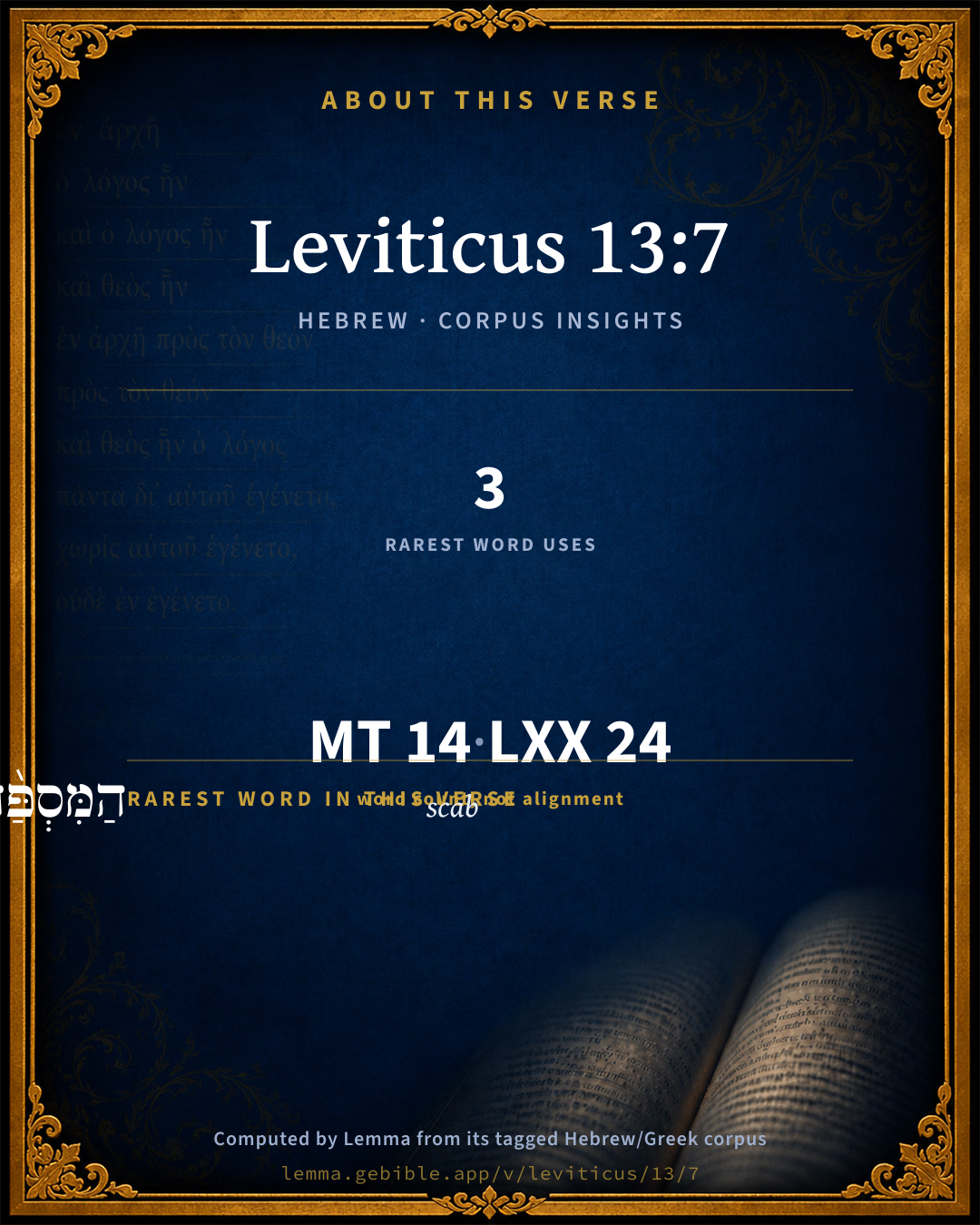
The rarest word here is הַמִּסְפַּ֨חַת֙ scab H4556 — appearing just 3 times in the whole Hebrew Bible.

Shared distinctive vocabulary

הַמִּסְפַּ֨חַת֙ scab H4556 occurs in 3 verses of the Hebrew Bible. Also found in:

Grammatical profile

  • 4 verbs
  • 5 nouns
  • 1 adjective
  • 3 prepositions
  • 1 conjunction

Verb forms

  • פָּשֹׂ֨ה Qal · Infinitive Absolute
  • תִפְשֶׂ֤ה Qal · Imperfect
  • הֵרָאֹת֛וֹ Niphal · Infinitive Construct
  • וְנִרְאָ֥ה Niphal · Sequential Perfect

Repetition

Words recur within this verse — often emphatic in Hebrew:

  • פָּשֹׂ֨ה to spread H6581 ×2
  • הֵרָאֹת֛וֹ to see H7200 ×2
  • הַכֹּהֵ֖ן priest H3548 ×2
  • אֶל to H413 ×2

Hebrew & Septuagint length

In English translation the verse runs 27 words from the Hebrew and 35 from the Septuagint (LXX English) — closely comparable.

A rough comparison of the two English renderings, which tokenize alike — not a word-level alignment.

Word counts can differ between the Hebrew and the Greek without any difference in meaning — e.g. the Hebrew direct-object marker אֵת has no separate Greek word, and Greek often adds the article ὁ.

In the original languages it is 14 Hebrew tokens and 24 Greek tokens — but the two are counted differently (Hebrew bundles its prefixes and suffixes into one token; the Greek is in lemma form), so that isn’t a like-for-like length.

Cross-references

6

Topical passages linked to Leviticus 13:7 in the Treasury of Scripture Knowledge — connected by theme and wording, ordered by reader-vote popularity; previews shown in the World English Bible.

  • Leviticus 13:27 The priest shall examine him on the seventh day. If it has spread in the skin, then the priest shall pronounce him unclean. It is the plague of leprosy.
  • Leviticus 13:35–36 But if the itch spreads in the skin after his cleansing,
  • Psalms 38:3 There is no soundness in my flesh because of your indignation, Neither is there any health in my bones because of my sin.
  • Isaiah 1:5–6 Why should you be beaten more, That you revolt more and more? The whole head is sick, And the whole heart faint.
  • Romans 6:12–14 Therefore don't let sin reign in your mortal body, that you should obey it in its lusts.
  • 2 Timothy 2:16–17 But shun empty chatter, for they will proceed further in ungodliness,

Cross-references courtesy of OpenBible.info (CC BY 4.0).

Hebrew and Greek witnesses Masoretic Hebrew ↔ Greek Septuagint

The same verse in the two great witnesses to the Old Testament, shown verse-for-verse.

These are two independent witnesses, not word-aligned to each other, and the Septuagint is shown in lemma (dictionary) form.

Hebrew Leviticus 13:7 Masoretic · Westminster Leningrad Codex

וְאִם פָּשֹׂ֨ה תִפְשֶׂ֤ה הַמִּסְפַּ֨חַת֙ בָּע֔וֹר אַחֲרֵ֧י הֵרָאֹת֛וֹ אֶל הַכֹּהֵ֖ן לְטָהֳרָת֑וֹ וְנִרְאָ֥ה שֵׁנִ֖ית אֶל הַכֹּהֵֽן

But if the scab spreads on the skin, after he has shown himself to the priest for his cleansing, he shall show himself to the priest again.

World English Bible · Public Domain

Greek LXX Leviticus 13:7 Septuagint · lemma form

ἐάν δέ μεταβάλλω μεταπίπτω ὁ σημασία ἐν ὁ δέρμα μετά ὁ ὁράω αὐτός ὁ ἱερεύς ὁ καθαρίζω αὐτός καί ὁράω ὁ δεύτερος ὁ ἱερεύς

But if the bright spot should have changed and spread in the skin, after the priest has seen him for the purpose of purifying him, then shall he appear the second time to the priest,

LXX2012 (modern English Septuagint) · Public Domain

Hebrew: Westminster Leningrad Codex (CC BY 4.0). Greek: Septuagint (public domain); English from LXX2012 (modern English Septuagint) (Public Domain). How the Septuagint differs from the Hebrew →

Targum (Aramaic paraphrase)

2

The Targum is the ancient Jewish Aramaic paraphrase of the Hebrew Scriptures — an interpretive translation, not the Hebrew text itself. Onkelos (literal) and Pseudo-Jonathan (expansive) render the Torah, and Jonathan the Prophets. Coverage is partial: where no permissively-licensed English translation exists for a verse, only the Aramaic is shown. This is verse-level text, not a word-by-word alignment to the Hebrew.

  1. Targum Onkelos Torah (Genesis–Deuteronomy)
    וְאִם אוֹסָפָא תוֹסֵף עֲדִיתָא בְּמַשְׁכָּא בָּתַר דְאִתְּחֲזִי לְכַהֲנָא לְדַכּוּתֵהּ וְיִתַּחֲזִי תִנְיָנוּת לְכַהֲנָא

    (no public-domain English translation for this verse)

    Targum Onkelos — Aramaic: “Onkelos Genesis” (public domain); “Onkelos Exodus” (public domain); “Onkelos Leviticus” (public domain); “Onkelos Numbers” (public domain); “Onkelos Deuteronomy” (public domain). English: “Sefaria Community Translation” (CC0 1.0 (public-domain dedication)); “J.W. Etheridge. The Targums of Onkelos and Jonathan Ben Uzziel on the Pentateuch. London: Longmans, Green, 1862” (public domain). Text via Sefaria.

  2. Targum Pseudo-Jonathan Torah (Genesis–Deuteronomy)
    וְאִם הֲלוּכֵי הֲלִיךְ פִּסְיוֹנָא דְקִילוּפֵי דְמִטַפְלָא בְּמַשְׁכָא בָּתַר דְאִיתְחַמֵי לְכַּהֲנָא לִדְכוּתֵיהּ וְיִתְחֲמֵי תִנְיָינוּת לְכַהֲנָא

    But if the inveterate sore widen in the skin after he had been shown to the priest who had pronounced him clean, let him a second time be seen by the priest.

    Targum Pseudo-Jonathan — Aramaic: “Targum Jonathan on Genesis” (public domain); “Targum Jonathan on Exodus” (public domain); “Targum Jonathan on Leviticus” (public domain); “Targum Jonathan on Numbers” (public domain); “Targum Jonathan on Deuteronomy” (public domain). English: “The Targum of Jonathan ben Uzziel, trans. J. W. Etheridge, London, 1862” (public domain). Text via Sefaria.

Commentary

Notes on Leviticus 13:7 from classic Christian and Jewish commentators (each source and its license shown beneath its notes). The classic Christian expositions comment on the surrounding passage and are grouped to its opening verse, so a note may address several verses; the Jewish commentaries on the Tanakh (Rashi and others) are per-verse, so they appear only where the commentator wrote on this verse.

Lemma curates 59 commentaries, every one of them public domain or Creative Commons licensed, each selected and text-cleaned for this edition rather than reprinted as found. About our sources →

Trapp's Complete Commentary

John Trapp

Lev 13:7 But if the scab spread much abroad in the skin, after that he hath been seen of the priest for his cleansing, he shall be seen of the priest again:

Ver. 7. But if the scab spread.] So if sin be gaining and growing still upon the sinner, even after admonition, or is scattered and spread to the infecting of others, it is a very ill sign.

John Trapp, A Commentary or Exposition upon All the Books of the Old and New Testament (1647–1656) — public domain. Text from a community e-Sword module.

Jamieson, Fausset & Brown

Robert Jamieson, A. R. Fausset & David Brown

But if the scab spread much abroad in the skin--Those doubtful cases, when they assumed a malignant character, appeared in one of two forms, apparently according to the particular constitution of the skin or of the habit generally. The one was "somewhat dark" [Lev 13:6] --that is, the obscure or dusky leprosy, in which the natural color of the hair (which in Egypt and Palestine is black) is not changed, as is repeatedly said in the sacred code, nor is there any depression in the dusky spot, while the patches, instead of keeping stationary to their first size, are perpetually enlarging their boundary. The patient laboring under this form was pronounced unclean by the Hebrew priest or physician, and hereby sentenced to a separation from his family and friends--a decisive proof of its being contagious.

Jamieson, Fausset & Brown — Commentary Critical and Explanatory on the Whole Bible (1871) — public domain (CC PDM 1.0). Text via the HelloAO Bible API.

Ellicott's Commentary for English Readers

(7, 8) But if the scab spread.—As Lev_13:5 prescribes that the priest who examines the patient after seven days’ quarantine, and finds no spreading of the affected spot, is to give another seven days’ quarantine, the verses before us declare what the examining priest is to do when he notices that the spot has spread.

For his cleansing.—That is, for the purpose of being declared clean. If, after he had appeared before the priest to be examined and declared not leprous, at the expiration of the first week of seclusion the priest finds that the spot has spread, he must pronounce him unclean, since the spreading indicates that it is leprosy.

A Bible Commentary for English Readers, edited by Charles John Ellicott (1878–1897) — public domain. Text from a community e-Sword module.

The Cambridge Bible for Schools and Colleges

gen. ed. J. J. S. Perowne

7. after that he hath shewn himself to the priest for his cleansing] i.e. in order to be declared clean. Three inspections by the priest are ordered with a week’s interval between each. If during either week the rising spreads, the priest shall pronounce him unclean.

It will be noticed that the word ‘plague’ is used to denote the rising or scab which is a mark of the leprosy, and also the person afflicted (in Lev_13:4; Lev_13:12-13; Lev_13:17 him that hath is not in the Heb.), as well as the disease itself in the phrase ‘the plague of leprosy.’

The Cambridge Bible for Schools and Colleges (gen. ed. J. J. S. Perowne; Cambridge University Press, 1878–1918) — public domain. Text from a community e-Sword module.

John Gill's Exposition

But if the scab spread much abroad in the skin,.... Or "in spreading spread" (k); spreads, and proceeds to spread more and more:

after that he hath been seen of the priest for his cleansing: even after he had been viewed upon the first presentation of him to him, and after he had been twice seen by him by the end of two weeks, in which he was shut up, and after he had been pronounced clean, and had washed his clothes for his purification:

he shall be seen of the priest again; either he shall go to him of himself, or be brought to him, to be reviewed and pass under afresh examination.

(k) "diffundendo diffuderit se", Montanus, Drusius, Piscator.

John Gill's Exposition of the Whole Bible (1746–1763) — public domain (CC PDM 1.0). Text via the HelloAO Bible API.

Albert Barnes' Notes on the Bible

Seen of the priest for his cleansing - The purport of these words is doubtful. They probably mean “seen by the priest and pronounced clean,” and refer to the visit of the suspected leper to the priest at the end of the second week. But some have taken the words to mean “seen by the priest with a view to be pronounced clean,” and regard the sentence of the priest as provisional, holding good only until the symptoms may appear to resume their progress. Compare Lev 13:35.

Albert Barnes' Notes on the Bible (1834–1885) — public domain. Text from a community e-Sword/MySword module.

Whedon's Commentary on the Bible

Daniel D. Whedon

7. If the scab spread — The white spot has now taken the form of a rapidly spreading scab. When the patient observes this he is under obligation to go to the priest to be examined again. According to Maimonides his neglect subjected him to the penalty of leprosy cleaving to him for life, as the leprosy of sin will cleave to the sinner who neglects to come to the great High Priest, Jesus Christ.

Daniel D. Whedon (gen. ed.), Commentary on the Old and New Testaments (1874–1909) — public domain. Text from a community e-Sword module.

unfoldingWord translationNotes

Door43 World Missions Community

he ... himself

This refers to the person with the skin disease.

the priest must pronounce him unclean

The man whom other people must not touch is spoken of as if he were physically unclean. (See: Metaphor)

infectious disease

See how you translated these words in Leviticus 13:3.

translationWords

priest

clean

clean

unfoldingWord translationNotes — © Distant Shores Media and the Door43 World Missions Community, licensed CC BY-SA 4.0. Source: git.door43.org/Door43/en_tn.

Lesson kit

Teaching starters — assembled from the data on this page, not authored interpretation. Every prompt links to the verse data it draws on. Edit before teaching.

Leviticus, in the Pentateuch, opens this verse with 14 words (10 distinct Hebrew lemmas). Its most distinctive word is miçpachath (“scab”). A historical commentator’s framing appears above. Read the whole chapter for the surrounding context.

Discussion questions

  1. What does “scab” (miçpachath) contribute to the verse as a whole?
  2. How does Leviticus 13:6, which shares the word «scab», read alongside this verse?
  3. What does the repetition of “to spread” (2× in this one verse) do in this verse?
  4. These translations render this verse differently. What is at stake in choosing one wording over another?
  5. «פָּשֹׂ֨ה» is a Qal Infinitive Absolute verb. How does that grammatical form shape the action described?
  6. Compare how Trapp's Complete Commentary and Jamieson, Fausset & Brown read this verse. Where do they agree or differ?

Things to notice

Reading settings

Reading text

Shown beneath each verse's original-language words.

Old Testament
Old Testament edition

Read the OT as the Masoretic Hebrew (MT) or the Greek Septuagint (LXX).

English shown for the Greek Septuagint (in the Hebrew ↔ Greek comparison).

Comparing translations? Open the Compare panel on any verse page to stack up to four side by side.