
Psalms 81:12

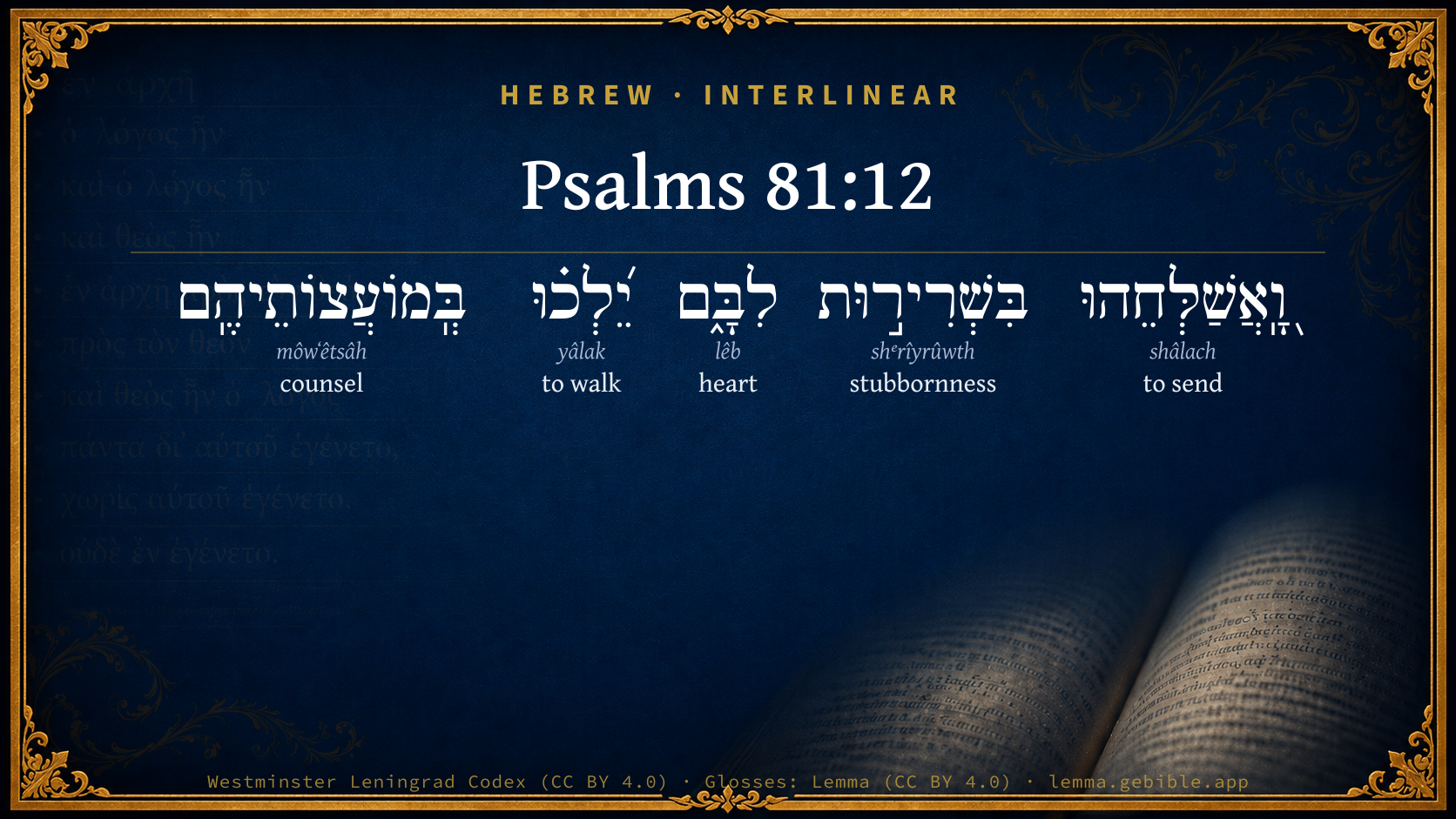
Hebrew (Westminster Leningrad Codex) Psalms 81:12 appears in the Hebrew Old Testament. The text above is from the Westminster Leningrad Codex. Each word links to its Strong’s number, a concise gloss, and parsing drawn from the Open Scriptures Hebrew Bible morphology. Click any word for its full Brown-Driver-Briggs (BDB) entry.
Download image
Cite this verse

Psalms 81:12 (World English Bible). Public Domain. Lemma interlinear Bible study tool, https://lemma.gebible.app/v/psalms/81/12.

Show BibTeX & RIS
BibTeX
RIS
English Translation
So I let them go after the stubbornness of their hearts, That they might walk in their own counsels.
World English Bible · Public Domain
Download a study sheet

One document with this verse’s original text, its word-by-word gloss line, the meaning frame, cross-references with their text, attributed commentary, and full source and license credits — printable, and it pastes into notes with its structure intact.

This verse Autodidact and up

Study sheet (.html) Plain text (.txt)

A passage Seminary Student

Up to 50 verses in one chapter. A passage sheet keeps up to 6 commentary sources and 12 cross-references per verse, in the order this page ranks them, and says so on the sheet whenever that leaves anything out. Ask for a single verse and you get the Autodidact verse sheet above.

Everything on this page stays free to read, with no account — the sheet is a download of what is already on screen, not access to it.

Want to remove ads? Support Godless Engineer
Compare translations 3

The same verse in 3 English versions, stacked beneath the original-language interlinear above. Click any original word for its lexicon entry.

Each is an independent rendering of the whole verse — the interlinear is not word-aligned to these translations.

Highlighted words mark where these versions differ — a whole-verse word diff, not a word-by-word alignment.

  • World English Bible Public Domain
    So I let them go after the stubbornness of their hearts, That they might walk in their own counsels.
  • King James Version Public Domain
    So I gave them up unto their own hearts' lust: and they walked in their own counsels.
  • unfoldingWord Literal Text CC BY-SA 4.0
    So I sent them away in the stubbornness of their heart; they walked in their counsels.

unfoldingWord Literal Text — © unfoldingWord, licensed CC BY-SA 4.0. Word-aligned USFM3 via Door43 (git.door43.org/unfoldingWord/en_ult).

Versions to compare (up to 4)

3 of 4 selected

Show all 18 translations

Every available English version of this verse, each an independent rendering of the whole verse.

  • World English Bible Public Domain
    So I let them go after the stubbornness of their hearts, That they might walk in their own counsels.
  • Berean Standard Bible Public Domain
    So I gave them up to their stubborn hearts to follow their own devices.
  • Majority Standard Bible Public Domain
    So I gave them up to their stubborn hearts to follow their own devices.
  • King James Version Public Domain
    So I gave them up unto their own hearts' lust: and they walked in their own counsels.
  • American Standard Version (1901) Public Domain
    So I let them go after the stubbornness of their heart, That they might walk in their own counsels.
  • Revised Version (1885) Public Domain
    So I let them go after the stubbornness of their heart, that they might walk in their own counsels.
  • Geneva Bible (1599) Public Domain
    So I gaue them vp vnto the hardnesse of their heart, and they haue walked in their owne cousels.
  • Douay-Rheims (1899) Public Domain
    But my people heard not my voice: and Israel hearkened not to me.
  • Young's Literal Translation Public Domain
    And I send them away in the enmity of their heart, They walk in their own counsels.
  • Literal Standard Version CC BY-SA 4.0
    And I send them away in the enmity of their heart, || They walk in their own counsels.
  • Unlocked Literal Bible CC BY-SA 4.0
    So I gave them over to their own stubborn way so that they might do what seemed right to them.
  • unfoldingWord Literal Text CC BY-SA 4.0
    So I sent them away in the stubbornness of their heart; they walked in their counsels.
  • Darby Bible Public Domain
    So I gave them up unto their own hearts' stubbornness: they walked after their own counsels.
  • World Messianic Bible Public Domain
    So I let them go after the stubbornness of their hearts, that they might walk in their own counsels.
  • Webster's Bible Public Domain
    \\81:11\\But my people would not hearken to my voice; and Israel would not obey me.
  • Free Bible Version CC BY-SA 4.0
    So I sent them away to follow their stubborn thinking, living as they chose.
  • Bible in Basic English Public Domain
    So I gave them up to the desires of their hearts; that they might go after their evil purposes.
  • JPS Tanakh (1917) Public Domain
    (81-13) So I let them go after the stubbornness of their heart, that they might walk in their own counsels.

Literal Standard Version (2020), Covenant Press — licensed CC BY-SA 4.0. Text via the HelloAO Bible API (eBible.org). Unlocked Literal Bible (unfoldingWord) — licensed CC BY-SA 4.0. Text via the HelloAO Bible API (eBible.org). unfoldingWord Literal Text — © unfoldingWord, licensed CC BY-SA 4.0. Word-aligned USFM3 via Door43 (git.door43.org/unfoldingWord/en_ult). Free Bible Version, Dr. Jonathan Gallagher — licensed CC BY-SA 4.0. Text via the HelloAO Bible API (eBible.org).

Word by word

More ways to search: Search by grammar → Find every occurrence → Compare this word →

Practice this passage: Drill this verse → Learn its vocabulary →

About this verse

These counts appear in no published source. They are computed here, from the morphology-tagged text and Lemma’s own curated glosses. What Lemma adds →

5
words
5
distinct lemmas
Wisdom
section

Notable vocabulary

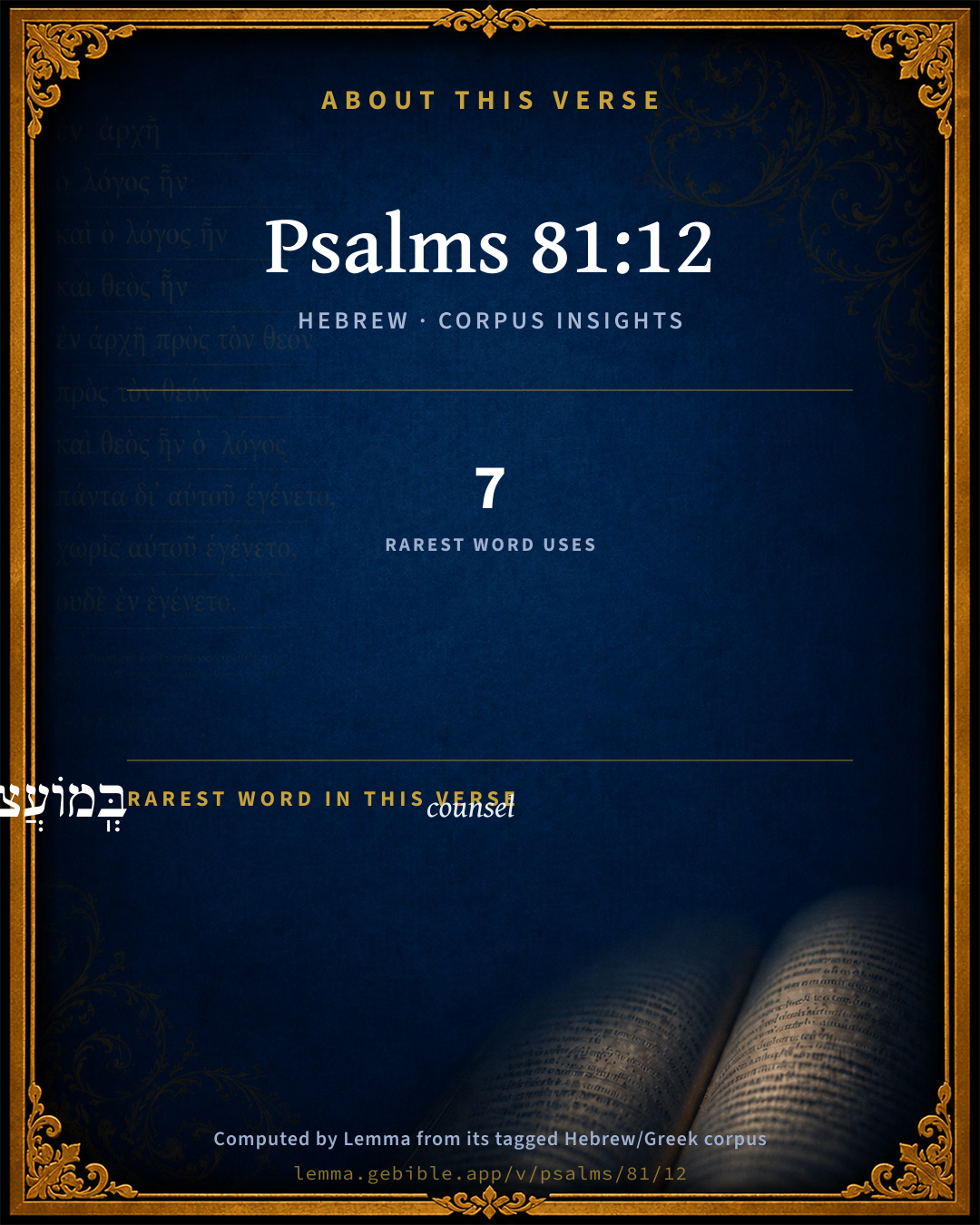
The rarest word here is בְּֽמוֹעֲצוֹתֵיהֶֽם counsel H4156 — appearing just 7 times in the whole Hebrew Bible.

Shared distinctive vocabulary

בְּֽמוֹעֲצוֹתֵיהֶֽם counsel H4156 occurs in 7 verses of the Hebrew Bible. Also found in:

Grammatical profile

  • 2 verbs
  • 3 nouns

Verb forms

  • וָֽ֭אֲשַׁלְּחֵהוּ Piel · Sequential Imperfect
  • יֵ֝לְכ֗וּ Qal · Imperfect

Hebrew & Septuagint length

In English translation the verse runs 19 words from the Hebrew and 20 from the Septuagint (LXX English) — closely comparable.

A rough comparison of the two English renderings, which tokenize alike — not a word-level alignment.

Word counts can differ between the Hebrew and the Greek without any difference in meaning — e.g. the Hebrew direct-object marker אֵת has no separate Greek word, and Greek often adds the article ὁ.

Cross-references

11

Topical passages linked to Psalms 81:12 in the Treasury of Scripture Knowledge — connected by theme and wording, ordered by reader-vote popularity; previews shown in the World English Bible.

  • Jeremiah 7:24 But they didn't listen nor turn their ear, but walked in [their own] counsels [and] in the stubbornness of their evil heart, and went backward, and not forward.
  • Romans 1:24 Therefore God also gave them up in the lusts of their hearts to uncleanness, that their bodies should be dishonored among themselves,
  • Isaiah 30:1 Woe to the rebellious children, says Yahweh, who take counsel, but not of me; and who make a league, but not of my Spirit, that they may add sin to sin,
  • Acts 7:42 But God turned, and gave them up to serve the host of the sky, as it is written in the book of the prophets, 'Did you offer to me slain animals and sacrifices Forty years in the wilderness, O house of Israel?
  • Acts 14:16 who in the generations gone by allowed all the nations to walk in their own ways.
  • Romans 1:26–27 For this reason, God gave them up to vile passions. For their women changed the natural function into that which is against nature.
  • 2 Thessalonians 2:9–11 even he whose coming is according to the working of Satan with all power and signs and lying wonders,
  • Jeremiah 44:16–17 As for the word that you have spoken to us in the name of Yahweh, we will not listen to you.
  • Job 8:4 If your children have sinned against him, He has delivered them into the hand of their disobedience;
  • Genesis 6:3 Yahweh said, "My Spirit will not strive with man forever, because he also is flesh; yet will his days be one hundred twenty years."
  • Exodus 11:9 Yahweh said to Moses, "Pharaoh won't listen to you, that my wonders may be multiplied in the land of Egypt."

Cross-references courtesy of OpenBible.info (CC BY 4.0).

Hebrew and Greek witnesses Masoretic Hebrew ↔ Greek Septuagint

The same verse in the two great witnesses to the Old Testament, shown verse-for-verse.

You’re reading Greek Psalm 80 (Hebrew Psalm 81). The Septuagint counts the superscription, so verse numbers can differ from the Hebrew — chapter-level alignment, not verse-by-verse. Numbering follows Rahlfs.

These are two independent witnesses, not word-aligned to each other, and the Septuagint is shown in lemma (dictionary) form.

Hebrew Psalms 81:12 Masoretic · Westminster Leningrad Codex

וָֽ֭אֲשַׁלְּחֵהוּ בִּשְׁרִיר֣וּת לִבָּ֑ם יֵ֝לְכ֗וּ בְּֽמוֹעֲצוֹתֵיהֶֽם

So I let them go after the stubbornness of their hearts, That they might walk in their own counsels.

World English Bible · Public Domain

Greek LXX Greek Psalm 80:12 Septuagint · lemma form

καί οὐ ἀκούω ὁ λαός ἐγώ ὁ φωνή ἐγώ καί ἰσραήλ οὐ προςἔχω ἐγώ

So I let them go after the ways of their own hearts: they will go on in their own ways.

LXX2012 (modern English Septuagint) · Public Domain

Hebrew: Westminster Leningrad Codex (CC BY 4.0). Greek: Septuagint (public domain); English from LXX2012 (modern English Septuagint) (Public Domain). How the Septuagint differs from the Hebrew →

Commentary

Notes on Psalms 81:12 from classic Christian and Jewish commentators (each source and its license shown beneath its notes). The classic Christian expositions comment on the surrounding passage and are grouped to its opening verse, so a note may address several verses; the Jewish commentaries on the Tanakh (Rashi and others) are per-verse, so they appear only where the commentator wrote on this verse.

Lemma curates 59 commentaries, every one of them public domain or Creative Commons licensed, each selected and text-cleaned for this edition rather than reprinted as found. About our sources →

Trapp's Complete Commentary

John Trapp

Psa 81:12 So I gave them up unto their own hearts’ lust: [and] they walked in their own counsels.

Ver. 12. So I gave them up] I left them as a ship without a rudder; as a horse without reins, to go whither they would, and do what they would. This is a fearful judgment ( poena rebellionis maxima), Hos 4:14 Rom 1:28 2Th 2:11-12.

And they walked in their own counsels] To their own ruin, because they took counsel, but not of God, and covered with a covering, but not of his Spirit, that they might add sin to sin, Isa 30:1.

John Trapp, A Commentary or Exposition upon All the Books of the Old and New Testament (1647–1656) — public domain. Text from a community e-Sword module.

Joseph Benson's Commentary

Psa 81:12. So I gave them up, &c. — Upon their obstinate and oft-repeated acts of disobedience, and their rejection of my grace and mercy offered to them, I withdrew all the restraints of my providence, and my Holy Spirit and grace from them, and wholly left them to follow their own vain and foolish imaginations, and wicked lusts. And they walked in their own counsels — The consequence of my thus giving them up to their own depraved inclinations was, that they practised all those things, both in common conversation and in religious worship, which were most agreeable, not to my commands or counsels, but to their own fancies and lusts, as appeared in the affair of the golden calf, and many other things.

Joseph Benson's Commentary on the Old and New Testaments (1811–1818) — public domain. Text from a community e-Sword module.

J. A. Alexander on Psalms

Joseph Addison Alexander

13. (Psa 81:12) And I gave them up to the corruption of their own heart; they go on in their own counsels. The first verb strictly means I sent them forth, i.e. to walk in the corruption of their own heart. The word translated corruption occurs elsewhere only in Deu 29:18, and in Jeremiah's imitations of it (Jer 3:17; Jer 7:24; Jer 9:13; Jer 11:8). According to a Syriac analogy, and the most probable Hebrew etymology, it properly means hardness, corresponding to its usage in the New Testament (Mar 7:5, Rom 11:25, Eph 4:18). In their own counsels, in the execution of their own evil purposes and unwise plans. The verb in the last clause may be read as a concession or permission, by referring the words to an anterior point of time. "I gave them up, etc., (saying) let them go on in their own counsels." As to the fearful kind of retribution here denounced, see Pro 1:30-31, Rom 1:24, 2Th 2:10-11.

Joseph Addison Alexander, The Psalms Translated and Explained (1850) — public domain. Text from a community e-Sword module.

Adam Clarke's Commentary

Verse 12. Unto their own hearts' lust] To the obstinate wickedness of their heart.

In their own counsels.] God withdrew his restraining grace, which they had abused; and then they fulfilled the inventions of their wicked hearts.

Adam Clarke's Commentary on the Bible (1810–1826) — public domain. Text from a community e-Sword/MySword module.

Ellicott's Commentary for English Readers

(12) Lust.—Rather, stubbornness, or perversity, from root meaning “to twist.”

A Bible Commentary for English Readers, edited by Charles John Ellicott (1878–1897) — public domain. Text from a community e-Sword module.

The Cambridge Bible for Schools and Colleges

gen. ed. J. J. S. Perowne

12. So I let them go after the stubbornness of their heart,

That they might walk in their own counsels. (R.V.).

God punishes men by leaving them to their own self-willed courses of action, which prove their ruin. Cp. Job_8:4; Pro_1:30 ff.; Rom_1:24 ff.; 2Th_2:10 ff. ‘Stubbornness’ is a favourite word with Jeremiah (Jer_7:24, &c.), occurring elsewhere only in Deu_29:19.

Most editions both of the Bible and of the Prayer Book wrongly print hearts’ for heart’s. See Scrivener, Auth. Ed. of Engl. Bible, p. 152, and Earle, Psalter of 1539, p. 313.

The Cambridge Bible for Schools and Colleges (gen. ed. J. J. S. Perowne; Cambridge University Press, 1878–1918) — public domain. Text from a community e-Sword module.

John Gill's Exposition

So I gave them up unto their own hearts' lust,.... Sometimes God gave them up, when they sinned, into the hands of the Moabites, or Ammonites, or Philistines, or other neighbouring nations, for their chastisement; but to be delivered up unto their own hearts' lust is worse than that; nay, than to be delivered to Satan: salvation may be the consequence of that, but damnation of this; and yet it is a righteous judgment; for as men like not to retain God in their knowledge, it is but just with him to give them up to vile affections, to a reprobate mind, to do things not convenient, Rom 1:24 there is nothing men are more desirous of than to have their hearts' lusts; and there is no greater judgment can befall them than to be left to the power of them, which must unavoidably issue in their ruin here and hereafter: and they walked in their own counsels; which were bad; after the imagination of their own evil hearts, and not after the counsels and directions of God in his word, and by his servants.

there is nothing men are more desirous of than to have their hearts' lusts; and there is no greater judgment can befall them than to be left to the power of them, which must unavoidably issue in their ruin here and hereafter: and they walked in their own counsels; which were bad; after the imagination of their own evil hearts, and not after the counsels and directions of God in his word, and by his servants.

Psalms 81:13

psa 81:13

psa 81:13

psa 81:13O that my people had hearkened unto me,.... This might have been expected from them, as they were his professing people; and it would have been to their advantage if they had hearkened to him, as well as it would have been well pleasing to him; for that is what is designed by this wish, which does not express the purposing will of God; for who hath resisted that? if he had so willed, he could have given them ears to hear; but his commanding will, and what is his approving one: to hearken to him is not only to hearken to what he commands, but to what he approves of; it is the good and acceptable will of God that men should hearken to the declarations of his will in the law, and to the declarations of his grace in the Gospel; and indeed it is the voice of Christ, the Angel of God's presence, who went before the children of Israel in the wilderness, which they were to hearken to and obey, that is here meant; see Exo 23:20, and Heb 3:6,

and Israel had walked in my ways; which he marked out and directed them unto, meaning his ordinances and commandments; which to walk in, as it denotes progress and continuance, and supposes and requires life and strength, so it is both pleasant and profitable.

John Gill's Exposition of the Whole Bible (1746–1763) — public domain (CC PDM 1.0). Text via the HelloAO Bible API.

Albert Barnes' Notes on the Bible

So I gave them up unto their own hearts’ lust - Margin, as in Hebrew, to the hardness of their own hearts. Literally, “I sent them, or I dismissed them, to the hardness of their hearts.” I suffered them to have what, in the hardness of their hearts they desired, or what their hard and rebellious hearts prompted them to desire: I indulged them in their wishes. I gave them what they asked, and left them to themselves to work out the problem about success and happiness in their own way - to let them see what must be the result of forsaking the true God. The world - and the church too - has been often suffered to make this experiment.

And they walked in their own counsels - As they thought wise and best. Compare Act 7:42; Act 14:16; Rom 1:24; Psa 78:26-37.

Albert Barnes' Notes on the Bible (1834–1885) — public domain. Text from a community e-Sword/MySword module.

Matthew Poole's English Annotations

Upon their obstinate and oft-repeated rebellions and rejections of my grace and mercy offered to them, I withdrew all the restraints of my providence, and my Holy Spirit, and grace from them, and wholly left them to follow their own vain and foolish imaginations and wicked lusts.

They walked in their own counsels; they practised those things, both in common conversation and in religious worship, which were most agreeable, not to my commands or counsels, but to their own fancies and inclinations, as appeared in the golden calf and many other things.

Matthew Poole's English Annotations on the Holy Bible (1683–1685) — public domain. Text from a community e-Sword/MySword module.

The Treasury of David

Charles H. Spurgeon

Ver. 12. So I gave them up unto their own hearts' lust. No punishment is more just or more severe than this. If men will not be checked, but madly take the bit between their teeth and refuse obedience, who shall wonder if the reins are thrown upon their necks, and they are let alone to work out their own destruction. It were better to be given up to lions than to our hearts' lusts.

And they walked in their own counsels. There was no doubt as to what course they would take, for man is everywhere wilful and loves his own way, that way being at all times in direct opposition to God's way. Men deserted of restraining grace, sin with deliberation; they consult, and debate, and consider, and then elect evil rather than good, with malice aforethought and in cool blood. It is a remarkable obduracy of rebellion when men not only run into sin through passion, but calmly "walk in their own counsels" of iniquity.

Ver. 12. So I gave them up. The word give up suggests the idea of a divorce, whereby a husband sends away a capricious wife, and commands her to live by herself...Transferred to God, it teaches us nothing else than that God withdraws his protecting and guiding hand from the people, and leaves them to themselves; so that he ceases to chasten and defend them, but, on the other hand, suffers them to become hardened and to perish. Venema.

Ver. 12. So I gave them up unto their own hearts' lusts, etc. A man may be given up to Satan for the destruction of the flesh, that the soul may be saved, but to be given up to sin is a thousand times worse, because that is the fruit of divine anger, in order to the damnation of the soul; here God wounds like an enemy and like a cruel one, and we may boldly say, God never punished any man or woman with this spiritual judgment in kindness and love. John Shower (1657-1715), in "The Day of Grace."

Ver. 12. I gave them up unto their own hearts' lusts. O dreadful word! The same will the Spirit do upon our rejecting or resisting of his leading. He may long strive, but he will "not always strive, " Ge 6:3. If the person led shall once begin to struggle with him that leads him, and shall refuse to follow his guidance, what is then to be done, but to leave him to himself? Continued, rooted, allowed resistance to the Spirit, makes him so to cast off a person as to lead him no more... Let it be your great and constant care and endeavour to get the Spirit's leading continued to you. You have it; pray keep it. Can it be well with a Christian, when this is suspended or withdrawn from him? How does he wander and bewilder himself, when the Spirit does not guide him! How backward is he to good, when the Spirit does not bend and incline him thereunto! How unable to go, when the Spirit does not uphold him! What vile lusts and passions rule him, when the Spirit does not put forth his holy and gracious government over him! O, it is of infinite concern to all that belong to God, to preserve and secure to themselves the Spirit's leading! Take a good man without this, and he is like a ship without a pilot, a blind man without a guide, a poor child that has none to sustain it, the rude multitude that have none to keep them in any order. What a sad difference is there in the same person, as to what he is when the Spirit leads him, and as to what he is when the Spirit leaves him! ...

OBJECTION. "But does the Spirit at any time do this to God's people? Does he ever suspend and withdraw his guidance from persons who once lived under it?"

ANSWER. Yes; too often. It is what he usually does, when his leadings are not followed. This is a thing that grieves him; and when he is grieved he departs, withholds, and recalls his former gracious influences, though not totally and finally; yet for a time and in such a degree. As a guide, that is to conduct the traveller; if this traveller shall refuse to follow him, or shall give unkind usage to him, what does the guide then do? Why, he receded, and leaves him to shift for himself. It is thus in the case in hand: if we comply with the Spirit, in his motions, and use him tenderly, he will hold on in his leading of us; but if otherwise, he will concern himself no more about us. O, take heed how you carry yourself towards him: not only upon ingenuousness, it is base to be unkind to our Guide, (Hast thou not procured this unto thyself, in that thou hast forsaken the Lord thy God, when he led thee by the way? Jer 2:17,)but also upon the account of self love: for "as we behave ourselves to him, so he will behave himself to us:" "Ita nos tractat, ut a nobis tractatur." Thomas Jacombe (1622-1687), in "Morning Exercises."

Ver. 12. I gave them up...and they walked in their own counsels. That was to give them up to a spirit of division, to a spirit of discontent, to a spirit of envy, and jealousy, to a spirit of ambition, of self seeking and emulation, and so to a spirit of distraction and confusion, and so to ruin and destruction. Such, and no better, is the issue, when God gives a people up to their own counsels; then they soon become a very chaos, and run themselves into a ruinous heap. As good have no counsel from man, as none but man's. Joseph Caryl.

Ver. 12. God calls upon Israel to hear and obey him, they will not: But my people would not hearken to my voice; and Israel would none of me. What was the result of their refusal? So I gave them up unto their own hearts lust: and they walked in their own counsels. God doth not testify his anger for their contempt of him be sending plague, or flames, or wild beasts among them. He doth not say, Well, since they thus slight my authority, I will be avenged on them to purpose; I will give them up to the sword, or famine, or racking diseases, or greedy devouring lions, which would have been sad and grievous; but he executes on them a far more sad and grievous judgment, when he saith, So I gave them up unto their own hearts' lust: and they walked in their own counsels. God's leaving one soul to one lust, (One's soul to one's lust?) is far worse than leaving him to all the lions in the world. Alas! it will tear the soul worse than a lion can do the body, and rend it in pieces, when there is none to deliver it. God's giving them up to their own wills, that they walked in their own counsels, is in effect a giving them up to eternal wrath and woe. George Swinnock.

Ver. 12. God moves everything on his ordinary providence according to their particular natures, God moves everything ordinarily according to the nature he finds it in. Had we stood in innocency, we had been moved according to that originally righteous nature; but since our fall we are moved according to that nature introduced into us with the expulsion of the other. Our first corruption was our own act, not God's work; we owe our creation to God, our corruption to ourselves. Now since God will govern his creature, I do not see how it can be otherwise, than according to the present nature of the creature, unless God be pleased to alter that nature. God forces no man against his nature; he doth not force the will in conversion, but graciously and powerfully inclines it. He doth never force nor incline the will to sin, but leaves it to the corrupt habits it hath settled in itself: So I gave them up unto their own hearts' lust: and they walked in their own counsels; counsels of their own framing, not of God's. He moves the will, which is sponte mala, according to its own nature and counsels. As a man flings several things out of his hand, which are of several figures, some spherical, tetragons, cylinders, conics, some round and some square, though the motion be from the agent, yet the variety of their motions is from their own figure and frame; and if any will hold his hand upon a ball in its motion, regularly it will move according to its nature and figure; and a man by casting a bowl out of his hand, is the cause of the motion, but the bad bias is the cause of its irregular motion. The power of action is from God, but the viciousness of that action from our own nature. As when a clock or watch hath some fault in any of the wheels, the man that winds it up, or putting his hand upon the wheels moves them, he is the cause of the motion, but it is the flaw in it, a deficiency of something, is the cause of its erroneous motion; that error was not from the person that made it, or the person that winds it up, and sets it on going, but from some other cause; yet till it be mended it will not go otherwise, so long as it is set upon motion. Our motion is from God, Ac 17:28, In him we move, but not the disorder of that motion. It is the fulness of a man's stomach at sea is the cause of his sickness, and not the pilot's government of the ship. God doth not infuse the lust, to excite it, though he doth present the object about which the lust is exercised. God delivered up Christ to the Jews, he presented him to them, but never commanded them to crucify him, nor infused that malice into them, nor quickened it; but he, seeing such a frame, withdrew his restraining grace, and left them to the conduct of their own vitiated wills. All the corruption in the world ariseth from lust in us, not from the objects which God in his providence presents to us: 2Pe 1:4, The corruption that is in the world through lust. Stephen Charnock.

Charles H. Spurgeon's The Treasury of David (1869–1885) — public domain. Psalms only. Text from a community e-Sword/MySword module.

Whedon's Commentary on the Bible

Daniel D. Whedon

12. So I gave them up—The testimony against his people being given by God, the language takes a tone of deeper sorrow as it passes to the consequences. “I gave them up,” is the form of the judicial sentence. He punishes and laments at one breath. His sorrow cannot avert the sentence. He cannot govern them by precept; he will, therefore, do it by penalty. So he gives “them up” to the hardness of their hearts. Their sins become the instruments of their punishment, as in Job_8:4, where read, “And he have delivered them over to the power of their transgression.”

Their own hearts’ lust—Literally, to the stubbornness of their heart.

Daniel D. Whedon (gen. ed.), Commentary on the Old and New Testaments (1874–1909) — public domain. Text from a community e-Sword module.

The Pulpit Commentary

So I gave them up unto their own hearts" lust. God"s Spirit will not always strive with men. (Gen_6:3) After a time, if they persist in evil courses and disobedience to his commands, he "gives them up," withdraws from them, leaves them to themselves, to the "lust," or rather "stubbornness" of their own hearts to their own perverse wills and imaginations. And they walked in their own counsels. (comp. Jer_7:24) This result is inevitable. If God no longer guides their thoughts and enlightens their understandings, they can but follow their own foolish counsels, and the result cannot but be disastrous.

Our own way our worst woe.

Our text a declaration of God"s dealing with rebellious men. We note concerning it that

I IT TELLS OF A PUNISHMENT WHICH SEEMS NO PUNISHMENT AT ALL. Those who rebelled so grievously against God were allowed to do just as they liked, to have their own way as they pleased.

1. Now, our text does tell of punishment. It is not a statement of indifference On the part of God, or of failure, but of his holy displeasure.

2. And it is a punishment of which we have many instances. As when Israel lusted after flesh. (Psa_78:30) And when they would have a king, and God gave them Saul. (1Sa 12 Ho 13) The history of Balaam. Ephraim joined to his idols. The devils asking and being allowed to enter the swine at Gadara. "Not this man, but Barabbas!" and they had their way. The prodigal would go into the far country. And there are many other illustrations beside.

3. God is slow to resort to it. He tries all other means first.

4. It convinces when none other will. Men are forced to believe, then, that God was right and they wrong.

5. But it seems the reverse of punish ment. For the Law of God was to Israel a yoke which galled and fretted and chafed them incessantly. Its "thou shalt not" met them at every turn of their lives. Now, this punishment seemed to be deliverance from the yoke and licence to do as they pleased. Where was the punishment in that?

6. And men think the same still. For to them the service of God is so much restraint, religion a tight torturing ligature, which holds them back from what they chooses and binds them down to what they would never choose. And undoubtedly religion is a restraint and a bond. We are never to conceal this fact, and the really religious have no desire to. But men generally do not like it at all, and are glad to be rid of it.

II BUT IT IS A PUNISHMENT SO TERRIBLE THAT NONE CAN BE MORE SO. To be given up to our own hearts" lust is God"s most awful doom.

1. What would such so called liberty be in other regions? Suppose the stars, instead of obeying their Creator"s laws, were each to wander at its own will? Where would music be it the laws of harmony were not obeyed? What home would that be where there was no law? Or state, where anarchy prevailed?

2. And so in regard to the soul. Man is made for God, and, as St. Augustine says, "Nostrum cor inquietum est donec requiescat in te." It must be so. See the varied and appalling judgments of which the Bible tells the Deluge; Sodom; the destruction of Pharaoh, etc. What are they all but the natural results of determined sin? Better any punishment even hell itself than that God should leave us alone, or give us up, as told of here.

CONCLUSION. Are you suffering under the hand of God now? Then assuredly he has not left you alone. Turn to him. Are you at ease in sin? Then "Awake, thou that sleepest!" You have need to. Are you serving God? Then let all men know that his service is perfect freedom, the delight of your soul. S.C.

The Pulpit Commentary (1880–1919), ed. H.D.M. Spence-Jones & Joseph S. Exell — public domain. Text from a community e-Sword module.

Scofield Reference Notes

C. I. Scofield

So I gave

See, Act 7:42; Act 14:16; Rom 1:24; Rom 1:26.

The Scofield Reference Bible (1917 edition), notes by C. I. Scofield — public domain. Text from a community e-Sword module.

Lesson kit

Teaching starters — assembled from the data on this page, not authored interpretation. Every prompt links to the verse data it draws on. Edit before teaching.

Psalms, in the Wisdom, opens this verse with 5 words (5 distinct Hebrew lemmas). Its most distinctive word is môwʻêtsâh (“counsel”). A historical commentator’s framing appears above. Read the whole chapter for the surrounding context.

Discussion questions

  1. The word môwʻêtsâh carries the sense “counsel.” How does it shape the verse?
  2. Psalms 5:10 shares the word «counsel» with this verse. How do the two illuminate each other?
  3. These translations render this verse differently. What is at stake in choosing one wording over another?
  4. The verb «וָֽ֭אֲשַׁלְּחֵהוּ» is Piel Sequential Imperfect. How does its form color the action?
  5. Reading how Trapp's Complete Commentary and Joseph Benson's Commentary read this verse, where do the two commentators agree and where do they part?

Things to notice

Reading settings

Reading text

Shown beneath each verse's original-language words.

Old Testament
Old Testament edition

Read the OT as the Masoretic Hebrew (MT) or the Greek Septuagint (LXX).

English shown for the Greek Septuagint (in the Hebrew ↔ Greek comparison).

Comparing translations? Open the Compare panel on any verse page to stack up to four side by side.