
1 Corinthians 3:19

Greek (Tischendorf 8th ed.) 1 Corinthians 3:19 appears in the Greek New Testament. The text above is from the Tischendorf 8th edition. Each word links to its Strong’s number and a concise gloss. Click any word for its full Thayer’s Greek Lexicon entry.
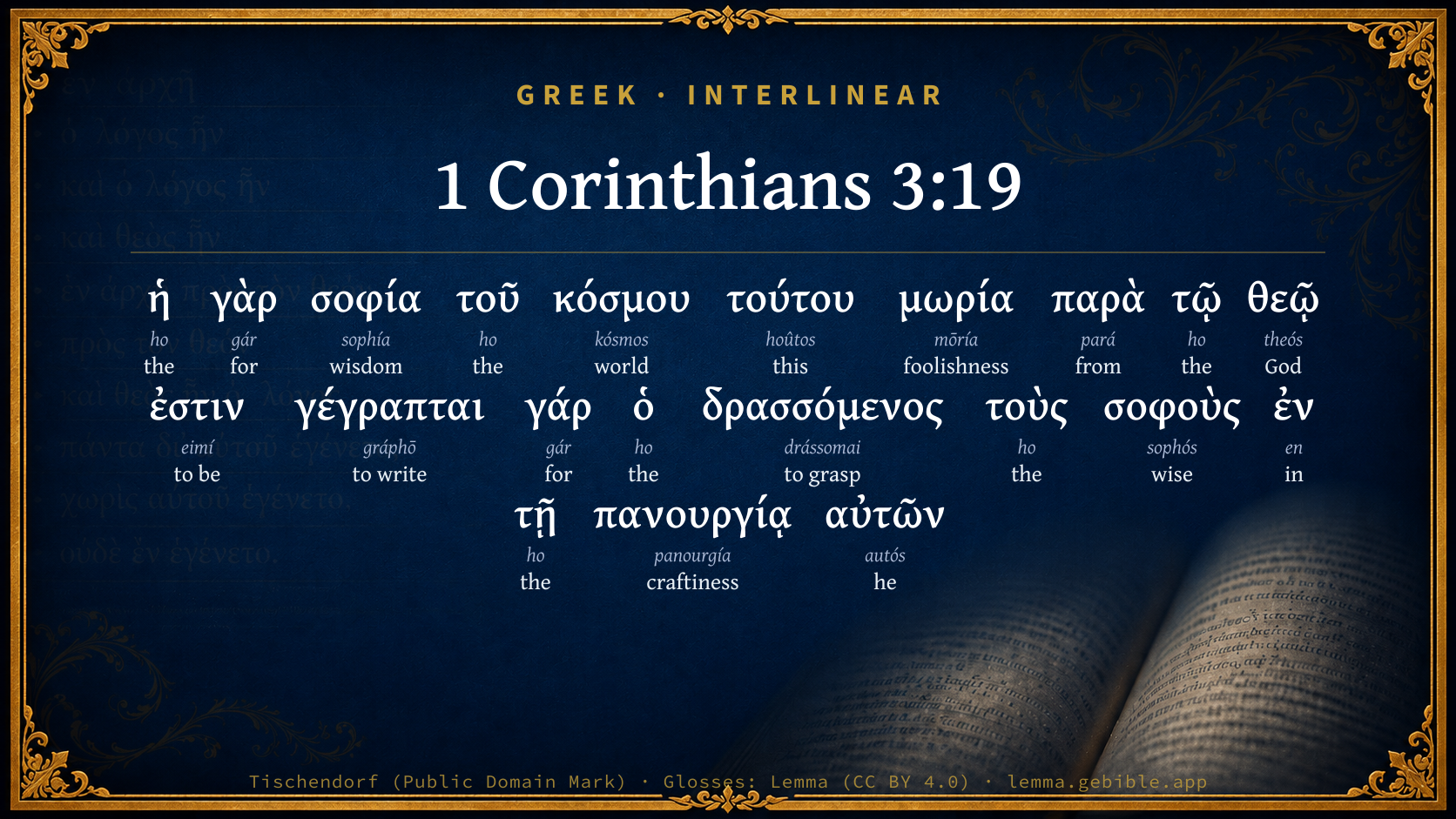
Download image
Cite this verse

1 Corinthians 3:19 (World English Bible). Public Domain. Lemma interlinear Bible study tool, https://lemma.gebible.app/v/1-corinthians/3/19.

Show BibTeX & RIS
BibTeX
RIS
English Translation
For the wisdom of this world is foolishness with God. For it is written, "He has taken the wise in their craftiness."
World English Bible · Public Domain
Highlights
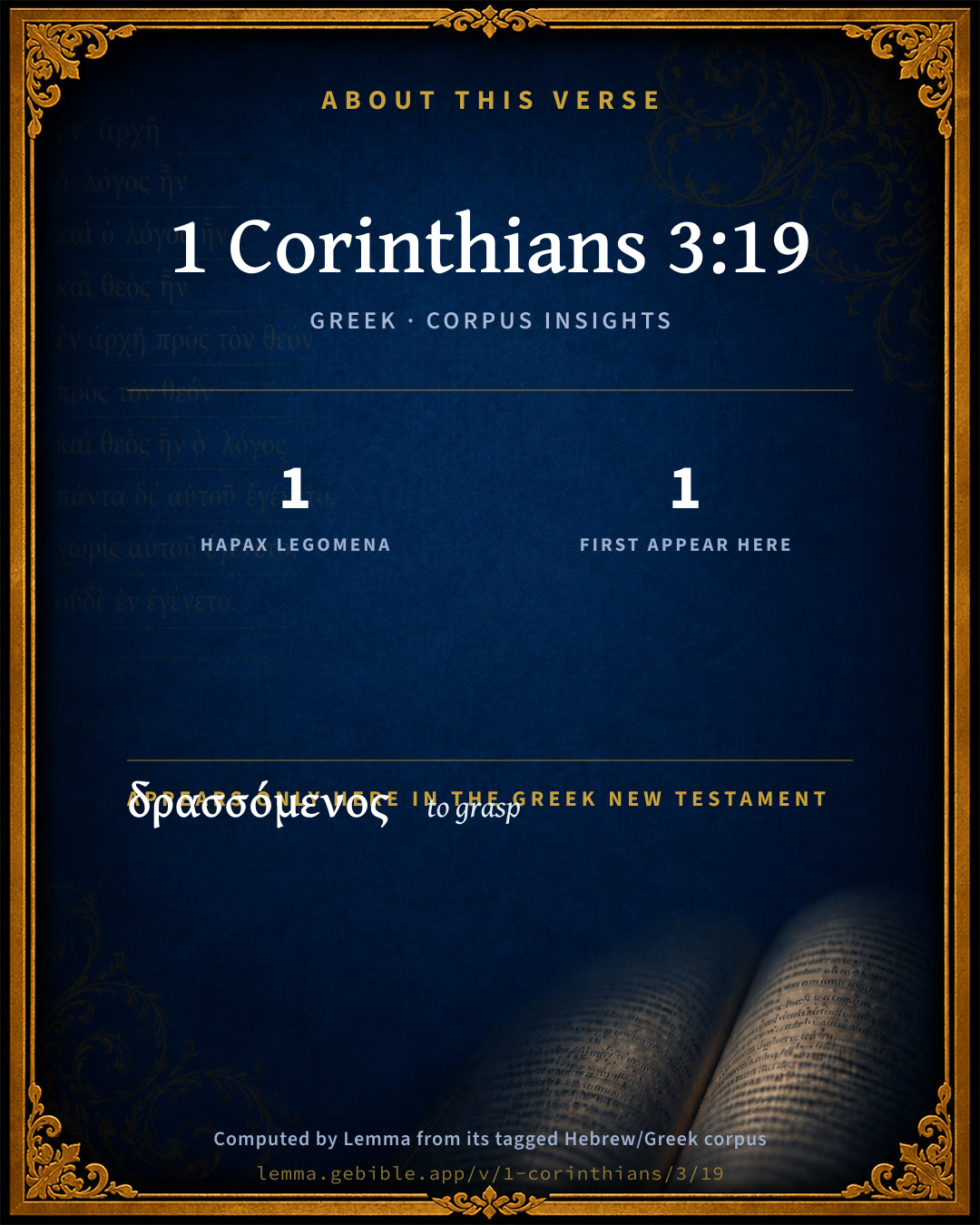
  • 1 hapax legomenon — only here in the Greek New Testament
  • 1 first appearance in the Greek New Testament
Full analysis ↓
Download a study sheet

One document with this verse’s original text, its word-by-word gloss line, the meaning frame, cross-references with their text, attributed commentary, and full source and license credits — printable, and it pastes into notes with its structure intact.

This verse Autodidact and up

Study sheet (.html) Plain text (.txt)

A passage Seminary Student

Up to 50 verses in one chapter. A passage sheet keeps up to 6 commentary sources and 12 cross-references per verse, in the order this page ranks them, and says so on the sheet whenever that leaves anything out. Ask for a single verse and you get the Autodidact verse sheet above.

Everything on this page stays free to read, with no account — the sheet is a download of what is already on screen, not access to it.

Want to remove ads? Support Godless Engineer
Compare translations 3

The same verse in 3 English versions, stacked beneath the original-language interlinear above. Click any original word for its lexicon entry.

Each is an independent rendering of the whole verse — the interlinear is not word-aligned to these translations.

Highlighted words mark where these versions differ — a whole-verse word diff, not a word-by-word alignment.

  • World English Bible Public Domain
    For the wisdom of this world is foolishness with God. For it is written, "He has taken the wise in their craftiness."
  • King James Version Public Domain
    For the wisdom of this world is foolishness with God. For it is written, He taketh the wise in their own craftiness.
  • unfoldingWord Literal Text CC BY-SA 4.0
    For the wisdom of this world is foolishness with God. For it is written, “He catches the wise in their craftiness.”

unfoldingWord Literal Text — © unfoldingWord, licensed CC BY-SA 4.0. Word-aligned USFM3 via Door43 (git.door43.org/unfoldingWord/en_ult).

Versions to compare (up to 4)

3 of 4 selected

Show all 19 translations

Every available English version of this verse, each an independent rendering of the whole verse.

  • World English Bible Public Domain
    For the wisdom of this world is foolishness with God. For it is written, "He has taken the wise in their craftiness."
  • Berean Standard Bible Public Domain
    For the wisdom of this world is foolishness in God’s sight. As it is written: “He catches the wise in their craftiness.”
  • Majority Standard Bible Public Domain
    For the wisdom of this world is foolishness in God’s sight. As it is written: “He catches the wise in their craftiness.”
  • King James Version Public Domain
    For the wisdom of this world is foolishness with God. For it is written, He taketh the wise in their own craftiness.
  • American Standard Version (1901) Public Domain
    For the wisdom of this world is foolishness with God. For it is written, He that taketh the wise in their craftiness:
  • Revised Version (1885) Public Domain
    For the wisdom of this world is foolishness with God. For it is written, He that taketh the wise in their craftiness:
  • Geneva Bible (1599) Public Domain
    For the wisdome of this worlde is foolishnesse with God: for it is written, He catcheth the wise in their owne craftinesse.
  • Douay-Rheims (1899) Public Domain
    For the wisdom of this world is foolishness with God. For it is written: I will catch the wise in their own craftiness.
  • Young's Literal Translation Public Domain
    for the wisdom of this world is foolishness with God, for it hath been written, `Who is taking the wise in their craftiness;'
  • Literal Standard Version CC BY-SA 4.0
    for the wisdom of this world is foolishness with God, for it has been written: “Who is taking the wise in their craftiness”;
  • Unlocked Literal Bible CC BY-SA 4.0
    For the wisdom of this world is foolishness with God. For it is written, “He catches the wise in their craftiness.”
  • unfoldingWord Literal Text CC BY-SA 4.0
    For the wisdom of this world is foolishness with God. For it is written, “He catches the wise in their craftiness.”
  • Darby Bible Public Domain
    For the wisdom of this world is foolishness with God; for it is written, He who takes the wise in their craftiness.
  • World Messianic Bible Public Domain
    For the wisdom of this world is foolishness with God. For it is written, “He has taken the wise in their craftiness.”
  • Webster's Bible Public Domain
    For the wisdom of this world is foolishness with God. For it is written, He taketh the wise in their own craftiness.
  • Free Bible Version CC BY-SA 4.0
    This world's wisdom is plain foolishness to God. As Scripture says, “He uses the cleverness of the wise to catch them out,”
  • Bible in Basic English Public Domain
    For the wisdom of this world is foolish before God. As it is said in the holy Writings, He who takes the wise in their secret designs:
  • Text-Critical English NT CC BY 4.0
    For the wisdom of this world is foolishness with God. As it is written, “He catches the wise in their craftiness,”
  • Tyndale New Testament (1534) Public Domain
    For the wisdome of this worlde is folysshnes with god. For it is written: he compaseth the wyse in their craftynes.

Literal Standard Version (2020), Covenant Press — licensed CC BY-SA 4.0. Text via the HelloAO Bible API (eBible.org). Unlocked Literal Bible (unfoldingWord) — licensed CC BY-SA 4.0. Text via the HelloAO Bible API (eBible.org). unfoldingWord Literal Text — © unfoldingWord, licensed CC BY-SA 4.0. Word-aligned USFM3 via Door43 (git.door43.org/unfoldingWord/en_ult). Free Bible Version, Dr. Jonathan Gallagher — licensed CC BY-SA 4.0. Text via the HelloAO Bible API (eBible.org).

Word by word

More ways to search: Search by grammar → Find every occurrence → Compare this word →

Practice this passage: Drill this verse → Learn its vocabulary →

δρασσόμενος
drássomai
G1405
“to grasp”
Verb, Present, Middle or Passive deponent, Participle, Nominative, Singular, Masculine
Part of Speech
Verb
Tense
Present
Voice
Middle or Passive deponent
Mood
Participle
Case
Nominative
Number
Singular
Gender
Masculine
Full Thayer's Definition

Origin: perhaps akin to the base of G1404 (through the idea of capturing)

TDNT: None

1. to grasp with the hand, take
  1. ἡ ho G3588 “the” Article, Nominative, Singular, Feminine
  2. γὰρ gár G1063 “for” Conjunction
  3. σοφία sophía G4678 “wisdom” Noun, Nominative, Singular, Feminine
  4. τοῦ ho G3588 “the” Article, Genitive, Singular, Masculine
  5. κόσμου kósmos G2889 “world” Noun, Genitive, Singular, Masculine
  6. τούτου hoûtos G3778 “this” Demonstrative pronoun, Genitive, Singular, Masculine
  7. μωρία mōría G3472 “foolishness” Noun, Nominative, Singular, Feminine
  8. παρὰ pará G3844 “from” Preposition
  9. τῷ ho G3588 “the” Article, Dative, Singular, Masculine
  10. θεῷ theós G2316 “God” Noun, Dative, Singular, Masculine
  11. ἐστιν eimí G1510 “to be” Verb, Present, Active, Indicative, 3rd person, Singular
  12. γέγραπται gráphō G1125 “to write” Verb, Perfect, Passive, Indicative, 3rd person, Singular
  13. γάρ gár G1063 “for” Conjunction
  14. ὁ ho G3588 “the” Article, Nominative, Singular, Masculine
  15. τοὺς ho G3588 “the” Article, Accusative, Plural, Masculine
  16. σοφοὺς sophós G4680 “wise” Adjective, Accusative, Plural, Masculine
  17. ἐν en G1722 “in” Preposition
  18. τῇ ho G3588 “the” Article, Dative, Singular, Feminine
  19. πανουργίᾳ panourgía G3834 “craftiness” Noun, Dative, Singular, Feminine
  20. αὐτῶν autós G846 “he” Personal pronoun, Genitive, Plural, Masculine

About this verse

These counts appear in no published source. They are computed here, from the morphology-tagged text and Lemma’s own curated glosses. What Lemma adds →

21
words
15
distinct lemmas
Pauline Epistles
section

Notable vocabulary

1 hapax legomenon — a word that appears only here in the entire Greek New Testament:

  • δρασσόμενος to grasp G1405

First appearance in Scripture

This word makes its first canonical appearance in the Greek New Testament here:

  • δρασσόμενος to grasp G1405

Shared distinctive vocabulary

μωρία foolishness G3472 occurs in 5 verses of the Greek New Testament. Also found in:
Repetition

Words recur within this verse:

Cross-references

16

Topical passages linked to 1 Corinthians 3:19 in the Treasury of Scripture Knowledge — connected by theme and wording, ordered by reader-vote popularity; previews shown in the World English Bible.

  • Job 5:13 He takes the wise in their own craftiness; The counsel of the cunning is carried headlong.
  • Psalms 141:10 Let the wicked fall together into their own nets, While I pass by.
  • 1 Corinthians 1:19–20 For it is written, "I will destroy the wisdom of the wise, I will bring the discernment of the discerning to nothing."
  • Romans 1:21–22 Because, knowing God, they didn't glorify him as God, neither gave thanks, but became vain in their reasoning, and their senseless heart was darkened.
  • Isaiah 44:25 who frustrates the signs of the liars, and makes diviners mad; who turns wise men backward, and makes their knowledge foolish;
  • Psalms 9:15–16 The nations have sunk down in the pit that they made; In the net which they hid, their own foot is taken.
  • 1 Corinthians 2:6 We speak wisdom, however, among those who are full grown; yet a wisdom not of this world, nor of the rulers of this world, who are coming to nothing.
  • Psalms 7:14–15 Behold, he travails with iniquity; Yes, he has conceived mischief, And brought forth falsehood.
  • Isaiah 29:14–16 therefore, behold, I will proceed to do a marvelous work among this people, even a marvelous work and a wonder; and the wisdom of their wise men shall perish, and the understanding of their prudent men shall be hid.
  • Exodus 18:11 Now I know that Yahweh is greater than all gods because of the thing in which they dealt arrogantly against them."
  • 2 Samuel 16:23 The counsel of Ahithophel, which he gave in those days, was as if a man inquired at the oracle of God: so was all the counsel of Ahithophel both with David and with Absalom.
  • Isaiah 19:11–14 The princes of Zoan are utterly foolish; the counsel of the wisest counselors of Pharaoh is become brutish: how do you say to Pharaoh, I am the son of the wise, the son of ancient kings?
  • 2 Samuel 15:31 One told David, saying, Ahithophel is among the conspirators with Absalom. David said, Yahweh, please turn the counsel of Ahithophel into foolishness.
  • 2 Samuel 17:14 Absalom and all the men of Israel said, The counsel of Hushai the Archite is better than the counsel of Ahithophel. For Yahweh had ordained to defeat the good counsel of Ahithophel, to the intent that Yahweh might bring evil on Absalom.
  • 2 Samuel 17:23 When Ahithophel saw that his counsel was not followed, he saddled his donkey, and arose, and got him home, to his city, and set his house in order, and hanged himself; and he died, and was buried in the tomb of his father.
  • Exodus 1:10 Come, let us deal wisely with them, lest they multiply, and it happen that when any war breaks out, they also join themselves to our enemies, and fight against us, and escape out of the land."

Cross-references courtesy of OpenBible.info (CC BY 4.0).

Commentary

Notes on 1 Corinthians 3:19 from classic Christian and Jewish commentators (each source and its license shown beneath its notes). The classic Christian expositions comment on the surrounding passage and are grouped to its opening verse, so a note may address several verses; the Jewish commentaries on the Tanakh (Rashi and others) are per-verse, so they appear only where the commentator wrote on this verse.

Lemma curates 59 commentaries, every one of them public domain or Creative Commons licensed, each selected and text-cleaned for this edition rather than reprinted as found. About our sources →

Bengel's Gnomon

Johann Albrecht Bengel

1Co 3:19. Ὁ δρασσόμενος τοὺς σοφοὺς ἐν τῇ πανουργίᾳ αὐτῶν) Eliphaz in Job 5:13, in the LXX., says, ὁ καταλαμβάνων σοφοὺς ἐν τῇ φρονήσει. The apostles seem to have kept very much by the words of the LXX. Interpreters in passages very well known to the Hellenists [the Greek-speaking Jews], for example in the Parschijoth[29] and Haphtaroth, and likewise in the Psalms; but they have recourse to the Hebrew, in passages less generally used, such as this passage of Job. Paul has also in another place referred to Job. See Php 1:19, note.—ἐν, in) not only whilst they think that they are acting wisely, but in such a way, that their very wisdom is a snare to them.

[29] Parschijoth, sections of the Pentateuch; Haphtaroth, sections of the Prophets, read publicly.—T.

Bengel's Gnomon of the New Testament — English translation (T&T Clark, Edinburgh, 1860) — public domain. Text from a community e-Sword module.

Meyer's Critical & Exegetical Commentary

Heinrich August Wilhelm Meyer

1Co_3:19. Giving the ground of the μωρὸς γενέσθω demanded in order to the γίνεσθαι σόφον.

τοῦ κόσμου τούτου] i.e. such as is peculiar to the pre-Messianic world (humanity), like the Hellenic sophistry, rhetoric, etc.; comp 1Co_1:21, 1Co_2:6.

παρὰ τ. Θεῷ] judice Deo; Rom_2:13; Winer, p. 369 [E. T. 493]. How truly that wisdom was its own very opposite, and how utterly to be given up!

γέγρ. γὰρ] Job_5:13, not according to the LXX., but expressing the sense of the Hebrew with quite as great fidelity. The passage, however, serves as proof, not for the warning and admonition in 1Co_3:18 (Hofmann),to take it thus would be arbitrarily to reach back over what immediately precedes the γάρ,but, as 1Co_3:20 also confirms, for the statement just made, ἡ γὰρ σοφία κ.τ.λ[559] If, namely, God did not count that wisdom to be folly, then He could not be spoken of as He who taketh the wise in their craftiness, i.e. who brings it to pass that the wise, while they cunningly pursue their designs, do not attain them, but rather their craftiness turns to their own destruction. Thus the hand of God comes in upon their doings and takes them in their craftiness, whereby He just practically proclaims His judgment regarding their wisdom, that it is foolishness. As respects πανουργία, comp the Hellenic distinction between it and the true wisdom in Plato, Menex. p. 247 A: πᾶσά τε ἐπιστήμη χωριζομένη δικαιοσύνης καὶ τῆς ἄλλης ἀρετῆς πανουργία, οὐ σοφία, φαίνεται.

ὁ δρασσόμ. is not ex Hebr. pro finito ΔΡΆΣΣΕΤΑΙ (Pott, following Beza), but the quotation, being taken out of its connection, does not form a complete sentence. Comp Heb_1:8; Winer, p. 330 [E. T. 443]; Buttmann, neut. Gr. p. 250 [E. T. 291].

On δράσσεσθαι with the accusative (commonly with the genitive), comp Herod. iii. 13, LXX. Lev_5:12, Num_5:26.

[559] .τ.λ. καὶ τὰ λοιπά.

Meyer — Critical and Exegetical Commentary on the New Testament — English translation by Peter Christie, edited by Frederick Crombie (T&T Clark, 1880) — public domain. Text from a community e-Sword module.

Expositor's Greek Testament

ed. W. Robertson Nicoll

1Co 3:19 a gives the reason why the philosophy of the times must be renounced by the aspirant to Christian wisdom: “For the wisdom of the world is folly with God” (= 1Co 1:20 ); and since it is folly with God , it must be counted folly, and not wisdom, amongst you (1Co 3:18 ). God’s judgment is decisive for His Church. παρὰ Θεῷ , apud Deum, judice Deo (see parls.).

1Co 3:19-20 . That the above is God’s judgment appears from two sayings of Scripture, bearing on the two classes of worldly wise the men of affairs (such as the ἄρχοντες of 1Co 2:6 ) and the philosophers (1Co 1:20 ), distinguished respectively by πανουργία and διαλογισμοί . In the first text (the only N.T. quotation from Job: Phi 1:19 , perhaps an allusion), Paul improves on the LXX, possibly from another version, substituting the vivid ὁ δρασσόμενος ( He that grips: cf. δραξάμενος φάρυγγος , Theocritus, xxiv. 28) for ὁ καταλαμβάνων , and πανουργίᾳ αὐτῶν for φρονήσει , both nearer to the Heb. (LXX reads πανουργίαν in 1Co 3:12 ). The words (from Eliphaz) are “appropriated because of their inherent truth” (Lt [615] ); they reassert the anticipation expressed in 1Co 2:6 . For πανουργία , see parls.; note its deterioration of meaning, as in Eng. craft . When the world’s schemers think themselves cleverest, Providence catches them in their own toils. The second text P. adapts by turning ἀνθρώπων into σοφῶν : what is true of the vanity of human thoughts generally ( machsh ’both ’âdâm ) he applies par excellence to “the reasonings of the wise ”. διαλογισμοί , signifying in Plutarch’s later Gr [616] debates, arguings (see parls.), recalls 1Co 1:19 f. above, echoing the quotation of that passage. On μάταιοι , futile , see note to 1Co 15:14 ( κενός ).

[615] J. B. Lightfoot’s (posthumous) Notes on Epp. of St. Paul (1895).

[616] Greek, or Grotius’ Annotationes in N.T.

The Expositor's Greek Testament, edited by W. Robertson Nicoll (1897–1910) — public domain. Text from a community e-Sword module.

Hodge's Commentary on Romans, Ephesians & First Corinthians

Charles Hodge

1Co_3:19, 1Co_3:20

For the wisdom of this world is foolishness with God. For it is written, He taketh the wise in their own craftiness. And again, The Lord knoweth the thoughts of the wise, that they are vain.

We must renounce our own wisdom because it is folly. The infinite mind sees that to be folly which we children think to be wisdom. There are two senses in which this is true, or in which wisdom may be said to be folly. Even truth or true knowledge becomes folly, if employed to accomplish an end for which it is not adapted. If a man attempts to make men holy or happy; if he undertakes to convert the world, by mathematics, or metaphysics, or moral philosophy, he is foolish, and his wisdom, as a means to that end is folly. He must renounce all dependence on those means if he would accomplish that end. But in the second place, much that passes for wisdom among men is in itself, and not merely as a means to an end, foolishness. Both these ideas are evidently comprehended in the apostles statement. He means to say that human knowledge is entirely inadequate to save men; because that end can only be accomplished by the gospel. And he means also to brand as folly the speculations of men about the deep things of God.

In proof of the assertion that the wisdom of men is foolishness with God, he quotes two passages of Scripture. The first is from Job_5:13 the second is from Psa_94:11. The former is a fragment of a sentence containing in the Greek no verb. Our translation renders the participle (ὁ δρασσόμενος) as though it were a verb. Those passages clearly express the same sentiment which the apostle had uttered. They declare the impotency and insufficiency of human wisdom.

Charles Hodge — Commentary on Romans (1835), First Corinthians (1857), and Ephesians (1856) — public domain. Text from a community e-Sword module.

Geneva Bible (1599)

Geneva Bible translators

Job 5:13

Be they never so crafty, yet the Lord will take them when he shall discover their treachery.

Geneva Bible (1599) marginal notes — public domain. Text via Bolls.life.

Jamieson, Fausset & Brown

Robert Jamieson, A. R. Fausset & David Brown

with God--in the judgment of God.

it is written--in Job 5:13. The formula of quoting SCRIPTURE used here, establishes the canonicity of Job.

He taketh . . . wise in . . . own craftiness--proving the "foolishness" of the world's wisdom, since it is made by God the very snare to catch those who think themselves so wise. Literally, "He who taketh . . . the whole of the sentence not being quoted, but only the part which suited Paul's purpose.

Jamieson, Fausset & Brown — Commentary Critical and Explanatory on the Whole Bible (1871) — public domain (CC PDM 1.0). Text via the HelloAO Bible API.

Adam Clarke's Commentary

Verse 19. The wisdom of this world] Whether it be the pretended deep and occult wisdom of the rabbins, or the wire-drawn speculations of the Grecian philosophers, is foolishness with God; for as folly consists in spending time, strength, and pains to no purpose, so these may be fitly termed fools who acquire no saving knowledge by their speculations. And is not this the case with the major part of all that is called philosophy, even in the present day? Has one soul been made wise unto salvation through it? Are our most eminent philosophers either pious or useful men? Who of them is meek, gentle, and humble! Who of them directs his researches so as to meliorate the moral condition of his fellow creatures? Pride, insolence, self-conceit, and complacency, with a general forgetfulness of God, contempt for his word, and despite for the poor, are their general characteristics.

He taketh the wise in their own craftiness.] This is a quotation from Job 5:13, and powerfully shows what the wisdom of this world is: it is a sort of craft, a subtle trade, which they carry on to wrong others and benefit themselves; and they have generally too much cunning to be caught by men; but God often overthrows them with their own devisings. Paganism raised up persecution against the Church of Christ, in order to destroy it: this became the very means of quickly spreading it over the earth, and of destroying the whole pagan system. Thus the wise were taken in their own craftiness.

Adam Clarke's Commentary on the Bible (1810–1826) — public domain. Text from a community e-Sword/MySword module.

John Calvin's Commentaries

19. For the wisdom of this world This is an argument taken from things opposite. To maintain the one is to overturn the other. As, therefore, the wisdom of this world is foolishness with God, it follows that we cannot be wise in the sight of God, unless we are fools in the view of the world. We have already explained (1 Corinthians 1:20) what he means by the wisdom of this world; for natural perspicacity is a gift of God, and the liberal arts, and all the sciences by which wisdom is acquired, are gifts of God. They are confined, however, within their own limits; for into God’s heavenly kingdom they cannot penetrate. Hence they must occupy the place of handmaid, not of mistress: nay more, they must be looked upon as empty and worthless, until they have become entirely subject to the word and Spirit of God. If, on the other hand, they set themselves in opposition to Christ, they must be looked upon as dangerous pests, and, if they strive to accomplish anything of themselves, as the worst of all hindrances. Hence the wisdom of the world, in Paul’s acceptation, is that which assumes to itself authority, and does not allow itself to be regulated by the word of God, or to be subdued, so as to yield itself up in entire subjection to him. Until, therefore, matters have come to this, that the individual acknowledges that he knows nothing but what he has learned from God, and, giving up his own understanding; resigns himself unreservedly to Christ’s guidance, he is wise in the world’s account, but he is foolish in the estimation of God.

For it is written, He taketh the wise He confirms this from two Scripture proofs, the first of which is taken from Job 5:13, where the wisdom of God is extolled on this ground, that no wisdom of the world can stand before it.

Now it is certain, that the Prophet speaks there of those that are cunning and crafty; but as the wisdom of man is invariably such without God, it is with good reason that Paul applies it in this sense, — that whatever wisdom men have of themselves is reckoned of no account in the sight of God. The second is from Psalm 94:11, where David, after claiming for God alone the office and authority of the Instructor of all, adds, that He knows the thoughts of all to be vain. Hence, in whatever estimation they are held by us, they are, in the judgment of God, vain Here we have an admirable passage for bringing down the confidence of the flesh, while God from on high declares that everything that the mind of man conceives and contrives is mere vanity

John Calvin's Commentaries (1540-1563) — public domain. Text from the Calvin Translation Society English edition (1840s-50s) via the Christian Classics Ethereal Library (ccel.org). Calvin's coverage is partial (roughly two-thirds of the Bible); uncommented books and verses are honest gaps, never fabricated. The 19th-century editor's footnotes and remarks are omitted so the notes are faithfully Calvin's own voice.

Ellicott's Commentary for English Readers

(19) With God.—Better, in the sight of God (Rom_2:13).

For it is written.—By two passages, one from Job, and the other from the Psalms, St. Paul proves the truth of his previous assertion regarding God’s estimate of mere “worldly wisdom.” It may be noticed that with the exception of the reference in Jas_5:11 to the “proverbial patience” of Job, of which the writer says “ye have heard” (not read), this is the only allusion to the book of Job or to Job in the New Testament.

A Bible Commentary for English Readers, edited by Charles John Ellicott (1878–1897) — public domain. Text from a community e-Sword module.

The Cambridge Bible for Schools and Colleges

gen. ed. J. J. S. Perowne

19. it is written] In Job_5:13.

The Cambridge Bible for Schools and Colleges (gen. ed. J. J. S. Perowne; Cambridge University Press, 1878–1918) — public domain. Text from a community e-Sword module.

John Gill's Exposition

For the wisdom of this world is foolishness with God,.... The wisdom of the Jewish, or Gentile world. It is had in no account with him; it is despised and neglected by him; he makes it foolish, destroys it, and brings it to nothing; he lays it aside as useless, to make men wise unto salvation, and by the foolishness of preaching saves them that believe; he passes by the wise and prudent, and hides the things of the Gospel from them; so, that, with all their learning and wisdom, they can neither apprehend nor comprehend the mysteries of grace, whilst he reveals them unto babes, and chooses the foolish things of this world to spread the knowledge of himself, his Son, his Gospel, and the truths of it, and whom he makes successful, to the confusion of the wise and learned.

"For it is written", an usual form of citing Scriptures with the Jews; it is in Job 5:13 he taketh the wise in their own craftiness, or by it. What Eliphaz says of the wise politicians of the world, who are often disappointed of their crafty devices, and cannot perform the enterprises they have took in hand, but their schemes are broken, and the snares they laid for others they are taken in themselves, is applied by the apostle to the Jewish doctors, or the Gentile philosophers, or rather to the false teachers among the Christians; whose schemes they have formed to corrupt the churches, and demolish the Gospel, prove their own destruction; nor will they, with all their cunning, be able to get out of the hand of God, and escape his awful vengeance. The allusion is either to the taking of wild beasts and birds in snares and nets, or to the taking of men in flight, laying hold of them with the hand, and grasping them hard, that they cannot get loose. The Targum interprets the words of the wise men of Pharaoh, and of the Egyptian astrologers, schemes they have formed to corrupt the churches, and demolish the Gospel, prove their own destruction; nor will they, with all their cunning, be able to get out of the hand of God, and escape his awful vengeance. The allusion is either to the taking of wild beasts and birds in snares and nets, or to the taking of men in flight, laying hold of them with the hand, and grasping them hard, that they cannot get loose. The Targum interprets the words of the wise men of Pharaoh, and of the Egyptian astrologers.

John Gill's Exposition of the Whole Bible (1746–1763) — public domain (CC PDM 1.0). Text via the HelloAO Bible API.

Trapp's Complete Commentary

John Trapp

19 For the wisdom of this world is foolishness with God. For it is written, He taketh the wise in their own craftiness.

Ver. 19. He taketh the wise] ο δρασσομενος, those natural brute beasts, made to be taken and destroyed, 2Pe 2:12; God takes them and makes fools of them.

In their own craftiness] When they have eviscerated themselves like spiders, tried all conclusions, beaten their brains, searched the devil’s skull for new devices, done all that may be done (as the word πανουργια imports) to effect their designs. Versutia veteratoria. God lets them carry the ball on the foot till they are almost at the goal, go to the utmost of their tether, and then pulls them back with shame enough to their task. Thus he dealt by Sennacherib, Haman, Herod, others.

John Trapp, A Commentary or Exposition upon All the Books of the Old and New Testament (1647–1656) — public domain. Text from a community e-Sword module.

Albert Barnes' Notes on the Bible

For the wisdom of this world - That which is esteemed to be wisdom by the people of this world on the subject of religion. It does not mean that true wisdom is foolishness with him. It does not mean that science, and prudence, and law - that the knowledge of his works - that astronomy, and medicine, and chemistry, are regarded by him as folly, and as unworthy the attention of people. God is the friend of truth on all subjects; and he requires us to become acquainted with his works, and commends those who search them, Psa 92:4; Psa 111:2. But the apostle refers here to that which was esteemed to be wisdom among the ancients, and in which they so much prided themselves, their vain, self-confident, and false opinions on the subject of religion; and especially those opinions when they were opposed to the simple but sublime truths of revelation. See the note at 1Co 1:20-21.

Is foolishness with God - Is esteemed by him to be folly. See the note at 1Co 1:20-24.

For it is written ... - Job 5:13. The word rendered “taketh” here denotes to clench with the fist, gripe, grasp. And the sense is:

(1) However crafty, or cunning, or skillful they may be; however self-confident, yet that they cannot deceive or impose upon God. He can thwart their plans, overthrow their schemes, defeat their counsels, and foil them in their enterprises, Job 5:12.

(2) He does it by their own cunning or craftiness. He allows them to involve themselves in difficulties or to entangle each other. He makes use of even their own craft and cunning to defeat their counsels. He allows the plans of one wise man to come in conflict with those of another, and thus to destroy one another. Honesty in religion, as in everything else, is the best policy; and a man who pursues a course of conscientious integrity may expect the protection of God. But he who attempts to carry his purposes by craft and intrigue - who depends on skill and cunning instead of truth and honesty, will often find that he is the prey of his own cunning and duplicity.

Albert Barnes' Notes on the Bible (1834–1885) — public domain. Text from a community e-Sword/MySword module.

Matthew Poole's English Annotations

For the wisdom of this world is foolishness with God; God accounteth that folly which the world calleth wisdom, and indeed it is so (for God cannot err, nor be mistaken in his judgment): the philosophers and wise men of the world propose the happiness of man as their end, which indeed is the true end which all men aim at, and do propound to themselves; true wisdom directeth the best means in order to the best end. Whatsoever directeth not to the best end, or to what is not the best means in order to that end, is not wisdom, but real folly; worldly wisdom neither directeth to the best end, for it looks at no further happiness than that of this life, nor yet to the best means, and therefore is truly, what God accounts it, foolishness.

For it is written: He taketh the wise in their own craftiness; and to see the wise and learned men of the world thus err both in their judgment and practice, is no wonder at all; for God is set out of old by Eliphaz, as one that taketh the wise in their own craftiness, Job 5:13.

Matthew Poole's English Annotations on the Holy Bible (1683–1685) — public domain. Text from a community e-Sword/MySword module.

Whedon's Commentary on the Bible

Daniel D. Whedon

19. Wisdom… foolishness—Parallel with 1Co_1:25, where see notes. Own craftiness—So that this world’s wisdom is the destruction of its possessor and professor.

Daniel D. Whedon (gen. ed.), Commentary on the Old and New Testaments (1874–1909) — public domain. Text from a community e-Sword module.

The Pulpit Commentary

The wisdom of this world. Here the word for "world" is kosmos, in the last verse it was alert. Kosmos is the world regarded objectively; aion the world regarded in its moral and intellectual aspect. He that taketh the wise in their craftiness. This is one of the few references to the Book of Job in the New Testament. It comes from the speech of Eliphaz in Job_5:13, but St. Paul substitutes the words "clutching" (drassomenos) and "craftiness" (panourgia) for the milder katalabon and phronesei of the LXX

The Pulpit Commentary (1880–1919), ed. H.D.M. Spence-Jones & Joseph S. Exell — public domain. Text from a community e-Sword module.

John Wesley's Explanatory Notes

For all the boasted wisdom of the world is mere foolishness in the sight of God. He taketh the wise in their own craftiness - Not only while they think they are acting wisely, but by their very wisdom, which itself is their snare, and the occasion of their destruction. Job v, 13.

John Wesley, Explanatory Notes Upon the Whole Bible (1754–1765) — public domain. Text via the GEBible commentary corpus.

McGarvey & Pendleton's Commentaries

J. W. McGarvey

For the wisdom of this world is foolishness with God. For it is written [ Job_5:13 ], He that taketh the wise in their craftiness:

J. W. McGarvey (with Philip Y. Pendleton), Commentaries on the New Testament (The Fourfold Gospel, 1914; Acts; and the epistles) — public domain. Text from a community e-Sword/MySword module.

The People's New Testament

B. W. Johnson

19. For the wisdom of this world is foolishness with God. See chapter 1:20. For it is written. Job 5:13.

B. W. Johnson's The People's New Testament with Notes (1889–1891) — public domain. Electronic text from the Christian Classics Ethereal Library (CCEL) ThML edition.

Cambridge Greek Testament for Schools and Colleges

19. γέγραπται. In Job 5:13.

δρασσόμενος. Stronger than take, A.V. Rather seize.

ἐν τῇ πανουργίᾳ αὐτῶν. Literally, in their scheming. The word represents the numberless devices of the man who is wise in his own conceit.

Cambridge Greek Testament for Schools and Colleges (Cambridge University Press, 1896; 21 vols, various authors incl. Carr, Maclear, Plummer, Farrar, Lumby, Moule, M. R. James, Simcox) — public domain. Text from a community e-Sword module.

Alford’s Greek Testament

Henry Alford

19.] Reason why this must be:—shewn from Scripture.

παρὰ θ., in the judgment of God, reff.

ὁ δρασσ.] The sense of the Heb. is equally expressed by the Apostle and the LXX. The words are taken out of the context as they stand, which accounts for the participle, see Heb 1:7. The sense is, ‘If God uses the craft of the wise as a net to catch them in, such wisdom is in His sight folly, since He turns it to their confusion.’ “δρασσόμενος (possibly a provincialism) is substituted for καταλαμβάνων, as a stronger and livelier expression for ‘grasping,’ or ‘catching with the hand.’ ” Stanley. Cf. Judith 13:7.

Henry Alford, The Greek Testament (1849–1861) — public domain. Text from a community e-Sword module.

International Critical Commentary

19. He explains the paradox of the last verse by stating the principle already established, 1:21, 2:6.

παρὰ τῷ Θεῷ. ‘Before God’ as judge; Rom 2:13, Rom 2:12:16; Act 26:8. Although μωρός is common in N.T. and LXX, μωρία occurs, in N.T., only in these three chapters; and, in LXX, only in Ecclus. 20:31, 41:15.

ὁ δρασσόμενος κ.τ.λ. From Job 5:13; a quotation independent of the LXX, and perhaps somewhat nearer to the original Hebrew. Job is quoted rarely in N.T., and chiefly by St Paul; and both here and in Rom 11:35, and in no other quotation, he varies considerably from the LXX. Like ὁ ποιῶν in Heb 1:7, ὁ δρασσόμενος here is left without any verb. It expresses the strong grasp or ‘grip’ which God has upon the slippery cleverness of the wicked: cf. Ecclus. 26:7, where it is said of an evil wife, ὁ κρατῶν αὐτῆς ὡς ὁ δρασσόμενος σκορπίου: and Ecclus. 34(31):2), the man who has his mind upon dreams is ὡς δρασσόμενος κιᾶς. The words in Psa 2:12 which are mistranslated ‘Kiss the Son’ are rendered in the LXX, δράξασθε παιδείας, ‘Lay hold on instruction.’ The verb occurs nowhere else in N.T., and in the LXX of Job 5:13 we have ὁ καταλαμβάνων.

πανουργίᾳ. ‘Versatile cleverness,’ ‘readiness for anything’ in order to gain one’s own ends. ‘Craftiness,’ like astutia (Vulg.), emphasizes the cunning which πανουργία often implies. The LXX has ἐν φρονήσει, a word which commonly has a good meaning, while πανουργία almost always has a bad one, although not always in the LXX, e.g. Pro 1:4, Pro 8:5. The adjective πανοῦργος is more often used in a better sense, and in the LXX is used with φρόνιμος to translate the same Hebrew word. Perhaps ‘cleverness’ would be better here than ‘craftiness’ (AV., RV.). See notes on Luk 20:23; Eph 4:14.

International Critical Commentary — older volumes (1896–1929), various authors — public domain. Text from a community e-Sword module.

Vincent's Word Studies in the New Testament

Marvin R. Vincent

He taketh [ο δρασσομενος] . Cited from Job 5:13, but not following the Septuagint verbally. The verb occurs only here, meaning to grasp with the hand. Rev., more accurately, gives the force of the participle with the article, he that taketh. This is the only allusion to the book of Job in the New Testament, except Jas 5:11.

Marvin R. Vincent, Word Studies in the New Testament (1887–1900) — public domain. Text from a community e-Sword/MySword module.

Godet's Commentaries

Frédéric Louis Godet

Vv. 19, 20. “For the wisdom of this world is foolishness with God. For it is written, ‘He that taketh the wise in their craftiness.’ 20. And again, ‘The Lord knoweth the reasonings of the wise, that they are vain.’”

The first passage declares the power-lessness of the wisdom of the world to reach the ends at which it aims, consequently its vanity from the standpoint of utility. It is taken from Job 5:13. The devices of the wise themselves become the net in which God takes them, so that they are forced in the end to confess that the more subtle, the more foolish they have been. The verb δράσσειν, to close the fist upon (from δράξ, the fist), is much more expressive than the word καταλαμβάνειν used by the LXX. to render the Hebrew term. The apostle likewise improves the translation of the LXX. by substituting for φρόνησις, prudence, the word πανουργία, from πᾶν and ἔργον, the capacity for doing everything, not in good, but in evil, to attain the end in view.

Frédéric Louis Godet — Commentaries on Luke, John, Romans, and 1 Corinthians — English translation (T&T Clark, Edinburgh, 1870s–1890s) — public domain. Text from a community e-Sword module.

Lesson kit

Teaching starters — assembled from the data on this page, not authored interpretation. Every prompt links to the verse data it draws on. Edit before teaching.

1 Corinthians, in the Pauline Epistles, opens this verse with 21 words (15 distinct Greek lemmas). Its most distinctive word is drássomai (“to grasp”). A historical commentator’s framing appears above. Read the whole chapter for the surrounding context.

Discussion questions

  1. What does “to grasp” (drássomai) contribute to the verse as a whole?
  2. This verse holds 1 word here found nowhere else in the Greek New Testament. What might the rare word draw attention to?
  3. The word “to grasp” first appears here in Scripture. What is being introduced at this debut?
  4. 1 Corinthians 1:18 shares the word «foolishness» with this verse. How do the two illuminate each other?
  5. “the” occurs 6× in this one verse. What is the effect of the repetition?
  6. These translations render this verse differently. What is at stake in choosing one wording over another?
  7. Reading how Bengel's Gnomon and Meyer's Critical & Exegetical Commentary read this verse, where do the two commentators agree and where do they part?

Things to notice

  • 1 word in this verse appears nowhere else in the Greek New Testament.
  • 1 word makes its first canonical appearance in Scripture here.
  • These translations choose different wording for 5 words in this verse.
  • “the” occurs 6× in this single verse.
  • 15 distinct Greek lemmas span 21 words in this verse.

Reading settings

Reading text

Shown beneath each verse's original-language words.

Old Testament
Old Testament edition

Read the OT as the Masoretic Hebrew (MT) or the Greek Septuagint (LXX).

English shown for the Greek Septuagint (in the Hebrew ↔ Greek comparison).

Comparing translations? Open the Compare panel on any verse page to stack up to four side by side.