
Psalms 140:9

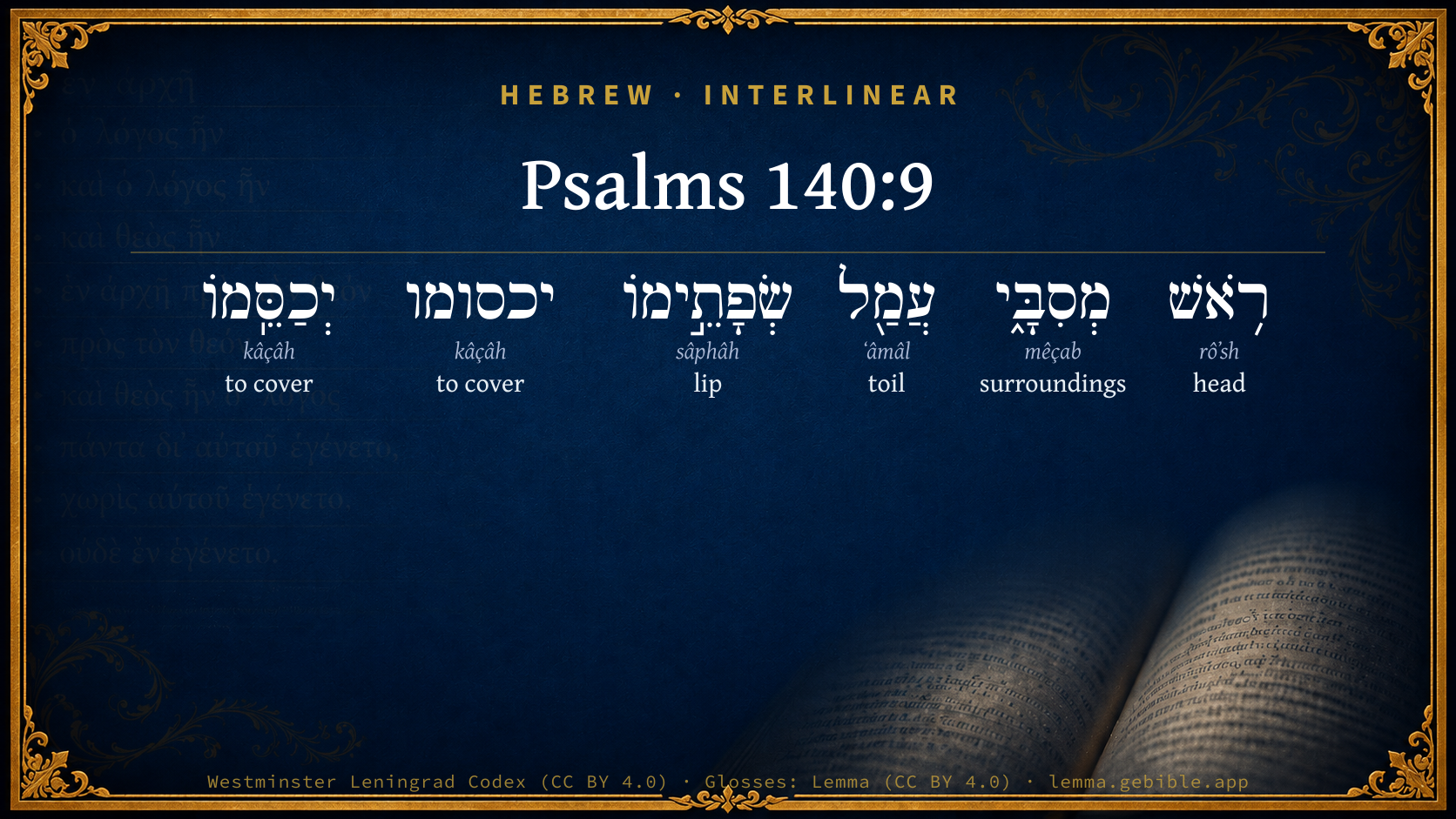
Hebrew (Westminster Leningrad Codex) Psalms 140:9 appears in the Hebrew Old Testament. The text above is from the Westminster Leningrad Codex. Each word links to its Strong’s number, a concise gloss, and parsing drawn from the Open Scriptures Hebrew Bible morphology. Click any word for its full Brown-Driver-Briggs (BDB) entry.
Download image
Cite this verse

Psalms 140:9 (World English Bible). Public Domain. Lemma interlinear Bible study tool, https://lemma.gebible.app/v/psalms/140/9.

Show BibTeX & RIS
BibTeX
RIS
English Translation
As for the head of those who surround me, Let the mischief of their own lips cover them.
World English Bible · Public Domain
Download a study sheet

One document with this verse’s original text, its word-by-word gloss line, the meaning frame, cross-references with their text, attributed commentary, and full source and license credits — printable, and it pastes into notes with its structure intact.

This verse Autodidact and up

Study sheet (.html) Plain text (.txt)

A passage Seminary Student

Up to 50 verses in one chapter. A passage sheet keeps up to 6 commentary sources and 12 cross-references per verse, in the order this page ranks them, and says so on the sheet whenever that leaves anything out. Ask for a single verse and you get the Autodidact verse sheet above.

Everything on this page stays free to read, with no account — the sheet is a download of what is already on screen, not access to it.

Want to remove ads? Support Godless Engineer
Compare translations 3

The same verse in 3 English versions, stacked beneath the original-language interlinear above. Click any original word for its lexicon entry.

Each is an independent rendering of the whole verse — the interlinear is not word-aligned to these translations.

Highlighted words mark where these versions differ — a whole-verse word diff, not a word-by-word alignment.

  • World English Bible Public Domain
    As for the head of those who surround me, Let the mischief of their own lips cover them.
  • King James Version Public Domain
    As for the head of those that compass me about, let the mischief of their own lips cover them.
  • unfoldingWord Literal Text CC BY-SA 4.0
    The head of the ones surrounding me— let the mischief of their lips cover them.

unfoldingWord Literal Text — © unfoldingWord, licensed CC BY-SA 4.0. Word-aligned USFM3 via Door43 (git.door43.org/unfoldingWord/en_ult).

Versions to compare (up to 4)

3 of 4 selected

Show all 18 translations

Every available English version of this verse, each an independent rendering of the whole verse.

  • World English Bible Public Domain
    As for the head of those who surround me, Let the mischief of their own lips cover them.
  • Berean Standard Bible Public Domain
    May the heads of those who surround me be covered in the trouble their lips have caused.
  • Majority Standard Bible Public Domain
    May the heads of those who surround me be covered in the trouble their lips have caused.
  • King James Version Public Domain
    As for the head of those that compass me about, let the mischief of their own lips cover them.
  • American Standard Version (1901) Public Domain
    As for the head of those that compass me about, Let the mischief of their own lips cover them.
  • Revised Version (1885) Public Domain
    As for the head of those that compass me about, let the mischief of their own lips cover them.
  • Geneva Bible (1599) Public Domain
    As for the chiefe of them, that compasse me about, let the mischiefe of their owne lippes come vpon them.
  • Douay-Rheims (1899) Public Domain
    If I take my wings early in the morning, and dwell in the uttermost parts of the sea:
  • Young's Literal Translation Public Domain
    The chief of my surrounders, The perverseness of their lips covereth them.
  • Literal Standard Version CC BY-SA 4.0
    The chief of my surrounders, || The perverseness of their lips covers them.
  • Unlocked Literal Bible CC BY-SA 4.0
    Those who surround me raise their heads; let the mischief of their own lips cover them.
  • unfoldingWord Literal Text CC BY-SA 4.0
    The head of the ones surrounding me— let the mischief of their lips cover them.
  • Darby Bible Public Domain
    [As for] the head of those that encompass me, let the mischief of their own lips cover them.
  • World Messianic Bible Public Domain
    As for the head of those who surround me, let the mischief of their own lips cover them.
  • Webster's Bible Public Domain
    \\140:8\\Grant not, O LORD, the desires of the wicked: further not his wicked device; lest they exalt themselves. Selah.
  • Free Bible Version CC BY-SA 4.0
    May the harm spoken against me by those who surround me fall back on them,
  • Bible in Basic English Public Domain
    As for those who come round me, let their heads be covered by the evil of their lips.
  • JPS Tanakh (1917) Public Domain
    (140-10) As for the head of those that compass me about, let the mischief of their own lips cover them.

Literal Standard Version (2020), Covenant Press — licensed CC BY-SA 4.0. Text via the HelloAO Bible API (eBible.org). Unlocked Literal Bible (unfoldingWord) — licensed CC BY-SA 4.0. Text via the HelloAO Bible API (eBible.org). unfoldingWord Literal Text — © unfoldingWord, licensed CC BY-SA 4.0. Word-aligned USFM3 via Door43 (git.door43.org/unfoldingWord/en_ult). Free Bible Version, Dr. Jonathan Gallagher — licensed CC BY-SA 4.0. Text via the HelloAO Bible API (eBible.org).

Word by word

More ways to search: Search by grammar → Find every occurrence → Compare this word →

Practice this passage: Drill this verse → Learn its vocabulary →

About this verse

These counts appear in no published source. They are computed here, from the morphology-tagged text and Lemma’s own curated glosses. What Lemma adds →

6
words
5
distinct lemmas
Wisdom
section

Notable vocabulary

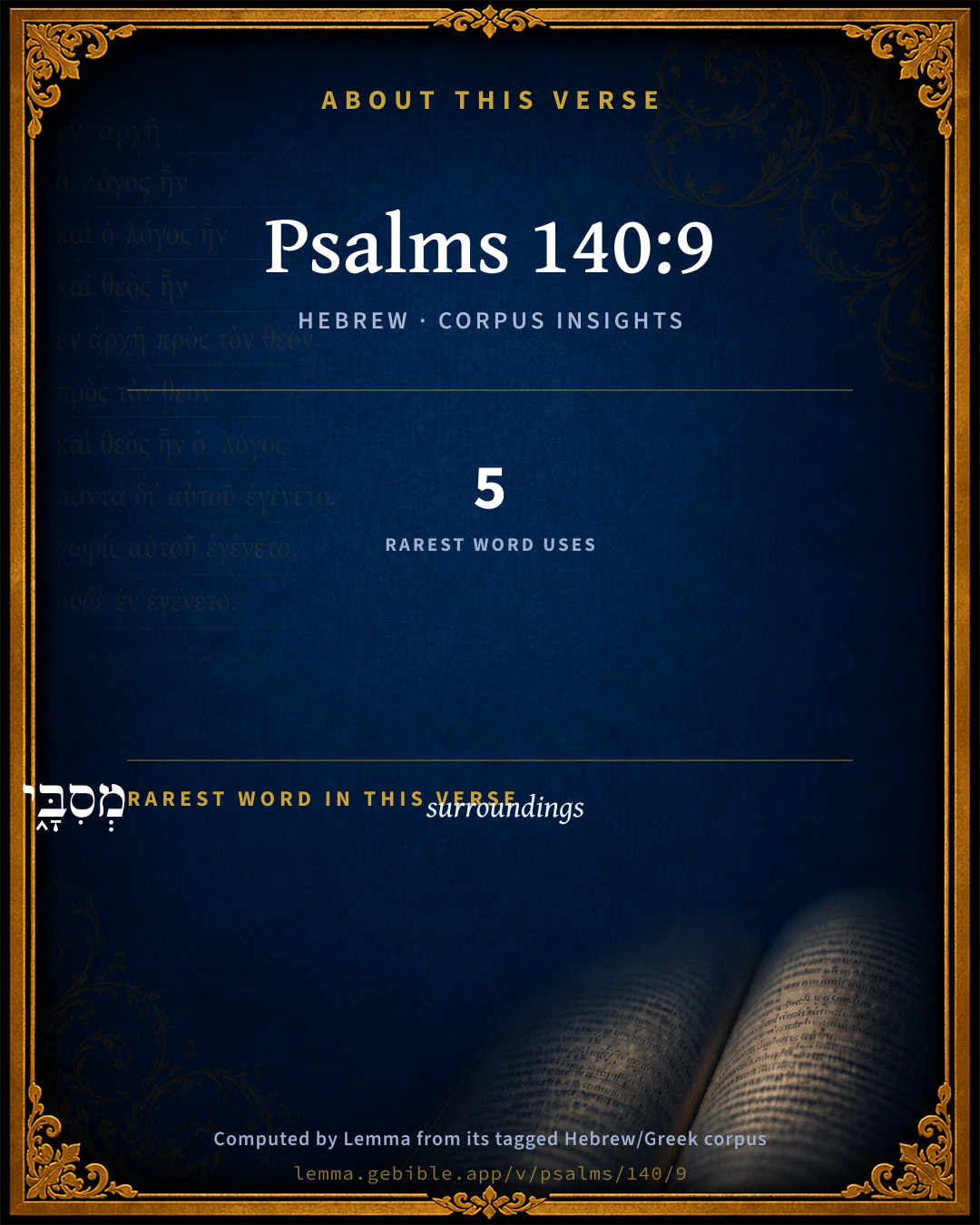
The rarest word here is מְסִבָּ֑י surroundings H4524 — appearing just 5 times in the whole Hebrew Bible.

Shared distinctive vocabulary

מְסִבָּ֑י surroundings H4524 occurs in 5 verses of the Hebrew Bible. Also found in:

Grammatical profile

  • 3 verbs
  • 3 nouns

Verb forms

  • מְסִבָּ֑י Hiphil · Participle Active
  • יכסומו Piel · Jussive
  • יְכַסֵּֽמוֹ Piel · Jussive

Repetition

A word recurs within this verse — often emphatic in Hebrew:

  • יכסומו to cover H3680 ×2

Hebrew & Septuagint length

In English translation the verse runs 18 words from the Hebrew and 17 from the Septuagint (LXX English) — closely comparable.

A rough comparison of the two English renderings, which tokenize alike — not a word-level alignment.

Word counts can differ between the Hebrew and the Greek without any difference in meaning — e.g. the Hebrew direct-object marker אֵת has no separate Greek word, and Greek often adds the article ὁ.

Cross-references

10

Topical passages linked to Psalms 140:9 in the Treasury of Scripture Knowledge — connected by theme and wording, ordered by reader-vote popularity; previews shown in the World English Bible.

  • Psalms 7:16 The trouble he causes shall return to his own head. His violence shall come down on the crown of his own head.
  • Proverbs 18:7 A fool's mouth is his destruction, And his lips are a snare to his soul.
  • Psalms 94:23 He has brought on them their own iniquity, And will cut them off in their own wickedness. Yahweh, our God, will cut them off.
  • Proverbs 12:13 An evil man is trapped by sinfulness of lips, But the righteous shall come out of trouble.
  • Esther 7:10 So they hanged Haman on the gallows that he had prepared for Mordecai. Then was the king's wrath pacified.
  • Psalms 64:8 Their own tongues shall ruin them. All who see them will shake their heads.
  • Proverbs 10:6 Blessings are on the head of the righteous, But violence covers the mouth of the wicked.
  • Proverbs 10:11 The mouth of the righteous is a spring of life, But violence covers the mouth of the wicked.
  • Esther 5:14 Then said Zeresh his wife and all his friends to him, Let a gallows be made fifty cubits high, and in the morning speak you to the king that Mordecai may be hanged thereon: then go you in merrily with the king to the banquet. The thing pleased Haman; and he caused the gallows to be made.
  • Matthew 27:25 All the people answered, "May his blood be on us, and on our children!"

Cross-references courtesy of OpenBible.info (CC BY 4.0).

Hebrew and Greek witnesses Masoretic Hebrew ↔ Greek Septuagint

The same verse in the two great witnesses to the Old Testament, shown verse-for-verse.

You’re reading Greek Psalm 139 (Hebrew Psalm 140). The Septuagint counts the superscription, so verse numbers can differ from the Hebrew — chapter-level alignment, not verse-by-verse. Numbering follows Rahlfs.

These are two independent witnesses, not word-aligned to each other, and the Septuagint is shown in lemma (dictionary) form.

Hebrew Psalms 140:9 Masoretic · Westminster Leningrad Codex

רֹ֥אשׁ מְסִבָּ֑י עֲמַ֖ל שְׂפָתֵ֣ימוֹ יכסומו יְכַסֵּֽמוֹ

As for the head of those who surround me, Let the mischief of their own lips cover them.

World English Bible · Public Domain

Greek LXX Greek Psalm 139:9 Septuagint · lemma form

μή παραδίδωμι ἐγώ κύριος ἀπό ὁ ἐπιθυμία ἐγώ ἁμαρτωλός διαλογίζομαι κατά ἐγώ μή ἐν καταλείπω ἐγώ μήποτε ὑψόω διάψαλμα

As for the head of them that compass me, the mischief of their lips shall cover them.

LXX2012 (modern English Septuagint) · Public Domain

On this verse, Keil & Delitzsch discusses the Septuagint’s reading. Read the note in Commentary ↓

Hebrew: Westminster Leningrad Codex (CC BY 4.0). Greek: Septuagint (public domain); English from LXX2012 (modern English Septuagint) (Public Domain). How the Septuagint differs from the Hebrew →

Commentary

Notes on Psalms 140:9 from classic Christian and Jewish commentators (each source and its license shown beneath its notes). The classic Christian expositions comment on the surrounding passage and are grouped to its opening verse, so a note may address several verses; the Jewish commentaries on the Tanakh (Rashi and others) are per-verse, so they appear only where the commentator wrote on this verse.

Lemma curates 59 commentaries, every one of them public domain or Creative Commons licensed, each selected and text-cleaned for this edition rather than reprinted as found. About our sources →

Trapp's Complete Commentary

John Trapp

Psa 140:9 [As for] the head of those that compass me about, let the mischief of their own lips cover them.

Ver. 9. As for the head] The chieftain, the ringleader, Doeg, or Saul himself. Or thus, let mischief cover the heads of my besiegers, let it fall upon their pates, as Psa 7:16 Similitudo est a sacrificiis, quorum capita execrabantur.

John Trapp, A Commentary or Exposition upon All the Books of the Old and New Testament (1647–1656) — public domain. Text from a community e-Sword module.

Joseph Benson's Commentary

Psa 140:9-11. As for the head of those, &c. — Bishop Hare connects this clause with the preceding, and translates the passage thus; Let not those that beset me lift up the head. Let the mischief of their own lips cover them — Let the evil, which by their calumnies they design to bring upon me fall upon themselves. Let burning coals fall, &c. — Rather, burning coals shall fall, the verb ימישׂו, and the other verbs in this verse being in the future tense: that is, the divine vengeance, often compared to coals of fire, shall fall upon them. The psalmist seems to allude to the destruction of the Sodomites. Let them be cast — They shall be cast, into the fire — Which themselves have kindled, and shall perish in the flames thereof: into deep pits — Into those dangers and mischiefs which, like deep pits, they prepared for my destruction; that they rise not, &c. — Hebrews they shall not rise again. Let not an evil speaker — Such as slander me and other innocent persons; Hebrew אישׁ לשׁון, a man of tongue, which, according to the Hebrew phraseology, signifies a detractor, a sycophant, one who gives his tongue the liberty to vent what mischief he pleases; be established — Hebrew בל יכון, he shall not be established; he shall not prosper, or establish his power or greatness by such base and wicked practices. Evil shall hunt the violent man — Either the evil of punishment, or which comes to the same thing, the evil of sin, shall pursue and overtake him. The wickedness of such persons shall recoil upon themselves to their utter destruction. “The prophet, in these three verses,” says Dr. Horne, “predicts those just judgments which Heaven would inflict on the slanderers and persecutors of the righteous. Their lips, which uttered mischief against others, shall be the means of covering themselves with confusion, when out of their own mouths they shall be judged. Those tongues which have contributed to set the world on fire shall be tormented with the hot burning coals of eternal vengeance; and they who with so much eagerness and diligence have prepared pits for the destruction of their brethren shall be cast into a deep and bottomless pit, out of which they will not rise up again any more for ever. Evil speakers and false accusers shall gain no lasting establishment, but punishment shall hunt sin through all its doubles, and seize it, at last, as its legal prey. Let those great truths be firmly rooted in our hearts, and they will keep us steady in the worst of times.”

Joseph Benson's Commentary on the Old and New Testaments (1811–1818) — public domain. Text from a community e-Sword module.

J. A. Alexander on Psalms

Joseph Addison Alexander

10. (Psa 140:9) The head of those surrounding me—the mischief of their lips shall cover them. The nominative absolute refers back to the covering of the Psalmist's head in Psa 140:7. While my head is covered by the divine protection, the head of those by whom I am beset shall be covered with the consequences or the punishment of the mischief occasioned by their calumnies and insults. Or the trouble, which their lips have caused to others, shall return upon themselves. Compare Psa 7:16. Those surrounding me, or, as a noun, my surroundings, as in 2Ki 23:5. The participle would, according to analogy and usage, mean causing me to turn back or retreat (Jer 21:4), which yields a good sense here. The head of those who once drove me back shall be covered, etc.

Joseph Addison Alexander, The Psalms Translated and Explained (1850) — public domain. Text from a community e-Sword module.

Tyndale Open Study Notes

Tyndale Open Resources

140:9-11 The psalmist prays for God’s judgment on the wicked.

Tyndale Open Study Notes — © Tyndale Open Resources, licensed CC BY-SA 4.0. Text via the HelloAO Bible API.

Geneva Bible (1599)

Geneva Bible translators

It seemeth that he alludeth to Saul.

Geneva Bible (1599) marginal notes — public domain. Text via Bolls.life.

John Calvin's Commentaries

9. As for the head, etc. There may be a doubt whether, under the term head, he refers to the chief of the faction opposed to him; for we call suppose an inversion in the sentence, and a change of the plural to the singular number, bringing out this sense. “Car il pourreit estre que l’ordre des mots seroit renverse, et que le nombre singulier seroit mis pour le pluriel, en ce sens,” etc. — Fr.

“The meaning of the verse may be, that the mischief designed by the wicked against others shall fall on their own head, as Psalm 7:17, ‘his violence shall descend on his own head;’ or it may express the leader of the hostile party, as Saul or Doeg, in the case of David being here the speaker.” — Phillips.

John Calvin's Commentaries (1540-1563) — public domain. Text from the Calvin Translation Society English edition (1840s-50s) via the Christian Classics Ethereal Library (ccel.org). Calvin's coverage is partial (roughly two-thirds of the Bible); uncommented books and verses are honest gaps, never fabricated. The 19th-century editor's footnotes and remarks are omitted so the notes are faithfully Calvin's own voice.

Ellicott's Commentary for English Readers

(9) Head.—Ewald, who keeps to the text, takes rôsh in the sense of poison (see Psa_69:22, Note):—

“The poison of those encircling me,

Let them be covered with the perdition of their lips.

This brings Psa_140:8-9 into harmony with Psa_140:4. But the emendation given above is better.

A Bible Commentary for English Readers, edited by Charles John Ellicott (1878–1897) — public domain. Text from a community e-Sword module.

The Cambridge Bible for Schools and Colleges

gen. ed. J. J. S. Perowne

9. A word seems to be wanting at the beginning of the verse, and if the last word of Psa_140:8, with the change of a single letter (ירימו for ירומו), is prefixed to this verse, it reads, When those that compass me about lift up the head, let the mischief &c. Let the mischief they are trying to do me by slander and calumny recoil upon themselves, and overwhelm them. Cp. Psa_141:10.

9–11. May retribution overtake my enemies!

The Cambridge Bible for Schools and Colleges (gen. ed. J. J. S. Perowne; Cambridge University Press, 1878–1918) — public domain. Text from a community e-Sword module.

John Gill's Exposition

As for the head of those that compass me about, let the,

mischief of their own lips cover them. Meaning either their natural head, put for their whole persons; and the sense is, let the mischief they have contrived for others fall upon themselves; see Eze 9:10, Psa 7:16; or some principal person, the head and leader of them, as the word is sometimes used, Isa 9:14; and designs either Saul, who at the head of three thousand men surrounded the hill where David and his men were; or Doeg the Edomite, who was over the servants of Saul, and accused David to him; so Kimchi: or Ahithophel, who was at the head of the conspirators against him; so the Targum paraphrases it,

"Ahithophel, the head of the sanhedrim of the disciples of wickedness.''

If we understand this clause of Christ, the antitype of David, it may design Judas; who was the guide to them that sought Jesus, and, at the head of a band of men, enclosed and took him: or if of the church and people of God, the man of sin may be intended, the pope of Rome; the head over many countries, the antichristian nations, Psa 110:6. The word is used of the gall and poison of asps, Job 20:14; and if so taken here, as Arama interprets it, it will make the sense agree with Psa 140:3; and may be read in connection with the following clause, thus: "let the poison of those that compass me about, even the mischief of their lips, cover them" (o); or the labour of them (p): let the lies and calumnies they have so industriously spread, and took so much pains to propagate to the hurt of others, like deadly poison, cover them with shame and confusion; and the mischief they have boasted of, and gave out that they would do, let it come upon them on all sides, and utterly ruin and destroy them.

(o) So Junius & Tremellius, Piscator. (p) "labor labiorum eorum", Montanus, Gejerus, Michaelis.

John Gill's Exposition of the Whole Bible (1746–1763) — public domain (CC PDM 1.0). Text via the HelloAO Bible API.

Albert Barnes' Notes on the Bible

As for the head of those that compass me about - Luther renders this, “The calamity which my enemies design against me must fall upon their own heads.” The passage stands in contrast with Psa 140:7 : “Thou hast covered my head,” etc. As for his own head, it had been protected in the day of battle. In reference now to the heads of his enemies - of those that compassed him about - he prays that what they had designed for “his” head might come by a just retribution on their own. The phrase “compass me about” refers to his enemies as being numerous, and as surrounding him on every side. See Psa 40:12; Psa 88:17; Psa 109:3; Psa 118:10-12.

Let the mischief of their own lips cover them - Come upon them. The mischief which they have designed against me; that which they have conspired to bring on me. The reference is to a combination against him, or to some agreement which they had made to destroy him.

Albert Barnes' Notes on the Bible (1834–1885) — public domain. Text from a community e-Sword/MySword module.

Matthew Poole's English Annotations

The head; or, heads; the singular number put for the plural, as is frequent. By which he understands either,

1. Their politic heads, their chiefs or ringleaders, who were most malicious, and by whom all the rest were supported and stirred up: or,

2. Their proper and natural heads, as this word is used Psa 140:7; and this covering of their heads here is opposed to the covering of David’s head there.

Let the mischief of their own lips cover them; let the mischief which by their calumnies they design against me fall upon themselves.

Matthew Poole's English Annotations on the Holy Bible (1683–1685) — public domain. Text from a community e-Sword/MySword module.

The Treasury of David

Charles H. Spurgeon

Ver. 9. As for the head of those that compass me about, let the mischief of their own lips cover them. To the Lord who had covered his head amid the din of arms the Psalmist appeals against his foes, that their heads may be covered in quite another sensecovered with the reward of their own malice. David's foes were so many that they hemmed him in, encircling him as hunters do their prey. It is little wonder that he turns to the Lord in his dire need. The poet represents his adversaries as so united as to have but one head; for there is often a unanimity among evil spirits which makes them the more strong and terrible for their vile purposes. The lex talionis, or law of retaliation, often brings down upon violent men the evil which they planned and spoke of for others: their arrows fall upon themselves. When a man's lips vent curses they will probably, like chickens, come home to roost. A stone hurled upward into the air is apt to fall upon the thrower's head.

David's words may be read in the future as a prophecy; but in this verse, at any rate, there is no need to do so in order to soften their tone. It is so just that the mischief which men plot and the slander which they speak should recoil upon themselves that every righteous man must desire it: he who does not desire it may wish to be considered humane and Christlike, but the chances are that he has a sneaking agreement with the wicked, or is deficient in a manly sense of right and wrong. When evil men fall into pits which they have digged for the innocent we believe that even the angels are glad; certainly the most gentle and tender of philanthropists, however much they pity the sufferers, must also approve the justice which makes them suffer. We suspect that some of our excessively soft spoken critics only need to be put into David's place, and they would become a vast deal more bitter than he ever was.

Ver. 9. As for the head of those that compass me about, etc. God, he saith, had covered his head in the day of battle: now contrariwise ho showeth what should cover the head of his enemies, viz., it should come to them as with their lips they had maliciously spoken against him; for it may be thus rendered"The head of my besieger, let the trouble of his lips cover it": for cursing, "let him be covered with cursing as with a cloak." John Mayer.

Ver. 9. Those that compass me about. For an explanation of this expression we would refer the reader to "The Treasury of David", vol.

1.p. 387, where he will find two very pertinent extracts from J. Stevenson and Dr. Shaw.

Ver. 9. The mischief of their own lips. The pride and hauteur of the Jews in our Lord's day brought the Roman arms upon them, and caused them to fall into irremediable ruin. They invoked their own fate by exposing themselves to an invasion from Rome at all; but they did it still more in that terrific cry"His blood be upon us and on our children." William Hill Tucker, in "The Psalms, with Notes, Shewing their Prophetic and Christian Character", 1840.

Ver. 9-10. Such passages admit of translation in the future, and are rather predictions than imprecations. Ingram Cobbin, 1839.

Ver. 9-11. The prophet, in these three verses, predicted those just judgments which heaven will inflict on the slanderers and persecutors of the righteous. Their lips, which uttered mischief against others, shall be the means of covering themselves with confusion, when out of their own mouths they shall be judged. Those tongues which have contributed to set the world on fire, shall be tormented with the hot burning coals of eternal vengeance: and they, who, with so much eagerness and diligence have prepared pits for the destruction of their brethren, shall be cast into a deep and bottomless pit, out of which they will not rise up again any more for ever. Evil speakers and false accusers shall gain no lasting establishment, but punishment shall hunt sin through all its doubles, and seize it at last as its legal prey. Let these great truths be firmly rooted in our hearts, and they will keep us steady in the worst of times. George Horne.

Ver. 9. How the sin of evil speakers comes home to them. W. B. H.

Psalms 140:10*

Charles H. Spurgeon's The Treasury of David (1869–1885) — public domain. Psalms only. Text from a community e-Sword/MySword module.

Whedon's Commentary on the Bible

Daniel D. Whedon

9. As for the head—Not figuratively the chiefs or leaders, but literally, as Psa_7:16. There seems an antithetic reference to Psa_140:7, thus: Thou hast covered my head in the day of armour… but the head of my besiegers, or those who surround me, mischief shall cover them.”

Daniel D. Whedon (gen. ed.), Commentary on the Old and New Testaments (1874–1909) — public domain. Text from a community e-Sword module.

The Pulpit Commentary

As for the head of those that compass me about. The "head" of David"s enemies is put in contrast with his own "head" (see ver. 7). While God shields and protects his head, theirs has no protection, but the mischief of their own lips which covers them, but with confusion, rather than with defense or safety.

The Pulpit Commentary (1880–1919), ed. H.D.M. Spence-Jones & Joseph S. Exell — public domain. Text from a community e-Sword module.

John Wesley's Explanatory Notes

Mischief - The mischief which they design against me, shall fall upon themselves.

John Wesley, Explanatory Notes Upon the Whole Bible (1754–1765) — public domain. Text via the GEBible commentary corpus.

Keil & Delitzsch

C. F. Keil & F. Delitzsch

The strophic symmetry is now at an end. The longer the poet lingers over the contemplation of the rebels the more lofty and dignified does his language become, the more particular the choice of the expressions, and the more difficult and unmanageable the construction. The Hiph. הסב signifies, causatively, to cause to go round about (Exo 13:18), and to raise round about (Ch2 14:6); here, after Jos 6:11, where with an accusative following it signifies to go round about: to make the circuit of anything, as enemies who surround a city on all sides and seek the most favourable point for assault; מסבּי from the participle מסב. Even when derived from the substantive מסב (Hupfeld), "my surroundings" is equivalent to איבי סביבותי in Psa 27:6. Hitzig, on the other hand, renders it: the head of my slanderers, from סבב, to go round about, Arabic to tell tales of any one, defame; but the Arabic sbb, fut. u, to abuse, the IV form (Hiphil) of which moreover is not used either in the ancient or in the modern language, has nothing to do with the Hebrew סבב, but signifies originally to cut off round about, then to clip (injure) any one's honour and good name.

(Note: The lexicographer Neshwn says, i. 279b: Arab. 'l-sbb 'l - šatm w-qı̂l an aṣl 'l-sbb 'l - qaṭ‛ ṯm ṣâr 'l - štm, "sebb is to abuse; still, the more original signification of cutting off is said to lie at the foundation of this signification." That Arab. qṭ‛ is synonymous with it, e.g., Arab. lı̂štqt‛fı̂nâ, why dost thou cut into us? i.e., why dost thou insult our honour? - Wetzstein.)

The fact that the enemies who surround the psalmist on every side are just such calumniators, is intimated here in the word שׂפתימו. He wishes that the trouble which the enemies' slanderous lips occasion him may fall back upon their own head. ראשׁ is head in the first and literal sense according to Psa 7:17; and יכסּימו (with the Jod of the groundform kcy, as in Deu 32:26; Kg1 20:35; Chethb יכסּוּמו,

(Note: Which is favoured by Exo 15:5, jechasjûmû with mû instead of mô, which is otherwise without example.)

after the attractional schema, Sa2 2:4; Isa 2:11, and frequently; cf. on the masculine form, Pro 5:2; Pro 10:21) refers back to ראשׁ, which is meant of the heads of all persons individually. In Psa 140:11 ימיטוּ (with an indefinite subject of the higher punitive powers, Ges. 137, note), in the signification to cause to descend, has a support in Psa 55:4, whereas the Niph. נמוט, fut. ימּט, which is preferred by the Ker, in the signification to be made to descend, is contrary to the usage of the language. The ἅπ. λεγ. מהמרות has been combined by Parchon and others with the Arabic hmr, which, together with other significations (to strike, stamp, cast down, and the like), also has the signification to flow (whence e.g., in the Koran, mâ' munhamir, flowing water). "Fire" and "water" are emblems of perils that cannot be escaped, Psa 66:12, and the mention of fire is therefore appropriately succeeded by places of flowing water, pits of water. The signification "pits" is attested by the Targum, Symmachus, Jerome, and the quotation in Kimchi: "first of all they buried them in מהמורות; when the flesh was consumed they collected the bones and buried them in coffins." On בּל־יקוּמוּ cf. Isa 26:14. Like Psa 140:10-11, Psa 140:12 is also not to be taken as a general maxim, but as expressing a wish in accordance with the excited tone of this strophe. אישׁ לשׁון is not a great talker, i.e., boaster, but an idle talker, i.e., slanderer (lxx ἀνὴρ γλωσσώδης, cf. Sir. 8:4). According to the accents, אישׁ חמס רע is the parallel; but what would be the object of this designation of violence as worse or more malignant? With Sommer, Olshausen, and others, we take רע as the subject to יצוּדנּוּ: let evil, i.e., the punishment which arises out of evil, hunt him; cf. Pro 13:21, חטּאים תּרדּף רעה, and the opposite in Psa 23:6. It would have to be accented, according to this our construction of the words, אישׁ חמס רע יצודני למדחפת. The ἅπ. λεγ. למדחפת we do not render, with Hengstenberg, Olshausen, and others: push upon push, with repeated pushes, which, to say nothing more, is not suited to the figure of hunting, but, since דּחף always has the signification of precipitate hastening: by hastenings, that is to say, forced marches.

Keil & Delitzsch — Biblical Commentary on the Old Testament (1861–1891) — public domain (CC PDM 1.0). Text via the HelloAO Bible API. (Old Testament only.)

unfoldingWord translationNotes

Door43 World Missions Community

raise their heads

This is a sign of being arrogant. AT: "are arrogant" (See: Symbolic Action)

let the mischief of their own lips cover them

This is a prayer that God would make the evildoers suffer from the trouble that they caused by the things they said.

the mischief of their own lips

The trouble that they themselves caused by what they said. (See: Metaphor)

cover them

That is, stop them from causing any more trouble. (See: Metaphor)

Let burning coals fall on them; throw them into the fire

Images of fire stand for severe punishment for the wicked. (See: Metaphor)

bottomless pits

This is probably a reference to Sheol, the world of the dead.

men of tongues

those who speak evil of others without cause (See: Idiom)

secure on the earth

"safe in this life"

may evil hunt down the violent man

Here evil is spoken of as if it were someone taking revenge on another person. (See: Personification)

translationWords

raise

fire

pit

earth

unfoldingWord translationNotes — © Distant Shores Media and the Door43 World Missions Community, licensed CC BY-SA 4.0. Source: git.door43.org/Door43/en_tn.

Rashi

Rabbi Shlomo Yitzchaki (Rashi)

the desires of the wicked The wicked Esau.

for they are constantly haughty Heb. ירומו סלה, because they are arrogant always. Our Rabbis, however (Gen. Rabbah 75:9) explained זממוֹ as an expression of a bit that muzzles the camel, and it is a mishnaic expression.

do not take out Heb. אל תפק, Do not take it out of his jaws.

Rashi on the Tanakh — English translations: “The Judaica Press complete Tanach with Rashi, translated by A. J. Rosenberg” (CC BY 4.0); “Pentateuch with Rashi's commentary by M. Rosenbaum and A.M. Silbermann, 1929-1934” (public domain); “The Metsudah Tanach series, Lakewood, N.J” (CC BY 4.0); and “The Book of Joshua, Metsudah Publications, 1997” (CC BY 4.0). Text via Sefaria.

Lesson kit

Teaching starters — assembled from the data on this page, not authored interpretation. Every prompt links to the verse data it draws on. Edit before teaching.

Psalms, in the Wisdom, opens this verse with 6 words (5 distinct Hebrew lemmas). Its most distinctive word is mêçab (“surroundings”). A historical commentator’s framing appears above. Read the whole chapter for the surrounding context.

Discussion questions

  1. The word mêçab carries the sense “surroundings.” How does it shape the verse?
  2. 1 Kings 6:29 shares the word «surroundings» with this verse. How do the two illuminate each other?
  3. “to cover” occurs 2× in this one verse. What is the effect of the repetition?
  4. These translations render this verse differently; the difference is in the English rendering, not the original. What questions does that raise?
  5. The verb «מְסִבָּ֑י» is Hiphil Participle Active. How does its form color the action?
  6. Reading how Trapp's Complete Commentary and Joseph Benson's Commentary read this verse, where do the two commentators agree and where do they part?

Things to notice

  • These translations choose different wording for 7 words in this verse.
  • “to cover” occurs 2× in this single verse.
  • 5 distinct Hebrew lemmas span 6 words in this verse.

Reading settings

Reading text

Shown beneath each verse's original-language words.

Old Testament
Old Testament edition

Read the OT as the Masoretic Hebrew (MT) or the Greek Septuagint (LXX).

English shown for the Greek Septuagint (in the Hebrew ↔ Greek comparison).

Comparing translations? Open the Compare panel on any verse page to stack up to four side by side.