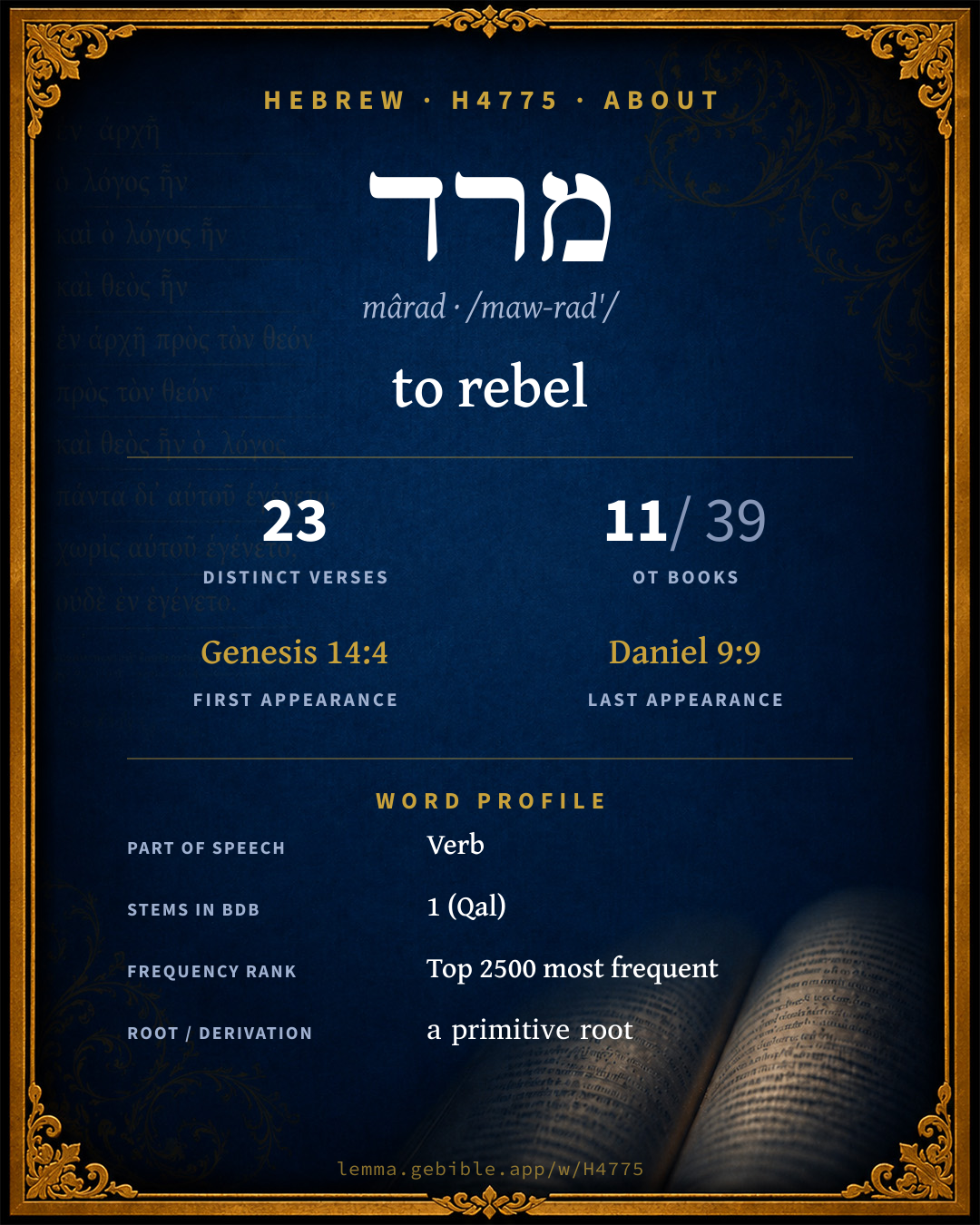
מָרַד
to rebel
also: revolt, be rebellious fuller range ↓
Full lexicon entry — Brown-Driver-Briggs (BDB)
From Brown-Driver-Briggs (BDB)
Where this word appears
Grammar key — what these labels mean
Part of speech
- Verb
- An action or state-of-being word.
Stem
- Qal
- The basic, simple active stem — the plain form of the verb (“he wrote”). Here: ‘against human king’
Form
- Sequential Imperfect
- An imperfect with prefixed waw — the standard past-narrative form (waw-consecutive imperfect).
- Jussive
- A third- or second-person volitional form expressing wish or command (“let him write”).
- Infinitive Construct
- A bound verbal noun, frequently with prepositions (“to write / in writing”).
- Participle Active
- A verbal adjective expressing ongoing or characteristic action (“writing / one who writes”).
- Perfect
- A completed action or state — Hebrew marks aspect (completeness) more than strict tense (“he wrote”).
- Imperfect
- An incomplete, ongoing, or future action (“he will / would write”).
State
- Absolute
- The independent form of a noun, not bound to a following word.
- Construct
- A noun bound to a following noun in a possessive / “of” relationship (the construct chain).
Person
- 3rd Person
- The one spoken about (“he / she / it / they”).
- 2nd Person
- The one addressed (“you”).
- 1st Person
- The speaker (“I / we”).
Gender
- Masculine
- Grammatically masculine.
- Common
- Either gender — not distinguished for this form.
Number
- Singular
- One.
- Plural
- More than one (in Hebrew, generally three or more).
Grammatical forms 11 distinct
- Verb, Qal, Sequential Imperfect, 3rd Person, Masculine, Singular 6 times (24%)
- Verb, Qal, Jussive, 2nd Person, Masculine, Plural 3 times (12%)
- Verb, Qal, Infinitive Construct 3 times (12%)
- Verb, Qal, Participle Active, Masculine, Plural, Absolute 3 times (12%)
- Verb, Qal, Perfect, 2nd Person, Masculine, Singular 2 times (8%)
- Verb, Qal, Perfect, 3rd Person, Common, Plural 2 times (8%)
- Verb, Qal, Perfect, 1st Person, Common, Plural 2 times (8%)
- Verb, Qal, Sequential Imperfect, 3rd Person, Masculine, Plural 1 time (4%)
+3 more forms (3 occurrences)
Parsed forms decoded from the imported morphology (morphhb / Westminster Leningrad Codex — WLC text public domain, morphhb tagging CC BY 4.0), counted across 25 parsed occurrences — not distinct verses.
Every verse where H4775 appears — 23 distinct verses across 11 books. Click any verse to open its interlinear word-by-word view. Verse text shown in the World English Bible for context — . Each verse’s Hebrew form is shown with its reference; the English is not keyword-highlighted, since the data carries no word-level English alignment. Use “Compare translations” on any verse to read it across multiple English versions. This concordance covers the Hebrew Bible; Septuagint (Greek Old Testament) occurrences are not indexed here.
Genesis 1 verse
Numbers 1 verse
Joshua 4 verses
- Joshua 22:16 לִ/מְרָדְ/כֶ֥ם prep + Qal inf.cs + sfx pers 2mp Thus says the whole congregation of Yahweh, What trespass is this that you have committed against the God of Israel, to turn away this day from following Yahweh, in that you have built you an altar, to rebel this day against Yahweh?
- Joshua 22:18 תִּמְרְד֤וּ Qal impf 2mp that you must turn away this day from following Yahweh? and it will be, seeing you rebel today against Yahweh, that tomorrow he will be angry with the whole congregation of Israel.
- Joshua 22:19 תִּמְרֹ֗דוּ תִּמְרֹ֔דוּ Qal juss 2mp Qal juss 2mp However, if the land of your possession be unclean, then pass over to the land of the possession of Yahweh, in which Yahweh's tent dwells, and take possession among us: but don't rebel against Yahweh, nor rebel against us, in building you an altar besides the altar of Yahweh our God.
- Joshua 22:29 לִ/מְרֹ֣ד prep + Qal inf.cs Far be it from us that we should rebel against Yahweh, and turn away this day from following Yahweh, to build an altar for burnt-offering, for meal-offering, or for sacrifice, besides the altar of Yahweh our God that is before his tent.
2 Kings 4 verses
- 2 Kings 18:7 וַ/יִּמְרֹ֥ד conj + Qal wimpf 3ms Yahweh was with him; wherever he went forth he prospered: and he rebelled against the king of Assyria, and didn't serve him.
- 2 Kings 18:20 מָרַ֖דְתָּ Qal pf 2ms You say (but they are but vain words), [There is] counsel and strength for the war. Now on whom do you trust, that you have rebelled against me?
- 2 Kings 24:1 וַ/יִּמְרָד conj + Qal wimpf 3ms In his days Nebuchadnezzar king of Babylon came up, and Jehoiakim became his servant three years: then he turned and rebelled against him.
- 2 Kings 24:20 וַ/יִּמְרֹ֥ד conj + Qal wimpf 3ms For through the anger of Yahweh did it happen in Jerusalem and Judah, until he had cast them out from his presence. Zedekiah rebelled against the king of Babylon.
2 Chronicles 2 verses
- 2 Chronicles 13:6 וַ/יִּמְרֹ֖ד conj + Qal wimpf 3ms Yet Jeroboam the son of Nebat, the servant of Solomon the son of David, rose up, and rebelled against his lord.
- 2 Chronicles 36:13 מָרָ֔ד Qal pf 3ms He also rebelled against king Nebuchadnezzar, who had made him swear by God: but he stiffened his neck, and hardened his heart against turning to Yahweh, the God of Israel.
Nehemiah 3 verses
- Nehemiah 2:19 מֹרְדִֽים Qal ptcp.act mp But when Sanballat the Horonite, and Tobiah the servant, the Ammonite, and Geshem the Arabian, heard it, they ridiculed us, and despised us, and said, What is this thing that you do? will you rebel against the king?
- Nehemiah 6:6 לִ/מְר֔וֹד prep + Qal inf.cs in which was written, It is reported among the nations, and Gashmu says it, that you and the Jews think to rebel; for which cause you are building the wall: and you would be their king, according to these words.
- Nehemiah 9:26 וַֽ/יִּמְרְד֜וּ conj + Qal wimpf 3mp Nevertheless they were disobedient, and rebelled against you, and cast your law behind their back, and killed your prophets that testified against them to turn them again to you, and they committed awful blasphemies.
Job 1 verse
Isaiah 1 verse
Jeremiah 1 verse
Ezekiel 3 verses
- Ezekiel 2:3 הַ/מּוֹרְדִ֖ים מָרְדוּ ptcl def.art + Qal ptcp.act mp Qal pf 3cp He said to me, Son of man, I send you to the children of Israel, to nations that are rebellious, which have rebelled against me: they and their fathers have transgressed against me even to this very day.
- Ezekiel 17:15 וַ/יִּמְרָד conj + Qal wimpf 3ms But he rebelled against him in sending his ambassadors into Egypt, that they might give him horses and much people. Shall he prosper? shall he escape who does such things? shall he break the covenant, and yet escape?
- Ezekiel 20:38 הַ/מֹּרְדִ֤ים ptcl def.art + Qal ptcp.act mp and I will purge out from among you the rebels, and those who disobey against me; I will bring them forth out of the land where they sojourn, but they shall not enter into the land of Israel: and you shall know that I am Yahweh.
Daniel 2 verses
- Daniel 9:5 וּ/מָרָ֑דְנוּ conj + Qal pf 1cp we have sinned, and have dealt perversely, and have done wickedly, and have rebelled, even turning aside from your precepts and from your ordinances;
- Daniel 9:9 מָרַ֖דְנוּ Qal pf 1cp To the Lord our God belong mercies and forgiveness; for we have rebelled against him;
About this entry
At a glance — auto-summarized from this page’s data, not written by a person. Every figure links to its source below. This summary describes the numbers; it doesn’t interpret them.
At its core, מרד (mârad) means “to rebel.” Scripture first uses it in Genesis 14:4. With 23 verses in 11 books, it is an uncommon word in the Hebrew Bible. Beyond its headline sense, its full sense range takes in “revolt” and “be rebellious”. Sharing its root, it stands alongside מרד, מרד and מרדות. Dig into 23-verse concordance and the renderings breakdown below.
Gloss history
Strong's 1890 vs modern scholarship
About this word
Strong's H4775 catalogs a Hebrew word from the Hebrew Old Testament.
These counts are not copied from any lexicon or concordance. They are computed here, from the morphology-tagged Hebrew Old Testament. What Lemma adds →
- 23
- distinct verses
- The word appears in 23 distinct verses.
- 11 / 39
- OT books
- The word appears in 11 of 39 Old Testament books.
- #1,282
- by frequency
- Top 2500 most frequent Hebrew words (rank 1,282 of 8,640 Hebrew words by occurrence).
View all 23 occurrences in the concordance →
By section of the Old Testament
By traditional corpus
Conventional, traditional groupings — biblical authorship is debated, so this is a traditional corpus grouping, not an authorship claim. Each share is this word’s portion of its verses in that division of the Hebrew canon. Each figure is a share of the word’s 23 distinct verses.
- Prophets (Nevi'im) 13 verses · 57%
- Writings (Ketuvim) 8 verses · 35%
- Torah (Pentateuch) 2 verses · 9%
How translations render this word
Counts come from each version’s own published word-to-Strong’s tagging or interlinear alignment — an approximate guide to how each version renders this word, not a word-level alignment the data otherwise carries. Because each total is that version’s own tagged count, the per-version totals vary from one another and need not match the appearance or distinct-verse counts above. These counts may also differ from a printed concordance because Lemma counts each distinctly tagged rendering and does not collapse phrase taggings into a single head-word total. This is a fixed set of word-tagged versions (KJV, ASV, BSB, ULT) and does not change with the reading translation you choose elsewhere. Each version’s license is shown beside its name below (and on Sources).
- King James Version: Rebelled 4×, Rebel 3×, Hath rebelled 2×
- American Standard Version: Rebelled 4×, Rebel 3×, Have rebelled 2×
- Berean Standard Bible: Rebelled 8×, Rebel 6×, You have rebelled 2×
- unfoldingWord Literal Text: Rebel 6×, Rebelled 5×, He rebelled 3×
King James Version Public Domain
Renders H4775 across 25 tagged occurrences — most commonly:
Plus 12 renderings that appear only once — usually multi-word phrases or single function words the recovered tagging swept in, not distinct renderings.
American Standard Version Public Domain
Renders H4775 across 25 tagged occurrences — most commonly:
Plus 12 renderings that appear only once — usually multi-word phrases or single function words the recovered tagging swept in, not distinct renderings.
Berean Standard Bible Public Domain
Renders H4775 across 24 tagged occurrences — most commonly:
Plus 8 renderings that appear only once — usually multi-word phrases or single function words the recovered tagging swept in, not distinct renderings. Not rendered by a distinct English word in 1 further occurrence.
unfoldingWord Literal Text CC BY-SA 4.0
Renders H4775 across 28 tagged occurrences — most commonly:
Plus 8 renderings that appear only once — usually multi-word phrases or single function words the recovered tagging swept in, not distinct renderings.
Senses in the full BDB
What do BDB’s symbols mean?
BDB uses these scholarly abbreviations:
| Symbol | Meaning |
|---|---|
| 𝔊 | the Septuagint (the ancient Greek translation, LXX) |
| 𝔙 | the Vulgate (the Latin translation) |
| 𝔖 | the Syriac version (the Peshitta) |
| 𝔗 | the Targum (the Aramaic translation) |
| ψ | the Psalms |
| √ | root (the underlying root or stem) |
| ‖ | parallel passage (a synonymous or contrasted parallel) |
| † | the dagger: every passage where the word occurs is cited |
The 4 senses and sub-senses the full Brown-Driver-Briggs lexicon distinguishes for this word, in lexicon order (not ranked by frequency), with BDB’s own verbatim wording and sub-sense lettering. Shown in Hebrew script with BDB’s own scholarly abbreviations. The condensed entry is in the Lexicon Entry tab. See also the Forms in the corpus table below.
Qal
- Pf. 3 ms. מָרָ֑ד 2 Ch 36:13, 2 ms. מָרַדְתָּ 2 K 18:20=Is 36:5, etc.; Impf. וַיִּמְרֹד 2 K 18:7 + 3 times, וַיִּמְרָד־ 2 K 24:1 Ez 17:15, etc.; Inf. cstr. לִמְרֹד Jos 22:29, לִמְרוֹד Ne 6:6; Pt. pl. מֹרְדִים Ne 2:19 Ez 20:38, מוֹ׳ Ez 2:3; cstr. מֹרְדֵי Jb 24:13;—rebel, revolt: e.g. 2 Chronicles 36:13
- 1. against human king, c. בְּ pers. 2 K 18:7, 20=Is 36:5, 2 K 24:1, 20=Je 52:3, cf. Ez 17:15 2 Ch 36:13, Ne 9:26; less often (late) c. עַל pers. 2 Ch 13:6 Ne 2:19; abs. Gn 14:4 Ne 6:6. e.g. 2 Kings 18:7
- 2. against God, c. בְּ Nu 14:9 (JE), Jos 22:16, 18, 29 (all P), Ez 2:3 (Co מָרוּ), Dn 9:9; abs. Ez 2:3 (pt., Co מורים), 20:38 Dn 9:5, c. את Jos 22:19. e.g. Numbers 14:9
- 3. poet., against light, only מֹרְדֵי אוֹר Jb 24:13. e.g. Job 24:13
Senses from the full Brown-Driver-Briggs lexicon (Brown, Driver, Briggs; Oxford 1906 — public domain), digitized via Sefaria, supplemented by the OpenScriptures HebrewLexicon (CC BY 4.0). Full attribution on Sources.
Word origin
vb. rebel (NH id.; Arabic مَرَدَ be bold and audacious in acts of rebellion or disobedience; Ethiopic መረደ run strenuously, attack; መራድ rebellion, PräBeiträge iii. 44; Sab. מרד rebellion Hal 535, 16 Sab.Denkm.38 HomChrestom. 127; Aramaic ܡܪܰܕ, מְרַד; rebel);—
— Brown-Driver-Briggs (Oxford 1906, public domain), digitized via Sefaria, supplemented by the OpenScriptures HebrewLexicon (CC BY 4.0). See Sources.
Origin: a primitive root
Jastrow Dictionary
A second Hebrew/Aramaic lexicon for comparison, covering Aramaic and post-biblical (Talmudic, Targumic, Midrashic) usage that the biblical-Hebrew BDB does not. Matched by lemma rather than by Strong’s number, so a lemma may carry more than one Jastrow headword (shown separately below), and the entries cover usage well beyond the Bible.
מָרַד I
- 1. to rebel, refuse obedience; to protest. Keth. V, 7 המוֹרֶדֶת על בעלה she who rebels against her husband (refusing marital duties; oth. opin. refusing to work). Ib. המוֹרֵד על אשתו a husband refusing marital duties (oth. opin. refusing to give her work and support); ib. 63ᵇ. Snh. 49ᵃ, a. fr. מורד במלכות rebel.—Meg. 13ᵃ מ׳ בעצת מרגלים he (Caleb) protested against the counsel of the spies. Ib. מרדה בגילולי וכ׳ she refused homage to the idols of her father’s house; a. fr.—[Y. Maas. Sh. I, 52ᵈ top מטבע שמרד, read: של מֶרֶד or מָרוֹד, q. v.]
- 2. to incite to rebellion. Gen. R. s. 23, v. infra.
- to make rebellious, to incite. Y. Keth. V, 30ᵇ bot. התורה הִמְרַדְתָּהּ עליו the Law requires her to be rebellious against him (to refuse sexual connection). Gen. R. s. 26 זה הִמְרִידָן עלי this man (Nimrod) made them rebel against me; ib. s. 23 זה המוֹרְדָן עלי (‘Rashi’: המרידן).
מָרַד II
- (v. preced., cmp. יָרד) to run, discharge matter; to be sore, inflamed. Ab. Zar. 28ᵇ; Y. ib. II, 40ᵈ top עין שמָרְדָה an inflamed eye (comment.: ‘which rebels’, i.e. threatens to burst out of its socket).—Sifra Thazr., Neg., Par. 3, ch. IV שחין המוֹרֵד ומכוה המוֹרֶדֶת a running (open) wound from contusion or from a burn; Neg. VI, 8; VIII, 5 השחין המכוה והקדח המוֹרְדִין (not והמורדין) running wounds from contusion, burn or inflammation; Tosef. ib. III, 10 השחין והמכוה והקרח והמירין ed. Zuck. (Var. והמידק, corr. acc.; v. R. S. to Neg. l. c.; R. S. to Neg. VI, 8 quotes a Var. מורר׳, v. R. S. to Par. IX, 2; v. מוֹרִיר). Sifra l. c., Par. 4, ch. VII מורדת; Y. Pes. VII, 34ᵃ bot. מגרדת (corr. acc.); a. fr.
מְרַד
- 1. = h. מָרַד I, to rebel, run away. Targ. I Kings XV, 27 (h. text קשר). Targ. II Kings IX, 14 (ed. Wil. מריד; h. text קשר Hithpa.). Targ. Jer. VIII, 5 למִמְרַד מן ed. Lag. (ed. למרד) to run away from (desert); a. fr.—Ber. 44ᵃ עד דמריד until he ran away (bewildered).
- 2. cmp. מֶרֶד II a. רָדָה) to rule. Targ. Lam. I, 7.
- to become rebellious, run away. Keth. 63ᵇ אִימְּרִידָא Rashi (ed. אִימְרְדָה, Alf. אִימְרְדָא) ran away (from her husband). B. Mets. 84ᵇ אימרדה אזלה וכ׳ (Ms. M. אימרי׳, v. מְרִי) she ran away and went to her paternal home.
מֶרֶד I
- [running away, running against, cmp. מַעַל,] desertion, rebellion. Pes. 55ᵇ אחר שלשה למִרְדָהּ after three days since her (the bird’s) deserting the eggs; ib. למוֹרְדָהּ. Midr. Till. to Ps. XC בשביל המ׳ שמרדתי אני וכ׳ I beg for amnesty for the rebellion which I made. Gen. R. s. 23; s. 26 (ref. to הוחל, החל, Gen. IV, 26; VI, 1; X, 8) לשון מ׳ it means desertion from the Lord (cmp. חָלַל, חוּלִּין); a. fr.—איגרת מ׳ a document stating a wife’s, or a husband’s, refusal of duties, v. מָרַד I. Keth. 64ᵃ; Y. ib. V, 30ᵇ bot.; Y. Kidd. I, 59ᵃ bot.; a. fr.—Pl. מְרָדִים rebellious acts, contrad. to sins of passion (זדונות). Tosef. Yoma II, 1; Yoma 36ᵇ; Y. ib. III, 40ᵈ bot., v. פֶּשַׁע. e.g. Genesis 4:26
מֶרֶד II
- (v. preced.; cmp. מרְדּוּת I a. רָדָה) [bringingdown,] subjugation. Gen. R. s. 42 (ref. to Gen. XIV, 4, sq.) בארבע עשר למִרְדָּן in the fourteenth year counting from their subjugation; Yalk. ib. 72. e.g. Genesis 14:4
מֵרַד
- (Bibl. chald. מְרַד) ch. = h.. Targ. Josh. XXII, 22 מירד ed. Lag. (ed. מרדא). Targ. II Sam. XV, 12 (h. text קשר); a. e.—Pl. מֵרְדִין, מֵי׳. Targ. Job VIII, 4. Ib. XXXV, 6 מְרָדָיִיךְ Ms. (ed. מָרוֹדָךְ, v. מָרוֹדָא).
A Dictionary of the Targumim, the Talmud Babli and Yerushalmi, and the Midrashic Literature (Marcus Jastrow; London, Luzac, 1903) — Public Domain. Digitized via Sefaria. Digitized via Sefaria. Full attribution on Sources.
Forms in the corpus
The 21 distinct written forms H4775 takes in the Hebrew Bible, most frequent first — each parse links to that stem’s occurrences in the concordance. Hebrew forms include their vowel points and cantillation, so a single lemma takes many written forms.
| Form | Parsing | Example | Uses |
|---|---|---|---|
| וַ/יִּמְרֹ֥ד | Verb, Qal, Sequential Imperfect, 3rd Person, Masculine, Singular | 2 Kings 18:7 | 3 |
| וַ/יִּמְרָד | Verb, Qal, Sequential Imperfect, 3rd Person, Masculine, Singular | Ezekiel 17:15 | 2 |
| מָרַ֖דְתָּ | Verb, Qal, Perfect, 2nd Person, Masculine, Singular | 2 Kings 18:20 | 2 |
| בְּֽ/מֹרְדֵ֫י | Verb, Qal, Participle Active, Masculine, Plural, Construct | Job 24:13 | 1 |
| הַ/מֹּרְדִ֤ים | Verb, Qal, Participle Active, Masculine, Plural, Absolute | Ezekiel 20:38 | 1 |
| הַ/מּוֹרְדִ֖ים | Verb, Qal, Participle Active, Masculine, Plural, Absolute | Ezekiel 2:3 | 1 |
| וַ/יִּמְרֹ֖ד | Verb, Qal, Sequential Imperfect, 3rd Person, Masculine, Singular | 2 Chronicles 13:6 | 1 |
| וַֽ/יִּמְרְד֜וּ | Verb, Qal, Sequential Imperfect, 3rd Person, Masculine, Plural | Nehemiah 9:26 | 1 |
| וּ/מָרָ֑דְנוּ | Verb, Qal, Perfect, 1st Person, Common, Plural | Daniel 9:5 | 1 |
| לִ/מְר֔וֹד | Verb, Qal, Infinitive Construct | Nehemiah 6:6 | 1 |
| לִ/מְרָדְ/כֶ֥ם | Verb, Qal, Infinitive Construct | Joshua 22:16 | 1 |
| לִ/מְרֹ֣ד | Verb, Qal, Infinitive Construct | Joshua 22:29 | 1 |
| מָרְדוּ | Verb, Qal, Perfect, 3rd Person, Common, Plural | Ezekiel 2:3 | 1 |
| מָרַ֖דְנוּ | Verb, Qal, Perfect, 1st Person, Common, Plural | Daniel 9:9 | 1 |
| מָרָ֔ד | Verb, Qal, Perfect, 3rd Person, Masculine, Singular | 2 Chronicles 36:13 | 1 |
| מָרָֽדוּ | Verb, Qal, Perfect, 3rd Person, Common, Plural | Genesis 14:4 | 1 |
| מֹרְדִֽים | Verb, Qal, Participle Active, Masculine, Plural, Absolute | Nehemiah 2:19 | 1 |
| תִּמְרְד֤וּ | Verb, Qal, Imperfect, 2nd Person, Masculine, Plural | Joshua 22:18 | 1 |
| תִּמְרֹ֔דוּ | Verb, Qal, Jussive, 2nd Person, Masculine, Plural | Joshua 22:19 | 1 |
| תִּמְרֹ֗דוּ | Verb, Qal, Jussive, 2nd Person, Masculine, Plural | Joshua 22:19 | 1 |
| תִּמְרֹדוּ֒ | Verb, Qal, Jussive, 2nd Person, Masculine, Plural | Numbers 14:9 | 1 |
Same root — word family
Other BDB entries built from the same root as H4775, grouped by Strong’s listed origin. These share a root / origin per the lexicon — not necessarily a shared meaning. Each links to that word’s own entry.
Derived from this word
Compare all same-root words → They share a root, not necessarily a meaning.
Septuagint verse parallels
This word appears in 19 verses that also exist in the Greek Old Testament (Septuagint), out of the 23 Hebrew verses it occurs in. You can read those verses in Greek by switching the Old Testament edition to the Septuagint.
Read these verses in the Septuagint
- Genesis 14:4
- Numbers 14:9
- Joshua 22:16
- 2 Kings 18:7
- 2 Chronicles 13:6
- Job 24:13
- Isaiah 36:5
- Ezekiel 2:3
- Daniel 9:5
This is a verse-level parallel only — the same verses exist in both the Hebrew and Greek Old Testaments. No word-level Hebrew↔Greek correspondence is claimed: the data carries no such alignment, so no Greek word is shown as this Hebrew word’s translation. Coverage is not total — the Septuagint omits the deuterocanon and renumbers the Psalms, so some Hebrew verses have no direct Greek parallel.