
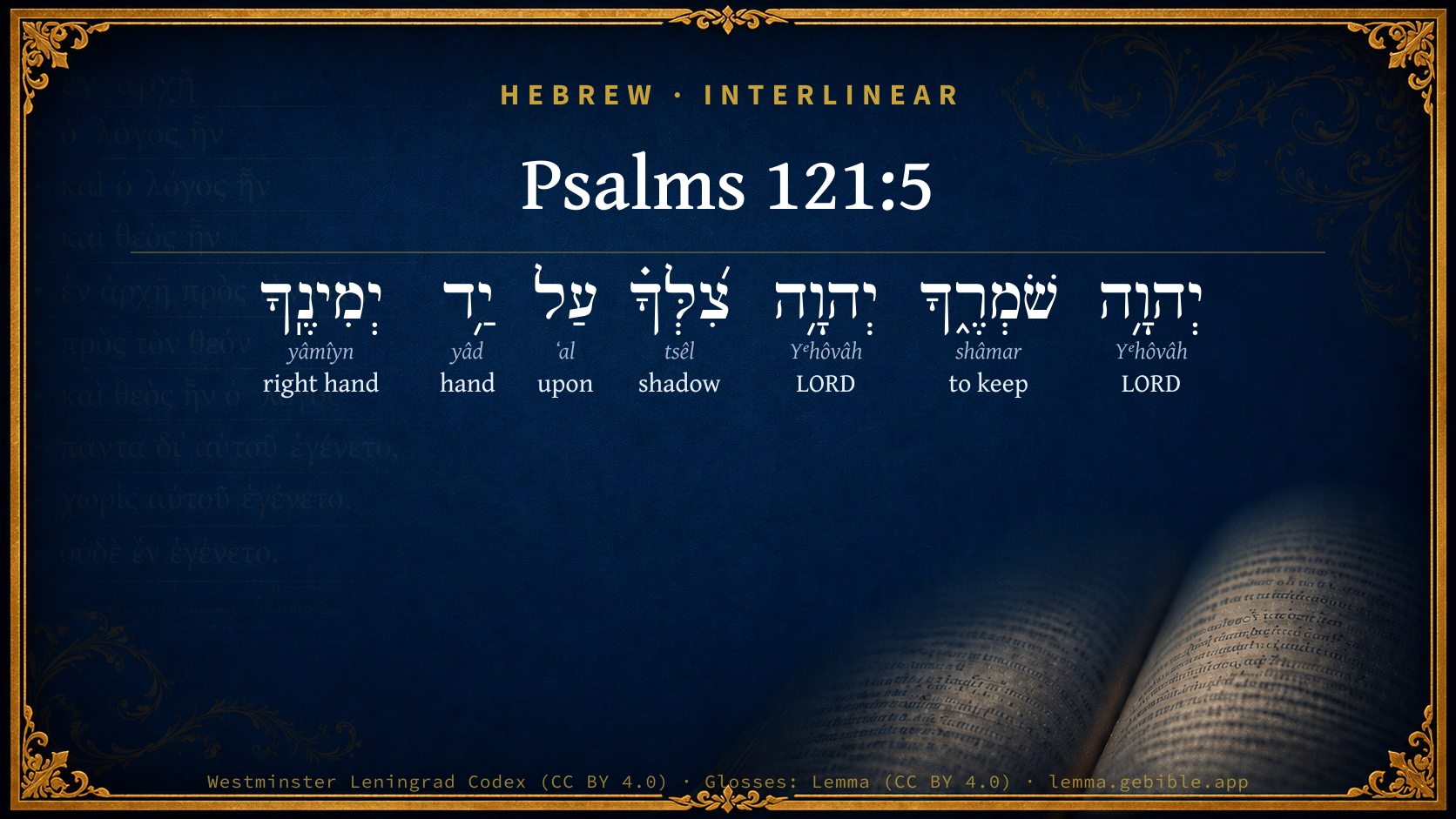
Psalms 121:5

Hebrew (Westminster Leningrad Codex) Psalms 121:5 appears in the Hebrew Old Testament. The text above is from the Westminster Leningrad Codex. Each word links to its Strong’s number, a concise gloss, and parsing drawn from the Open Scriptures Hebrew Bible morphology. Click any word for its full Brown-Driver-Briggs (BDB) entry.
Download image
Cite this verse

Psalms 121:5 (World English Bible). Public Domain. Lemma interlinear Bible study tool, https://lemma.gebible.app/v/psalms/121/5.

Show BibTeX & RIS
BibTeX
RIS
English Translation
Yahweh is your keeper. Yahweh is your shade on your right hand.
World English Bible · Public Domain
Download a study sheet

One document with this verse’s original text, its word-by-word gloss line, the meaning frame, cross-references with their text, attributed commentary, and full source and license credits — printable, and it pastes into notes with its structure intact.

This verse Autodidact and up

Study sheet (.html) Plain text (.txt)

A passage Seminary Student

Up to 50 verses in one chapter. A passage sheet keeps up to 6 commentary sources and 12 cross-references per verse, in the order this page ranks them, and says so on the sheet whenever that leaves anything out. Ask for a single verse and you get the Autodidact verse sheet above.

Everything on this page stays free to read, with no account — the sheet is a download of what is already on screen, not access to it.

Want to remove ads? Support Godless Engineer
Compare translations 3

The same verse in 3 English versions, stacked beneath the original-language interlinear above. Click any original word for its lexicon entry.

Each is an independent rendering of the whole verse — the interlinear is not word-aligned to these translations.

Highlighted words mark where these versions differ — a whole-verse word diff, not a word-by-word alignment.

  • World English Bible Public Domain
    Yahweh is your keeper. Yahweh is your shade on your right hand.
  • King James Version Public Domain
    The LORD is thy keeper: the LORD is thy shade upon thy right hand.
  • unfoldingWord Literal Text CC BY-SA 4.0
    Yahweh your keeper; Yahweh your shade upon your right hand.

unfoldingWord Literal Text — © unfoldingWord, licensed CC BY-SA 4.0. Word-aligned USFM3 via Door43 (git.door43.org/unfoldingWord/en_ult).

Versions to compare (up to 4)

3 of 4 selected

Show all 18 translations

Every available English version of this verse, each an independent rendering of the whole verse.

  • World English Bible Public Domain
    Yahweh is your keeper. Yahweh is your shade on your right hand.
  • Berean Standard Bible Public Domain
    The LORD is your keeper; the LORD is the shade on your right hand.
  • Majority Standard Bible Public Domain
    The LORD is your keeper; the LORD is the shade on your right hand.
  • King James Version Public Domain
    The LORD is thy keeper: the LORD is thy shade upon thy right hand.
  • American Standard Version (1901) Public Domain
    Jehovah is thy keeper: Jehovah is thy shade upon thy right hand.
  • Revised Version (1885) Public Domain
    The LORD is thy keeper: the LORD is thy shade upon thy right hand.
  • Geneva Bible (1599) Public Domain
    The Lord is thy keeper: the Lord is thy shadow at thy right hand.
  • Douay-Rheims (1899) Public Domain
    Woe is me, that my sojourning is prolonged! I have dwelt with the inhabitants of cedar:
  • Young's Literal Translation Public Domain
    Jehovah `is' thy preserver, Jehovah `is' thy shade on thy right hand,
  • Literal Standard Version CC BY-SA 4.0
    YHWH [is] He who is preserving you, || YHWH [is] your shade on your right hand,
  • Unlocked Literal Bible CC BY-SA 4.0
    Yahweh is your guardian; Yahweh is the shade at your right hand.
  • unfoldingWord Literal Text CC BY-SA 4.0
    Yahweh your keeper; Yahweh your shade upon your right hand.
  • Darby Bible Public Domain
    Jehovah is thy keeper, Jehovah is thy shade upon thy right hand;
  • World Messianic Bible Public Domain
    The LORD is your keeper. The LORD is your shade on your right hand.
  • Webster's Bible Public Domain
    The LORD is thy keeper: the LORD is thy shade upon thy right hand.
  • Free Bible Version CC BY-SA 4.0
    The Lord keeps watch over you; the Lord protects you; he stands right beside you.
  • Bible in Basic English Public Domain
    The Lord is your keeper; the Lord is your shade on your right hand.
  • JPS Tanakh (1917) Public Domain
    The LORD is thy keeper; the LORD is thy shade upon thy right hand.

Literal Standard Version (2020), Covenant Press — licensed CC BY-SA 4.0. Text via the HelloAO Bible API (eBible.org). Unlocked Literal Bible (unfoldingWord) — licensed CC BY-SA 4.0. Text via the HelloAO Bible API (eBible.org). unfoldingWord Literal Text — © unfoldingWord, licensed CC BY-SA 4.0. Word-aligned USFM3 via Door43 (git.door43.org/unfoldingWord/en_ult). Free Bible Version, Dr. Jonathan Gallagher — licensed CC BY-SA 4.0. Text via the HelloAO Bible API (eBible.org).

Word by word

More ways to search: Search by grammar → Find every occurrence → Compare this word →

Practice this passage: Drill this verse → Learn its vocabulary →

About this verse

These counts appear in no published source. They are computed here, from the morphology-tagged text and Lemma’s own curated glosses. What Lemma adds →

7
words
6
distinct lemmas
Wisdom
section

Shared distinctive vocabulary

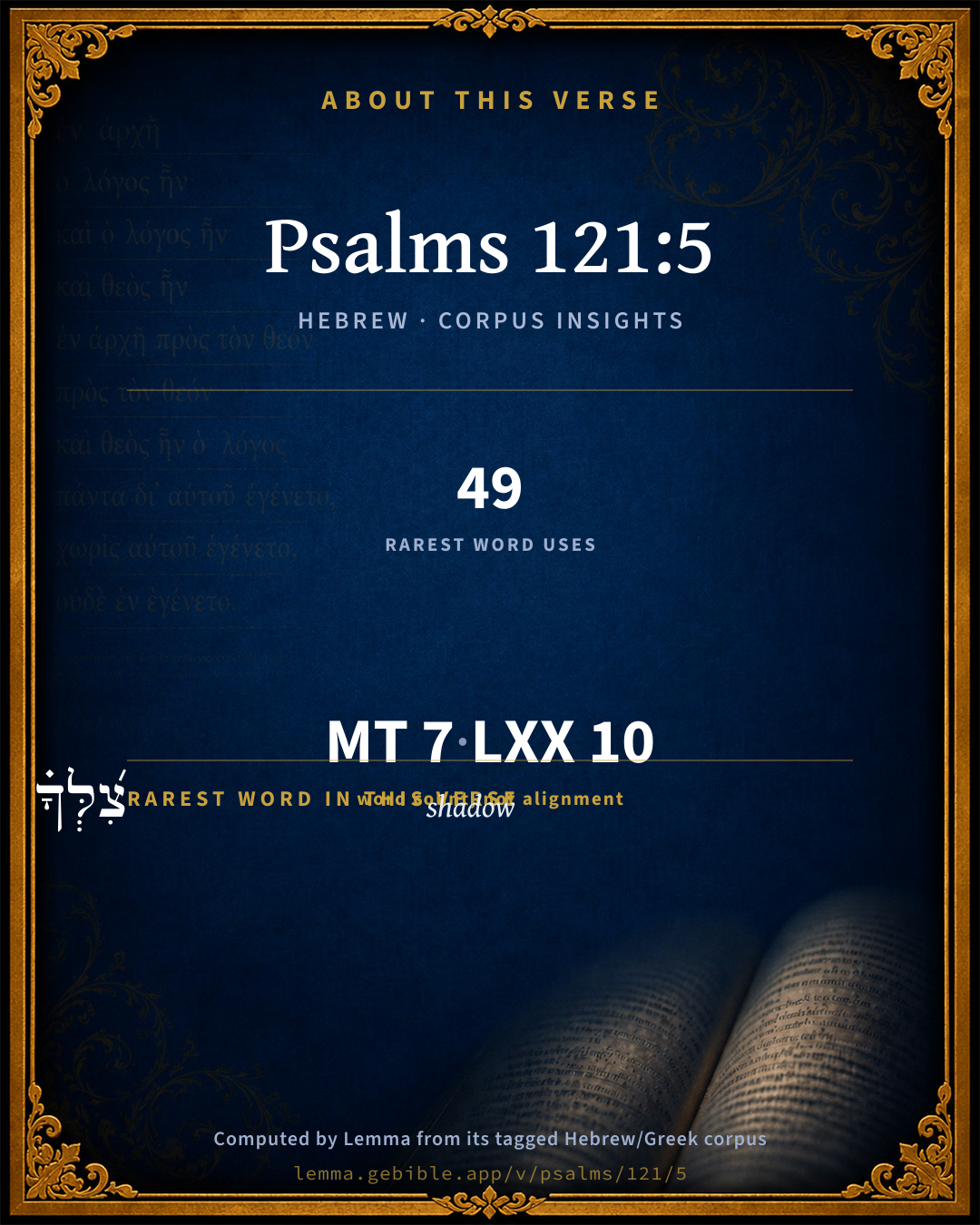
צִ֝לְּךָ֗ shadow H6738 occurs in 47 verses of the Hebrew Bible. Also found in:

Grammatical profile

  • 1 verb
  • 5 nouns
  • 1 preposition

Verb forms

  • שֹׁמְרֶ֑ךָ Qal · Participle Active

Repetition

A word recurs within this verse — often emphatic in Hebrew:

  • יְהוָ֥ה LORD H3068 ×2

Hebrew & Septuagint length

In English translation the verse runs 12 words from the Hebrew and 14 from the Septuagint (LXX English) — closely comparable.

A rough comparison of the two English renderings, which tokenize alike — not a word-level alignment.

Word counts can differ between the Hebrew and the Greek without any difference in meaning — e.g. the Hebrew direct-object marker אֵת has no separate Greek word, and Greek often adds the article ὁ.

In the original languages it is 7 Hebrew tokens and 10 Greek tokens — but the two are counted differently (Hebrew bundles its prefixes and suffixes into one token; the Greek is in lemma form), so that isn’t a like-for-like length.

Cross-references

8

Topical passages linked to Psalms 121:5 in the Treasury of Scripture Knowledge — connected by theme and wording, ordered by reader-vote popularity; previews shown in the World English Bible.

  • Isaiah 25:4 For you have been a stronghold to the poor, a stronghold to the needy in his distress, a refuge from the storm, a shade from the heat, when the blast of the awesome ones is as a storm against the wall.
  • Psalms 91:1 He who dwells in the secret place of the Most High Will rest in the shadow of the Almighty.
  • Exodus 13:21 Yahweh went before them by day in a pillar of cloud, to lead them on their way, and by night in a pillar of fire, to give them light, that they might go by day and by night:
  • Psalms 16:8 I have set Yahweh always before me. Because he is at my right hand, I shall not be moved.
  • Isaiah 4:5–6 Yahweh will create over the whole habitation of Mount Zion, and over her assemblies, a cloud and smoke by day, and the shining of a flaming fire by night; for over all the glory will be a canopy.
  • Psalms 109:31 For he will stand at the right hand of the needy, To save him from those who judge his soul.
  • Isaiah 32:2 A man shall be as a hiding-place from the wind, and a covert from the tempest, as streams of water in a dry place, as the shade of a great rock in a weary land.
  • Matthew 23:37 "Jerusalem, Jerusalem, who kills the prophets, and stones those who are sent to her! How often would I have gathered your children together, even as a hen gathers her chickens under her wings, and you would not!

Cross-references courtesy of OpenBible.info (CC BY 4.0).

Hebrew and Greek witnesses Masoretic Hebrew ↔ Greek Septuagint

The same verse in the two great witnesses to the Old Testament, shown verse-for-verse.

You’re reading Greek Psalm 120 (Hebrew Psalm 121). The Septuagint counts the superscription, so verse numbers can differ from the Hebrew — chapter-level alignment, not verse-by-verse. Numbering follows Rahlfs.

These are two independent witnesses, not word-aligned to each other, and the Septuagint is shown in lemma (dictionary) form.

Hebrew Psalms 121:5 Masoretic · Westminster Leningrad Codex

יְהוָ֥ה שֹׁמְרֶ֑ךָ יְהוָ֥ה צִ֝לְּךָ֗ עַל יַ֥ד יְמִינֶֽךָ

Yahweh is your keeper. Yahweh is your shade on your right hand.

World English Bible · Public Domain

Greek LXX Greek Psalm 120:5 Septuagint · lemma form

κύριος φυλάσσω σύ κύριος σκέπης σύ ἐπί χείρ δεξιός σύ

The Lord shall keep you: the Lord is your shelter upon your right hand.

LXX2012 (modern English Septuagint) · Public Domain

On this verse, John Gill's Exposition discusses the Septuagint’s reading. Read the note in Commentary ↓

Hebrew: Westminster Leningrad Codex (CC BY 4.0). Greek: Septuagint (public domain); English from LXX2012 (modern English Septuagint) (Public Domain). How the Septuagint differs from the Hebrew →

Commentary

Notes on Psalms 121:5 from classic Christian and Jewish commentators (each source and its license shown beneath its notes). The classic Christian expositions comment on the surrounding passage and are grouped to its opening verse, so a note may address several verses; the Jewish commentaries on the Tanakh (Rashi and others) are per-verse, so they appear only where the commentator wrote on this verse.

Lemma curates 59 commentaries, every one of them public domain or Creative Commons licensed, each selected and text-cleaned for this edition rather than reprinted as found. About our sources →

The Cambridge Bible for Schools and Colleges

gen. ed. J. J. S. Perowne

5. thy shade upon thy right hand] ‘Shade’ seems simply to denote ‘protection’ generally, the idea of the metaphor being lost (Psa_91:1; Num_14:9); hence it can be joined with “upon thy right hand,” that being the usual position of the champion or protector (Psa_16:8; Psa_109:31). The phrase may however be a poetical abbreviation for Jehovah is thy shade, (he is) on thy right hand.

5–8. The comforting thought that Jehovah is the guardian of Israel is developed and appropriated to each individual Israelite. Psa_121:5; Psa_121:7 may have been sung by one singer or group of singers, and Psa_121:6; Psa_121:8 as a response by another singer or group of singers: or perhaps Psa_121:5-6 by one, and Psa_121:7-8 by another.

The Cambridge Bible for Schools and Colleges (gen. ed. J. J. S. Perowne; Cambridge University Press, 1878–1918) — public domain. Text from a community e-Sword module.

Trapp's Complete Commentary

John Trapp

Psa 121:5 The LORD [is] thy keeper: the LORD [is] thy shade upon thy right hand.

Ver. 5. The Lord is thy keeper] His peace within thee and his power without thee shall safeguard thee to his heavenly kingdom, φρουρησει, Php 4:7.

The Lord is thy shade upon thy right hand] To shelter and shield thee from all annoyances, as the pillar of cloud did the Israelites in the wilderness, as the poet feigneth that Paris, out matched by Menelaus in a duel, was by Venus wrapped in a cloud, and carried off.

John Trapp, A Commentary or Exposition upon All the Books of the Old and New Testament (1647–1656) — public domain. Text from a community e-Sword module.

The Biblical Illustrator

Joseph S. Exell

Psa_121:5-8

The Lord is thy keeper.

Divine protection

A celebrated traveller--after an absence of three years, during which he had walked across the continent of Africa from east to west, through vast regions never before trodden by the foot of the white man--recently received an enthusiastic welcome home. As he approached the quiet Kentish village where he had spent his boyish days, his first act, before entering his much-loved home, was to pass through the portals of the church where his aged father ministered, and, humbly kneeling, offer his devout thanksgiving to that God who had watched over and preserved him in all his wanderings. Among other appropriate Scriptures this psalm was read. It was a touching scene! Many hearts heaved with emotion, and many tears were shed, as the reader,, in trembling accents, uttered the words, The Lord is thy keeper, etc. It was a fitting acknowledgment of that Divine goodness which had safely conducted the weary, sun-burnt traveller through all the perils of his great and adventurous journey.

I. The Divine protection is ample and efficient.

1. It is ample. The Lord is thy shade. He surrounds His people, and guards them at every point of attack. The foe must be able to pierce the invulnerable, and conquer the invincible, before he can touch the feeblest saint who is sheltered by the wings of God.

2. It is efficient. Upon thy right hand. As the enemies of Gods people are ever standing at their right hand to frustrate all their efforts in well-doing, so Jehovah is at their right hand to encourage and sustain those efforts, and restrain their enemies.

II. The Divine protection shields from the most open assaults. The sun shall not smite thee by day. The worker in the dismal mine, the traveller by road, or rail, or sea, the toiler surrounded by the most destructive materials, is alike under the shadow of the Divine protection.

III. The Divine protection guards from the effects of the most secret treachery. Nor the moon by night. The Divine Sentinel never slumbers. He can never be outwitted by the cunning of the most malicious.

IV. The Divine protection is a defence against every evil. The Lord shall preserve thee from evil: He shall preserve thy soul. He protects from the evil of sin and of suffering. He turns away the evil that is feared, and alleviates and sanctifies the evil He permit.

V. The Divine protection is realized amid the active duties of life. The Lord shall preserve thy going out. The good man is directed in the beginning of his undertakings, and shielded by the Divine presence during their active prosecution (Deu_28:3-6). He is safe wherever his duties carry him--in the workshop, the street, the busy mart, on the restless sea, or in strange and distant countries.

VI. The Divine protection overshadows the rest and quietness of home. And thy coming in. Evening brings all home; and the weary one, after the toils and dangers of the day, enjoys the peace and rest of his home all the more because he knows he is encircled by the Divine guardianship. And when the shadows of lifes eventide gather round him, he fears not. The Lord will preserve his coming in--his tranquil entrance into the heavenly home!

VII. The Divine protection is unremitting. From this time forth and even for evermore. Lessons--

1. Offer grateful praise for the protection of the past.

2. Fear not the most furious assaults of the enemy.

3. Put all your confidence in the Divine Protector. (G. Barlow.)

The Lord our Keeper

I. The keeper.

1. Those who are redeemed need to be kept (Exo_23:20).

2. He who is our Redeemer is also our Keeper (Psa_121:5; 1Sa_2:9; Isa_42:6; Joh_17:11).

(1) He keeps us in His power (1Pe_1:5).

(2) He keeps us by His peace (Php_4:7).

II. The keeping.

1. As in a tower (Pro_18:20; Psa_18:2).

2. As in a bank (2Ti_1:12).

3. As in a sheepfold (Psa_23:1; Psa_80:1).

4. As behind a shield (Psa_84:11).

(1) Safe (Psa_31:20; Psa_121:5-8; Jud_1:24).

(2) Holy (Joh_17:11; Joh_17:15; 1Th_5:23-24).

(3) Happy (Isa_26:3; Psa_32:7).

(4) Ceaseless (Isa_27:3; Psa_121:3).

III. The kept.

1. They renounce their own keeping (Pro_3:26; Psa_127:1).

2. They commit themselves to be kept (1Pe_4:19; Psa_31:5).

3. They trust Him to meet them (2Ti_1:12; Psa_31:23). (E. H. Hopkins.)

Kept by God

1. The Lord is my Watchman! I remember that in the days of my boy-hood when my father was away from home, it was sometimes my duty to lock up the house. I used to try every door and every window, but never went to bed with a feeling of peace. I never gained an assurance that everything was safe. I feared that some door remained unlocked, or, if I were sure about the doors, some window would haunt me through the night and disturb my rest. But when my father was the watchman, and had gone round the house and seen to the doors and windows, I laid me down in peace and slept. I could trust his vigilance and his care, and the trust was the parent of restful contentment. The Lord is thy Watchman. Our Father does not leave us to our own self-discovery; He tries the doors and windows of my being. He knows the state of the locks. He knows every room in my personality, and just what are the chances of each room being burglariously entered and despoiled. Our Father especially watches over our safety in the seasons of the night. When sorrow is in the home, when death is at the gate, when calamity blackens the sky, the heavenly Watchman is always near. He keepeth watch over His flock by night.

2. He is not only my Watchman, He is my Defence.

(1) Now let us remember that our Father is sometimes compelled to provide defences for us in ways that are not agreeable or welcome. Defences may sometimes seem the agents of cruelty. The cruelty, however, is only apparent. There is no cruelty in the act of a father who places barbed wire fencing round the edge of the precipice. There is no unkindliness when we put the barbed wire round the mouth of a perilous well. The thorny hedge may keep us from the more dangerous ditch. Have we not sometimes heard people speak in this wise: Ah, well, his present illness is no doubt saving him from a greater one. Only the other day I heard a doctor say, speaking of a certain patient: His fever was his salvation. In the feverish fire something was consumed that might have been productive of a more perilous disease. And our Father sometimes sends the fire into our life in order that He might keep us from something infinitely worse. The fire in the forest wards off the wild beasts; and in the fire which God sometimes permits to dwell in our life many things are seared away, and many things are destroyed. In the fire of tribulation superciliousness is destroyed, and so is callousness and every form of pride. The Lord is our Keeper, and in apparent cruelty He pours out the treasures of His heart.

(2) Now let us mark the thoroughness of our Fathers keeping. He shall keep thee as the apple of the eye. How wonderful is the figure I The delicate, sensitive organ, the eye, is protected by the bony framework like an encircling cave. The exquisite instrument is enthroned, as it were, in walls of rock. And just as the eye is protected with these strong encircling ramparts, so my Father will protect me. He is able to keep you from falling. It is an exquisite figure; the mother is training her little one to walk, and while in great timidity and uncertainty it moves from step to step, the mothers arms almost encircle it, and most surely prevent it from falling. And I, too, am learning to walk, am learning to walk as a child of light; and my feet are so uncertain, and my resolution is so Wavering, that I need the encircling care of the everlasting arms. The Lord is thy keeper, and He is able to keep you from falling. (J. H. Jowett, M. A.)

God our Keeper

This verse refers to God during the day. For, oh, when we get out during the day, end go down to the town there, and go about our daily business, we are apt to think: Now, we do not need all that our minister has been preaching to us about--Gods care, and Gods keeping, and God being our nursing Father. During the day we will kind of forge ahead without Him. Nay; do not make that mistake, for you will not. Let God be your Keeper down in business there. I speak to you business men. Suffer the word of exhortation. On some grounds I have no right to speak to you. I stand here and speak for God, and say, when you go back to the office, before you take that budget of letters and open them, look up to God, and say, Now, Thou art to help me here--here among these papers, and manuscripts, and these clerks, and this business of per cents., and I do not know what all. Aye, they are dangerous things--per cents. Oh, Heaven help you! You need God among the per cents. You will lose your soul among the per cents, and the ledgers. Remember the overshadowing Presence, and, while it keeps you, may it also sanctify you. The Lord is thy shade upon thy right hand. The sun shall not smite thee by day, nor the moon by night. Travellers in tropical countries know the great danger from a stroke of the sun, or a stroke of the moon, or from lying out at night in the mists and the damps. All the dangers of the way are met and forestalled by this great and mighty Keeper of His people. (John McNeill.)

Safety in Gods keeping

The Lord is thy Keeper, but not thy jailor. His keeping is not confinement, but protection. When you commit your ways to Him, He does not abridge your liberty; He only defends you against evil.

The Biblical Illustrator, edited by Joseph S. Exell (c. 1880s–1900s) — public domain. Text from a community e-Sword module.

Keil & Delitzsch

C. F. Keil & F. Delitzsch

That which holds good of "the Keeper of Israel" the poet applies believingly to himself, the individual among God's people, in Psa 121:5 after Gen 28:15. Jahve is his Keeper, He is his shade upon his right hand (היּמין as in Jdg 20:16; Sa2 20:9, and frequently; the construct state instead of an apposition, cf. e.g., Arab. jânbu 'l-grbı̂yi, the side of the western = the western side), which protecting him and keeping him fresh and cool, covers him from the sun's burning heat. על, as in Psa 109:6; Psa 110:5, with the idea of an overshadowing that screens and spreads itself out over anything (cf. Num 14:9). To the figure of the shadow is appended the consolation in Psa 121:6. הכּה of the sun signifies to smite injuriously (Isa 49:10), plants, so that they wither (Psa 102:5), and the head (Jon 4:8), so that symptoms of sun-stroke (Kg2 4:19, Judith 8:2f.) appears. The transferring of the word of the moon is not zeugmatic. Even the moon's rays may become insupportable, may affect the eyes injuriously, and (more particularly in the equatorial regions) produce fatal inflammation of the brain.

(Note: Many expositors, nevertheless, understand the destructive influence of the moon meant here of the nightly cold, which is mentioned elsewhere in the same antithesis. Gen 31:40; Jer 36:30. De Sacy observes also: On dit quelquefois d'un grand froid, comme d'un grand chaud, qu'il est brulant. The Arabs also say of snow and of cold as of fire: jaḥrik, it burns.)

From the hurtful influences of nature that are round about him the promise extends in Psa 121:7-8 in every direction. Jahve, says the poet to himself, will keep (guard) thee against all evil, of whatever kind it may be and whencesoever it may threaten; He will keep thy soul, and therefore thy life both inwardly and outwardly; He will keep (ישׁמר־, cf. on the other hand ישׁפּט־ in Psa 9:9) thy going out and coming in, i.e., all thy business and intercourse of life (Deu 28:6, and frequently); for, as Chrysostom observes, ἐν τούτοις ὁ βίος ἅπας, ἐν εἰσόδοις καὶ ἐξόδοις, therefore: everywhere and at all times; and that from this time forth even for ever. In connection with this the thought is natural, that the life of him who stands under the so universal and unbounded protection of eternal love can suffer no injury.

Keil & Delitzsch — Biblical Commentary on the Old Testament (1861–1891) — public domain (CC PDM 1.0). Text via the HelloAO Bible API. (Old Testament only.)

J. A. Alexander on Psalms

Joseph Addison Alexander

5. (Psa 121:5) Jehovah is thy keeper; Jehovah is thy shade upon thy right hand. The keeper or protector of Israel, who had twice been mentioned by that and the right hand often mentioned as the place of a protector. See above, title, is now named. A shade or shadow is a common figure for protector, on Psa 109:6; Psa 110:5, and compare Num 14:9.

Joseph Addison Alexander, The Psalms Translated and Explained (1850) — public domain. Text from a community e-Sword module.

Ellicott's Commentary for English Readers

(5) Thy keeper.—Notice again how the prominent word is caught up from the preceding verse and amplified, and then again repeated, and again amplified in Psa_121:7-8, where preserve is an unfortunate substitution by the Authorised Version.

Shade.—An image of protection, and one peculiarly attractive to the Oriental. (See Num_14:9, margin; Psa_91:1; Isa_25:4; Isa_32:2.)

Upon thy right hand.—Some commentators combine this expression with the figure of the shadow, supposing the psalmist, in the phrase “right hand,” to allude to the south or sunny side. But this is prosaic. No doubt there is here, as so often, a confused combination of metaphors. We have several times met with the figure of the right-hand comrade in war, a protection to the unshielded side (Psa_16:8; Psa_109:31, &c).

A Bible Commentary for English Readers, edited by Charles John Ellicott (1878–1897) — public domain. Text from a community e-Sword module.

John Gill's Exposition

The sun shall not smite thee by day,.... With its rays, which it shoots forth like darts, and which fly swiftly, and pierce and hurt: hence Apollo, the same with the sun, is represented with a bow and arrows (o); so the rays of the sun seem to be called in Hab 2:11;

nor the moon by night; this clause should be supplied, as a learned man (p) observes, thus, "neither shall the moon cool thee by night"; for that has no warmth in it, and cannot smite with heat, as the sun does: for even, as he observes, its rays focused by a magnifying glass will not communicate the least degree of sensible heat to bodies objected thereunto; yet some say (q) the moon is not only moist, but heats bodies as the sun. And Isaac Vossius (r) observes, that there can be no light, which, separately considered, does not contain some heat at least: and Macrobius (s) speaks of the lunar heat; and Plutarch (t) ascribes heat and inflammation to it, and asserts it to be fire. It is said (u) that some men of good credit, in a voyage to Guinea, strongly affirmed, that, in the night season, they felt a sensible heat to come from the beams of the moon. The Septuagint version is, "the sun shall not burn thee by day, nor the moon by night". And burning may be ascribed to the cold frosty air in a moonlight night, as to the north wind, as in the Apocrypha:

"20 When the cold north wind bloweth, and the water is congealed into ice, it abideth upon every gathering together of water, and clotheth the water as with a breastplate. 21 It devoureth the mountains, and burneth the wilderness, and consumeth the grass as fire.'' (Sirach 43)

see Gen 31:40; and our English poet (w) expresses a sentiment to this effect; yet not what affects the bodies of men, but plants, trees, &c. and this not owing to the moon, but to the air. However, these clauses are not to be understood literally; for good men may be smitten and hurt by the heat of the one and the cold of the other, as Jacob and Jonah, Gen 31:40; but mystically, of persecuting antichristian tyrants, which are sometimes signified by the sun and moon, as both in Rome Pagan and Papal, Rev 6:12; and of persecution and tribulation itself, Mat 13:6; and is sometimes applied to the perfect state of the saints, either in the New Jerusalem, or ultimate glory, when there will be nothing more of this kind, Rev 7:15. And there are some periods in the present state, when those entirely cease; nor are the saints ever really hurt by them, they being always for their good; or, however, not so as to affect their eternal happiness. The Targum is,

"in the day, when the sun rules, the morning spirits shall not smite thee; nor the nocturnal ones in the night, when the moon rules.''

(o) Macrob. Saturnal. l. 1. c. 17. (p) Scheuchzer. Physic. Sacr. p. 976, 977. (q) Suidas in voce so Theodoret. (r) De Motu Marium & Vent. c. 6. Vid. Senecae Nat. Quaest. l. 5. c. 9. (s) Saturnal. l. 7. c. 16. (t) De Facie Lunae, in tom. 2. p. 933. (u) The Second Voyage in Eden's Travels, p. 350. 2. (w) "----The parching air----Burns frore (frosty) and cold performs the effect of fire". Milton's Paradise Lost, l. 2. v. 594.

John Gill's Exposition of the Whole Bible (1746–1763) — public domain (CC PDM 1.0). Text via the HelloAO Bible API.

Albert Barnes' Notes on the Bible

The Lord is thy keeper - Thy Preserver; thy Defender. He will keep time from danger; he will keep thee from sin; he will keep thee unto salvation.

The Lord is thy shade - The Lord is as a shadow: as the shadow of a rock, a house, or a tree, in the intense rays of the burning sun. See the notes at Isa 25:4.

Upon thy right hand - See Psa 16:8; Psa 109:31. Perhaps the particular allusion to the right hand here may be that that was the place of a protector. He would thus be at hand, or would be ready to interpose in defense of him whom he was to guard. It is possible, however, that the idea here may be derived from the fact that in Scripture the geographer is represented as looking to the east, and not toward the north, as with us. Hence, the south is always spoken of as the right, or at the right hand (compare the notes at Psa 89:12); and as the intense rays of the sun are from the south, the idea may be, that God would be as a shade in the direction from which those burning rays came.

Albert Barnes' Notes on the Bible (1834–1885) — public domain. Text from a community e-Sword/MySword module.

Matthew Poole's English Annotations

Thy shade; both to refresh thee and keep thee from the burning heat of the sun, as it is expressed in the next verse, and to protect thee by his power from all thine enemies; for which reason God is oft called a shadow in Scripture.

Upon thy right hand; partly to uphold thy right hand, which is the chief instrument of action; and partly to defend thee in that place where thine enemies oppose thee; of which on Psa 109:6. And compare Psa 16:8; 109:31.

Matthew Poole's English Annotations on the Holy Bible (1683–1685) — public domain. Text from a community e-Sword/MySword module.

The Treasury of David

Charles H. Spurgeon

Ver. 5. The Lord is thy keeper. Here the preserving One, who had been spoken of by pronouns in the two previous verses, is distinctly namedJehovah is thy keeper. What a mint of meaning lies here: the sentence is a mass of bullion, and when coined and stamped with the king's name it will bear all our expenses between our birthplace on earth and our rest in heaven. Here is a glorious personJehovah, assuming a gracious office and fulfilling it in person, Jehovah is thy keeper, in behalf of a favoured individualthy, and a firm assurance of revelation that it is even so at this hourJehovah is thy keeper. Can we appropriate the divine declaration? If so, we may journey onward to Jerusalem and know no fear; yea, we may journey through the valley of the shadow of death and fear no evil.

The Lord is thy shade upon thy right hand. A shade gives protection from burning heat and glaring light. We cannot bear too much blessing; even divine goodness, which is a right hand dispensation, must be toned down and shaded to suit our infirmity, and this the Lord will do for us. He will bear a shield before us, and guard the right arm with which we fight the foe. That member which has the most of labour shall have the most of protection. When a blazing sun pours down its burning beams upon our heads the Lord Jehovah himself will interpose to shade us, and that in the most honourable manner, acting as our right hand attendant, and placing us in comfort and safety. "The Lord at thy right hand shall smite through kings". How different this from the portion of the ungodly ones who have Satan standing at their right hand, and of those of whom Moses said, "their defence has departed from them". God is as near us as our shadow, and we are as safe as angels.

Ver. 5. The Lord is thy keeper. Two principal points are asserted in these previous words.

1. Jehovah, and Jehovah alone, the omnipotent and self existent God, is the Keeper and Preserver of his people.

2. The people of God are kept, at all times and in all circumstances, by his mighty power unto everlasting salvation; they are preserved even "for evermore." In the first particular, the divinity of the great Keeper is declared; and, in the second, the eternal security of his people through his omnipotence and faithfulness. This was the Psalmist's gospel. He preached it to others, and he felt it himself. He did not speculate upon what he did not understand; but he had a clear evidence, and a sweet perception, of these two glorious doctrines, which he delivered to the people... This character, under the name of Jehovah, is the character of Christ. Just such a one is Jesus, the Shepherd of Israel. He says of himself to the Father, "Those that thou gavest me I have kept, and none of them is lost, but the Son of Perdition, that the Scripture might be fulfilled." ...From what has been premised, it seems evident, that the keeper of the faithful is no other than Jehovah. This the Psalmist has proved. It appears equally evident that Christ is their Keeper and Preserver. This he hath declared himself; and his apostles have repeatedly declared it of him. It follows, therefore, that Christ is truly and essentially Jehovah. All the sophistry in the world cannot elude this conclusion; nor all the heretics in the world destroy the premises. And, if Christ be Jehovah, he is all that supreme, eternal, omnipotent being, which Arians, Socinians, and others deny him to be. Ambrose Serle, in "Hora Sotitarice", 1815.

Ver. 5. Keeper. Shade. The titles of God are virtually promises. When he is called a sun, a shield, a strong tower, a hiding place, a portion. The titles of Christ, light of the world, bread of life, the way, the truth, and life; the titles of the Spirit, the Spirit of truth, of holiness, of glory, of grace, and supplication, the sealing, witnessing Spirit; faith may conclude as much out of these as out of promises. Is the Lord a sun? then he will influence me, etc. Is Christ life? then he will enliven me, etc. David Clarkeon, 1621-1686.

Ver. 5. Thy shade upon thy right hand. That is, always present with thee; or, as the Jewish Arab renders it, "Closer than thy shadow at, or from thy right hand." Thomas Benton, in "Annotations on the Book of Job and the Psalms", 1732.

Ver. 5. Thy shade. In eastern countries the sun's burning rays are often arrows by which premature death is inflicted; and when the Psalmist speaks of Jehovah as a shady covert for the righteous that imagery suggests the idea of the "coup de soleil" or sunstroke as the evil avoided. J.F., in The Baptist Magazine, 1831.

Ver. 5. Shade. The Hebrew word is tsel, "a shadow, "and hence it has been supposed that the words, "thy shadow at thy right hand, "are a figurative expression, referring to the protection afforded by the shade of a tree against the scorching rays of the sun, or to the custom which prevails in tropical climates especially, of keeping off the intense heat of the sun by a portable screen, such as an umbrella or parasol. The word is often put for defence in general. Compare Nu 14:9; Isa 30:2; Jer 48:45. James Anderson.

Ver. 5-8. How large a writ or patent of protection is granted here! No time shall be hurtful, neither "day nor night, "which includes all times. Nothing shall hurt, neither sun nor moon, nor heat nor cold. These should include all annoyances. Nothing shall be hurt. "Thy soul shall be preserved, thy outgoings and thy comings in shall be preserved." These include the whole person of man, and him in all his just affairs and actions. Nothing of man is safe without a guard, and nothing of man can be unsafe which is thus guarded. They should be kept who can say, "The Lord is our keeper"; and they cannot be kept, no, not by legions of angels, who have not the Lord for their keeper. None can keep us but he, and he hath promised to keep us "for evermore". Joseph Caryl.

Ver. 5. The Lord Keeper.

1. Blessings included in this title.

2. Necessities which demand it.

3. Offices which imply it, Shepherd, King, Husband, Father, etc.

4. Conduct suggested by it.

Ver. 5 (last clause). God as near us, and as indivisible from us as our shadow.

Ver. 5. The Lord is thy keeper, not angels.

1. He is able to keep thee. He has infinite knowledge, power, etc.

2. He has engaged to keep thee.

3. He has kept thee.

4. He will keep thee. In his love; in his covenant, etc., as his sheep, his children, his treasures, as the apple of his eye, etc. F.J.B.

Ver. 5. The Lord is thy keeper.

1. Wakeful: "Will not slumber."

2. Universal: "Thy going out and thy coming in:" "From all evil."

3. Perpetual: "Day:" "night: ...evermore."

4. Special: "Thy:" "Israel." W.J.

Psalms 121:6*

Charles H. Spurgeon's The Treasury of David (1869–1885) — public domain. Psalms only. Text from a community e-Sword/MySword module.

Whedon's Commentary on the Bible

Daniel D. Whedon

5. Thy shade—Shadow, as a covering, gives the idea, figuratively, of protection, as Psa_91:1; Isa_30:2-3, and is here parallel to keeper in the first member of the verse.

Daniel D. Whedon (gen. ed.), Commentary on the Old and New Testaments (1874–1909) — public domain. Text from a community e-Sword module.

The Pulpit Commentary

The Lord is thy Keeper; the Lord is thy shade upon thy right hand. "Thy shade" means "thy protection." "thy defense." Protection was especially needed on the right hand, as the side which no shield guarded. Latin writers call the right side "latus aperture."

The Pulpit Commentary (1880–1919), ed. H.D.M. Spence-Jones & Joseph S. Exell — public domain. Text from a community e-Sword module.

John Wesley's Explanatory Notes

Shade - To keep thee from the burning heat of the sun.

John Wesley, Explanatory Notes Upon the Whole Bible (1754–1765) — public domain. Text via the GEBible commentary corpus.

unfoldingWord translationNotes

Door43 World Missions Community

Yahweh is the shade at your right hand

Here "shade" refers to protection. AT: "God is beside you to protect you from things that would hurt you" (See: Metonymy)

at your right hand

Here this expression means to be beside or near to the writer.

The sun will not harm you by day, nor the moon by night

The contrasting terms "day" and "night" refer to those extremes and everything in between. AT: "God protects you from the elements at all times" (See: Merism)

nor the moon by night

It is implies that "will not harm you" is implied here. The full meaning of this statement may be made clear. AT: "nor will the moon harm you by night" (See: Ellipsis)

unfoldingWord translationNotes — © Distant Shores Media and the Door43 World Missions Community, licensed CC BY-SA 4.0. Source: git.door43.org/Door43/en_tn.

Lesson kit

Teaching starters — assembled from the data on this page, not authored interpretation. Every prompt links to the verse data it draws on. Edit before teaching.

Psalms, in the Wisdom, opens this verse with 7 words (6 distinct Hebrew lemmas). Its most distinctive word is tsêl (“shadow”). A historical commentator’s framing appears above. Read the whole chapter for the surrounding context.

Discussion questions

  1. How does “shadow” (tsêl) shape what this verse is saying?
  2. How does Genesis 19:8, which shares the word «shadow», read alongside this verse?
  3. What does the repetition of “LORD” (2× in this one verse) do in this verse?
  4. These translations render this verse differently; the difference is in the English rendering, not the original. What questions does that raise?
  5. «שֹׁמְרֶ֑ךָ» is a Qal Participle Active verb. How does that grammatical form shape the action described?
  6. Compare how The Cambridge Bible for Schools and Colleges and Trapp's Complete Commentary read this verse. Where do they agree or differ?

Things to notice

Reading settings

Reading text

Shown beneath each verse's original-language words.

Old Testament
Old Testament edition

Read the OT as the Masoretic Hebrew (MT) or the Greek Septuagint (LXX).

English shown for the Greek Septuagint (in the Hebrew ↔ Greek comparison).

Comparing translations? Open the Compare panel on any verse page to stack up to four side by side.