John 8:58

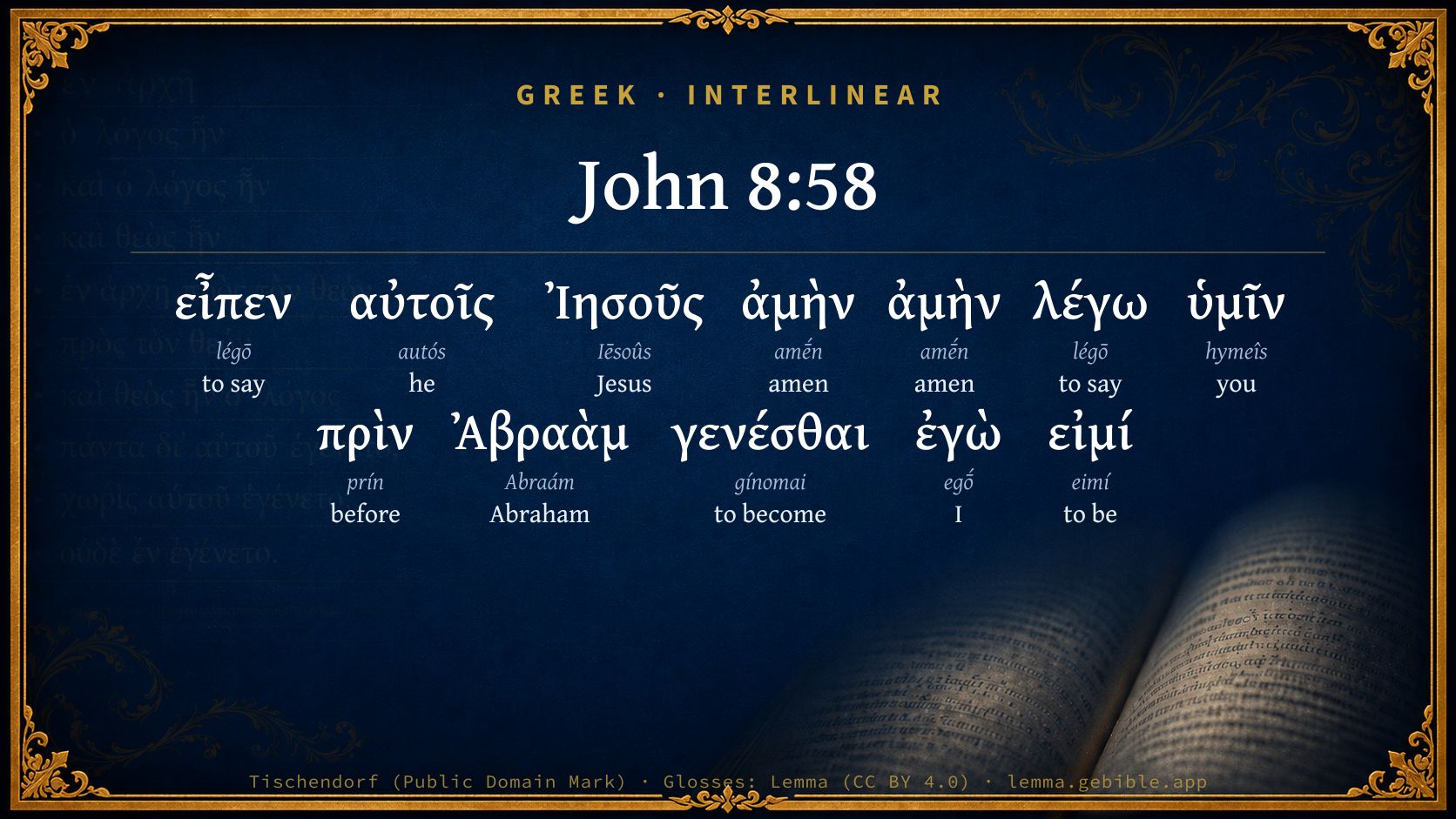
Greek (Tischendorf 8th ed.) John 8:58 appears in the Greek New Testament. The text above is from the Tischendorf 8th edition. Each word links to its Strong’s number and a concise gloss. Click any word for its full Thayer’s Greek Lexicon entry.
Download image
Cite this verse

John 8:58 (World English Bible). Public Domain. Lemma interlinear Bible study tool, https://lemma.gebible.app/v/john/8/58.

Show BibTeX & RIS
BibTeX
RIS
English Translation
Jesus said to them, "Most assuredly, I tell you, before Abraham came into existence, I AM."
World English Bible · Public Domain
Download a study sheet

One document with this verse’s original text, its word-by-word gloss line, the meaning frame, cross-references with their text, attributed commentary, and full source and license credits — printable, and it pastes into notes with its structure intact.

This verse Autodidact and up

Study sheet (.html) Plain text (.txt)

A passage Seminary Student

Up to 50 verses in one chapter. A passage sheet keeps up to 6 commentary sources and 12 cross-references per verse, in the order this page ranks them, and says so on the sheet whenever that leaves anything out. Ask for a single verse and you get the Autodidact verse sheet above.

Everything on this page stays free to read, with no account — the sheet is a download of what is already on screen, not access to it.

Want to remove ads? Support Godless Engineer
Compare translations 3

The same verse in 3 English versions, stacked beneath the original-language interlinear above. Click any original word for its lexicon entry.

Each is an independent rendering of the whole verse — the interlinear is not word-aligned to these translations.

Highlighted words mark where these versions differ — a whole-verse word diff, not a word-by-word alignment.

  • World English Bible Public Domain
    Jesus said to them, "Most assuredly, I tell you, before Abraham came into existence, I AM."
  • King James Version Public Domain
    Jesus said unto them, Verily, verily, I say unto you, Before Abraham was, I am.
  • unfoldingWord Literal Text CC BY-SA 4.0
    Jesus said to them, “Truly, truly, I say to you, before Abraham came into existence, I am.”

unfoldingWord Literal Text — © unfoldingWord, licensed CC BY-SA 4.0. Word-aligned USFM3 via Door43 (git.door43.org/unfoldingWord/en_ult).

Versions to compare (up to 4)

3 of 4 selected

Show all 19 translations

Every available English version of this verse, each an independent rendering of the whole verse.

  • World English Bible Public Domain
    Jesus said to them, "Most assuredly, I tell you, before Abraham came into existence, I AM."
  • Berean Standard Bible Public Domain
    “Truly, truly, I tell you,” Jesus declared, “before Abraham was born, I am!”
  • Majority Standard Bible Public Domain
    “Truly, truly, I tell you,” Jesus declared, “before Abraham was born, I am!”
  • King James Version Public Domain
    Jesus said unto them, Verily, verily, I say unto you, Before Abraham was, I am.
  • American Standard Version (1901) Public Domain
    Jesus said unto them, Verily, verily, I say unto you, Before Abraham was born, I am.
  • Revised Version (1885) Public Domain
    Jesus said unto them, Verily, verily, I say unto you, Before Abraham was, I am.
  • Geneva Bible (1599) Public Domain
    Iesus sayd vnto them, Verely, verely I say vnto you, before Abraham was, I am.
  • Douay-Rheims (1899) Public Domain
    Jesus said to them: Amen, amen I say to you, before Abraham was made, I am.
  • Young's Literal Translation Public Domain
    Jesus said to them, `Verily, verily, I say to you, Before Abraham's coming -- I am;'
  • Literal Standard Version CC BY-SA 4.0
    Jesus said to them, “Truly, truly, I say to you, before Abraham’s coming—I AM”;
  • Unlocked Literal Bible CC BY-SA 4.0
    Jesus said to them, “Truly, truly, I say to you, before Abraham was, I AM.”
  • unfoldingWord Literal Text CC BY-SA 4.0
    Jesus said to them, “Truly, truly, I say to you, before Abraham came into existence, I am.”
  • Darby Bible Public Domain
    Jesus said to them, Verily, verily, I say unto you, Before Abraham was, I am.
  • World Messianic Bible Public Domain
    Yeshua said to them, “Most certainly, I tell you, before Abraham came into existence, I AM.”
  • Webster's Bible Public Domain
    Jesus said to them, Verily, verily, I say to you, Before Abraham was, I am.
  • Free Bible Version CC BY-SA 4.0
    “I tell you the truth, before Abraham was born, I am,” said Jesus.
  • Bible in Basic English Public Domain
    Jesus said to them, Truly I say to you, Before Abraham came into being, I am.
  • Text-Critical English NT CC BY 4.0
    Jesus said to them, “Truly, truly, I say to you, before Abraham was, I am.”
  • Tyndale New Testament (1534) Public Domain
    Iesus sayd vnto them: Verely verely I saye vnto you: yer Abraham was I am.

Literal Standard Version (2020), Covenant Press — licensed CC BY-SA 4.0. Text via the HelloAO Bible API (eBible.org). Unlocked Literal Bible (unfoldingWord) — licensed CC BY-SA 4.0. Text via the HelloAO Bible API (eBible.org). unfoldingWord Literal Text — © unfoldingWord, licensed CC BY-SA 4.0. Word-aligned USFM3 via Door43 (git.door43.org/unfoldingWord/en_ult). Free Bible Version, Dr. Jonathan Gallagher — licensed CC BY-SA 4.0. Text via the HelloAO Bible API (eBible.org).

Word by word

More ways to search: Search by grammar → Find every occurrence → Compare this word →

Practice this passage: Drill this verse → Learn its vocabulary →

About this verse

These counts appear in no published source. They are computed here, from the morphology-tagged text and Lemma’s own curated glosses. What Lemma adds →

12
words
10
distinct lemmas
Gospels
section

Notable vocabulary

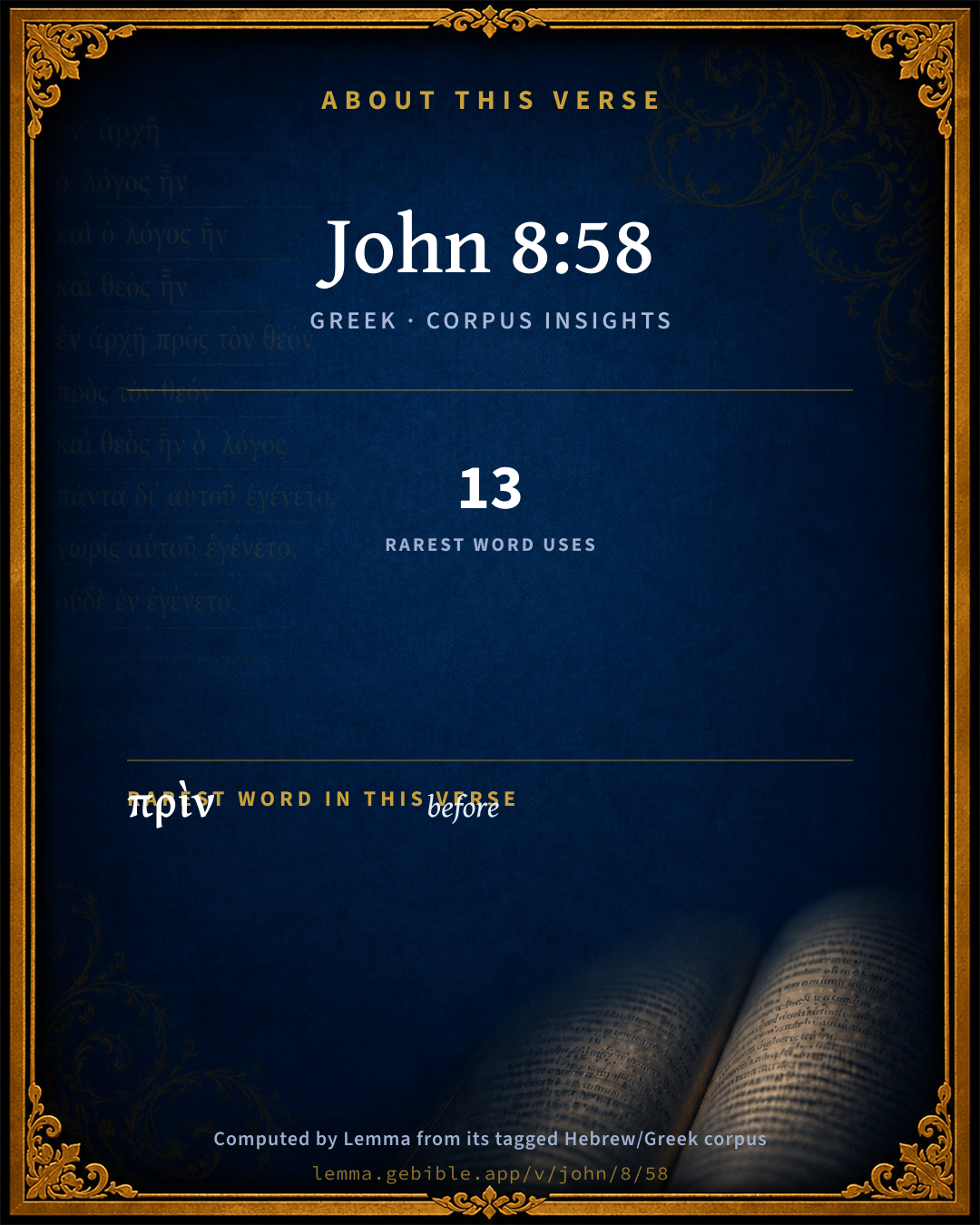
The rarest word here is πρὶν before G4250 — appearing just 13 times in the whole Greek New Testament.

Shared distinctive vocabulary

πρὶν before G4250 occurs in 13 verses of the Greek New Testament. Also found in:

Repetition

Words recur within this verse:

  • εἶπεν to say G3004 ×2
  • ἀμὴν amen G281 ×2

Cross-references

21

Topical passages linked to John 8:58 in the Treasury of Scripture Knowledge — connected by theme and wording, ordered by reader-vote popularity; previews shown in the World English Bible.

  • Exodus 3:14 God said to Moses, "I AM WHO I AM," and he said, "You shall tell the children of Israel this: "I AM has sent me to you."
  • Colossians 1:17 He is before all things, and in him all things are held together.
  • John 17:5 Now, Father, glorify me with your own self with the glory which I had with you before the world existed.
  • John 1:1–2 In the beginning was the Word, and the Word was with God, and the Word was God.
  • Isaiah 44:6 Thus says Yahweh, the King of Israel, and his Redeemer, Yahweh of Hosts: I am the first, and I am the last; and besides me there is no God.
  • John 17:24 Father, I desire that they also whom you have given me be with me where I am, that they may see my glory, which you have given me, for you loved me before the foundation of the world.
  • Hebrews 13:8 Jesus Christ is the same yesterday, today, and forever.
  • Revelation 1:8 "I am the Alpha and the Omega," says the Lord God, "who is and who was and who is to come, the Almighty."
  • Isaiah 9:6 For to us a child is born, to us a son is given; and the government shall be on his shoulder: and his name shall be called Wonderful, Counselor, Mighty God, Everlasting Father, Prince of Peace.
  • Isaiah 48:12 Listen to me, O Jacob, and Israel my called: I am he; I am the first, I also am the last.
  • Revelation 2:8 "To the angel of the assembly in Smyrna write: "The first and the last, who was dead, and has come to life says these things:
  • Micah 5:2 But you, Bethlehem Ephrathah, Being small among the clans of Judah, Out of you one will come forth to me that is to be ruler in Israel; Whose goings forth are from of old, from everlasting.
  • Hebrews 1:10–12 And, "You, Lord, in the beginning, laid the foundation of the earth. The heavens are the works of your hands.
  • Revelation 1:17–18 When I saw him, I fell at his feet like a dead man. He laid his right hand on me, saying, "Don't be afraid. I am the first and the last,
  • Isaiah 43:13 Yes, since the day was I am he; and there is none who can deliver out of my hand: I will work, and who can hinder it?
  • Isaiah 46:9 Remember the former things of old: for I am God, and there is none else; [I am] God, and there is none like me;
  • Isaiah 44:8 Don't fear, neither be afraid: haven't I declared to you of old, and shown it? You are my witnesses. Is there a God besides me? Indeed, there is not. I don't know any Rock.
  • Proverbs 8:22–30 "Yahweh possessed me in the beginning of his work, Before his deeds of old.
  • John 8:51 Most assuredly, I tell you, if a person keeps my word, he will never see death."
  • John 8:34 Jesus answered them, "Most assuredly I tell you, everyone who commits sin is the bondservant of sin.
  • Revelation 1:11 saying, "What you see, write in a book and send to the seven assemblies: to Ephesus, Smyrna, Pergamum, Thyatira, Sardis, Philadelphia, and to Laodicea."

Cross-references courtesy of OpenBible.info (CC BY 4.0).

Commentary

Notes on John 8:58 from classic Christian and Jewish commentators (each source and its license shown beneath its notes). The classic Christian expositions comment on the surrounding passage and are grouped to its opening verse, so a note may address several verses; the Jewish commentaries on the Tanakh (Rashi and others) are per-verse, so they appear only where the commentator wrote on this verse.

Lemma curates 59 commentaries, every one of them public domain or Creative Commons licensed, each selected and text-cleaned for this edition rather than reprinted as found. About our sources →

The Biblical Illustrator

Joseph S. Exell

Joh_8:58

Before Abraham was, I am.

Here the Saviour claims with a double Amen the Incommunicable Name (Exo_3:14). It signifies unchangeable essence and everlasting duration. This is the name which the Jews for centuries had not dared to utter. Silently they had read it, used another in its stead, revered and adored it. Now the humble Nazarene openly assumes and claims it. Gods word to Moses implies the impossibility of a full definition of the name, or that finite creatures could not comprehend it if given. He does not say, I am their Light, Life, Guide, Strength, or Tower. He sets His hand to a blank, that faith may write her prayer. Are believers weary? I am their strength. Poor? I am their riches. In trouble? I am their comfort. Sick? I am their health. Dying? I am their life. I am justice and mercy, grace and goodness, glory, beauty, holiness, perfection--all-sufficient through eternity. (W. H. Van Doren, D. D.)

I am

This title teaches us

I. THE SELF-EXISTENCE OF CHRIST. The creature is a dependent being; God alone is independent and self-existent.

II. HIS UNCHANGEABLENESS. Change is written on everything earthly. The billows of a thousand generations may sweep over the rock, but it is steadfast. Jesus is the same today, yesterday, and forever.

III. HIS ALL-SUFFICIENCY. We are at liberty to write what we like after I am. Whatever you want to make you happy, put in there. (J. M. Randall.)

The eternity of Christ

With filial pride the Jew thought of Father Abraham. So hearing of our Lords lofty claims they asked, Art thou greater than he? Yes. He rejoiced to see My day. With prophetic vision, doubtless; but surely more than this is meant. When did Christs day begin? Away back at the time of the first promise it broke. God, called also the Angel of the Lord, or Christ Himself temporarily assuming human form, appeared to Abraham more than once, and perhaps here is a reference to a revelation of Christ, brighter than the rest, but made known to none other. Then the Jews said, Thou art not fifty years old, etc. Our Lord replied (literally), Before Abraham was brought into being, I exist.

The statement is not that Christ came into existence before Abraham, but that He never came into being at all. The Jews understood this as a Divine claim, and took up stones against Him as a blasphemer.

1. Then we think of the eternity of Christ. There never was a point when He began to be. Not so with man, angels, the universe. Go back eighteen hundred years to the time of Abraham; back further still to the time of Noah, Enoch, Adam; back before any creature existed: In the beginning was the Word, etc. Meet Him anywhere in eternity past or in eternity to come, and He says, I am.

2. How can we think of the eternity of Christ? What know we of eternity? Suppose the patriarchs were living now, with what awe should we listen to their words weighty with the experience of millenniums. But they had a beginning. Let the ages be reckoned back to when the world was not, and added to those which shall follow till it shall cease to be, and what shall we pay for the stupendous sum total? But this is not eternity. Call in angelic numeration, and gather into one gigantic aggregate the sands of the shore, the drops of the ocean, and the stars of the sky; what would it be? Only a spot of spray to the immeasurable ocean.

3. But the eternity of Christ is a doctrine most blessed and practical, because related to the Divinity of Christ. We need a Divine as well as human Saviour, and we have one in the I am.

I. Is Christ eternal? THEN ASSURED IS THE LIFE OF ALL LIVING THINGS, By Him all things consist. Because He is eternal, the stars wax not dim; they are as bright to us as they were to Abraham. Because He is eternal, the flowers of each coming spring are as fair as their blooming ancestry in the dawn of the world. Because He lives, While the earth remaineth, seed time and harvest … shall not cease. Because He lives man lives. How sweet and fresh the beauty of the newborn child! The hand of the Eternal has moulded it. And so come the successive generations of children. The years bring changes, and the man is unlike the child. Yet the soul that lives in Christ is never old; it is renewed day by day.

II. Is Christ eternal? THERE IS HOPE, THEN, FOR EVERY MAN. Withdrawn from human sight, He ever liveth to make intercession for us. Stephen saw Him, and Paul, and John; and now He reaches forth His invisible hand to save.

III. Is Christ eternal? THEN WE HAVE ONE ABIDING FRIEND. We can lose much here; much, thank God, that it is well to lose--ignorance, bad habits, sin. But there are some bereavements that impoverish us, through injustice, misfortune, accident, loss of friends. But if Christ is ours we have an eternal possession. He loves us to the end. Lose what we may, who can be poor with Him. Who shall separate us, etc.

IV. Is Christ eternal? THEN HIS KINGDOM THOUGH DELAYED SHALL COME. We wonder at the tardy steps of Truth. But what are the millenniums to Christ? His name shall endure forever. (G. T. Coster.)

The pre-existence of Christ

Does it appear that Christ was conscious of having existed previously to His human life? Suppose that He is only a good man enjoying the highest degree of intercommunion with God, no reference to a pre-existent life can be anticipated. There is nothing to warrant it in the Mosaic revelation, and to have professed it on the soil of Palestine would have been regarded as proof of derangement. But believe that Christ is the Only-begotten Son of God, and some references to a consciousness extending backwards into a boundless eternity are to be looked for. Let us then listen to Him as He proclaims, If a man keep My saying He shall never see death (Joh_8:52). The Jews exclaim that by such an announcement He assumes to be greater than Abraham. The response to this is, Your father Abraham rejoiced to see My day, etc. Abraham had seen the day of Messiah by the light of prophecy, and accordingly this statement was a claim on the part of Jesus to be the true Messiah. Of itself such a claim would not have shocked the Jews; they would have discussed it on its merits. They had latterly looked for a political chief, victorious but human, in their expected Messiah; they would have welcomed any prospect of realizing their expectations. But they detected a deeper and less welcome meaning. He had meant, they thought, by His day, something more than the years of His human life. At any rate, they would ask Him a question, which would at once justify their suspicions or enable Him to clear Himself (Joh_8:57). Now if our Lord had only claimed to be a human Messiah He must have earnestly disavowed any such inference. He might have replied that if Abraham saw Him by the light of prophecy, this did not of itself imply that He was Abrahams contemporary. But His actual answer more than justified the most extreme suspicions, Before Abraham was, I am. In these tremendous words the Speaker institutes a double contrast in respect both of the duration and the mode of His existence, between Himself and the great ancestor of Israel. Abraham had come into existence at some given point of time, and did not exist until his parents gave him birth. But I AM. Here is a simple existence, with no note of beginning or end. Our Lord claims pre-existence indeed, but not merely pre-existence; He unveils a consciousness of Eternal Being. He speaks as one on whom time has no effect, and for whom it has no meaning. He is the I AM of ancient Israel; He knows no past as He knows no future; He is unbeginning, unending Being; He is the eternal Now. This is the plain sense of his language, and perhaps the most instructive commentary on its force is to be found in the violent expedients to which Humanitarian writers have been driven in order to evade it. (Canon Liddon.)

The Biblical Illustrator, edited by Joseph S. Exell (c. 1880s–1900s) — public domain. Text from a community e-Sword module.

Tyndale Open Study Notes

Tyndale Open Resources

8:58 before Abraham was even born, I Am! Jesus’ life spans the past from before creation (1:1-2) and sweeps beyond the present into eternity. • I Am: This title is reminiscent of God’s name given on Mount Sinai (Exod 3:14; cp. John 4:26; Isa 43:11-13; 48:12).

Tyndale Open Study Notes — © Tyndale Open Resources, licensed CC BY-SA 4.0. Text via the HelloAO Bible API.

Bengel's Gnomon

Johann Albrecht Bengel

Joh 8:58. Πρὶν Ἀβραάμ γενέσθαι, ἐγὼ εἰμί, before that Abraham was brought into being, I am) The Jews are hereby refuted, who were denying, that Abraham even then could have seen that day. I was, saith Jesus, even then; therefore I saw Abraham, and Abraham saw My day: not merely did I not begin to be only afterwards [afterwards and not till then], but I was, before that he teas brought into being. The difference is to be observed between I am brought into being, and I am; Mar 4:22 [οὐ γάρ ἐστί (is) τι κρυπρὸν, ὁ ἐὰν μὴ φανερωθῇ· οὐδὲ ἐγένετο (has been made, or, become, viz. by design), ἀπόκρυφον, ἀλλʼ ἵνα εἰς φανερὸν ἔλθῃ]. Act 26:29, “I would to God that—all—γενέσθαι, might become such as I am, εἰμι:” 1Co 3:18, “If any man seemeth to be wise—εἶναι—let him become a fool—γενέσθω.” Moreover, it is an abbreviated form of expression, in this sense; Before that Abraham was made, I was: and at this day, at so long an interval after the death of Abraham, I am. For John often expresses himself in such a way, that the Protasis and Apodosis mutually complete one another; Joh 8:28, “When ye have lifted up the Son of Man, then shall ye know that I am He, and that I do nothing of Myself:” Joh 8:38, “I speak that which, etc., and ye do that which,” etc. [do is to be supplied to the first clause, speak to the second]; ch. Joh 5:21, “As the Father raiseth up—and quickeneth, even so the Son quickeneth” (underst., and raiseth up) etc.; Joh 8:30, “I can of Mine own self do (supply, and judge) nothing; as I hear I judge” (supply, and do); ch. Joh 11:8, Joh 14:10, “The words I speak,—I speak not of Myself (supply, and the works I do, I do not of Myself) but the Father—doeth the works (supply, and speaketh the words); ch. Joh 15:27; Rev 14:10, notes. Thus the particle before and the present I am, elegantly cohere; comp. also Col 1:17, He Himself is before all things. And yet Artemonius in Diss. iv., p. 618, calls this expression, after the daring example of Enjedinus, a barbarism; but the present is often so put, as that the past time is included; Luk 15:29, So many years (I have served and still) serve thee (τοσαῦτα ἔτη δουλεύω). In the same ch. Joh 8:31 (thou hast been) and art always with Me, as the Goth. Vers. renders it [πάντοτε—εἶ]. Septuag. Psa 90:2, πρὸ τοῦ ὄρη γενηθῆναι, σὺ εἶ [before the mountains were brought forth, thou art], where Artemonius can by no effort of his change the punctuation. Pro 8:25, πρὸ πὰντων βουνῶν γεννᾷ με, where, if only Artemonius be right in saying that there is some error, nothing [no correction] is nearer (for חוללתי) than γεννῶμαι, which is also present. I would like to see what device he would contrive to meet Jer 1:5, πρὸ τοῦ με καταπλάσαι σε ἐν κοιλίᾳ, ἐπίσταμαί σε. Artemonius, with Socinus, thus explains the words; Before that Abraham is made the father of many nations, I am, to wit, the Christ: and also he takes I am in the same sense as at Joh 8:24, “If ye believe not that I am He;” Joh 8:28, “Then shall ye know that I am He;” ch. Joh 13:19, “That, when it is come to pass, ye may believe that I am He;” Mar 13:6, “Many shall come saying, I am (Christ).” I reply, 1) The Jews had objected that Abraham was deceased for more than fifty years before; Abraham was not regarded by them as about to belong to the New Testament. 2) This sentiment would not have borne that most solemn asseveration, Verily, verily, I say unto you. For in this sense even the Jews, who were then living, would have been before Abraham. 3) The word I am, in this colloquy, is employed concerning age and time, in antithesis to the inchoative to be brought into being [γενέσθαι]. Moreover, the reference of the words opposed is the same, and both verbs ought to be understood absolutely, as was is used; ch. Joh 1:1, “In the beginning was the Word,” etc. However this absolute signification includes that other by consequence; before that Abraham was brought into being; He who speaks, was; and He was the same as He asserted to the Jews that He was.—πρἰν Ἀβραάμ γενέσθαι) Γενέσθαι is wanting in some of the old fathers, especially the Latin fathers; but the use of the adverb πρίν does not bear the omission. That indeed is certain, that those fathers had no thought of the Socinian perversion of the sense of the verb γενέσθαι, and so the perversion of this whole passage. [Dabc and Epiphanius omit γενέσθαι. But [237][238], Vulg. and Orige[239] I., 750 f, etc., have it.]

[237] the Alexandrine MS.: in Brit. Museum: fifth century: publ. by Woide, 1786–1819: O. and N. Test. defective.

[238] Cod. Basilianus (not the B. Vaticanus): Revelation: in the Vatican: edited by Tisch., who assigns it to the beginning of the eighth century.

[239] rigen (born about 186 A.D., died 253 A.D., a Greek father: two-thirds of the N. Test. are quoted in his writings). Ed. Vinc. Delarue, Paris. 1733, 1740, 1759.

Bengel's Gnomon of the New Testament — English translation (T&T Clark, Edinburgh, 1860) — public domain. Text from a community e-Sword module.

Meyer's Critical & Exegetical Commentary

Heinrich August Wilhelm Meyer

Joh_8:58. Not a continuation of the discourse in Joh_8:56, so that Jesus would thus not have given any answer to the question of the Jews (B. Crusius); but, as the contents themselves, and the solemn ἀμὴν ἀμὴν λ. ὑμ. shows, an answer to Joh_8:57. This reply asserts even more than the Jews had asked, namely, πρὶν, etc., before Abraham became, or was born (not: was, as Tholuck, De Wette, Ewald, and others translate),[41] I am; older than Abrahams origin is my existence. As Abraham had not pre-existed, but came into existence[42] (by birth), therefore γενέσθαι is used; whereas ΕἸΜΊ denotes being per se, which belonged to Jesus, so far as He existed before time, as to His divine nature, without having previously come into being. Comp. I. 1. 6; and see even Chrysostom. The Praesens denotes that which continues from the past, i.e. here: that which continues from before time (Joh_1:1, Joh_17:5). Comp. LXX.; Psa_90:2; also Jer_1:5. ʼΕγώ εἰμι must neither be taken as ideal being (De Wette), nor as being Messiah (Scholten), and transferred into the counsel of God (Sam. Crellius, Grotius, Paulus, B. Crusius), which is forbidden even by the use of the Praesens; nor may we, with Beyschlag, conceive the being as that of the real image of God,a thought which, after Joh_8:57, is neither suggested by the context, nor would occur to Christs hearers without some more precise indication; nor, lastly, is the utterance to be regarded merely as a momentary vision, as in a state of prophetic elevation (Weizsäcker), inasmuch as it corresponds essentially to the permanent consciousness which Jesus had of His personal (the condition, in the present connection, of His having seen Abraham) pre-existence, and which everywhere manifests itself in the Gospel of John. Comp. on Joh_17:5, Joh_6:46; Joh_6:62. The thought is not an intuitive, conclusion backwards, but a glance backward, of the consciousness of Jesus (against Beyschlag). Only noteworthy in a historical point of view is the perverse explanation of Faustus Socinus, which from him passed over into the Socinian confession of faith (see Catech. Racov., ed. Oeder, p. 144 f.): Before Abraham becomes Abraham, i.e. the father of many nations, I am it, namely, the Messiah, the Light of the world. He thus admonishes the Jews to believe on Him while they have an opportunity, before grace is taken from them and transferred to the heathen, in which way Abraham will become the father of many nations.

[41] Also the English Authorized Version.

[42] This view, factus est, forms a more significant correlate to εἰμί than if γενέσθαι were taken as equivalent to nasci, which in itself would be also correct (Gal_4:4; and see especially Raphelius on the passage).

Meyer — Critical and Exegetical Commentary on the New Testament — English translation by Peter Christie, edited by Frederick Crombie (T&T Clark, 1880) — public domain. Text from a community e-Sword module.

Expositor's Greek Testament

ed. W. Robertson Nicoll

Joh 8:58 . The misunderstanding of His words elicits from Jesus the statement: πρὶν Αβραὰμ γενέσθαι , ἐγώ εἰμι . “Before Abraham was born I am.” “Antequam Abraham fieret, Ego sum,” Vulgate. Plummer aptly compares Psa 90:2 , πρὸ τοῦ ὄρη γενηθῆναι … σὺ εἶ . Before Abraham came into existence I am, eternally existent. No stronger affirmation of pre-existence occurs, and Beyschlag’s subtle attempt to evade the meaning is unsuccessful.

The Expositor's Greek Testament, edited by W. Robertson Nicoll (1897–1910) — public domain. Text from a community e-Sword module.

Geneva Bible (1599)

Geneva Bible translators

Christ as he was God, was before Abraham: and he was the Lamb slain from the beginning of the world.

Geneva Bible (1599) marginal notes — public domain. Text via Bolls.life.

Jamieson, Fausset & Brown

Robert Jamieson, A. R. Fausset & David Brown

Before Abraham was, I am--The words rendered "was" and "am" are quite different. The one clause means, "Abraham was brought into being"; the other, "I exist." The statement therefore is not that Christ came into existence before Abraham did (as Arians affirm is the meaning), but that He never came into being at all, but existed before Abraham had a being; in other words, existed before creation, or eternally (as Joh 1:1). In that sense the Jews plainly understood Him, since "then took they up stones to cast at Him," just as they had before done when they saw that He made Himself equal with God (Joh 5:18).

hid himself--(See on Luk 4:30).

Next: John Chapter 9

Jamieson, Fausset & Brown — Commentary Critical and Explanatory on the Whole Bible (1871) — public domain (CC PDM 1.0). Text via the HelloAO Bible API.

Adam Clarke's Commentary

Verse 58. Before Abraham was, I am.] The following is a literal translation of Calmet's note on this passage:-"I am from all eternity. I have existed before all ages. You consider in me only the person who speaks to you, and who has appeared to you within a particular time. But besides this human nature, which ye think ye know, there is in me a Divine and eternal nature. Both, united, subsist together in my person. Abraham knew how to distinguish them. He adored me as his God; and desired me as his Saviour. He has seen me in my eternity, and he predicted my coming into the world."

On the same verse Bishop Pearce speaks as follows:- "What Jesus here says relates (I think) to his existence antecedent to Abraham's days, and not to his having been the Christ appointed and foretold before that time; for, if Jesus had meant this, the answer I apprehend would not have been a pertinent one. He might have been appointed and foretold for the Christ; but if he had not had an existence before Abraham's days, neither could he have seen Abraham, (as, according to our English translation, the Jews suppose him to have said,) nor could Abraham have seen him, as I suppose the Jews understood him to have said in the preceding verse, to which words of the Jews the words of Jesus here are intended as an answer."

Adam Clarke's Commentary on the Bible (1810–1826) — public domain. Text from a community e-Sword/MySword module.

John Calvin's Commentaries

58. Before Abraham was. As unbelievers judge only from the appearance of the flesh, Christ reminds them that he has something greater and higher than human appearance, which is hidden from the senses of the flesh, and is perceived only by the eyes of faith; and that, in this respect, he might be seen by the holy fathers, before he was manifested in the flesh. But he uses different verbs. Before Abraham was, or, Before Abraham was born, I am. But by these words he excludes himself from the ordinary rank of men, and claims for himself a power more than human, a power heavenly and divine, the perception of which reached from the beginning of the world through all ages.

Yet these words may be explained in two ways. Some think that this applies simply to the eternal Divinity of Christ, and compare it with that passage in the writings of Moses, I am what I am, (Exodus 3:14.) But I extend it much farther, because the power and grace of Christ, so far as he is the Redeemer of the world, was common to all ages. It agrees therefore with that saying of the apostle, Christ yesterday, and to-day, and for ever, (Hebrews 13:8.) For the context appears to demand this interpretation. He had formerly said that Abraham longed for his day with vehement desire; and as this seemed incredible to the Jews, he adds, that he himself also existed at that time. The reason assigned will not appear sufficiently strong, if we do not understand that he was even then acknowledged to be the Mediator, by whom God was to be appeased. And yet the efficacy which belonged, in all ages, to the grace of the Mediator depended on his eternal Divinity; so that this saying of Christ contains a remarkable testimony of his Divine essence.

We ought also to observe the solemn form of an oath, Verily, verily. Nor do I disapprove of the opinion of Chrysostom, that the present tense of the verb is emphatic; for he does not say, I was, but I am; by which he denotes a condition uniformly the same from the beginning to the end. And he does not say, Before Abraham was, but, Before Abraham was made; which implies that Abraham had a beginning.

John Calvin's Commentaries (1540-1563) — public domain. Text from the Calvin Translation Society English edition (1840s-50s) via the Christian Classics Ethereal Library (ccel.org). Calvin's coverage is partial (roughly two-thirds of the Bible); uncommented books and verses are honest gaps, never fabricated. The 19th-century editor's footnotes and remarks are omitted so the notes are faithfully Calvin's own voice.

Ellicott's Commentary for English Readers

(58) Before Abraham was, I am.—Better, Before Abraham was born, I am. (Comp. Note on Joh_1:6; and see another striking instance in Luk_6:36, “Become ye merciful as your Father also is merciful.”) Here they ask in wonder, not unmixed with scorn, if He was coeval with Abraham. The answer is that Abraham, like all men, came into being. There was a time when he was not. But there was never a time when the Son of God was not. In the time before Abraham, in the eternity before time (Joh_1:1), He still was. No word which expresses becoming can be used of His existence. He is the I AM, present equally in the human “was,” and “is,” and “is to come.”

A Bible Commentary for English Readers, edited by Charles John Ellicott (1878–1897) — public domain. Text from a community e-Sword module.

The Cambridge Bible for Schools and Colleges

gen. ed. J. J. S. Perowne

58. Before Abraham was, I am] Here our translators have lamentably gone back from earlier translations. Cranmer has, ‘Ere Abraham was born, I am;’ and the Rhemish, ‘Before that Abraham was made, I am,’ following the Vulgate, Antequam Abraham fieret, Ego sum. See notes on ‘was’ in Joh_1:1; Joh_1:6. ‘I am’ denotes absolute existence, and in this passage clearly involves the pre-existence and Divinity of Christ, as the Jews see. Comp. Joh_8:24; Joh_8:28; Rev_1:4; Rev_1:8; and see on Joh_8:24.

The Cambridge Bible for Schools and Colleges (gen. ed. J. J. S. Perowne; Cambridge University Press, 1878–1918) — public domain. Text from a community e-Sword module.

Trapp's Complete Commentary

John Trapp

58 Jesus said unto them, Verily, verily, I say unto you, Before Abraham was, I am.

Ver. 58. Before Abraham was, I am] "I am that I am," in regard of mine eternal generation. And as mediator, "I am Jesus Christ, yesterday, today, and for ever," Heb 13:8.

John Trapp, A Commentary or Exposition upon All the Books of the Old and New Testament (1647–1656) — public domain. Text from a community e-Sword module.

Albert Barnes' Notes on the Bible

Verily, verily - This is an expression used only in John. It is a strong affirmation denoting particularly the great importance of what was about to be affirmed. See the notes at Joh 3:5.

Before Abraham was - Before Abraham lived.

I am - The expression I am, though in the present tense, is clearly designed to refer to a past time. Thus, in Psa 90:2, “From everlasting to everlasting thou art God.” Applied to God, it denotes continued existence without respect to time, so far as he is concerned. We divide time into the past, the present, and the future. The expression, applied to God, denotes that he does not measure his existence in this manner, but that the word by which we express the present denotes his continued and unchanging existence. Hence, he assumes it as his name, “I AM,” and “I AM that I AM,” Exo 3:14. Compare Isa 44:6; Isa 47:8. There is a remarkable similarity between the expression employed by Jesus in this place and that used in Exodus to denote the name of God. The manner in which Jesus used it would strikingly suggest the application of the same language to God. The question here was about his pre-existence. The objection of the Jews was that he was not 50 years old, and could not, therefore, have seen Abraham. Jesus replied to that that he existed before Abraham. As in his human nature he was not yet 50 years old, and could not, as a man, have existed before Abraham, this declaration must be referred to another nature; and the passage proves that, while he was a man, he was also endowed with another nature existing before Abraham, and to which he applied the term (familiar to the Jews as expressive of the existence of God) I AM; and this declaration corresponds to the affirmation of John Joh 1:1, that he was in the beginning with God, and was God. This affirmation of Jesus is one of the proofs on which John relies to prove that he was the Messiah Joh 20:31, to establish which was the design of writing this book.

Albert Barnes' Notes on the Bible (1834–1885) — public domain. Text from a community e-Sword/MySword module.

Haydock's Catholic Bible Commentary

Before Abraham was made, I am.[4] Christ here speaks of his eternal existence as God. St. Augustine shews this by these very words, I am. He does not say, before Abraham was made, I was made: because, as the Son of God, he never was made: but I am, which shews his eternal divine nature. (Witham)

===============================

[BIBLIOGRAPHY]

Abraham fieret, ego sum; Greek: prin Abraam genesthai, ego eimi. St. Augustine, (tract. xliii. in Joan. num. 17. p. 588.) intellige, fieret ad creaturam, sum vero pertinere ad divinam substantiam: non dixit, antequam Abraham esset, ego eram, ... neque dixit, ego factus sum ... agnoscite creatorem, discernite creaturam.

====================

George Leo Haydock (1774–1849), Haydock's Catholic Family Bible and Commentary, 1859 edition — public domain. Excludes Psalms (Douay-Rheims chapter numbering differs from Protestant) and Deuterocanonical books (Catholic canon only).

Matthew Poole's English Annotations

Some will have the meaning to be, that Christ was before Abraham’s time constituted Mediator; as he is said to be the Lamb slain from the foundation of the world, Rev 13:8; so 1Pe 1:20. But thus it might have been said of any of the elect, that they were chosen before Abraham was. It is therefore undoubtedly to be understood of Christ’s eternal existence, as to his Divine nature; and this will appear, as from other arguments, so from the whole scope of our Saviour’s former discourse in this chapter, which was to assert his Divine nature and equality with the Father.

Matthew Poole's English Annotations on the Holy Bible (1683–1685) — public domain. Text from a community e-Sword/MySword module.

Whedon's Commentary on the Bible

Daniel D. Whedon

58. Before Abraham was—Before Abraham became, or came into being. The Greek term was, as applied to Abraham, is wholly different from the AM claimed by Christ to himself.

I am—The permanent present of the verb of existence. Present, before Abraham was; present to-day, yesterday, and forever. Biblical scholars of all ages have seen in this sublime word the I am that I am of the eternal Jehovah. Thus does Jesus, threading through all the intricacies of Jewish gainsaying, wind up with this grand climax of self-affirmed eternity!

Daniel D. Whedon (gen. ed.), Commentary on the Old and New Testaments (1874–1909) — public domain. Text from a community e-Sword module.

The Pulpit Commentary

The reply of Jesus to this taunt is one of the most surprising and baffling kind on any hypothesis of our Lord"s consciousness being limited as that of all other of the sons of men. He gives the solemn emphasis of the Amhn once moreVerily, verily, I say unto you, Before Abraham was born (came into being), I am. Abraham came into existence by birth (the Vulgate translates, Antequam fierat Abraham Ego sum): I am. Numerous attempts have been made to explain this climacteric utterance on some humanistic theory. The contrast is very remarkable between genesyai and eimi . Jesus Christ declared his own timeless existence to have been in his consciousness before Abraham came into being at all. The "I am" reminds us repeatedly, when used by Jesus, of the "I AM THAT I AM" of Exo_3:14, and the "thou art" of Ps 90. (89:2, LXX); Psa_102:28. His human consciousness gave utterance to the awful depths of the eternal Ego. Now, some critics have limited it in its meaning to "I existed in the counsel of God." But there are three objections to this interpretation: one is

(1) that the present tense, eimi , and not the past, hn , was used by our Lord; and

(2) on this interpretation Abraham must have also equally pre-existed in the counsel of God; and

(3) such a statement would throw no light on the previous discourse. The Racovian Confession of Faith, based on the view of Socinus, explains, "Before Abram becomes Abraham, i.e. the father of many nations, I am it, the Messiah, the Light of the world." Not until my Messianic claims are acknowledged, and the many nations become children of Abraham, does Abraham really become Abraham, does his name derive its full meaning. This would be rabbinical trifling (J.P. Smith, "Script. Test. to Messiah," vol. 2). Beyschlag thinks that our Lord realized in his Person not a conscious pre-existence before Abraham, or before all worlds, but an impersonal principle, the image of God, which could only "be" in the eternal mind of God. There is a sense in which every man may realize such pre-existence as this, not merely "the Son of God," nor the new man in Christ, but every man whatsoever; but such a statement is entirely out of harmony with the whole passage that precedes. If the Jews had understood it in this sense, they would not have taken up stores to stone him, but, after their wont, would have said, "So also were we." "Ideas do not see one another." The first egw eimi (ver. 12) brought out their angry unbelief, but this excites their murderous assault. We have to observe that this remarkable expression does not stand alone. St. John had reasons for saying "that the Word was with God, and was God. and was made flesh". (Joh_1:1, Joh_1:3, Joh_1:14) If Jesus, in his Divine consciousness, had never elsewhere spoken of having had a being before his manifestation, (Joh_6:46, 62 17:5) of having taken part with the Father from the beginning, (Joh_5:17) of being "one with the Father", (Joh_10:30, Joh_10:33) of being greater than the temple or the sabbath, as being the Object of the eternal love in coming down from heaven, in laying down his life that he might take it again; (Joh_10:17, Joh_10:18) and if the language of the apostles (Heb_1:1,col Heb 1:17 Rev_1:18) had not entirely prepared our mind for the data on which such conclusions rested, a generation before this Gospel was reduced to form, we might join the effort to resist such a claim as that of eternal pre-existence. But the whole tenor of the Gospel and the entire New Testament teaching are seen, more and more, to turn upon this fundamental position that in Christ dwells all the fulness of the Godhead, that he had life in himself, and eternity, and that the manhood has not only been lifted to the highest place in human remembrance, but to the midst of the throne.

The Pulpit Commentary (1880–1919), ed. H.D.M. Spence-Jones & Joseph S. Exell — public domain. Text from a community e-Sword module.

John Wesley's Explanatory Notes

Before Abraham was I AM - Even from everlasting to everlasting. This is a direct answer to the objection of the Jews, and shows how much greater he was than Abraham.

John Wesley, Explanatory Notes Upon the Whole Bible (1754–1765) — public domain. Text via the GEBible commentary corpus.

The People's New Testament

B. W. Johnson

58. Verily, verily, I say unto you, Before Abraham was, I am. A solemn and official declaration, preceded by “Verily, verily.” The utterance is a remarkable one. It does not merely assert that he was before Abraham, but before Abraham was, I AM. It identifies with the I AM of the Old Testament. Divinity has no past tense, no future tense, but always the present.

B. W. Johnson's The People's New Testament with Notes (1889–1891) — public domain. Electronic text from the Christian Classics Ethereal Library (CCEL) ThML edition.

Cambridge Greek Testament for Schools and Colleges

58. Ἀμὴν ἀμήν. For the third time in this discourse (Joh 8:34; Joh 8:51) Jesus uses this asseveration. Having answered the charge of self-glorification (Joh 8:54-55), and shewn that Abraham was on His side not theirs (Joh 8:57), He now solemnly declares His superiority to him.

πρὶν’ Αβρ. γ. ἐγώ εἰμι. Here A.V. has lamentably gone back from earlier translations. Cranmer has, ‘Ere Abraham was born, I am,’ perhaps following Erasmus’ Antequam nasceretur A., Ego sum; and the Rhemish has, ‘Before that Abraham was made, I am,’ following the Vulgate, Antequam Abraham fieret, Ego sum. See notes on ἦν in Joh 1:1; Joh 1:6. ‘I am,’ denotes absolute existence, and in this passage clearly involves the pre-existence and Divinity of Christ, as the Jews see. Comp. Joh 8:24; Joh 8:28; Rev 1:4; Rev 1:8; and see on Joh 8:24. ‘I was’ would have been less comprehensive, and need not have meant more than that Christ was prior to Abraham. In O.T. we have the same thought, πρὸ τοῦ ὄρη γενηθῆναι … σὺ εἶ, Psa 90:2; Psa 102:27.

Cambridge Greek Testament for Schools and Colleges (Cambridge University Press, 1896; 21 vols, various authors incl. Carr, Maclear, Plummer, Farrar, Lumby, Moule, M. R. James, Simcox) — public domain. Text from a community e-Sword module.

Alford’s Greek Testament

Henry Alford

58.] As Lücke remarks, all unbiassed exegesis of these words must recognize in them a declaration of the essential præ-existence of Christ. All such interpretations of πρὶν Ἀβραὰμ γενέσθαι, as “before Abraham became Abraham,” i.e. father of many nations (Socinus and others), and of ἐγὼ εἰμί, as “I was predetermined, promised by God” (Grotius and the Socinian interpreters), are little better than dishonest quibbles. The distinction between γενέσθαι and εἰμί is important. “Antequam nasceretur Abraham, ego sum” (Erasmus). The present εἰμί expresses essential existence, as in reff., especially Col 1:17, and was often used by our Lord to assert His Divine Being.

In this verse the God-head of Christ is involved; and this the Jews clearly understood, by their conduct to Him.

Henry Alford, The Greek Testament (1849–1861) — public domain. Text from a community e-Sword module.

International Critical Commentary

58. ἀμὴν ἀμὴν λέγω ὑμῖν. We have had this solemn form of affirmation (see on 1:51) twice before in this discourse, at vv. 34, 51; and in each case, as here, it sums up what has gone before.

πρὶν Ἀβραὰμ γενέσθαι ἐγὼ εἰμί, i.e. “before Abraham came into being, I AM.” The contrast between the verbs γίγνεσθαι and εἶναι is as unmistakable as it is in Psa 90:2, πρὸ τοῦ ὄρη γενηθῆναι … ἀπὸ τοῦ αἰῶνος ἕως τοῦ αἰῶνος σὺ εἶ, “before the mountains came into being … from age to age THOU ART.”1 Of God it could not be said that He “came into being” or “became,” for He IS. Cf. 1:18 and Col 1:17 for this absolute use of εἶναι; see also on 1:1. It has been pointed out already (see Introd., p. cxxi) that ἐγὼ εἰμί used absolutely, where no predicate is expressed or implied, is the equivalent of the solemn אֲנִי־הוּא, I (am) He, which is the self-designation of Yahweh in the prophets. A similar use of the phrase is found at 13:19. It is clear that Jn. means to represent Jesus as thus claiming for Himself the timeless being of Deity, as distinct from the temporal existence of man. This is the teaching of the Prologue to the Gospel about Jesus (1:1, 18); but here (and at 13:19) Jesus Himself is reported as having said I (am) He, which is a definite assertion of His Godhead, and was so understood by the Jews. They had listened to His argument up to this point; but they could bear with it no longer. These words of mystery were rank blasphemy (see 10:33), and they proceeded to stone Him.

For other occurrences in Jn. of ἐγὼ εἰμί without a predicate following, see 6:20, 9:9, 18:6, as well as vv. 24, 28 of the present chapter.

The Angry People Would Stone Jesus, But He Escapes from Them into Hiding (V. 59)

International Critical Commentary — older volumes (1896–1929), various authors — public domain. Text from a community e-Sword module.

Vincent's Word Studies in the New Testament

Marvin R. Vincent

Was, I am [γενεσθαι, εγω ειμι] . It is important to observe the distinction between the two verbs. Abraham 's life was under the conditions of time, and therefore had a temporal beginning. Hence, Abraham came into being, or was born [γενεσθαι] . Jesus ' life was from and to eternity. Hence the formula for absolute, timeless existence, I am [εγω ειμι] . See on 1 3; Joh 7:34.

Marvin R. Vincent, Word Studies in the New Testament (1887–1900) — public domain. Text from a community e-Sword/MySword module.

Lesson kit

Teaching starters — assembled from the data on this page, not authored interpretation. Every prompt links to the verse data it draws on. Edit before teaching.

John, in the Gospels, opens this verse with 12 words (10 distinct Greek lemmas). Its most distinctive word is prín (“before”). A historical commentator’s framing appears above. Read the whole chapter for the surrounding context.

Discussion questions

  1. How does “before” (prín) shape what this verse is saying?
  2. Matthew 1:18 shares the word «before» with this verse. How do the two illuminate each other?
  3. “to say” occurs 2× in this one verse. What is the effect of the repetition?
  4. These translations render this verse differently; the difference is in the English rendering, not the original. What questions does that raise?
  5. Reading how The Biblical Illustrator and Tyndale Open Study Notes read this verse, where do the two commentators agree and where do they part?

Things to notice

  • These translations choose different wording for 9 words in this verse.
  • “to say” occurs 2× in this single verse.
  • 10 distinct Greek lemmas span 12 words in this verse.

Reading settings

Reading text

Shown beneath each verse's original-language words.

Old Testament
Old Testament edition

Read the OT as the Masoretic Hebrew (MT) or the Greek Septuagint (LXX).

English shown for the Greek Septuagint (in the Hebrew ↔ Greek comparison).

Comparing translations? Open the Compare panel on any verse page to stack up to four side by side.