Psalms 28:4

Hebrew (Westminster Leningrad Codex) Psalms 28:4 appears in the Hebrew Old Testament. The text above is from the Westminster Leningrad Codex. Each word links to its Strong’s number, a concise gloss, and parsing drawn from the Open Scriptures Hebrew Bible morphology. Click any word for its full Brown-Driver-Briggs (BDB) entry.
Download image
Cite this verse

Psalms 28:4 (World English Bible). Public Domain. Lemma interlinear Bible study tool, https://lemma.gebible.app/v/psalms/28/4.

Show BibTeX & RIS
BibTeX
RIS
English Translation
Give them according to their work, and according to the wickedness of their doings. Give them according to the operation of their hands. Bring back on them what they deserve.
World English Bible · Public Domain
Download a study sheet

One document with this verse’s original text, its word-by-word gloss line, the meaning frame, cross-references with their text, attributed commentary, and full source and license credits — printable, and it pastes into notes with its structure intact.

This verse Autodidact and up

Study sheet (.html) Plain text (.txt)

A passage Seminary Student

Up to 50 verses in one chapter. A passage sheet keeps up to 6 commentary sources and 12 cross-references per verse, in the order this page ranks them, and says so on the sheet whenever that leaves anything out. Ask for a single verse and you get the Autodidact verse sheet above.

Everything on this page stays free to read, with no account — the sheet is a download of what is already on screen, not access to it.

Want to remove ads? Support Godless Engineer
Compare translations 3

The same verse in 3 English versions, stacked beneath the original-language interlinear above. Click any original word for its lexicon entry.

Each is an independent rendering of the whole verse — the interlinear is not word-aligned to these translations.

Highlighted words mark where these versions differ — a whole-verse word diff, not a word-by-word alignment.

  • World English Bible Public Domain
    Give them according to their work, and according to the wickedness of their doings. Give them according to the operation of their hands. Bring back on them what they deserve.
  • King James Version Public Domain
    Give them according to their deeds, and according to the wickedness of their endeavours: give them after the work of their hands; render to them their desert.
  • unfoldingWord Literal Text CC BY-SA 4.0
    Give to them according to their work and according to the evil of their deeds; give to them according to the work of their hands; return to them their recompense.

unfoldingWord Literal Text — © unfoldingWord, licensed CC BY-SA 4.0. Word-aligned USFM3 via Door43 (git.door43.org/unfoldingWord/en_ult).

Versions to compare (up to 4)

3 of 4 selected

Show all 18 translations

Every available English version of this verse, each an independent rendering of the whole verse.

  • World English Bible Public Domain
    Give them according to their work, and according to the wickedness of their doings. Give them according to the operation of their hands. Bring back on them what they deserve.
  • Berean Standard Bible Public Domain
    Repay them according to their deeds and for their works of evil. Repay them for what their hands have done; bring back on them what they deserve.
  • Majority Standard Bible Public Domain
    Repay them according to their deeds and for their works of evil. Repay them for what their hands have done; bring back on them what they deserve.
  • King James Version Public Domain
    Give them according to their deeds, and according to the wickedness of their endeavours: give them after the work of their hands; render to them their desert.
  • American Standard Version (1901) Public Domain
    Give them according to their work, and according to the wickedness of their doings: Give them after the operation of their hands; Render to them their desert.
  • Revised Version (1885) Public Domain
    Give them according to their work, and according to the wickedness of their doings: give them after the operation of their hands; render to them their desert.
  • Geneva Bible (1599) Public Domain
    Reward them according to their deedes, and according to the wickednes of their inuentions: recompense them after the woorke of their handes: render them their reward.
  • Douay-Rheims (1899) Public Domain
    Give them according to their works, and according to the wickedness of their inventions. According to the works of their hands give thou to them: render to them their reward.
  • Young's Literal Translation Public Domain
    Give to them according to their acting, And according to the evil of their doings. According to the work of their hands give to them. Return their deed to them.
  • Literal Standard Version CC BY-SA 4.0
    Give to them according to their acting, || And according to the evil of their doings. Give to them according to the work of their hands. Return their deed to them.
  • Unlocked Literal Bible CC BY-SA 4.0
    Give them what their deeds deserve and repay them what their wickedness demands, repay them for the work of their hands and render to them their due.
  • unfoldingWord Literal Text CC BY-SA 4.0
    Give to them according to their work and according to the evil of their deeds; give to them according to the work of their hands; return to them their recompense.
  • Darby Bible Public Domain
    Give them according to their doing, and according to the wickedness of their deeds; give them after the work of their hands, render to them their desert.
  • World Messianic Bible Public Domain
    Give them according to their work, and according to the wickedness of their doings. Give them according to the operation of their hands. Bring back on them what they deserve.
  • Webster's Bible Public Domain
    Give them according to their deeds, and according to the wickedness of their endeavors: give them after the work of their hands; render to them their desert.
  • Free Bible Version CC BY-SA 4.0
    Give them what they deserve for their evil actions. Pay them back for what they've done. Give them the reward they've earned!
  • Bible in Basic English Public Domain
    Give them the right reward of their acts, and of their evil doings: give them punishment for the works of their hands, let them have their full reward.
  • JPS Tanakh (1917) Public Domain
    Give them according to their deeds, and according to the evil of their endeavours; give them after the work of their hands; render to them their desert.

Literal Standard Version (2020), Covenant Press — licensed CC BY-SA 4.0. Text via the HelloAO Bible API (eBible.org). Unlocked Literal Bible (unfoldingWord) — licensed CC BY-SA 4.0. Text via the HelloAO Bible API (eBible.org). unfoldingWord Literal Text — © unfoldingWord, licensed CC BY-SA 4.0. Word-aligned USFM3 via Door43 (git.door43.org/unfoldingWord/en_ult). Free Bible Version, Dr. Jonathan Gallagher — licensed CC BY-SA 4.0. Text via the HelloAO Bible API (eBible.org).

Word by word

More ways to search: Search by grammar → Find every occurrence → Compare this word →

Practice this passage: Drill this verse → Learn its vocabulary →

וּכְרֹ֪עַ
rôaʻ
H7455
“and · like/as · badness of”
Conjunction + Preposition + Noun, Common, Masculine, Singular, Construct
Part of Speech
Conjunction + Preposition + Noun
Type
Common
Gender
Masculine
Number
Singular
State
Construct
Full BDB Definition

Origin: from H7489

TWOT: 2191b

badness, evil - badness, bad quality - wilfulness - evil, badness (ethical) - sadness
  1. תֶּן nâthan H5414 “give” Verb, Qal, Imperative, 2nd Person, Masculine, Singular
  2. כְּפָעֳלָם֮ pôʻal H6467 “like/as · work · their” Preposition + Noun, Common, Masculine, Singular, Construct + Suffix, Personal, 3rd Person, Masculine, Plural
  3. מַֽעַלְלֵ֫יהֶ֥ם maʻălâl H4611 “deeds · their” Noun, Common, Masculine, Plural, Construct + Suffix, Personal, 3rd Person, Masculine, Plural
  4. כְּמַעֲשֵׂ֣ה maʻăseh H4639 “like/as · work of” Preposition + Noun, Common, Masculine, Singular, Construct
  5. יְ֭דֵיהֶם yâd H3027 “hands · their” Noun, Common, Both, Dual, Construct + Suffix, Personal, 3rd Person, Masculine, Plural
  6. תֵּ֣ן nâthan H5414 “give” Verb, Qal, Imperative, 2nd Person, Masculine, Singular
  7. הָשֵׁ֖ב shûwb H7725 “return” Verb, Hiphil, Imperative, 2nd Person, Masculine, Singular
  8. גְּמוּלָ֣ם gᵉmûwl H1576 “recompense · their” Noun, Common, Masculine, Singular, Construct + Suffix, Personal, 3rd Person, Masculine, Plural

About this verse

These counts appear in no published source. They are computed here, from the morphology-tagged text and Lemma’s own curated glosses. What Lemma adds →

12
words
8
distinct lemmas
Wisdom
section

Notable vocabulary

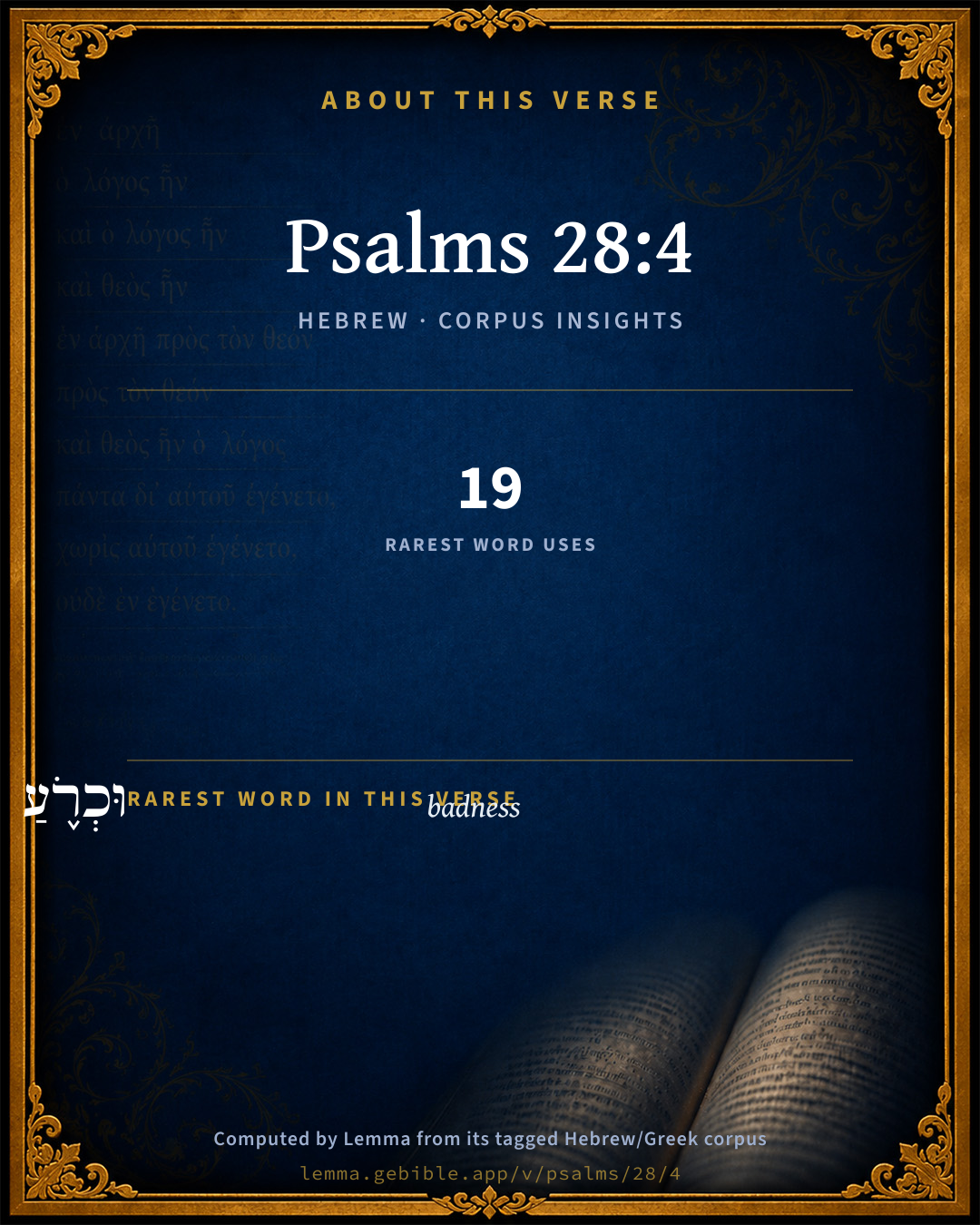
The rarest word here is וּכְרֹ֪עַ badness H7455 — appearing just 19 times in the whole Hebrew Bible.

Shared distinctive vocabulary

וּכְרֹ֪עַ badness H7455 occurs in 19 verses of the Hebrew Bible. Also found in:

Grammatical profile

  • 3 verbs
  • 6 nouns
  • 3 prepositions

Verb forms

  • תֶּן Qal · Imperative
  • תֵּ֣ן Qal · Imperative
  • הָשֵׁ֖ב Hiphil · Imperative

Repetition

A word recurs within this verse — often emphatic in Hebrew:

  • תֶּן to give H5414 ×2

Hebrew & Septuagint length

In English translation the verse runs 30 words from the Hebrew and 28 from the Septuagint (LXX English) — closely comparable.

A rough comparison of the two English renderings, which tokenize alike — not a word-level alignment.

Word counts can differ between the Hebrew and the Greek without any difference in meaning — e.g. the Hebrew direct-object marker אֵת has no separate Greek word, and Greek often adds the article ὁ.

Cross-references

17

Topical passages linked to Psalms 28:4 in the Treasury of Scripture Knowledge — connected by theme and wording, ordered by reader-vote popularity; previews shown in the World English Bible.

  • 2 Timothy 4:14 Alexander, the coppersmith, did much evil to me. The Lord will repay him according to his works,
  • Revelation 22:12 "Behold, I come quickly. My reward is with me, to repay to each man according to his work.
  • Psalms 109:17–21 Yes, he loved cursing, and it came to him. He didn't delight in blessing, and it was far from him.
  • Revelation 18:6 Return to her just as she returned, and repay her double as she did, and according to her works. In the cup which she mixed, mix to her double.
  • Ezra 9:13 After all that is come on us for our evil deeds, and for our great guilt, seeing that you our God have punished us less than our iniquities deserve, and have given us such a remnant,
  • Psalms 2:1–5 Why do the nations rage, And the peoples plot a vain thing?
  • Psalms 5:10 Hold them guilty, God. Let them fall by their own counsels; Thrust them out in the multitude of their transgressions, For they have rebelled against you.
  • Psalms 59:12–13 For the sin of their mouth, and the words of their lips, Let them be caught in their pride, For the curses and lies which they utter.
  • Psalms 69:22–24 Let their table before them become a snare. May it become a retribution and a trap.
  • Psalms 103:10 He has not dealt with us according to our sins, Nor repaid us for our iniquities.
  • Ezekiel 38:10 Thus says the Lord Yahweh: It shall happen in that day, that things shall come into your mind, and you shall devise an evil device:
  • Romans 11:22 See then the goodness and severity of God. Toward those who fell, severity; but toward you, goodness, if you continue in his goodness; otherwise you also will be cut off.
  • Psalms 21:10 You will destroy their descendants from the earth, Their posterity from among the children of men.
  • Psalms 62:12 Also to you, Lord, belongs loving kindness, For you reward every man according to his work.
  • Psalms 103:3–4 Who forgives all your sins; Who heals all your diseases;
  • Jeremiah 18:21–23 Therefore deliver up their children to the famine, and give them over to the power of the sword; and let their wives become childless, and widows; and let their men be slain of death, [and] their young men struck of the sword in battle.
  • Romans 2:6–8 who "will pay back to everyone according to their works:"

Cross-references courtesy of OpenBible.info (CC BY 4.0).

Hebrew and Greek witnesses Masoretic Hebrew ↔ Greek Septuagint

The same verse in the two great witnesses to the Old Testament, shown verse-for-verse.

You’re reading Greek Psalm 27 (Hebrew Psalm 28). The Septuagint counts the superscription, so verse numbers can differ from the Hebrew — chapter-level alignment, not verse-by-verse. Numbering follows Rahlfs.

These are two independent witnesses, not word-aligned to each other, and the Septuagint is shown in lemma (dictionary) form.

Hebrew Psalms 28:4 Masoretic · Westminster Leningrad Codex

תֶּן לָהֶ֣ם כְּפָעֳלָם֮ וּכְרֹ֪עַ מַֽעַלְלֵ֫יהֶ֥ם כְּמַעֲשֵׂ֣ה יְ֭דֵיהֶם תֵּ֣ן לָהֶ֑ם הָשֵׁ֖ב גְּמוּלָ֣ם לָהֶֽם

Give them according to their work, and according to the wickedness of their doings. Give them according to the operation of their hands. Bring back on them what they deserve.

World English Bible · Public Domain

Greek LXX Greek Psalm 27:4 Septuagint · lemma form

δίδωμι αὐτός κατά ὁ ἔργον αὐτός καί κατά ὁ πονηρία ὁ ἐπιτήδευμα αὐτός κατά ὁ ἔργον ὁ χείρ αὐτός δίδωμι αὐτός ἀποδίδωμι ὁ ἀνταπόδομα αὐτός αὐτός

Give them according to their works, and according to the wickedness of their devices: give them according to the works of their hands; render their recompense to them.

LXX2012 (modern English Septuagint) · Public Domain

Hebrew: Westminster Leningrad Codex (CC BY 4.0). Greek: Septuagint (public domain); English from LXX2012 (modern English Septuagint) (Public Domain). How the Septuagint differs from the Hebrew →

Commentary

Notes on Psalms 28:4 from classic Christian and Jewish commentators (each source and its license shown beneath its notes). The classic Christian expositions comment on the surrounding passage and are grouped to its opening verse, so a note may address several verses; the Jewish commentaries on the Tanakh (Rashi and others) are per-verse, so they appear only where the commentator wrote on this verse.

Lemma curates 59 commentaries, every one of them public domain or Creative Commons licensed, each selected and text-cleaned for this edition rather than reprinted as found. About our sources →

Trapp's Complete Commentary

John Trapp

Psa 28:4 Give them according to their deeds, and according to the wickedness of their endeavours: give them after the work of their hands; render to them their desert.

Ver. 4. Give them according to their deeds] God loveth to retaliate; and David, out of a public and prophetic spirit (not from private revenge, or troubled affections), taketh thus upon him to imprecate.

And according to the wickedness of their endeavours] They were therefore old, habituated, irreclaimable sinners whom he thus cursed, and against such this and such like imprecations are still in force.

Give them after the works of their hands] Because they regard not the works of thine hands, Psa 28:5. Par pari, saith Aben Ezra here.

John Trapp, A Commentary or Exposition upon All the Books of the Old and New Testament (1647–1656) — public domain. Text from a community e-Sword module.

The Biblical Illustrator

Joseph S. Exell

Psa_28:4-5

Give them according to their deeds.

Saints desire God to punish sinners

I. why impenitent sinners deserve to be punished. Their wickedness lies in their endeavours, or intentions, to do evil. All their free, voluntary exercises are entirely selfish and criminal, for which they deserve to be punished.

II. some sinners more deserve to be punished than others. One may design to take away a mans property, another may design to take away a mans life, and another may design to destroy a nation. These are all bad designs; but the second is worse than the first, and the third is worse than the second. Ill desert is always in proportion to the ill design of the agent; and the ill design of the agent is always in proportion to the magnitude of the evil he designs to do.

III. what is implied in Gods punishing finally impenitent sinners according to their deserts.

1. According to the duration of their deserts, i.e. for ever.

2. According to the degrees of their guilt. Christ expressly declares that it shall be more intolerable for some sinners than for others in the day of judgment.

IV. why good men desire that God would punish the finally impenitent according to their deserts.

1. It is the nature of true benevolence to love justice.

2. It is the nature of true love to God to desire that He may be glorified for ever.

3. To promote the highest good of the universe.

Conclusion:

1. If the ill desert of sinners essentially and necessarily consists in their free, voluntary design to do evil, then neither the foreknowledge, nor purpose, nor agency of God can ever afford them the least ground or reason to complain of Him for punishing them for ever.

2. If good men, for good reasons, desire God would punish the finally impenitent according to their deserts, then they are prepared to rejoice when they shall see Him display the glory of His justice in their future and eternal punishment.

3. If good men desire God to punish the finally impenitent for ever, for the reasons that have been mentioned, then sinners will never have any just ground to reproach or complain of them for feeling and expressing such a desire.

4. If good men desire God to punish the finally impenitent for ever, then they have no more reason to disbelieve and oppose the doctrine of reprobation than the doctrine of election.

5. If guilt or ill desert consists in the evil intentions of the heart, then there is a wide difference between awakenings and convictions. Sinners are commonly awakened before they are convinced. It is one thing to be sensible of danger, another thing to be sensible of guilt.

6. If guilt or ill desert consists in the selfish and sinful affections of the heart, then we may see why moral sinners commonly experience the deepest convictions before they are converted. They are not so easily awakened and alarmed as more open and profligate sinners.

7. Since all guilt or ill desert consists in the evil affections of the heart, it is easy to see why good men have been so much borne down with the burden of sin. Job, David, and Paul had a deep and habitual sense of their great criminality and guilt. The reason was, they had experienced keen convictions of conscience before they were converted; and this made their conscience always tender afterwards. (N. Emmons, D. D.)

The Biblical Illustrator, edited by Joseph S. Exell (c. 1880s–1900s) — public domain. Text from a community e-Sword module.

The Treasury of David

Charles H. Spurgeon

Ver. 4. When we view the wicked simply as such, and not as our fellow men, our indignation against sin leads us entirely to coincide with the acts of divine justice which punish evil, and to wish that justice might use her power to restrain by her terrors the cruel and unjust; but still the desires of the present verse, as our version renders it, are not readily made consistent with the spirit of the Christian dispensation, which seeks rather the reformation than the punishment of sinners. If we view the words before us as prophetic, or as in the future tense, declaring a fact, we are probably nearer to the true meaning than that given in our version. Ungodly reader, what will be your lot when the Lord deals with you according to your desert, and weighs out to you his wrath, not only in proportion to what you have actually done, but according to what you would have done if you could. Our endeavours are taken as facts; God takes the will for the deed, and punishes or rewards accordingly. Not in this life, but certainly in the next, God will repay his enemies to their faces, and give them the wages of their sins. Not according to their fawning words, but after the measure of their mischievous deeds, will the Lord mete out vengeance to them that know him not.

Ver. 4. Give them according to their deeds, etc. Here, again, occurs the difficult question about praying for vengeance, which, however, I shall despatch in a few words. In the first place, then, it is unquestionable, that if the flesh move us to seek revenge, the desire is wicked in the sight of God. He not only forbids us to imprecate evil upon our enemies in revenge for private injuries, but it cannot be otherwise than that all those desires which spring from hatred must be disordered. David's example, therefore, must not be alleged by those who are driven by their own intemperate passion to seek vengeance. The holy prophet is not inflamed here by his own private sorrow to devote his enemies to destruction; but laying aside the desire of the flesh, he give judgment concerning the matter itself. Before a man can, therefore, denounce vengeance against the wicked, he must first shake himself free from all improper feelings in his own mind. In the second place, prudence must be exercised, that the heinousness of the evils which offend us drive us not to intemperate zeal, which happened even to Christ's disciples, when they desired that fire might be brought from heaven to consume those who refused to entertain their Master. Lu 9:54. They pretended, it is true, to act according to the example of Elias, but Christ severely rebuked them, and told them that they knew not by what spirit they were actuated. In particular, we must observe this general rule, that we cordially desire and labour for the welfare of the whole human race. Thus it will come to pass, that we shall not only give way to the exercise of God's mercy, but shall also wish the conversion of those who seem obstinately to rush upon their own destruction. In short, David, being free from every evil passion, and likewise endued with the spirit of discretion and judgment, pleads here not so much his own cause as the cause of God. And by this prayer, he further reminds both himself and the faithful, that although the wicked may give themselves loose reins in the commission of every species of vice with impunity for a time, they must at length stand before the judgment seat of God. John Calvin.

Ver. 4. Give them according to their deeds, and according to the wickedness of their endeavours. Yes, great God, since thou hast from the beginning been only occupied in saving men, thou wilt surely strike with an eternal malediction these children of iniquity who appear to have been born only to be lost themselves, and to destroy others. The very benevolence towards mankind solicits thy thunders against these corrupters of society. The more thou hast done for our race, the more surely will the severity of thy justice reveal itself in destroying the wretches whose only study is to counteract thy goodness towards mankind. They labour incessantly to put men far away from thee, O my God, and in return thou wilt put them far away from thee for ever. They count it great gain to make their fellows thine enemies, and they shall have the desperate consolation of being such themselves to all eternity. What more fitting punishment for the wretches who desire to make all hearts rebel against thine adorable Majesty, than to lie through the baseness of their nature, under the eternal and frightful necessity of hating thee for ever. Jean Baptiste Massillon, rendered very freely by C. H. S.

Ver. 4. Give them according to their deeds. The Egyptians killed the Hebrew male children, and God smote the firstborn of Egypt. Sisera, who thought to destroy Israel with his iron chariots, was himself killed with an iron nail, stuck through his temples. Adonibezek, Jud 1:5-7. Gideon slew forty elders of Succoth, and his sons were murdered by Abimelech. Abimelech slew seventy sons of Gideon upon one stone, and his own head was broken by a piece of millstone thrown by a woman. Samson fell by the "lust of the eye, "and before death the Philistines put out his eyes. Agag, 1Sa 20:33. Saul slew the Gibeonites, and seven of his sons were hung up before the Lord. 2Sa 21:1-9. Ahab, after coveting Naboth's vineyard, 1Ki 21:19, fulfilled 2Ki 9:24-26. Jeroboam, the same hand that was stretched forth against the altar was withered, 1Ki 13:1-6. Joab having killed Abner, Amasa, and Absalom, was put to death by Solomon. Daniel's accusers thrown into the lion's den meant for Daniel. Haman hung upon the gallows designed for Mordecai. Judas purchased the field of blood, and then went and hanged himself. So in the history of later days, Bajazet was carried about by Tamerlane in an iron cage, as he intended to have carried Tamerlane. Mazentius built a bridge to entrap Constantine, and was overthrown himself of that very spot. Alexander VI. was poisoned by the wine he had prepared for another. Charles IX. made the streets of Paris to stream with Protestant blood, and soon after blood streamed from all parts of his body in a bloody sweat. Cardinal Beaton condemned George Wishart to death, and presently died a violent death himself. He was murdered in bed, and his body was laid out in the same window from which he had looked upon Wishart's execution. G. S. Bowes, in "Illustrative Gatherings."

Ver. 4. Render to them their desert. Meditate on God's righteousness, that it is not only his will, but his nature to punish sin; sin must damn thee without Christ, there is not only a possibility or probability that sin may ruin, but without an interest in Christ it must do so; whet much upon thy heart that must; God cannot but hate sin, because he is holy; and he cannot but punish sin, because he is righteous. God must not forego his own nature to gratify our humours. Christopher Fowler, in "Morning Exercises, "1676.

Ver. 4. He prayeth against his enemies, not out of any private revenge, but being led by the infallible spirit of prophecy, looking through these men to the enemies of Christ, and of his people in all ages. David Dickson.

Ver. 4-5. In these verses, as indeed in most of the imprecatory passages, the imperative and the future are used promiscuously: Give themrender themhe shall destroy them. If therefore, the verbs, in all such passages, were uniformly rendered in the "future, "every objection against the Scripture imprecations would vanish at once, and they would appear clearly to be what they are, namely, prophecies of the divine judgments, which have been since executed against the Jews, and which will be executed against all the enemies of Jehovah, and his Christ; whom neither the "works" of creation, nor those of redemption, can lead to repentance. George Horne.

Ver. 4. Measure for measure, or punishment proportioned to desert.

Ver. 4. Endeavour the measure of sin rather than mere result. Hence some are guilty of sins which they were unable to commit.

Psalms 28:5*

Ver. 4-5. See Psalms on "Ps 28:4" for further information. In these verses, as indeed in most of the imprecatory passages, the imperative and the future are used promiscuously: Give themrender themhe shall destroy them. If therefore, the verbs, in all such passages, were uniformly rendered in the "future, "every objection against the Scripture imprecations would vanish at once, and they would appear clearly to be what they are, namely, prophecies of the divine judgments, which have been since executed against the Jews, and which will be executed against all the enemies of Jehovah, and his Christ; whom neither the "works" of creation, nor those of redemption, can lead to repentance. George Horne.

Charles H. Spurgeon's The Treasury of David (1869–1885) — public domain. Psalms only. Text from a community e-Sword/MySword module.

Joseph Benson's Commentary

Psa 28:4. Give them according to their deeds, &c. — It is fit that they should suffer as they have acted, and reap the fruit of their manifold wickedness. Give them after the work of their hands, &c. — Dispense a reward to them according to their works, and deal with them as they have dealt with others. This verse would be better translated in the future; Thou wilt give, &c. For this prayer is evidently a prophecy, that God will, sooner or later, render to all impenitent sinners according to their deserts: see the next verse, and note on Psa 5:10.

Joseph Benson's Commentary on the Old and New Testaments (1811–1818) — public domain. Text from a community e-Sword module.

J. A. Alexander on Psalms

Joseph Addison Alexander

4. (Psa 28:4) Give to them according to their act, and according to the evil of their deeds, according to the work of their hands give thou to them; return their treatment to them. Having prayed that he may not share the destruction of the wicked, he now prays that they may not escape it. But as this is merely asking God to act as a just and holy being must act, the charge of vindictive ruelty is not merely groundless, but absurd.—The evil of their deeds is a phrase borrowed from Moses (Deut. xxviii. 20), and often repeated by Jeremiah (Jer 4:4; Jer 21:12; Jer 23:2; Jer 23:22; Jer 26:3; Jer 44:22). The same prophet has combined two of the phrases here employed in Jer 25:14, and Lam 3:64. The word translated treatment is a participle meaning that which is done by one person to another, whether good or evil. See above, on Psa 7:5 (4).

Joseph Addison Alexander, The Psalms Translated and Explained (1850) — public domain. Text from a community e-Sword module.

Geneva Bible (1599)

Geneva Bible translators

He thus prayeth in respect to God’s glory and not for his own cause, being assured that God would punish the persecutors of his Church.

Geneva Bible (1599) marginal notes — public domain. Text via Bolls.life.

Jamieson, Fausset & Brown

Robert Jamieson, A. R. Fausset & David Brown

The imprecation is justified in Psa 28:5. The force of the passage is greatly enhanced by the accumulation of terms describing their sin.

endeavours--points out their deliberate sinfulness.

Jamieson, Fausset & Brown — Commentary Critical and Explanatory on the Whole Bible (1871) — public domain (CC PDM 1.0). Text via the HelloAO Bible API.

Adam Clarke's Commentary

Verse 4. Give them] Is the same as thou wilt give them; a prophetic declaration of what their lot will be.

Adam Clarke's Commentary on the Bible (1810–1826) — public domain. Text from a community e-Sword/MySword module.

John Calvin's Commentaries

4. Give them according to their works. Having thus requested God to have a regard to his innocence, the Psalmist thunders forth a curse against his enemies. And the accumulation of words shows that he had groaned long and grievously under the burden before he broke forth to desire such vengeance. He intimates that the wicked of whom he speaks had transgressed not once, nor for a short time, nor in one way, but that they had proceeded so far in their constant evil doings, that their audacity was no longer to be endured. We know how troublesome and grievous a temptation it is to see the ungodly proceeding without measure or end, as if God connived at their wickedness. David, therefore, wearied as it were with continual forbearing, and fainting under the burden, implores God, at length, to restrain the wantonness of his enemies, who of late ceased not to heap wickedness upon wickedness. Thus we perceive that there is nothing superfluous in this verse, when to works he adds the wickedness of their doings, and the work of their hands, and thrice petitions that they may receive the reward which they have deserved. Add to this, that he at the same time bears testimony to his own faith, to which boasting hypocrites often compel the children of God, while by their deceit and cavils, they impose upon the judgments of the world. We see how men who are distinguished for wickedness, not content with impunity themselves, cannot abstain from oppressing the innocent by false accusations, just as the wolf, desirous of making a prey “Voulant devorer les agneaux.” — Fr.

John Calvin's Commentaries (1540-1563) — public domain. Text from the Calvin Translation Society English edition (1840s-50s) via the Christian Classics Ethereal Library (ccel.org). Calvin's coverage is partial (roughly two-thirds of the Bible); uncommented books and verses are honest gaps, never fabricated. The 19th-century editor's footnotes and remarks are omitted so the notes are faithfully Calvin's own voice.

Ellicott's Commentary for English Readers

(4) Give them according to their deeds.—The justice of the lex talionis was deeply impressed on the mind of Israel, and we need not wonder to find its enforcement made the subject of prayer. A general notice of the imprecations of the Psalms will be found in the General Introduction (VI.). Here it is enough to remark that there is no indication of personal animosity or vindictiveness. The poet, even if expressing his own feelings, was identified with devout Israel, to whom it was natural not only to expect from Jehovah the manifestation of judgment which could alone remove the conditions that were so unfavourable to the true religion, but also to pray that He would at the same time vindicate Himself and justify those faithful to Him. (Comp. for the general thought Isa_3:8-11.) In the actual course of God’s providence, the retribution is often very accurately apportioned to the evil deed, and the Bible contains many strong instances—e.g., that of Adonibezek (Jdg_1:5; Jdg_1:7).

A Bible Commentary for English Readers, edited by Charles John Ellicott (1878–1897) — public domain. Text from a community e-Sword module.

The Cambridge Bible for Schools and Colleges

gen. ed. J. J. S. Perowne

4. Give them according to their work,

And according to the evil of their doings:

Give them according to the operation of their hands.

This is not a vindictive craving for personal revenge, but a solemn prayer that Jehovah will openly convict false and wicked men by manifesting His righteous judgements upon them, and punishing them as they deserve. See Introd. p. xc.

Give] Of a judicial sentence. Cp. Hos_9:14; Jer_32:19.

their desert] The word denotes an action either good or bad, and its fitting reward.

The Cambridge Bible for Schools and Colleges (gen. ed. J. J. S. Perowne; Cambridge University Press, 1878–1918) — public domain. Text from a community e-Sword module.

John Gill's Exposition

Give them according to their deeds,.... According to the demerit of them, which is death, even death eternal;

and according to the wickedness of their endeavours; for though wicked men do not always succeed; yet their want of success does not excuse their wickedness;

give them after the work of their hands; see Ti2 4:14;

render to them their desert; what their iniquities, in thought, word, and deed, deserve: such petitions are not contrary to that Christian charity which the Gospel recommends; nor do they savour of a spirit of revenge, which is condemned by the word of God; for it should be observed, that these things are said with respect to men given up to a reprobate mind; and that the psalmist does not seek to avenge himself, nor to gratify his own mind; but he sought the glory of God, and moreover spoke by a prophetic spirit, knowing what was the will of God in this case; see Psa 28:5; and therefore these petitions of his are not to be drawn into an example in common and ordinary cases.

John Gill's Exposition of the Whole Bible (1746–1763) — public domain (CC PDM 1.0). Text via the HelloAO Bible API.

Albert Barnes' Notes on the Bible

Give them according to their deeds - Deal righteously with them. Recompense them as they deserve.

And according to the wickedness of their endeavours - Their designs; their works; their plans.

Give them after the work of their hands - Reward them according to what they do.

Render to them their desert - A just recompense. This whole verse is a prayer that God would deal “justly” with them. There is no evidence that there is anything of vindictiveness or malice in the prayer. In itself considered, there is no impropriety in praying that “justice” may be done to the violators of law. See the general introduction, section 6.

Albert Barnes' Notes on the Bible (1834–1885) — public domain. Text from a community e-Sword/MySword module.

Matthew Poole's English Annotations

David useth these imprecations, partly, to vindicate himself from the slanders of his enemies, who reported him to be as wicked as they were, only more close and cunning therein; which, if he had been, he had bitterly cursed himself; which it could not reasonably be presumed that he would do; partly, from his great and long experience of their implacable and incorrigible malignity, not only against him, but against God, and his declared will, and against all truly good men, and that covered with pretences of piety to God, and of peaceableness towards their neighbours, Psa 28:3, which made their wickedness more inexcusable and detestable; partly, by the instinct and direction of God’s Spirit, by whose inspiration he uttered this as well as the rest of the Psalm; and partly, that hereby he might provoke them to repentance; for this curse belongs only to those who shall obstinately persist in their wicked courses. Add to all this, that as verbs of the imperative mood are oft used by the Hebrews for futures, so these may not be proper imprecations, but predictions of their destruction.

Matthew Poole's English Annotations on the Holy Bible (1683–1685) — public domain. Text from a community e-Sword/MySword module.

Whedon's Commentary on the Bible

Daniel D. Whedon

4. Give them according to their deeds—The prayer of this verse is only that justice may obtain, not for purposes of private revenge, but of public safety. The character and designs of David’s enemies must be considered.

The nation was in the tumult of rebellion and the whirl of revolution. He was the king and father of his people; and for their sakes, and for righteousness’ sake, he prays for that interposition of penal judgment which alone could save the nation.

Daniel D. Whedon (gen. ed.), Commentary on the Old and New Testaments (1874–1909) — public domain. Text from a community e-Sword module.

The Pulpit Commentary

Give them according to their deeds, and according to the wickedness of their endeavours. The feeling of righteous indignation, naturally implanted in us, causes us to desire the punishment of the wicked, quite apart from any wrong that they may have done to ourselves (Aristotle, "Rhet.," 2:1, Give them after the work of their hands: render to them their desert. Nothing satisfies our moral feelings but exact retribution Eike tayoi tak erexe, dikh h iyeia genoito . David shows in both respects a moral nature uncorrupted by contact with the world of his day.

The Pulpit Commentary (1880–1919), ed. H.D.M. Spence-Jones & Joseph S. Exell — public domain. Text from a community e-Sword module.

Lesson kit

Teaching starters — assembled from the data on this page, not authored interpretation. Every prompt links to the verse data it draws on. Edit before teaching.

Psalms, in the Wisdom, opens this verse with 12 words (8 distinct Hebrew lemmas). Its most distinctive word is rôaʻ (“badness”). A historical commentator’s framing appears above. Read the whole chapter for the surrounding context.

Discussion questions

  1. What does “badness” (rôaʻ) contribute to the verse as a whole?
  2. Genesis 41:19 shares the word «badness» with this verse. How do the two illuminate each other?
  3. “to give” occurs 2× in this one verse. What is the effect of the repetition?
  4. These translations render this verse differently; the difference is in the English rendering, not the original. What questions does that raise?
  5. The verb «תֶּן» is Qal Imperative. How does its form color the action?
  6. Reading how Trapp's Complete Commentary and The Biblical Illustrator read this verse, where do the two commentators agree and where do they part?

Things to notice

Reading settings

Reading text

Shown beneath each verse's original-language words.

Old Testament
Old Testament edition

Read the OT as the Masoretic Hebrew (MT) or the Greek Septuagint (LXX).

English shown for the Greek Septuagint (in the Hebrew ↔ Greek comparison).

Comparing translations? Open the Compare panel on any verse page to stack up to four side by side.