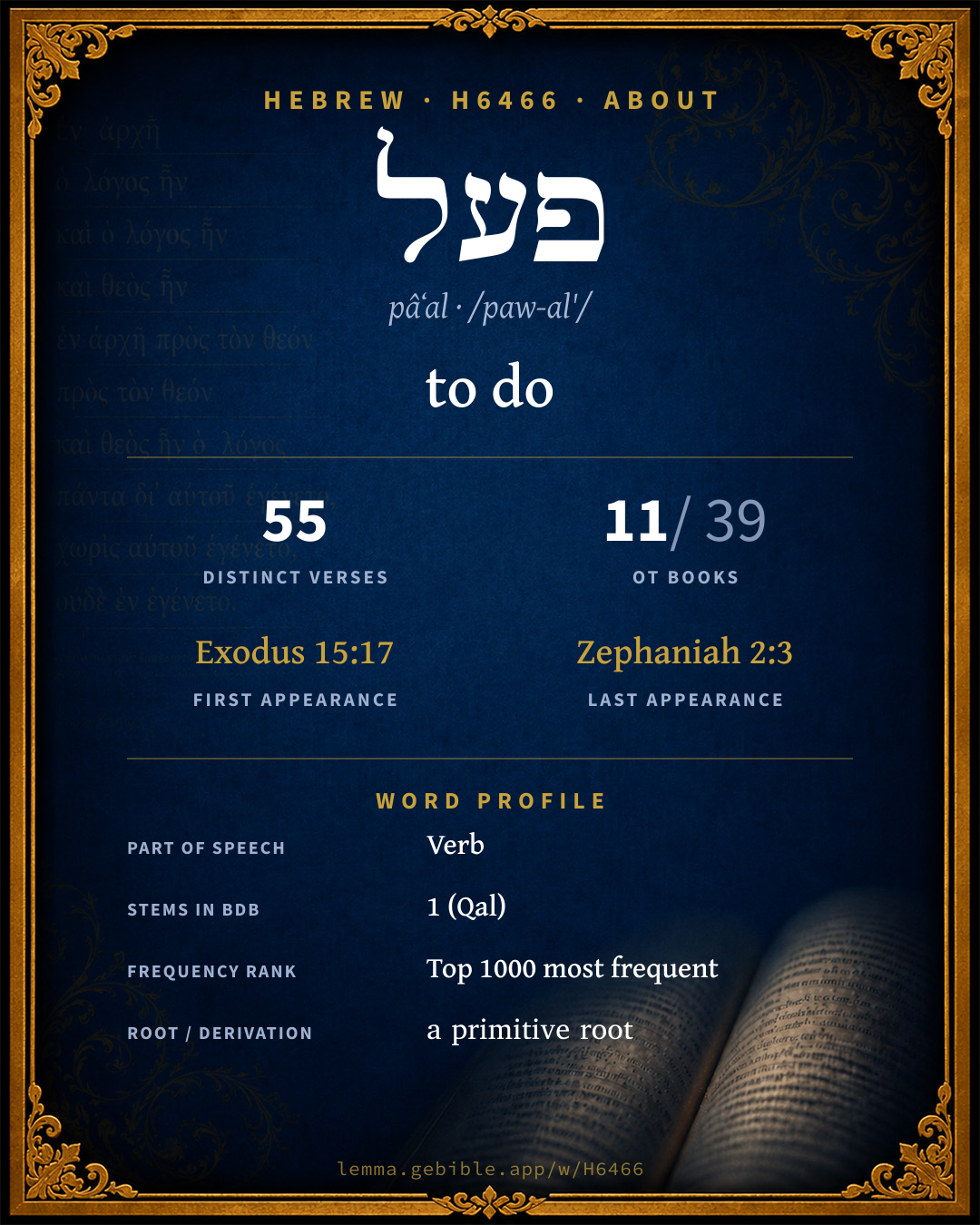
פָּעַל
to do
‘to do’ is one of 3 main senses fuller range ↓
Full lexicon entry — Brown-Driver-Briggs (BDB)
From Brown-Driver-Briggs (BDB)
Where this word appears
Grammar key — what these labels mean
Part of speech
- Verb
- An action or state-of-being word.
Stem
- Qal
- The basic, simple active stem — the plain form of the verb (“he wrote”). Here: ‘do’
Form
- Participle Active
- A verbal adjective expressing ongoing or characteristic action (“writing / one who writes”).
- Perfect
- A completed action or state — Hebrew marks aspect (completeness) more than strict tense (“he wrote”).
- Imperfect
- An incomplete, ongoing, or future action (“he will / would write”).
- Sequential Imperfect
- An imperfect with prefixed waw — the standard past-narrative form (waw-consecutive imperfect).
State
- Construct
- A noun bound to a following noun in a possessive / “of” relationship (the construct chain).
- Absolute
- The independent form of a noun, not bound to a following word.
Person
- 2nd Person
- The one addressed (“you”).
- 3rd Person
- The one spoken about (“he / she / it / they”).
- 1st Person
- The speaker (“I / we”).
Gender
- Masculine
- Grammatically masculine.
- Common
- Either gender — not distinguished for this form.
Number
- Plural
- More than one (in Hebrew, generally three or more).
- Singular
- One.
Grammatical forms 12 distinct
- Verb, Qal, Participle Active, Masculine, Plural, Construct 24 times (43%)
- Verb, Qal, Perfect, 2nd Person, Masculine, Singular 6 times (11%)
- Verb, Qal, Perfect, 3rd Person, Masculine, Singular 6 times (11%)
- Verb, Qal, Imperfect, 3rd Person, Masculine, Singular 5 times (9%)
- Verb, Qal, Perfect, 3rd Person, Common, Plural 3 times (5%)
- Verb, Qal, Participle Active, Masculine, Singular, Absolute 3 times (5%)
- Verb, Qal, Imperfect, 1st Person, Common, Singular 2 times (4%)
- Verb, Qal, Imperfect, 2nd Person, Masculine, Singular 2 times (4%)
+4 more forms (5 occurrences)
Parsed forms decoded from the imported morphology (morphhb / Westminster Leningrad Codex — WLC text public domain, morphhb tagging CC BY 4.0), counted across 56 parsed occurrences — not distinct verses.
Every verse where H6466 appears — 55 distinct verses across 11 books. Click any verse to open its interlinear word-by-word view. Verse text shown in the World English Bible for context — . Each verse’s Hebrew form is shown with its reference; the English is not keyword-highlighted, since the data carries no word-level English alignment. Use “Compare translations” on any verse to read it across multiple English versions. This concordance covers the Hebrew Bible; Septuagint (Greek Old Testament) occurrences are not indexed here.
Exodus 1 verse
Numbers 1 verse
Deuteronomy 1 verse
Job 11 verses
- Job 7:20 אֶפְעַ֨ל Qal impf 1cs If I have sinned, what do I do to you, you watcher of men? Why have you set me as a mark for you, So that I am a burden to myself?
- Job 11:8 תִּפְעָ֑ל Qal impf 2ms They are high as heaven. What can you do? Deeper than Sheol: what can you know?
- Job 22:17 יִּפְעַ֖ל Qal impf 3ms Who said to God, 'Depart from us;' And, 'What can the Almighty do for us?'
- Job 31:3 לְ/פֹ֣עֲלֵי prep + Qal ptcp.act mp cs Is it not calamity to the unrighteous, And disaster to the workers of iniquity?
- Job 33:29 יִפְעַל Qal impf 3ms "Behold, God works all these things, Twice, yes three times, with a man,
- Job 34:8 פֹּ֣עֲלֵי Qal ptcp.act mp cs Who goes in company with the workers of iniquity, And walks with wicked men?
- Job 34:22 פֹּ֣עֲלֵי Qal ptcp.act mp cs There is no darkness, nor thick gloom, Where the workers of iniquity may hide themselves.
- Job 34:32 פָּ֝עַ֗לְתִּי Qal pf 1cs Teach me that which I don't see. If I have done iniquity, I will do it no more'?
- Job 35:6 תִּפְעָל Qal impf 2ms If you have sinned, what effect do you have against him? If your transgressions are multiplied, what do you do to him?
- Job 36:3 וּ֝/לְ/פֹעֲלִ֗/י conj + prep + Qal ptcp.act ms cs + sfx pers 1cs I will get my knowledge from afar, And will ascribe righteousness to my Maker.
- Job 36:23 פָּעַ֥לְתָּ Qal pf 2ms Who has prescribed his way for him? Or who can say, 'You have committed unrighteousness?'
Psalms 26 verses
- Psalms 5:5 פֹּ֥עֲלֵי Qal ptcp.act mp cs The arrogant shall not stand in your sight. You hate all workers of iniquity.
- Psalms 6:8 פֹּ֣עֲלֵי Qal ptcp.act mp cs Depart from me, all you workers of iniquity, For Yahweh has heard the voice of my weeping.
- Psalms 7:13 יִפְעָֽל Qal impf 3ms He has also prepared for himself the instruments of death. He makes ready his flaming arrows.
- Psalms 7:15 יִפְעָֽל Qal impf 3ms He has dug a hole, And has fallen into the pit which he made.
- Psalms 11:3 פָּעָֽל Qal pf 3ms If the foundations are destroyed, What can the righteous do?
- Psalms 14:4 פֹּ֪עֲלֵ֫י Qal ptcp.act mp cs Have all the workers of iniquity no knowledge, Who eat up my people as they eat bread, And don't call on Yahweh?
- Psalms 15:2 וּ/פֹעֵ֥ל conj + Qal ptcp.act ms He who walks blamelessly does what is right, And speaks truth in his heart;
- Psalms 28:3 פֹּ֪עֲלֵ֫י Qal ptcp.act mp cs Don't draw me away with the wicked, With the workers of iniquity who speak peace with their neighbors, But mischief is in their hearts.
- Psalms 31:19 פָּ֭עַלְתָּ Qal pf 2ms Oh how great is your goodness, Which you have laid up for those who fear you, Which you have worked for those who take refuge in you, Before the sons of men!
- Psalms 36:12 פֹּ֣עֲלֵי Qal ptcp.act mp cs There the workers of iniquity are fallen. They are thrust down, and shall not be able to rise.
- Psalms 44:1 פָּעַ֥לְתָּ Qal pf 2ms We have heard with our ears, God; Our fathers have told us, What work you did in their days, In the days of old.
- Psalms 53:4 פֹּ֤עֲלֵ֫י Qal ptcp.act mp cs Have the workers of iniquity no knowledge, Who eat up my people as they eat bread, And don't call on God?
- Psalms 58:2 תִּפְעָ֫ל֥וּ/ן Qal impf 2mp + sfx n No, in your heart you plot injustice. You measure out the violence of your hands in the earth.
- Psalms 59:2 מִ/פֹּ֣עֲלֵי prep + Qal ptcp.act mp cs Deliver me from the workers of iniquity. Save me from the bloodthirsty men.
- Psalms 64:2 פֹּ֣עֲלֵי Qal ptcp.act mp cs Hide me from the conspiracy of the wicked, From the noisy crowd of the ones doing evil;
- Psalms 68:28 פָּעַ֥לְתָּ Qal pf 2ms Your God has commanded your strength. Strengthen, God, that which you have done for us.
- Psalms 74:12 פֹּעֵ֥ל Qal ptcp.act ms Yet God is my King of old, Working salvation in the midst of the earth.
- Psalms 92:7 פֹּ֣עֲלֵי Qal ptcp.act mp cs Though the wicked spring up as the grass, And all the evil-doers flourish, They will be destroyed forever.
- Psalms 92:9 פֹּ֥עֲלֵי Qal ptcp.act mp cs For, behold, your enemies, Yahweh, For, behold, your enemies shall perish. All the evil-doers will be scattered.
- Psalms 94:4 פֹּ֥עֲלֵי Qal ptcp.act mp cs They pour out arrogant words. All the evil-doers boast.
- Psalms 94:16 פֹּ֥עֲלֵי Qal ptcp.act mp cs Who will rise up for me against the wicked? Who will stand up for me against the evil-doers?
- Psalms 101:8 פֹּ֥עֲלֵי Qal ptcp.act mp cs Morning by morning, I will destroy all the wicked of the land; To cut off all the workers of iniquity from Yahweh's city.
- Psalms 119:3 פָעֲל֣וּ Qal pf 3cp Yes, they do nothing wrong. They walk in his ways.
- Psalms 125:5 פֹּעֲלֵ֣י Qal ptcp.act mp cs But as for those who turn aside to their crooked ways, Yahweh will lead them away with the workers of iniquity. Peace be on Israel.
- Psalms 141:4 פֹּֽעֲלֵי Qal ptcp.act mp cs Don't incline my heart to any evil thing, To practice deeds of wickedness with men who work iniquity. Don't let me eat of their delicacies.
- Psalms 141:9 פֹּ֣עֲלֵי Qal ptcp.act mp cs Keep me from the snare which they have laid for me, From the traps of the workers of iniquity.
Proverbs 4 verses
- Proverbs 10:29 לְ/פֹ֣עֲלֵי prep + Qal ptcp.act mp cs The way of Yahweh is a stronghold to the upright, But it is a destruction to the workers of iniquity.
- Proverbs 16:4 פָּעַ֣ל Qal pf 3ms Yahweh has made everything for its own end-- Yes, even the wicked for the day of evil.
- Proverbs 21:15 לְ/פֹ֣עֲלֵי prep + Qal ptcp.act mp cs It is joy to the righteous to do justice; But it is a destruction to the workers of iniquity.
- Proverbs 30:20 פָעַ֥לְתִּי Qal pf 1cs So is the way of an adulterous woman: She eats and wipes her mouth, And says, 'I have done nothing wrong.'
Isaiah 6 verses
- Isaiah 26:12 פָּעַ֥לְתָּ Qal pf 2ms Yahweh, you will ordain peace for us; for you have also worked all our works for us.
- Isaiah 31:2 פֹּ֥עֲלֵי Qal ptcp.act mp cs Yet he also is wise, and will bring evil, and will not call back his words, but will arise against the house of the evil-doers, and against the help of those who work iniquity.
- Isaiah 41:4 פָעַ֣ל Qal pf 3ms Who has worked and done it, calling the generations from the beginning? I, Yahweh, the first, and with the last, I am he.
- Isaiah 43:13 אֶפְעַ֖ל Qal impf 1cs Yes, since the day was I am he; and there is none who can deliver out of my hand: I will work, and who can hinder it?
- Isaiah 44:12 וּ/פָעַל֙ וַ/יִּפְעָלֵ֨/הוּ֙ conj + Qal pf 3ms conj + Qal wimpf 3ms + sfx pers 3ms The smith [makes] an axe, and works in the coals, and fashions it with hammers, and works it with his strong arm: yes, he is hungry, and his strength fails; he drinks no water, and is faint.
- Isaiah 44:15 יִפְעַל Qal impf 3ms Then shall it be for a man to burn; and he takes of it, and warms himself; yes, he kindles it, and bakes bread: yes, he makes a god, and worships it; he makes it an engraved image, and falls down to it.
Hosea 2 verses
- Hosea 6:8 פֹּ֣עֲלֵי Qal ptcp.act mp cs Gilead is a city of those who work iniquity; It is stained with blood.
- Hosea 7:1 פָעֲל֖וּ Qal pf 3cp When I would heal Israel, Then the iniquity of Ephraim is uncovered, Also the wickedness of Samaria; For they commit falsehood, And the thief enters in, And the gang of robbers ravages outside.
Micah 1 verse
Habakkuk 1 verse
Zephaniah 1 verse
About this entry
At a glance — auto-summarized from this page’s data, not written by a person. Every figure links to its source below. This summary describes the numbers; it doesn’t interpret them.
פעל — transliterated pâʻal — is a Hebrew verb carrying the sense “to do.” Older and newer Bibles part ways — “workers” in the King James Version, “doers of” (unfoldingWord Literal Text) in modern versions. See the renderings breakdown. It appears 55 verses across 11 books of the Hebrew Bible, among its moderately common vocabulary. More than a third of its appearances fall in Psalms. The lexicon spreads it across several senses; see its full sense range. Each statement above links to its evidence; the full detail follows below.
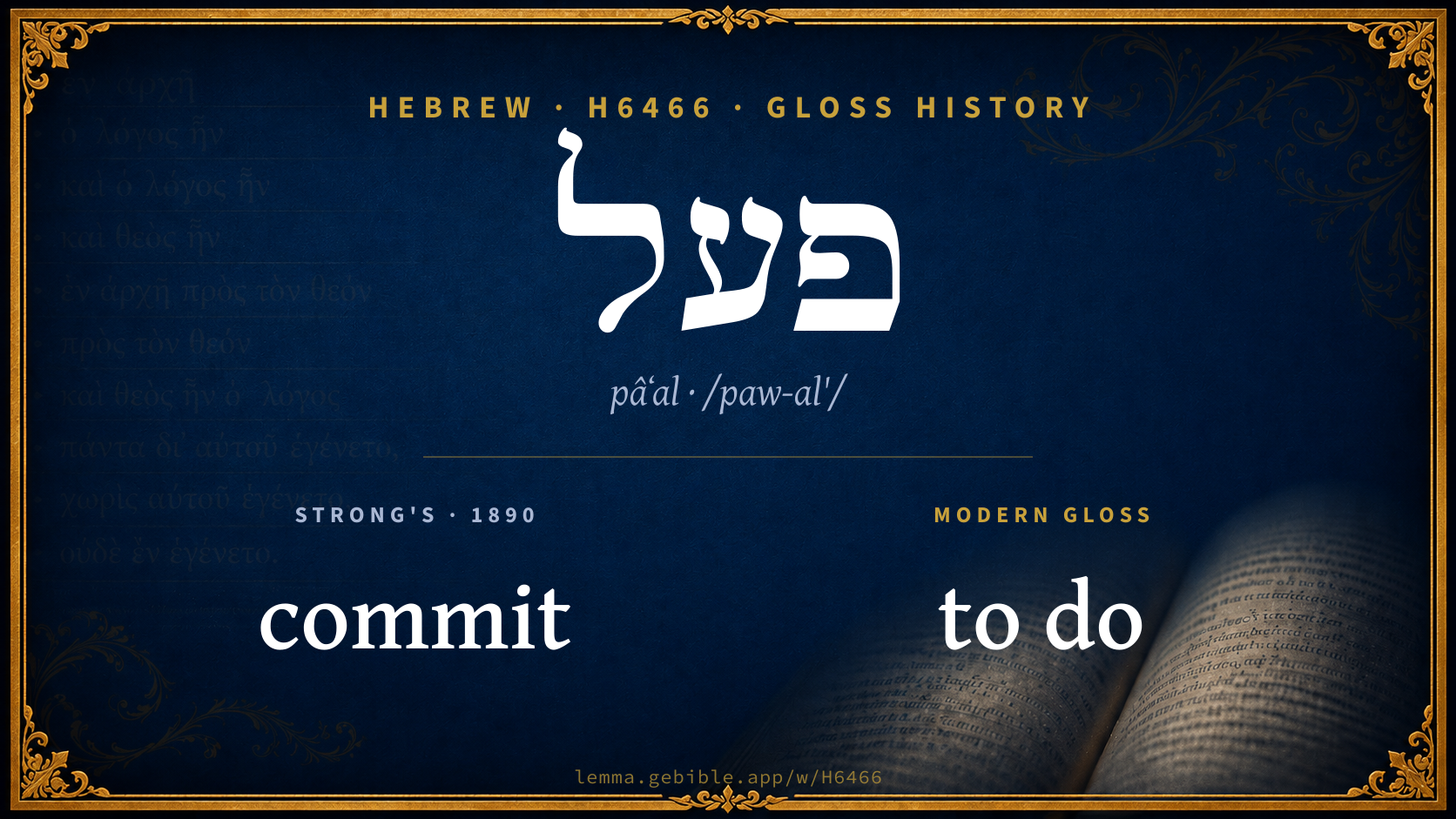
Gloss history
Strong's 1890 vs modern scholarship
About this word
Strong's H6466 catalogs a Hebrew word from the Hebrew Old Testament.
These counts are not copied from any lexicon or concordance. They are computed here, from the morphology-tagged Hebrew Old Testament. What Lemma adds →
- 55
- distinct verses
- The word appears in 55 distinct verses.
- 11 / 39
- OT books
- The word appears in 11 of 39 Old Testament books.
- #678
- by frequency
- Top 1000 most frequent Hebrew words (rank 678 of 8,640 Hebrew words by occurrence).
View all 55 occurrences in the concordance →
By section of the Old Testament
By traditional corpus
Conventional, traditional groupings — biblical authorship is debated, so this is a traditional corpus grouping, not an authorship claim. Each share is this word’s portion of its verses in that division of the Hebrew canon. Each figure is a share of the word’s 55 distinct verses.
- Writings (Ketuvim) 41 verses · 75%
- Prophets (Nevi'im) 11 verses · 20%
- Torah (Pentateuch) 3 verses · 5%
How translations render this word
Counts come from each version’s own published word-to-Strong’s tagging or interlinear alignment — an approximate guide to how each version renders this word, not a word-level alignment the data otherwise carries. Because each total is that version’s own tagged count, the per-version totals vary from one another and need not match the appearance or distinct-verse counts above. These counts may also differ from a printed concordance because Lemma counts each distinctly tagged rendering and does not collapse phrase taggings into a single head-word total. This is a fixed set of word-tagged versions (KJV, ASV, BSB, ULT) and does not change with the reading translation you choose elsewhere. Each version’s license is shown beside its name below (and on Sources).
- King James Version: Workers 7×, Work 4×, All the workers 3×
- American Standard Version: Workers 9×, All the workers 4×, Work 3×
- Berean Standard Bible: Workers 9×, Evildoers 8×, Do 5×
- unfoldingWord Literal Text: Doers of 13×, Workers of 9×, Do 5×
King James Version Public Domain
Renders H6466 across 56 tagged occurrences — most commonly:
Plus 32 renderings that appear only once — usually multi-word phrases or single function words the recovered tagging swept in, not distinct renderings.
American Standard Version Public Domain
Renders H6466 across 54 tagged occurrences — most commonly:
Plus 33 renderings that appear only once — usually multi-word phrases or single function words the recovered tagging swept in, not distinct renderings.
Berean Standard Bible Public Domain
Renders H6466 across 57 tagged occurrences — most commonly:
Plus 29 renderings that appear only once — usually multi-word phrases or single function words the recovered tagging swept in, not distinct renderings.
unfoldingWord Literal Text CC BY-SA 4.0
Renders H6466 across 65 tagged occurrences — most commonly:
Plus 32 renderings that appear only once — usually multi-word phrases or single function words the recovered tagging swept in, not distinct renderings.
8 senses and sub-senses in the full BDB
What do BDB’s symbols mean?
BDB uses these scholarly abbreviations:
| Symbol | Meaning |
|---|---|
| 𝔊 | the Septuagint (the ancient Greek translation, LXX) |
| 𝔙 | the Vulgate (the Latin translation) |
| 𝔖 | the Syriac version (the Peshitta) |
| 𝔗 | the Targum (the Aramaic translation) |
| ψ | the Psalms |
| √ | root (the underlying root or stem) |
| ‖ | parallel passage (a synonymous or contrasted parallel) |
| † | the dagger: every passage where the word occurs is cited |
The 8 senses and sub-senses the full Brown-Driver-Briggs lexicon distinguishes for this word, in lexicon order (not ranked by frequency), with BDB’s own verbatim wording and sub-sense lettering. Shown in Hebrew script with BDB’s own scholarly abbreviations. The condensed entry is in the Lexicon Entry tab. See also the Forms in the corpus table below.
Qal
- Pf. 3 ms. Dt 32:27 +, פָ֫עַל אֵל Nu 23:23, 2 ms. פָּעַלְתָּ Ex 15:17 +, etc.; Impf. 3 ms. יִפְעַל Jb 22:17 +; 2 ms. תִּפְעָל־ 35:6, etc.; Inf. cstr. לְפָעֳלָם Jb 37:12 (v. infr.); Pt. act. פֹּעֵל ψ 15:2 +, pl. cstr. פֹּעֲלֵי 5:6 +, etc.;— e.g. Deuteronomy 32:27
- 1. do:
- a. of God, c. acc. (abstr.) Nu 23:23; Dt 32:27; Jb 33:29, יְשׁוּעוֹת ψ 74:12; + ל pers. ψ 31:20; 68:29; Is 26:12 Jb 22:17; c. acc. cogn. פֹּעַלִ ψ 44:2 Hb 1:5; acc. om. Is 43:13, cf. 41:4. e.g. Numbers 23:23
- b. of men, c. acc. ψ 11:3 Jb 11:8, + ל pers. (God) 7:20, + ב pers. (God) 35:6; especially of doing evil, שָׁ֑קֶר Ho 7:1, עָוֶל Jb 34:32, עַוְלָה 36:23 ψ 58:3; 119:3, אָוֶן Pr 30:20, especially פֹּעֲלֵי אָוֶן Ho 6:8; Is 31:2 Jb 31:3; 34:8, 22 ψ 5:6 + 15 times ψ, Pr 10:29; 21:15, פֹּעֲלֵי רָע Mi 2:1; rarely of doing right, c. acc. מִשְׁפָּטוֹ Zp 2:3, צֶדֶק ψ 15:2. e.g. Psalms 11:3
- c. of clouds, c. acc. Jb 37:12 (disregarding—֑). e.g. Job 37:12
- 2. make:
- a. of God, c. acc. concr. object + ל end Pr 16:4, ל of 2nd obj. ψ 7:14; פֹּעֲלִי Jb 36:3 my Maker. e.g. Proverbs 16:4
- b. of man, c. acc. concr. Is 44:12, 15; acc. om. 44:12 ψ 7:16.—Is 1:31 v. פֹּעַל. e.g. Isaiah 44:12
Senses from the full Brown-Driver-Briggs lexicon (Brown, Driver, Briggs; Oxford 1906 — public domain), digitized via Sefaria, supplemented by the OpenScriptures HebrewLexicon (CC BY 4.0). Full attribution on Sources.
Word origin
vb. do, make (poet. for עָשָׂה) (NH פּוֹעֵל workman, cf. J Aram.; Ph. פעל = BH (often); Arabic فَعَلَ id.; Old Aramaic פעל; Syriac in der. spec. and deriv.);—
— Brown-Driver-Briggs (Oxford 1906, public domain), digitized via Sefaria, supplemented by the OpenScriptures HebrewLexicon (CC BY 4.0). See Sources.
Origin: a primitive root
Jastrow Dictionary
A second Hebrew/Aramaic lexicon for comparison, covering Aramaic and post-biblical (Talmudic, Targumic, Midrashic) usage that the biblical-Hebrew BDB does not. Matched by lemma rather than by Strong’s number, so a lemma may carry more than one Jastrow headword (shown separately below), and the entries cover usage well beyond the Bible.
פָּעַל I
- (b. h.) [to split, cmp. פלח,] to work. Y. Sabb. II, end, 8ᵈ; Tanḥ. Emor 7; Lev. R. s. 27 (ref. to Num. XXIII, 23) כל מי שפ׳ עם לא וכ׳ let whosoever worked with God come and take his reward. Lev. R. s. 4 כל מה שיִפְעַל אדם עם נפשו וכ׳ however much man may do for his soul, he has not done his full duty. Gen. R. s. 15 (ref. to Ps. LXXIV, 12) ראו פועלא טבא שהתקין … עמדתי לִפְעוֹל see the good employer, for the Lord has prepared my wages (the garden of Eden), before yet I arose to work; Yalk. ib. 20. Midr. Till. to Ps. XCII בששת … פָּעַלְתִּי את העולם ובשבת נחתי in the six working days I worked and made the world, and on the Sabbath I rested; a. fr.—Esp. to deal. Lam. R. to III, 33 [read:] בשני מקומות פָּעֲלוּ ישראל עם הקב"ה באחד פעלו בפיהם ולא בלבם ובאחד פעלו בלבם ולא בפיהם in two places Israelites dealt with God, in one they dealt with their mouth (professed faith), but not with their heart, and in the other, they dealt with their heart (were loyal at heart), but not with their mouth; בסיני פעלו בפיהם וכ׳ at Sinai they dealt with their mouth but not with their heart (ref. to Ps. LXXVIII, 36); בבבל פעלו בלבם וכ׳ in Babylonia they dealt with their heart, but not with their mouth (ref. to Lam. l. c.); Cant. R. to VII, 8. e.g. Numbers 23:23
פָּעַל II
- laborer, v. פּוֹעַל II.
A Dictionary of the Targumim, the Talmud Babli and Yerushalmi, and the Midrashic Literature (Marcus Jastrow; London, Luzac, 1903) — Public Domain. Digitized via Sefaria. Digitized via Sefaria. Full attribution on Sources.
Forms in the corpus
The 36 distinct written forms H6466 takes in the Hebrew Bible, most frequent first — each parse links to that stem’s occurrences in the concordance. Hebrew forms include their vowel points and cantillation, so a single lemma takes many written forms.
| Form | Parsing | Example | Uses |
|---|---|---|---|
| פֹּ֣עֲלֵי | Verb, Qal, Participle Active, Masculine, Plural, Construct | Hosea 6:8 | 8 |
| פֹּ֥עֲלֵי | Verb, Qal, Participle Active, Masculine, Plural, Construct | Isaiah 31:2 | 6 |
| פָּעַ֥לְתָּ | Verb, Qal, Perfect, 2nd Person, Masculine, Singular | Isaiah 26:12 | 4 |
| לְ/פֹ֣עֲלֵי | Verb, Qal, Participle Active, Masculine, Plural, Construct | Job 31:3 | 3 |
| יִפְעַל | Verb, Qal, Imperfect, 3rd Person, Masculine, Singular | Isaiah 44:15 | 2 |
| יִפְעָֽל | Verb, Qal, Imperfect, 3rd Person, Masculine, Singular | Psalms 7:13 | 2 |
| פֹּ֪עֲלֵ֫י | Verb, Qal, Participle Active, Masculine, Plural, Construct | Psalms 14:4 | 2 |
| אֶפְעַ֖ל | Verb, Qal, Imperfect, 1st Person, Common, Singular | Isaiah 43:13 | 1 |
| אֶפְעַ֨ל | Verb, Qal, Imperfect, 1st Person, Common, Singular | Job 7:20 | 1 |
| וַ/יִּפְעָלֵ֨/הוּ֙ | Verb, Qal, Sequential Imperfect, 3rd Person, Masculine, Singular | Isaiah 44:12 | 1 |
| וּ/פָעַל֙ | Verb, Qal, Perfect, 3rd Person, Masculine, Singular | Isaiah 44:12 | 1 |
| וּ/פֹ֥עֲלֵי | Verb, Qal, Participle Active, Masculine, Plural, Construct | Micah 2:1 | 1 |
| וּ/פֹעֵ֥ל | Verb, Qal, Participle Active, Masculine, Singular, Absolute | Psalms 15:2 | 1 |
| וּ֝/לְ/פֹעֲלִ֗/י | Verb, Qal, Participle Active, Masculine, Singular, Construct | Job 36:3 | 1 |
| יִּפְעַ֖ל | Verb, Qal, Imperfect, 3rd Person, Masculine, Singular | Job 22:17 | 1 |
| מִ/פֹּ֣עֲלֵי | Verb, Qal, Participle Active, Masculine, Plural, Construct | Psalms 59:2 | 1 |
| פָעֲל֖וּ | Verb, Qal, Perfect, 3rd Person, Common, Plural | Hosea 7:1 | 1 |
| פָעֲל֣וּ | Verb, Qal, Perfect, 3rd Person, Common, Plural | Psalms 119:3 | 1 |
| פָעַ֣ל | Verb, Qal, Perfect, 3rd Person, Masculine, Singular | Isaiah 41:4 | 1 |
| פָעַ֥לְתִּי | Verb, Qal, Perfect, 1st Person, Common, Singular | Proverbs 30:20 | 1 |
| פָּ֖עַל | Verb, Qal, Perfect, 3rd Person, Masculine, Singular | Numbers 23:23 | 1 |
| פָּ֝עַ֗לְתִּי | Verb, Qal, Perfect, 1st Person, Common, Singular | Job 34:32 | 1 |
| פָּ֭עַלְתָּ | Verb, Qal, Perfect, 2nd Person, Masculine, Singular | Psalms 31:19 | 1 |
| פָּעַ֖לְתָּ | Verb, Qal, Perfect, 2nd Person, Masculine, Singular | Exodus 15:17 | 1 |
| פָּעַ֣ל | Verb, Qal, Perfect, 3rd Person, Masculine, Singular | Proverbs 16:4 | 1 |
| פָּעַ֥ל | Verb, Qal, Perfect, 3rd Person, Masculine, Singular | Deuteronomy 32:27 | 1 |
| פָּעָ֑לוּ | Verb, Qal, Perfect, 3rd Person, Common, Plural | Zephaniah 2:3 | 1 |
| פָּעָֽל | Verb, Qal, Perfect, 3rd Person, Masculine, Singular | Psalms 11:3 | 1 |
| פֹּ֤עֲלֵ֫י | Verb, Qal, Participle Active, Masculine, Plural, Construct | Psalms 53:4 | 1 |
| פֹּֽעֲלֵי | Verb, Qal, Participle Active, Masculine, Plural, Construct | Psalms 141:4 | 1 |
| פֹּעֲלֵ֣י | Verb, Qal, Participle Active, Masculine, Plural, Construct | Psalms 125:5 | 1 |
| פֹּעֵ֣ל | Verb, Qal, Participle Active, Masculine, Singular, Absolute | Habakkuk 1:5 | 1 |
| פֹּעֵ֥ל | Verb, Qal, Participle Active, Masculine, Singular, Absolute | Psalms 74:12 | 1 |
| תִּפְעָ֑ל | Verb, Qal, Imperfect, 2nd Person, Masculine, Singular | Job 11:8 | 1 |
| תִּפְעָ֫ל֥וּ/ן | Verb, Qal, Imperfect, 2nd Person, Masculine, Plural | Psalms 58:2 | 1 |
| תִּפְעָל | Verb, Qal, Imperfect, 2nd Person, Masculine, Singular | Job 35:6 | 1 |
Same root — word family
Other BDB entries built from the same root as H6466, grouped by Strong’s listed origin. These share a root / origin per the lexicon — not necessarily a shared meaning. Each links to that word’s own entry.
Derived from this word
Compare all same-root words → They share a root, not necessarily a meaning.
Septuagint verse parallels
This word appears in 49 verses that also exist in the Greek Old Testament (Septuagint), out of the 55 Hebrew verses it occurs in. You can read those verses in Greek by switching the Old Testament edition to the Septuagint.
Read these verses in the Septuagint
- Exodus 15:17
- Numbers 23:23
- Deuteronomy 32:27
- Job 7:20
- Psalms 5:5
- Proverbs 10:29
- Isaiah 26:12
- Hosea 6:8
- Micah 2:1
- Habakkuk 1:5
- Zephaniah 2:3
This is a verse-level parallel only — the same verses exist in both the Hebrew and Greek Old Testaments. No word-level Hebrew↔Greek correspondence is claimed: the data carries no such alignment, so no Greek word is shown as this Hebrew word’s translation. Coverage is not total — the Septuagint omits the deuterocanon and renumbers the Psalms, so some Hebrew verses have no direct Greek parallel.