
Psalms 104:28

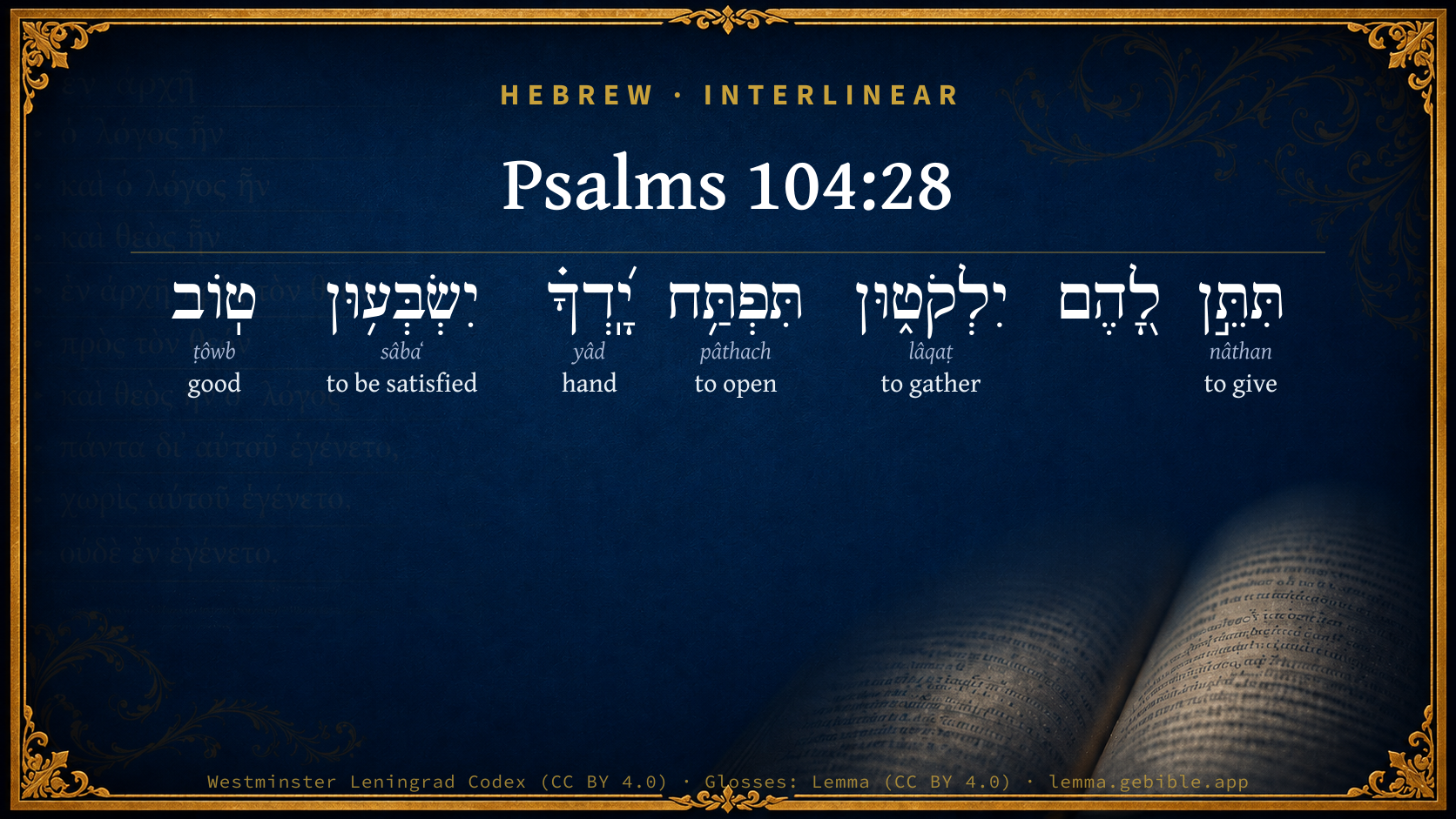
Hebrew (Westminster Leningrad Codex) Psalms 104:28 appears in the Hebrew Old Testament. The text above is from the Westminster Leningrad Codex. Each word links to its Strong’s number, a concise gloss, and parsing drawn from the Open Scriptures Hebrew Bible morphology. Click any word for its full Brown-Driver-Briggs (BDB) entry.
Download image
Cite this verse

Psalms 104:28 (World English Bible). Public Domain. Lemma interlinear Bible study tool, https://lemma.gebible.app/v/psalms/104/28.

Show BibTeX & RIS
BibTeX
RIS
English Translation
You give to them; they gather. You open your hand; they are satisfied with good.
World English Bible · Public Domain
Download a study sheet

One document with this verse’s original text, its word-by-word gloss line, the meaning frame, cross-references with their text, attributed commentary, and full source and license credits — printable, and it pastes into notes with its structure intact.

This verse Autodidact and up

Study sheet (.html) Plain text (.txt)

A passage Seminary Student

Up to 50 verses in one chapter. A passage sheet keeps up to 6 commentary sources and 12 cross-references per verse, in the order this page ranks them, and says so on the sheet whenever that leaves anything out. Ask for a single verse and you get the Autodidact verse sheet above.

Everything on this page stays free to read, with no account — the sheet is a download of what is already on screen, not access to it.

Want to remove ads? Support Godless Engineer
Compare translations 3

The same verse in 3 English versions, stacked beneath the original-language interlinear above. Click any original word for its lexicon entry.

Each is an independent rendering of the whole verse — the interlinear is not word-aligned to these translations.

Highlighted words mark where these versions differ — a whole-verse word diff, not a word-by-word alignment.

  • World English Bible Public Domain
    You give to them; they gather. You open your hand; they are satisfied with good.
  • King James Version Public Domain
    That thou givest them they gather: thou openest thine hand, they are filled with good.
  • unfoldingWord Literal Text CC BY-SA 4.0
    You give to them; they gather; you open your hand; they are satisfied good.

unfoldingWord Literal Text — © unfoldingWord, licensed CC BY-SA 4.0. Word-aligned USFM3 via Door43 (git.door43.org/unfoldingWord/en_ult).

Versions to compare (up to 4)

3 of 4 selected

Show all 18 translations

Every available English version of this verse, each an independent rendering of the whole verse.

  • World English Bible Public Domain
    You give to them; they gather. You open your hand; they are satisfied with good.
  • Berean Standard Bible Public Domain
    When You give it to them, they gather it up; when You open Your hand, they are satisfied with good things.
  • Majority Standard Bible Public Domain
    When You give it to them, they gather it up; when You open Your hand, they are satisfied with good things.
  • King James Version Public Domain
    That thou givest them they gather: thou openest thine hand, they are filled with good.
  • American Standard Version (1901) Public Domain
    Thou givest unto them, they gather; Thou openest thy hand, they are satisfied with good.
  • Revised Version (1885) Public Domain
    That thou givest unto them they gather; thou openest thine hand, they are satisfied with good.
  • Geneva Bible (1599) Public Domain
    Thou giuest it to them, and they gather it: thou openest thine hand, and they are filled with good things.
  • Douay-Rheims (1899) Public Domain
    What thou givest to them they shall gather up: when thou openest thy hand, they shall all be filled with good.
  • Young's Literal Translation Public Domain
    Thou dost give to them -- they gather, Thou dost open Thy hand -- they `are' satisfied `with' good.
  • Literal Standard Version CC BY-SA 4.0
    You give to them—they gather, || You open Your hand—they [are] satisfied [with] good.
  • Unlocked Literal Bible CC BY-SA 4.0
    When you give to them, they gather; when you open your hand, they are satisfied.
  • unfoldingWord Literal Text CC BY-SA 4.0
    You give to them; they gather; you open your hand; they are satisfied good.
  • Darby Bible Public Domain
    That thou givest unto them, they gather; thou openest thy hand, they are filled with good.
  • World Messianic Bible Public Domain
    You give to them; they gather. You open your hand; they are satisfied with good.
  • Webster's Bible Public Domain
    That which thou givest them, they gather: thou openest thy hand, they are filled with good.
  • Free Bible Version CC BY-SA 4.0
    When you provide it, they gather it up. You hand out food to them, and they are well-fed.
  • Bible in Basic English Public Domain
    They take what you give them; they are full of the good things which come from your open hand.
  • JPS Tanakh (1917) Public Domain
    Thou givest it unto them, they gather it; Thou openest Thy hand, they are satisfied with good.

Literal Standard Version (2020), Covenant Press — licensed CC BY-SA 4.0. Text via the HelloAO Bible API (eBible.org). Unlocked Literal Bible (unfoldingWord) — licensed CC BY-SA 4.0. Text via the HelloAO Bible API (eBible.org). unfoldingWord Literal Text — © unfoldingWord, licensed CC BY-SA 4.0. Word-aligned USFM3 via Door43 (git.door43.org/unfoldingWord/en_ult). Free Bible Version, Dr. Jonathan Gallagher — licensed CC BY-SA 4.0. Text via the HelloAO Bible API (eBible.org).

Word by word

More ways to search: Search by grammar → Find every occurrence → Compare this word →

Practice this passage: Drill this verse → Learn its vocabulary →

About this verse

These counts appear in no published source. They are computed here, from the morphology-tagged text and Lemma’s own curated glosses. What Lemma adds →

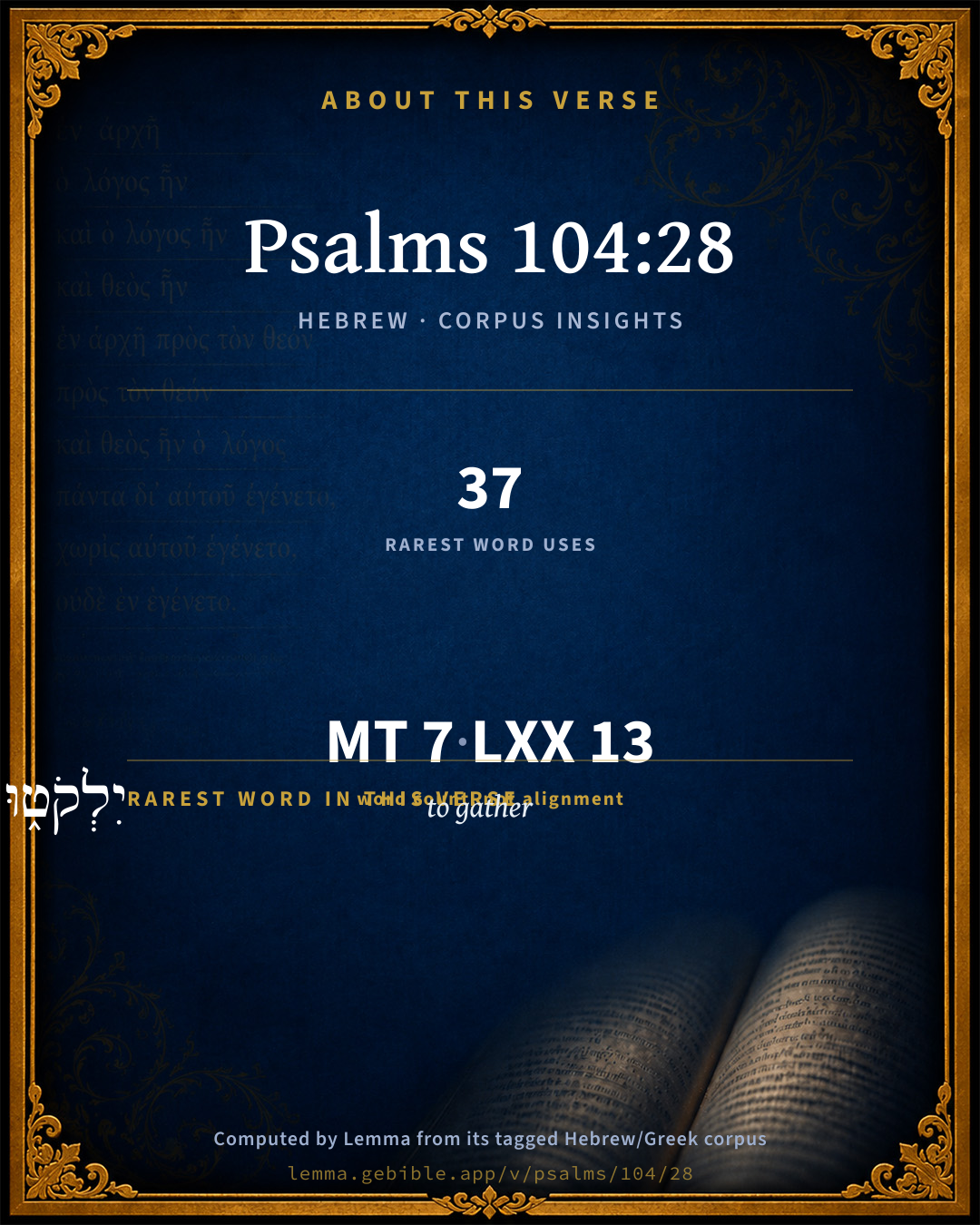
7
words
6
distinct lemmas
Wisdom
section

Shared distinctive vocabulary

יִלְקֹט֑וּן to gather H3950 occurs in 34 verses of the Hebrew Bible. Also found in:

Grammatical profile

  • 4 verbs
  • 1 noun
  • 1 adjective
  • 1 preposition

Verb forms

  • תִּתֵּ֣ן Qal · Imperfect
  • יִלְקֹט֑וּן Qal · Imperfect
  • תִּפְתַּ֥ח Qal · Imperfect
  • יִשְׂבְּע֥וּן Qal · Imperfect

Hebrew & Septuagint length

In English translation the verse runs 15 words from the Hebrew and 24 from the Septuagint (LXX English) — closely comparable.

A rough comparison of the two English renderings, which tokenize alike — not a word-level alignment.

Word counts can differ between the Hebrew and the Greek without any difference in meaning — e.g. the Hebrew direct-object marker אֵת has no separate Greek word, and Greek often adds the article ὁ.

In the original languages it is 7 Hebrew tokens and 13 Greek tokens — but the two are counted differently (Hebrew bundles its prefixes and suffixes into one token; the Greek is in lemma form), so that isn’t a like-for-like length.

Cross-references

1

Topical passages linked to Psalms 104:28 in the Treasury of Scripture Knowledge — connected by theme and wording, ordered by reader-vote popularity; previews shown in the World English Bible.

  • Psalms 145:16 You open your hand, And satisfy the desire of every living thing.

Cross-references courtesy of OpenBible.info (CC BY 4.0).

Hebrew and Greek witnesses Masoretic Hebrew ↔ Greek Septuagint

The same verse in the two great witnesses to the Old Testament, shown verse-for-verse.

You’re reading Greek Psalm 103 (Hebrew Psalm 104). The Septuagint counts the superscription, so verse numbers can differ from the Hebrew — chapter-level alignment, not verse-by-verse. Numbering follows Rahlfs.

These are two independent witnesses, not word-aligned to each other, and the Septuagint is shown in lemma (dictionary) form.

Hebrew Psalms 104:28 Masoretic · Westminster Leningrad Codex

תִּתֵּ֣ן לָ֭הֶם יִלְקֹט֑וּן תִּפְתַּ֥ח יָֽ֝דְךָ֗ יִשְׂבְּע֥וּן טֽוֹב

You give to them; they gather. You open your hand; they are satisfied with good.

World English Bible · Public Domain

Greek LXX Greek Psalm 103:28 Septuagint · lemma form

δίδωμι σύ αὐτός συνλέγω ἀναοἴγω δέ σύ ὁ χείρ ὁ σύμπας πίμπλημι χρηστότης

When you have given it them, they will gather it; and when you have opened your hand, they shall all be filled with good.

LXX2012 (modern English Septuagint) · Public Domain

Hebrew: Westminster Leningrad Codex (CC BY 4.0). Greek: Septuagint (public domain); English from LXX2012 (modern English Septuagint) (Public Domain). How the Septuagint differs from the Hebrew →

Commentary

Notes on Psalms 104:28 from classic Christian and Jewish commentators (each source and its license shown beneath its notes). The classic Christian expositions comment on the surrounding passage and are grouped to its opening verse, so a note may address several verses; the Jewish commentaries on the Tanakh (Rashi and others) are per-verse, so they appear only where the commentator wrote on this verse.

Lemma curates 59 commentaries, every one of them public domain or Creative Commons licensed, each selected and text-cleaned for this edition rather than reprinted as found. About our sources →

Trapp's Complete Commentary

John Trapp

Psa 104:28 [That] thou givest them they gather: thou openest thine hand, they are filled with good.

Ver. 28. That thou givest them they gather] Neither have they the least morsel of meat but what thou castest them by thy providence. Turcicure imperium quantum quantum est nihil est nisi panis mica quam dives paterfamilias proiecit caniubs, saith Luther.

Thou openest thine hand] By opening the bosom of the earth thou richly providest for them, ο δοτηρ εαων.

John Trapp, A Commentary or Exposition upon All the Books of the Old and New Testament (1647–1656) — public domain. Text from a community e-Sword module.

The Biblical Illustrator

Joseph S. Exell

Psa_104:28

That Thou givest them they gather.

Gods giving and mans gathering

I. God alone gives; we only gather. He is the Sole Proprietor in the universe, and of it. We can have nothing but by His bestowal. Our industry, perseverance, skill, are only methods that we employ in gathering. We have nothing that we have not received.

II. What God gives we ought to gather.

1. In the world of nature. The fields must be cultivated, harvests reaped, etc.

2. In the realm of grace. Truth must be apprehended, Christ believed, the Holy Ghost received. (U. R. Thomas.)

Gathering Gods gifts

This text refers to the animals mentioned in the preceding verses. The birds and beasts are set forth by our Lord as examples of the providence of God. Your Heavenly Father feedeth them. And perhaps to our minds they supply the most perfect illustration of dependence. God supplies their wants; He gives them everything; and if He did not feed them they would perish. Yet, though He gives all, they have to gather all. Not a mouthful does one of them get which it has not worked for. Now, there is a great principle of the Divine procedure here, which God observes not only in providence, but in grace. He gives, but we must gather. He is able to make His grace abound to us, so that we, always having all sufficiency in all things, may abound unto every good work. It is this fulness of the Divine grace, accessible and available to us, that we must think of first when we are speaking about the deepening of the spiritual life. But the other side is not to be forgotten, or the good of it all may be lost--that which He giveth we must gather. Take even the illustration of the steam-engine. You say, What would the engine be without the steam? Yes; but what would the steam be without the engine? There was plenty of steam in the world before James Watt was born. But it was not gathered. Take another illustration. Here is a rifle, exquisitely constructed beautifully grooved inside, and with it cartridges made on the most scientific principles. You might look at it and moralize in this way: What a heavy thing; what a cold thing; how useless it would be to hit anything without the powder; it is the little thimbleful of gunpowder and the flash of fire by which everything is done. Now, this is perfectly true, and it illustrates a grand spiritual truth. It is the flash of fire from heaven that does all the execution in the wars of the Lord. Yet how important also is the other side of the truth. What would the powder be if it were not for the gun? Why, the puff of it would hardly singe a fly. It is when its force is gathered and packed close in the cartridge, and when the ball is directed on its course by the finely-grooved barrel, that it brings down the object at a thousand yards. Gods power, I say, is often there; but we are not in a position to use it and to retain it. He gives, but we do not gather. This is a principle in Christian work of every kind. Mr. Moody has been going from town to town over Scotland. Now, if you meet the ministers of some of these towns a year hence, they may tell you that the meetings were very successful, the district was stirred, the churches were filled, and there were hundreds of inquirers. But it has not come to much. The results that have lasted are small. This may be true, but what is the reason of it? In many cases the reason, I believe, is this: God has given, but His servants have not gathered. It is the same with His work in our own souls. He blesses us, but we lose the blessing. For example, I hear a Christian complaining that he is cold and not growing in grace. But I take up his Bible and turn over its leaves. They are as clean as when they came from the printer, and here and there they are actually sticking together. The man might as well construct a zinc covering over the flower-bed in his garden, and then complain that the flowers are dying for want of rain. There is plenty of rain, but he has kept it away from the plants. Or I meet a young man or woman who is at that period of life when the mind is all awake and alive, reading books, acquiring scientific methods of research, and entering into the glorious heritage of the knowledge of the past. The man complains that he is not enjoying his Bible; and the fact is his Bible is distressing him. I ask him how he reads it, and he says, Oh, just as I have always done. That is, I say, you read a chapter a day, and you give five minutes to it? Yes. You never spend the time on it that you do on an ode of Horace or a paragraph of Thucydides; you never study a book of it as you would a play of Shakespeare? Oh no, I never thought of such a thing. Then no wonder you are getting no good out of your Bible. Gods manna is there, but you are not gathering it. (J. Stalker, D.D.)

The Biblical Illustrator, edited by Joseph S. Exell (c. 1880s–1900s) — public domain. Text from a community e-Sword module.

J. A. Alexander on Psalms

Joseph Addison Alexander

28. (Psa 104:28) Thou givest to them, they gather; thou openest thy hand, they are filled (with) food. The point of the significant antithesis is this, that God as easily bestows as they receive. He has only to give, they have only to gather. He has but to open his hand, and they are instantly provided, even to satiety. Filled, satisfied, abundantly supplied, as in Psa 104:13. The verb rendered gather means to pick up or collect from the ground. It is used in the history of the manna (Exo 16:1; Exo 16:5; Exo 16:16), to which there is obvious allusion. The act of gathering from the ground seems to pre-suppose a previous throwing down from heaven. The common version, that (meaning what) thou givest them they gather, weakens the sentence, if it does not render it unmeaning.

Joseph Addison Alexander, The Psalms Translated and Explained (1850) — public domain. Text from a community e-Sword module.

Adam Clarke's Commentary

Verse 28. That thou givest them they gather] All creatures are formed with such and such digestive organs, and the food proper for them is provided. Infinitely varied as are living creatures in their habits and internal economy, so are the aliments which God has caused the air, the earth, and the waters to produce.

Thou openest thine hand] An allusion to the act of scattering grain among fowls.

Adam Clarke's Commentary on the Bible (1810–1826) — public domain. Text from a community e-Sword/MySword module.

The Cambridge Bible for Schools and Colleges

gen. ed. J. J. S. Perowne

28. Thou givest unto them, they gather:

Thou openest thine hand, they are satisfied with good.

The Cambridge Bible for Schools and Colleges (gen. ed. J. J. S. Perowne; Cambridge University Press, 1878–1918) — public domain. Text from a community e-Sword module.

John Gill's Exposition

That thou givest them they gather,.... What God bestows upon them as a bounty of Providence they take and make use of, and in their way thankfully, and without repining; some gather it up for immediate use and service, and not into barns; others gather it up for time to come, as the ant, Mat 6:26. Kimchi understands this of a time of scarcity, when they gather here a little and there a little; as he does the following clause of a time of plenty.

Thou openest thine hand, they are filled with good; God, in whose hand all things are, and from whence all things come, opens his hand of providence, and liberally and bountifully gives, as this phrase signifies, Deu 15:11 and all his creatures are filled with his good things to their satisfaction: and thus the spiritual food which he gives his people, they gather it by the hand of faith, as the Israelites gathered the manna in the wilderness every morning, and according to their eating, what was sufficient for them; and to whom he gives liberally, even all things richly to enjoy; all things pertaining to life and godliness; Christ, and all things along with him; abundance of grace here, and glory hereafter; and they are satisfied with his good things as with marrow and fatness.

John Gill's Exposition of the Whole Bible (1746–1763) — public domain (CC PDM 1.0). Text via the HelloAO Bible API.

Albert Barnes' Notes on the Bible

That thou givest them they gather - What thou dost place before them they collect. They have no resources of their own. They can invent nothing; they cannot vary their food by art, as man does; they cannot make use of reason, as man does, or of skill, in preparing it, to suit and pamper the appetite. It comes prepared for them direct from the hand of God.

Thou openest thine hand - As one does who bestows a gift on another. The point in the passage is, that they receive it immediately from God, and that they are wholly dependent on him for it. They have not to labor to prepare it, but it is made ready for them, and they have only to gather it up. The allusion in the “language” may be to the gathering of manna in the wilderness, when it was provided by God, and people had only to collect it for their use. So it is with the brute creation on land and in the waters.

They are filled with good - They are “satiated” with good; that is, They are satisfied with what to them is good, or with what supplies their needs.

Albert Barnes' Notes on the Bible (1834–1885) — public domain. Text from a community e-Sword/MySword module.

Matthew Poole's English Annotations

Whatsoever they receive is from thy bounty and gift.

Thou openest thine hand; thou providest plentifully for them; as this phrase implies, Deu 15:1; compare Pro 31:20.

Matthew Poole's English Annotations on the Holy Bible (1683–1685) — public domain. Text from a community e-Sword/MySword module.

The Treasury of David

Charles H. Spurgeon

Ver. 28. That thou givest them they gather. God gives it, but they must gather it, and they are glad that he does so, for otherwise their gathering would be in vain. We often forget that animals and birds in their free life have to work to obtain food even as we do; and yet it is true with them as with us that our heavenly Father feeds all. When we see the chickens picking up the corn which the housewife scatters from her lap we have an apt illustration of the manner in which the Lord supplies the needs of all living thingshe gives and they gather.

Thou openest thine hand, they are filled with good. Here is divine liberality with its open hand filling needy creatures till they want no more: and here is divine omnipotence feeding a world by simply opening its hand. What should we do if that hand were closed? There would be no need to strike a blow, the mere closing of it would produce death by famine. Let us praise the open handed Lord, whose providence and grace satisfy our mouths with good things.

Ver. 28. That thou givest them they gather. This sentence describes The Commissariat of Creation. The problem is the feeding of "the creeping things innumerable, both small and great beasts, "which swarm the sea; the armies of birds which fill the air, and the vast hordes of animals which people the dry land; and in this sentence we have the problem solved, "That thou givest them they gather." The work is stupendous, but it is done with ease because the Worker is infinite: if he were not at the head of it the task would never be accomplished. Blessed be God for the great They of the text. It is every way our sweetest consolation that the personal God is still at work in the world: leviathan in the ocean, and the sparrow on the bough, may be alike glad of this; and we, the children of the great Father, much more.

The general principle of the text is, God gives to his creatures, and his creatures gather. That general principle we shall apply to our own case as men and women; for it is as true of us as it is of the fish of the sea, and the cattle on the hills: "That thou givest them they gather."

1. We have only to gather, for God gives. In temporal things: God gives us day by day our daily bread, and our business is simply to gather it. As to spirituals, the principle is true, most emphatically, we have, in the matter of grace, only to gather what God gives. The natural man thinks that he has to earn divine favour; that he has to purchase the blessing of heaven; but he is in grave error: the soul has only to receive that which Jesus freely gives.

2. We can only gather what God gives; however eager we may be, there is the end of the matter. The diligent bird shall not be able to gather more than the Lord has given it; neither shall the most avaricious and covetous man. "It is vain for you to rise up early and to sit up late, to eat the bread of carefulness; for so he giveth his beloved sleep."

3. We must gather what God gives, or else we shall get no good by his bountiful giving. God feeds the creeping things innumerable, but each creature collects the provender for itself. The huge leviathan receives his vast provision, but he must go ploughing through the boundless meadows and gather up the myriads of minute objects which supply his need. The fish must leap up to catch the fly, the swallow must hawk for its food, the young lions must hunt for their prey.

4. The fourth turn of the text gives us the sweet thought that, we may gather what he gives. We have divine permission to enjoy freely what the Lord bestows.

5. The last thing is, God will always give us something to gather. It is written, "The Lord will provide." Thus is it also in spiritual things. If you are willing to gather, God will always give. C.H.S.

Ver. 28. Gather. The verb rendered "gather" means to pick up or collect from the ground. It is used in the history of the manna (Ex 16:1, 5, 16), to which there is obvious allusion. The act of gathering from the ground seems to presuppose a previous throwing down from heaven. J.A. Alexander.

Ver. 28. Thou openest thine hand. The Greek expositors take the opening of the hand to indicate facility. I am of opinion that it refers also to abundance and liberality, as in Ps 145:16: "Thou openest thine hand, and satisfiest the desire of every living thing." Using this same formula, God commands us not to close the hand, but to open it to the poor. Lorinus.

Psalms 104:29*

Charles H. Spurgeon's The Treasury of David (1869–1885) — public domain. Psalms only. Text from a community e-Sword/MySword module.

The Pulpit Commentary

That thou givest them they gather; literally, thou givest to them; they gather. Thou openest thine hand, they are filled with good; or, "are satisfied with good" (Kay, Revised Version).

God gives we gather: harvest thanksgiving.

I GOD"S GIFT IN THE HARVEST. God gives:

1. The soil.

2. The seed.

3. The forces which make the seed extract the virtues of the soil.

4. The sunshine, the rain, and the wind, which minister to the growth of the blade, and which ripen the grain.

5. The intelligence which enables us to cultivate the ground, to acquire the art of agriculture. (Isa_28:26)

II OUR HUMAN SHARE IN IT. We "gather." There are places where the gathering is all that man has to do; e.g. the bread fruit in the tropics. But usually "gathering" includes more than that it includes the preparation of the soil, sowing, weeding, watering, etc. To the production of the harvest there goes not a little human thought, skill, labour. Where, then, is

III GOD"S GOODNESS IN IT?

1. Our share is very much the smaller.

2. God"s gifts are bestowed on us with such ceaseless constancy, never failing through all the ages of human existence, and in spite of the ingratitude, the atheism, or even the idolatry, of the husbandmen.

3. God"s requirement of our labour is an instance of Divine goodness, to be added to, not subtracted from, his other loving kindnesses (see supra).

The Pulpit Commentary (1880–1919), ed. H.D.M. Spence-Jones & Joseph S. Exell — public domain. Text from a community e-Sword module.

Lesson kit

Teaching starters — assembled from the data on this page, not authored interpretation. Every prompt links to the verse data it draws on. Edit before teaching.

Psalms, in the Wisdom, opens this verse with 7 words (6 distinct Hebrew lemmas). Its most distinctive word is lâqaṭ (“to gather”). A historical commentator’s framing appears above. Read the whole chapter for the surrounding context.

Discussion questions

  1. How does “to gather” (lâqaṭ) shape what this verse is saying?
  2. How does Genesis 31:46, which shares the word «to gather», read alongside this verse?
  3. The translations on this page render this verse differently — a whole-verse word diff, not a word-by-word alignment. What might account for the different wordings?
  4. «תִּתֵּ֣ן» is a Qal Imperfect verb. How does that grammatical form shape the action described?
  5. Compare how Trapp's Complete Commentary and The Biblical Illustrator read this verse. Where do they agree or differ?

Things to notice

Reading settings

Reading text

Shown beneath each verse's original-language words.

Old Testament
Old Testament edition

Read the OT as the Masoretic Hebrew (MT) or the Greek Septuagint (LXX).

English shown for the Greek Septuagint (in the Hebrew ↔ Greek comparison).

Comparing translations? Open the Compare panel on any verse page to stack up to four side by side.