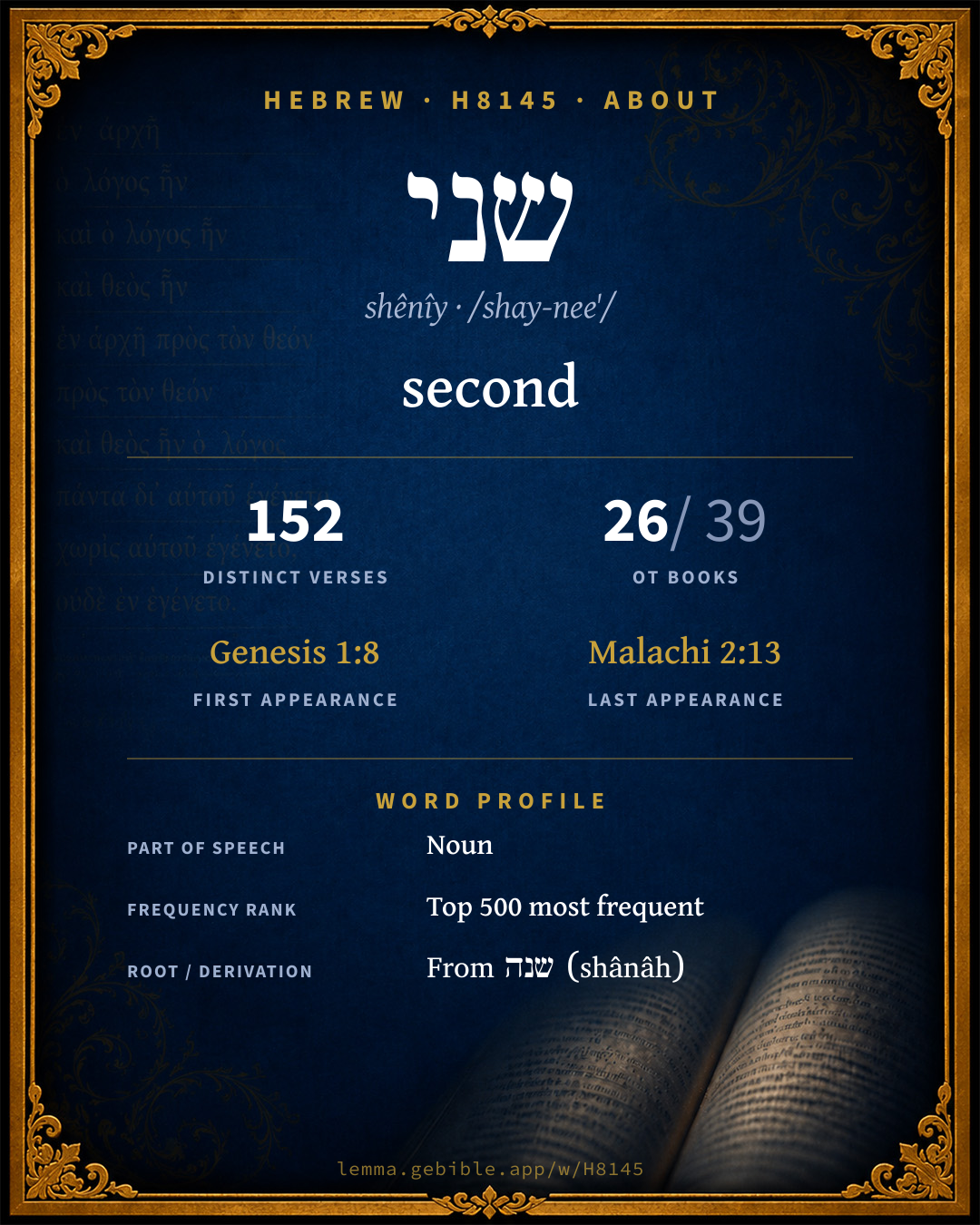
שֵׁנִי
second
‘second’ is one of 4 main senses fuller range ↓
Full lexicon entry — Brown-Driver-Briggs (BDB)
From Brown-Driver-Briggs (BDB)
Where this word appears
Grammar key — what these labels mean
Part of speech
- Adjective
- A word that describes or qualifies a noun.
- Noun
- A naming word — a person, place, thing, or idea.
Noun type
- Common
- A common noun — a general class of person, place, or thing (“king,” “city,” “water”), not a specific name.
State
- Absolute
- The independent form of a noun, not bound to a following word.
- Construct
- A noun bound to a following noun in a possessive / “of” relationship (the construct chain).
Gender
- Masculine
- Grammatically masculine.
- Feminine
- Grammatically feminine.
- Both
- Attested as both masculine and feminine.
Number
- Singular
- One.
- Plural
- More than one (in Hebrew, generally three or more).
Every verse where H8145 appears in the Book of Ezra — 1 distinct verse. Click any verse to open its interlinear word-by-word view. Verse text shown in the World English Bible for context — . Each verse’s Hebrew form is shown with its reference; the English is not keyword-highlighted, since the data carries no word-level English alignment. Use “Compare translations” on any verse to read it across multiple English versions. This concordance covers the Hebrew Bible; Septuagint (Greek Old Testament) occurrences are not indexed here.
Ezra
About this entry
At a glance — auto-summarized from this page’s data, not written by a person. Every figure links to its source below. This summary describes the numbers; it doesn’t interpret them.
שני — transliterated shênîy — is a Hebrew noun carrying the sense “second.” BDB distinguishes 4 senses for it. Spanning 152 verses in 26 books, it ranks among the common words of the Hebrew Bible. Its earliest occurrence is Genesis 1:8. Sharing its root, it stands alongside שנה, משנה and שנה. See the sense tree, 152-verse concordance, and the renderings breakdown below.
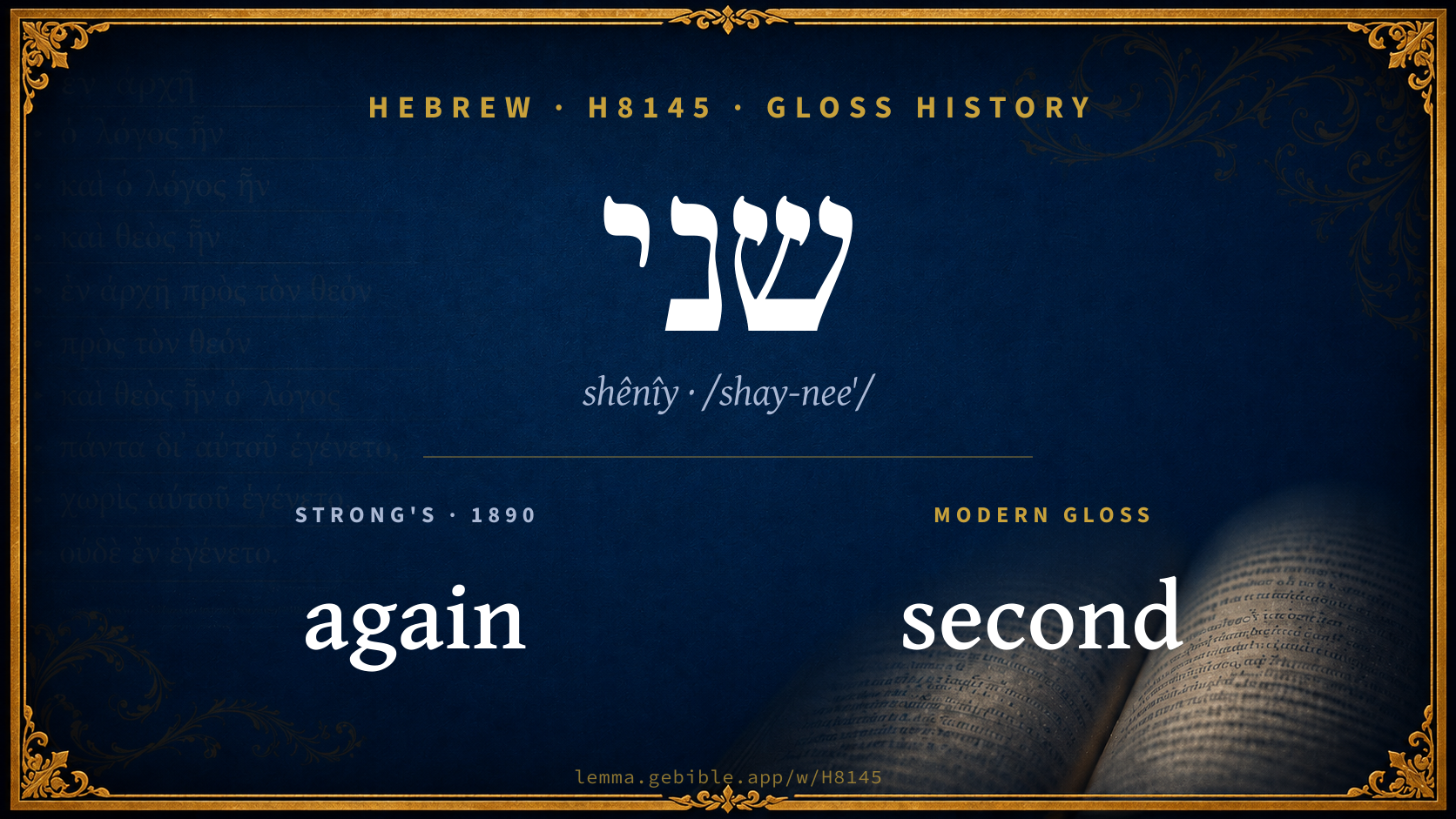
Gloss history
Strong's 1890 vs modern scholarship
About this word
Strong's H8145 catalogs a Hebrew word from the Hebrew Old Testament.
These counts are not copied from any lexicon or concordance. They are computed here, from the morphology-tagged Hebrew Old Testament. What Lemma adds →
- 152
- distinct verses
- The word appears in 152 distinct verses.
- 26 / 39
- OT books
- The word appears in 26 of 39 Old Testament books.
- #293
- by frequency
- Top 500 most frequent Hebrew words (rank 293 of 8,640 Hebrew words by occurrence).
View all 152 occurrences in the concordance →
Most concentrated in
- Exodus 26 verses 17%
- 1 Chronicles 18 verses 12%
- 1 Kings 14 verses 9%
By section of the Old Testament
By traditional corpus
Conventional, traditional groupings — biblical authorship is debated, so this is a traditional corpus grouping, not an authorship claim. Each share is this word’s portion of its verses in that division of the Hebrew canon. Each figure is a share of the word’s 152 distinct verses.
- Torah (Pentateuch) 60 verses · 39%
- Prophets (Nevi'im) 49 verses · 32%
- Writings (Ketuvim) 43 verses · 28%
How translations render this word
Counts come from each version’s own published word-to-Strong’s tagging or interlinear alignment — an approximate guide to how each version renders this word, not a word-level alignment the data otherwise carries. Because each total is that version’s own tagged count, the per-version totals vary from one another and need not match the appearance or distinct-verse counts above. These counts may also differ from a printed concordance because Lemma counts each distinctly tagged rendering and does not collapse phrase taggings into a single head-word total. This is a fixed set of word-tagged versions (KJV, ASV, BSB, ULT) and does not change with the reading translation you choose elsewhere. Each version’s license is shown beside its name below (and on Sources).
- King James Version: Second 71×, Other 34×, Second time 11×
- American Standard Version: Second 69×, Other 30×, Second time 10×
- Berean Standard Bible: Second 89×, Other 20×, Another 12×
- unfoldingWord Literal Text: Second 141×, Second time 9×, Time 7×
King James Version Public Domain
Renders H8145 across 156 tagged occurrences — most commonly:
Plus 17 renderings that appear only once — usually multi-word phrases or single function words the recovered tagging swept in, not distinct renderings.
American Standard Version Public Domain
Renders H8145 across 156 tagged occurrences — most commonly:
Plus 23 renderings that appear only once — usually multi-word phrases or single function words the recovered tagging swept in, not distinct renderings.
Berean Standard Bible Public Domain
Renders H8145 across 146 tagged occurrences — most commonly:
Plus 10 renderings that appear only once — usually multi-word phrases or single function words the recovered tagging swept in, not distinct renderings. Not rendered by a distinct English word in 10 further occurrences.
unfoldingWord Literal Text CC BY-SA 4.0
Renders H8145 across 167 tagged occurrences — most commonly:
Plus 8 renderings that appear only once — usually multi-word phrases or single function words the recovered tagging swept in, not distinct renderings.
Senses in BDB
The 4 senses BDB distinguishes for this word, in lexicon order (not ranked by frequency or importance). The full entry — with sub-senses — is in the Lexicon Entry tab.
- second
- second (the ordinal number)
- again (a second time)
- another, other (something as distinct from something else)
Word origin
m. שֵׁנִית f.157 adj.num.ord. second;—בַּיּוֹם הַשֵּׁנִי Ex 2:13 +, etc. (שֵׁנִי 82 times + Ne 3:30, read שֵׁנִית; read וְהַשֵּׁנִי also 1 Ch 6:13 for ושני); בַּשָּׁנָה הַשֵּׁנִית Gn 47:18 +, etc. (שֵׁנִית 72 times + Ne 3:30 v. supr.), שִׁבְעַת יָמִים שׁ׳ Lv 13:5, 33, 54 a second heptad of days; שֵׁנִית = a second time Gn 22:15 + 16 times + (= again, of similar—not identical—act, or another point in a series) Ez 4:6; Mal 2:13, וְהַשֵּׁנִית 2 S 16:19; †mpl. שְׁנִיִּם Nu 2:16 they shall set out as second, but Gn 6:16 second stories (in ark).
— Brown-Driver-Briggs (Oxford 1906, public domain), digitized via Sefaria, supplemented by the OpenScriptures HebrewLexicon (CC BY 4.0). See Sources.
Derived from שנה (shânâh) (H8138) — to change.
Jastrow Dictionary
A second Hebrew/Aramaic lexicon for comparison, covering Aramaic and post-biblical (Talmudic, Targumic, Midrashic) usage that the biblical-Hebrew BDB does not. Matched by lemma rather than by Strong’s number, so a lemma may carry more than one Jastrow headword (shown separately below), and the entries cover usage well beyond the Bible.
שָׁנֵי
- , Targ. Cant. I, 17 ed. Vien., read שָׁגֵי, v. שָׁאגָא
שָׁנִי
- (b. h.) scarlet; תולעת ש׳, v. תֹּולֵעָה.—Pl. שָׁנִים. Sabb. 89ᵇ (ref. to Is. I, 18) כשנים כשני מיבעי ליה וכ׳ kasshanim? it ought to read kasshani (as scarlet) &c.; Yalk. Is. 256; a. e., v. שָׁנָה II. e.g. Isaiah 1:18
שני
- (b. h.)
- 1. to repeat, do a second time. Yoma 86ᵇ ואם ש׳ בהן וכ׳ but if he committed the same sins again, he must confess them. Ib. כיון … וש׳ בה וכ׳ when a man commits a sin and repeats it, it appears to him permitted; M. Kat. 27ᵇ. Ib. 16ᵇ; Ber. 18ᵃ אם קרית לא שָׁנִיתָ ואם שנית וכ׳ if thou hast read (studied), thou hast not repeated, and if thou hast repeated, thou hast not reviewed a third time, and if thou hast done so, they have not explained it to thee (v. פָּרַשׁ). Sot. 9ᵃ (ref. to Mal. III, 6) לא … ושָׁנִיתִי לה וכ׳ I never struck a nation and had to do it a second time, but you, children of Israel, have not been consumed; Yalk. Deut. 825. Ib. שהיה מכה … ולא שֹׁונֶה לו who used to strike a man once and no more (killed with one stroke). Tosef. Toh. IV, 1 אומר לו שיִשְׁנֶה we say to him that he should do it again (when it will be seen whether it can be done without touching uncleanness); אין שֹׁונִין בטהרות we must not try again for the purpose of deciding in matters of levitical cleanness; Nidd. 5ᵇ אומרים לו שְׁנֵה ושונה we say to him, do it again, and he does it again; a. fr.—Part. pass. שָׁנוּי; f. שְׁנוּיָה &c. Meg. 31ᵃ; Ab. Zar. 19ᵇ, v. שָׁלַשׁ; a. e. e.g. Malachi 3:6
- 2. (denom. of מִשְׁנָה) to study the Mishnah; in gen. to study; to teach. Meg. 28ᵇ; Nidd. 73ᵃ כל השונה וכ׳ he who studies (reviews) traditional laws every day. Meg. 32ᵃ; Treat. Sof’rim III, 10 השונה בלא זמרה who studies (Mishnah and Gemarah) without chant. B. Mets. 44ᵃ שנית לנו … ותִשְׁנֶה לנו וכ׳ in thy earlier days thou taughtest us …, and again in thy old days, thou teachest us &c.?; Ab. Zar. 52ᵇ. Erub. 92ᵃ וכי רבי לא שְׁנָאָהּ וכ׳ but if Rabbi has not taught that, whence could R. Ḥiyya have it?; Yeb. 43ᵃ; Nidd. 62ᵃ רבי לא שנה וכ׳ Rabbi has not taught this? whence &c.? Yeb. 108ᵇ, a. e. מי שש׳ זו לא ש׳ זו he who taught this, has not taught that, i.e. the two clauses in the Mishnah are from different authors, v. תַּבְרָא. Ḥull. 85ᵃ ראה רבי … ושְׁנָאָן וכ׳ Ms. M. (ed. ושנאו) Rabbi approved of the opinion of R. …, and embodied it in the Mishnah as the opinion of ‘the scholars’. Pes. 3ᵇ; Ḥull. 63ᵇ לעולם יִשְׁנֶה אדם לתלמידו וכ׳ one should always teach his pupil the shortest way (use the briefest terms). Ib. 81ᵇ, a. fr. לא שָׁנוּ אלא וכ׳ they have taught this only with regard to a case &c., i.e. this is meant only when &c.; a. fr.—Part. pass. as ab. Nidd. 22ᵇ, a. fr. במחלוקת שנויה, v. מַחֲלוֹקֶת.
- 1. to be repeated. Snh. 59ᵃ ונִישְׁנֵית, v. נֹחַ. Ḥull. 63ᵇ למה נִשְׁנוּ בבהמה וכ׳ why are the laws of clean and unclean animals repeated (in Deut.)? With reference to quadrupeds, on account of hassh’suʿah (Deut. XIV, 7, which is not found in Lev. XI, 4) &c., v. שְׁסוּעָה; Bekh. 6ᵇ; a. e. e.g. Deuteronomy 14:7
- 2. to be taught. B. Mets. 33ᵇ; B. Kam. 94ᵇ, a. e. בימי רבי נשנית משנה זו this Mishnah was taught (originated) in Rabbi’s days. Ber. 28ᵃ, v. עֵדוּת; a. e.
- to teach (Mishnah &c.). Lam. R. to I, 6 הַשְׁנֵינִי פרק וכ׳, v. קָרָא II; a. e.
- 1. to repeat, to come a second time. Y. Snh. III, 21ᵇ bot. לְשַׁנֹּות, v. טַעֲנָה. Num. R. s. 420 ולא שִׁינְּתָה, v. שָׁלַשׁ.
- 2. to change, vary, modify; to make a distinction. B. Mets. VI, 2 כל המְשַׁנֶּה ידיו וכ׳, v. יָד. Snh. 92ᵇ אפי׳ … לא יְשַׁנֶּה אדם את עצמו וכ׳ even in time of danger (persecution) a man must not change himself from (disguise the insignia of) his office. Yeb. 65ᵇ מותר … לשנות וכ׳ one may modify (the report of a person’s utterances) in the interest of peace. Ib. גדול … הקב"ה ש׳ בו וכ׳ peace is a great thing, for even the Lord modified (Sarah’s words) for its sake (ref. to Gen. XVIII, 12 a. 13). Y. Pes. IV, 30ᵈ top אל תְּשַׁנּוּ מנהג וכ׳ change not the usage of your fathers &c. Gen. R. s. 48 זה אחד … שׁשִׁינּוּ וכ׳ this is one of the things which they (the seventy translators) changed for king Ptolemee. Sabb. 10ᵇ לעולם אל יְשַׁנֶּה אדם בנו בין הבנים a man must never distinguish his son among his sons (favor one son more than the others); Gen. R. s. 84. Bets. 30ᵃ אם אי אפשר לשנות if it is not possible to do the thing in a different manner (so as to be reminded that it is a Holy Day). Tanḥ. Nitsabim 3 כבר … שלא אֲשׁנֶּה בכם וכ׳ I have sworn to you that I will not change my relation to you &c. Yalk. Mal. 589 מי שי׳ במי which of us changed his conduct towards the other?; המקום לא שי׳ בישראל God has not changed his relation to Israel; a. fr.—Part. pass. מְשׁוּנֶּה; f. מְשׁוּנָּה. Y. Taan. I, end, 64ᵈ עורב יצא מש׳ מן הבריות the raven came out of the ark looking different from all other creatures (black). Shek. V, 2, v. רִצְפָה. Sabb. 56ᵃ (ref. to II Sam. XII, 9) מש׳ רעה זו וכ׳ this evil deed is different from all &c. Ib. 156ᵇ מיתה מש׳ a strange (unnatural, sudden) death; Sot. 35ᵃ; a. fr.—Deut. R. s. 9 ראה אותו מש׳ he saw him (the angel of death) looking strange (excited); מפני מה אתה מש׳ why art thou excited? e.g. Genesis 18:12
- to be changed, different. Snh. 38ᵃ בשלשה … מִשְׁתַּנֶּה מחבירו וכ׳ by three things one man is distinguishable from another: by his voice &c. Pes. X, 4 (116ᵃ) מה נ׳ הלילה וכ׳ why is this night different from all other nights? Snh. 71ᵇ [read:] הואיל ונ׳ דינו ונִשְׁתַּנֵית מיתתו because his (the proselyte’s) legal status is different, and the mode of capital punishment is different for him. Sabb. 53ᵇ נִשְׁתַּנּוּ לו סדרי וכ׳ the order of nature had to be changed for him. R. Hash. 19ᵃ מה נִישְׁתַּנִּינוּ מכל וכ׳ wherein are we different from any other nation or tongue that you decree for us such hard decrees?; a. e.
שְׁנֵי
- 1. to repeat. Targ. I Sam. XXVI, 8 ed. Wil. (v. תְּנֵי).—Snh. 59ᵃ ולמה לי למִישְׁנֵי בסיני and why is it repeated at Sinai?; a. e.
- 2. to change; to be different. Targ. O. Deut. XXXIV, 7.—Lev. R. s. 22 כל מאי דהוה הדין ש׳ הדין ש׳ as the one (the mosquito) changed, so did the other (Titus) change. Yeb. 21ᵇ או דילמא לא שנא (abbrev. ל"ש) or is there no difference (between the wife of a brother on the mother’s side and that of a brother on the father’s side)? Succ. 29ᵇ ל"ש ביו"ט … ול"ש וכ׳ no difference whether it is the first Holy Day or the second. Ib. 30ᵃ ל"ש לפני וכ׳ no difference whether before &c. Sabb. 6ᵃ הכי נמי ל"ש in this case, too, it is the same; a. v. fr.—Yeb. l. c. מאי ש׳ הני מאי ש׳ הא (abbrev. מ"ש) what difference is there between the former and the latter? Sabb. 4ᵃ ומאי ש׳ and wherein lies the difference? Ib. 2ᵇ מ"ש הכא … ומ"ש התם וכ׳ wherein lies the difference (what reason is there) that the Mishnah says here, ‘two which are four within, and two which are four without’, and there (Shebu. I, 1) only, ‘two which are four’?; a. fr.—Part. שָׁאנֵי it is different. Succ. 21ᵇ ש׳ שוורים הואיל וכ׳ it is different in the case of oxen, because &c. Sabb. 7ᵇ ש׳ צרור וכ׳ it is different with bundles and other objects &c. Ker. 11ᵃ והכא ש׳ but here it is different; a. v. fr.—V. שׁנִיא.
- 1. to change; to act strangely. Targ. Gen. XLI, 14. Targ. Ps. LXXXIX, 35. Ib. XXXIV, 1. Targ. Y. II, Deut. XXXII, 5; a. fr.—[Ib. 41 אישני, read: אישנן, v. שְׁנַן.—Targ. Jud. XX, 16 משנן, read: משגן, v. שְׁגֵי.]—Taan. 24ᵇ שַׁנִּי דוכתיך change thy place; ש׳ דוכתיה he changed his place. Ker. 11ᵃ לישנא דשׁנּוּיֵי, v. חָרַף. Bets. 30ᵃ כמה דאפשר לשנויי מְשַׁנִּינָן וכ׳ as much as it is feasible to change (the mode of doing a thing), we must change on the Holy Day; Sabb. 128ᵇ; ib. 117ᵇ מְשַׁנִּין. Bets. l. c. והא הני נשי … ולא מְשַׁנְּיָין וכ׳ but there are those women that fill their pitchers … without any change, and we say nothing to them (to interfere)! Snh. 96ᵃ top שני נפשך (Rashi אַשְׁנִי) disguise thyself; במאי אִישַׁנֵּי how shall I disguise (myself)?; Yalk. Is. 276; a. fr.
- 2. to reply. Sabb. 7ᵇ זימנין מְשַׁנֵּי לה וכ׳ at times he replied to it (met the objection by saying) &c. Ib. 3ᵇ דמשני לך; Keth. 98ᵇ דשַׁנִּינָן, v. שִׁינּוּיָא. Pes. 20ᵇ ומְשַׁנֵּי שאני התם וכ׳ and he answered, it is different in that case; a. fr.—Shebu. 21ᵃ top כדשני ליה (Rashi כדמשני) as he (Abayi) replied to him (R. Papa, further below).
- to change, act strangely. Targ. Mal. III, 6. Targ. O. a. Y. I Deut. XXXII, 5; a. fr.—[Targ. Ps. LXXI, 17 אשני, read with ed. Lag. אתני.]—Snh. 96ᵃ top, v. supra. e.g. Deuteronomy 32:5
- 1. to be changed. Targ. Deut. l. c. Targ. Lam. IV, 1; a. e.—Snh. 71ᵇ נימא הואיל וא׳ א׳ let us say, because his status has changed, he is a different person (not responsible for acts committed in his previous condition); האי דינו א׳ מיתתו לא א׳ this man’s legal status has changed, but the mode of his execution is not affected thereby. Ib. הואיל וא׳ א׳ … דא׳ לגמרי because a change has taken place (by her becoming of age), she is a different person (and the mode of her execution must be different): so much the more here (in the case of a proselyte) where a complete change has taken place. Ib. 96ᵃ א׳ אפיה והוה וכ׳ his face changed, and he looked like a dog. Sabb. 36ᵃ הני … א׳ שמייהו וכ׳ the names of the following three things have changed since the destruction of the Temple; Succ. 34ᵃ; a. e.
שְׁנֵי ²
- two, v. שְׁנַיִם.
שְׂנֵי
- to hate, v. סְנֵי.
שֵׁנִי
- (b. h.) second. Meg. IV, 1 בש׳ on the second day of the week. Ib. 22ᵃ; Taan. 27ᵇ הש׳ קורא וכ׳ the second (of those called to read from the Law) reads &c. Bets. 6ᵃ, a. fr. יום טוב ש׳ the second (Rabbinical) Holy Day (instituted on account of the uncertainty of the calendar). Sabb. 40ᵇ, a. fr. כלי ש׳ second vessel, i.e. a vessel into which a boiling mass has been poured, contrad. to כלי ראשון a vessel direct from the fire.—Maas. Sh. I, 1, a. fr. מעשר ש׳, v. מַעֲשֵׂר.—Esp. a) (לטומאה) ש׳ the second degree of levitical uncleanness, an object made unclean through contact with uncleanness, v. רִאשׁוֹן. Toh. II, 2 האוכל … אוכל ש׳ ש׳ he that eats food unclean in the second degree, becomes unclean in the second degree. Pes. 14ᵃ ש׳ וש׳ הוא וכ׳ it is a contact between two things both unclean in the second degree, and why do you say that he adds to the degree of uncleanness?; a. fr.—b) relationship in the second degree, second generation. Snh. 28ᵃ ש׳ בש׳ תנן we have learned that a relative in the second degree (first cousin) cannot testify for or against a relative in the second degree; ש׳ בראשון תנן we have learned that one of the second generation cannot testify for or against one of the first generation, i.e. his uncle. Ib. שלישי בש׳ a relative in the third degree against one in the second degree, i.e. his father’s first cousin; a. fr.—Pl. שְׁנִיִּים. Yad. II, 2 ואת הש׳ למקום אחר and water poured over his hands a second time on another place. Ib. ועל הש׳ טהור and a loaf which fell on the place which received the second water is clean. Gen. R. s. 31 ש׳ לו וכ׳ the second story of the ark was for him (Noah) and his sons and the clean animals; a. fr.—Fem. שְׁנִיָּה, שְׁנִיָּיה. Shek. III, 4; a. fr.—Pl. שְׁנִיּוֹת. Yad. III, 2 ש׳ (sub. לטומאה), v. supra. Ab. Zar. 3ᵇ ש׳ during the second three hours of the day; a. fr.—Esp. שניה (sub. לערוה) incest of second degree, intermarriage forbidden by rabbinical enactment. Yeb. 21ᵇ אמו ערוה אם אמו ש׳ connection with one’s mother is incest, with one’s mother’s mother incest in the second degree. Ib. משום ש׳ as incest of the second degree; a. fr.—Pl. as above. Ib.ᵃ מה הם ש׳ what relationships are sh’niyoth? Ib. (ref. to Lev. XVIII, 27) האל … מאי נינהו ש׳ haël means the severe, which implies that there are milder forms of incest; what are they? The sh’niyoth; a. fr. e.g. Leviticus 18:27
A Dictionary of the Targumim, the Talmud Babli and Yerushalmi, and the Midrashic Literature (Marcus Jastrow; London, Luzac, 1903) — Public Domain. Digitized via Sefaria. Digitized via Sefaria. Full attribution on Sources.
Forms in the corpus
The 42 distinct written forms H8145 takes in the Hebrew Bible, most frequent first — each parse links to that state’s occurrences in the concordance. Hebrew forms include their vowel points and cantillation, so a single lemma takes many written forms.
Same root — word family
Other BDB entries built from the same root as H8145, grouped by Strong’s listed origin. These share a root / origin per the lexicon — not necessarily a shared meaning. Each links to that word’s own entry.
Derives from
Shares the same root
Derived from this word
Compare all same-root words → Showing 4 of 5 — not the complete family. They share a root, not necessarily a meaning.
Septuagint verse parallels
This word appears in 142 verses that also exist in the Greek Old Testament (Septuagint), out of the 152 Hebrew verses it occurs in. You can read those verses in Greek by switching the Old Testament edition to the Septuagint.
Read these verses in the Septuagint
- Genesis 1:8
- Exodus 1:15
- Leviticus 5:10
- Numbers 1:1
- Joshua 5:2
- Judges 6:25
- Ruth 1:4
- 1 Samuel 1:2
- 2 Samuel 4:2
- 1 Kings 6:1
- 2 Kings 9:19
- 1 Chronicles 2:13
This is a verse-level parallel only — the same verses exist in both the Hebrew and Greek Old Testaments. No word-level Hebrew↔Greek correspondence is claimed: the data carries no such alignment, so no Greek word is shown as this Hebrew word’s translation. Coverage is not total — the Septuagint omits the deuterocanon and renumbers the Psalms, so some Hebrew verses have no direct Greek parallel.