
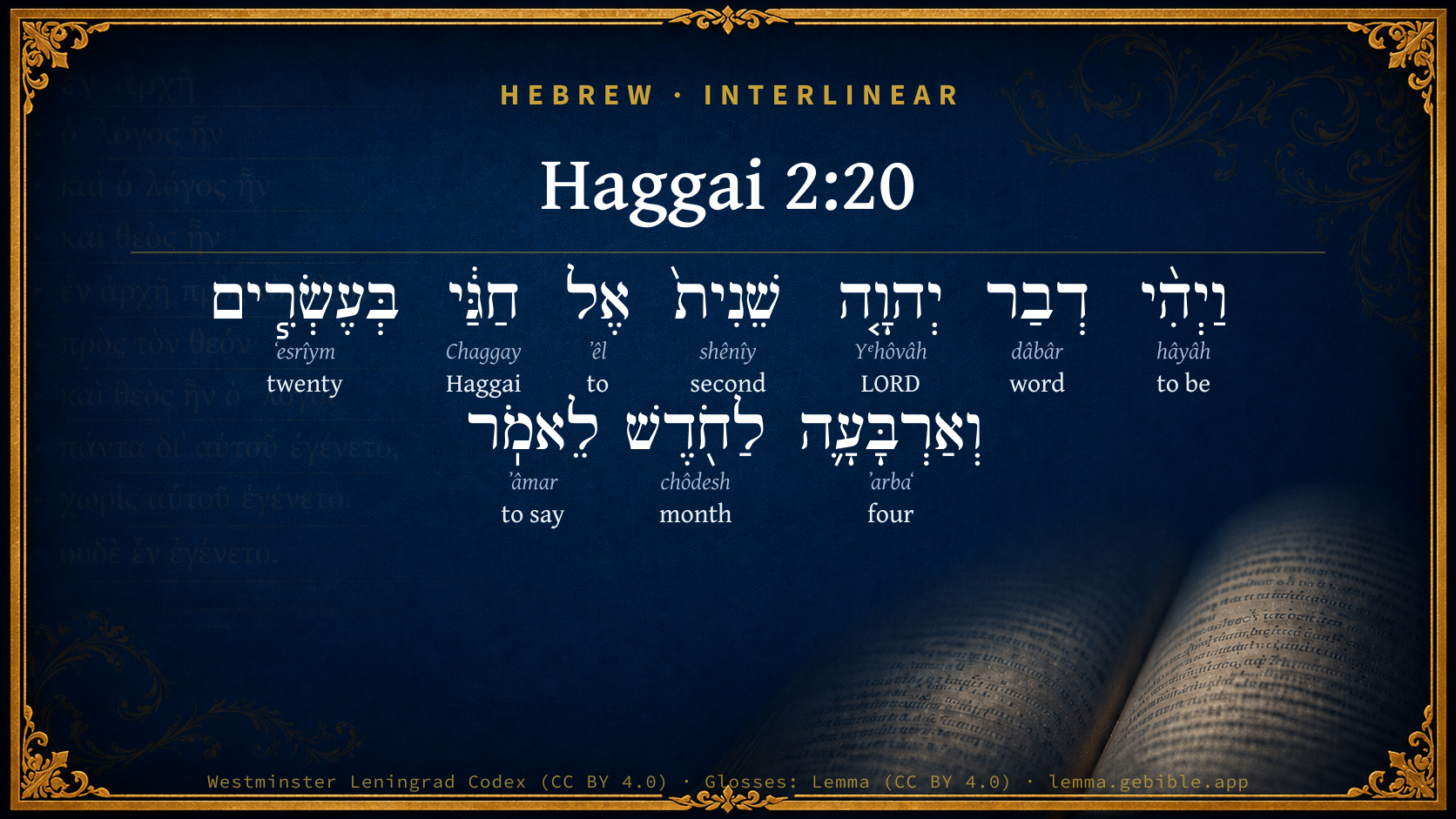
Haggai 2:20

Hebrew (Westminster Leningrad Codex) Haggai 2:20 appears in the Hebrew Old Testament. The text above is from the Westminster Leningrad Codex. Each word links to its Strong’s number, a concise gloss, and parsing drawn from the Open Scriptures Hebrew Bible morphology. Click any word for its full Brown-Driver-Briggs (BDB) entry.
Download image
Cite this verse

Haggai 2:20 (World English Bible). Public Domain. Lemma interlinear Bible study tool, https://lemma.gebible.app/v/haggai/2/20.

Show BibTeX & RIS
BibTeX
RIS
English Translation
The Word of Yahweh came the second time to Haggai in the twenty-fourth day of the month, saying,
World English Bible · Public Domain
Download a study sheet

One document with this verse’s original text, its word-by-word gloss line, the meaning frame, cross-references with their text, attributed commentary, and full source and license credits — printable, and it pastes into notes with its structure intact.

This verse Autodidact and up

Study sheet (.html) Plain text (.txt)

A passage Seminary Student

Up to 50 verses in one chapter. A passage sheet keeps up to 6 commentary sources and 12 cross-references per verse, in the order this page ranks them, and says so on the sheet whenever that leaves anything out. Ask for a single verse and you get the Autodidact verse sheet above.

Everything on this page stays free to read, with no account — the sheet is a download of what is already on screen, not access to it.

Want to remove ads? Support Godless Engineer
Compare translations 3

The same verse in 3 English versions, stacked beneath the original-language interlinear above. Click any original word for its lexicon entry.

Each is an independent rendering of the whole verse — the interlinear is not word-aligned to these translations.

Highlighted words mark where these versions differ — a whole-verse word diff, not a word-by-word alignment.

  • World English Bible Public Domain
    The Word of Yahweh came the second time to Haggai in the twenty-fourth day of the month, saying,
  • King James Version Public Domain
    And again the word of the LORD came unto Haggai in the four and twentieth day of the month, saying,
  • unfoldingWord Literal Text CC BY-SA 4.0
    And the word of Yahweh was to Haggai a second time on the twenty-fourth of the month, saying,

unfoldingWord Literal Text — © unfoldingWord, licensed CC BY-SA 4.0. Word-aligned USFM3 via Door43 (git.door43.org/unfoldingWord/en_ult).

Versions to compare (up to 4)

3 of 4 selected

Show all 18 translations

Every available English version of this verse, each an independent rendering of the whole verse.

  • World English Bible Public Domain
    The Word of Yahweh came the second time to Haggai in the twenty-fourth day of the month, saying,
  • Berean Standard Bible Public Domain
    For the second time that day, the twenty-fourth day of the month, the word of the LORD came to Haggai, saying,
  • Majority Standard Bible Public Domain
    For the second time that day, the twenty-fourth day of the month, the word of the LORD came to Haggai, saying,
  • King James Version Public Domain
    And again the word of the LORD came unto Haggai in the four and twentieth day of the month, saying,
  • American Standard Version (1901) Public Domain
    And the word of Jehovah came the second time unto Haggai in the four and twentieth `day' of the month, saying,
  • Revised Version (1885) Public Domain
    And the word of the LORD came the second time unto Haggai in the four and twentieth day of the month, saying,
  • Geneva Bible (1599) Public Domain
    Is the seede yet in the barne? as yet the vine, and the figtree, and the pomegranate, and the oliue tree hath not brought forth: from this day will I blesse you.
  • Douay-Rheims (1899) Public Domain
    Is the seed as yet sprung up? or hath the vine, and the fig tree, and the pomegranate, and the olive tree as yet flourished? from this day I will bless you.
  • Young's Literal Translation Public Domain
    And there is a word of Jehovah a second time unto Haggai, on the twenty and fourth of the month, saying:
  • Literal Standard Version CC BY-SA 4.0
    And there is a word of YHWH a second time to Haggai, on the twenty-fourth of the month, saying,
  • Unlocked Literal Bible CC BY-SA 4.0
    Then the word of Yahweh came a second time to Haggai on the twenty-fourth day of the month and said,
  • unfoldingWord Literal Text CC BY-SA 4.0
    And the word of Yahweh was to Haggai a second time on the twenty-fourth of the month, saying,
  • Darby Bible Public Domain
    And the word of Jehovah came the second time unto Haggai on the four and twentieth [day] of the month, saying,
  • World Messianic Bible Public Domain
    The LORD’s word came the second time to Haggai in the twenty-fourth day of the month, saying,
  • Webster's Bible Public Domain
    And again the word of the LORD came to Haggai in the four and twentieth day of the month, saying,
  • Free Bible Version CC BY-SA 4.0
    The Lord sent another message through the prophet Haggai on the twenty-fourth day of the month:
  • Bible in Basic English Public Domain
    And the word of the Lord came a second time to Haggai, on the twenty-fourth day of the month, saying,
  • JPS Tanakh (1917) Public Domain
    And the word of the LORD came the second time unto Haggai in the four and twentieth day of the month, saying:

Literal Standard Version (2020), Covenant Press — licensed CC BY-SA 4.0. Text via the HelloAO Bible API (eBible.org). Unlocked Literal Bible (unfoldingWord) — licensed CC BY-SA 4.0. Text via the HelloAO Bible API (eBible.org). unfoldingWord Literal Text — © unfoldingWord, licensed CC BY-SA 4.0. Word-aligned USFM3 via Door43 (git.door43.org/unfoldingWord/en_ult). Free Bible Version, Dr. Jonathan Gallagher — licensed CC BY-SA 4.0. Text via the HelloAO Bible API (eBible.org).

Word by word

More ways to search: Search by grammar → Find every occurrence → Compare this word →

Practice this passage: Drill this verse → Learn its vocabulary →

About this verse

These counts appear in no published source. They are computed here, from the morphology-tagged text and Lemma’s own curated glosses. What Lemma adds →

10
words
10
distinct lemmas
Prophets
section

Notable vocabulary

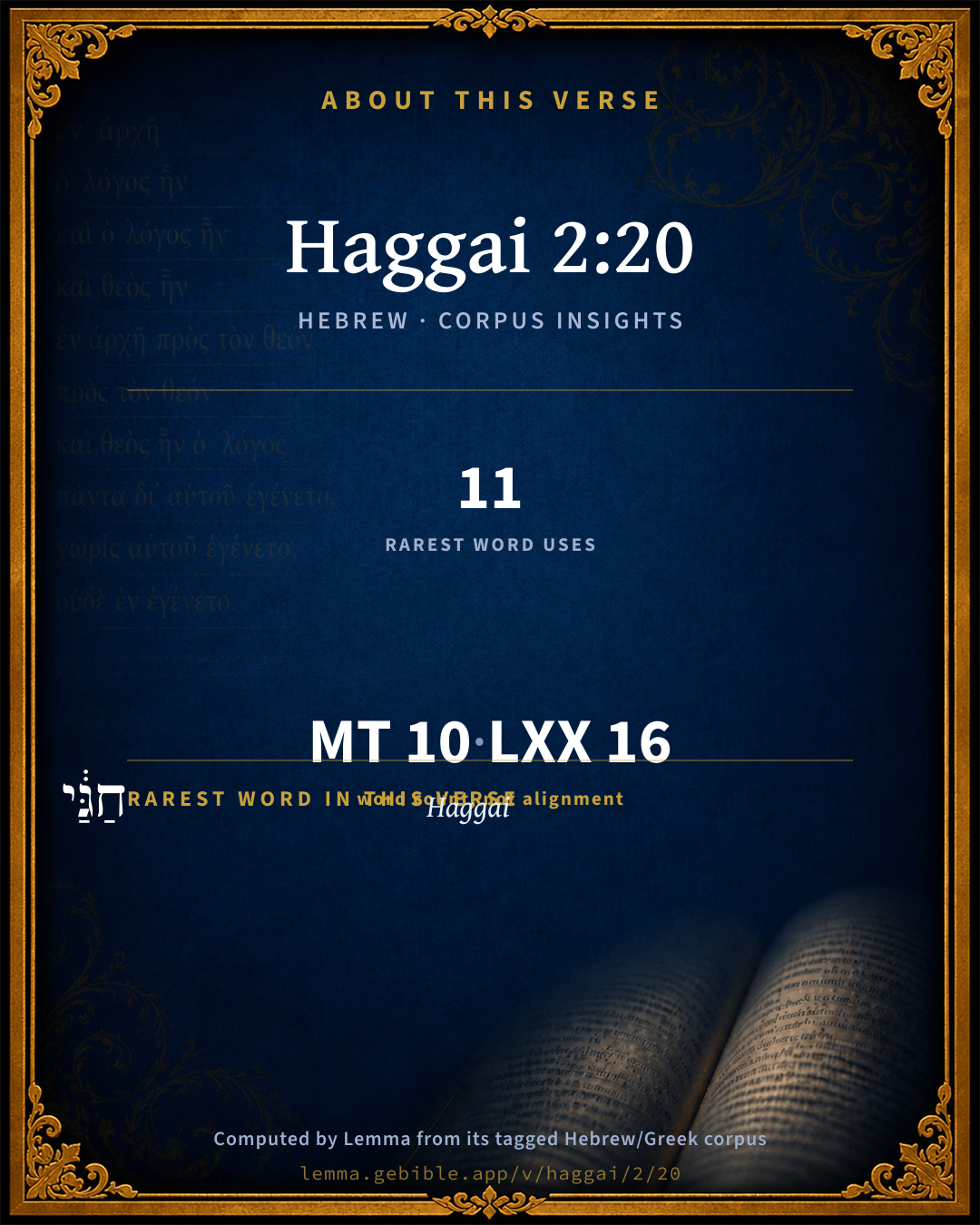
The rarest word here is חַגַּ֔י Haggai H2292 — appearing just 11 times in the whole Hebrew Bible.

Shared distinctive vocabulary

חַגַּ֔י Haggai H2292 occurs in 11 verses of the Hebrew Bible. Also found in:

Grammatical profile

  • 2 verbs
  • 4 nouns
  • 3 adjectives
  • 1 preposition

Verb forms

  • וַיְהִ֨י Qal · Sequential Imperfect
  • לֵאמֹֽר Qal · Infinitive Construct

Hebrew & Septuagint length

In English translation the verse runs 18 words from the Hebrew and 41 from the Septuagint (LXX English) — the Septuagint runs noticeably longer here. See the side-by-side →

A rough comparison of the two English renderings, which tokenize alike — not a word-level alignment.

Word counts can differ between the Hebrew and the Greek without any difference in meaning — e.g. the Hebrew direct-object marker אֵת has no separate Greek word, and Greek often adds the article ὁ.

In the original languages it is 10 Hebrew tokens and 16 Greek tokens — but the two are counted differently (Hebrew bundles its prefixes and suffixes into one token; the Greek is in lemma form), so that isn’t a like-for-like length.

Hebrew and Greek witnesses Masoretic Hebrew ↔ Greek Septuagint

The same verse in the two great witnesses to the Old Testament, shown verse-for-verse.

Here the Septuagint runs noticeably longer than the Hebrew — LXX2012 (modern English Septuagint) 41 words vs World English Bible 18. A rough length comparison of the two English translations, not a word-level alignment — read both below.

These are two independent witnesses, not word-aligned to each other, and the Septuagint is shown in lemma (dictionary) form.

Hebrew Haggai 2:20 Masoretic · Westminster Leningrad Codex

וַיְהִ֨י דְבַר יְהוָ֤ה שֵׁנִית֙ אֶל חַגַּ֔י בְּעֶשְׂרִ֧ים וְאַרְבָּעָ֛ה לַחֹ֖דֶשׁ לֵאמֹֽר

The Word of Yahweh came the second time to Haggai in the twenty-fourth day of the month, saying,

World English Bible · Public Domain

Greek LXX Haggai 2:20 Septuagint · lemma form

καί γίγνομαι λόγος κύριος ἐκ δεύτερος πρός αγγαιος ὁ προφήτης τετράς καί εἰκάς ὁ μήν λέγω

consider in your hearts, whether this shall be known on the corn-floor, and whether yet the vine, and the fig tree, and the pomegranate, and the olive-trees that bear no fruit are with you: from this day will I bless you.

LXX2012 (modern English Septuagint) · Public Domain

On this verse, Haydock's Catholic Bible Commentary discusses the Septuagint’s reading. Read the note in Commentary ↓

Hebrew: Westminster Leningrad Codex (CC BY 4.0). Greek: Septuagint (public domain); English from LXX2012 (modern English Septuagint) (Public Domain). How the Septuagint differs from the Hebrew →

Targum (Aramaic paraphrase)

1

The Targum is the ancient Jewish Aramaic paraphrase of the Hebrew Scriptures — an interpretive translation, not the Hebrew text itself. Onkelos (literal) and Pseudo-Jonathan (expansive) render the Torah, and Jonathan the Prophets. Coverage is partial: where no permissively-licensed English translation exists for a verse, only the Aramaic is shown. This is verse-level text, not a word-by-word alignment to the Hebrew.

  1. Targum Jonathan Prophets (Joshua–Malachi)
    וַהֲוָה פִּתְגַם נְבוּאָה מִן קֳדָם יְיָ תִּנְיָנוּת עִם חַגַי בְּעַסְרִין וְאַרְבְּעָא לְיַרְחָא לְמֵימָר:

    (no public-domain English translation for this verse)

    Targum Jonathan — Aramaic: “Mikraot Gedolot” (public domain). English: “Sefaria Community Translation” (CC0 1.0 (public-domain dedication)); “London "Chaldee Paraphrase," 1871” (public domain). Text via Sefaria.

Commentary

Notes on Haggai 2:20 from classic Christian and Jewish commentators (each source and its license shown beneath its notes). The classic Christian expositions comment on the surrounding passage and are grouped to its opening verse, so a note may address several verses; the Jewish commentaries on the Tanakh (Rashi and others) are per-verse, so they appear only where the commentator wrote on this verse.

Lemma curates 59 commentaries, every one of them public domain or Creative Commons licensed, each selected and text-cleaned for this edition rather than reprinted as found. About our sources →

Jamieson, Fausset & Brown

Robert Jamieson, A. R. Fausset & David Brown

FOURTH PROPHECY. God's promise through Zerubbabel to Israel of safety in the coming commotions. (Hag 2:20-23)

the month--the ninth in the second year of Darius. The same date as Prophecy III (Hag 2:10).

Jamieson, Fausset & Brown — Commentary Critical and Explanatory on the Whole Bible (1871) — public domain (CC PDM 1.0). Text via the HelloAO Bible API.

The Cambridge Bible for Schools and Colleges

gen. ed. J. J. S. Perowne

20. again] the second time. R. V.

Ch. Hag_2:20-23. The Fourth Prophecy

In a short, final prophecy, uttered on the same day as that which preceded it, Haggai addresses Zerubbabel as the Ruler and Representative of the Jewish nation, and the Predecessor and Type of the true King of the Jews. The former prediction (ver. 6, 7) of the shaking of heaven and earth, and the overthrow of mighty nations is repeated. But to Zerubbabel, and in him to the nation which he represented, a gracious promise of safety and distinction is vouchsafed.

The Cambridge Bible for Schools and Colleges (gen. ed. J. J. S. Perowne; Cambridge University Press, 1878–1918) — public domain. Text from a community e-Sword module.

Trapp's Complete Commentary

John Trapp

Hag 2:20 And again the word of the LORD came unto Haggai in the four and twentieth [day] of the month, saying,

Ver. 20. And again, the word of the Lord] Again the same day. Twice a day preaching is no new practice then. This prophet did it; so did our Saviour, Mat 13:1. So did Chrysostom, as appeareth by his note on 1Th 5:17. So did Luther; which, because one Nicholas White commended in him, he was accused of heresy, in the reign of Henry VIII It is not so long since it was held here practical Puritanism. The late arch-prelate being sued unto by a nobleman to prefer a chaplain of his (whom he commended for an able divine, and a twice-a-day preacher), turned away in a great heat, saying, The more fool he.

John Trapp, A Commentary or Exposition upon All the Books of the Old and New Testament (1647–1656) — public domain. Text from a community e-Sword module.

The Biblical Illustrator

Joseph S. Exell

Hag_2:20-23

And I will overthrow the throne of kingdoms.

The blessing of calamities

These are the concluding words of the prophecies of Haggai. The Old Testament is one continual declaration and snowing form of this truth, that sin, when it has conceived, brings forth death, and all the family of death. On the contrary, the godly, who give themselves up to doing the Lords will still find that God blesses them,--with peace; with all manner of spiritual graces; with the light of His countenance; and, may be, with worldly prosperity. Whenever God executes judgment it must be against evil. Nothing but evil can move the wrath of God. Nor does God ever shake, or overthrow, or destroy anything, except by reason of evil. The natural man imagines a God who cares not about the life or death of His creatures, who merely creates them to show forth His power and His skill. This image is altogether different from the true God, as He has revealed Himself to mankind in His Word, and by the incarnation of His only-begotten Son. The true God has no pleasure in the ebb and flow of life and death. He wills life, not death. The only thing God wilts to destroy is sin--not the sinner, but the sin. When He destroys the sinner, it is solely for the sake of the sin. The works of destruction spoken of in the text are part of that warfare which God is continually waging against sin and all manner of evil, and accordingly agree in their spirit and purpose with the barrenness and blasting and mildew sent upon the Israelites, because they had neglected their appointed work of building the house of the Lord. When God takes in hand a work of destruction, it is never purely and entirely a work of destruction. Whenever God executes judgment, mercy is always going along with judgment. Were not this Gods purpose, He would be giving up the victory to the spirit of evil, and death would triumph over life. This then is the end and purpose of Haggais prophecy. It speaks of terrible and awful things; but it ends with worlds of comfort and peace. It says that, while the nations around Judea were to be shaken and disturbed by wars and divers disasters, and while many were to perish, Zerubbabel would establish the remnant of Gods people in the land of their fathers; and so, we know, he did. The coming of Zerubbabel, which is spoken of as the coming of the desire of all nations, whereby the house of the Lord was to be filled with glory, was a type of a threefold fulfilment, one of which has already taken place once for all; one of which has been continually taking place ever since, and is continually taking place at this day; and one of which Will take place hereafter: and all these fulfilments are accompained by signs more or less like those foretold in the text, as ordained to attend the coming of Zerubbabel. Thus the coming of Zerubbabel was a type of Christs coming in the flesh. Zerubbabel was not really the Desire of all nations, but Christ was. Zerubbabel could not fill Gods house with glory, but Christ did fill it with an infinite, undying, heavenly glory . . . Whenever God has purposed to raise His Church to a higher stage of power and glory, the world has been shaken by the new life which has entered and taken possession of it. The heart of the Christian will not fail when he sees the shaking of the nations, or of the powers of heaven. He will not be troubled or disquieted by fears, as though evil were about to gain victory over good. Our Lords promise is, that, from amid the clouds and the storm, the sign of the Son of Man shall come forth with power and great glory. (J. C. Hare, M. A.)

Terrible revolutions

These verses remind us--

I.

that the revolutions amongst mankind are sometimes very terrible. Here we read of the shaking of the heavens and the earth, the crash of thrones, the destruction of kingdoms, the overthrow of chariots, etc. What the particular revolutions referred to here are, cannot be determined. Such revolutions imply the existence and prevalence of two antagonistic moral principles in the world--good and evil. These are the Titanic chieftains in all the battles, the elemental forces in all the convulsions of the world. It is truth against error, right against wrong, liberty against thraldom, virtue against vice.

II. That God has to do even with the most terrible of these revolutions. I will shake the heavens, I will overthrow the throne, etc. I will destroy the strength, etc. Inasmuch

(1) As God is eternally against the false and the wrong and the tyrannic, He may be said to be Author of these revolutions. Inasmuch

(2) As He can prevent them, He may be said to be the Author of these revolutions. He does not originate them, but He permits them. He could annihilate all wicked doers by a volition, He allows them to fight themselves often to death in battling against the right and the true. The Lord sitteth upon the flood. He sits in serene majesty, controlling all the fury of the battling forces. He holds the winds in His fist.

III. That the good man is safe in the most tremendous revolutions of time. In that day, saith the Lord of hosts, will I take thee, O Zerubbabel, My servant, the son of Shealtiel, saith the Lord, and will make thee as a signet: for I have chosen thee, saith the Lord of hosts. What is here said of Zerubbabel suggests three thoughts.

(1) That good men sustain the highest office. Zerubbabel was not only a servant, but a chosen servant. He was selected for the work of rebuilding the temple. It suggests

(2) That good men will receive the highest distinction I will make thee as a signet. A signet indicates,

(a) Worth. It was a ring with a seal on it, worn on the finger, as an ornament of great value. Good men are elsewhere represented as Gods jewels. A signet indicates,

(b) Authority. The signet of an Eastern monarch was a sign of delegated authority. A good man is invested with the highest authority--the authority to fight against wrong and to promote right, at all times and in every place. It suggests

(3) That goodmen will always be safely kept, Jehovah says this to Zerubbabel. Amidst all evil, God is my refuge and strength, a very present help in trouble. (Homilist.)

The safety of Gods people amidst the coming commotions

1. Great political convulsions may be expected in the future, as well as in the past, because the same reason exists for them; the ungodly nature of existing political forms (Hag_2:21).

2. Wars, revolutions, and tumults of nations are all working out Gods designs of mercy to the world, by means of His Church (Hag_2:22).

3. Amidst all the convulsions of human history, the people of God are safe, the gates of hell can never prevail against the Church. The past in this respect is prophet of the future (Hag_2:23).

4. The best protection for any nation, the surest guarantee for its political existence, is a living, working Church in its midst, for as long as the stream of national life carries the vessel in which Christ is carried, that stream shall flow on in safety. Sodom shall stand as long as a righteous Lot is found in it (Hag_2:23). The general drift of this prophecy by Haggai may now be perceived. His specific work was to urge the rebuilding of the temple. This work was important, because the temple was the seat of the theocracy, and the theocracy was the existing form of the great work of redemption. To erect that, and thus prepare for the reinauguration of the temple-worship, was the great work of the restoration. To urge them to this work, the prophet tears away their subterfuges and excuses shows them how they had already suffered by its neglect; develops to them the real greatness of the work, in spite of its outward littleness, as a necessary link in the great purposes of redemption; and guarantees the safety of the theocratic people amidst all the convulsions that were to come on the earth. All these predictions have been fulfilled to the letter, proving that Haggai was what he claimed to be, a true prophet of Jehovah. (T. V. Moore, D. D.)

The Biblical Illustrator, edited by Joseph S. Exell (c. 1880s–1900s) — public domain. Text from a community e-Sword module.

Joseph Benson's Commentary

Hag 2:20-22. Again the word of the Lord came unto Haggai — Probably on the same day that he uttered what precedes, from Hag 2:10; speak to Zerubbabel, governor of Judah — The same title which is given to him chap. Hag 1:1; in which character he was the type of the Messiah, to whom the following words chiefly belong. I will shake the heavens and the earth — I will cause great commotions, and bring great things to pass. I will overthrow the throne of kingdoms — This is supposed to be spoken of the overthrow of the Persian empire, in Egypt, which, lying near to the Jewish territories, was regarded by them with great awe; and therefore its subversion was foretold to them, to encourage them to go on in the rebuilding of the temple. I will destroy the strength of the kingdoms of the heathen — Or, of the nations. The strength of the Persians, whose empire consisted of many kingdoms, or nations, was broken in a most remarkable manner by the little country of Greece. Such vast overthrows, both by sea and land, as they received from the Greeks, are scarcely to be paralleled. The horses and their riders shall come down — Shall fall to the earth; every one by the sword of his brother — That is, of his fellow-creature. Perhaps the different nations which should be concerned in these commotions, namely, the Persians, Egyptians, and Greeks, are here called brothers, because they were all idolaters, or worshippers of fictitious gods.

Joseph Benson's Commentary on the Old and New Testaments (1811–1818) — public domain. Text from a community e-Sword module.

The Preacher's Complete Homiletical Commentary

Joseph S. Exell (gen. ed.)

CRITICAL NOTES.]

Hag_2:20-23.] Renewal of promise to save in convulsions.

Hag_2:21. Shake] Points back to Hag_2:6 and Hag_2:7.

Hag_2:22. Throne] Government which binds nations together (Dan_7:27). War-chariots, horses, and riders, military power, and support of kingdoms, to be overthrown by one another’s sword. “One hostile kingdom will destroy another, and in the last conflict the heathen hosts will annihilate one another” (cf. Eze_38:21; Zec_14:13) [Keil].

Hag_2:23.] At that time Jehovah would take Zerubbabel, invest him with power and authority as head over all, as kings depute viceroys by giving them their signet (Est_3:10; Est_8:2). Some think, as seals and rings were objects of great value and regard, so Zerubbabel would be dear, and held close, to God—an object of incessant care and delight (Jer_22:24; Son_8:6). In a theocratic sense he restored the reign of David. What was promised to him was equally promised to all faithful rulers of Judah. They would be guardians of the people, and should stand secure amid the fall of earthly kingdoms. This prosperity and triumph of old prefigured the Redeemer’s reign, whom God would exalt on the throne of David (Mat_1:12; Luk_3:2), crown as king of the earth (Psa_89:27), and endow with a kingdom which will never be destroyed (Dan_2:44; Heb_12:28; 1Co_15:24).

HOMILETICS

THE PRESERVATION OF GOD’S PEOPLE AMID THE OVERTHROW OF EMPIRES.—Hag_2:20-23

The same day in which God promised the bounties of nature, the prophet received a second message for Zerubbabel, who was concerned for the interests of Zion in predicted revolutions. God would overturn the nations, but preserve his people and their rulers as elect and precious in his sight.

I. Earthly kingdoms will be overthrown. “I will shake the heavens and the earth” (cf. Hag_2:6-7).

1. Overthrown by Divine agency. “I will shake”—“I will overthrow,” and “I will destroy.” God is enthroned over all kingdoms, puts down one, and exalts another in his pleasure (Dan_2:21; Luk_1:52).

2. Overthrown by mutual strife. “Every one by the sword of his brother.” Men opposed to God are often opposed to one another. If national truth and righteousness do not control national life, then we may expect self-destruction, if not fratricidal war. Mutual destruction is a feature of Divine judgment upon wicked nations at the end of the world. “Every man’s sword shall be against his brother” (Eze_38:8-9; Eze_38:21; Isa_9:19).

3. Overthrown in military strength. “The strength of the kingdoms,” that which supports them—their chariots and horsemen, and all their military preparations. The kingdoms shall be shaken, thrones upset, and dynasties destroyed. Every people will be shorn of its strength, fall, and cease to be; but the Church of God will be preserved, when unfaithful nations are blotted out of existence.

II. God’s people will be protected. “In that day, saith the Lord of Hosts, will I take thee,” to protect and promote thee and thy people to honour.

1. Certain protection. The words, “saith the Lord of Hosts,” are given three times, for greater assurance and confirmation of faith.

2. A delightful protection. “I have chosen thee.” God loves his people, and chooses them for himself. He will never cast them off, but make them subjects of his special care. They are a seal upon his heart, a seal upon his arm (Dan_7:13); and hidden in the shadow of his hand (Isa_49:2).

3. An everlasting protection. As the ring is inseparable from its possessor, so God’s people will be permanently connected with him, and become his special inheritance. As royal signets on the eternal hand shall they be safely guarded. They are sealed in Christ, and safe for ever—heirs of that kingdom before which all earthly dominions shall fall. “These shall make war with the Lamb, and the Lamb shall overcome them: for he is Lord of lords, and King of kings: and they that are with him are called, and chosen, and faithful” (Rev_17:14).

HOMILETIC HINTS AND SUGGESTIONS

Hag_2:22. The overthrow prophesied is universal. It is not one throne only, as of Persia, but the throne, i.e., the sovereigns of kingdoms; not a change of dynasty, but a destruction of their strength; not of a few powers only, but the kingdoms of the heathen; and that in detail; that in which their chief strength lay, the chariots and horsemen and their riders, and this man by man, every one by the sword of his brother [Pusey].

Hag_2:23. As a signet.

1. A token of value.

2. A token of love (Son_8:6).

3. A token of remembrance. This promise is the reverse of Jeconiah’s sentence: “though he were the signet upon my right hand, yet would I pluck thee thence” (Jer_22:24). “Zerubbabel was a devoted servant of God. God acknowledges his faithfulness. Only the beginning of all was with God. God speaks of the nearness to himself which he had given him. But in two words he cuts off all possible boastfulness of his creature. Zerubbabel was all this, not of himself, but because God had chosen him” [Pusey]. In his theocratic relation he represented and preserved the kingdom of David. Hence he is regarded by many as a type of Christ, the son of David, and descendant of Zerubbabel (cf. 1Ch_3:19; Mat_1:12; Luk_3:27), in whom the kingdom shall be perpetuated. It will be assailed, but never destroyed. All nations that resist shall be broken to pieces, and scattered like chaff before the wind.

ILLUSTRATIONS TO CHAPTER 2

Hag_2:21-23. Overthrow. In spite of man’s short-sighted endeavours to dispose of events according to his own wishes and his own purposes, there is an Intelligence beyond his reason, which holds the scales of justice, and promotes his well-being in spite of his puny efforts [Morier]. Take thee. The weakest believer is safe, because, by believing, he is within the strongest of all defences. None can pluck him out of the hands of Christ (Pro_14:26). “Let God be thy love and thy fear, and he will be also thy refuge” [Nicholls].

The Preacher's Complete Homiletical Commentary (gen. ed. Joseph S. Exell; Funk & Wagnalls, c. 1892) — public domain (pre-1929). A full-Bible homiletical/sermon-outline anthology covering 65 of 66 books (2 John is absent from the source module). Text from a community e-Sword module.

Keil & Delitzsch

C. F. Keil & F. Delitzsch

Renewal of the Promise of Salvation. - Hag 2:20. On the same day on which the Lord promised to the people the return of the blessings of nature, Haggai received a second revelation, which promised to the community the preservation and care of the Davidic monarchy, represented for the time by Zerubbabel, in the midst of the storms that were about to burst upon the power of the world. Hag 2:21. "Speak to Zerubbabel the governor of Judah thus: I shake the heaven and the earth. Hag 2:22. And I will overthrow the throne of the kingdoms; and destroy the might of the kingdoms of the nations; and will overthrow the war-chariots, and those who ride in them: and horses and their riders shall fall, one by the sword of the other. Hag 2:23. On that day, is the saying of Jehovah of hosts, will I take thee, Zerubbabel son of Shealtiel, my servant, is the saying of Jehovah, and make thee as a signet-ring: for I have chosen thee, is the saying of Jehovah of hosts." אני מרעישׁ does not stand for הנני מרעישׁ, but the participial clause is to be taken as a circumstantial clause: If I shake heaven and earth, I overthrow (cf. Ewald, 341, c and d). The words point back to the shaking of the world predicted in Hag 2:6, Hag 2:7. When this shaking takes place, then shall the throne of the kingdoms be thrown down, and their might be destroyed. The singular כּסּא is used collectively, or rather distributively: "every throne of the kingdoms." The throne is the symbol of the monarchy, or of the government (cf. Dan 7:27); not in this sense, however, that "the prophet regarded all the kingdoms of the earth as one combined power in contradistinction to the people of God, or as a single power, as the power of the world, which was sitting as mistress at the time upon the throne of the earth" (Koehler). The plural mamlâkhōth does not agree with this, since every kingdom had both a king and a throne. The continuance of this throne rests upon the strength (chōqez) of the heathen kingdoms, and this again upon their military power, their war-chariots, horses, and riders. These are to be overthrown and fall to the ground, and indeed by one another's swords. One hostile kingdom will destroy another, and in the last conflict the heathen hosts will annihilate one another (compare Eze 38:21; Zac 14:13). At that time, when the dominion of the heathen had thus collapsed, Jehovah would take Zerubbabel and set or make him as a signet-ring. The verb 'eqqach (will I take) simply serves to introduce the following act as one of importance, as for example in Deu 4:20 and Kg2 14:21. The meaning of the figurative expression, to make Zerubbabel as a signet-ring, is evident from the importance of the signet-ring in the eyes of an oriental, who is accustomed to carry his signet-ring constantly about with him, and to take care of it as a very valuable possession. It is introduced with the same idea in the Sol 8:6, "Lay me as a signet-ring upon thy breast, as a signet-ring in thine arms;" and it is in the same sense that Jehovah says of Jehoiachin in Jer 22:24, "Though Coniah the son of Jehoiakim were even a signet-ring upon my right hand, i.e., a possession from which it would be thought impossible that I should separate myself, yet would I tear thee away from thence." Hence we obtain this thought for our present passage, namely, that on the day on which Jehovah would overthrow the kingdoms of the nations, He would make Zerubbabel like a signet-ring, which is inseparable from its possessor; that is to say, He would give him a position in which he would be and remain inseparably connected with Him (Jehovah), would therefore not cast him off, but take care of him as His valuable possession. This is the explanation given by Koehler (after Calvin, Osiander, and others); and he has also refuted the various explanations that differ from it. But in order clearly to understand the meaning of this promise, we must look at the position which Zerubbabel occupied in the community of Israel on its return from exile. For we may at the outset assume that the promise did not apply to his own particular person, but rather to the official post he held, from the fact that what is here predicted was not to take place till after the overthrow of the throne and might of all the kingdoms of the heathen, and therefore could not take place in Zerubbabel's lifetime, inasmuch as, although the fall of this or the other kingdom might be looked for in the course of one generation, the overthrow of all kingdoms and the coming of all the heathen to fill the temple of the Lord with their possessions (Hag 2:7) certainly could not. Zerubbabel was (Persian) governor in Judah, and had no doubt been selected for this office because he was prince of Judah (Ezr 1:8), and as son of Shealtiel was a descendant of the family of David (see at Hag 1:1). Consequently the sovereignty of David in its existing condition of humiliation, under the sovereignty of the imperial power, was represented and preserved in his appointment as prince and governor of Judah, so that the fulfilment of the divine promise of the eternal perpetuation of the seed of David and his kingdom was then associated with Zerubbabel, and rested upon the preservation of his family. Hence the promise points to the fact, that at the time when Jehovah would overthrow the heathen kingdoms, He would maintain and take good care of the sovereignty of David in the person of Zerubbabel. For Jehovah had chosen Zerubbabel as His servant. With these words the Messianic promise made to David was transferred to Zerubbabel and his family among David's descendants, and would be fulfilled in his person in just the same way as the promise given to David, that God would make him the highest among the kings of the earth (Psa 89:27). The fulfilment culminates in Jesus Christ, the son of David and descendant of Zerubbabel (Mat 1:12; Luk 3:27), in whom Zerubbabel was made the signet-ring of Jehovah. Jesus Christ has raised up the kingdom of His father David again, and of His kingdom there will be no end (Luk 1:32-33). Even though it may appear oppressed and deeply humiliated for the time by the power of the kingdoms of the heathen, it will never be crushed and destroyed, but will break in pieces all these kingdoms, and destroy them, and will itself endure for ever (Dan 2:44; Heb 12:28; Co1 15:24).

Keil & Delitzsch — Biblical Commentary on the Old Testament (1861–1891) — public domain (CC PDM 1.0). Text via the HelloAO Bible API. (Old Testament only.)

Lange's Commentary on the Holy Scriptures

FIFTH ADDRESS

Preservation of the People in the Convulsions that should destroy the surrounding Nations

Hag_2:20-23

20     And there was a word of Jehovah a second time to Haggai on the twenty-fourth (day) of the month, saying: 21Speak to Zerubbabel, Governor of Judah, saying: I will be shaking22 the heavens and the earth; 22And I will overturn the throne of the kingdoms, and will destroy the strength of the kingdoms of the nations, and will overthrow the chariot and its riders, and the horses and their riders shall sink down, each by the sword of his brother. 23In that day, saith Jehovah of Hosts I will take thee, Zerubbabel, son of Shealtiel, my servant, saith Jehovah, and will place thee as a signet, for thee have I chosen, saith Jehovah of Hosts.

EXEGETICAL AND CRITICAL

In order to supply all that was now needed to motions to strengthen and encourage his people, the Prophet delivers, on the same day, a second message, predicting their safety amidst the upheavals of the Gentile world, and assuring them of God’s guardian care over their rulers as a pledge of this promise.

Hag_2:20-22. And there was a word of Jehovah.… each by the sword of his brother, The shaking of the heavens and the earth here predicted coincides to some extent with that fore told in Hag_2:6-7. To establish the distinction that does exist, we have only to assume that the commotions to be excited among the Gentiles to carry out God’s purposes with respect to the world are to be understood as limited by the results to be accomplished. In the passage referred to, as we have seen, the ultimate submission and worship of the world is announced; here we are told of nothing beyond the temporal security of the Jews (for how long a period is not indicated) amidst the mutual destruction of other nationalities. It is most probable that the reference is to wars in which those countries were involved, with which Israel had been brought into contact,—Babylon (whose capture and cruel treatment by Darius Hystaspes, after rebellion against him, occurred soon after the delivery of this prophecy); Persia in its conflicts with Scythia, etc., and especially with Greece; Syria in its protracted wars with Egypt. These limitations seem to be correct: (1) because the prophecy does not say that the Jews would be preserved in contending against other nations, but only during the mutual contentions of the latter; (2) because we find that the Jews did actually succumb to the power of the Gentiles. The throne of the kingdoms here means their government, that which binds men together as a nation (comp. Dan_7:27). This is based upon the strength of the kingdoms, which is shattered by the destruction of their armies. Every man by the sword of his brother, asserts in a general way that the nations in their wars would become self-destructive as well as mutually destructive.

Hag_2:23. In that day. This expression denotes, according to its usual prophetic indefiniteness, not the period introduced by the commotions just predicted,—a supposition tenable only by those who assume that by Zerubbabel the Messiah is directly intended,—but the period, of whatever duration it should be, during which the commotions should continue. If the verses just preceding had alluded to any remote consequences of the conflicts between the nations, the former explanation would be admissible. I will place thee as a signe-tring. The signet-ring was held very precious, and worn constantly by its oriental possessor; comp. Son_8:6; Jer_11:14. The announcement thus conveyed, that during these convulsions Jehovah, who had chosen Zerubbabel as his servant, would take him under his peculiar and special care, is probably to be accounted for and explained in the following way: The Jews, although it was now several years since they had returned from exile, had been constituted a theocratic nation, and recognized as such by God only through the erection of the Temple, which was in fact the condition of their national existence. In the midst of the convulsions that were to shake the surrounding nations, they would naturally feel themselves insecure. To anticipate and allay this anxiety, it was now announced to them that their government and institutions would be preserved. For Zerubbabel, though appointed by the Persian monarch who was temporarily to be their ruler, was chosen by Jehovah also as the representative of the throne and family (Luk_3:27) of David, which was to stand secure, while the kingdoms of the earth should fall. In this promise Zerubbabel is fitly taken to represent all the rulers of the Jews during the period within the range of the prophecy. He was the first and the greatest of their post-exilic rulers. In a theocratic relation he was the restorer of the dynasty of David. What was promised to him we may regard as equally promised to all the faithful rulers of Judæa who should come after him. They also would be chosen of God and the objects of his watchful care, as the guardians of his people. This we regard as the direct occasion of the promise. It is probable, however, that these words were addressed to Zerubbabel (comp. Zec_4:6-10), partly to give him encouragement in his direction and supervision of the work upon the Temple, and in his efforts to mould and control the little community at such a critical period of its history.

This discourse has been regarded by most orthodox commentators as Messianic in the strict sense, namely, as gaining its full and only adequate application when understood of the Messiah and his kingdom. It is clear, however, from the foregoing exposition, that it is Messianic only in so far as the progress and prosperity of God’s people under the Old Covenant prefigured the triumph of the Redeemer’s reign. It may be urged against this restriction that the address is prefaced (Hag_2:21) by an expression similar to that by which the Messianic promises in Hag_2:6-9 were introduced. There is this distinction, however, among others, between the two predictions. In the former the discourse relates to the Temple as representing the Church of God in its perpetual and ever-increasing glory and as the refuge of all nations; in the latter we have no indication of a reference to anything beyond the preservation of the theocracy so long as it should suit the divine purposes. The shaking of the heavens and the earth illustrates in both cases the violent commotions among the Gentiles through the divine power, but the result in the one was to be their ultimate conversion, in the other their destruction. Among Anglo-American commentators Henderson and Moore hold to the restricted and indirect Messianic sense.

DOCTRINAL AND ETHICAL

1. The destinies of nations and their rulers are determined by their relations to the kingdom of God. When they subserve its advancement, they are not merely preserved by Him, but even become the objects of his special care (comp., e.g., Isa_45:1-6). When they cease to do so they are shorn of their strength and fall. This is the highest and clearest lesson of history, written as plainly upon her records, as upon the pages of the Old Covenant.

2. The Jewish nation formed no exception to this divine law. The only respect in which it differed from other nations in this regard, was that it contained for a time the Church of God. This was its glory and its high trust. Its rulers, when faithful to the interests of God’s kingdom committed to their keeping, were, as his chosen ministers, precious in his sight, and the objects of his peculiar care and never-failing help. Through the administration of such the nation prospered. And we know as well that it was through the unfaithfulness of the leaders of the Jewish people, that God’s favor was withdrawn from them and they were blotted out from among the nations.

HOMILETICAL AND PRACTICAL

Hag_2:22. Do righteousness and truth control our national life? If they do not we may expect national dissolution; perhaps the recurrence of fratricidal war.

Hag_2:23. Are our rulers controlled in their every act by a regard for righteousness and truth? If they are, they will be guarded and guided by God for the nation’s prosperity and true glory. If they are not, let them remember the denunciations of the prophets and of Christ himself against the unfaithful leaders of the Jews.

Moore: The best protection for any nation, the surest guarantee for its political existence, is a living, working Church in its midst.

Pressel: Even though we are not royal signe-trings, O God, but only little rings on thy eternal hand, how safely are we guarded!

Footnotes:

[22]Hag_2:21-22.—The force and construction of מַרְעִישׁ in connection with the following preterites, are the same as those of the same word in Hag_2:6 : I shall be shaking (a participle being indefinite as to time) and (Shall) have overturned.

Lange's Commentary on the Holy Scriptures (Critical, Doctrinal, and Homiletical), ed. John Peter Lange, English translation edited by Philip Schaff (1864–1880) — public domain. Text from a community e-Sword module.

The Annotated Bible

Arno C. Gaebelein

CHAPTER 2:20-23

The Fifth Address

The final address of Jehovah’s messenger is altogether prophetic. It is addressed exclusively to Zerubbabel, the governor, a son of David. He tells the princely leader that the heavens and the earth will be shaken; it is the same as in Hag 2:6. When that comes the throne of the kingdoms will be overthrown; the power of the kingdoms of the nations (the ten kingdoms; Dan 2:1-49 will be destroyed, for in that day, the falling stone, typifying the second coming of Christ, will make an end of Gentile dominion. The battle of Armageddon will take place and end the military power of these nations. Zerubbabel, the son of David, is the type of Christ, the Son of David. He will then receive the throne of His father David. He will be made a signet. The signet-ring was among those nations a mark of honor. It was given by monarchs to their prime-ministers, conferring all authority upon them. Thus the Lord Jesus Christ is pictured as receiving from God the rule and authority.

Arno C. Gaebelein, The Annotated Bible (1913–1922) — public domain. Text from a community e-Sword module.

The Expositor's Bible

4. THE REINVESTMENT OF ISRAELS HOPE

Hag_2:20-23

On the same day Haggai published another oracle, in which he put the climax to his own message by reinvesting in Zerubbabel the ancient hopes of his people. When the monarchy fell the Messianic hopes were naturally no longer concentrated in the person of a king; and the great evangelist of the Exile found the elect and anointed Servant of Jehovah in the people as a whole, or in at least the pious part of them, with functions not of political government but of moral influence and instruction towards all the peoples of the earth. Yet in the Exile Ezekiel still predicted an individual Messiah, a son of the house of David; only it is significant that, in his latest prophecies delivered after the overthrow of Jerusalem, Ezekiel calls him not king any more, but prince.

After the return of Sheshbazzar to Babylon this position was virtually filled by Zerubbabel, a grandson of Jehoiakin, the second last king of Judah, and appointed by the Persian king Pehah or Satrap of Judah. Him Haggai now formally names the elect servant of Jehovah. In that overturning of the kingdoms of the world which Haggai had predicted two months before, and which he now explains as their mutual destruction by war, Jehovah of Hosts will make Zerubbabel His signet-ring, inseparable from Himself and the symbol of His authority.

"And the word of Jehovah came a second time to Haggai on the twenty-fourth day of the ninth month, saying: Speak to Zerubbabel, Satrap of Judah, saying: I am about to shake the heavens and the earth, and I will overturn the thrones of kingdoms, and will shatter the power of the kingdoms of the Gentiles, and will overturn chariots and their riders, and horses and their riders will come down, every man by the sword of his brother. In that day - oracle of Jehovah of Hosts-I will take Zerubbabel, son of Shealtiel, My servant-oracle of Jehovah-and will make him like a signet-ring; for thee have I chosen-oracle of Jehovah of Hosts."

The wars and mutual destruction of the Gentiles, of which Haggai speaks, are doubtless those revolts of races and provinces which threatened to disrupt the Persian Empire upon the accession of Darius in 521. Persians, Babylonians, Medes, Armenians, the Sacae and others rose together or in succession. In four years Darius quelled them all, and reorganized his empire before the Jews finished their Temple. Like all the Syrian governors, Zerubbabel remained his poor lieutenant and submissive tributary. History rolled westward into Europe. Greek and Persian began their struggle for the control of its future, and the Jews fell into an obscurity and oblivion unbroken for centuries. The "signet-ring of Jehovah" was not acknowledged by the world-does not seem even to have challenged its briefest attention. But Haggai had at least succeeded in asserting the Messianic hope of Israel, always baffled, never quenched, in this re-opening of her life. He had delivered the ancient heritage of Israel to the care of the new Judaism.

Haggais place in the succession of prophecy ought now to be clear to us. The meagerness of his words and their crabbed style, his occupation with the construction of the Temple, his unfulfilled hope in Zerubbabel, his silence on the great inheritance of truth delivered by his predecessors, and the absence from his prophesying of all visions of Gods character and all emphasis upon the ethical elements of religion-these have moved some to depress his value as a prophet almost to the vanishing point. Nothing could be more unjust. In his opening message Haggai evinced the first indispensable power of the prophet: to speak to the situation of the moment, and to succeed in getting men to take up the duty at their feet; in another message he announced a great ethical principle; in his last he conserved the Messianic traditions of his religion, and though not less disappointed than Isaiah in the personality to whom he looked for their fulfillment, he succeeded in passing on their hope undiminished to future ages.

William Robertson Nicoll, ed., The Expositor's Bible (London: Hodder & Stoughton, 1887–1910) — public domain. 65 of 66 books (1 Corinthians is not separately keyed, as that volume carries no machine-parseable verse references); section-level commentary keyed to the opening verse. Introductory and overview sections not keyed to a specific passage are excluded.

Tyndale Open Study Notes

Tyndale Open Resources

2:20-23 Haggai’s final message is perhaps the most important; it reestablishes the prominence of David’s descendant in Israel’s religious and political life. The dynasty of David was key to restoring the Hebrew people after the Babylonian exile (see Jer 23:5; Ezek 37:24). God had cursed David’s descendant, King Jehoiachin, at the time of the Exile (Jer 22:24-30), but Haggai’s last message overturns that curse and reinstates the covenant with David (see 2 Sam 7:4-17) as the means by which God will carry out his promises to bless and restore Israel.

Tyndale Open Study Notes — © Tyndale Open Resources, licensed CC BY-SA 4.0. Text via the HelloAO Bible API.

Geneva Bible (1599)

Geneva Bible translators

He exhorteth them to patience, and to abide till the harvest came, and then they should see God’s blessings.

Geneva Bible (1599) marginal notes — public domain. Text via Bolls.life.

Matthew Henry's Commentary

After Haggai's sermon ad populum - to the people, here follows one, the same day, ad magistratum - to the magistrates, a word directed particularly to Zerubbabel, the governor of Judah, who was a leading active man in this good work which the people now set about, and therefore he shall have some particular marks put upon him (Hag 2:21): Speak to Zerubbabel, governor of Judah, speak to him by himself. He has thoughts in his head far above those of the common people, as wise princes are wont to have, who move in a higher and larger sphere than others. The people of the land are in care about their corn-fields and vineyards; God has assured them that they shall prosper, and we hope that will make them easy; but Zerubbabel is concerned about the community and its interests, about the neighbouring nations, and the revolutions of their governments, and what will become of the few and feeble Jews in those changes and convulsions, and how such a poor prince as he is should be able to keep his ground and serve his country. "Go to him," says God, "and tell him it shall be well with him and his remnant, and let that make him easy."

I. Let him expect to hear of great commotions in the nations of the earth, and let them not be a surprise to him; behold, he is told of them before (Hag 2:21, Hag 2:22): I will shake the heavens and the earth. This he had said before (Hag 2:6, Hag 2:7), and now says it again to Zerubbabel; let him expect shaking times, universal concussions. The world is like the sea, like the wheel, always in motion, but sometimes in a special manner turbulent. But, Blessed be God, if the earth be shaken, it is to shake the wicked out of it, Job 38:13. In the apocalyptic visions earthquakes bode no ill to the church. Here the heavens and the earth are shaken, that proud oppressors may be broken and brought down: I will overthrow the throne of kingdoms. The Chaldean monarchy, which had been the throne of kingdoms a great while, was already overthrown; and the powers that are, and are yet to come, shall in like manner be overthrown; their day will come to fall. 1. Though they be ever so powerful, yet the strength of their kingdoms shall be destroyed. They trust in chariots and horses (Psa 20:7), but their chariots shall be overthrown, and those that ride in them, so that they shall not be able to attack the people of God, whom they persecute, not to escape the judgments of God, which persecute them. 2. Though there appear none likely to be the instruments of their destruction, yet God will bring it about, for they shall be brought down every one by the sword of his brother. This reads the doom of all the enemies of God's church, that will not repent to give him glory; it seems likewise designed as a promise of Christ's victory over the powers of darkness, his overthrow of Satan's throne, that throne of kingdoms, the throne of the god of this world, the taking from him all the armour wherein he trusted and dividing the spoil. And all opposing rule, principality, and power, shall be put down, that the kingdom may be delivered up to God, even the Father.

II. Let him depend upon it that he shall be safe under the divine protection in the midst of all these commotions, Hag 2:23. Zerubbabel was active to build God a house, and therefore God makes the same promise to him as he did to David on the like occasion - that he would build him a house, and establish it, even in that day when heaven and earth are shaken. This promise refers to this good man himself and to his family. He honoured God, and God would honour him. His successors likewise in the government of Judah might take encouragement from it; though their authority was very precarious as to men, yet God would confirm it, and this would contribute to the stability of the people over whom God had set them. But this promise has special reference to Christ, who lineally descended from Zerubbabel, and is the sole builder of the gospel-temple. 1. Zerubbabel is here owned as God's servant, and it is an honourable mention that is hereby made of him, as Moses and David my servants. When God destroys his enemies he will prefer his servants. Our Lord Jesus is his Father's servant in the work of redemption, but faithful as a Son, Isa 42:1. 2. He is owned as God's elect: I have chosen thee to this office; and whom God makes choice of he will make use of. Our Lord Jesus is chosen of God, Pe1 2:4. And he is the head of the chosen remnant; in him they are chosen. 3. It is promised that, being chosen, God will make him as a signet. Jeconiah had been as the signet on God's right hand, but was plucked thence (Jer 22:24); and now Zerubbabel is substituted in the room of him. He shall be near and dear to God, precious in his sight, and honourable, and his family shall continue till the Messiah spring out of it, who is the signet on God's right hand. This intimates, (1.) The delight the Father has in him. In him he once and again declared himself to be well pleased. He is set as a seal upon his heart, a seal upon his arm, is brought near unto him (Dan 7:13), is hidden in the shadow of his hand, Isa 49:2. (2.) The dominion the Father has entrusted him with. Princes sign their edicts, grants, and commissions, with their signet-rings, Est 3:10. Our Lord Jesus is the signet on God's right hand, for all power is given to him and derived from him. By him the great charter of the gospel is signed and ratified, and it is in him that all the promises of God are yea and amen.

Matthew Henry's Commentary on the Whole Bible (1708–1710) — public domain (CC PDM 1.0). Text via the HelloAO Bible API.

Adam Clarke's Commentary

Verse 20. Again the word of the Lord came] This was a second communication in the same day.

Adam Clarke's Commentary on the Bible (1810–1826) — public domain. Text from a community e-Sword/MySword module.

John Calvin's Commentaries

The Prophet now proceeds still farther; for there is here a really gratuitous and spiritual promise, by which God affirms that he will have a care for his people to the end. He does not now speak of wine and corn, in order to feed the hungry; but he shows that he would be an eternal Father to that people; for he could not and would not forget the covenant he made with their fathers. There is no doubt but he points out Christ in the person of Zerubbabel, as we shall presently see. So that it is right to distinguish this prophecy from the last; for God has before shown, that the worship which the Jews had for a time disregarded was pleasing to him, as a reward was in readiness, and also that he was offended with the negligence previously reproved, as he had inflicted manifest punishment, not once, nor for a short time, but for many years, and in various ways. What then does follow? In this second prophecy he addresses Zerubbabel, and promises to be a Savior to the people under his authority.

With regard to these words, some think that a continued act is signified when he says, I shake the heavens and the earth; and they give this explanation—That though it belongs to me to shake the heaven and the earth, and I am wont to subvert kingdoms, yet I will render firm the sacred kingdom which I have raised among my people. But this view is very frigid: and we see even from this chapter what is meant by the shaking of the heaven and of the earth, of which mention is made. The Apostle also rightly interprets this passage, when he teaches us, that this prophecy properly belongs to the kingdom of Christ. (Hebrews 12:26.) There is therefore no doubt, but that the Prophet means here something special, when he introduces God as saying, Behold, I shake the heavens and the earth. God then does not speak of his ordinary providence, nor simply claim to himself the government of the heaven and of the earth, nor teach us that he raises on high the humble and the low, and also brings down the high and the elevated; but he intimates, that he has some memorable work in contemplation, which, when done, would shake men with fear, and make heaven and earth to tremble. Hence, the Prophet no doubt intended here to lead the Jews to the hope of that redemption, some prelude of which God had then given them; but its fullness could not as yet be seen—nay, it was hid from the view of men: for who could have expected such a renovation of the world as was effected by the coming of Christ? When the Jews found themselves exposed to the wrongs of all men, when so small a number returned, and there was no kingdom and no power, they thought themselves to have been as it were deceived. Hence the Prophet affirms here, that there would be a wonderful work of God, which would shake the heaven and the earth. It is therefore necessary that this should be applied to Christ; for it was, as it were, a new creation of the world, when Christ gathered together the things scattered, as the Apostle says, in the heaven and in the earth. (Colossians 1:20.) When he reconciled men to God and to angels, when he conquered the devil and restored life to the dead, when he shone forth with his own righteousness, then indeed God shook the heaven and the earth; and he still shakes them at this day, when the gospel is preached; for he forms anew the children of Adam after his own image. This spiritual regeneration then is such an evidence of God’s power and grace, that he may justly be said to shake the heaven and the earth. The import of the passage is, that it behaved the Jews to form a conception in their minds of something greater than could be seen by their eyes; for their redemption was not yet completed.

Hence he subjoins—I will overthrow the throne of kingdoms; I will destroy the strength of the kingdoms of the nations; and I will overthrow the chariot and him who sits in it; come down shall the horses and their riders; every one shall fall by the sword of his brother. He confirms here the former sentence—that nothing would be an hindrance that God should not renew his Church. And rightly he adds this by way of anticipation; for the Jews were surrounded on all sides by inveterate enemies; they had as many enemies as they had neighbors; and they were hated even by the whole world. How then could they emerge into that dignity which was then promised to them, except God overturned the rest of the world? But the Prophet here meets this objection, and briefly shows that God would rather that all the nations should perish, than that his Church should remain in that dishonorable state. We then see that the Prophet here means no other thing then that God would overcome all those impediments, which Satan and the whole world may throw in the way, when it is his purpose to restore his Church.

We now perceive the Prophet’s designs, and we also perceive the application of his doctrine. For whenever impediments and difficulties come in our way, calculated to drive us to despair, when we think of the restoration of the Church, this prophecy ought to come to our minds, which shows that it is in God’s power, and that it is his purpose to overturn all the kingdoms of the earth, to break chariots in pieces, to cast down and lay prostrate all riders, rather then to allow them to prevent the restoration of his Church.

But in the last verse the Prophet shows why God would do this—even that Zerubbabel might prosper together with the whole people. Hence he says—In that day saith Jehovah, I will take thee, Zerubbabel, and will set thee as a signet, for I have chosen thee. As we have before said, God addresses Zerubbabel here, that in his person he might testify that he would bless the people whom he intended to gather under that sacred leader; for though Zerubbabel never had a kingdom, nor ever wore a crown, he was yet of the tribe of Judah; and God designed that some spark of that kingdom should exist, which he had raised in the family of David. Since, then, Zerubbabel was at that time a type of Christ, God declares here that he would be to him as a signet—that is, that his dignity would be esteemed by him. This comparison of a signet is found also in other places. It is said in Jeremiah 22:24—“Though this Coniah were a signet on my right hand I would pluck him thence.” But here God says that Zerubbabel would be to him a signet—that is, Thou shalt be with me in high esteem. For a sealing signet is wont to be carefully preserved, as kings seek in this way to secure to themselves the highest authority, so that more trust may be placed in their seal than in the greatest princes. The meaning, then, of the similitude is, that Zerubbabel, though despised by the world, was yet highly esteemed by God. But it is evident that this was never fulfilled in the person of Zerubbabel. It hence follows that it is to be applied to Christ. God, in short, shows, that people gathered under one head would be accepted by him; for Christ was at length to rise, as it is evident, from the seed of Zerubbabel.

But this reason is to be especially noticed—Because I have chosen thee. For God does not here ascribe excellencies or merits to Zerubbabel, when he says that he would hold him in great esteem; but he attributes this to his own election. If, then, the reason be asked why God had so much exalted Zerubbabel, and bestowed on him favors so illustrious, it can be found in nothing else but in the goodness of God alone. God had made a covenant with David, and promised that his kingdom would be eternal; hence it was that he chose Zerubbabel after the people had returned from exile; and this election was the reason why God exalted Zerubbabel, though his power at that time was but small. We indeed know that he was exposed to the contempt of all nations; but God invites here the attention of the faithful to their election, so that they might hope for more than what the perception of the flesh could conceive or apprehend; for what he has decreed cannot be made void; and in the person of Zerubbabel he had determined to save a chosen people; for from him, as it has been said, Christ was to come.

John Calvin's Commentaries (1540-1563) — public domain. Text from the Calvin Translation Society English edition (1840s-50s) via the Christian Classics Ethereal Library (ccel.org). Calvin's coverage is partial (roughly two-thirds of the Bible); uncommented books and verses are honest gaps, never fabricated. The 19th-century editor's footnotes and remarks are omitted so the notes are faithfully Calvin's own voice.

Ellicott's Commentary for English Readers

(20-23) The Fifth Utterance.—The promise of Hag_2:6-9 is enlarged. The heathen powers shall be consumed one of another, but the line of Zerubbabel shall stand secure, and be a witness to Jehovah’s faithfulness. Here, as in Hag_2:6-9, the only satisfactory interpretation is that Haggai was charged with a prediction—purposely vague and indistinct in character—of the extension of God’s kingdom by the Christian dispensation. “Zerubbabel,” the descendant of David, includes in himself Him who was according to the flesh his lineal descendant. Just in the same way in older prophecy “David” is himself identified with that Messiah in whom the glories of the Davidic house were to culminate. (See Psa_89:19, and comp. Jennings and Lowe, Commentary, Introd. to Psalms 89) It appears as unnecessary to find a literal fulfilment of the prediction of the overthrow of the world-powers, “every one by the sword of his brother,” as of the utterance (repeated from Hag_2:6), “I will shake the heavens and the earth.” It is true that the empires of Babylon, Persia, Syria, and Greece each in its turn declined and passed away. But in the Roman Empire the world-power was as strongly represented as ever, when Christ came on earth. It was to succumb later on to moral, not to material force. Nothing, in fact, can be extracted from these passages beyond a dim presage of the heathen kingdoms being pervaded by the moral influence of the Christian Church.

A Bible Commentary for English Readers, edited by Charles John Ellicott (1878–1897) — public domain. Text from a community e-Sword module.

John Gill's Exposition

Speak to Zerubbabel, governor of Judah,.... The former discourse or prophecy chiefly related to the people, for their encouragement in building; this is directed to the prince over them, to support him under all the changes and revolutions made in the world; that he should be regarded by the Lord in a very tender manner, and his government continued, as a type of Christ and his kingdom:

saying, I will shake the heavens and the earth; make great commotions, changes, and revolutions in the world, by wars, and otherwise: the Persian kingdom being subdued by the Grecian; the Grecian by the Romans; the Roman empire by the Goths and Vandals; and the antichristian states, both Papal and Mahometan, by the vials of God's wrath poured out upon them, by means of Christian princes: such revolutions are often designed by the shaking of the heavens, especially by earthquakes in the book of the Revelation; see Rev 6:14.

John Gill's Exposition of the Whole Bible (1746–1763) — public domain (CC PDM 1.0). Text via the HelloAO Bible API.

Haydock's Catholic Bible Commentary

Sprung up. Hebrew, "in the granary," or cave, magura, whence the African mangaria, or huts, are derived. Chaldean and Septuagint, "barn floor," as it was commonly adjoining to these huts. Some have, "in blade." But this seems to be the sense: the corn is not yet sown, nor the trees in blossom, yet I announce great fertility next year. He spoke in November, during which and the following month the seed was committed to the earth, in Palestine, as (Calmet) it was in Egypt, the wheat ripening in seven months, (Pliny, [Natural History?] xviii. 7.) and being cut towards the end of June. (St. Jerome) --- Aggeus probably composed the Psalm lxiv., to thank God for this fertility.

George Leo Haydock (1774–1849), Haydock's Catholic Family Bible and Commentary, 1859 edition — public domain. Excludes Psalms (Douay-Rheims chapter numbering differs from Protestant) and Deuterocanonical books (Catholic canon only).

Matthew Poole's English Annotations

See Hag 2:10,15.

Matthew Poole's English Annotations on the Holy Bible (1683–1685) — public domain. Text from a community e-Sword/MySword module.

Whedon's Commentary on the Bible

Daniel D. Whedon

THE EXALTATION OF ZERUBBABEL, 20-23.

The fourth utterance of Haggai is Messianic in character; it promises the exaltation of Zerubbabel, the prince of David’s house. In the second discourse the prophet announced the shaking of the nations, which would pave the way for the establishment of the kingdom of God (see on Hag_2:7). Since Haggai, like the earlier prophets (Isa_9:1 ff; Isa_11:1 ff.; Mic_5:1 ff.), expected the Messianic king to be of the dynasty of David, and since he believed that the shaking would occur in the near future, it was quite natural that his Messianic hopes should center in the descendant of the house of David who was standing out most prominently in his day (compare also Zec_6:9 ff.).

20. The message was delivered on the same day as the preceding and forms the climax of the promises made there. The people will, indeed, be blessed abundantly in their temporal affairs, but there is more to come; the long-anticipated Messianic king is soon to set up his kingdom of peace and righteousness. 21. Zerubbabel (see on Hag_1:1) is the central figure of the promise, therefore this oracle is addressed to him exclusively. For 21b see on Hag_2:6.

Hag_2:22 is an expansion of Hag_2:7; it also speaks of the upheaval expected by Haggai to take place in the near future (see on Hag_2:7).

Throne — Used collectively — thrones, governments. Nations and governments will be overthrown.

Strength — Which enables them to exist and gives them authority over others.

Chariots,… horses — These and the soldiers using them, that is, the well-equipped armies, are the source of their power and strength. With them gone, their power vanishes and the nations themselves will perish.

By the sword of his brother — The prophet is thinking of the civil war, which threatened the Persian empire in the beginning of the reign of Darius. Haggai evidently expected these struggles to bring about the downfall of the great empire, which consisted of many nations.

23. The dissolution of the hostile world power will clear the way for the setting up of the kingdom of God under the rule of the Messianic king.

In that day — When the power of the nations will collapse.

Zerubbabel — See on Hag_1:1.

My servant — An epithet applied to Zerubbabel because he was ordained to carry out the divine purpose (see on Zec_3:8).

Will make thee as a signet — The signet ring is one of the most precious possessions of the Oriental; he guards it carefully and carries it about with him constantly (Jer_22:24; Son_8:6). Hence the promise means that Zerubbabel shall be exceedingly precious to Jehovah, who will keep him constantly under his protecting care.

I have chosen thee — Jehovah has selected Zerubbabel to be Branch (see on Zec_3:8; Zec_6:12-13), who will be the ruler of the kingdom of God (compare Isa_42:1; Isa_43:10, etc.). The thrice-repeated “saith Jehovah” adds solemnity and weight to the promise. On the fulfillment of this and similar prophecies see closing remarks on Micah, chapter 5.

From this passage and similar utterances in the Book of Zechariah, Sellin has attempted to prove that, at the instigation of the two prophets, Zerubbabel was crowned king, but that he was soon dethroned and put to death by the Persians. At one time he went so far as to identify Zerubbabel with the “suffering Servant” of Isaiah 53; but subsequently he modified his view and has now given up entirely the identification of Zerubbabel with the “Servant.”

Daniel D. Whedon (gen. ed.), Commentary on the Old and New Testaments (1874–1909) — public domain. Text from a community e-Sword module.

The Pulpit Commentary

Vers. 20-23Part V THE FOURTH ADDRESS: PROMISE OF THE RESTORATION AND ESTABLISHMENT OF THE HOUSE OF DAVID, WHEN THE STORM BURSTS ON THE KINGDOMS OF THE WORLD.

Temporal blessings had been promised to the people generally; now spiritual blessings are announced to Zerubbabel as the head of the nation and the representative of the house of David. And again; and a second time; ejk deuterou (Septuagint). This revelation took place on the same day as the preceding one.

Vers. 20-23The final message.

We gather from this last recorded message of this prophet, and addressed to Zerubbabel

I THE IMPOSSIBILITY OF JUDGING RESPECTING THE FUTURE FROM PRESENT APPEARANCES. The seer referred to coming commotions and upheavings in national life (vers. 21, 22); but at the time he gave utterance to these intimations all was peace and tranquillity. Rawlinson refers to the Persian empire as spreading over two millions of square miles, or more than half of modern Europe, and this vast power was at this time unassailed. In the opening vision of Zechariah, having reference to this time, the representation made was, "Behold, all the earth sitteth still, and is at rest". (Zec_1:11) We cannot forecast the future; we know not what a day may bring forth.

II THE RECOGNITION OF GOD IN THE OVERTHROW OF NATIONS. Repeatedly in vers. 21, 22, the Most High refers to his own action in the convulsions and revolutions to take place. "I will shake," etc. Whilst civil broils and contentions and military conflicts contribute to the effecting of such desolation, these are but agents unconsciously fulfilling the Divine behests. "The Lord God Omnipotent reigneth;" "He changeth the times and the seasons:he removeth kings and setteth up kings"; (Dan_2:21) "This is the finger of God.

III THE SECURITY AMIDST ALL THESE CHANGES OF SUCH AS ARE TRULY CONSECRATED TO THE SERVICE OF THE LORD. (Ver. 23.) The signet ring was a precious token. It was worn by the Eastern prince on one of the fingers of his right hand, and was prized by him above all things. The symbol, as used here, suggests that Zerubbabel the prince, who had so faithfully fuifilled his trust, should be loved and cared for by God; that the Lord would cherish him even as the signet ring was cherished by its owner. Zerubbabel is regarded by some as a symbolical character, as typical of Christ, the Prince of Peace, who was to come; and such regard this assurance addressed to him as having its application to the Messiah, and as setting forth the Divine Father"s delight in him. The emblem may be still further extended in its application. All true and loyal hearts are cared for by him as his chosen ones, and he will preserve them unto his everlasting kingdom. S.D.H.

Vers. 20-23Terrible revolutions.

again the word of the Lord came unto Haggai in the four and twentieth day of the month, saying, Speak to Zerubbabel, Governor of Judah, saying, I will shake the heavens and the earth; and I will overthrow the throne of kingdoms," etc. This is the fourth address. These verses remind us

I THAT THE REVOLUTIONS AMONGST MANKIND ARE SOMETIMES VERY TERRIBLE. Here we read of the "shaking of the heavens and the earth," the "crash of thrones," the "destruction of kingdoms," the "overthrow of chariots," etc. What the particular revolutions referred to here are cannot be determined. Alas! we know well enough that such terrible catastrophes have been too common in every age and land. During the last forty years what tremendous revolutions have occurred in Europe and in America! The political heavens and earth have been shaken to their very centre, and even now the political world throughout Christendom is heaving with earthquakes and thundering with volcanoes. Such revolutions imply the existence and prevalence of two antagonistic moral principles in the worldgood and evil. These are the Titanic chieftains in all the battles, the elemental forces in all the convulsions of the world. It is truth against error, right against wrong, liberty against thraldom, virtue against vice.

II THAT GOD HAS TO DO EVEN WITH THE MOST TERRIBLE OF THESE REVOLUTIONS. "I will shake the heavens,... I will overthrow the throne," etc. "I will destroy the strength," etc. Inasmuch:

1. As God is eternally against the false and the wrong and the tyrannic, he may be said to be the Author of these revolutions.

2. As he can prevent them, he may be said to be the Author of theserevolutions. He does not originate them, but he permits them. He could annihilate all wicked doers by a volition; he allows them to fight themselves often to death in battling against the right and the true. Hence God permits and controls all human revolutions. This should inspire us with confidence in the most terrible scenes. "The Lord sitteth upon the flood." He sits in serene majesty, controlling all the fury of the battling forces. He "holds the winds in his fist.

III THAT THE GOOD MAN IS SAFE IN THE MOST TREMENDOUS REVOLUTIONS OF TIME. "In that day, saith the Lord of hosts, will I take thee, O Zerubbabel, my servant, the son of Shealtiel, saith the Lord, and will make thee as a signet: for I have chosen thee, saith the Lord of hosts" (ver. 23). What is here said of Zerubbabel suggests three thoughts.

1. That good men sustain the highest office. Zerubbabel was not only a servant, but a "chosen servant," He was selected for the work of rebuilding the temple. The highest honour for moral intelligence is to be the appointed servant of Jehovah.

2. That good men will receive the highest distinction. "I will make thee as a signet," A signet indicates:

(1) Worth. It was a ring with a seal on it, worn on the finger, as an ornament of great value. Good men are elsewhere represented as God"s jewels.

(2) Authority. The signet of an Eastern monarch was a sign of delegated authority. A good man is invested with the highest authority the authority to fight against wrong and to promote right, at all times and in every place

3. That good men will always be safely kept. Jehovah says this to Zeubbabel Amidst all evil, "God is my Refuge and Strength, a very present Help in trouble D.T.

The Pulpit Commentary (1880–1919), ed. H.D.M. Spence-Jones & Joseph S. Exell — public domain. Text from a community e-Sword module.

Kretzmann's Popular Commentary

Paul E. Kretzmann

A Special Promise to Zerubbabel

v. 20. And again the word of the Lord came unto Haggai in the four and twentieth day of the month, this being a second revelation on the same day, saying,

v. 21. Speak to Zerubbabel, governor of Judah, saying, in a message of encouragement which was nevertheless intended for the entire assembly of returned exiles, I will shake the heavens and the earth, setting their machinery in motion in the interest of His plans for His people;

v. 22. and I will overthrow the throne of kingdoms, all the world-powers opposed to His reign, and I will destroy the strength of the kingdoms of the heathen, all the forces of evil that are opposed to the Church of the Lord; and I will overthrow the chariots. and those that ride in them, the leaders of the hostile forces; and the horses and their riders shall come down, being overthrown and destroyed, every one by the sword of his brother; for that, in the end, is a condition which favors the Lord’s kingdom, the fact that the enemies are often not at peace among themselves, but turn their weapons against one another.

v. 23. In that day, saith the Lord of hosts, will I take thee, O Zerubbabel, My servant, the son of Shealtiel, saith the Lord, Zerubbabel as a member of the family of David being a type of the coming Messiah, and will make thee as a signet, a very precious possession in the eyes of its Oriental possessor; for I have chosen thee, saith the Lord of hosts. The fulfilment of tills prophecy is found in Jesus Christ, the son of David and descendant of Zerubbabel, for He established the kingdom of His father David in a. most unique manner, as a spiritual rule and reign, which is to last throughout eternity. Cf Luk 1:32-33.

Paul E. Kretzmann, Popular Commentary of the Bible (1921–1924) — public domain. Text from a community e-Sword module.

unfoldingWord translationNotes

Door43 World Missions Community

the word of Yahweh came

This idiom is used to introduce a special message from God. See how you translated this in Haggai 1:1. AT: "Yahweh gave a message" or "Yawheh spoke this message" (See: Idiom)

Haggai ... Zerubbabel

These are names of men. See how you translated this in Haggai 1:1. (See: How to Translate Names)

on the twenty-fourth day of the month

You may need to make explicit which month is spoken of. AT: "on the twenty-fourth day of the ninth month" (See: Hebrew Months and Ordinal Numbers and Ellipsis)

I will shake the heavens and the earth

The words "I will shake the earth" could be translated as "I will cause an earthquake." Yahweh speaks of the heavens as if they also were solid objects that he could shake. See how these ideas are translated in Haggai 2:6.(See: Metaphor)

shake

Use the verb you usually use for pushing trees back and forth to get fruit or other objects to fall from them. See how you translated this in Haggai 2:6.

the heavens and the earth

This is a merism for "the whole universe" or "everything that exists." (See: Merism)

I will overthrow the throne of kingdoms

The throne is a metonym for the person sitting on the throne. AT: "I will take kings off of their thrones" (See: Metonymy)

the throne of kingdoms

Here "throne" is a metonym for the king who sits on it. AT: "government ruled by kings" (See: Metonymy)

I will ... destroy the strength of the kingdoms of the nations

You may need to make explicit that "the nations" are Israel's enemies. AT: "I will make it so the kingdoms of the nations that are Israel's enemies are no longer strong" (See: Assumed Knowledge and Implicit Information)

each one because of his brother's sword

The sword here is a metonym for violent death. AT: "each one because his brother has killed him" (See: Metonymy)

translationWords

word of God

day

govern

Judah

heaven

earth

kingdom

nation

chariot

horse

brother

sword

unfoldingWord translationNotes — © Distant Shores Media and the Door43 World Missions Community, licensed CC BY-SA 4.0. Source: git.door43.org/Door43/en_tn.

Lesson kit

Teaching starters — assembled from the data on this page, not authored interpretation. Every prompt links to the verse data it draws on. Edit before teaching.

Haggai, in the Prophets, opens this verse with 10 words (10 distinct Hebrew lemmas). Its most distinctive word is Chaggay (“Haggai”). The Greek Septuagint runs longer here. A historical commentator’s framing appears above. Read the whole chapter for the surrounding context.

Discussion questions

  1. The word Chaggay carries the sense “Haggai.” How does it shape the verse?
  2. How does Ezra 5:1, which shares the word «Haggai», read alongside this verse?
  3. The Septuagint runs longer here than the Hebrew. What might account for the difference?
  4. These translations render this verse differently. What is at stake in choosing one wording over another?
  5. «וַיְהִ֨י» is a Qal Sequential Imperfect verb. How does that grammatical form shape the action described?
  6. Compare how Jamieson, Fausset & Brown and The Cambridge Bible for Schools and Colleges read this verse. Where do they agree or differ?

Things to notice

Reading settings

Reading text

Shown beneath each verse's original-language words.

Old Testament
Old Testament edition

Read the OT as the Masoretic Hebrew (MT) or the Greek Septuagint (LXX).

English shown for the Greek Septuagint (in the Hebrew ↔ Greek comparison).

Comparing translations? Open the Compare panel on any verse page to stack up to four side by side.