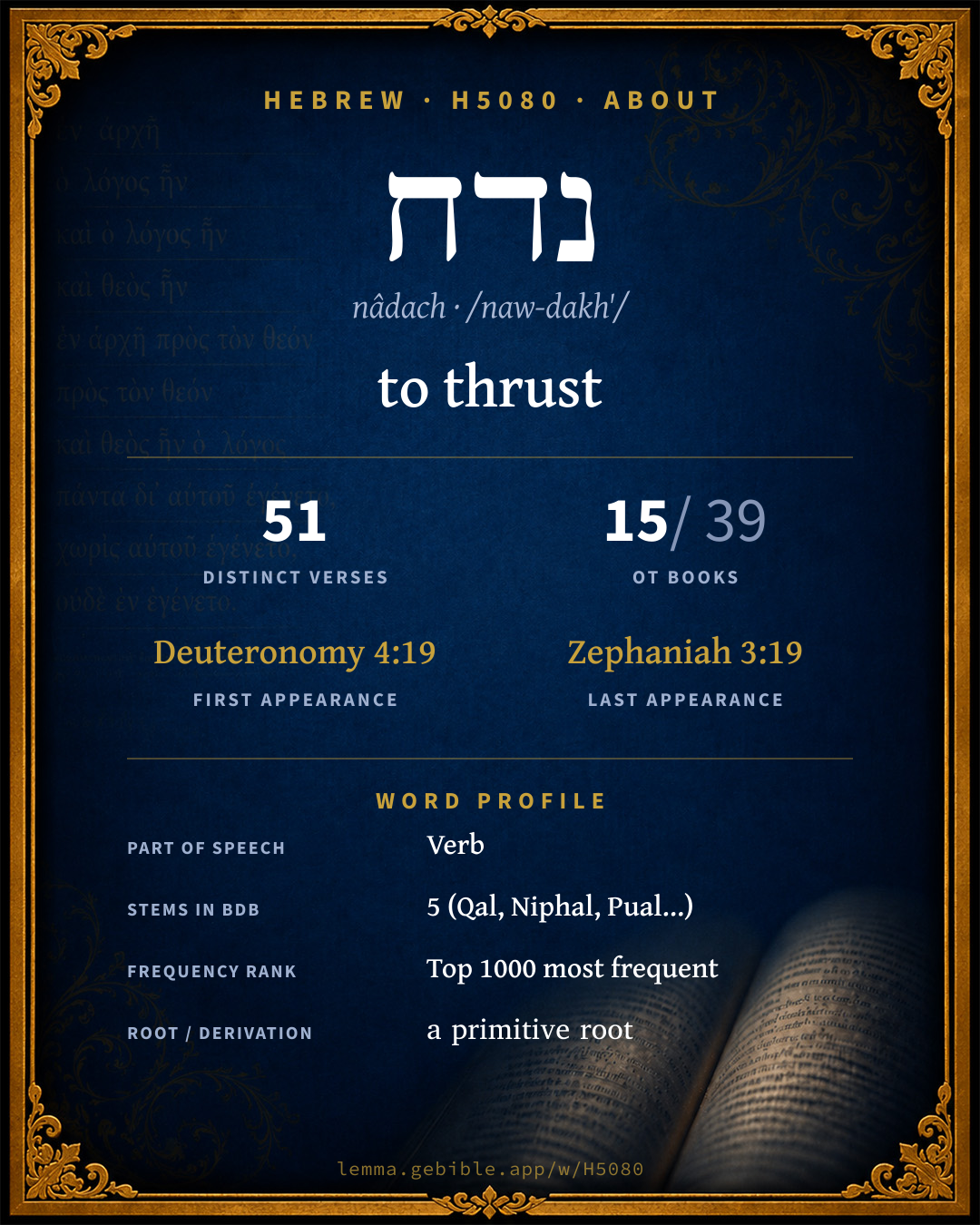
נָדַח
to thrust
‘to thrust’ is one of 3 main senses fuller range ↓
Full lexicon entry — Brown-Driver-Briggs (BDB)
From Brown-Driver-Briggs (BDB)
Where this word appears
See every Hiphil verb in the Hebrew Bible →
Grammar key — what these labels mean
Part of speech
- Verb
- An action or state-of-being word.
Stem
- Hiphil
- The causative active stem (“he caused / brought about”). Here: ‘thrust’
- Niphal
- Usually the simple passive or reflexive of the Qal (“he was written”). Here: ‘be impelled’
- Qal
- The basic, simple active stem — the plain form of the verb (“he wrote”). Here: ‘impel’
- Hophal
- The passive counterpart of the Hiphil (“he was caused to…”).
- Pual
- The passive counterpart of the Piel.
Form
- Perfect
- A completed action or state — Hebrew marks aspect (completeness) more than strict tense (“he wrote”).
- Sequential Perfect
- A perfect with prefixed waw continuing a preceding imperfect or command (waw-consecutive perfect).
- Sequential Imperfect
- An imperfect with prefixed waw — the standard past-narrative form (waw-consecutive imperfect).
- Infinitive Construct
- A bound verbal noun, frequently with prepositions (“to write / in writing”).
- Participle Passive
- A verbal adjective expressing action received (“written”).
- Participle Active
- A verbal adjective expressing ongoing or characteristic action (“writing / one who writes”).
- Imperfect
- An incomplete, ongoing, or future action (“he will / would write”).
- Imperative
- A direct command (“write!”).
State
- Absolute
- The independent form of a noun, not bound to a following word.
- Construct
- A noun bound to a following noun in a possessive / “of” relationship (the construct chain).
Person
- 1st Person
- The speaker (“I / we”).
- 2nd Person
- The one addressed (“you”).
- 3rd Person
- The one spoken about (“he / she / it / they”).
Gender
- Common
- Either gender — not distinguished for this form.
- Masculine
- Grammatically masculine.
- Feminine
- Grammatically feminine.
Number
- Singular
- One.
- Plural
- More than one (in Hebrew, generally three or more).
Grammatical forms 31 distinct
- Verb, Hiphil, Perfect, 1st Person, Common, Singular 7 times (13%)
- Verb, Hiphil, Infinitive Construct 4 times (8%)
- Verb, Niphal, Participle Passive, Feminine, Singular, Absolute 4 times (8%)
- Verb, Niphal, Sequential Perfect, 2nd Person, Masculine, Singular 2 times (4%)
- Verb, Hiphil, Sequential Imperfect, 3rd Person, Masculine, Singular 2 times (4%)
- Verb, Niphal, Perfect, 3rd Person, Common, Plural 2 times (4%)
- Verb, Niphal, Participle Active, Masculine, Plural, Absolute 2 times (4%)
- Verb, Hiphil, Imperfect, 1st Person, Common, Singular 2 times (4%)
+23 more forms (27 occurrences)
Parsed forms decoded from the imported morphology (morphhb / Westminster Leningrad Codex — WLC text public domain, morphhb tagging CC BY 4.0), counted across 52 parsed occurrences — not distinct verses.
Every verse where H5080 appears — 51 distinct verses across 15 books. Click any verse to open its interlinear word-by-word view. Verse text shown in the World English Bible for context — . Each verse’s Hebrew form is shown with its reference; the English is not keyword-highlighted, since the data carries no word-level English alignment. Use “Compare translations” on any verse to read it across multiple English versions. This concordance covers the Hebrew Bible; Septuagint (Greek Old Testament) occurrences are not indexed here.
Deuteronomy 10 verses
- Deuteronomy 4:19 וְ/נִדַּחְתָּ֛ conj + Niphal wpf 2ms and lest you lift up your eyes to the sky, and when you see the sun and the moon and the stars, even all the host of the sky, you are drawn away and worship them, and serve them, which Yahweh your God has allotted to all the peoples under the whole sky.
- Deuteronomy 13:5 לְ/הַדִּֽיחֲ/ךָ֙ prep + Hiphil inf.cs + sfx pers 2ms That prophet, or that dreamer of dreams, shall be put to death, because he has spoken rebellion against Yahweh your God, who brought you out of the land of Egypt, and redeemed you out of the house of bondage, to draw you aside out of the way which Yahweh your God commanded you to walk in. So shall you put away the evil from the midst of you.
- Deuteronomy 13:10 לְ/הַדִּֽיחֲ/ךָ֙ prep + Hiphil inf.cs + sfx pers 2ms You shall stone him to death with stones, because he has sought to draw you away from Yahweh your God, who brought you out of the land of Egypt, out of the house of bondage.
- Deuteronomy 13:13 וַ/יַּדִּ֛יחוּ conj + Hiphil wimpf 3mp Certain base fellows are gone out from the midst of you, and have drawn away the inhabitants of their city, saying, Let us go and serve other gods, which you have not known;
- Deuteronomy 19:5 וְ/נִדְּחָ֨ה conj + Niphal wpf 3fs as when a man goes into the forest with his neighbor to hew wood, and his hand fetches a stroke with the axe to cut down the tree, and the head slips from the handle, and lights on his neighbor, so that he dies; he shall flee to one of these cities and live:
- Deuteronomy 20:19 לִ/נְדֹּ֤חַ prep + Qal inf.cs When you shall besiege a city a long time, in making war against it to take it, you shall not destroy the trees of it by wielding an axe against them; for you may eat of them, and you shall not cut them down; for is the tree of the field man, that it should be besieged of you?
- Deuteronomy 22:1 נִדָּחִ֔ים Niphal ptcp.act mp You shall not see your brother's ox or his sheep go astray, and hide yourself from them: you shall surely bring them again to your brother.
- Deuteronomy 30:1 הִדִּיחֲ/ךָ֛ Hiphil pf 3ms + sfx pers 2ms It shall happen, when all these things are come on you, the blessing and the curse, which I have set before you, and you shall call them to mind among all the nations, where Yahweh your God has driven you,
- Deuteronomy 30:4 נִֽדַּחֲ/ךָ֖ Niphal ptcp.pass ms cs + sfx pers 2ms If [any of] your outcasts are in the uttermost parts of the heavens, from there will Yahweh your God gather you, and from there will he bring you back:
- Deuteronomy 30:17 וְ/נִדַּחְתָּ֗ conj + Niphal wpf 2ms But if your heart turn away, and you will not hear, but shall be drawn away, and worship other gods, and serve them;
2 Samuel 3 verses
- 2 Samuel 14:13 נִדְּחֽ/וֹ Niphal ptcp.act ms cs + sfx pers 3ms The woman said, Why then have you devised such a thing against the people of God? for in speaking this word the king is as one who is guilty, in that the king does not bring home again his banished one.
- 2 Samuel 14:14 יִדַּ֥ח נִדָּֽח Niphal impf 3ms Niphal ptcp.act ms For we must needs die, and are as water split on the ground, which can't be gathered up again; neither does God take away life, but devises means, that he who is banished not be an outcast from him.
- 2 Samuel 15:14 וְ/הִדִּ֤יחַ conj + Hiphil wpf 3ms David said to all his servants who were with him at Jerusalem, Arise, and let us flee; for else none of us shall escape from Absalom: make speed to depart, lest he overtake us quickly, and bring down evil on us, and strike the city with the edge of the sword.
2 Kings 1 verse
2 Chronicles 2 verses
- 2 Chronicles 13:9 הִדַּחְתֶּם֙ Hiphil pf 2mp Haven't you driven out the priests of Yahweh, the sons of Aaron, and the Levites, and made you priests after the manner of the peoples of [other] lands? so that whoever comes to consecrate himself with a young bull and seven rams, the same may be a priest of [those who are] no gods.
- 2 Chronicles 21:11 וַ/יַּדַּ֖ח conj + Hiphil wimpf 3ms Moreover he made high places in the mountains of Judah, and made the inhabitants of Jerusalem to play the prostitute, and led Judah astray.
Nehemiah 1 verse
Job 1 verse
Psalms 2 verses
- Psalms 5:10 הַדִּיחֵ֑/מוֹ Hiphil impv 2ms + sfx pers 3mp Hold them guilty, God. Let them fall by their own counsels; Thrust them out in the multitude of their transgressions, For they have rebelled against you.
- Psalms 62:4 לְ/הַדִּיחַ֮ prep + Hiphil inf.cs They fully intend to throw him down from his lofty place. They delight in lies. They bless with their mouth, but they curse inwardly. Selah.
Proverbs 1 verse
Isaiah 5 verses
- Isaiah 8:22 מְנֻדָּֽח Pual ptcp.pass ms and they shall look to the earth, and see, distress and darkness, the gloom of anguish; and into thick darkness [they shall be] driven away.
- Isaiah 13:14 מֻדָּ֔ח Hophal ptcp.pass ms It shall happen, that as the chased roe, and as sheep that no man gathers, they shall turn every man to his own people, and shall flee every man to his own land.
- Isaiah 16:3 נִדָּחִ֔ים Niphal ptcp.act mp Give counsel, execute justice; make your shade as the night in the midst of the noonday; hide the outcasts; don't betray the fugitive.
- Isaiah 16:4 נִדָּחַ֔/י Niphal ptcp.pass mp cs + sfx pers 1cs Let my outcasts dwell with you; as for Moab, be a covert to him from the face of the destroyer. For the extortioner is brought to nothing, destruction ceases, the oppressors are consumed out of the land.
- Isaiah 27:13 וְ/הַ/נִּדָּחִ֖ים conj + ptcl def.art + Niphal ptcp.pass mp It shall happen in that day, that a great trumpet shall be blown; and they shall come who were ready to perish in the land of Assyria, and those who were outcasts in the land of Egypt; and they shall worship Yahweh in the holy mountain at Jerusalem.
Jeremiah 18 verses
- Jeremiah 8:3 הִדַּחְתִּ֣י/ם Hiphil pf 1cs + sfx pers 3mp Death shall be chosen rather than life by all the residue that remain of this evil family, that remain in all the places where I have driven them, says Yahweh of Hosts.
- Jeremiah 16:15 הִדִּיחָ֖/ם Hiphil pf 3ms + sfx pers 3mp but, As Yahweh lives, who brought up the children of Israel from the land of the north, and from all the countries where he had driven them. I will bring them again into their land that I gave to their fathers.
- Jeremiah 23:2 וַ/תַּדִּח֔וּ/ם conj + Hiphil wimpf 2mp + sfx pers 3mp Therefore thus says Yahweh, the God of Israel, against the shepherds who feed my people: You have scattered my flock, and driven them away, and have not visited them; behold, I will visit on you the evil of your doings, says Yahweh.
- Jeremiah 23:3 הִדַּ֥חְתִּי Hiphil pf 1cs I will gather the remnant of my flock out of all the countries where I have driven them, and will bring them again to their folds; and they shall be fruitful and multiply.
- Jeremiah 23:8 הִדַּחְתִּ֖י/ם Hiphil pf 1cs + sfx pers 3mp but, As Yahweh lives, who brought up and who led the seed of the house of Israel out of the north country, and from all the countries where I had driven them. They shall dwell in their own land.
- Jeremiah 24:9 אַדִּיחֵ֥/ם Hiphil impf 1cs + sfx pers 3mp I will even give them up to be tossed back and forth among all the kingdoms of the earth for evil; to be a reproach and a proverb, a taunt and a curse, in all places where I shall drive them.
- Jeremiah 27:10 וְ/הִדַּחְתִּ֥י conj + Hiphil wpf 1cs for they prophesy a lie to you, to remove you far from your land, and that I should drive you out, and you should perish.
- Jeremiah 27:15 הַדִּיחִ֤/י Hiphil inf.cs + sfx pers 1cs For I have not sent them, says Yahweh, but they prophesy falsely in my name; that I may drive you out, and that you may perish, you, and the prophets who prophesy to you.
- Jeremiah 29:14 הִדַּ֧חְתִּי Hiphil pf 1cs I will be found by you, says Yahweh, and I will turn again your captivity, and I will gather you from all the nations, and from all the places where I have driven you, says Yahweh; and I will bring you again to the place from where I caused you to be carried away captive.
- Jeremiah 29:18 הִדַּחְתִּ֥י/ם Hiphil pf 1cs + sfx pers 3mp I will pursue after them with the sword, with the famine, and with the pestilence, and will deliver them to be tossed back and forth among all the kingdoms of the earth, to be an object of horror, and an astonishment, and a hissing, and a reproach, among all the nations where I have driven them;
- Jeremiah 30:17 נִדָּחָה֙ Niphal ptcp.pass fs For I will restore health to you, and I will heal you of your wounds, says Yahweh; because they have called you an outcast, [saying], It is Zion, whom no man seeks after.
- Jeremiah 32:37 הִדַּחְתִּ֥י/ם Hiphil pf 1cs + sfx pers 3mp Behold, I will gather them out of all the countries, where I have driven them in my anger, and in my wrath, and in great indignation; and I will bring them again to this place, and I will cause them to dwell safely:
- Jeremiah 40:12 נִדְּחוּ Niphal pf 3cp then all the Jews returned out of all places where they were driven, and came to the land of Judah, to Gedaliah, to Mizpah, and gathered wine and summer fruits very much.
- Jeremiah 43:5 נִדְּחוּ Niphal pf 3cp But Johanan the son of Kareah, and all the captains of the forces, took all the remnant of Judah, who were returned from all the nations where they had been driven, to sojourn in the land of Judah;
- Jeremiah 46:28 הִדַּחְתִּ֣י/ךָ Hiphil pf 1cs + sfx pers 2ms Don't be afraid you, O Jacob my servant, says Yahweh; for I am with you: for I will make a full end of all the nations where I have driven you; but I will not make a full end of you, but I will correct you in measure, and will in no way leave you unpunished.
- Jeremiah 49:5 וְ/נִדַּחְתֶּם֙ conj + Niphal wpf 2mp Behold, I will bring a fear on you, says the Lord, Yahweh of Hosts, from all who are round about you; and you shall be driven out every man right forth, and there shall be none to gather together the fugitives.
- Jeremiah 49:36 נִדְּחֵ֥י Niphal ptcp.pass mp cs On Elam will I bring the four winds from the four quarters of the sky, and will scatter them toward all those winds; and there shall be no nation where the outcasts of Elam shall not come.
- Jeremiah 50:17 הִדִּ֑יחוּ Hiphil pf 3cp Israel is a hunted sheep; the lions have driven him away: first, the king of Assyria devoured him; and now at last Nebuchadrezzar king of Babylon has broken his bones.
Ezekiel 3 verses
- Ezekiel 4:13 אַדִּיחֵ֖/ם Hiphil impf 1cs + sfx pers 3mp Yahweh said, Even thus shall the children of Israel eat their bread unclean, among the nations where I will drive them.
- Ezekiel 34:4 הַ/נִּדַּ֨חַת֙ ptcl def.art + Niphal ptcp.pass fs You haven't strengthened the diseased, neither have you healed that which was sick, neither have you bound up that which was broken, neither have you brought back that which was driven away, neither have you sought that which was lost; but with force and with rigor have you ruled over them.
- Ezekiel 34:16 הַ/נִּדַּ֣חַת ptcl def.art + Niphal ptcp.pass fs I will seek that which was lost, and will bring back that which was driven away, and will bind up that which was broken, and will strengthen that which was sick: but the fat and the strong I will destroy; I will feed them in justice.
Daniel 1 verse
Joel 1 verse
Micah 1 verse
Zephaniah 1 verse
About this entry
At a glance — auto-summarized from this page’s data, not written by a person. Every figure links to its source below. This summary describes the numbers; it doesn’t interpret them.
At its core, נדח (nâdach) means “to thrust.” Read the stem: it spans 5 stems, including Qal and Niphal. With 51 verses in 15 books, it is a moderately common word in the Hebrew Bible. Its uses concentrate in Jeremiah (35% of all occurrences). First canonically at Deuteronomy 4:19, it enters the text early. Dig into 51-verse concordance and the renderings breakdown below.
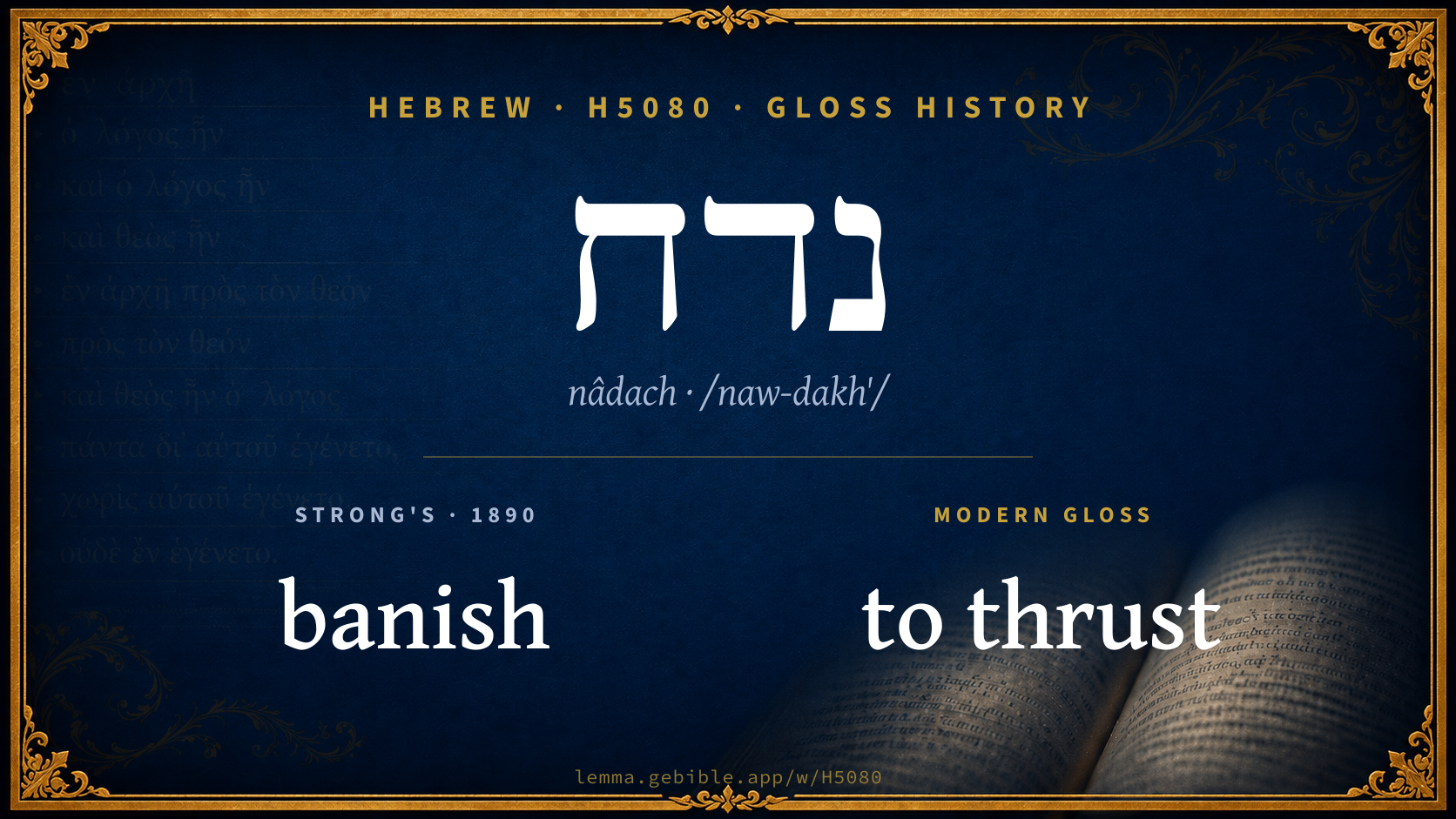
Gloss history
Strong's 1890 vs modern scholarship
About this word
Strong's H5080 catalogs a Hebrew word from the Hebrew Old Testament.
These counts are not copied from any lexicon or concordance. They are computed here, from the morphology-tagged Hebrew Old Testament. What Lemma adds →
- 51
- distinct verses
- The word appears in 51 distinct verses.
- 15 / 39
- OT books
- The word appears in 15 of 39 Old Testament books.
- #718
- by frequency
- Top 1000 most frequent Hebrew words (rank 718 of 8,640 Hebrew words by occurrence).
View all 51 occurrences in the concordance →
Most concentrated in
- Jeremiah 18 verses 35%
- Deuteronomy 10 verses 20%
- Isaiah 5 verses 10%
By section of the Old Testament
By traditional corpus
Conventional, traditional groupings — biblical authorship is debated, so this is a traditional corpus grouping, not an authorship claim. Each share is this word’s portion of its verses in that division of the Hebrew canon. Each figure is a share of the word’s 51 distinct verses.
- Prophets (Nevi'im) 33 verses · 65%
- Torah (Pentateuch) 10 verses · 20%
- Writings (Ketuvim) 8 verses · 16%
How translations render this word
Counts come from each version’s own published word-to-Strong’s tagging or interlinear alignment — an approximate guide to how each version renders this word, not a word-level alignment the data otherwise carries. Because each total is that version’s own tagged count, the per-version totals vary from one another and need not match the appearance or distinct-verse counts above. These counts may also differ from a printed concordance because Lemma counts each distinctly tagged rendering and does not collapse phrase taggings into a single head-word total. This is a fixed set of word-tagged versions (KJV, ASV, BSB, ULT) and does not change with the reading translation you choose elsewhere. Each version’s license is shown beside its name below (and on Sources).
- King James Version: Whither i have driven 6×, Banished 2×, Outcasts 2×
- American Standard Version: Whither i have driven 5×, Was driven away 3×
- Berean Standard Bible: Exiles 4×, I have banished them 4×, Astray 2×
- unfoldingWord Literal Text: And 3×, Banished 2×, I will drive 2×
King James Version Public Domain
Renders H5080 across 52 tagged occurrences — most commonly:
Plus 40 renderings that appear only once — usually multi-word phrases or single function words the recovered tagging swept in, not distinct renderings.
American Standard Version Public Domain
Renders H5080 across 52 tagged occurrences — most commonly:
Plus 44 renderings that appear only once — usually multi-word phrases or single function words the recovered tagging swept in, not distinct renderings.
Berean Standard Bible Public Domain
Renders H5080 across 54 tagged occurrences — most commonly:
Plus 36 renderings that appear only once — usually multi-word phrases or single function words the recovered tagging swept in, not distinct renderings.
unfoldingWord Literal Text CC BY-SA 4.0
Renders H5080 across 50 tagged occurrences — most commonly:
Plus 41 renderings that appear only once — usually multi-word phrases or single function words the recovered tagging swept in, not distinct renderings.
15 senses and sub-senses in the full BDB
Hebrew verbs can shift meaning by stem (binyan): Qal is the basic action, Niphal is often passive or reflexive, Piel often intensifies or makes it factitive, and Hiphil is typically causative. The senses below are grouped under the stem BDB assigns to each. This entry also uses Pual (the passive of Piel) and Hophal (the passive of Hiphil).
What do BDB’s symbols mean?
BDB uses these scholarly abbreviations:
| Symbol | Meaning |
|---|---|
| 𝔊 | the Septuagint (the ancient Greek translation, LXX) |
| 𝔙 | the Vulgate (the Latin translation) |
| 𝔖 | the Syriac version (the Peshitta) |
| 𝔗 | the Targum (the Aramaic translation) |
| ψ | the Psalms |
| √ | root (the underlying root or stem) |
| ‖ | parallel passage (a synonymous or contrasted parallel) |
| † | the dagger: every passage where the word occurs is cited |
The 15 senses and sub-senses the full Brown-Driver-Briggs lexicon distinguishes for this word, in lexicon order (not ranked by frequency), with BDB’s own verbatim wording and sub-sense lettering. Shown in Hebrew script with BDB’s own scholarly abbreviations. The condensed entry is in the Lexicon Entry tab. See also the Forms in the corpus table below.
Qal
- Impf. יִדַּח 2 S 14:14; Inf. לִנְדֹּחַ Dt 20:19;—trans. e.g. 2 Samuel 14:14
- 1. impel (i.e. wield) an axe, sq. עַל־ Dt 20:19; e.g. Deuteronomy 20:19
- 2. thrust away, banish, sq. מִן־ 2 S 14:14. e.g. 2 Samuel 14:14
Niphal
- Pf. 3 fs. נִדְּחָה Jb 6:13, etc.; (Impf. יִדַּ֫חוּ Je 23:12 v. דחח); Pt. נִדָּח 2 S 14:14; נִדָּחָה Mi 4:6 + 2 times; נִדַּ֫חַת Ez 34:4, 16, etc. On נִדְחֵי Is 11:12; 56:8; ψ 147:2 v. Ki Köi. 317;— e.g. Job 6:13
- 1. be impelled: וְנדְּחָה יָדוֹ בַּגַּרְזֶן be impelled with the axe Dt 19:5. e.g. Deuteronomy 19:5
- 2. be thrust out, banished: of dispersion in exile, sq. שָׁם Je 40:12; 43:5 (‖ שׁוּב); sq. לִפְנֵי 49:5 (‖ קִבֵּץ); cf. also fig. תֻּשִׁיָּה נִדְּחָה מִמֶּנִּי Jb 6:13 is banished from me, i.e. is non-existent; especially Pt. banished one(s), outcast(s), as acc. cogn. c. נָדַח 2 S 14:14; c. קִבֵּץ Mi 4:6; Dt 30:4; Zp 3:19; Ne 1:9; נ׳ יִשִׂרָאֵל, c. אָסַף Is 11:12 (‖ נְפֻצוֹת יְקַבֵּץ); c. קִבֵּץ 56:8; c. כִּנֵּס ψ 147:2; c. הֵשִׁיב 2 S 14:13; Ez 34:4, 16 (both ‖ אֹבֵד); c. בּוֹא Is 27:13 (‖ id.); v. also Is 16:3, 4 Je 49:36; outcast = neglected one, fig. of Zion 30:17 (‖ דֹּרֵשׁ אֵין לָהּ). e.g. Jeremiah 40:12
- 3. driven away (from herd, i.e.) straying Dt 22:1. e.g. Deuteronomy 22:1
- 4. thrust away, aside, from י׳ to idolatry Dt 4:19; 30:17 (sq. וְהִשְׁתַּחֲוָה). e.g. Deuteronomy 4:19
Pual
- Pt. אֲפֵלָה מְנֻדָּח Is 8:22 thrust into darkness. e.g. Isaiah 8:22
Hiphil
- Pf. וְהִדִּיחַ consec. 2 S 15:14; הִדַּ֫חְתִּי Je 23:3; 29:14, etc.; Impf. sf. וַיַּדַּח 2 Ch 21:11 + 2 K 17:21 Qr; וַיַּדִּ֫יחוּ Dt 13:14, etc.; Imv. sf. הַדִּיחֵ֫מוֹ ψ 5:11; Inf. הַדִּיחַ 62:5, etc.;— e.g. 2 Samuel 15:14
- 1. thrust, move, impel, fig., obj. רָעָה 2 S 15:14 (sq. עַל־). e.g. 2 Samuel 15:14
- 2. thrust out, banish, especially of exile, subj. י׳, c. acc. sq. שָׁ֫מָּה Dt 30:1 Je 46:28; 16:15 (‖ הֶעֱלָה); sq. שָׁם Je 8:3; 24:9; 29:18 Dn 9:7 + Ez 4:13 (om. 𝔊 Co); Je 23:3 (‖ קִבֵּץ), v 8 (‖ הֶעֱלָה, הֵבִיא), 29:14 (‖ קִבֵּץ, הֵשִׁיב, so 32:37; also 27:10 (‖ הַרְחִיק), v 15 (‖ אָבַד), cf. 23:2 (Judah under fig. of flock, subj. evil shepherd, ‖ הֵפִיץ), 50:17 (Isr. as sheep, subj. enemies as lions); of driving out priests 2 Ch 13:9; invader Jo 2:20 (sq. אֶל־); wicked ψ 5:11 (‖ הַאֲשִׁימֵם); good man from his eminence ψ 62:5 (sq. מִן). e.g. Deuteronomy 30:1
- 3. thrust away, aside, from י׳ to idolatry, c. acc., Dt 13:14; sq. מִן־הַדֶּרֶךְ v 6; מֵעַל י׳ v 11; מֵאַחֲרֵי י׳ 2 K 17:21 Qr (Kt v. נדא); cf. 2 Ch 21:11 (‖ הִזְנָה). e.g. Deuteronomy 13:14
- 4. compel, force, subj. adulteress (by flattery), sq. acc. Pr 7:21 (‖ הִטָּה). e.g. Proverbs 7:21
Hophal
- Pt. מֻדָּח chased, hunted, צְבִי מ׳ Is 13:14, sim. of fugitive Babylonians. e.g. Isaiah 13:14
Senses from the full Brown-Driver-Briggs lexicon (Brown, Driver, Briggs; Oxford 1906 — public domain), digitized via Sefaria, supplemented by the OpenScriptures HebrewLexicon (CC BY 4.0). Full attribution on Sources.
Word origin
vb. impel, thrust, banish (especially Dt. Je. and later) (NH id., beguile, Hiph. Niph.; Aramaic נְדַח (rare) = BH; Ethiopic ነድሐ thrust; Arabic نَدَخَ is drive a ship to shore);—
— Brown-Driver-Briggs (Oxford 1906, public domain), digitized via Sefaria, supplemented by the OpenScriptures HebrewLexicon (CC BY 4.0). See Sources.
Origin: a primitive root
Jastrow Dictionary
A second Hebrew/Aramaic lexicon for comparison, covering Aramaic and post-biblical (Talmudic, Targumic, Midrashic) usage that the biblical-Hebrew BDB does not. Matched by lemma rather than by Strong’s number, so a lemma may carry more than one Jastrow headword (shown separately below), and the entries cover usage well beyond the Bible.
נָדַח
- (b. h.) to slip, move away.
- 1. (interch. with (interch. with דחה) to be banished, exiled. Y. Snh. X, 29ᶜ top (ref. to Is. XXVII, 13) והנִידָּחִים … זו דור וכ׳ ‘those who were exiles in the land of Egypt’ means the generation of the wilderness. Midr. Till. to Ps. CXLVII, 2 שנִדְּחוּ (or שנִדְחוּ); a. e. e.g. Isaiah 27:13
- 2. to be made to slip, to be led away (to idolatry); עיר הנִדַּחַת the case of a place whose inhabitants were led astray, the condemned town (Deut. XIII, 13 to 18). Snh. X, 4 אנשי עיר הנ׳ the inhabitants of a condemned city. Tosef. ib. XIV, 1, a. e. עיר הנ׳ לא היתה וכ׳ a case of a condemned city never occurred nor ever will occur. Ib. אין עושין שלש עיירות נִידָּחוֹת וכ׳ three cities dare not be condemned (at a time) in Palestine; Yalk. Deut. 886 מְנוּדָּחוֹת (Pu.); a. fr. e.g. Deuteronomy 13:13
- to lead astray. Snh. VII, 10 המַדִּיחַ זה האומר וכ׳ a maddiaḥ (amenable to the law Deut. l. c.) is he who says, let us go and worship &c.; contrad. to מסית; ib. 67ᵃ מַדִּיחֵי עיר הנדחת שנו כאן the seducers of a condemned city are meant here. Ib. נביא שה׳ a prophet that led a town astray. Ib. X, 4 (111ᵇ) הִדִּיחוּהָ נשים if women led a town astray; היו מַדִּיחֶיהָ חוצה לה if the seducers were outsiders; עד שיַדִּיחוּהָ אנשים unless the seducers are men; a. fr.
- 1. to be led astray. Ib. ה׳ מיעוטה if a minority of the town was led astray. Tosef. ib. XIV, 3 הוּדְּחוּ עמה they were led astray along with the inhabitants; a. e.
- 2. (interch. with דָּחָה) to be banished. Yalk. Num. 739 הוּדַּחְתִּי מן האהל I have been banished from the Tabernacle.
נְדַח
- , to cause to slip. Targ. Ps. LXII, 5 (some ed. למנדע, corr. acc.).
- to be banished. Targ. Job VI, 13 אִתְנַדְּחַת Regia (ed. אתברחת; h. text נִדְּחָה).
A Dictionary of the Targumim, the Talmud Babli and Yerushalmi, and the Midrashic Literature (Marcus Jastrow; London, Luzac, 1903) — Public Domain. Digitized via Sefaria. Digitized via Sefaria. Full attribution on Sources.
Forms in the corpus
The 48 distinct written forms H5080 takes in the Hebrew Bible, most frequent first — each parse links to that stem’s occurrences in the concordance. Hebrew forms include their vowel points and cantillation, so a single lemma takes many written forms.
Same root — word family
Other BDB entries built from the same root as H5080, grouped by Strong’s listed origin. These share a root / origin per the lexicon — not necessarily a shared meaning. Each links to that word’s own entry.
Derived from this word
Compare all same-root words → They share a root, not necessarily a meaning.
Septuagint verse parallels
This word appears in 44 verses that also exist in the Greek Old Testament (Septuagint), out of the 51 Hebrew verses it occurs in. You can read those verses in Greek by switching the Old Testament edition to the Septuagint.
Read these verses in the Septuagint
- Deuteronomy 4:19
- 2 Samuel 14:13
- 2 Kings 17:21
- 2 Chronicles 13:9
- Job 6:13
- Psalms 5:10
- Proverbs 7:21
- Isaiah 8:22
- Jeremiah 8:3
- Ezekiel 4:13
- Daniel 9:7
- Joel 2:20
This is a verse-level parallel only — the same verses exist in both the Hebrew and Greek Old Testaments. No word-level Hebrew↔Greek correspondence is claimed: the data carries no such alignment, so no Greek word is shown as this Hebrew word’s translation. Coverage is not total — the Septuagint omits the deuterocanon and renumbers the Psalms, so some Hebrew verses have no direct Greek parallel.