
Jeremiah 49:36

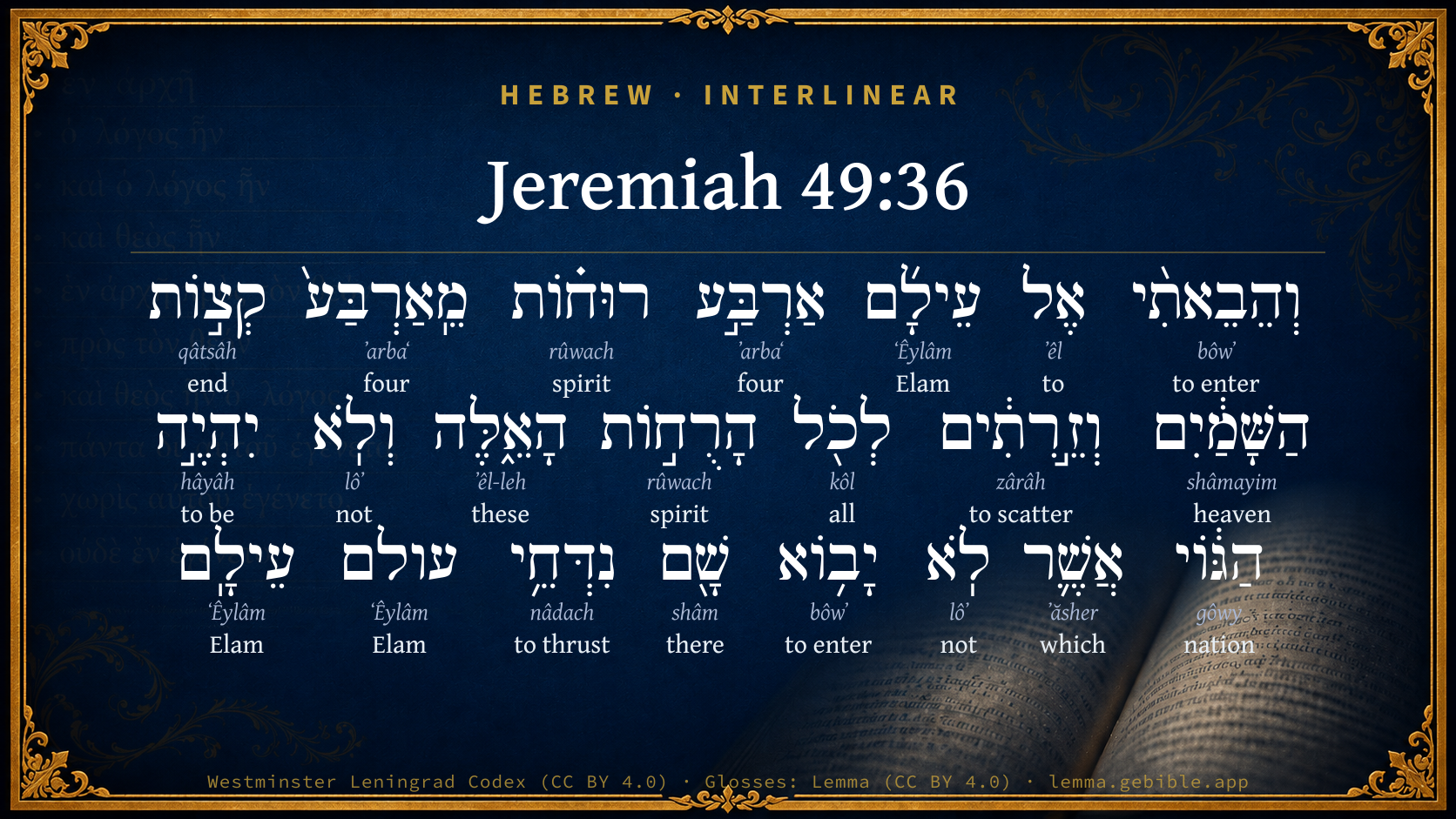
Hebrew (Westminster Leningrad Codex) Jeremiah 49:36 appears in the Hebrew Old Testament. The text above is from the Westminster Leningrad Codex. Each word links to its Strong’s number, a concise gloss, and parsing drawn from the Open Scriptures Hebrew Bible morphology. Click any word for its full Brown-Driver-Briggs (BDB) entry.
Download image
Cite this verse

Jeremiah 49:36 (World English Bible). Public Domain. Lemma interlinear Bible study tool, https://lemma.gebible.app/v/jeremiah/49/36.

Show BibTeX & RIS
BibTeX
RIS
English Translation
On Elam will I bring the four winds from the four quarters of the sky, and will scatter them toward all those winds; and there shall be no nation where the outcasts of Elam shall not come.
World English Bible · Public Domain
Download a study sheet

One document with this verse’s original text, its word-by-word gloss line, the meaning frame, cross-references with their text, attributed commentary, and full source and license credits — printable, and it pastes into notes with its structure intact.

This verse Autodidact and up

Study sheet (.html) Plain text (.txt)

A passage Seminary Student

Up to 50 verses in one chapter. A passage sheet keeps up to 6 commentary sources and 12 cross-references per verse, in the order this page ranks them, and says so on the sheet whenever that leaves anything out. Ask for a single verse and you get the Autodidact verse sheet above.

Everything on this page stays free to read, with no account — the sheet is a download of what is already on screen, not access to it.

Want to remove ads? Support Godless Engineer
Compare translations 3

The same verse in 3 English versions, stacked beneath the original-language interlinear above. Click any original word for its lexicon entry.

Each is an independent rendering of the whole verse — the interlinear is not word-aligned to these translations.

Highlighted words mark where these versions differ — a whole-verse word diff, not a word-by-word alignment.

  • World English Bible Public Domain
    On Elam will I bring the four winds from the four quarters of the sky, and will scatter them toward all those winds; and there shall be no nation where the outcasts of Elam shall not come.
  • King James Version Public Domain
    And upon Elam will I bring the four winds from the four quarters of heaven, and will scatter them toward all those winds; and there shall be no nation whither the outcasts of Elam shall not come.
  • unfoldingWord Literal Text CC BY-SA 4.0
    For I will bring the four winds from the four corners of the heavens, and I will scatter the people of Elam to all of those winds. There is no nation to which those scattered from Elam will not go.

unfoldingWord Literal Text — © unfoldingWord, licensed CC BY-SA 4.0. Word-aligned USFM3 via Door43 (git.door43.org/unfoldingWord/en_ult).

Versions to compare (up to 4)

3 of 4 selected

Show all 18 translations

Every available English version of this verse, each an independent rendering of the whole verse.

  • World English Bible Public Domain
    On Elam will I bring the four winds from the four quarters of the sky, and will scatter them toward all those winds; and there shall be no nation where the outcasts of Elam shall not come.
  • Berean Standard Bible Public Domain
    I will bring the four winds against Elam from the four corners of the heavens, and I will scatter them to all these winds. There will not be a nation to which Elam’s exiles will not go.
  • Majority Standard Bible Public Domain
    I will bring the four winds against Elam from the four corners of the heavens, and I will scatter them to all these winds. There will not be a nation to which Elam’s exiles will not go.
  • King James Version Public Domain
    And upon Elam will I bring the four winds from the four quarters of heaven, and will scatter them toward all those winds; and there shall be no nation whither the outcasts of Elam shall not come.
  • American Standard Version (1901) Public Domain
    And upon Elam will I bring the four winds from the four quarters of heaven, and will scatter them toward all those winds; and there shall be no nation whither the outcasts of Elam shall not come.
  • Revised Version (1885) Public Domain
    And upon Elam will I bring the four winds from the four quarters of heaven, and will scatter them toward all those winds; and there shall be no nation whither the outcasts of Elam shall not come.
  • Geneva Bible (1599) Public Domain
    And vpon Elam I will bring the foure windes from the foure quarters of heauen, and will scatter them towardes all these windes, and there shall bee no nation, whither the fugitiues of Elam shall not come.
  • Douay-Rheims (1899) Public Domain
    And I will bring upon Elam the four winds from the fear quarters of heaven: and I will scatter them into all these winds: and there shall be no nation, to which the fugitives of Elam shall not come.
  • Young's Literal Translation Public Domain
    And I have brought in to Elam four winds, From the four ends of the heavens, And have scattered them to all these winds, And there is no nation whither outcasts of Elam come not in.
  • Literal Standard Version CC BY-SA 4.0
    And I have brought four winds to Elam, || From the four ends of the heavens, || And have scattered them to all these winds, || And there is no nation to where outcasts of Elam do not come in.
  • Unlocked Literal Bible CC BY-SA 4.0
    For I will bring the four winds from the four corners of the heavens, and I will scatter the people of Elam to all of those winds. There is no nation to which those scattered from Elam will not go.
  • unfoldingWord Literal Text CC BY-SA 4.0
    For I will bring the four winds from the four corners of the heavens, and I will scatter the people of Elam to all of those winds. There is no nation to which those scattered from Elam will not go.
  • Darby Bible Public Domain
    And upon Elam will I bring the four winds, from the four ends of the heavens, and I will scatter them toward all those winds; and there shall be no nation whither the outcasts of Elam shall not come.
  • World Messianic Bible Public Domain
    I will bring on Elam the four winds from the four quarters of the sky, and will scatter them toward all those winds. There will be no nation where the outcasts of Elam will not come.
  • Webster's Bible Public Domain
    And upon Elam will I bring the four winds from the four quarters of heaven, and will scatter them towards all those winds; and there shall be no nation whither the outcasts of Elam shall not come.
  • Free Bible Version CC BY-SA 4.0
    I will bring winds from all directions to attack Elam, and I will scatter them in all directions. There won't be a nation that doesn't have some of Elam's exiles.
  • Bible in Basic English Public Domain
    And I will send on Elam four winds from the four quarters of heaven, driving them out to all those winds; there will be no nation into which the wanderers from Elam do not come.
  • JPS Tanakh (1917) Public Domain
    And I will bring against Elam the four winds from the four quarters of heaven, and will scatter them toward all those winds; and there shall be no nation whither the dispersed of Elam shall not come.

Literal Standard Version (2020), Covenant Press — licensed CC BY-SA 4.0. Text via the HelloAO Bible API (eBible.org). Unlocked Literal Bible (unfoldingWord) — licensed CC BY-SA 4.0. Text via the HelloAO Bible API (eBible.org). unfoldingWord Literal Text — © unfoldingWord, licensed CC BY-SA 4.0. Word-aligned USFM3 via Door43 (git.door43.org/unfoldingWord/en_ult). Free Bible Version, Dr. Jonathan Gallagher — licensed CC BY-SA 4.0. Text via the HelloAO Bible API (eBible.org).

Word by word

More ways to search: Search by grammar → Find every occurrence → Compare this word →

Practice this passage: Drill this verse → Learn its vocabulary →

עֵילָ֜ם
ʻÊylâm
H5867
“Elam”
Noun, Proper
Part of Speech
Noun
Type
Proper
Full BDB Definition

Origin: probably from H5956

TWOT: None

Elam = "eternity" - a Korhite Levite in the time of David (noun proper masculine) - a chief man of the tribe of Benjamin (noun proper masculine) - ancestor of a family of exiles who returned with Zerubbabel (noun proper masculine) - a chief of the people who signed the covenant with Nehemiah (noun proper masculine) - another ancestor of another family of exiles who returned with Zerubbabel (noun proper masculine) - a priest who assisted at the dedication of the wall of Jerusalem in the time of Nehemiah (noun proper masculine) - another head of a family of returning exiles (noun proper masculine) - a province east of Babylon and northeast of the lower Tigris (noun proper locative)
  1. וְהֵבֵאתִ֨י bôwʼ H935 “and · to enter” Conjunction + Verb, Hiphil, Sequential Perfect, 1st Person, Common, Singular
  2. אֶל ʼêl H413 “to” Preposition
  3. אַרְבַּ֣ע ʼarbaʻ H702 “four” Adjective, Cardinal number, Feminine, Singular, Absolute
  4. רוּח֗וֹת rûwach H7307 “spirits” Noun, Common, Both, Plural, Absolute
  5. מֵֽאַרְבַּע֙ ʼarbaʻ H702 “from · four” Preposition + Adjective, Cardinal number, Feminine, Singular, Absolute
  6. קְצ֣וֹת qâtsâh H7098 “ends of” Noun, Common, Both, Plural, Construct
  7. הַשָּׁמַ֔יִם shâmayim H8064 “the · heaven(s)” Particle, Definite Article + Noun, Common, Masculine, Plural, Absolute
  8. וְזֵ֣רִתִ֔ים zârâh H2219 “and · to scatter · them” Conjunction + Verb, Piel, Sequential Perfect, 1st Person, Common, Singular + Suffix, Personal, 3rd Person, Masculine, Plural
  9. לְכֹ֖ל kôl H3605 “to/for · all of” Preposition + Noun, Common, Masculine, Singular, Construct
  10. הָרֻח֣וֹת rûwach H7307 “the · spirits” Particle, Definite Article + Noun, Common, Both, Plural, Absolute
  11. הָאֵ֑לֶּה ʼêl-leh H428 “the · these” Particle, Definite Article + Pronoun, Demonstrative, Common, Plural
  12. וְלֹֽא lôʼ H3808 “and · not” Conjunction + Particle, Negative
  13. יִהְיֶ֣ה hâyâh H1961 “to be” Verb, Qal, Imperfect, 3rd Person, Masculine, Singular
  14. הַגּ֔וֹי gôwy H1471 “the · nation” Particle, Definite Article + Noun, Common, Masculine, Singular, Absolute
  15. אֲשֶׁ֛ר ʼăsher H834 “which” Particle, Relative
  16. לֹֽא lôʼ H3808 “not” Particle, Negative
  17. יָב֥וֹא bôwʼ H935 “to enter” Verb, Qal, Imperfect, 3rd Person, Masculine, Singular
  18. שָׁ֖ם shâm H8033 “there” Adverb
  19. נִדְּחֵ֥י nâdach H5080 “thrust” Verb, Niphal, Participle Passive, Masculine, Plural, Construct
  20. עולם ʻÊylâm H5867 “Elam” Noun, Common, Masculine, Singular, Absolute
  21. עֵילָֽם ʻÊylâm H5867 “Elam” Noun, Common, Masculine, Singular, Absolute

About this verse

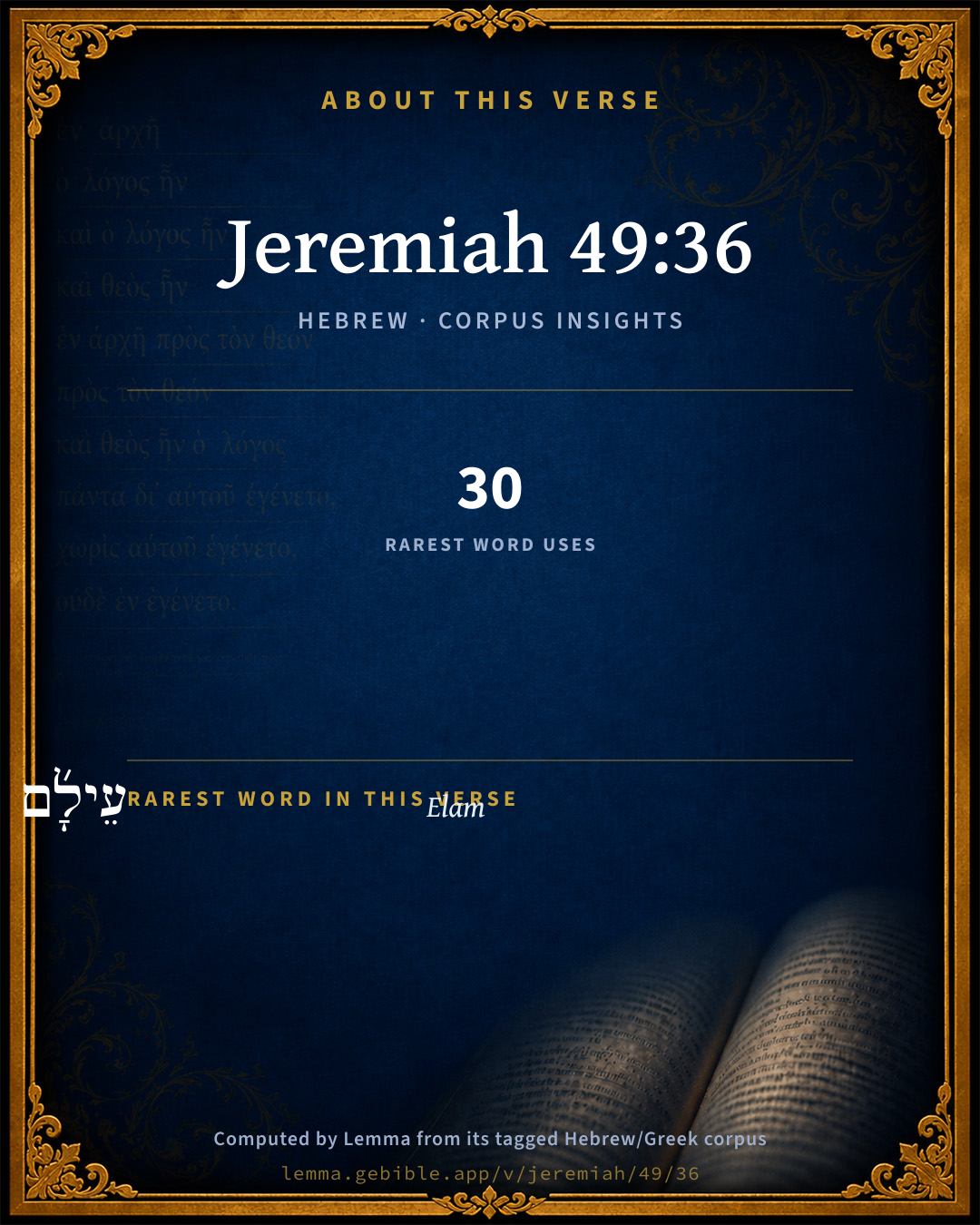
These counts appear in no published source. They are computed here, from the morphology-tagged text and Lemma’s own curated glosses. What Lemma adds →

22
words
16
distinct lemmas
Prophets
section

Shared distinctive vocabulary

עֵילָ֜ם Elam H5867 occurs in 27 verses of the Hebrew Bible. Also found in:

Grammatical profile

  • 5 verbs
  • 9 nouns
  • 2 adjectives
  • 1 pronoun
  • 1 preposition
  • 1 adverb
  • 3 particles

Verb forms

  • וְהֵבֵאתִ֨י Hiphil · Sequential Perfect
  • וְזֵ֣רִתִ֔ים Piel · Sequential Perfect
  • יִהְיֶ֣ה Qal · Imperfect
  • יָב֥וֹא Qal · Imperfect
  • נִדְּחֵ֥י Niphal · Participle Passive

Repetition

Words recur within this verse — often emphatic in Hebrew:

  • עֵילָ֜ם Elam H5867 ×3
  • וְהֵבֵאתִ֨י to enter H935 ×2
  • אַרְבַּ֣ע four H702 ×2
  • רוּח֗וֹת spirit H7307 ×2
  • וְלֹֽא not H3808 ×2

Cross-references

17

Topical passages linked to Jeremiah 49:36 in the Treasury of Scripture Knowledge — connected by theme and wording, ordered by reader-vote popularity; previews shown in the World English Bible.

  • Jeremiah 49:32 Their camels shall be a booty, and the multitude of their cattle a spoil: and I will scatter to all winds those who have the corners [of their hair] cut off; and I will bring their calamity from every side of them, says Yahweh.
  • Jeremiah 30:17 For I will restore health to you, and I will heal you of your wounds, says Yahweh; because they have called you an outcast, [saying], It is Zion, whom no man seeks after.
  • Ezekiel 5:10 Therefore the fathers shall eat the sons in the midst of you, and the sons shall eat their fathers; and I will execute judgments on you; and the whole remnant of you will I scatter to all the winds.
  • Daniel 8:8 The male goat magnified himself exceedingly: and when he was strong, the great horn was broken; and instead of it there came up four notable [horns] toward the four winds of the sky.
  • Amos 9:9 "For, behold, I will command, and I will sift the house of Israel among all the nations, as grain is sifted in a sieve, yet not the least kernel will fall on the earth.
  • Revelation 7:1 After this, I saw four angels standing at the four corners of the earth, holding the four winds of the earth, so that no wind would blow on the earth, or on the sea, or on any tree.
  • Deuteronomy 28:25 Yahweh will cause you to be struck before your enemies; you shall go out one way against them, and shall flee seven ways before them: and you shall be tossed back and forth among all the kingdoms of the earth.
  • Deuteronomy 28:64 Yahweh will scatter you among all peoples, from the one end of the earth even to the other end of the earth; and there you shall serve other gods, which you have not known, you nor your fathers, even wood and stone.
  • Psalms 147:2 Yahweh builds up Jerusalem. He gathers together the outcasts of Israel.
  • Isaiah 11:12 He will set up an ensign for the nations, and will assemble the outcasts of Israel, and gather together the dispersed of Judah from the four corners of the earth.
  • Isaiah 16:3–4 Give counsel, execute justice; make your shade as the night in the midst of the noonday; hide the outcasts; don't betray the fugitive.
  • Isaiah 27:13 It shall happen in that day, that a great trumpet shall be blown; and they shall come who were ready to perish in the land of Assyria, and those who were outcasts in the land of Egypt; and they shall worship Yahweh in the holy mountain at Jerusalem.
  • Isaiah 56:8 The Lord Yahweh, who gathers the outcasts of Israel, says, Yet will I gather [others] to him, besides his own who are gathered.
  • Ezekiel 5:12 A third part of you shall die with the pestilence, and with famine shall they be consumed in the midst of you; and a third part shall fall by the sword round about you; and a third part I will scatter to all the winds, and will draw out a sword after them.
  • Daniel 8:22 As for that which was broken, in the place where four stood up, four kingdoms shall stand up out of the nation, but not with his power.
  • Daniel 11:4 When he shall stand up, his kingdom shall be broken, and shall be divided toward the four winds of the sky, but not to his posterity, nor according to his dominion with which he ruled; for his kingdom shall be plucked up, even for others besides these.
  • Daniel 7:2–3 Daniel spoke and said, I saw in my vision by night, and, behold, the four winds of the sky broke forth on the great sea.

Cross-references courtesy of OpenBible.info (CC BY 4.0).

Hebrew and Greek witnesses Masoretic Hebrew ↔ Greek Septuagint

The same verse in the two great witnesses to the Old Testament, shown verse-for-verse.

These are two independent witnesses, not word-aligned to each other, and the Septuagint is shown in lemma (dictionary) form.

Hebrew Jeremiah 49:36 Masoretic · Westminster Leningrad Codex

וְהֵבֵאתִ֨י אֶל עֵילָ֜ם אַרְבַּ֣ע רוּח֗וֹת מֵֽאַרְבַּע֙ קְצ֣וֹת הַשָּׁמַ֔יִם וְזֵ֣רִתִ֔ים לְכֹ֖ל הָרֻח֣וֹת הָאֵ֑לֶּה וְלֹֽא יִהְיֶ֣ה הַגּ֔וֹי אֲשֶׁ֛ר לֹֽא יָב֥וֹא שָׁ֖ם נִדְּחֵ֥י עולם עֵילָֽם

On Elam will I bring the four winds from the four quarters of the sky, and will scatter them toward all those winds; and there shall be no nation where the outcasts of Elam shall not come.

World English Bible · Public Domain

Greek LXX Structure differs

In the Septuagint, Jeremiah is about an eighth shorter than the Hebrew and arranges its material differently — the Oracles Against the Nations (Hebrew chapters 46–51) appear in the middle of the Greek book, after 25:13. Because the chapter and verse boundaries do not line up, a verse-for-verse comparison with the Hebrew is not shown.

A verse-for-verse comparison isn’t shown here because the chapters and verses don’t line up. Switch to the LXX edition with the MT / LXX toggle above to read the Greek directly.

Hebrew: Westminster Leningrad Codex (CC BY 4.0). Greek: Septuagint (public domain); English from a public-domain English Septuagint. How the Septuagint differs from the Hebrew →

Targum (Aramaic paraphrase)

1

The Targum is the ancient Jewish Aramaic paraphrase of the Hebrew Scriptures — an interpretive translation, not the Hebrew text itself. Onkelos (literal) and Pseudo-Jonathan (expansive) render the Torah, and Jonathan the Prophets. Coverage is partial: where no permissively-licensed English translation exists for a verse, only the Aramaic is shown. This is verse-level text, not a word-by-word alignment to the Hebrew.

  1. Targum Jonathan Prophets (Joshua–Malachi)
    וְאַיְתִי עַל עֵילָם אַרְבַּע מַלְכְּוָן מֵאַרְבַּע רוּחֵי שְׁמַיָא וֶאֱבַדְרִינוּן לְכֹל רוּחָתָא הָאִלֵין וְלָא יְהֵי עַם דְלָא יְהָכוּן לְתַמָן מְטַלְטְלֵי עֵילָם:

    (no public-domain English translation for this verse)

    Targum Jonathan — Aramaic: “Mikraot Gedolot” (public domain). English: “Sefaria Community Translation” (CC0 1.0 (public-domain dedication)); “London "Chaldee Paraphrase," 1871” (public domain). Text via Sefaria.

Commentary

Notes on Jeremiah 49:36 from classic Christian and Jewish commentators (each source and its license shown beneath its notes). The classic Christian expositions comment on the surrounding passage and are grouped to its opening verse, so a note may address several verses; the Jewish commentaries on the Tanakh (Rashi and others) are per-verse, so they appear only where the commentator wrote on this verse.

Lemma curates 59 commentaries, every one of them public domain or Creative Commons licensed, each selected and text-cleaned for this edition rather than reprinted as found. About our sources →

Trapp's Complete Commentary

John Trapp

Jer 49:36 And upon Elam will I bring the four winds from the four quarters of heaven, and will scatter them toward all those winds; and there shall be no nation whither the outcasts of Elam shall not come.

Ver. 36. And upon Elam will I bring the four winds,] i.e., Great concussions, enemies on all sides, Scythians and Sarmatians especially out of the north. Calvin thinks this prophecy was fulfilled after Alexander’s death, when his captains strove most fiercely for the kingdoms of the earth which he had subdued.

John Trapp, A Commentary or Exposition upon All the Books of the Old and New Testament (1647–1656) — public domain. Text from a community e-Sword module.

Tyndale Open Study Notes

Tyndale Open Resources

49:36 The common aftermath of a successful invasion was for the victors to scatter the refugees far and wide.

Tyndale Open Study Notes — © Tyndale Open Resources, licensed CC BY-SA 4.0. Text via the HelloAO Bible API.

Jamieson, Fausset & Brown

Robert Jamieson, A. R. Fausset & David Brown

four winds, &c.--Nebuchadnezzar's army containing soldiers from the four quarters.

Jamieson, Fausset & Brown — Commentary Critical and Explanatory on the Whole Bible (1871) — public domain (CC PDM 1.0). Text via the HelloAO Bible API.

Adam Clarke's Commentary

Verse 36. Will I bring the four winds] Nebuchadnezzar and his armies, gathered out of different provinces, and attacking this people at all points in the same time.

There shall be no nation, &c.] They shall be scattered through the one hundred and twenty-seven provinces of which the Babylonish empire is composed.

Adam Clarke's Commentary on the Bible (1810–1826) — public domain. Text from a community e-Sword/MySword module.

John Calvin's Commentaries

He now adds that four winds would come, which would dissipate the whole people. God himself speaks, in order that the word might be more powerful and have more weight. I will rouse up, he says, four winds And we know that the air is in a moment put in motion whenever it pleases God; and when Scripture extols the power of God, it does not without reason refer to the winds; for it is not a small miracle when the whole world is on a sudden put in motion. It is now tranquil, and then in half an hour the winds rise and conflict together in mid air. And God alludes to what is usual in nature: as then he suddenly rouses up winds which make, as it were, the whole world to shake and tremble; so he says he would raise up winds from the four ends of the world. But he speaks metaphorically; by winds he understands enemies, who would on all sides unite their powers to oppress the Elamites. I will bring, he says, on Elam the four winds from the four quarters of the world By the last words he expresses more clearly what I have just said, that God alludes to that formidable power which is daily presented to our eyes in nature. As, then, a sudden change disturbs the whole earth when winds arise, so God declares that he would rouse up four winds from the four quarters of the heavens. And he calls them the quarters of the heavens; for though the winds arise from the earth, yet their blowing is not perceived until they ascend into mid air: and though sometimes they seem to be formed above the clouds, they yet arise from the earth; for the origin of the wind is cold and dry exhalation.

We now understand the reason why the Prophet speaks of the winds. There is yet no doubt but that he denotes some enemies by the four winds; but this prophecy was not fulfilled as long as the Persian monarchy ruled and flourished. It is, then, probable that the destruction denounced by the Prophet took place many ages after, even when the soldiers of Alexander contended about the supremacy; for we know how grievously distressed were all the Orientals when Alexander made an irruption into those countries. It was, indeed, a horrible tempest. But as he enjoyed the empire of the east but for a short time, what is said by the Prophet here was not then fulfilled. But those countries were afterwards so miserable, torn by intestine wars, that the Prophet does not without reason compare those contrary and opposite movements to four winds; for never has there been a fiercer emulation between enemies, and each of them had strong armies. Hence, then, it was, that that land was not oppressed by one enemy, but exposed to various and almost innumerable calamities. This is the reason that leads me to interpret this prophecy as fulfilled in the calamities which followed the death of Alexander the Great.

I will scatter them, he says, to these four winds; that is, as one wind breaks out at one time, and another at another time, so the Elamites shall flee here and there. For no one ruled long peaceably in the East, till almost all the soldiers of Alexander were consumed by mutual slaughters. Then Seleucus obtained Syria, and exercised the cruelest tyranny. But, as I have said, before Seleucus obtained peace and security, the whole of that part of the world had been inundated with blood. This is the reason why the Prophet says that the Elamites would be scattered to these four winds

The end of the verse remains: and there shall be no nation to which some of the fugitives from Elam shall not come We cannot, certainly, show from histories when this was fulfilled which the Prophet now says; but it is probable that that people were scattered at the time when the chiefs contended about the supremacy, that is, those who obtained power under Alexander. At the same time there would be nothing unreasonable were we to say that the Prophet spoke hyperbolically; and no doubt he exceeds due limits when he says “There shall be no nation to which some of the fugitives from Elam shall not come.” He indeed understands all the neighboring nations. But it may also have been that they did not flee to the Asiatics, but rather departed towards the Persian sea or to the Indies. We have already stated why the servants of God sometimes introduced hyperbolical expressions into their teaching, even because they had to do with men who were slow and stupid, who would not hear God when speaking in a simple manner, and could hardly be moved when he thundered. It now follows —

John Calvin's Commentaries (1540-1563) — public domain. Text from the Calvin Translation Society English edition (1840s-50s) via the Christian Classics Ethereal Library (ccel.org). Calvin's coverage is partial (roughly two-thirds of the Bible); uncommented books and verses are honest gaps, never fabricated. The 19th-century editor's footnotes and remarks are omitted so the notes are faithfully Calvin's own voice.

Ellicott's Commentary for English Readers

(36) Upon Elam will I bring the four winds . . .—The words reproduce those of Jer_49:32 as to the extent of the dispersion, but there is an added circumstance of terror in the picture of destruction. The “four winds” whirling round as in a cyclone are to be the instruments of destruction. The imagery of the threshing-floor seems once more brought before us, and the Elamites are as the chaff which the winds, in such a tempest, carry off in all directions.

A Bible Commentary for English Readers, edited by Charles John Ellicott (1878–1897) — public domain. Text from a community e-Sword module.

The Cambridge Bible for Schools and Colleges

gen. ed. J. J. S. Perowne

36. Co. with considerable probability holds this v. to be the work of a supplementer, as being an interruption to the order of thought (when compared with the succeeding v.) and as suggested by Eze_5:10; Eze_5:12; Eze_12:14, and also by Eze_37:9.

The Cambridge Bible for Schools and Colleges (gen. ed. J. J. S. Perowne; Cambridge University Press, 1878–1918) — public domain. Text from a community e-Sword module.

John Gill's Exposition

And upon Elam will I bring the four winds from the four quarters of heaven,.... The Targum interprets it the four kingdoms; see Dan 7:2. Some think this had its accomplishment in the times of Alexander; or else after his death, in the times of his four successors; but rather in the times of Nebuchadnezzar, who should bring with him, in his army, people that dwelt in the several parts of the world, comparable to the winds for their swiftness and strength; whose blast would be so great as to drive the Elamites to every part of the world, as every light thing is by the wind:

and will scatter them towards all those winds; those four winds, east, west, north, and south:

and there shall be no nation whither the outcasts of Elam shall not come; those that are driven out of it, forced to flee from it, or are taken captive, should come into the several nations of the world; so that there would not be any in which an Elamite was not.

John Gill's Exposition of the Whole Bible (1746–1763) — public domain (CC PDM 1.0). Text via the HelloAO Bible API.

Albert Barnes' Notes on the Bible

In a whirlwind violent gales seem to blow from every quarter, and whatever is exposed to their fury they scatter over the whole country. With similar violence the whole nation of Elam shall be dispersed far and wide.

Albert Barnes' Notes on the Bible (1834–1885) — public domain. Text from a community e-Sword/MySword module.

Matthew Poole's English Annotations

The prophet threateneth the destruction of the Persians by a confederacy of enemies, suppose Babylonians, Medes, &c., which should assault them on all sides, as when the wind blows at the same time from all quarters, which causeth a whirlwind, which driveth the dust every way hither and thither, so he saith the Persians should be scattered into all nations.

Matthew Poole's English Annotations on the Holy Bible (1683–1685) — public domain. Text from a community e-Sword/MySword module.

Whedon's Commentary on the Bible

Daniel D. Whedon

36. Four winds from the four quarters — Truthful description of a terrific storm, which, in its destructive fury, seems to come from all quarters at once.

Outcasts of Elam — A singular error has crept into the written text, consisting in substituting a vav (ו) for a yodh, (י) so that the actual reading is outcasts of eternity. It is perfectly obvious that it is a mere mistake, and the Versions so treat it. The only value it has, however, is to illustrate the possibility of a case in which the internal evidence as to a reading may quite overbear the external; and this gives some protection to conjectural emendations in other places.

Daniel D. Whedon (gen. ed.), Commentary on the Old and New Testaments (1874–1909) — public domain. Text from a community e-Sword module.

The Pulpit Commentary

An emblem of the utter hopelessness of escape. The four winds (figuratively spoken of by Zechariah (Zec_6:5) as "presenting themselves" before God, to receive his commissions) shall combine their forces to scatter the doomed nation. The outcasts of Elam. This is the marginal reading in the Hebrew Bible; the text has, "the perpetual outcasts." No philological eye can doubt that the correction should be admitted (a yod for a vav).

The Pulpit Commentary (1880–1919), ed. H.D.M. Spence-Jones & Joseph S. Exell — public domain. Text from a community e-Sword module.

Lesson kit

Teaching starters — assembled from the data on this page, not authored interpretation. Every prompt links to the verse data it draws on. Edit before teaching.

Jeremiah, in the Prophets, opens this verse with 22 words (16 distinct Hebrew lemmas). Its most distinctive word is ʻÊylâm (“Elam”). A historical commentator’s framing appears above. Read the whole chapter for the surrounding context.

Discussion questions

  1. The word ʻÊylâm carries the sense “Elam.” How does it shape the verse?
  2. How does Genesis 10:22, which shares the word «Elam», read alongside this verse?
  3. What does the repetition of “Elam” (3× in this one verse) do in this verse?
  4. These translations render this verse differently. What is at stake in choosing one wording over another?
  5. «וְהֵבֵאתִ֨י» is a Hiphil Sequential Perfect verb. How does that grammatical form shape the action described?
  6. Compare how Trapp's Complete Commentary and Tyndale Open Study Notes read this verse. Where do they agree or differ?

Things to notice

Reading settings

Reading text

Shown beneath each verse's original-language words.

Old Testament
Old Testament edition

Read the OT as the Masoretic Hebrew (MT) or the Greek Septuagint (LXX).

English shown for the Greek Septuagint (in the Hebrew ↔ Greek comparison).

Comparing translations? Open the Compare panel on any verse page to stack up to four side by side.