
Jeremiah 46:28

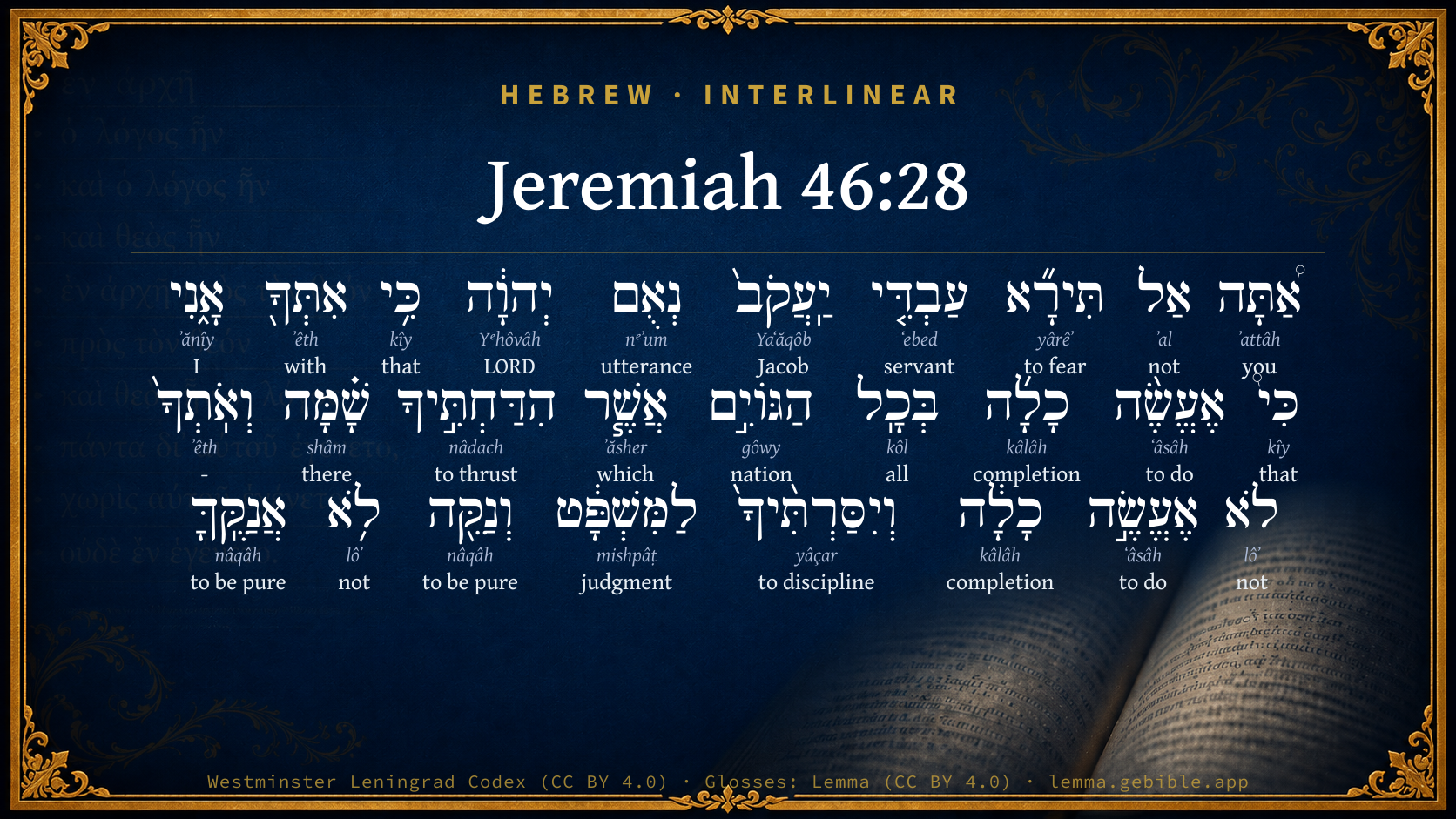
Hebrew (Westminster Leningrad Codex) Jeremiah 46:28 appears in the Hebrew Old Testament. The text above is from the Westminster Leningrad Codex. Each word links to its Strong’s number, a concise gloss, and parsing drawn from the Open Scriptures Hebrew Bible morphology. Click any word for its full Brown-Driver-Briggs (BDB) entry.
Download image
Cite this verse

Jeremiah 46:28 (World English Bible). Public Domain. Lemma interlinear Bible study tool, https://lemma.gebible.app/v/jeremiah/46/28.

Show BibTeX & RIS
BibTeX
RIS
English Translation
Don't be afraid you, O Jacob my servant, says Yahweh; for I am with you: for I will make a full end of all the nations where I have driven you; but I will not make a full end of you, but I will correct you in measure, and will in no way leave you unpunished.
World English Bible · Public Domain
Download a study sheet

One document with this verse’s original text, its word-by-word gloss line, the meaning frame, cross-references with their text, attributed commentary, and full source and license credits — printable, and it pastes into notes with its structure intact.

This verse Autodidact and up

Study sheet (.html) Plain text (.txt)

A passage Seminary Student

Up to 50 verses in one chapter. A passage sheet keeps up to 6 commentary sources and 12 cross-references per verse, in the order this page ranks them, and says so on the sheet whenever that leaves anything out. Ask for a single verse and you get the Autodidact verse sheet above.

Everything on this page stays free to read, with no account — the sheet is a download of what is already on screen, not access to it.

Want to remove ads? Support Godless Engineer
Compare translations 3

The same verse in 3 English versions, stacked beneath the original-language interlinear above. Click any original word for its lexicon entry.

Each is an independent rendering of the whole verse — the interlinear is not word-aligned to these translations.

Highlighted words mark where these versions differ — a whole-verse word diff, not a word-by-word alignment.

  • World English Bible Public Domain
    Don't be afraid you, O Jacob my servant, says Yahweh; for I am with you: for I will make a full end of all the nations where I have driven you; but I will not make a full end of you, but I will correct you in measure, and will in no way leave you unpunished.
  • King James Version Public Domain
    Fear thou not, O Jacob my servant, saith the LORD: for I am with thee; for I will make a full end of all the nations whither I have driven thee: but I will not make a full end of thee, but correct thee in measure; yet will I not leave thee wholly unpunished.
  • unfoldingWord Literal Text CC BY-SA 4.0
    You, my servant Jacob, do not fear—this is Yahweh’s declaration—for I am with you, so I will bring complete destruction against all the nations where I scattered you. But I will not destroy you completely. Yet I will discipline you justly and will certainly not leave you unpunished.”

unfoldingWord Literal Text — © unfoldingWord, licensed CC BY-SA 4.0. Word-aligned USFM3 via Door43 (git.door43.org/unfoldingWord/en_ult).

Versions to compare (up to 4)

3 of 4 selected

Show all 18 translations

Every available English version of this verse, each an independent rendering of the whole verse.

  • World English Bible Public Domain
    Don't be afraid you, O Jacob my servant, says Yahweh; for I am with you: for I will make a full end of all the nations where I have driven you; but I will not make a full end of you, but I will correct you in measure, and will in no way leave you unpunished.
  • Berean Standard Bible Public Domain
    And you, My servant Jacob, do not be afraid, declares the LORD, for I am with you. Though I will completely destroy all the nations to which I have banished you, I will not completely destroy you. Yet I will discipline you justly, and will by no means leave you unpunished.”
  • Majority Standard Bible Public Domain
    And you, My servant Jacob, do not be afraid, declares the LORD, for I am with you. Though I will completely destroy all the nations to which I have banished you, I will not completely destroy you. Yet I will discipline you justly, and will by no means leave you unpunished.”
  • King James Version Public Domain
    Fear thou not, O Jacob my servant, saith the LORD: for I am with thee; for I will make a full end of all the nations whither I have driven thee: but I will not make a full end of thee, but correct thee in measure; yet will I not leave thee wholly unpunished.
  • American Standard Version (1901) Public Domain
    Fear not thou, O Jacob my servant, saith Jehovah; for I am with thee: for I will make a full end of all the nations whither I have driven thee; but I will not make a full end of thee, but I will correct thee in measure, and will in no wise leave thee unpunished.
  • Revised Version (1885) Public Domain
    Fear not thou, O Jacob my servant, saith the LORD; for I am with thee: for I will make a full end of all the nations whither I have driven thee, but I will not make a full end of thee; but I will correct thee with judgment, and will in no wise leave thee unpunished.
  • Geneva Bible (1599) Public Domain
    Feare thou not, O Iaakob my seruant, saith the Lord: for I am with thee, and I will vtterly destroy all the nations, whither I haue driuen thee: but I will not vtterly destroy thee, but correct thee by iudgement, and not vtterly cut thee off.
  • Douay-Rheims (1899) Public Domain
    And thou, my servant Jacob, fear not, saith the Lord: because I am with thee, for I will consume all the nations to which I have cast thee out: but thee I will not consume, but I will correct thee in judgment, neither will I spare thee as if thou wert innocent.
  • Young's Literal Translation Public Domain
    Thou, thou dost not fear, My servant Jacob, An affirmation of Jehovah -- for with thee I `am', For I make an end of all the nations Whither I have driven thee, And of thee I do not make an end, And I have reproved thee in judgment, And do not entirely acquit thee!'
  • Literal Standard Version CC BY-SA 4.0
    You do not fear, My servant Jacob, || A declaration of YHWH, || For I [am] with you, || For I make an end of all the nations || To where I have driven you, || And I do not make an end of you, || And I have reproved you in judgment, || And do not entirely acquit you!”
  • Unlocked Literal Bible CC BY-SA 4.0
    You, my servant Jacob, do not fear—this is Yahweh's declaration—for I am with you, so I will bring complete destruction against all the nations where I scattered you. But I will not destroy you completely. Yet I will discipline you justly and will certainly not leave you unpunished.”
  • unfoldingWord Literal Text CC BY-SA 4.0
    You, my servant Jacob, do not fear—this is Yahweh’s declaration—for I am with you, so I will bring complete destruction against all the nations where I scattered you. But I will not destroy you completely. Yet I will discipline you justly and will certainly not leave you unpunished.”
  • Darby Bible Public Domain
    Fear thou not, my servant Jacob, saith Jehovah: for I am with thee; for I will make a full end of all the nations whither I have driven thee, but I will not make a full end of thee; but I will correct thee with judgment, and I will not hold thee altogether guiltless.
  • World Messianic Bible Public Domain
    Don’t be afraid, O Jacob my servant,” says the LORD, “for I am with you; for I will make a full end of all the nations where I have driven you, but I will not make a full end of you, but I will correct you in measure, and will in no way leave you unpunished.”
  • Webster's Bible Public Domain
    Fear thou not, O Jacob my servant, saith the LORD: for I am with thee; for I will make a full end of all the nations whither I have driven thee: but I will not make a full end of thee, but correct thee in measure; yet will I not leave thee wholly unpunished.
  • Free Bible Version CC BY-SA 4.0
    You descendants of Jacob, don't be afraid! declares the Lord, for I will be with you. I will completely destroy all the nations where I've scattered you, I won't completely destroy you. However, I will discipline you as you deserve, and you can be sure I won't leave you unpunished.
  • Bible in Basic English Public Domain
    Have no fear, O Jacob, my servant, says the Lord; for I am with you: for I will put an end to all the nations where I have sent you, but I will not put an end to you completely: though with wise purpose I will put right your errors, and will not let you go quite without punishment.
  • JPS Tanakh (1917) Public Domain
    Fear not thou, O Jacob My servant, saith the LORD, for I am with thee; for I will make a full end of all the nations whither I have driven thee, but I will not make a full end of thee; and I will correct thee in measure, but will not utterly destroy thee.

Literal Standard Version (2020), Covenant Press — licensed CC BY-SA 4.0. Text via the HelloAO Bible API (eBible.org). Unlocked Literal Bible (unfoldingWord) — licensed CC BY-SA 4.0. Text via the HelloAO Bible API (eBible.org). unfoldingWord Literal Text — © unfoldingWord, licensed CC BY-SA 4.0. Word-aligned USFM3 via Door43 (git.door43.org/unfoldingWord/en_ult). Free Bible Version, Dr. Jonathan Gallagher — licensed CC BY-SA 4.0. Text via the HelloAO Bible API (eBible.org).

Word by word

More ways to search: Search by grammar → Find every occurrence → Compare this word →

Practice this passage: Drill this verse → Learn its vocabulary →

כָלָ֜ה
kâlâh
H3617
“completion”
Noun, Common, Feminine, Singular, Absolute
Part of Speech
Noun
Type
Common
Gender
Feminine
Number
Singular
State
Absolute
Full BDB Definition

Origin: from H3615

TWOT: 982a

completion, termination, full end, complete destruction, consumption, annihilation - completion - completely, altogether (adverb) - complete destruction, consumption, annihilation
  1. אַ֠תָּה ʼattâh H859 “you” Pronoun, Personal, 2nd Person, Masculine, Singular
  2. אַל ʼal H408 “not” Particle, Negative
  3. תִּירָ֞א yârêʼ H3372 “to fear” Verb, Qal, Jussive, 2nd Person, Masculine, Singular
  4. עַבְדִּ֤י ʻebed H5650 “servant · my” Noun, Common, Masculine, Singular, Construct + Suffix, Personal, 1st Person, Common, Singular
  5. יַֽעֲקֹב֙ Yaʻăqôb H3290 “Jacob” Noun, Proper
  6. נְאֻם nᵉʼum H5002 “utterance of” Noun, Common, Masculine, Singular, Construct
  7. יְהוָ֔ה Yᵉhôvâh H3068 “LORD” Noun, Proper
  8. כִּ֥י kîy H3588 “that” Conjunction
  9. אִתְּךָ֖ ʼêth H854 “with · you” Preposition + Suffix, Personal, 2nd Person, Masculine, Singular
  10. אָ֑נִי ʼănîy H589 “I” Pronoun, Personal, 1st Person, Common, Singular
  11. כִּי֩ kîy H3588 “that” Conjunction
  12. אֶעֱשֶׂ֨ה ʻâsâh H6213 “to do” Verb, Qal, Imperfect, 1st Person, Common, Singular
  13. בְּכָֽל kôl H3605 “in/at · all of” Preposition + Noun, Common, Masculine, Singular, Construct
  14. הַגּוֹיִ֣ם gôwy H1471 “the · nations” Particle, Definite Article + Noun, Common, Masculine, Plural, Absolute
  15. אֲשֶׁ֧ר ʼăsher H834 “which” Particle, Relative
  16. הִדַּחְתִּ֣יךָ nâdach H5080 “to thrust · you” Verb, Hiphil, Perfect, 1st Person, Common, Singular + Suffix, Personal, 2nd Person, Masculine, Singular
  17. שָׁ֗מָּה shâm H8033 “there · toward” Adverb + Suffix, Demonstrative
  18. וְאֹֽתְךָ֙ ʼêth H853 “and · - · you” Conjunction + Particle, Direct Object + Suffix, Personal, 2nd Person, Masculine, Singular
  19. לֹא lôʼ H3808 “not” Particle, Negative
  20. אֶעֱשֶׂ֣ה ʻâsâh H6213 “to do” Verb, Qal, Imperfect, 1st Person, Common, Singular
  21. כָלָ֔ה kâlâh H3617 “completion” Noun, Common, Feminine, Singular, Absolute
  22. וְיִסַּרְתִּ֨יךָ֙ yâçar H3256 “and · to discipline · you” Conjunction + Verb, Piel, Sequential Perfect, 1st Person, Common, Singular + Suffix, Personal, 2nd Person, Masculine, Singular
  23. לַמִּשְׁפָּ֔ט mishpâṭ H4941 “to/for the · judgment” Preposition, Determined + Noun, Common, Masculine, Singular, Absolute
  24. וְנַקֵּ֖ה nâqâh H5352 “and · to be pure” Conjunction + Verb, Piel, Infinitive Absolute
  25. לֹ֥א lôʼ H3808 “not” Particle, Negative
  26. אֲנַקֶּֽךָּ nâqâh H5352 “to be pure · you” Verb, Piel, Imperfect, 1st Person, Common, Singular + Suffix, Personal, 2nd Person, Masculine, Singular

About this verse

These counts appear in no published source. They are computed here, from the morphology-tagged text and Lemma’s own curated glosses. What Lemma adds →

27
words
22
distinct lemmas
Prophets
section

Notable vocabulary

The rarest word here is כָלָ֜ה completion H3617 — appearing just 21 times in the whole Hebrew Bible.

Shared distinctive vocabulary

כָלָ֜ה completion H3617 occurs in 19 verses of the Hebrew Bible. Also found in:

Grammatical profile

  • 7 verbs
  • 9 nouns
  • 2 pronouns
  • 1 preposition
  • 2 conjunctions
  • 1 adverb
  • 5 particles

Verb forms

  • תִּירָ֞א Qal · Jussive
  • אֶעֱשֶׂ֨ה Qal · Imperfect
  • הִדַּחְתִּ֣יךָ Hiphil · Perfect
  • אֶעֱשֶׂ֣ה Qal · Imperfect
  • וְיִסַּרְתִּ֨יךָ֙ Piel · Sequential Perfect
  • וְנַקֵּ֖ה Piel · Infinitive Absolute
  • אֲנַקֶּֽךָּ Piel · Imperfect

Repetition

Words recur within this verse — often emphatic in Hebrew:

  • אֶעֱשֶׂ֨ה to do H6213 ×2
  • כָלָ֜ה completion H3617 ×2
  • וְנַקֵּ֖ה to be pure H5352 ×2
  • כִּ֥י that H3588 ×2
  • לֹא not H3808 ×2

Cross-references

31

Topical passages linked to Jeremiah 46:28 in the Treasury of Scripture Knowledge — connected by theme and wording, ordered by reader-vote popularity; previews shown in the World English Bible.

  • Jeremiah 10:24 Yahweh, correct me, but in measure: not in your anger, lest you bring me to nothing.
  • 1 Corinthians 11:32 But when we are judged, we are punished by the Lord, that we may not be condemned with the world.
  • Revelation 3:19 As many as I love, I reprove and chasten. Be zealous therefore, and repent.
  • Jeremiah 4:27 For thus says Yahweh, The whole land shall be a desolation; yet will I not make a full end.
  • Jeremiah 30:11 For I am with you, says Yahweh, to save you: for I will make a full end of all the nations where I have scattered you, but I will not make a full end of you; but I will correct you in measure, and will in no way leave you unpunished.
  • Amos 9:8–9 Behold, the eyes of the Lord Yahweh are on the sinful kingdom, and I will destroy it from off the surface of the earth; except that I will not utterly destroy the house of Jacob," says Yahweh.
  • Psalms 46:7 Yahweh of Hosts is with us. The God of Jacob is our refuge. Selah.
  • Psalms 46:11 Yahweh of Hosts is with us. The God of Jacob is our refuge. Selah.
  • Isaiah 8:9–10 Make an uproar, O you peoples, and be broken in pieces! And give ear, all you of far countries: gird yourselves, and be broken in pieces! Gird yourselves, and be broken in pieces!
  • Isaiah 43:2 When you pass through the waters, I will be with you; and through the rivers, they shall not overflow you: when you walk through the fire, you shall not be burned, neither shall the flame kindle on you.
  • Jeremiah 1:19 They shall fight against you; but they shall not prevail against you: for I am with you, says Yahweh, to deliver you.
  • Jeremiah 25:9 behold, I will send and take all the families of the north, says Yahweh, and [I will send] to Nebuchadrezzar the king of Babylon, my servant, and will bring them against this land, and against the inhabitants of it, and against all these nations round about; and I will utterly destroy them, and make them an astonishment, and a hissing, and perpetual desolations.
  • Jeremiah 32:42–44 For thus says Yahweh: Like as I have brought all this great evil on this people, so will I bring on them all the good that I have promised them.
  • Daniel 2:35 Then was the iron, the clay, the brass, the silver, and the gold, broken in pieces together, and became like the chaff of the summer threshing floors; and the wind carried them away, so that no place was found for them: and the stone that struck the image became a great mountain, and filled the whole earth.
  • Habakkuk 3:2 Yahweh, I have heard of your fame. I stand in awe of your deeds, Yahweh. Renew your work in the midst of the years. In the midst of the years make it known. In wrath, you remember mercy.
  • Matthew 1:23 "Behold, the virgin shall be with child, And shall bring forth a son. They shall call his name Immanuel;" Which is, being interpreted, "God with us."
  • Hebrews 12:5–10 and you have forgotten the exhortation which reasons with you as with children, "My son, don't take lightly the chastening of the Lord, Nor faint when you are reproved by him;
  • Joshua 1:5 There shall not any man be able to stand before you all the days of your life. As I was with Moses, so I will be with you; I will not fail you, nor forsake you.
  • Joshua 1:9 Haven't I commanded you? Be strong and of good courage; don't be afraid, neither be dismayed: for Yahweh your God is with you wherever you go.
  • Isaiah 27:7 Has he struck them as he struck those who struck them? or are they slain according to the slaughter of those who were slain by them?
  • Isaiah 27:9 Therefore by this shall the iniquity of Jacob be forgiven, and this is all the fruit of taking away his sin: that he makes all the stones of the altar as chalk stones that are beaten in sunder, [so that] the Asherim and the sun-images shall rise no more.
  • Isaiah 41:10 Don't you be afraid, for I am with you; don't be dismayed, for I am your God; I will strengthen you; yes, I will help you; yes, I will uphold you with the right hand of my righteousness.
  • Isaiah 45:23 By myself have I sworn, the word is gone forth from my mouth [in] righteousness, and shall not return, that to me every knee shall bow, every tongue shall swear.
  • Jeremiah 5:10 Go up on her walls, and destroy; but don't make a full end: take away her branches; for they are not Yahweh's.
  • Jeremiah 5:18 But even in those days, says Yahweh, I will not make a full end with you.
  • Jeremiah 15:20 I will make you to this people a fortified brazen wall; and they shall fight against you, but they shall not prevail against you; for I am with you to save you and to deliver you, says Yahweh.
  • Jeremiah 33:24–26 Don't you consider what this people has spoken, saying, The two families which Yahweh did choose, he has cast them off? thus do they despise my people, that they should be no more a nation before them.
  • Matthew 28:20 teaching them to observe all things that I commanded you. Behold, I am with you always, even to the end of the age." Amen.
  • Acts 18:10 for I am with you, and no one will attack you to harm you, for I have many people in this city."
  • Romans 11:15–17 For if the rejection of them is the reconciling of the world, what would their acceptance be, but life from the dead?
  • 2 Timothy 4:17 But the Lord stood by me, and strengthened me, that through me the message might be fully proclaimed, and that all the Gentiles might hear; and I was delivered out of the mouth of the lion.

Cross-references courtesy of OpenBible.info (CC BY 4.0).

Hebrew and Greek witnesses Masoretic Hebrew ↔ Greek Septuagint

The same verse in the two great witnesses to the Old Testament, shown verse-for-verse.

These are two independent witnesses, not word-aligned to each other, and the Septuagint is shown in lemma (dictionary) form.

Hebrew Jeremiah 46:28 Masoretic · Westminster Leningrad Codex

אַ֠תָּה אַל תִּירָ֞א עַבְדִּ֤י יַֽעֲקֹב֙ נְאֻם יְהוָ֔ה כִּ֥י אִתְּךָ֖ אָ֑נִי כִּי֩ אֶעֱשֶׂ֨ה כָלָ֜ה בְּכָֽל הַגּוֹיִ֣ם אֲשֶׁ֧ר הִדַּחְתִּ֣יךָ שָׁ֗מָּה וְאֹֽתְךָ֙ לֹא אֶעֱשֶׂ֣ה כָלָ֔ה וְיִסַּרְתִּ֨יךָ֙ לַמִּשְׁפָּ֔ט וְנַקֵּ֖ה לֹ֥א אֲנַקֶּֽךָּ

Don't be afraid you, O Jacob my servant, says Yahweh; for I am with you: for I will make a full end of all the nations where I have driven you; but I will not make a full end of you, but I will correct you in measure, and will in no way leave you unpunished.

World English Bible · Public Domain

Greek LXX Structure differs

In the Septuagint, Jeremiah is about an eighth shorter than the Hebrew and arranges its material differently — the Oracles Against the Nations (Hebrew chapters 46–51) appear in the middle of the Greek book, after 25:13. Because the chapter and verse boundaries do not line up, a verse-for-verse comparison with the Hebrew is not shown.

A verse-for-verse comparison isn’t shown here because the chapters and verses don’t line up. Switch to the LXX edition with the MT / LXX toggle above to read the Greek directly.

Hebrew: Westminster Leningrad Codex (CC BY 4.0). Greek: Septuagint (public domain); English from a public-domain English Septuagint. How the Septuagint differs from the Hebrew →

Targum (Aramaic paraphrase)

1

The Targum is the ancient Jewish Aramaic paraphrase of the Hebrew Scriptures — an interpretive translation, not the Hebrew text itself. Onkelos (literal) and Pseudo-Jonathan (expansive) render the Torah, and Jonathan the Prophets. Coverage is partial: where no permissively-licensed English translation exists for a verse, only the Aramaic is shown. This is verse-level text, not a word-by-word alignment to the Hebrew.

  1. Targum Jonathan Prophets (Joshua–Malachi)
    אַתְּ לָא תִדְחַל עַבְדִי יַעֲקֹב אֲמַר יְיָ אֲרֵי בְּסַעֲדָךְ מֵימְרִי אֲרֵי אַעְבֵיד גְמִירָא בְּכָל עַמְמַיָא דִי אַגְלֵיתָךְ לְתַמָן וְעִמָךְ לָא אַעְבֵּיד גְמִירָא וְאַיְתֵי עֲלָךְ יְסוּרִין לְאַלְפוּתָךְ בְּרַם בְּדִין חֲסוֹךְ וְשֵׁיצָאָה לָא אֱשֵׁיצִינָךְ:

    (no public-domain English translation for this verse)

    Targum Jonathan — Aramaic: “Mikraot Gedolot” (public domain). English: “Sefaria Community Translation” (CC0 1.0 (public-domain dedication)); “London "Chaldee Paraphrase," 1871” (public domain). Text via Sefaria.

Commentary

Notes on Jeremiah 46:28 from classic Christian and Jewish commentators (each source and its license shown beneath its notes). The classic Christian expositions comment on the surrounding passage and are grouped to its opening verse, so a note may address several verses; the Jewish commentaries on the Tanakh (Rashi and others) are per-verse, so they appear only where the commentator wrote on this verse.

Lemma curates 59 commentaries, every one of them public domain or Creative Commons licensed, each selected and text-cleaned for this edition rather than reprinted as found. About our sources →

Trapp's Complete Commentary

John Trapp

Jer 46:28 Fear thou not, O Jacob my servant, saith the LORD: for I [am] with thee; for I will make a full end of all the nations whither I have driven thee: but I will not make a full end of thee, but correct thee in measure; yet will I not leave thee wholly unpunished.

Ver. 28. Fear thou not, O Jacob, &c.] See Jer 30:11.

But correct thee in measure, &c.] God dealeth much otherwise with his own people than he doth with unbelievers, whose prosperity, as it is full of thorns, so their adversity is but a foretaste of eternal torment; whereas "all things," even afflictions also, "work together for good to them that love God."

John Trapp, A Commentary or Exposition upon All the Books of the Old and New Testament (1647–1656) — public domain. Text from a community e-Sword module.

The Biblical Illustrator

Joseph S. Exell

Jer_46:28

But correct thee in measure.

Chastisement duly proportioned

Correction is like physic, not to be given without good advice and caution. We use a difference when we go about to hew a rugged piece of timber, and to smooth a little stick, which you can bend as you please. A fit season must be observed. Cut your trees at some time of the year, and you kill them; prune them at other times, and they thrive much the better. Horses too straight reined in are apt to rise up with their forefeet; when they are allowed convenient liberty with their heads they go better. (G. Swinnock.)

.

The Biblical Illustrator, edited by Joseph S. Exell (c. 1880s–1900s) — public domain. Text from a community e-Sword module.

Geneva Bible (1599)

Geneva Bible translators

Read Jer. 10:14.

Geneva Bible (1599) marginal notes — public domain. Text via Bolls.life.

Adam Clarke's Commentary

Verse 28. I will make a full end of all the nations whither I have driven thee; but I will not make a full end of thee] The Jews still remain as a distinct people, while the Assyrians, Chaldeans, Egyptians, c., are no more!

ON this subject, I cannot withhold from my readers the following very judicious remarks of Bp. Newton, in his Dissertations on the Prophecies.

"The preservation of the Jews through so many ages, and the total destruction of their enemies, are wonderful events and are made still more wonderful by being signified beforehand by the spirit of prophecy, as particularly in the passage before us. Their preservation is really one of the most illustrious acts of Divine Providence. They are dispersed among all nations, yet not confounded with any. The drops of rain which fall, nay the great rivers which flow into the ocean, are soon mingled with and lost in that immense body of waters. And the same, in all human probability, would have been the fate of the Jews; they would have been mingled and lost in the common mass of mankind: but, on the contrary, they flow into all parts of the world, mix with all nations, and yet keep separate from all. They still live as a distinct people; and yet they nowhere live according to their own laws, nowhere elect their own magistrates, nowhere enjoy the full exercise of their religion. Their solemn feasts and sacrifices are limited to one certain place; and that hath been now for many ages in the hands of strangers and aliens, who will not suffer them to come thither. No people have continued unmixed so long as they have done; not only of those who have sent colonies into foreign countries, but even of those who have remained in their own country. The northern nations have come in swarms into the more southern parts of Europe: but where are they now to be discerned and distinguished? The Gauls went forth in great bodies to seek their fortune in foreign parts; but what traces or footsteps of them are now remaining any where? In France, who can separate the race of the ancient Gauls from the various other people who from time to time have settled there? In Spain, who can distinguish between the first possessors, the Spaniards, and the Goths and Moors, who conquered and kept possession of the country for some ages? In England, who can pretend to say certainly which families are derived from the ancient Britons, and which from the Romans, Saxons, Danes, and Normans? The most ancient and honourable pedigrees can be traced up only to a certain period; and beyond that there is nothing but conjecture and uncertainty, obscurity and ignorance. But the Jews can go up higher than any nation; they can even deduce their pedigree from the beginning of the world. They may not know from what particular tribe or family they are descended; but they know certainly that they all sprang from the stock of Abraham. And yet the contempt with which they have been treated, and the hardships they have undergone in almost all countries, should, one would think, have made them desirous to forget or renounce their original: but they profess it; they glory in it; and after so many wars, massacres, and persecutions, they still subsist; they are still very numerous. And what but a supernatural power could have preserved them in such a manner as no other nation upon earth has been preserved? Nor is the providence of God less remarkable in the destruction of their enemies, than in their own preservation. For, from the beginning, who have been the great enemies and oppressors of the Jewish nation, removed them from their own land, and compelled them into captivity and slavery? The Egyptians afflicted them much, and detained them in bondage several years. The Assyrians carried away captive the ten tribes of Israel; and the Babylonians, afterwards, the two remaining tribes of Judah and Benjamin. The Syro-Macedonians, especially Antiochus Epiphanes, cruelly persecuted them; and the Romans utterly dissolved the Jewish state, and dispersed the people so as that they have never been able to recover their city and country again. And where are now those great and famous monarchies, which in their turn subdued and oppressed the people of God? Are they not vanished as a dream; and not only their power, but their very names, lost in the earth? The Egyptians, Assyrians, and Babylonians were overthrown and entirely subjugated by the Persians; and the Persians, it is remarkable, were the restorers of the Jews as well as the destroyers of their enemies. The Syro-Macedonians were swallowed up by the Romans; and the Roman empire, great and powerful as it was, was broken into pieces by the incursions of the northern nations; while the Jews are subsisting as a distinct people at this day. And what a wonder of providence is it, that the vanquished should so many ages survive the victors; and the former be spread all over the world, while the latter are no more! Nay, not only nations have been punished for their cruelties to the Jews, but Divine vengeance has pursued even single persons who have been their persecutors and oppressors. The first-born of Pharaoh was destroyed; and he himself with his host, drowned in the sea. Nebuchadnezzar was stricken with madness, and the crown was transferred from his family to strangers. Antiochus Epiphanes and Herod died in great agonies, with ulcers and vermin issuing from them. Flaccus, governor of Egypt, who barbarously plundered and oppressed the Jews of Alexandria, was afterwards banished and slain; and Caligula, who persecuted the Jews for refusing to do Divine honours to his statue, was murdered in the flower of his age, after a short and wicked reign. But where are now, - since they have absolutely rejected the Gospel, and been no longer the peculiar people of God, - where are now such visible manifestations of a Divine interposition in their favour? The Jews would do well to consider this point; for, rightly considered, it may be an effectual means of opening their eyes, and of turning them to Christ our Saviour." See Bp. Newton on the prophecies, dissert. viii. sect. 2. And see the notes on Ezekiel, where the calamities of these miserable people are largely detailed.

Adam Clarke's Commentary on the Bible (1810–1826) — public domain. Text from a community e-Sword/MySword module.

John Calvin's Commentaries

He repeats the same thing, and no wonder, for under circumstances so hopeless it was not easy to raise up and sustain the minds of the people, so that they might patiently wait for the time of their redemption. He had to raise them to light as it were from the lowest depths, for captivity was little short of death, according to what Ezekiel says, (Ezekiel 37) who shews that the common saying among them was,

“Can God raise the dead from their graves?”

Whenever the Prophets promised that God would become their Redeemer, they said, “Oh, will God raise us up again? It is all a fable.” For this reason God commanded dead and dry bones to rise and to assume their own skin and flesh, at least this was shewn to the Prophet in a vision.

We now then understand why the Prophet repeated twice what was in itself sufficiently clear, Fear not, my servant Jacob, even because they could not apprehend God’s mercy, except they looked off from their great difficulties, and further, because it was not enough for them once to embrace this promise, without recumbing on it constantly. Hence the Prophet, in order to encourage them firmly to hope, and at the same time to render them persevering, and to confirm them, says twice, Fear not, my servant Jacob He then adds, I am with thee And this promise, as it has been said, depends on gratuitous adoption, because God had chosen that people for himself, that they might be a priestly kingdom.

He afterwards adds, For I will make a consummation among all the nations, etc. By this comparison he softens and alleviates all sorrow: for however bitter the condition of the people might be, yet when they considered that fled would deal milder with them than with other mortals, it was a cause of ample consolation. The Prophet, then, seeing that the Jews, while their minds were embittered, could not accept God’s favor, shews here, that however severely God might chastise them, he yet would be more merciful to them than to other nations: how so? because, he says, I will make a consummation among other nations, that is, they shall be destroyed without any remedy; as though he had said, that the wound he would inflict on other nations would be deadly, but that he would not make a consummation as to his chosen people.

This seems not to agree with what he had said before, that Egypt should be again inhabited as in days of old. How can the restoration of Egypt be consistent with the words of the Prophet here? To this I answer, that when God mitigates his rigor towards the unbelieving, he is not yet propitious to them, nor is the indulgence shewn to them a proof of his paternal favor, as I have before observed. Though then there were Egyptians who remained alive after the ruin of their kingdom, yet God made a consummation in Egypt, for there his vengeance continued after that, time. Now, when we come to the chosen people, God says in many places, I will not make a consummation There seems to be here again some contrariety, when any one attends only to the words; for God is said to have made a consummation as to his elect people: but this was the case, when he destroyed the whole body of the people; and that consummation was external; there ever remained at the same time some hidden root.

In short, when God says, that he makes a consummation as to heathen nations, it ought to be understood, that God curses them from the root. As when a tree stands, when its root is dead; so also heathen nations, as it were, stand, but in the meantime they are consumed, for God has doomed them to eternal ruin. But consummation is said to be as to God’s children, when nothing appears on the surface, but perhaps a dry trunk; yet a living root remains, which will again grow up, and from it branches will arise. We hence see how God makes a consummation as to all the unbelieving, and yet does not make a consummation as to his chosen people.

John Calvin's Commentaries (1540-1563) — public domain. Text from the Calvin Translation Society English edition (1840s-50s) via the Christian Classics Ethereal Library (ccel.org). Calvin's coverage is partial (roughly two-thirds of the Bible); uncommented books and verses are honest gaps, never fabricated. The 19th-century editor's footnotes and remarks are omitted so the notes are faithfully Calvin's own voice.

John Gill's Exposition

Fear thou not, O Jacob, my servant, saith the Lord, for I am with thee,.... Though afar off, in foreign lands, and in captivity: this exhortation is repeated, to strengthen their consolation, and them, against their fears of being cast off by the Lord:

for I will make a full end of all the nations whither I have driven thee; the Babylonians and Chaldeans are no more:

but I will not make a full end of thee; the Jews to this day remain a people, and distinct from others, though scattered about in the world:

but correct thee in measure; with judgment, and in mercy:

yet will I not leave thee wholly unpunished; See Gill on Jer 30:11.

Next: Jeremiah Chapter 47

John Gill's Exposition of the Whole Bible (1746–1763) — public domain (CC PDM 1.0). Text via the HelloAO Bible API.

Haydock's Catholic Bible Commentary

Nations of Assyria, Chaldea, &c., chap. xxx. 11. (Calmet)

George Leo Haydock (1774–1849), Haydock's Catholic Family Bible and Commentary, 1859 edition — public domain. Excludes Psalms (Douay-Rheims chapter numbering differs from Protestant) and Deuterocanonical books (Catholic canon only).

Matthew Poole's English Annotations

See Poole "Jer 30:10", See Poole "Jer 30:11", where is the substance of what is said in these two verses, and almost the very words are repeated. The great thing to be observed by us is the difference which the just and righteous God maketh betwixt his punishments of his church and own people, and his punishments of wicked men, who are their enemies: as there is a great difference in the root of such dispensations, God dealing them out to his people out of love, that they might not be condemned with the wicked; so there is a great deal of difference in the measure and duration of their punishments, the rod of the wicked shall not always lie upon the backs of the righteous, and they are corrected in measure.

Matthew Poole's English Annotations on the Holy Bible (1683–1685) — public domain. Text from a community e-Sword/MySword module.

The Pulpit Commentary

Correction, but in measure.

(Cf. homily on God"s reserve of mercy, vol. 1. p. 95.) C.

The Pulpit Commentary (1880–1919), ed. H.D.M. Spence-Jones & Joseph S. Exell — public domain. Text from a community e-Sword module.

Rashi

Rabbi Shlomo Yitzchaki (Rashi)

justly With sparing justice, little by little.

completely destroy Heb. ונקה [lit. clean,] an expression of sweeping and destroying, and Jonathan too rendered it an expression of destroying.

Rashi on the Tanakh — English translations: “The Judaica Press complete Tanach with Rashi, translated by A. J. Rosenberg” (CC BY 4.0); “Pentateuch with Rashi's commentary by M. Rosenbaum and A.M. Silbermann, 1929-1934” (public domain); “The Metsudah Tanach series, Lakewood, N.J” (CC BY 4.0); and “The Book of Joshua, Metsudah Publications, 1997” (CC BY 4.0). Text via Sefaria.

Lesson kit

Teaching starters — assembled from the data on this page, not authored interpretation. Every prompt links to the verse data it draws on. Edit before teaching.

Jeremiah, in the Prophets, opens this verse with 27 words (22 distinct Hebrew lemmas). Its most distinctive word is kâlâh (“completion”). A historical commentator’s framing appears above. Read the whole chapter for the surrounding context.

Discussion questions

  1. What does “completion” (kâlâh) contribute to the verse as a whole?
  2. How does Genesis 18:21, which shares the word «completion», read alongside this verse?
  3. What does the repetition of “to do” (2× in this one verse) do in this verse?
  4. These translations render this verse differently. What is at stake in choosing one wording over another?
  5. «תִּירָ֞א» is a Qal Jussive verb. How does that grammatical form shape the action described?
  6. Compare how Trapp's Complete Commentary and The Biblical Illustrator read this verse. Where do they agree or differ?

Things to notice

Reading settings

Reading text

Shown beneath each verse's original-language words.

Old Testament
Old Testament edition

Read the OT as the Masoretic Hebrew (MT) or the Greek Septuagint (LXX).

English shown for the Greek Septuagint (in the Hebrew ↔ Greek comparison).

Comparing translations? Open the Compare panel on any verse page to stack up to four side by side.