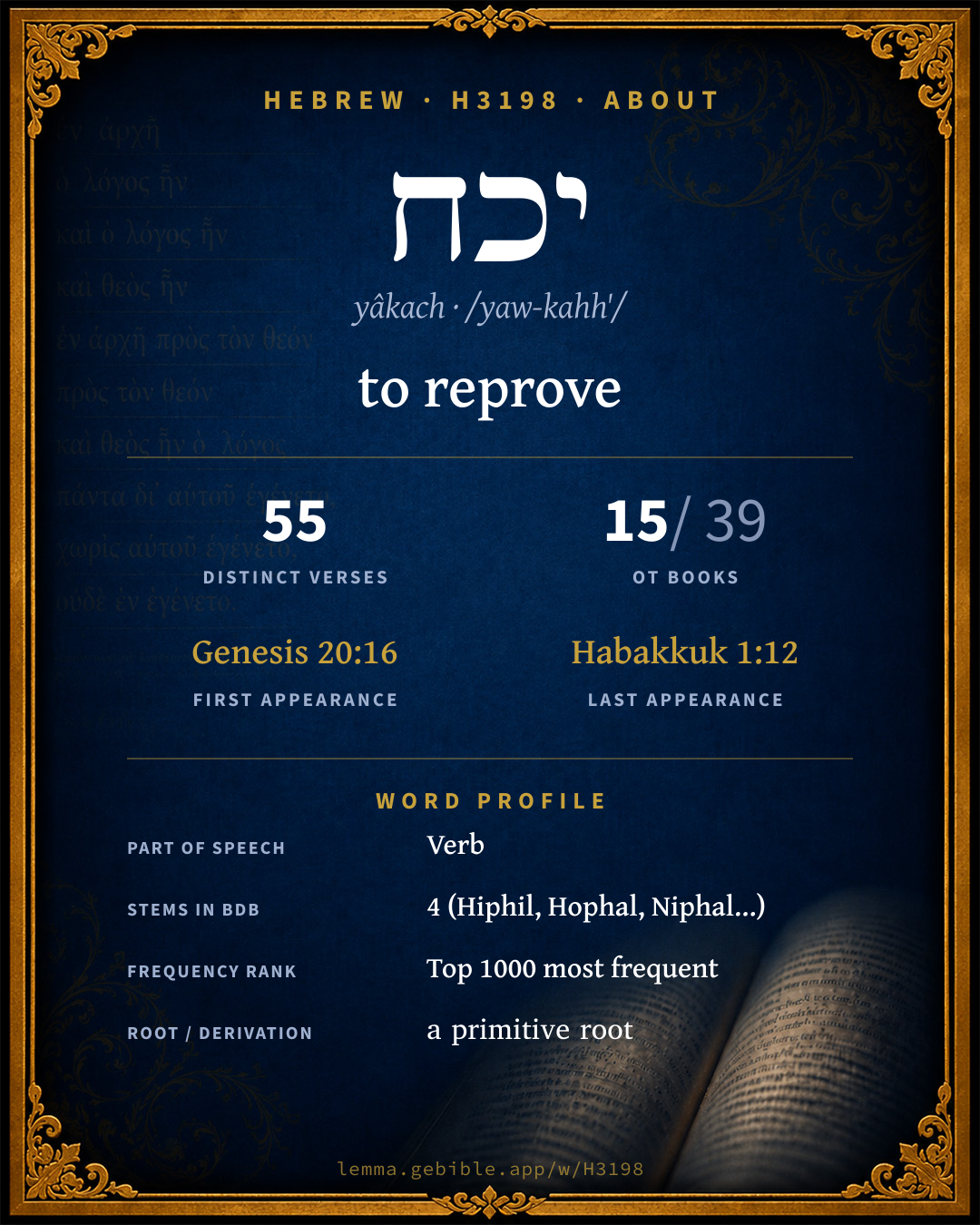
יָכַח
to reprove
‘to reprove’ is one of 4 main senses fuller range ↓
Full lexicon entry — Brown-Driver-Briggs (BDB)
From Brown-Driver-Briggs (BDB)
Where this word appears
See every Hiphil verb in the Hebrew Bible →
Grammar key — what these labels mean
Part of speech
- Verb
- An action or state-of-being word.
Stem
- Hiphil
- The causative active stem (“he caused / brought about”). Here: ‘decide’
- Hophal
- The passive counterpart of the Hiphil (“he was caused to…”).
- Niphal
- Usually the simple passive or reflexive of the Qal (“he was written”).
- Hithpael
- The reflexive or reciprocal stem (the subject acts on itself).
Form
- Participle Active
- A verbal adjective expressing ongoing or characteristic action (“writing / one who writes”).
- Imperfect
- An incomplete, ongoing, or future action (“he will / would write”).
- Sequential Perfect
- A perfect with prefixed waw continuing a preceding imperfect or command (waw-consecutive perfect).
- Infinitive Absolute
- An unbound verbal noun, often intensifying or standing in for a finite verb.
- Sequential Imperfect
- An imperfect with prefixed waw — the standard past-narrative form (waw-consecutive imperfect).
- Cohortative
- A first-person volitional form expressing wish or resolve (“let me / let us write”).
- Infinitive Construct
- A bound verbal noun, frequently with prepositions (“to write / in writing”).
- Jussive
- A third- or second-person volitional form expressing wish or command (“let him write”).
- Perfect
- A completed action or state — Hebrew marks aspect (completeness) more than strict tense (“he wrote”).
- Imperative
- A direct command (“write!”).
State
- Absolute
- The independent form of a noun, not bound to a following word.
Person
- 3rd Person
- The one spoken about (“he / she / it / they”).
- 1st Person
- The speaker (“I / we”).
- 2nd Person
- The one addressed (“you”).
Gender
- Masculine
- Grammatically masculine.
- Common
- Either gender — not distinguished for this form.
- Feminine
- Grammatically feminine.
Number
- Singular
- One.
- Plural
- More than one (in Hebrew, generally three or more).
Grammatical forms 23 distinct
- Verb, Hiphil, Imperfect, 3rd Person, Masculine, Singular 11 times (19%)
- Verb, Hiphil, Participle Active, Masculine, Singular, Absolute 9 times (15%)
- Verb, Hiphil, Infinitive Absolute 6 times (10%)
- Verb, Hiphil, Sequential Perfect, 3rd Person, Masculine, Singular 5 times (8%)
- Verb, Hiphil, Sequential Imperfect, 3rd Person, Masculine, Singular 3 times (5%)
- Verb, Hiphil, Imperfect, 1st Person, Common, Singular 3 times (5%)
- Verb, Hiphil, Imperfect, 2nd Person, Masculine, Singular 3 times (5%)
- Verb, Hiphil, Infinitive Construct 3 times (5%)
+15 more forms (16 occurrences)
Parsed forms decoded from the imported morphology (morphhb / Westminster Leningrad Codex — WLC text public domain, morphhb tagging CC BY 4.0), counted across 59 parsed occurrences — not distinct verses.
Every verse where H3198 appears — 55 distinct verses across 15 books. Click any verse to open its interlinear word-by-word view. Verse text shown in the World English Bible for context — . Each verse’s Hebrew form is shown with its reference; the English is not keyword-highlighted, since the data carries no word-level English alignment. Use “Compare translations” on any verse to read it across multiple English versions. This concordance covers the Hebrew Bible; Septuagint (Greek Old Testament) occurrences are not indexed here.
Genesis 6 verses
- Genesis 20:16 וְ/נֹכָֽחַת conj + Niphal ptcp.act fs To Sarah he said, "Behold, I have given your brother a thousand pieces of silver. Behold, it is for you a covering of the eyes to all that are with you. In front of all you are vindicated."
- Genesis 21:25 וְ/הוֹכִ֥חַ conj + Hiphil pf 3ms Abraham complained to Abimelech because of a water well, which Abimelech's servants had violently taken away.
- Genesis 24:14 הֹכַ֨חְתָּ֙ Hiphil pf 2ms Let it happen, that the young lady to whom I will say, 'Please let down your pitcher, that I may drink.' She will say, 'Drink, and I will also give your camels a drink.' Let the same be she who you have appointed for your servant Isaac. Thereby will I know that you have shown kindness to my master."
- Genesis 24:44 הֹכִ֥יחַ Hiphil pf 3ms She will tell me, "Drink, and I will also draw for your camels." Let the same be the woman whom Yahweh has appointed for my master's son.'
- Genesis 31:37 וְ/יוֹכִ֖יחוּ conj + Hiphil juss 3mp Now that you have felt around in all my stuff, what have you found of all your household stuff? Set it here before my relatives and your relatives, that they may judge between us two.
- Genesis 31:42 וַ/יּ֥וֹכַח conj + Hiphil wimpf 3ms Unless the God of my father, the God of Abraham, and the fear of Isaac, had been with me, surely now you would have sent me away empty. God has seen my affliction and the labor of my hands, and rebuked you last night."
Leviticus 1 verse
2 Samuel 1 verse
2 Kings 1 verse
1 Chronicles 2 verses
- 1 Chronicles 12:17 וְ/יוֹכַֽח conj + Hiphil impf 3ms David went out to meet them, and answered them, If you be come peaceably to me to help me, my heart shall be knit to you; but if [you be come] to betray me to my adversaries, seeing there is no wrong in my hands, the God of our fathers look thereon, and rebuke it.
- 1 Chronicles 16:21 וַ/יּ֥וֹכַח conj + Hiphil wimpf 3ms He allowed no man to do them wrong; Yes, he reproved kings for their sakes,
Job 15 verses
- Job 5:17 יוֹכִחֶ֣/נּֽוּ Hiphil impf 3ms + sfx pers 3ms "Behold, happy is the man whom God corrects: Therefore do not despise the chastening of the Almighty.
- Job 6:25 יּוֹכִ֖יחַ הוֹכֵ֣חַ Hiphil impf 3ms Hiphil inf.abs How forcible are words of uprightness! But your reproof, what does it reprove?
- Job 6:26 הַ/לְ/הוֹכַ֣ח ptcl inter + prep + Hiphil inf.cs Do you intend to reprove words, Seeing that the speeches of one who is desperate are as wind?
- Job 9:33 מוֹכִ֑יחַ Hiphil ptcp.act ms There is no umpire between us, That might lay his hand on us both.
- Job 13:3 וְ/הוֹכֵ֖חַ conj + Hiphil inf.abs "Surely I would speak to the Almighty. I desire to reason with God.
- Job 13:10 הוֹכֵ֣חַ יוֹכִ֣יחַ Hiphil inf.abs Hiphil impf 3ms He will surely reprove you If you secretly show partiality.
- Job 13:15 אוֹכִֽיחַ Hiphil impf 1cs Behold, he will kill me; I have no hope. Nevertheless, I will maintain my ways before him.
- Job 15:3 הוֹכֵ֣חַ Hiphil inf.abs Should he reason with unprofitable talk, Or with speeches with which he can do no good?
- Job 16:21 וְ/יוֹכַ֣ח conj + Hiphil impf 3ms That he would maintain the right of a man with God, Of a son of man with his neighbor!
- Job 19:5 וְ/תוֹכִ֥יחוּ conj + Hiphil impf 2mp If indeed you will magnify yourselves against me, And plead against me my reproach;
- Job 22:4 יֹכִיחֶ֑/ךָ Hiphil impf 3ms + sfx pers 2ms Is it for your piety that he reproves you, That he enters with you into judgment?
- Job 23:7 נוֹכָ֣ח Niphal ptcp.act ms There the upright might reason with him, So I should be delivered forever from my judge.
- Job 32:12 מוֹכִ֑יחַ Hiphil ptcp.act ms Yes, I gave you my full attention, But there was no one who convinced Job, Or who answered his words, among you.
- Job 33:19 וְ/הוּכַ֣ח conj + Hophal wpf 3ms He is chastened also with pain on his bed, With continual strife in his bones;
- Job 40:2 מוֹכִ֖יחַ Hiphil ptcp.act ms "Shall he who argues contend with the Almighty? He who argues with God, let him answer it."
Psalms 7 verses
- Psalms 6:1 תוֹכִיחֵ֑/נִי Hiphil impf 2ms + sfx pers 1cs Yahweh, don't rebuke me in your anger, Neither discipline me in your wrath.
- Psalms 38:1 תוֹכִיחֵ֑/נִי Hiphil impf 2ms + sfx pers 1cs Yahweh, don't rebuke me in your wrath, Neither chasten me in your hot displeasure.
- Psalms 50:8 אוֹכִיחֶ֑/ךָ Hiphil impf 1cs + sfx pers 2ms I don't rebuke you for your sacrifices. Your burnt offerings are continually before me.
- Psalms 50:21 אוֹכִיחֲ/ךָ֖ Hiphil impf 1cs + sfx pers 2ms You have done these things, and I kept silent. You thought that the "I AM" was just like you. I will rebuke you, and accuse you in front of your eyes.
- Psalms 94:10 יוֹכִ֑יחַ Hiphil impf 3ms He who disciplines the nations, won't he punish? He who teaches man knows.
- Psalms 105:14 וַ/יּ֖וֹכַח conj + Hiphil wimpf 3ms He allowed no one to do them wrong. Yes, he reproved kings for their sakes,
- Psalms 141:5 וְֽ/יוֹכִיחֵ֗/נִי conj + Hiphil impf 3ms + sfx pers 1cs Let the righteous strike me, it is kindness; Let him reprove me, it is like oil on the head; Don't let my head refuse it; Yet my prayer is always against evil deeds.
Proverbs 9 verses
- Proverbs 3:12 יוֹכִ֑יחַ Hiphil impf 3ms For whom Yahweh loves, he reproves; Even as a father reproves the son in whom he delights.
- Proverbs 9:7 וּ/מוֹכִ֖יחַ conj + Hiphil ptcp.act ms He who corrects a mocker invites insult. He who reproves a wicked man invites abuse.
- Proverbs 9:8 תּ֣וֹכַח הוֹכַ֥ח Hiphil juss 2ms Hiphil impv 2ms Don't reprove a scoffer, lest he hate you. Reprove a wise man, and he will love you.
- Proverbs 15:12 הוֹכֵ֣חַֽ Hiphil inf.abs A scoffer doesn't love to be reproved; He will not go to the wise.
- Proverbs 19:25 וְ/הוֹכִ֥יחַ conj + Hiphil inf.cs Flog a scoffer, and the simple will learn prudence; Rebuke one who has understanding, and he will gain knowledge.
- Proverbs 24:25 וְ/לַ/מּוֹכִיחִ֥ים conj + prep det + Hiphil ptcp.act mp But it will go well with those who convict the guilty, And a rich blessing will come on them.
- Proverbs 25:12 מוֹכִ֥יחַ Hiphil ptcp.act ms As an ear-ring of gold, and an ornament of fine gold, So is a wise reprover to an obedient ear.
- Proverbs 28:23 מ֘וֹכִ֤יחַ Hiphil ptcp.act ms One who rebukes a man will afterward find more favor Than one who flatters with the tongue.
- Proverbs 30:6 יוֹכִ֖יחַ Hiphil impf 3ms Don't you add to his words, Lest he reprove you, and you be found a liar.
Isaiah 6 verses
- Isaiah 1:18 וְ/נִוָּֽכְחָ֖ה conj + Niphal coh 1cp "Come now, and let us reason together," says Yahweh: "Though your sins be as scarlet, they shall be as white as snow. Though they be red like crimson, they shall be as wool.
- Isaiah 2:4 וְ/הוֹכִ֖יחַ conj + Hiphil wpf 3ms He will judge between the nations, And will decide concerning many peoples; And they shall beat their swords into plowshares, And their spears into pruning-hooks. Nation shall not lift up sword against nation, Neither shall they learn war any more.
- Isaiah 11:3 יוֹכִֽיחַ Hiphil impf 3ms His delight shall be in the fear of Yahweh; and he shall not judge after the sight of his eyes, neither decide after the hearing of his ears;
- Isaiah 11:4 וְ/הוֹכִ֥יחַ conj + Hiphil wpf 3ms but with righteousness shall he judge the poor, and decide with equity for the humble of the earth; and he shall strike the earth with the rod of his mouth; and with the breath of his lips shall he kill the wicked.
- Isaiah 29:21 וְ/לַ/מּוֹכִ֥יחַ conj + prep det + Hiphil ptcp.act ms that make a man an offender in [his] cause, and lay a snare for him who reproves in the gate, and turn aside the just with a thing of nothing.
- Isaiah 37:4 וְ/הוֹכִ֨יחַ֙ conj + Hiphil wpf 3ms It may be Yahweh your God will hear the words of Rabshakeh, whom the king of Assyria his master has sent to defy the living God, and will rebuke the words which Yahweh your God has heard. Therefore lift up your prayer for the remnant that is left.
Jeremiah 1 verse
Ezekiel 1 verse
Hosea 1 verse
Amos 1 verse
Micah 2 verses
- Micah 4:3 וְ/הוֹכִ֛יחַ conj + Hiphil wpf 3ms And he will judge between many peoples, And will decide concerning strong nations afar off. They will beat their swords into plowshares, And their spears into pruning hooks. Nation will not lift up sword against nation, Neither will they learn war any more.
- Micah 6:2 יִתְוַכָּֽח Hithpael impf 3ms Hear, you mountains, Yahweh's controversy, And you enduring foundations of the earth; For Yahweh has a controversy with his people, And he will contend with Israel.
Habakkuk 1 verse
About this entry
At a glance — auto-summarized from this page’s data, not written by a person. Every figure links to its source below. This summary describes the numbers; it doesn’t interpret them.
“to reprove” is the headline sense of the Hebrew verb יכח (yâkach). Different stems carry different senses — BDB groups them under 4 stems, among them Hiphil and Hophal. It turns up in 55 verses across 15 books, a moderately common footprint. It concentrates in Job, which alone accounts for 27% of its uses. First canonically at Genesis 20:16, it enters the text early. See the sense tree, 55-verse concordance, and the renderings breakdown below.
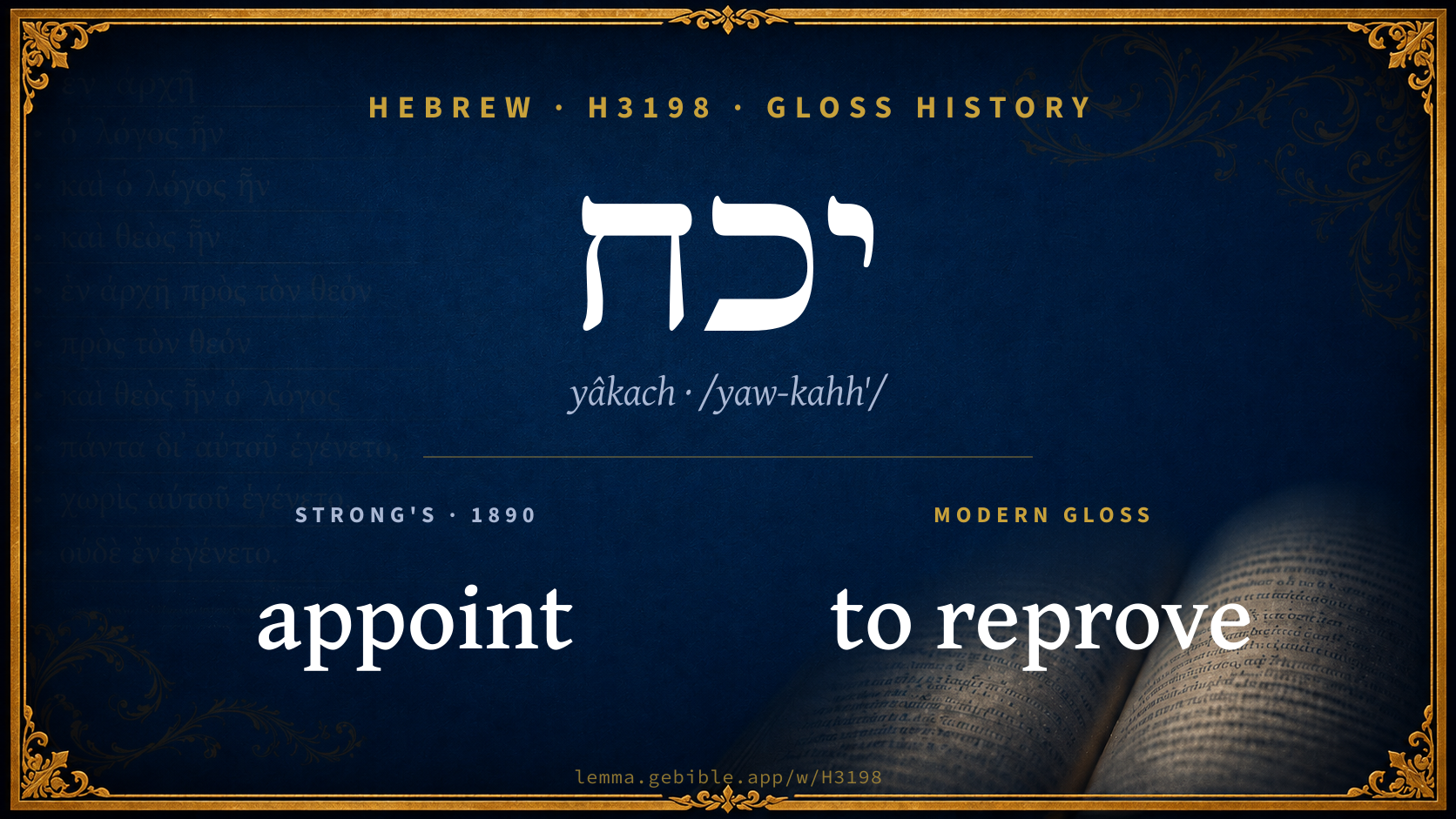
Gloss history
Strong's 1890 vs modern scholarship
About this word
Strong's H3198 catalogs a Hebrew word from the Hebrew Old Testament.
These counts are not copied from any lexicon or concordance. They are computed here, from the morphology-tagged Hebrew Old Testament. What Lemma adds →
- 55
- distinct verses
- The word appears in 55 distinct verses.
- 15 / 39
- OT books
- The word appears in 15 of 39 Old Testament books.
- #647
- by frequency
- Top 1000 most frequent Hebrew words (rank 647 of 8,640 Hebrew words by occurrence).
View all 55 occurrences in the concordance →
By section of the Old Testament
By traditional corpus
Conventional, traditional groupings — biblical authorship is debated, so this is a traditional corpus grouping, not an authorship claim. Each share is this word’s portion of its verses in that division of the Hebrew canon. Each figure is a share of the word’s 55 distinct verses.
- Writings (Ketuvim) 33 verses · 60%
- Prophets (Nevi'im) 15 verses · 27%
- Torah (Pentateuch) 7 verses · 13%
How translations render this word
Counts come from each version’s own published word-to-Strong’s tagging or interlinear alignment — an approximate guide to how each version renders this word, not a word-level alignment the data otherwise carries. Because each total is that version’s own tagged count, the per-version totals vary from one another and need not match the appearance or distinct-verse counts above. These counts may also differ from a printed concordance because Lemma counts each distinctly tagged rendering and does not collapse phrase taggings into a single head-word total. This is a fixed set of word-tagged versions (KJV, ASV, BSB, ULT) and does not change with the reading translation you choose elsewhere. Each version’s license is shown beside its name below (and on Sources).
- King James Version: Reprove 8×, Rebuke 5×, He that rebuketh 2×
- American Standard Version: Rebuke 4×, Reprove 4×, Decide 2×
- Berean Standard Bible: Rebuke 5×, Arbitrate 2×, He rebuked 2×
- unfoldingWord Literal Text: Rebuke 5×, Correct 2×, Correcting 2×
King James Version Public Domain
Renders H3198 across 58 tagged occurrences — most commonly:
Plus 39 renderings that appear only once — usually multi-word phrases or single function words the recovered tagging swept in, not distinct renderings. Not rendered by a distinct English word in 1 further occurrence.
American Standard Version Public Domain
Renders H3198 across 57 tagged occurrences — most commonly:
Plus 37 renderings that appear only once — usually multi-word phrases or single function words the recovered tagging swept in, not distinct renderings.
Berean Standard Bible Public Domain
Renders H3198 across 56 tagged occurrences — most commonly:
Plus 39 renderings that appear only once — usually multi-word phrases or single function words the recovered tagging swept in, not distinct renderings. Not rendered by a distinct English word in 3 further occurrences.
unfoldingWord Literal Text CC BY-SA 4.0
Renders H3198 across 71 tagged occurrences — most commonly:
Plus 44 renderings that appear only once — usually multi-word phrases or single function words the recovered tagging swept in, not distinct renderings.
9 senses and sub-senses in the full BDB
Hebrew verbs can shift meaning by stem (binyan): Qal is the basic action, Niphal is often passive or reflexive, Piel often intensifies or makes it factitive, and Hiphil is typically causative. The senses below are grouped under the stem BDB assigns to each. This entry also uses Hophal (the passive of Hiphil) and Hithpael (reflexive or reciprocal).
What do BDB’s symbols mean?
BDB uses these scholarly abbreviations:
| Symbol | Meaning |
|---|---|
| 𝔊 | the Septuagint (the ancient Greek translation, LXX) |
| 𝔙 | the Vulgate (the Latin translation) |
| 𝔖 | the Syriac version (the Peshitta) |
| 𝔗 | the Targum (the Aramaic translation) |
| ψ | the Psalms |
| √ | root (the underlying root or stem) |
| ‖ | parallel passage (a synonymous or contrasted parallel) |
| † | the dagger: every passage where the word occurs is cited |
The 9 senses and sub-senses the full Brown-Driver-Briggs lexicon distinguishes for this word, in lexicon order (not ranked by frequency), with BDB’s own verbatim wording and sub-sense lettering. Shown in Hebrew script with BDB’s own scholarly abbreviations. The condensed entry is in the Lexicon Entry tab. See also the Forms in the corpus table below.
Hiphil
- 1. decide, judge
- 2. adjudge, appoint
- 3. shew to be right, prove
- 4. convince, convict
- 5. reprove, chide
- 6. correct, rebuke
Hophal
- . he is chastened also with pain
Niphal
- . come now and let us reason together; there an upright man might reason with him; and thou art set right, righted, justified
Hithpael
- . with Israel he will argue
Senses from the full Brown-Driver-Briggs lexicon (Brown, Driver, Briggs; Oxford 1906 — public domain), digitized via Sefaria, supplemented by the OpenScriptures HebrewLexicon (CC BY 4.0). Full attribution on Sources.
Word origin
[ יָכַח ] vb. Hiph. decide, adjudge, prove
— Brown-Driver-Briggs (Oxford 1906, public domain), digitized via Sefaria, supplemented by the OpenScriptures HebrewLexicon (CC BY 4.0). See Sources.
Origin: a primitive root
Jastrow Dictionary
A second Hebrew/Aramaic lexicon for comparison, covering Aramaic and post-biblical (Talmudic, Targumic, Midrashic) usage that the biblical-Hebrew BDB does not. Matched by lemma rather than by Strong’s number, so a lemma may carry more than one Jastrow headword (shown separately below), and the entries cover usage well beyond the Bible.
יָכַח
- v. כֹּחַ) to be firm, stand, be right.—Denom. נֹכַח.
- [to place opposite,]
- 1. to admonish, reprove. Ber. 31ᵃ sq. (ref. to I Sam. I, 14) מכאן … שצריך להוֹכִיחוֹ from here we learn that he who sees in his neighbor something unbecoming, is bound to admonish him; Arakh. 16ᵇ. Ib. הוֹכִיחוֹ … ויוֹכִיהֶנּוּ if he did admonish him and he did not heed it, he must do it again. Ib. … תמיהני שיודע להוכיח I wonder whether there is in this generation one who knows how to admonish; a. fr. e.g. 1 Samuel 1:14
- 2. to prove, to serve as an analogy. B. Kam. 6ᵃ אש תּוֹכִיחַ let the law concerning incendiary (Ex. XXII, 5) be taken as a standard (it being the result of human action); בור תוכיח let the law about a pit (ib. XXI, 33) decide (it being stationary). Kidd. 7ᵃ; a. v. fr.— to be evidence, to show. M. Kat. 4ᵇ זיבלו מוֹכִיחַ עליו his dung shows what he is about doing; a. fr. e.g. Exodus 22:5
- , Nithpa. נִתְוַוכֵּחַ to argue, be justified. Lev. R. s. 27 בא הקב"ה לה׳ וכ׳ the Lord came to argue with Israel; ib. כלום אינון יכולין לה׳ עם בוראן can they argue (successfully) with their Creator?; Num. R. s. 10, beg.; a. fr.
- same. Cant. R. to V, 16 מי יוכל לִיוָּכֵחַ וכ׳ (not לוו׳) who dares to argue with &c.
A Dictionary of the Targumim, the Talmud Babli and Yerushalmi, and the Midrashic Literature (Marcus Jastrow; London, Luzac, 1903) — Public Domain. Digitized via Sefaria. Digitized via Sefaria. Full attribution on Sources.
Forms in the corpus
The 49 distinct written forms H3198 takes in the Hebrew Bible, most frequent first — each parse links to that stem’s occurrences in the concordance. Hebrew forms include their vowel points and cantillation, so a single lemma takes many written forms.
Same root — word family
Other BDB entries built from the same root as H3198, grouped by Strong’s listed origin. These share a root / origin per the lexicon — not necessarily a shared meaning. Each links to that word’s own entry.
Derived from this word
Compare all same-root words → They share a root, not necessarily a meaning.
Septuagint verse parallels
This word appears in 55 verses that also exist in the Greek Old Testament (Septuagint), out of the 55 Hebrew verses it occurs in. You can read those verses in Greek by switching the Old Testament edition to the Septuagint.
Read these verses in the Septuagint
- Genesis 20:16
- Leviticus 19:17
- 2 Samuel 7:14
- 2 Kings 19:4
- 1 Chronicles 12:17
- Job 5:17
- Psalms 6:1
- Proverbs 3:12
- Isaiah 1:18
- Jeremiah 2:19
- Ezekiel 3:26
- Hosea 4:4
This is a verse-level parallel only — the same verses exist in both the Hebrew and Greek Old Testaments. No word-level Hebrew↔Greek correspondence is claimed: the data carries no such alignment, so no Greek word is shown as this Hebrew word’s translation. Coverage is not total — the Septuagint omits the deuterocanon and renumbers the Psalms, so some Hebrew verses have no direct Greek parallel.