
Micah 6:2

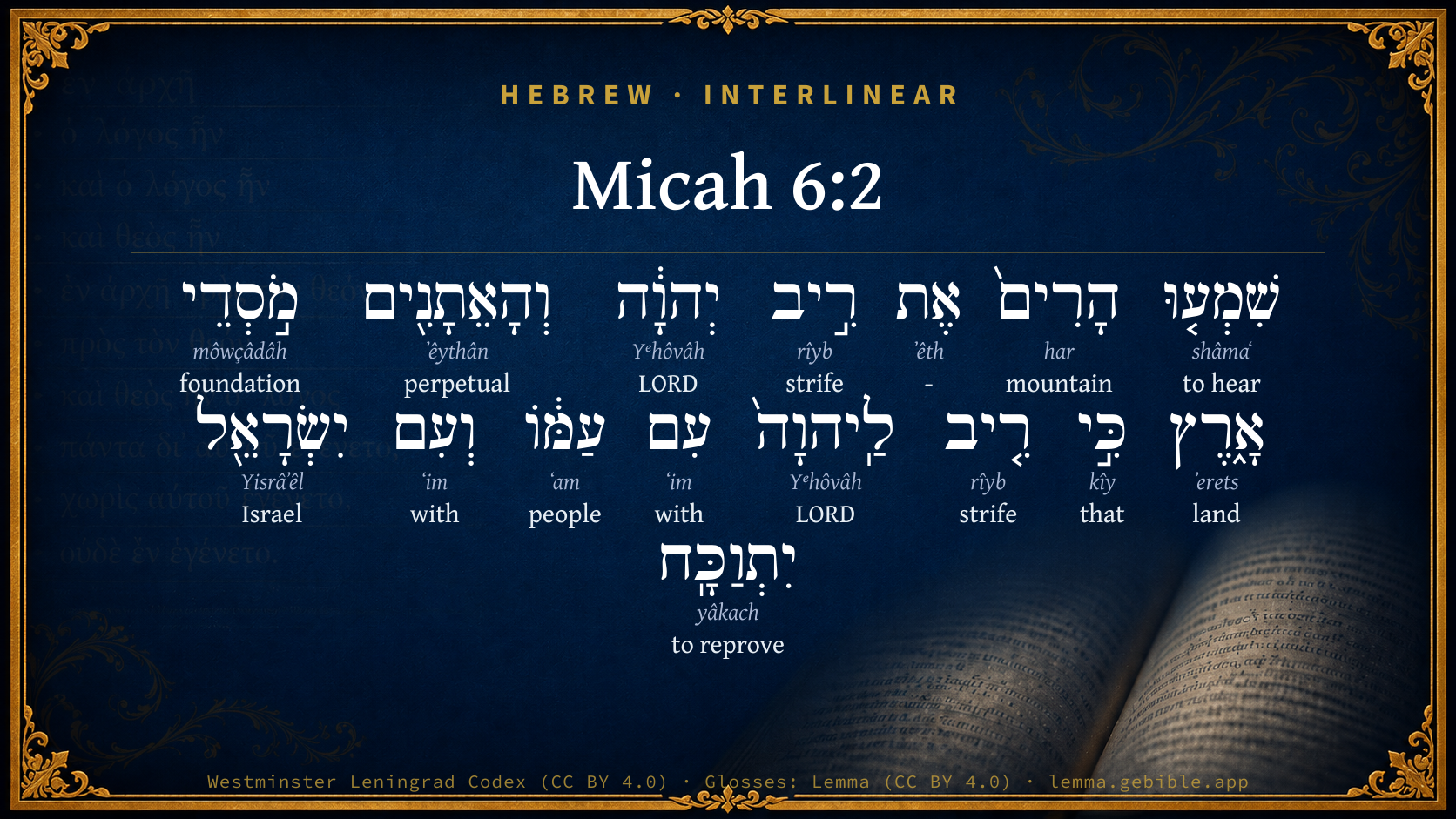
Hebrew (Westminster Leningrad Codex) Micah 6:2 appears in the Hebrew Old Testament. The text above is from the Westminster Leningrad Codex. Each word links to its Strong’s number, a concise gloss, and parsing drawn from the Open Scriptures Hebrew Bible morphology. Click any word for its full Brown-Driver-Briggs (BDB) entry.
Download image
Cite this verse

Micah 6:2 (World English Bible). Public Domain. Lemma interlinear Bible study tool, https://lemma.gebible.app/v/micah/6/2.

Show BibTeX & RIS
BibTeX
RIS
English Translation
Hear, you mountains, Yahweh's controversy, And you enduring foundations of the earth; For Yahweh has a controversy with his people, And he will contend with Israel.
World English Bible · Public Domain
Download a study sheet

One document with this verse’s original text, its word-by-word gloss line, the meaning frame, cross-references with their text, attributed commentary, and full source and license credits — printable, and it pastes into notes with its structure intact.

This verse Autodidact and up

Study sheet (.html) Plain text (.txt)

A passage Seminary Student

Up to 50 verses in one chapter. A passage sheet keeps up to 6 commentary sources and 12 cross-references per verse, in the order this page ranks them, and says so on the sheet whenever that leaves anything out. Ask for a single verse and you get the Autodidact verse sheet above.

Everything on this page stays free to read, with no account — the sheet is a download of what is already on screen, not access to it.

Want to remove ads? Support Godless Engineer
Compare translations 3

The same verse in 3 English versions, stacked beneath the original-language interlinear above. Click any original word for its lexicon entry.

Each is an independent rendering of the whole verse — the interlinear is not word-aligned to these translations.

Highlighted words mark where these versions differ — a whole-verse word diff, not a word-by-word alignment.

  • World English Bible Public Domain
    Hear, you mountains, Yahweh's controversy, And you enduring foundations of the earth; For Yahweh has a controversy with his people, And he will contend with Israel.
  • King James Version Public Domain
    Hear ye, O mountains, the LORD's controversy, and ye strong foundations of the earth: for the LORD hath a controversy with his people, and he will plead with Israel.
  • unfoldingWord Literal Text CC BY-SA 4.0
    Hear the dispute of Yahweh, you mountains, and you enduring foundations of the earth, for Yahweh has a dispute with his people, and with Israel he will argue.

unfoldingWord Literal Text — © unfoldingWord, licensed CC BY-SA 4.0. Word-aligned USFM3 via Door43 (git.door43.org/unfoldingWord/en_ult).

Versions to compare (up to 4)

3 of 4 selected

Show all 18 translations

Every available English version of this verse, each an independent rendering of the whole verse.

  • World English Bible Public Domain
    Hear, you mountains, Yahweh's controversy, And you enduring foundations of the earth; For Yahweh has a controversy with his people, And he will contend with Israel.
  • Berean Standard Bible Public Domain
    Hear, O mountains, the LORD’s indictment, you enduring foundations of the earth. For the LORD has a case against His people, and He will argue it against Israel:
  • Majority Standard Bible Public Domain
    Hear, O mountains, the LORD’s indictment, you enduring foundations of the earth. For the LORD has a case against His people, and He will argue it against Israel:
  • King James Version Public Domain
    Hear ye, O mountains, the LORD's controversy, and ye strong foundations of the earth: for the LORD hath a controversy with his people, and he will plead with Israel.
  • American Standard Version (1901) Public Domain
    Hear, O ye mountains, Jehovah's controversy, and ye enduring foundations of the earth; for Jehovah hath a controversy with his people, and he will contend with Israel.
  • Revised Version (1885) Public Domain
    Hear, O ye mountains, the LORD’S controversy, and ye enduring foundations of the earth: for the LORD hath a controversy with his people, and he will plead with Israel.
  • Geneva Bible (1599) Public Domain
    Heare ye, O mountaynes, the Lordes quarel, and ye mightie foundations of the earth: for the Lord hath a quarell against his people, and he will pleade with Israel.
  • Douay-Rheims (1899) Public Domain
    Let the mountains hear the judgment of the Lord, and the strong foundations of the earth: for the Lord will enter into judgment with his people, and he will plead against Israel.
  • Young's Literal Translation Public Domain
    Hear, O mountains, the strife of Jehovah, Ye strong ones -- foundations of earth! For a strife `is' to Jehovah, with His people, And with Israel He doth reason.
  • Literal Standard Version CC BY-SA 4.0
    Hear, O mountains, the strife of YHWH, || You strong ones—foundations of earth! For a strife [is] to YHWH, with His people, || And with Israel He reasons.
  • Unlocked Literal Bible CC BY-SA 4.0
    Listen to Yahweh's lawsuit, you mountains, and you enduring foundations of the earth. For Yahweh has a lawsuit with his people, and he will fight in court against Israel.”
  • unfoldingWord Literal Text CC BY-SA 4.0
    Hear the dispute of Yahweh, you mountains, and you enduring foundations of the earth, for Yahweh has a dispute with his people, and with Israel he will argue.
  • Darby Bible Public Domain
    Hear, ye mountains, Jehovah's controversy, and ye, unchanging foundations of the earth; for Jehovah hath a controversy with his people, and he will plead with Israel.
  • World Messianic Bible Public Domain
    Hear, you mountains, the LORD’s indictment, and you enduring foundations of the earth; for the LORD has a case against his people, and he will contend with Israel.
  • Webster's Bible Public Domain
    Hear ye, O mountains, the LORD'S controversy, and ye strong foundations of the earth: for the LORD hath a controversy with his people, and he will plead with Israel.
  • Free Bible Version CC BY-SA 4.0
    And now, mountains, hear the Lord's argument. Listen, everlasting foundations of the earth, for the Lord has a case against his people. He will bring charges against Israel.
  • Bible in Basic English Public Domain
    Give ear, O you mountains, to the Lord's cause, and take note, you bases of the earth: for the Lord has a cause against his people, and he will take it up with Israel.
  • JPS Tanakh (1917) Public Domain
    Hear, O ye mountains, the LORD'S controversy, and ye enduring rocks, the foundations of the earth; for the LORD hath a controversy with His people, and He will plead with Israel.

Literal Standard Version (2020), Covenant Press — licensed CC BY-SA 4.0. Text via the HelloAO Bible API (eBible.org). Unlocked Literal Bible (unfoldingWord) — licensed CC BY-SA 4.0. Text via the HelloAO Bible API (eBible.org). unfoldingWord Literal Text — © unfoldingWord, licensed CC BY-SA 4.0. Word-aligned USFM3 via Door43 (git.door43.org/unfoldingWord/en_ult). Free Bible Version, Dr. Jonathan Gallagher — licensed CC BY-SA 4.0. Text via the HelloAO Bible API (eBible.org).

Word by word

More ways to search: Search by grammar → Find every occurrence → Compare this word →

Practice this passage: Drill this verse → Learn its vocabulary →

מֹ֣סְדֵי
môwçâdâh
H4146
“foundations of”
Noun, Common, Both, Plural, Construct
Part of Speech
Noun
Type
Common
Gender
Both
Number
Plural
State
Construct
Full BDB Definition

Origin: from H4144

TWOT: 875f

foundation
  1. שִׁמְע֤וּ shâmaʻ H8085 “hear” Verb, Qal, Imperative, 2nd Person, Masculine, Plural
  2. הָרִים֙ har H2022 “mountains” Noun, Common, Masculine, Plural, Absolute
  3. אֶת ʼêth H853 “-” Particle, Direct Object
  4. רִ֣יב rîyb H7379 “strife of” Noun, Common, Both, Singular, Construct
  5. יְהוָ֔ה Yᵉhôvâh H3068 “LORD” Noun, Proper
  6. וְהָאֵתָנִ֖ים ʼêythân H386 “and · the · perpetual” Conjunction + Particle, Definite Article + Adjective, Adjective, Masculine, Plural, Absolute
  7. אָ֑רֶץ ʼerets H776 “land” Noun, Common, Both, Singular, Absolute
  8. כִּ֣י kîy H3588 “that” Conjunction
  9. רִ֤יב rîyb H7379 “strife” Noun, Common, Both, Singular, Absolute
  10. לַֽיהוָה֙ Yᵉhôvâh H3068 “to/for · LORD” Preposition + Noun, Proper
  11. עִם ʻim H5973 “with” Preposition
  12. עַמּ֔וֹ ʻam H5971 “people · his” Noun, Common, Masculine, Singular, Construct + Suffix, Personal, 3rd Person, Masculine, Singular
  13. וְעִם ʻim H5973 “and · with” Conjunction + Preposition
  14. יִשְׂרָאֵ֖ל Yisrâʼêl H3478 “Israel” Noun, Proper
  15. יִתְוַכָּֽח yâkach H3198 “to reprove” Verb, Hithpael, Imperfect, 3rd Person, Masculine, Singular

About this verse

These counts appear in no published source. They are computed here, from the morphology-tagged text and Lemma’s own curated glosses. What Lemma adds →

16
words
13
distinct lemmas
Prophets
section

Notable vocabulary

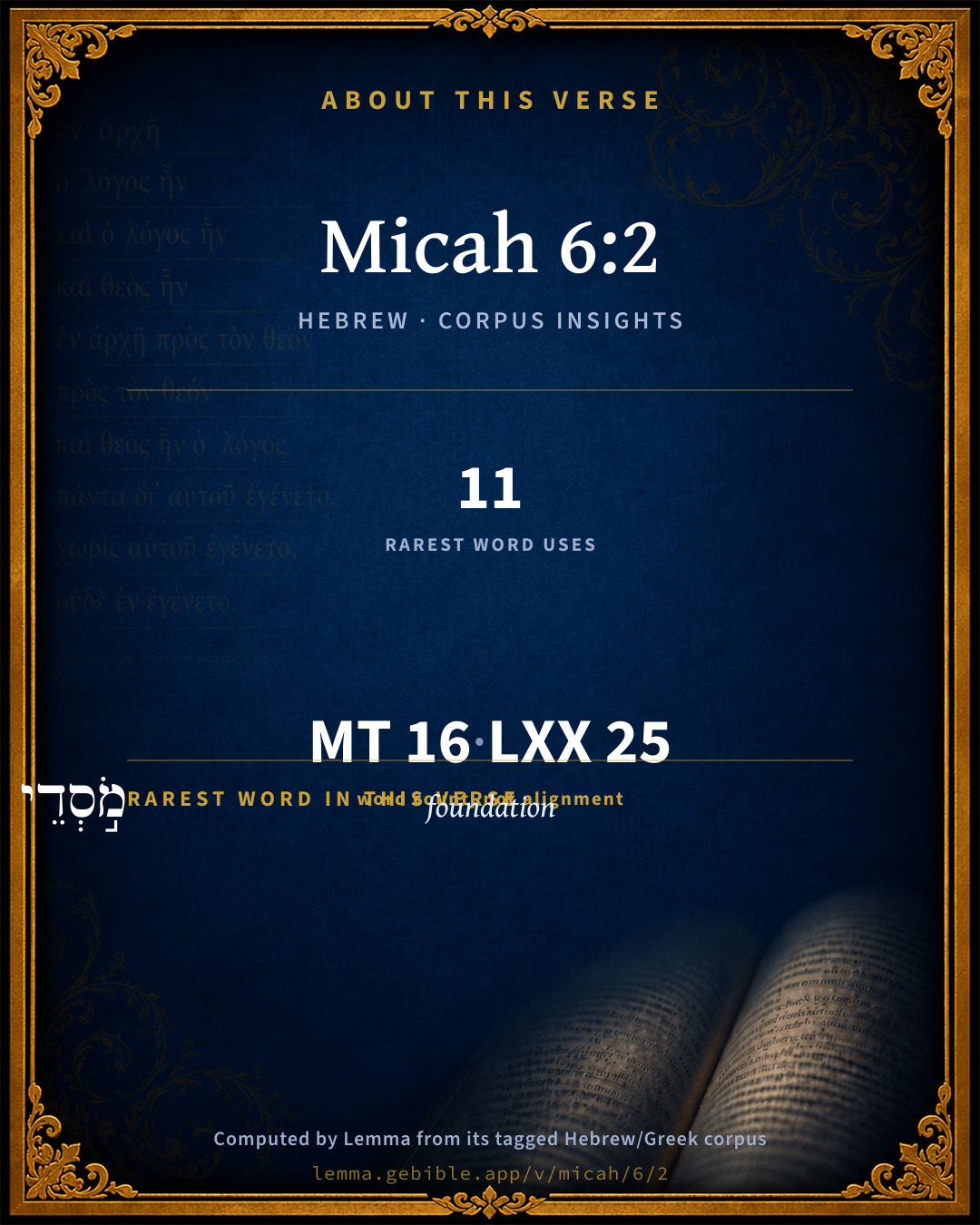
The rarest word here is מֹ֣סְדֵי foundation H4146 — appearing just 11 times in the whole Hebrew Bible.

Shared distinctive vocabulary

מֹ֣סְדֵי foundation H4146 occurs in 11 verses of the Hebrew Bible. Also found in:

Grammatical profile

  • 2 verbs
  • 9 nouns
  • 1 adjective
  • 2 prepositions
  • 1 conjunction
  • 1 particle

Verb forms

  • שִׁמְע֤וּ Qal · Imperative
  • יִתְוַכָּֽח Hithpael · Imperfect

Repetition

Words recur within this verse — often emphatic in Hebrew:

  • רִ֣יב strife H7379 ×2
  • יְהוָ֔ה LORD H3068 ×2
  • עִם with H5973 ×2

Hebrew & Septuagint length

In English translation the verse runs 26 words from the Hebrew and 32 from the Septuagint (LXX English) — closely comparable.

A rough comparison of the two English renderings, which tokenize alike — not a word-level alignment.

Word counts can differ between the Hebrew and the Greek without any difference in meaning — e.g. the Hebrew direct-object marker אֵת has no separate Greek word, and Greek often adds the article ὁ.

In the original languages it is 16 Hebrew tokens and 25 Greek tokens — but the two are counted differently (Hebrew bundles its prefixes and suffixes into one token; the Greek is in lemma form), so that isn’t a like-for-like length.

Cross-references

15

Topical passages linked to Micah 6:2 in the Treasury of Scripture Knowledge — connected by theme and wording, ordered by reader-vote popularity; previews shown in the World English Bible.

  • Hosea 4:1 Hear the word of Yahweh, you children of Israel; For Yahweh has a charge against the inhabitants of the land: "Indeed there is no truth, Nor goodness, Nor knowledge of God in the land.
  • Hosea 12:2 Yahweh also has a controversy with Judah, And will punish Jacob according to his ways; According to his deeds he will repay him.
  • Isaiah 1:18 "Come now, and let us reason together," says Yahweh: "Though your sins be as scarlet, they shall be as white as snow. Though they be red like crimson, they shall be as wool.
  • Deuteronomy 32:22 For a fire is kindled in my anger, Burns to the lowest Sheol, Devours the earth with its increase, Sets on fire the foundations of the mountains.
  • 2 Samuel 22:16 Then the channels of the sea appeared, The foundations of the world were laid bare, By the rebuke of Yahweh, At the blast of the breath of his nostrils.
  • Psalms 104:5 He laid the foundations of the earth, That it should not be moved forever.
  • Proverbs 8:29 When he gave to the sea its boundary, That the waters should not violate his commandment, When he marked out the foundations of the earth;
  • 2 Samuel 22:8 Then the earth shook and trembled, The foundations of heaven quaked Were shaken, because he was angry.
  • Isaiah 5:3 "Now, inhabitants of Jerusalem and men of Judah, Please judge between me and my vineyard.
  • Jeremiah 2:9 Therefore I will yet contend with you, says Yahweh, and with your children's children will I contend.
  • Jeremiah 2:29–35 Why will you contend with me? you all have transgressed against me, says Yahweh.
  • Jeremiah 25:31 A noise shall come even to the end of the earth; for Yahweh has a controversy with the nations; he will enter into judgment with all flesh: as for the wicked, he will give them to the sword, says Yahweh.
  • Jeremiah 31:37 Thus says Yahweh: If heaven above can be measured, and the foundations of the earth searched out beneath, then will I also cast off all the seed of Israel for all that they have done, says Yahweh.
  • Ezekiel 20:35–36 and I will bring you into the wilderness of the peoples, and there will I enter into judgment with you face to face.
  • Isaiah 43:26 Put me in remembrance; let us plead together: set you forth [your cause], that you may be justified.

Cross-references courtesy of OpenBible.info (CC BY 4.0).

Hebrew and Greek witnesses Masoretic Hebrew ↔ Greek Septuagint

The same verse in the two great witnesses to the Old Testament, shown verse-for-verse.

These are two independent witnesses, not word-aligned to each other, and the Septuagint is shown in lemma (dictionary) form.

Hebrew Micah 6:2 Masoretic · Westminster Leningrad Codex

שִׁמְע֤וּ הָרִים֙ אֶת רִ֣יב יְהוָ֔ה וְהָאֵתָנִ֖ים מֹ֣סְדֵי אָ֑רֶץ כִּ֣י רִ֤יב לַֽיהוָה֙ עִם עַמּ֔וֹ וְעִם יִשְׂרָאֵ֖ל יִתְוַכָּֽח

Hear, you mountains, Yahweh's controversy, And you enduring foundations of the earth; For Yahweh has a controversy with his people, And he will contend with Israel.

World English Bible · Public Domain

Greek LXX Micah 6:2 Septuagint · lemma form

ἀκούω βουνός ὁ κρίσις ὁ κύριος καί ὁ φάραγξ θεμέλιον ὁ γῆ ὅτι κρίσις ὁ κύριος πρός ὁ λαός αὐτός καί μετά ὁ ἰσραήλ διαἐλέγχω

Hear you⌃, O mountains, the controversy of the Lord, and you⌃ valleys even the foundations of the earth: for the Lord has a controversy with his people, and will plead with Israel.

LXX2012 (modern English Septuagint) · Public Domain

On this verse, Whedon's Commentary on the Bible discusses the Septuagint’s reading. Read the note in Commentary ↓

Hebrew: Westminster Leningrad Codex (CC BY 4.0). Greek: Septuagint (public domain); English from LXX2012 (modern English Septuagint) (Public Domain). How the Septuagint differs from the Hebrew →

Targum (Aramaic paraphrase)

1

The Targum is the ancient Jewish Aramaic paraphrase of the Hebrew Scriptures — an interpretive translation, not the Hebrew text itself. Onkelos (literal) and Pseudo-Jonathan (expansive) render the Torah, and Jonathan the Prophets. Coverage is partial: where no permissively-licensed English translation exists for a verse, only the Aramaic is shown. This is verse-level text, not a word-by-word alignment to the Hebrew.

  1. Targum Jonathan Prophets (Joshua–Malachi)
    שְׁמָעוּ טוּרַיָא יַת דִינַיָא דַייָ וְעִקְרַיָא מִיסוֹדֵי אַרְעָא אֲרֵי דִינָא קֳדָם יְיָ עִם עַמֵיהּ וְעִם יִשְׂרָאֵל עָבִיד תּוֹכֵחָה:

    (no public-domain English translation for this verse)

    Targum Jonathan — Aramaic: “Mikraot Gedolot” (public domain). English: “Sefaria Community Translation” (CC0 1.0 (public-domain dedication)); “London "Chaldee Paraphrase," 1871” (public domain). Text via Sefaria.

Commentary

Notes on Micah 6:2 from classic Christian and Jewish commentators (each source and its license shown beneath its notes). The classic Christian expositions comment on the surrounding passage and are grouped to its opening verse, so a note may address several verses; the Jewish commentaries on the Tanakh (Rashi and others) are per-verse, so they appear only where the commentator wrote on this verse.

Lemma curates 59 commentaries, every one of them public domain or Creative Commons licensed, each selected and text-cleaned for this edition rather than reprinted as found. About our sources →

Trapp's Complete Commentary

John Trapp

Mic 6:2 Hear ye, O mountains, the LORD’S controversy, and ye strong foundations of the earth: for the LORD hath a controversy with his people, and he will plead with Israel.

Ver. 2. Hear ye, O mountains, the Lord’s controversy] Although the people would neither hear nor obey God, the prophet doth; and, according to command, he summoneth the mountains to hear and testify; the Lord seeming to say unto him, as once he did to Ezekiel, "But thou, son of man, be not thou rebellious like that rebellious house; but hear what I say unto thee, and do it." It might seem to him a senseless thing to cite the mountains. But he knew that if God command a thing, to argue or debate upon it were bold presumption, to search the reason of it proud curiosity, to detract or disobey it flat rebellion. To the mountains and foundations of the earth he applies himself; haply with like mind and in like manner as the host of Nola did to the churchyard, and there called at the graves of the dead, Oh, ye good men of Nola, come away; for the Roman censor calls for your appearance; for he knew not where to call for a good man alive.

And ye strong foundations of the earth] Those "roots of the mountains," Jon 2:7; yet not so strong but God can shake them, Job 9:5-6 Nah 1:5-6; and that by so weak a creature as air, gotten underground, and seeking a vent. He can lift them off their foundations, Deu 32:22, and carry them to another place to hear his controversy, as he did the hill in Herefordshire, A. D. 1571, and that other in the territories of Bern, that removing out of his place in an earthquake, covered a whole village, that had ninety families in it. {See Trapp on "Amo 1:1"}

For the Lord hath a controversy with his people] {See Trapp on "Hos 4:1"} Learn to tremble before this great God, who "sitteth upon the circle of the earth, and the inhabitants thereof are as grasshoppers," Isa 40:22; which he can shake out of their place at pleasure, and send them packing to hell. O consider what a fearful thing it is to be at controversy with God, and to have him both our accuser, witness, and judge. O the terror of the Lord at that great and last day of the world! Utinam ubique de hoc iudicio differetur! "Then shall they begin to say to the mountains, Fall on us" (but they shall reply, We are witnesses against you for your detestable unthankfulness), "and to the hills, Cover us," Luk 23:30, but they shall echo out, Cover us; for who can dwell with this devouring fire? who can abide these everlasting burnings?

And he will plead with Israel] At which time they shall find that an empty title hath but an empty comfort; and that tribulation and anguish shall be on every soul of man that doeth evil: but of the Jew first, because of his privilege, and then of the Gentile, Rom 2:9. None so deep in utter darkness as those that once were angels of light. Let us all pray with holy David, "Enter not into judgment with thy servant, O Lord," Psa 143:2. And with Job, "If thou shouldest contend with me, I could not answer thee one of a thousand," Job 9:2-3. And with Daniel, "O Lord, righteousness belongs unto thee; but to us confusion of face, because we have sinned against thee," Dan 9:7-8.

John Trapp, A Commentary or Exposition upon All the Books of the Old and New Testament (1647–1656) — public domain. Text from a community e-Sword module.

Whedon's Commentary on the Bible

Daniel D. Whedon

2. Hear ye, O mountains — In Mic_6:2 the prophet turns to the mountains to tell them what is coming, in order that they may know what is expected of them.

Strong [“enduring”] foundations of the earth — Identical in meaning with “mountains” (compare Jon_2:6). They have endured for ages, and they have seen the manifestations of the divine mercy and of the people’s ingratitude; therefore they may be summoned as competent witnesses. Because the Hebrew construction is peculiar and the word translated “strong” is used elsewhere only of perennial streams, some scholars suspect a corruption of the text. A very simple change would give the verb form “give ear,” which would be a suitable parallel to “hear.” In favor of the emendation is the fact that the two verbs are found together very frequently. If the change is made the appeal reads, “Hear, O ye mountains… give ear, ye foundations of the earth” (compare Isa_1:2; Deu_32:1).

His people — The pronoun is significant in this connection, suggesting, on the one hand, the right of Jehovah to call to account (compare Isa_3:13-15); on the other, the special privileges enjoyed by Israel (Amo_3:12).

In Mic_6:3-5 Jehovah presents the indictment. Israel has proved ungrateful, though one look into the past should have been sufficient to awaken an appreciative response to the divine mercy. The fact of ingratitude is not definitely stated, but is clearly implied in the complaint of Jehovah. His plea is truly pathetic, “full of holy earnestness and of heart-touching tenderness.”

My people — In spite of their ingratitude he recognizes them as his own.

What have I done… wearied — Could they point to anything which God had done or left undone that could excuse their attitude toward him? He might have made them weary of serving him either by making excessive demands upon them (compare Mic_6:6-8; Isa_43:23) or by failing to keep the promises made to them (compare Jer_2:29). Jehovah knew that no fault could be found with him; for, far from making excessive demands, he had showered upon them blessings without number. Of these, Mic_6:4-5 enumerate three: the deliverance from Egypt, the guidance through the desert, the crossing of the Jordan in safety.

House of servants — R.V., “of bondage,” an expression frequently applied to Egypt (Exo_13:3; Exo_13:14; Deu_5:6; Jer_34:13).

I sent before thee — To be thy leaders (Psa_77:20).

Moses — The prophet with whom Jehovah spake face to face (Num_12:8).

Aaron — The spokesman of Moses, and thus also a mediator between Jehovah and the people (Exo_4:16).

Miriam — The sister of the two, and the leader of the triumphal dance after the crossing of the Red Sea (Exo_15:20). The mere mention of the names, undoubtedly familiar to all, would awaken memories of wonderful manifestations of Jehovah on behalf of his people (compare also Amo_2:9 ff.). The second illustration is the frustration of Balak’s plan to cut off Israel, which is recorded in Numbers 22-24; Jehovah turned curses into blessings.

From Shittim unto Gilgal — The grammatical connection of these words is somewhat obscure. However, R.V. is probably correct in rendering “remember from Shittim to Gilgal,” and the thought is, “remember everything that happened from the time you left Shittim, the last station of the Israelites east of the Jordan, until you reached Gilgal, the first stopping place in Canaan.” During this period the most important event was the crossing of the Jordan, which is probably in the mind of the prophet. There seems to be insufficient reason for rejecting the words as a later gloss, or for supposing that some words have dropped out.

That ye may know the righteousness [“righteous acts”] of Jehovah — They are to remember the events in their early history, for from them they may see that Jehovah has not been unfair but righteous, and that there is no cause for complaint; and this recognition should produce a grateful appreciation.

In Mic_6:6-7 the people are the speakers. They do not deny the truth of the accusation implied in Mic_6:3-5; apparently they are ready to admit their shortcomings, but in self-defense they plead ignorance of the real requirements of Jehovah. If they only knew, they would be willing to take upon themselves the severest tasks, in order to atone for their guilt and to appease the divine wrath.

Wherewith shall I come… bow myself — After listening to the severe arraignment they feel the need of prostrating themselves humbly before Jehovah, and of taking some steps to regain the divine favor. At a time when sacrifices played such an important part in the religious thinking of the people, it is only natural that they should think of these as the proper means by which to propitiate the offended deity.

Burnt offerings,… calves of a year old — The two expressions belong closely together, burnt offerings consisting of calves a year old. On burnt offerings see comments on Hos_6:6. Calves a year old were commonly used for sacrificial purposes (Lev_9:3), though younger calves might be used.

If the ordinary offerings are not sufficient they are ready to present extraordinary gifts.

Thousands of rams,… ten thousands of rivers of oil — The numbers are not to be understood literally; they signify great, unlimited numbers. “As sin assumes a thousand forms, far exceeding the limit of expiation by legal methods, the question arises, whether Jehovah’s favor can be gained by greatly multiplied sacrifices, by thousands of rams or myriads of streams of oil.” The ram was a common sacrificial animal. Oil, so far as we can learn from the description of the ritual in the Old Testament was not offered independently; but in connection with other offerings large quantities must have been consumed. It is possible that at an earlier period the use of oil played a more important part in the religious cult.

If this is insufficient they are ready to sacrifice their most precious possessions, even their own children.

Firstborn… fruit of my body — Human sacrifice was practiced among Israel’s neighbors (2Ki_3:27); the sacrifice of Isaac (Genesis 22) and that of Jephthah’s daughter (Jdg_11:34 ff.) may indicate that in the earliest times it was practiced even among the Hebrews without serious scruples, but at a later time the custom received the severest condemnation (2Ki_16:3; 2Ki_21:6; Jer_7:31; Eze_20:26). Human sacrifice was offered only as a last resort, when everything else seemed to fail; and this is the thought here: if everything else fails they are willing to offer their own children; surely, such sacrifice should move Jehovah to compassion.

Transgression,… sin — The two words, which are synonyms here, are used in the sense of “expiation of transgression,… of sin”; and the two questions which are identical in meaning, might be rendered, “Shall I give my firstborn as an expiation of my transgression, the fruit of my body as an expiation of the sin of my soul?”

Mic_6:8 has been called “the greatest verse in the Old Testament.” The questions in Mic_6:6-7 make it clear that the people did not understand the true character and requirements of Jehovah. They thought that the painstaking observance of the ceremonial and the perfunctory bringing of sacrifices constituted true religion. Their ignorance was, indeed, great, but it was inexcusable, for Jehovah had made known again and again what was acceptable in his sight (Amo_5:21 ff.; Isa_1:11-17; Hos_6:6).

He hath showed thee — Through Moses, the prophets, the Nazirites, and other teachers (Amo_2:11).

What is good — A holy and righteous God can take pleasure only in that which is good, and this he requires of them. The essential elements of goodness are pointed out in a few words.

Do justly — Live according to the principles of righteousness and equity (see on Amo_5:7). Love mercy [“kindness”] — Practice diligently the principles of kindness and brotherliness (see on Hos_2:19). This is a distinct advance over the preceding. Obedience to these two exhortations implies the keeping of the commandments in the second part of the Decalogue. The former of these is emphasized repeatedly by Amos (for example, Amo_5:24), the latter by Hosea (for example, Hos_6:6). But Israel was doing the very opposite; on every hand was to be seen cruelty, injustice, oppression (Mic_2:1-2; Mic_2:8; Mic_3:2-3; Mic_3:9, etc.). Micah emphasizes a third requirement, which is a correlative of the majesty and holiness of Jehovah taught by Isaiah, and the proper observance of which meets the requirements in the first part of the Decalogue:

Walk humbly with thy God — A humble walk with God is “a life of fellowship with God implying an identity of will and purpose, but fellowship conditioned by that spirit of humility which must ever govern the intercourse of weak and sinful man with a perfect and infinite God” (compare Deu_10:12-13).

In these few words is expressed more clearly than anywhere else in the eighth century prophecies the startling contrast between the popular religion and the religion of the prophets.

Mic_6:9-10

Indignant denunciation of prevalent crimes, Mic_6:9-16.

Mic_6:9 is the introduction, summoning the listeners to pay earnest heed to the words about to be uttered.

Jehovah’s voice — It is not a faultfinding prophet, but Jehovah himself, who brings the accusation.

The city — Jerusalem.

The man of wisdom shall see thy name — Literally, wisdom will see thy name. If translated thus the meaning is obscure. Keil and others take “thy name” as subject and “wisdom” as object, and render, “Thy name sees wisdom,” that is, has the true wisdom of life in view. On name see on Mic_5:4. Even if the meaning “have in view” could be established for the verb “see” by passages like Gen_20:10, and Psa_66:18, this translation would be improbable, since the thought expressed is foreign to the context. It is much better to follow the ancient versions and read “fear” (compare R.V. margin). The result is “wisdom fears thy name,” or, better, “let wisdom fear thy name,” or even, “it is wisdom to fear thy name.” Since the pronoun of the second person is peculiar in this connection, it may be best to follow LXX. also in reading “his name.” “When Jehovah’s voice sounds so threatening and his rod is already buzzing near it is prudent to fear his name and to hear what is said in his name.” Another meaning of the word translated “wisdom” is “safety,” but the thought is not affected if it is substituted for the former.

Hear ye the rod — The prophecy concerning the rod; the judgment about to fall.

Who hath appointed it — Hear the voice of Him who has ordained the judgment, Jehovah. 9b is altered by many commentators on the basis of LXX. so as to read, “Hear ye, O tribe and council of the city.”

The words of denunciation begin with Mic_6:10. The causes of the judgment are stated first. This is done in the form of questions, which are to arouse the attention and the consciences of the hearers. The sins condemned are the same as those named by the other eighth century prophets.

Treasures of wickedness — The exhortations and denunciations of the past have wrought no change for the better; the oppressors still continue their violence and robbery; they acquire treasures by wicked means, and thus they keep alive the wrath of Jehovah.

Scant measure — Literally, ephah of leanness. They cheat the buyer by using small measures (see on Amo_8:5; Hos_3:2; compare Deu_24:14-15).

Daniel D. Whedon (gen. ed.), Commentary on the Old and New Testaments (1874–1909) — public domain. Text from a community e-Sword module.

Jamieson, Fausset & Brown

Robert Jamieson, A. R. Fausset & David Brown

Lord's controversy--How great is Jehovah's condescension, who, though the supreme Lord of all, yet wishes to prove to worms of the earth the equity of His dealings (Isa 5:3; Isa 43:26).

Jamieson, Fausset & Brown — Commentary Critical and Explanatory on the Whole Bible (1871) — public domain (CC PDM 1.0). Text via the HelloAO Bible API.

Adam Clarke's Commentary

Verse 2. Hear ye, O mountains] Micah, as God's advocate, summons this people into judgment, and makes an appeal to inanimate creation against them. He had spoken to the priests, to the princes, to the people. He had done every thing that was necessary to make them wise, and holy, and happy; they had uniformly disobeyed, and were ever ungrateful. It was not consistent with either the justice or mercy of God to permit them to go on without reprehension and punishment. He now calls them into judgment; and such was the nature of their crimes that, to heighten the effect, and show what reason he had to punish such a people, he appeals to inanimate creation. Their ingratitude and rebellion are sufficient to make the mountains, the hills, and the strong foundations of the earth to hear, tremble, and give judgment against them. This, then, is the Lord's controversy with his people, and thus he will plead with Israel.

Adam Clarke's Commentary on the Bible (1810–1826) — public domain. Text from a community e-Sword/MySword module.

John Calvin's Commentaries

Hear, ye mountains, the controversy of Jehovah, how? and ye strong foundations of the earth, he says. He speaks here no more of hills, but summons the whole world; as though he said, “There is not one of the elements which is not to bear witness respecting the obstinacy of this people; for the voice of God will penetrate to the farthest roots of the earth, it will reach the lowest depths: these men will at the same time continue deaf.” And he says not, the Lord threatens you, or denounces judgment on you; but Jehovah has a contention with his people. We now then see that there is no metaphor in these words; but that the Prophet merely shows how monstrous was the stupor of the people, who profited nothing by the celestial doctrine delivered to them, so that the very mountains and the whole machinery of earth and heaven, though destitute of reason, had more understanding than these men. And it is not unusual with the Prophets, we know, to turn their discourse to mute elements, when there remains no hope of success from men. But our Prophet does not abruptly address mountains and hills as Isaiah does, (Isaiah 1:2,) and as also Moses had done,

‘Hear, ye heavens, what I shall say, let the earth hear the words of my mouth,’ (Deuteronomy 32:1,)

but he prefaces his discourse by saying, that it had been specially commanded to him to summon the mountains and hills to God’s judgment. By saying then, “Hear ye what Jehovah saith,” he prepares as I have said, the Jews to hear, that they might know that something uncommon and altogether unusual was to be announced, — that the Lord, in order more fully to convict them of extreme impiety, intended to plead his cause before the mountains.

Arise, then, and plead before the mountains, and let the hills hear thy voice. What sort of voice was this? They who think that the judges are here figuratively pointed out may be easily refuted; for Micah in the next verse mentions the substance of this pleading, namely that the Lord expostulated with his people. We hence see that God had no contention with the mountains, but that, on the contrary, the mountains were summoned, that they might understand God’s pleading, not against them, but against the people. Hear then, ye mountains, Jehovah’s controversy, and ye strong foundations of the earth, that is, the very rocks. There is nothing so hard in the world, he says, that shall not be inane to hear; for this pleading shall reach the lowest depths. Jehovah then has a controversy with his people, and he will plead, or contend, with Israel It follows —

John Calvin's Commentaries (1540-1563) — public domain. Text from the Calvin Translation Society English edition (1840s-50s) via the Christian Classics Ethereal Library (ccel.org). Calvin's coverage is partial (roughly two-thirds of the Bible); uncommented books and verses are honest gaps, never fabricated. The 19th-century editor's footnotes and remarks are omitted so the notes are faithfully Calvin's own voice.

The Cambridge Bible for Schools and Colleges

gen. ed. J. J. S. Perowne

2. ye strong foundations] ‘Strong’ should rather be enduring. The hills have outlived generation after generation of rebellious Israelites.

with his people] The phrase is very significant in this connexion; if anything could awaken Israel’s conscience, it would be the thought of the special mercies of which he had been the recipient.

The Cambridge Bible for Schools and Colleges (gen. ed. J. J. S. Perowne; Cambridge University Press, 1878–1918) — public domain. Text from a community e-Sword module.

John Gill's Exposition

Hear ye, O mountains, the Lord's controversy, and ye strong foundations of the earth,.... These are the words of the prophet, obeying the divine command, calling upon the mountains, which are the strong parts of the earth, and the bottoms of them the foundations of it, to hear the Lord's controversy with his people, and judge between them; or, as some think, these are the persons with whom, and against whom, the controversy was; the chief and principal men of the land, who were as pillars to the common people to support and uphold them:

for the Lord hath a controversy with his people, and he will plead with Israel; his people Israel, who were so by choice, by covenant, by their own avouchment and profession: they had been guilty of many sins and transgressions against both tables of the law; and now the Lord had a controversy with them for them, and was determined to enter into judgment, and litigate the point with them; and dreadful it is when God brings in a charge, and pleads his own cause with sinful men; they are not able to contend with him, nor answer him for one of a thousand faults committed against him; see Hos 4:1.

John Gill's Exposition of the Whole Bible (1746–1763) — public domain (CC PDM 1.0). Text via the HelloAO Bible API.

Albert Barnes' Notes on the Bible

Hear, ye strong (or, it may be, ye enduring,) foundations of the earth - Mountains and rocks carry the soul to times far away, before and after. They change net, like the habitable, cultivated, surface of the earth. There they were, before the existence of our short-lived generations; there they will be, until time shall cease to be. They have witnessed so many vicissitudes of human things, themselves unchanging. The prophet is directed to seize this feeling of simple nature. “They have seen so much before me,” Yes! “then they have seen all which befell my forefathers; all God’s benefits, all along, to them and to us, all their and our unthankfulness.”

He will plead with Israel - God hath a strict severe judgment with His people, and yet vouchsafes to clear Himself before His creatures, to come down from His throne of glory and place Himself on equal terms with them. He does not plead only, but mutually (such is the force of the word) impleads with His people, hears if they would say aught against Himself, and then gives His own judgment . But this willingness to hear, only makes us condemn ourselves, so that we should be without excuse before Him. We do owe ourselves wholly to Him who made us and hath given us all things richly to enjoy.

If we have withdrawn ourselves from His Service, unless He dealt hardly with us, we dealt rebelliously and ungratefully with Him. God brings all pleas into a narrow space. The fault is with Him or with us. He offers to clear Himself. He sets before us His good deeds, His Loving kindness, Providence, Grace, Long-suffering, Bounty, Truth, and contrasts with them our evil deeds, our unthankfulness, despitefulness, our breach of His laws, and disorderings of His creation. And then, in the face of His Goodness, He asks, “What evil have I done, what good have I left undone?” so that our evil and negligences should be but a requital of His. For if it is evil to return evil for evil, or not to return good for good, what evil is it to return evil for His exceeding good! As He says by Isaiah, “What could have been done more to My vineyard and I have not done in it. Wherefore, when I looked that it should bring forth grapes, brought it forth wild grapes?” Isa 5:4.

And our Blessed Lord asks; “Many good works have I shewed you from My Father. For which of those works do ye stone Me?” Joh 10:32. “Which of you convinceth Me of sin? And if I say the truth, why do ye not believe Me?” Joh 8:46. Away from the light of God, we may plead excuses, and cast the blame of our sins upon our temptations, or passions, or nature, that is, on Almighty God Himself, who made us. When His light streams in upon our conscience, we are silent. Blessed if we be silenced and confess to Him then, that we be not first silenced in the Day of Judgment Job 1:8; Job 2:3; Eze 14:20. Righteous Job said, “I desire to reason with God” Job 13:3; but when his eye saw Him, he said, “wherefore I abhor myself, and repent in dust and ashes” Job 42:5-6.

Albert Barnes' Notes on the Bible (1834–1885) — public domain. Text from a community e-Sword/MySword module.

Matthew Poole's English Annotations

Hear ye, O mountains: in the first verse God directs Micah to take the mountains and hills for witnesses; now in this verse he doth call upon those mountains to hear: it is a prosopoeia, an elegant personating of hearers and witnesses, as Deu 32:1; Isa 1:2; 2:2. Some by

mountains understand princes and nobles, and by

strong foundations of the earth inferior magistrates, as Psa 75:3; but it may as well, or better, be an appeal to these creatures in so just a cause for their Creator.

The Lord’s controversy, whose sovereign Majesty may well command what he pleaseth, and expect to be obeyed, and whose unparalleled goodness to Israel ought to have been uncontroverted motives to obey him in all things; yet the sovereign goodness is slighted and disobeyed; on which he now impleads his people, brings his action against them.

Ye strong foundations of the earth; called before hills: it is an explanation of the former, mountains; or it may be an appeal to those deep foundations which are hid from any eye, and which seem most remote from what is done on earth; but the ill carriage, the disobedience, and sin of Israel is so notorious, that the whole creation may be subpoenaed witnesses against them.

The Lord hath a controversy with his people; covenant, redeemed, and only people, as Amo 3:2.

He will plead with Israel; no longer put off the cause, nor forbear to punish them and right himself, he will bring the cause to hearing judgment, and execution too.

Matthew Poole's English Annotations on the Holy Bible (1683–1685) — public domain. Text from a community e-Sword/MySword module.

The Pulpit Commentary

Hear ye, O mountains. Insensate nature is called upon as a witness. (For similar appeals, comp. Deu_4:26 Deu_32:1 Isa_1:2 Jer_22:29) The Lord"s controversy. So God calls his pleading with his people to show them their sin and thankless unbelief; as he says in Isa_1:18, "Come, and let us reason together". (comp. Hos_4:1 Hos_12:2) Ye strong (enduring) foundations of the earth. The mountains are called everlasting, (Gen_49:26 Deu_33:15) as being firm, unchangeable, and as compared with man"s life and doings, which are but transitory. The LXX offers an interpretation as well as a translation, Ai faraggev yemelia thv ghv , "Ye valleys, the foundations of the earth." With his people. It is because Israel is God"s people that her sin is so heinous, and that God condescends to plead with her. He would thus touch her conscience by recalling his benefits. So in the following verses.

The Pulpit Commentary (1880–1919), ed. H.D.M. Spence-Jones & Joseph S. Exell — public domain. Text from a community e-Sword module.

John Wesley's Explanatory Notes

Foundations of the earth - The mountains properly so called; the sin of Israel is so notorious, that the whole creation may be summoned as a witness against them.

John Wesley, Explanatory Notes Upon the Whole Bible (1754–1765) — public domain. Text via the GEBible commentary corpus.

Lesson kit

Teaching starters — assembled from the data on this page, not authored interpretation. Every prompt links to the verse data it draws on. Edit before teaching.

Micah, in the Prophets, opens this verse with 16 words (13 distinct Hebrew lemmas). Its most distinctive word is môwçâdâh (“foundation”). A historical commentator’s framing appears above. Read the whole chapter for the surrounding context.

Discussion questions

  1. How does “foundation” (môwçâdâh) shape what this verse is saying?
  2. Deuteronomy 32:22 shares the word «foundation» with this verse. How do the two illuminate each other?
  3. “strife” occurs 2× in this one verse. What is the effect of the repetition?
  4. The translations on this page render this verse differently — a whole-verse word diff, not a word-by-word alignment. What might account for the different wordings?
  5. The verb «שִׁמְע֤וּ» is Qal Imperative. How does its form color the action?
  6. Reading how Trapp's Complete Commentary and Whedon's Commentary on the Bible read this verse, where do the two commentators agree and where do they part?

Things to notice

Reading settings

Reading text

Shown beneath each verse's original-language words.

Old Testament
Old Testament edition

Read the OT as the Masoretic Hebrew (MT) or the Greek Septuagint (LXX).

English shown for the Greek Septuagint (in the Hebrew ↔ Greek comparison).

Comparing translations? Open the Compare panel on any verse page to stack up to four side by side.