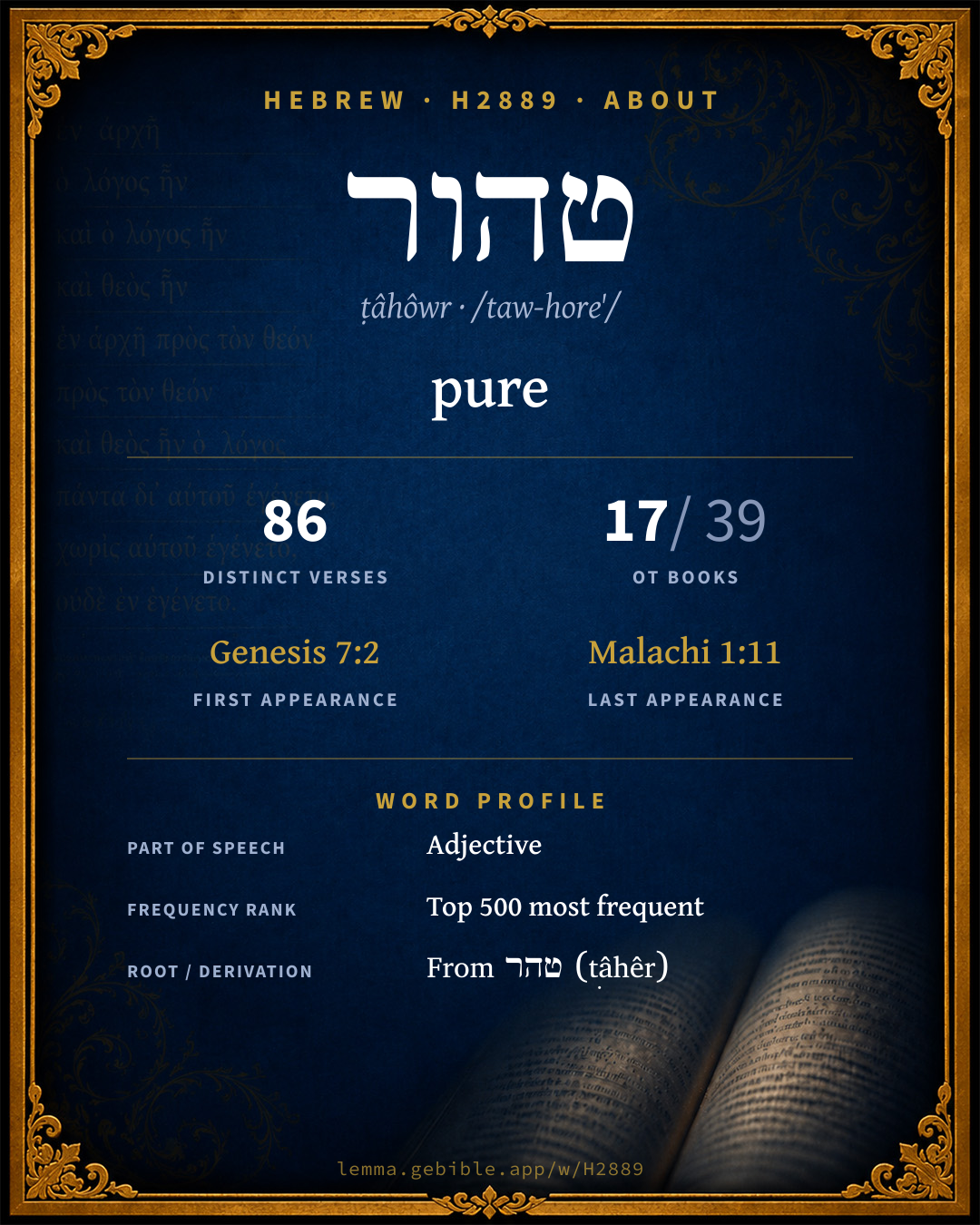
טָהוֹר
pure
‘pure’ is one of 4 main senses fuller range ↓
Full lexicon entry — Brown-Driver-Briggs (BDB)
From Brown-Driver-Briggs (BDB)
Where this word appears
Grammar key — what these labels mean
Part of speech
- Adjective
- A word that describes or qualifies a noun.
State
- Absolute
- The independent form of a noun, not bound to a following word.
- Construct
- A noun bound to a following noun in a possessive / “of” relationship (the construct chain).
Gender
- Masculine
- Grammatically masculine.
- Feminine
- Grammatically feminine.
Number
- Singular
- One.
- Plural
- More than one (in Hebrew, generally three or more).
Every verse where H2889 appears in the Book of Exodus — 28 distinct verses. Click any verse to open its interlinear word-by-word view. Verse text shown in the World English Bible for context — . Each verse’s Hebrew form is shown with its reference; the English is not keyword-highlighted, since the data carries no word-level English alignment. Use “Compare translations” on any verse to read it across multiple English versions. This concordance covers the Hebrew Bible; Septuagint (Greek Old Testament) occurrences are not indexed here.
Exodus
- Exodus 25:11 טָה֔וֹר adj Adjective ms You shall overlay it with pure gold. Inside and outside shall you overlay it, and shall make a gold molding around it.
- Exodus 25:17 טָה֑וֹר adj Adjective ms You shall make a mercy seat of pure gold. Two and a half cubits shall be its length, and a cubit and a half its breadth.
- Exodus 25:24 טָה֑וֹר adj Adjective ms You shall overlay it with pure gold, and make a gold molding around it.
- Exodus 25:29 טָה֖וֹר adj Adjective ms You shall make its dishes, its spoons, its ladles, and its bowls to pour out offerings with. Of pure gold shall you make them.
- Exodus 25:31 טָה֑וֹר adj Adjective ms "You shall make a lampstand of pure gold. Of hammered work shall the lampstand be made, even its base, its shaft, its cups, its buds, and its flowers, shall be of one piece with it.
- Exodus 25:36 טָהֽוֹר adj Adjective ms Their buds and their branches shall be of one piece with it, the whole of it one beaten work of pure gold.
- Exodus 25:38 טָהֽוֹר adj Adjective ms Its snuffers and its snuff dishes shall be of pure gold.
- Exodus 25:39 טָה֖וֹר adj Adjective ms It shall be made of a talent of pure gold, with all these accessories.
- Exodus 28:14 טָה֔וֹר adj Adjective ms and two chains of pure gold; you make them like cords shall, of braided work: and you shall put the braided chains on the settings.
- Exodus 28:22 טָהֽוֹר adj Adjective ms You shall make on the breastplate chains like cords, of braided work of pure gold.
- Exodus 28:36 טָה֑וֹר adj Adjective ms "You shall make a plate of pure gold, and engrave on it, like the engravings of a signet, 'HOLY TO YAHWEH.'
- Exodus 30:3 טָה֗וֹר adj Adjective ms You shall overlay it with pure gold, the top of it, the sides of it around it, and its horns; and you shall make a gold molding around it.
- Exodus 30:35 טָה֥וֹר adj Adjective ms and you shall make incense of it, a perfume after the art of the perfumer, seasoned with salt, pure and holy:
- Exodus 31:8 הַ/טְּהֹרָ֖ה ptcl def.art + Adjective Adjective fs the table and its vessels, the pure lampstand with all its vessels, the altar of incense,
- Exodus 37:2 טָה֖וֹר adj Adjective ms He overlaid it with pure gold inside and outside, and made a molding of gold for it round about.
- Exodus 37:6 טָה֑וֹר adj Adjective ms He made a mercy seat of pure gold. Its length was two and a half cubits, and a cubit and a half its breadth.
- Exodus 37:11 טָה֑וֹר adj Adjective ms He overlaid it with pure gold, and made a gold molding around it.
- Exodus 37:16 טָהֽוֹר adj Adjective ms He made the vessels which were on the table, its dishes, its spoons, its bowls, and its pitchers with which to pour out, of pure gold.
- Exodus 37:17 טָה֑וֹר adj Adjective ms He made the lampstand of pure gold. He made the lampstand of beaten work. Its base, its shaft, its cups, its buds, and its flowers were of one piece with it.
- Exodus 37:22 טָהֽוֹר adj Adjective ms Their buds and their branches were of one piece with it. The whole thing was one beaten work of pure gold.
- Exodus 37:23 טָהֽוֹר adj Adjective ms He made its seven lamps, and its snuffers, and its snuff dishes, of pure gold.
- Exodus 37:24 טָה֖וֹר adj Adjective ms He made it of a talent of pure gold, with all its vessels.
- Exodus 37:26 טָה֗וֹר adj Adjective ms He overlaid it with pure gold, its top, its sides around it, and its horns. He made a gold molding around it.
- Exodus 37:29 טָה֑וֹר adj Adjective ms He made the holy anointing oil and the pure incense of sweet spices, after the art of the perfumer.
- Exodus 39:15 טָהֽוֹר adj Adjective ms They made on the breastplate chains like cords, of braided work of pure gold.
- Exodus 39:25 טָה֑וֹר adj Adjective ms They made bells of pure gold, and put the bells between the pomegranates around the skirts of the robe, between the pomegranates;
- Exodus 39:30 טָה֑וֹר adj Adjective ms They made the plate of the holy crown of pure gold, and wrote on it a writing, like the engravings of a signet: "HOLY TO YAHWEH."
- Exodus 39:37 הַ/טְּהֹרָ֜ה ptcl def.art + Adjective Adjective fs the pure lampstand, its lamps, even the lamps to be set in order, all its vessels, the oil for the light,
About this entry
At a glance — auto-summarized from this page’s data, not written by a person. Every figure links to its source below. This summary describes the numbers; it doesn’t interpret them.
At its core, טהור (ṭâhôwr) means “pure.” Catalogued under 4 senses, its meaning is not single-sense. With 86 verses in 17 books, it is a moderately common word in the Hebrew Bible. Its uses concentrate in Exodus (33% of all occurrences). First canonically at Genesis 7:2, it enters the text early. Dig into 86-verse concordance and the renderings breakdown below.
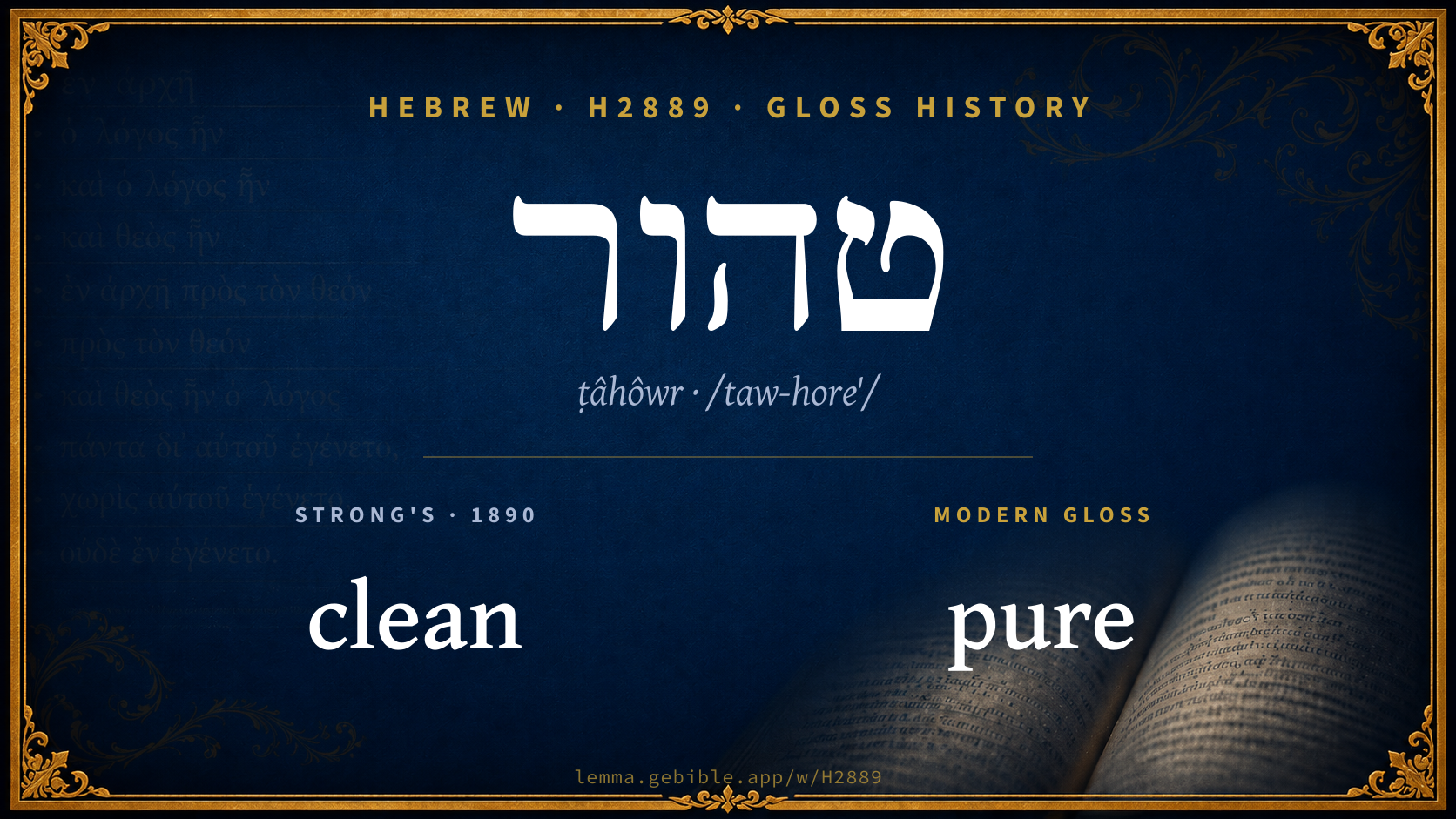
Gloss history
Strong's 1890 vs modern scholarship
About this word
Strong's H2889 catalogs a Hebrew word from the Hebrew Old Testament.
These counts are not copied from any lexicon or concordance. They are computed here, from the morphology-tagged Hebrew Old Testament. What Lemma adds →
- 86
- distinct verses
- The word appears in 86 distinct verses.
- 17 / 39
- OT books
- The word appears in 17 of 39 Old Testament books.
- #440
- by frequency
- Top 500 most frequent Hebrew words (rank 440 of 8,640 Hebrew words by occurrence).
View all 86 occurrences in the concordance →
By section of the Old Testament
By traditional corpus
Conventional, traditional groupings — biblical authorship is debated, so this is a traditional corpus grouping, not an authorship claim. Each share is this word’s portion of its verses in that division of the Hebrew canon. Each figure is a share of the word’s 86 distinct verses.
- Torah (Pentateuch) 64 verses · 74%
- Writings (Ketuvim) 15 verses · 17%
- Prophets (Nevi'im) 7 verses · 8%
How translations render this word
Counts come from each version’s own published word-to-Strong’s tagging or interlinear alignment — an approximate guide to how each version renders this word, not a word-level alignment the data otherwise carries. Because each total is that version’s own tagged count, the per-version totals vary from one another and need not match the appearance or distinct-verse counts above. These counts may also differ from a printed concordance because Lemma counts each distinctly tagged rendering and does not collapse phrase taggings into a single head-word total. This is a fixed set of word-tagged versions (KJV, ASV, BSB, ULT) and does not change with the reading translation you choose elsewhere. Each version’s license is shown beside its name below (and on Sources).
- King James Version: Pure 33×, Clean 22×, Is clean 5×
- American Standard Version: Pure 29×, Clean 21×, Is clean 6×
- Berean Standard Bible: Pure 34×, Clean 24×, Ceremonially clean 6×
- unfoldingWord Literal Text: Pure 38×, Clean 36×, Is clean 8×
King James Version Public Domain
Renders H2889 across 93 tagged occurrences — most commonly:
Plus 14 renderings that appear only once — usually multi-word phrases or single function words the recovered tagging swept in, not distinct renderings. Not rendered by a distinct English word in 1 further occurrence.
American Standard Version Public Domain
Renders H2889 across 94 tagged occurrences — most commonly:
Plus other, less common renderings. Plus 14 renderings that appear only once — usually multi-word phrases or single function words the recovered tagging swept in, not distinct renderings.
Berean Standard Bible Public Domain
Renders H2889 across 89 tagged occurrences — most commonly:
Plus 11 renderings that appear only once — usually multi-word phrases or single function words the recovered tagging swept in, not distinct renderings. Not rendered by a distinct English word in 5 further occurrences.
unfoldingWord Literal Text CC BY-SA 4.0
Renders H2889 across 99 tagged occurrences — most commonly:
Plus 12 renderings that appear only once — usually multi-word phrases or single function words the recovered tagging swept in, not distinct renderings.
Senses in BDB
The 4 senses BDB distinguishes for this word, in lexicon order (not ranked by frequency or importance). The full entry — with sub-senses — is in the Lexicon Entry tab.
- pure, clean
- clean (ceremonially - of animals)
- pure (physically)
- pure, clean (morally, ethically)
Word origin
טָהוֹר adj. clean, pure
— Brown-Driver-Briggs (Oxford 1906, public domain), digitized via Sefaria, supplemented by the OpenScriptures HebrewLexicon (CC BY 4.0). See Sources.
Derived from טהר (ṭâhêr) (H2891) — to cleanse.
Jastrow Dictionary
A second Hebrew/Aramaic lexicon for comparison, covering Aramaic and post-biblical (Talmudic, Targumic, Midrashic) usage that the biblical-Hebrew BDB does not. Matched by lemma rather than by Strong’s number, so a lemma may carry more than one Jastrow headword (shown separately below), and the entries cover usage well beyond the Bible.
טָהוֹר
- next w.)
- 1. clean, pure; not subject to levitical uncleanness. B. Mets. 86ᵃ שגופך ט׳ … נשמתך בט׳ (Ms. בטהרה) thy body is pure, and thy soul expired with (the word) ‘pure’; Snh. 68ᵃ.—Kidd. 70ᵇ וסימניך טמא טמא ט׳ ט׳ and the sign (by which to remember which of the two families is of unblemished descent) is, that with the name of an unclean animal (raven) is unclean, that with the name of a clean animal (dove) is clean; B. Bath. 91ᵃ. Kel. III, 7 ובחרסית ט׳ and the person that touches the clay is clean (not affected by levitical uncleanness). Ib. IV, 1 ט׳ is not subject to levitical uncleanness; a. v. fr.—דג ט׳, עוף; בהמה טהורה a fish, a bird, a domestic animal permitted to eat. Ḥull. XII, 2. Ib. IV, 3 בטהורה טהור if it occurs with an animal of the clean class, the person is levitically clean; a. v. fr.—Pl. טְהוֹרִים, טְהוֹרִין; טְהוֹרוֹת. Kel. II, 1 פשוטיהן ט׳ the flat-surfaced among them are not subject to uncleanness.—Ber. 2ᵇ שהכהנים ט׳ וכ׳ Ms. M. (ed. מטוהרים) when the purified priests enter &c. B. Mets. 61ᵇ; a. v. fr.
A Dictionary of the Targumim, the Talmud Babli and Yerushalmi, and the Midrashic Literature (Marcus Jastrow; London, Luzac, 1903) — Public Domain. Digitized via Sefaria. Digitized via Sefaria. Full attribution on Sources.
Forms in the corpus
The 45 distinct written forms H2889 takes in the Hebrew Bible, most frequent first — each parse links to that state’s occurrences in the concordance. Hebrew forms include their vowel points and cantillation, so a single lemma takes many written forms.
Same root — word family
Other BDB entries built from the same root as H2889, grouped by Strong’s listed origin. These share a root / origin per the lexicon — not necessarily a shared meaning. Each links to that word’s own entry.
Derives from
Shares the same root
Compare all same-root words → They share a root, not necessarily a meaning.
Septuagint verse parallels
This word appears in 78 verses that also exist in the Greek Old Testament (Septuagint), out of the 86 Hebrew verses it occurs in. You can read those verses in Greek by switching the Old Testament edition to the Septuagint.
Read these verses in the Septuagint
- Genesis 7:2
- Exodus 25:11
- Leviticus 4:12
- Numbers 5:28
- Deuteronomy 12:15
- 1 Samuel 20:26
- 1 Chronicles 28:17
- 2 Chronicles 3:4
- Ezra 6:20
- Job 14:4
- Psalms 12:6
- Proverbs 15:26
This is a verse-level parallel only — the same verses exist in both the Hebrew and Greek Old Testaments. No word-level Hebrew↔Greek correspondence is claimed: the data carries no such alignment, so no Greek word is shown as this Hebrew word’s translation. Coverage is not total — the Septuagint omits the deuterocanon and renumbers the Psalms, so some Hebrew verses have no direct Greek parallel.