
Psalms 19:9

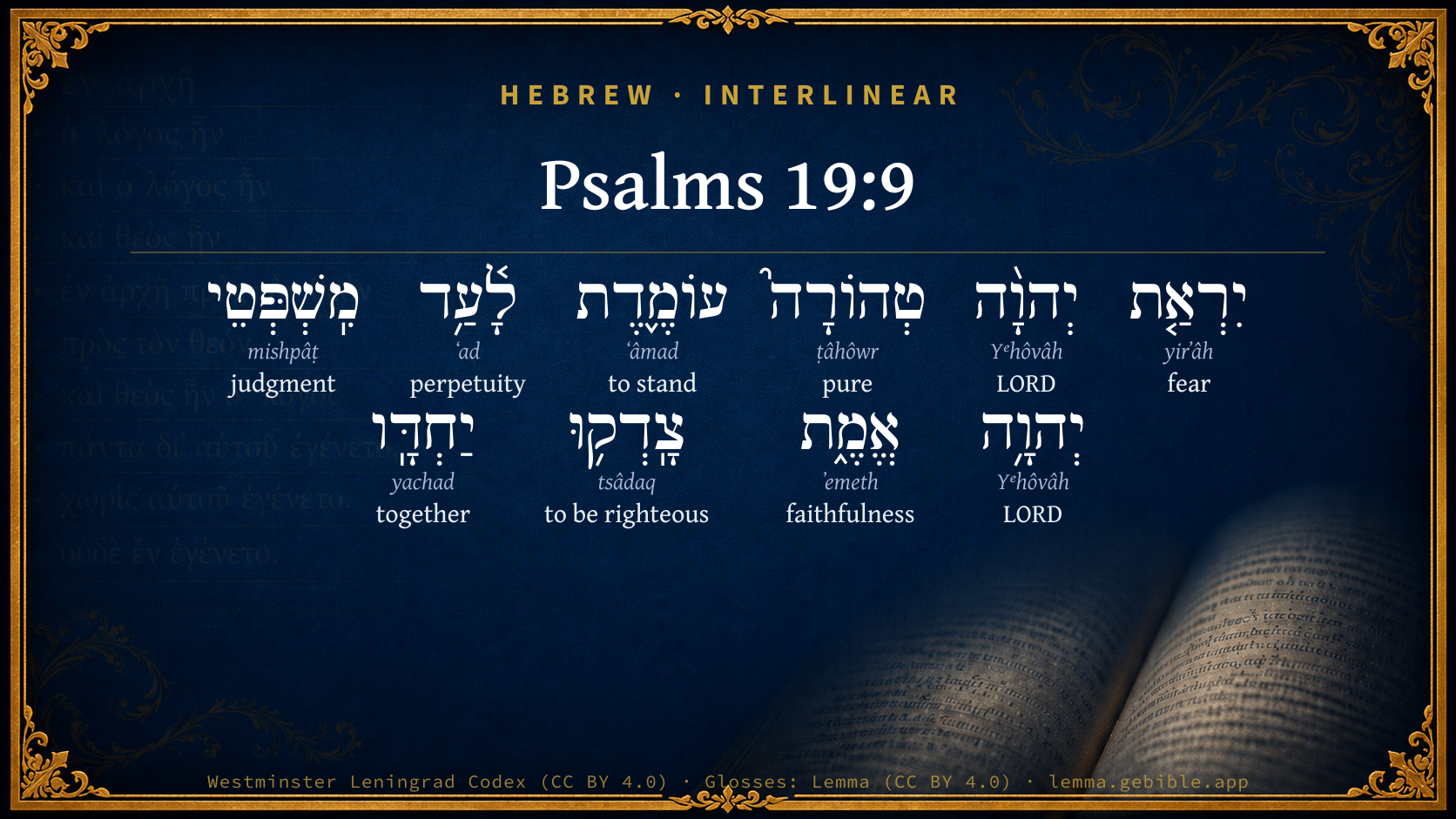
Hebrew (Westminster Leningrad Codex) Psalms 19:9 appears in the Hebrew Old Testament. The text above is from the Westminster Leningrad Codex. Each word links to its Strong’s number, a concise gloss, and parsing drawn from the Open Scriptures Hebrew Bible morphology. Click any word for its full Brown-Driver-Briggs (BDB) entry.
Download image
Cite this verse

Psalms 19:9 (World English Bible). Public Domain. Lemma interlinear Bible study tool, https://lemma.gebible.app/v/psalms/19/9.

Show BibTeX & RIS
BibTeX
RIS
English Translation
The fear of Yahweh is clean, enduring forever. Yahweh's ordinances are true, and righteous altogether.
World English Bible · Public Domain
Download a study sheet

One document with this verse’s original text, its word-by-word gloss line, the meaning frame, cross-references with their text, attributed commentary, and full source and license credits — printable, and it pastes into notes with its structure intact.

This verse Autodidact and up

Study sheet (.html) Plain text (.txt)

A passage Seminary Student

Up to 50 verses in one chapter. A passage sheet keeps up to 6 commentary sources and 12 cross-references per verse, in the order this page ranks them, and says so on the sheet whenever that leaves anything out. Ask for a single verse and you get the Autodidact verse sheet above.

Everything on this page stays free to read, with no account — the sheet is a download of what is already on screen, not access to it.

Want to remove ads? Support Godless Engineer
Compare translations 3

The same verse in 3 English versions, stacked beneath the original-language interlinear above. Click any original word for its lexicon entry.

Each is an independent rendering of the whole verse — the interlinear is not word-aligned to these translations.

Highlighted words mark where these versions differ — a whole-verse word diff, not a word-by-word alignment.

  • World English Bible Public Domain
    The fear of Yahweh is clean, enduring forever. Yahweh's ordinances are true, and righteous altogether.
  • King James Version Public Domain
    The fear of the LORD is clean, enduring for ever: the judgments of the LORD are true and righteous altogether.
  • unfoldingWord Literal Text CC BY-SA 4.0
    The fear of Yahweh is clean, enduring forever; the judgments of Yahweh are true, they are altogether righteous.

unfoldingWord Literal Text — © unfoldingWord, licensed CC BY-SA 4.0. Word-aligned USFM3 via Door43 (git.door43.org/unfoldingWord/en_ult).

Versions to compare (up to 4)

3 of 4 selected

Show all 18 translations

Every available English version of this verse, each an independent rendering of the whole verse.

  • World English Bible Public Domain
    The fear of Yahweh is clean, enduring forever. Yahweh's ordinances are true, and righteous altogether.
  • Berean Standard Bible Public Domain
    The fear of the LORD is pure, enduring forever; the judgments of the LORD are true, being altogether righteous.
  • Majority Standard Bible Public Domain
    The fear of the LORD is pure, enduring forever; the judgments of the LORD are true, being altogether righteous.
  • King James Version Public Domain
    The fear of the LORD is clean, enduring for ever: the judgments of the LORD are true and righteous altogether.
  • American Standard Version (1901) Public Domain
    The fear of Jehovah is clean, enduring for ever: The ordinances of Jehovah are true, `and' righteous altogether.
  • Revised Version (1885) Public Domain
    The fear of the LORD is clean, enduring for ever: the judgments of the LORD are true, and righteous altogether.
  • Geneva Bible (1599) Public Domain
    The feare of the Lord is cleane, and indureth for euer: the iudgements of the Lord are trueth: they are righteous altogether,
  • Douay-Rheims (1899) Public Domain
    The justices of the Lord are right, rejoicing hearts: the commandment of the Lord is lightsome, enlightening the eyes.
  • Young's Literal Translation Public Domain
    The fear of Jehovah `is' clean, standing to the age, The judgments of Jehovah `are' true, They have been righteous -- together.
  • Literal Standard Version CC BY-SA 4.0
    The fear of YHWH [is] clean, standing for all time, || The judgments of YHWH [are] true, || They have been righteous—together.
  • Unlocked Literal Bible CC BY-SA 4.0
    The fear of Yahweh is pure, enduring forever; the righteous decrees of Yahweh are true and altogether right!
  • unfoldingWord Literal Text CC BY-SA 4.0
    The fear of Yahweh is clean, enduring forever; the judgments of Yahweh are true, they are altogether righteous.
  • Darby Bible Public Domain
    The fear of Jehovah is clean, enduring for ever; the judgments of Jehovah are truth, they are righteous altogether:
  • World Messianic Bible Public Domain
    The fear of the LORD is clean, enduring forever. The LORD’s ordinances are true, and righteous altogether.
  • Webster's Bible Public Domain
    \\19:8\\The statutes of the LORD are right, rejoicing the heart: the commandment of the LORD is pure, enlightening the eyes.
  • Free Bible Version CC BY-SA 4.0
    Reverence for the Lord is right, and lasts forever. The Lord's judgments are both true and fair.
  • Bible in Basic English Public Domain
    The fear of the Lord is clean, and has no end; the decisions of the Lord are true and full of righteousness.
  • JPS Tanakh (1917) Public Domain
    (19-10) The fear of the LORD is clean, enduring for ever; the ordinances of the LORD are true, they are righteous altogether;

Literal Standard Version (2020), Covenant Press — licensed CC BY-SA 4.0. Text via the HelloAO Bible API (eBible.org). Unlocked Literal Bible (unfoldingWord) — licensed CC BY-SA 4.0. Text via the HelloAO Bible API (eBible.org). unfoldingWord Literal Text — © unfoldingWord, licensed CC BY-SA 4.0. Word-aligned USFM3 via Door43 (git.door43.org/unfoldingWord/en_ult). Free Bible Version, Dr. Jonathan Gallagher — licensed CC BY-SA 4.0. Text via the HelloAO Bible API (eBible.org).

Word by word

More ways to search: Search by grammar → Find every occurrence → Compare this word →

Practice this passage: Drill this verse → Learn its vocabulary →

צָֽדְק֥וּ
tsâdaq
H6663
“to be righteous”
Verb, Qal, Perfect, 3rd Person, Common, Plural
Part of Speech
Verb
Stem
Qal
Form
Perfect
Person
3rd Person
Gender
Common
Number
Plural
Full BDB Definition

Origin: a primitive root

TWOT: 1879

to be just, be righteous - (Qal) - to have a just cause, be in the right - to be justified - to be just (of God) - to be just, be righteous (in conduct and character) - (Niphal) to be put or made right, be justified - (Piel) justify, make to appear righteous, make someone righteous - (Hiphil) - to do or bring justice (in administering law) - to declare righteous, justify - to justify, vindicate the cause of, save - to make righteous, turn to righteousness - (Hithpael) to justify oneself
  1. יִרְאַ֤ת yirʼâh H3374 “fear of” Noun, Common, Feminine, Singular, Construct
  2. יְהוָ֨ה Yᵉhôvâh H3068 “LORD” Noun, Proper
  3. טְהוֹרָה֮ ṭâhôwr H2889 “pure” Adjective, Adjective, Feminine, Singular, Absolute
  4. עוֹמֶ֪דֶת ʻâmad H5975 “standing” Verb, Qal, Participle Active, Feminine, Singular, Absolute
  5. לָ֫עַ֥ד ʻad H5703 “to/for · perpetuity” Preposition + Noun, Common, Masculine, Singular, Absolute
  6. מִֽשְׁפְּטֵי mishpâṭ H4941 “judgments of” Noun, Common, Masculine, Plural, Construct
  7. יְהוָ֥ה Yᵉhôvâh H3068 “LORD” Noun, Proper
  8. אֱמֶ֑ת ʼemeth H571 “faithfulness” Noun, Common, Feminine, Singular, Absolute
  9. יַחְדָּֽו yachad H3162 “together” Adverb

About this verse

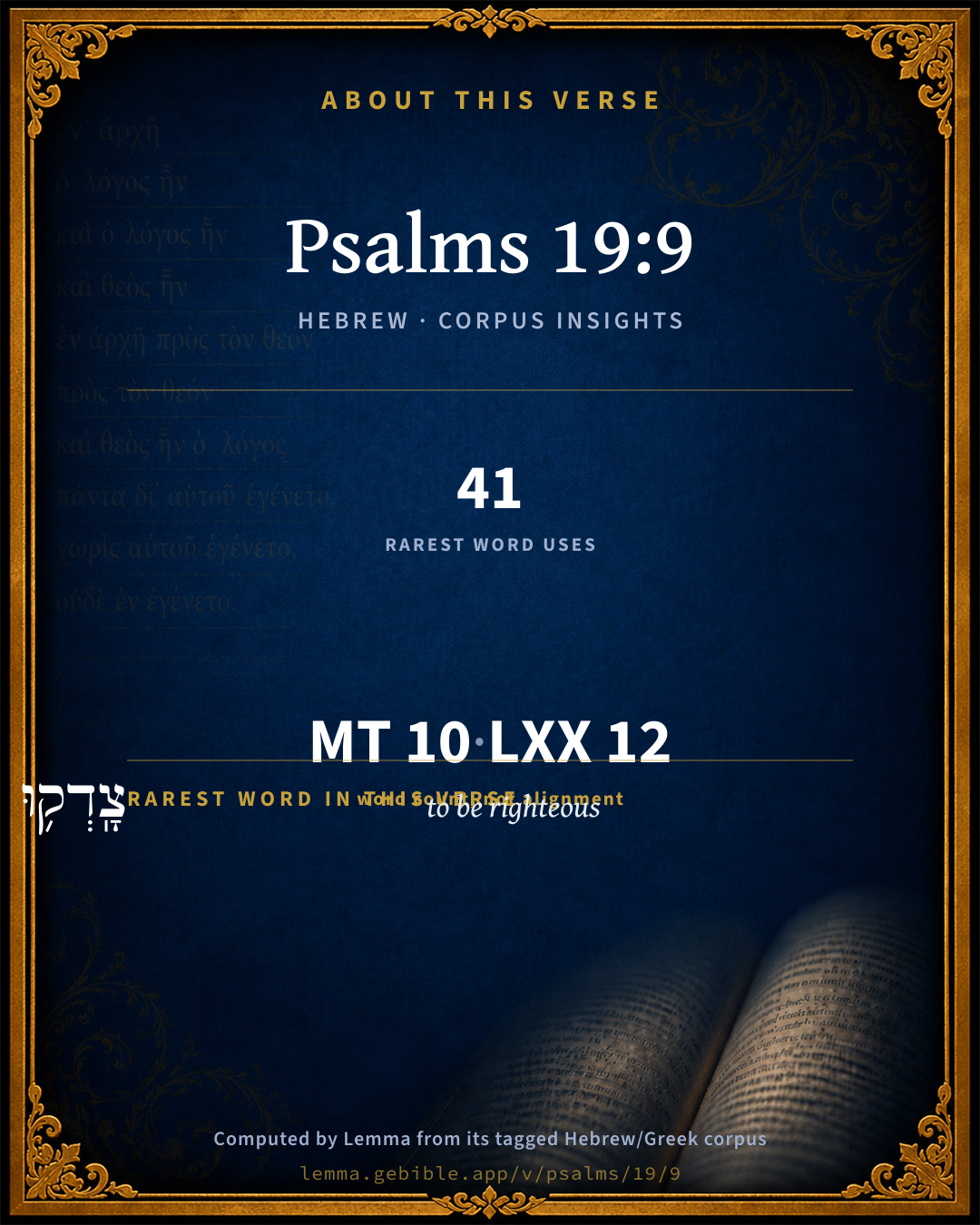
These counts appear in no published source. They are computed here, from the morphology-tagged text and Lemma’s own curated glosses. What Lemma adds →

10
words
9
distinct lemmas
Wisdom
section

Shared distinctive vocabulary

צָֽדְק֥וּ to be righteous H6663 occurs in 40 verses of the Hebrew Bible. Also found in:

Grammatical profile

  • 2 verbs
  • 6 nouns
  • 1 adjective
  • 1 adverb

Verb forms

  • עוֹמֶ֪דֶת Qal · Participle Active
  • צָֽדְק֥וּ Qal · Perfect

Repetition

A word recurs within this verse — often emphatic in Hebrew:

  • יְהוָ֨ה LORD H3068 ×2

Hebrew & Septuagint length

In English translation the verse runs 15 words from the Hebrew and 22 from the Septuagint (LXX English) — closely comparable.

A rough comparison of the two English renderings, which tokenize alike — not a word-level alignment.

Word counts can differ between the Hebrew and the Greek without any difference in meaning — e.g. the Hebrew direct-object marker אֵת has no separate Greek word, and Greek often adds the article ὁ.

In the original languages it is 10 Hebrew tokens and 12 Greek tokens — but the two are counted differently (Hebrew bundles its prefixes and suffixes into one token; the Greek is in lemma form), so that isn’t a like-for-like length.

Cross-references

33

Topical passages linked to Psalms 19:9 in the Treasury of Scripture Knowledge — connected by theme and wording, ordered by reader-vote popularity; previews shown in the World English Bible.

  • 1 Samuel 12:24 Only fear Yahweh, and serve him in truth with all your heart; for consider how great things he has done for you.
  • Psalms 119:142 Your righteousness is an everlasting righteousness. Your law is truth.
  • Psalms 119:137–138 You are righteous, Yahweh. Your judgments are upright.
  • Psalms 34:11–14 Come, you children, listen to me. I will teach you the fear of Yahweh.
  • Psalms 119:1 Blessed are those whose ways are blameless, Who walk according to Yahweh's law.
  • Psalms 111:10–112:6 The fear of Yahweh is the beginning of wisdom. All those who do his work have a good understanding. His praise endures forever!
  • Psalms 115:13 He will bless those who fear Yahweh, Both small and great.
  • Revelation 15:3 They sang the song of Moses, the servant of God, and the song of the Lamb, saying, "Great and marvelous are your works, Lord God, the Almighty; Righteous and true are your ways, you King of the nations.
  • Genesis 42:18 Joseph said to them the third day, "Do this, and live, for I fear God.
  • Deuteronomy 4:8 What great nation is there, that has statutes and ordinances so righteous as all this law, which I set before you this day?
  • 1 Kings 18:12 It will happen, as soon as I am gone from you, that the Spirit of Yahweh will carry you I don't know where; and so when I come and tell Ahab, and he can't find you, he will kill me: but I your servant fear Yahweh from my youth.
  • Psalms 10:5 His ways are prosperous at all times; He is haughty, and your laws are far from his sight: As for all his adversaries, he sneers at them.
  • Revelation 16:7 I heard the altar saying, "Yes, Lord God, the Almighty, true and righteous are your judgments."
  • Genesis 22:12 He said, "Don't lay your hand on the boy, neither do anything to him. For now I know that you fear God, seeing you have not withheld your son, your only son, from me."
  • Exodus 21:1 "Now these are the ordinances which you shall set before them.
  • 1 Kings 18:3–4 Ahab called Obadiah, who was over the household. (Now Obadiah feared Yahweh greatly:
  • Nehemiah 5:15 But the former governors who were before me were chargeable to the people, and took of them bread and wine, besides forty shekels of silver; yes, even their servants bore rule over the people: but I didn't do so, because of the fear of God.
  • Psalms 36:1 An oracle is within my heart about the disobedience of the wicked: "There is no fear of God before his eyes."
  • Psalms 36:6 Your righteousness is like the mountains of God. Your judgments are like a great deep. Yahweh, you preserve man and animal.
  • Psalms 72:1–2 God, give the king your justice; Your righteousness to the royal son.
  • Psalms 119:7 I will give thanks to you with uprightness of heart, When I learn your righteous judgments.
  • Psalms 119:106 I have sworn, and have confirmed it, That I will obey your righteous ordinances.
  • Isaiah 26:8 Yes, in the way of your judgments, Yahweh, have we waited for you; to your name, even to your memorial [name], is the desire of our soul.
  • Romans 2:2 We know that the judgment of God is according to truth against those who practice such things.
  • Revelation 19:2 for true and righteous are his judgments. For he has judged the great prostitute, who corrupted the earth with her sexual immorality, and he has avenged the blood of his servants at her hand."
  • Psalms 119:39 Take away my disgrace that I dread, For your ordinances are good.
  • Psalms 119:62 At midnight I will rise to give thanks to you, Because of your righteous ordinances.
  • Psalms 119:75 Yahweh, I know that your judgments are righteous, That in faithfulness you have afflicted me.
  • Psalms 147:19 He shows his word to Jacob; His statutes and his ordinances to Israel.
  • Proverbs 8:13 The fear of Yahweh is to hate evil. I hate pride, arrogance, the evil way, and the perverse mouth.
  • Acts 10:22 They said, "Cornelius, a centurion, a righteous man and one who fears God, and well spoken of by all the nation of the Jews, was directed by a holy angel to invite you to his house, and to listen to what you say."
  • Romans 3:10–18 As it is written, "There is no one righteous. No, not one.
  • Romans 11:22 See then the goodness and severity of God. Toward those who fell, severity; but toward you, goodness, if you continue in his goodness; otherwise you also will be cut off.

Cross-references courtesy of OpenBible.info (CC BY 4.0).

Hebrew and Greek witnesses Masoretic Hebrew ↔ Greek Septuagint

The same verse in the two great witnesses to the Old Testament, shown verse-for-verse.

You’re reading Greek Psalm 18 (Hebrew Psalm 19). The Septuagint counts the superscription, so verse numbers can differ from the Hebrew — chapter-level alignment, not verse-by-verse. Numbering follows Rahlfs.

These are two independent witnesses, not word-aligned to each other, and the Septuagint is shown in lemma (dictionary) form.

Hebrew Psalms 19:9 Masoretic · Westminster Leningrad Codex

יִרְאַ֤ת יְהוָ֨ה טְהוֹרָה֮ עוֹמֶ֪דֶת לָ֫עַ֥ד מִֽשְׁפְּטֵי יְהוָ֥ה אֱמֶ֑ת צָֽדְק֥וּ יַחְדָּֽו

The fear of Yahweh is clean, enduring forever. Yahweh's ordinances are true, and righteous altogether.

World English Bible · Public Domain

Greek LXX Greek Psalm 18:9 Septuagint · lemma form

ὁ δικαίωμα κύριος εὐθύς εὐφραίνω καρδία ὁ ἐντολή κύριος τηλαυγής φωτίζω ὀφθαλμός

The fear of the Lord is pure, enduring for ever and ever: the judgments of the Lord are true, and justified altogether.

LXX2012 (modern English Septuagint) · Public Domain

Hebrew: Westminster Leningrad Codex (CC BY 4.0). Greek: Septuagint (public domain); English from LXX2012 (modern English Septuagint) (Public Domain). How the Septuagint differs from the Hebrew →

Commentary

Notes on Psalms 19:9 from classic Christian and Jewish commentators (each source and its license shown beneath its notes). The classic Christian expositions comment on the surrounding passage and are grouped to its opening verse, so a note may address several verses; the Jewish commentaries on the Tanakh (Rashi and others) are per-verse, so they appear only where the commentator wrote on this verse.

Lemma curates 59 commentaries, every one of them public domain or Creative Commons licensed, each selected and text-cleaned for this edition rather than reprinted as found. About our sources →

Trapp's Complete Commentary

John Trapp

Psa 19:9 The fear of the LORD [is] clean, enduring for ever: the judgments of the LORD [are] true [and] righteous altogether.

Ver. 9. The fear of the Lord is clean] That is, the doctrine which teacheth the true fear of God is such as cleanseth the conscience, ferreteth out corruption, sanctifieth the whole man, Joh 17:17; Joh 15:3 Act 20:32; Act 26:18.

Enduring for ever] "For ever, O Lord, thy word is established in heaven." Psa 119:89. Heaven and earth shall pass, but not one jot or tittle of the law; not one hair of that sacred head shall fall to the ground, Mat 5:18; should all the powers on earth make war against the very paper of the Scriptures, they cannot possibly destroy it. What God hath written he hath written, and it shall stand inviolable to the world’s end. Antiochus, Epiphanes, Dioclesian, and other tyrants have attempted to burn up all Bibles, but could never effect it. Other laws and religions are antiquated and altered, as all histories testify; not so this.

The judgments of the Lord are true] Heb. truth, as coming from a God of truth, and without iniquity, just and righteous is he, Deu 32:4. All his sayings are faithful, and therefore worthy of all acceptation, 1Ti 1:15. The Eternity of Israel cannot lie, 1Sa 15:29. He will not suffer his faithfulness to fail, nor alter the thing that is gone out of his mouth, Psa 89:33-34. Mονιμον η αληθεια, saith Plato; truth is lasting, and γλυκεια η αληθεια, , Truth is sweet, said Mercury’s priests when they ate their figs. Divine truths should be so to us in a special manner. And as Cyprian, in any great doubt or difficulty, would call to Paulus Concordiensis (who was his notary), for Tertullian’s works, saying, Da magistrum, Reach hither my master; so should we call for the Bible, and therehence fetch satisfaction and settlement, as holding it infallible.

And righteous altogether] Not one of them to be found fault with; but all of them every way complete and absolute. Iustificata sunt simul, so some render it, they are altogether justified. What a high esteem the Jews at this day have of the law hath been elsewhere noted; while they carry it usually about their synagogues at the end of their service in procession, with many ornaments of crowns and sceptres; the children kissing it as it passeth by them. To their disciples they prescribe, not to write any letter of the law without a copy, no line of it without a rule, no parchment but made of the skin of a clean beast, no word must be written in a different colour. No man might carry it behind him, but lay it next to his heart in his travel; nor read it, but in a clean place; nor sell it, though the copy were moth eaten, and himself half famished (Schicard. de iure Reg. Heb.). The last day of the feast of tabernacles they call Shimchah Torah, the rejoining at the law. They have chosen also, then, two, that are called sponsi legis; one of which is to read the end of it, called Chathan Torah, the bridegroom of the law ended; the other Chathan Bereshith, because he presently beginneth it again; these are to express joy (Leo Modena of Jewish Rites).

John Trapp, A Commentary or Exposition upon All the Books of the Old and New Testament (1647–1656) — public domain. Text from a community e-Sword module.

The Biblical Illustrator

Joseph S. Exell

Psa_19:9

The fear of the Lord is clean, enduring forever.

The Word of God enduring forever

We are to consider the abiding and habitual effect of the Word of God upon believing hearts. And this effect is expressed in this phrase, the fear of the Lord. Note what is said of it.

I. It is clean--its purity. It is so, because it is the only true and sound basis of a due social regard to man, and the only valid bond of union, whether domestic, private, or public. Every believer ought to bear witness to the cleansing, purifying power of the fear of the Lord.

II. Its perpetuity--enduring forever. This tells of the effect of the principle rather than of the principle itself, though this latter is not to be omitted. But in its effects it is consistent, unswerving, abiding, all-powerful. It enters into the man, and goes with him wherever he goes. He cannot and would not shake it off. And its effects are eternal, they can never pass away. And all may possess it, through Christ. It shall be for your peace here and happiness hereafter. (Thomas Dale, M. A.)

The judgments of the Lord are true and righteous altogether.

The Word of God altogether true and righteous

I. Consider these judgments as matters of fact. Take--

1. The expulsion of our first parents from Eden. None can understand why God created man capable of falling, and foreknowing that he would fall. But this does not say that God made him on purpose that he should fall. This would be to assume that we know all Gods purpose in creating man, which we do not. We cannot reconcile the supremacy of God and the free agency of man. It is of no use to attempt to be wise above what is written, but our duty is to take man as he is--capable of understanding and obeying Gods command, which Adam unquestionably was. There was in him no moral difficulty as in us, since the imagination of his heart was not, as ours, evil continually. We must deplore the instability of the man, bat we cannot on that account take exception to the judgments of the Lord. And the transmission to offspring of the properties of the parent--this law had been ordained before this fatal event, and what right have we to think that He who made all things very good should remodel or reverse His laws in consequence of that event? Hence, although in Adam all die, was it unrighteous in God to act in accordance with His own previously established law? Adam himself caused, of his own choice, that it should work ill to him and his. But are we to blame God for that?

2. The judgment upon Cain. Surely this was far less than he deserved. And the gate of mercy and of grace was not closed upon him.

3. The deluge, the overthrow of Jerusalem, and many others. In reference to each of these we might prove it to be altogether righteous. For by righteous we understand perfect consistency with previous revelations given by God--with the laws enacted and bearing on each case, and with the penalties threatened by God and consciously incurred by man. And when men object to these judgments they do not attempt to justify the conduct of the sinner, but only to condemn the law under which, and the Judge by whom, he was condemned. They affirm that God is without compassion for human frailty, and without consideration for human folly.

II. As matters of faith--they are altogether true. Necessarily, many of the judgments of God are matters of faith. For the interpositions of God, though sometimes seen in the crisis and agony of nations, are, in the case of individuals, scarcely, if at all, discernible.

III. In their bearing upon ourselves. As we cannot impeach Gods righteousness in His judgments in the past, can we, in what we expect in the future, doubt His truth? Meantime the victory that overcometh the world is this, even our faith. (Thomas Dale, M. A.)

The Biblical Illustrator, edited by Joseph S. Exell (c. 1880s–1900s) — public domain. Text from a community e-Sword module.

Joseph Benson's Commentary

Psa 19:9. The fear of the Lord — True religion and godliness, prescribed in the word, reigning in the heart and practised in the life; or rather, that word or law itself is intended, and called the fear of the Lord, because it is both the rule and cause of that fear, or of true religion; is clean — Sincere, not adulterated with any mixture of vanity, falsehood, or vice; not countenancing or allowing any sin or impurity of any kind, and preservative of the purity and holiness of the soul; enduring for ever — Constant and unchangeable, the same for substance in all ages. Which is most true, both of the moral law and of the doctrine of God’s grace and mercy to sinful and miserable man, which two are the principal parts of that law of which he here speaks. For as to the difference between the Old Testament and the New, that lies only in circumstantial and ritual things, which are not here intended. And that alteration also was foretold in the Old Testament, and consequently the accomplishment of it did not destroy, but confirm, the certainty and constancy of God’s word. This also is opposed to human laws, in which there are, and ought to be, manifold changes, according to the difference of times, and people, and circumstances. The judgments of the Lord — His laws, frequently called his judgments, because they are the declarations of his righteous will; and, as it were, his judicial sentence, by which he expects that men should govern themselves, and by which he will judge them at the last day; are true — Grounded on the most sacred and unquestionable truths; and righteous altogether — Without the smallest exception; not like those of men, often wrong and unrighteous, but perfectly and constantly equitable, just, and holy.

Joseph Benson's Commentary on the Old and New Testaments (1811–1818) — public domain. Text from a community e-Sword module.

J. A. Alexander on Psalms

Joseph Addison Alexander

10. (Psa 19:9). The fear of Jehovah is clean, standing for ever; the judgments of Jehovah are truth, they are righteous altogether. As the fear of Jehovah, in its proper sense, would here be out of place, and as the law was designed to teach men how to fear the Lord (Deu 17:19), the phrase may here be understood as a description of the law viewed in reference to this peculiar purpose, the fear of the Lord being put for that which leads or teaches men to fear him, a sense which the expression is supposed to have in several other places. See Psa 34:12 (11), Proverbs 29, Pro 2:5; Pro 15:33.—Standing for ever, of perpetual obligation. Even Christ came not to destroy, but to fulfil. See Mat 5:17-18. With the form of expression here compare Psa 33:11; Psa 112:3.—Judgments are properly judicial decisions, but are here put, as in Psa 18:23 (22), for all God's requisitions. They are truth (itself) may be a strong expression, meaning they are perfectly and absolutely true; but as this would make the last clause little more than a tautology, the first phrase may be understood to mean that they are really that which they purport and claim to be, and therefore must be righteous altogether, i. e. all, without exception, righteous, which is tantamount, in fact, though not in form, to wholly or completely righteous.

Joseph Addison Alexander, The Psalms Translated and Explained (1850) — public domain. Text from a community e-Sword module.

Geneva Bible (1599)

Geneva Bible translators

So that all man’s inventions and intentions are lies.

Everyone without exception.

Geneva Bible (1599) marginal notes — public domain. Text via Bolls.life.

Adam Clarke's Commentary

Verse 9. The fear of the Lord] יראה yirah, from ירא yara, to fear, to venerate; often put for the whole of Divine worship. The reverence we owe to the Supreme Being.

Is clean] טהורה tehorah, from טהר tahar, to be pure, clean; not differing much from ברה barah, (see above,) to be clean and bright as the heavens; as purified SILVER. Its object is to purge away all defilement, to make a spotless character.

Enduring for ever] עומדת לעד omedeth laad, standing up to PERPETUITY. The fear that prevents us from offending God, that causes us to reverence him, and is the beginning as it is the safeguard of wisdom, must be carried all through life. No soul is safe for a moment without it. It prevents departure from God, and keeps that clean which God has purified. This is ITS use.

The judgments of the Lord] משפטים mishpatim, from שפת shaphat, he judged, regulated, disposed, All God's regulations, all his decisions; what he has pronounced to be right and proper.

Are true] אמת emeth, truth, from אם am, to support, confirm, make stable, and certain. This is the character of God's judgments. They shall all stand. All dispensations in providence and grace confirm them; they are certain, and have a fixed character.

And righteous altogether.] They are not only according to truth; but they are righteous, צדקו tsadeku, they give to all their due. They show what belongs to God, to man, and to ourselves. And hence the word altogether, יחדו yachdav, equally, is added; or truth and righteousness united.

Adam Clarke's Commentary on the Bible (1810–1826) — public domain. Text from a community e-Sword/MySword module.

John Calvin's Commentaries

9. The fear of Jehovah is clean. By the fear of God we are here to understand the way in which God is to be served; and therefore it is taken in an active sense for the doctrine which prescribes to us the manner in which we ought to fear God. The way in which men generally manifest their fear of God, is by inventing false religions and a vitiated worship; in doing which they only so much the more provoke his wrath. David, therefore, here indirectly condemns these corrupt inventions, about which men torment themselves in vain, “Apres lesquelles les hommes se tourmentent en vain.” — Fr.

John Calvin's Commentaries (1540-1563) — public domain. Text from the Calvin Translation Society English edition (1840s-50s) via the Christian Classics Ethereal Library (ccel.org). Calvin's coverage is partial (roughly two-thirds of the Bible); uncommented books and verses are honest gaps, never fabricated. The 19th-century editor's footnotes and remarks are omitted so the notes are faithfully Calvin's own voice.

Ellicott's Commentary for English Readers

(9) The fear of the Lord.—Here plainly not a moral quality of the individual, but, as in Pro_15:33 (comp. Deu_17:19), religion, the service demanded by the Law, which, being “pure and undented,” endures, while the false systems of idolatrous nations perish. Based on the eternal principle of right, the judgments of God, it is eternal as they are.

A Bible Commentary for English Readers, edited by Charles John Ellicott (1878–1897) — public domain. Text from a community e-Sword module.

The Cambridge Bible for Schools and Colleges

gen. ed. J. J. S. Perowne

9. The fear of the Lord] Another synonym for the ‘law,’ inasmuch as its aim and object is to implant the fear of God in men’s hearts. (Deu_4:10). It is clean or pure (Psa_12:6), in contrast to the immoralities of heathenism. It is like Jehovah Himself (Hab_1:13), and like Him, it stands fast for ever (Psa_102:26); for “righteousness is immortal” (Wis_1:15).

The judgments] Decisions, ordinances. These are truth (Joh_17:17); one and all they are in accordance with the standard of absolute justice (Deu_4:8).

The Cambridge Bible for Schools and Colleges (gen. ed. J. J. S. Perowne; Cambridge University Press, 1878–1918) — public domain. Text from a community e-Sword module.

John Gill's Exposition

More to be desired are they than gold,.... This refers to all the truths in the word of God; to all the doctrines of the Gospel; which, by good men, are more desirable, and by them more prized and valued, than all worldly riches and treasure;

yea, than much fine gold: more than gold, and the best of gold, and a great deal of it, than thousands of gold and silver; see Psa 119:72, Pro 8:10;

sweeter also than honey, and the honeycomb; or "the dropping of the honeycombs" (h), which is the purest and sweetest of the honey; and what honey is to the natural taste of men, that is the Gospel, and the truths of it, to the spiritual taste of believers, Psa 119:103; and when the presence of Christ is enjoyed, his love is shed abroad, and the blessings of his grace are partook of, the ordinances of the Gospel are very delightful, Sol 2:3; eloquence, and eloquent orators, are sometimes described by mellifluous words; or by their expressions being like honey, and sweeter than that (i).

(h) "stillatione favorum", Vatablus, Rivetus, Cocceius; so Ainsworth. (i) , Homer. Iliad. 1. v. 249.

John Gill's Exposition of the Whole Bible (1746–1763) — public domain (CC PDM 1.0). Text via the HelloAO Bible API.

Albert Barnes' Notes on the Bible

The fear of the Lord - The word rendered fear in this place - יראה yir'âh - means properly fear, terror, Jon 1:10; then, reverence, or holy fear, Psa 2:11; Psa 5:7; and hence, reverence toward God, piety, religion - in which sense it is often used. Compare Pro 1:7; Job 28:28; Isa 11:2. Hence, by metonymy, it means the precepts of piety or religion. It is used evidently in this sense here, as referring to revelation, or to revealed truth, in the sense that it promotes proper reverence for God, or secures a proper regard for his name and worship.

Is clean - The word used here - טהור ṭâhôr - means properly clear, pure, in a physical sense, as opposed to filthy, soiled; then, in a ceremonial sense, as opposed to that which is profane or common Lev 13:17, and then, in a moral sense, as a clean heart, etc., Psa 12:6; Psa 51:10. It is also applied to pure gold, Exo 25:11. The sense here is, that there is nothing in it that tends to corrupt the morals, or defile the soul. Everything connected with it is of a pure or holy tendency, adapted to cleanse the soul and to make it holy.

Enduring for ever - Standing to all eternity. Not temporary; not decaying; not destined to pass away. It stands firm now, and it will stand firm for ever. That is, the law of God, considered as adapted to make the heart holy and pure, is eternal. What it is now it will always be. What its teaching is now it will continue to be forever.

The judgments of the Lord - The word here rendered judgments refers also to the revealed truth of God, with the idea that that has been judged or determined by him to be right and to be best. It is the result of the divine adjudication as to what is true, and what is best for man. The word is often used in this sense. Compare Exo 21:1; Lev 18:5; Lev 26:43; compare Psa 9:7, Psa 9:16; Psa 10:5.

Are true - Margin, truth. So the Hebrew. That is, they accord entirely with the truth, or are a correct representation of the reality of things. They are not arbitrary, but are in accordance with what is right. This supposes that there is such a thing as truth in itself, and the divine law conforms to that; not that God determines a thing by mere will, and that it is, therefore, right. God is infinitely perfect, and what he does will be always right, for that is in, accordance with his nature; but still his judgments are right, not because he makes that to be right which is determined by his will, but because his will is always in accordance with what is right.

And righteous altogether - That is, they are, without exception, just; or, they are altogether or wholly righteous. There is no one of them which is not just and proper. All that God determines, whether in giving or in executing his laws - all in his requirements, and all in the administration of his government - is always and wholly righteous. It is precisely what it should be in the case, and is, therefore, worthy of universal confidence.

Albert Barnes' Notes on the Bible (1834–1885) — public domain. Text from a community e-Sword/MySword module.

Matthew Poole's English Annotations

The fear of the Lord; by which he understands not the grace of God’s fear, as this phrase is commonly taken; nor the whole worship of God, as it is taken Psa 34:9,11; Mt 15:9; but the law and word of God, which is the only thing that is here commended, and which is meant by all the other parallel titles of his testimony, and statutes, and commandments, and judgments, and consequently by this of his fear, which is as it were hemmed in within them. And this may well be so called by a usual metonymy, because it is both the object, and the rule, and the cause of this grace of holy fear, as God himself is called fear for the like reason, Gen 31:53, and in the Hebrew, Psa 76:1. Clean, i.e. sincere, not adulterated with any mixture of vanity, or falsehood, or vice; not requiring nor allowing any uncleanness or wickedness, as the religion of the Gentiles did.

Enduring for ever; constant and unchangeable, the same for substance in all the ages of the church and the world: which is most true, both of the moral law, and of the doctrine of God’s grace and mercy to sinful and miserable man; which two are the principal parts of that law, of which he here speaks, as is evident from the whole context. For as for the difference between the Old and the New Testament, that lies only in circumstantial, and ceremonial, or ritual things, which are not here intended; and that alteration also was foretold in the Old Testament, and consequently the accomplishment of it did not destroy, but confirm, the certainty and constancy of God’s word. This also is opposed to human laws, wherein there are and ought to be manifold changes, according to the difference of times, and people, and circumstances.

The judgments of the Lord, i.e. God’s laws, frequently called his judgments, because they are the declarations of his righteous will, and as it were his legal or judicial sentence by which he expects that men should govern themselves, and by which he will judge them at the last day.

Matthew Poole's English Annotations on the Holy Bible (1683–1685) — public domain. Text from a community e-Sword/MySword module.

The Treasury of David

Charles H. Spurgeon

Ver. 9. The fear of the Lord is clean. The doctrine of truth is here described by its spiritual effect, viz., inward piety, or the fear of the Lord; this is clean in itself, and cleanses out the love of sin, sanctifying the heart in which it reigns. Mr. Godly fear is never satisfied till every street, lane, and alley, yea, and every house and every corner of the town of Man soul is clean rid of the Diablolonians who lurk therein.

Enduring for ever. Filth brings decay, but cleanness is the great foe of corruption. The grace of God in the heart being a pure principle, is also an abiding and incorruptible principle, which may be crushed for a time, but cannot be utterly destroyed. Both in the Word and in the heart, when the Lord writes, he says with Pilate, "What I have written, I have written; "he will make no erasures himself, much less suffer others to do so. The revealed will of God is never changed; even Jesus came not to destroy but to fulfil, and even the ceremonial law was only changed as to its shadow, the substance intended by it is eternal. When the governments of nations are shaken with revolution, and ancient constitutions are being repealed, it is comforting to know that the throne of God is unshaken, and his law unaltered.

The judgments of the Lord are true and righteous altogether; jointly and severally the words of the Lord are true; that which is good in detail is excellent in the mass; no exception may be taken to a single clause separately, or to the book as a whole. God's judgments, all of them together, or each of them apart, are manifestly just, and need no laborious excuses to justify them. The judicial decisions of Jehovah, as revealed in the law, or illustrated in the history of his providence, are truth itself, and commend themselves to every truthful mind; not only is their power invincible, but their justice is unimpeachable.

Ver. 9. The purity and permanence of true religion, and the truth and justice of the principles upon which it is founded.

Psalms 19:10*

Charles H. Spurgeon's The Treasury of David (1869–1885) — public domain. Psalms only. Text from a community e-Sword/MySword module.

Whedon's Commentary on the Bible

Daniel D. Whedon

9. The fear of the Lord—We must accept this as another title of “the law,” Psa_19:8, by metonomy of the effect, that is, taking the effect, “fear,” for the cause, “law,” because it is the office of the latter to create fear, or reverence, in the mind, as Deu_17:19. יראת, (yeerath,) translated “fear,” seems to take the signification of instruction, doctrine, from its verbal root ירה, (yahrah,) which in Hippil has the sense of to instruct, teach. From the same root comes תורה, law. The connexion— the parallel word “judgments” in the next line—and the predicates pure and enduring forever—require the sense we have given.

Clean—Pure, unmixed. The word is often applied to the purity of metals. Exo_25:11; Exo_25:17, Psa_12:6; the purity of water, etc., Eze_36:25. There is no alloy of error in God’s word.

Enduring for ever—For the reason just given—its purity—it will never change or pass away. Unlike human laws, which often contain mixtures of good and evil, the divine law is essential holiness, justice, and love; the living word, which abideth for ever.

Judgments—So called because God’s laws are the rule and measure of his judicial decisions on moral conduct.

Are true—Truth, faithfulness, the abstract for the concrete.

Altogether—Wholly and harmoniously. Whether viewed separately or as a collective body, the divine laws are perfect in themselves and in their harmony. The poetic measure of Psa_19:7-9 is very regular. Each verse is of two lines, each line having five words, making ten words in each verse, the number of commandments in the decalogue.

Daniel D. Whedon (gen. ed.), Commentary on the Old and New Testaments (1874–1909) — public domain. Text from a community e-Sword module.

The Pulpit Commentary

The fear of the Lord is clean, enduring for ever. Hengstenberg explains "the fear of the Lord" in this place as "the instruction afforded by God for fearing him." And certainly, unless we adopt some such explanation, we shall find it difficult to account for the intrusion of the clause into its present position. The Law, the testimony, the statutes (or precepts), the commandment (vers. 7, 8), and the judgments (ver. 9), are external to man, objective; the fear of the Lord. as commonly understood, is internal, subjective, a "settled habit of his soul." It is not a thing of the same kind with the other five nominatives, and appears out of place among them. Hence it seems best, with Professor Alexander, to adopt Hengstenberg"s explanation. The Law, viewed as teaching the fear of God, is undoubtedly "clean i.e. pure, perfect and "endures for ever," or is of perpetual obligation. The judgments of the Lord are true and righteous altogether . In "judgments" we have another of the recognized synonyms for the entire Law, (Psa_119:7, Psa_119:13, Psa_119:43, Psa_119:52, Psa_119:62) which is from first to last "exceeding righteous and true". (Psa_119:138, Prayer-book Version)

The Pulpit Commentary (1880–1919), ed. H.D.M. Spence-Jones & Joseph S. Exell — public domain. Text from a community e-Sword module.

John Wesley's Explanatory Notes

The fear - The law and word of God, because it is both the object and the rule, and the cause of holy fear. Clean - Sincere, not adulterated with any mixture. Constant and unchangeable, the same for substance in all ages. Judgments - God's laws are frequently called his judgments, because they are the declarations of his righteous will, and as it were his judicial sentence by which he expects that men should govern themselves, and by which he will judge them at the last day.

John Wesley, Explanatory Notes Upon the Whole Bible (1754–1765) — public domain. Text via the GEBible commentary corpus.

Scofield Reference Notes

C. I. Scofield

fear of the Lord

The "fear of the Lord," a phrase of the O.T. piety, meaning reverential trust, with hatred of evil.

The Scofield Reference Bible (1917 edition), notes by C. I. Scofield — public domain. Text from a community e-Sword module.

unfoldingWord translationNotes

Door43 World Missions Community

altogether right

"completely right"

They are of greater value than gold ... they are sweeter than honey

Yahweh's decrees are spoken of as if they could be bought and tasted. AT: "If you could buy them, they would be of greater value than gold ... if you could taste them, they would be sweeter than honey" (See: Metaphor)

even more than much fine gold

The word "valuable" is understood from the previous phrase and can be repeated. AT: "even more valuable than a lot of fine gold" (See: Ellipsis)

fine gold

"pure gold" or "expensive gold"

translationWords

fear

pure

eternity

righteous

decree

true

gold

honey

unfoldingWord translationNotes — © Distant Shores Media and the Door43 World Missions Community, licensed CC BY-SA 4.0. Source: git.door43.org/Door43/en_tn.

Rashi

Rabbi Shlomo Yitzchaki (Rashi)

clear Shining.

Rashi on the Tanakh — English translations: “The Judaica Press complete Tanach with Rashi, translated by A. J. Rosenberg” (CC BY 4.0); “Pentateuch with Rashi's commentary by M. Rosenbaum and A.M. Silbermann, 1929-1934” (public domain); “The Metsudah Tanach series, Lakewood, N.J” (CC BY 4.0); and “The Book of Joshua, Metsudah Publications, 1997” (CC BY 4.0). Text via Sefaria.

Radak

Rabbi David Kimhi (Radak)

The treasures of the Lord: – We should have interpreted פקודי as “commandments” in accordance with its Targum, only that he speaks afterwards of the commandment of the Lord; so we interpret פקודי here on the analogy of “And the food shall be for a store (פקדון)” (Gen. 41:36), where the meaning is that of treasuring and depositing. They are the things about which reason teaches. He says of them also that they

are right: – There is in them no perversion nor crookedness, for if they were not so reason would not be teaching concerning them. And for this cause they

rejoice the heart: – for the wise man rejoices over his understanding; and when it gains control over the body and leads it in the ways of understanding there is no joy in the world like that joy, which is the joy of the soul. For this reason he says rejoicing the heart, and does not say rejoicing “man,” for man rejoices in the lusts of the world; but the understanding – that is, the heart – rejoices only in the ways of understanding. And so it says (Ps. cxix. iii): “For they are the rejoicing of my heart.” And he says:

The commandment of the Lord is pure: – Every single commandment wherever it is is pure and bright without any alloy: and it

enlightens the eyes: – because people who are without the commandments walk in darkness, for the commandments give light to the heart and are the steps by which to ascend to the great Glory.

Radak on the Tanakh — English translations: “Sefaria Community Translation” (CC0 1.0 (public-domain dedication)); “Eliyahu Munk, HaChut Hameshulash” (CC BY 4.0); “Rabbi Mike Feuer, Jerusalem Anthology” (CC BY 4.0); and “R. David Kimhi on the first book of Psalms, Translated by R.G. Finch, London, 1919” (public domain). Text via Sefaria.

Lesson kit

Teaching starters — assembled from the data on this page, not authored interpretation. Every prompt links to the verse data it draws on. Edit before teaching.

Psalms, in the Wisdom, opens this verse with 10 words (9 distinct Hebrew lemmas). Its most distinctive word is tsâdaq (“to be righteous”). A historical commentator’s framing appears above. Read the whole chapter for the surrounding context.

Discussion questions

  1. How does “to be righteous” (tsâdaq) shape what this verse is saying?
  2. How does Genesis 38:26, which shares the word «to be righteous», read alongside this verse?
  3. What does the repetition of “LORD” (2× in this one verse) do in this verse?
  4. These translations render this verse differently. What is at stake in choosing one wording over another?
  5. «עוֹמֶ֪דֶת» is a Qal Participle Active verb. How does that grammatical form shape the action described?
  6. Compare how Trapp's Complete Commentary and The Biblical Illustrator read this verse. Where do they agree or differ?

Things to notice

Reading settings

Reading text

Shown beneath each verse's original-language words.

Old Testament
Old Testament edition

Read the OT as the Masoretic Hebrew (MT) or the Greek Septuagint (LXX).

English shown for the Greek Septuagint (in the Hebrew ↔ Greek comparison).

Comparing translations? Open the Compare panel on any verse page to stack up to four side by side.