
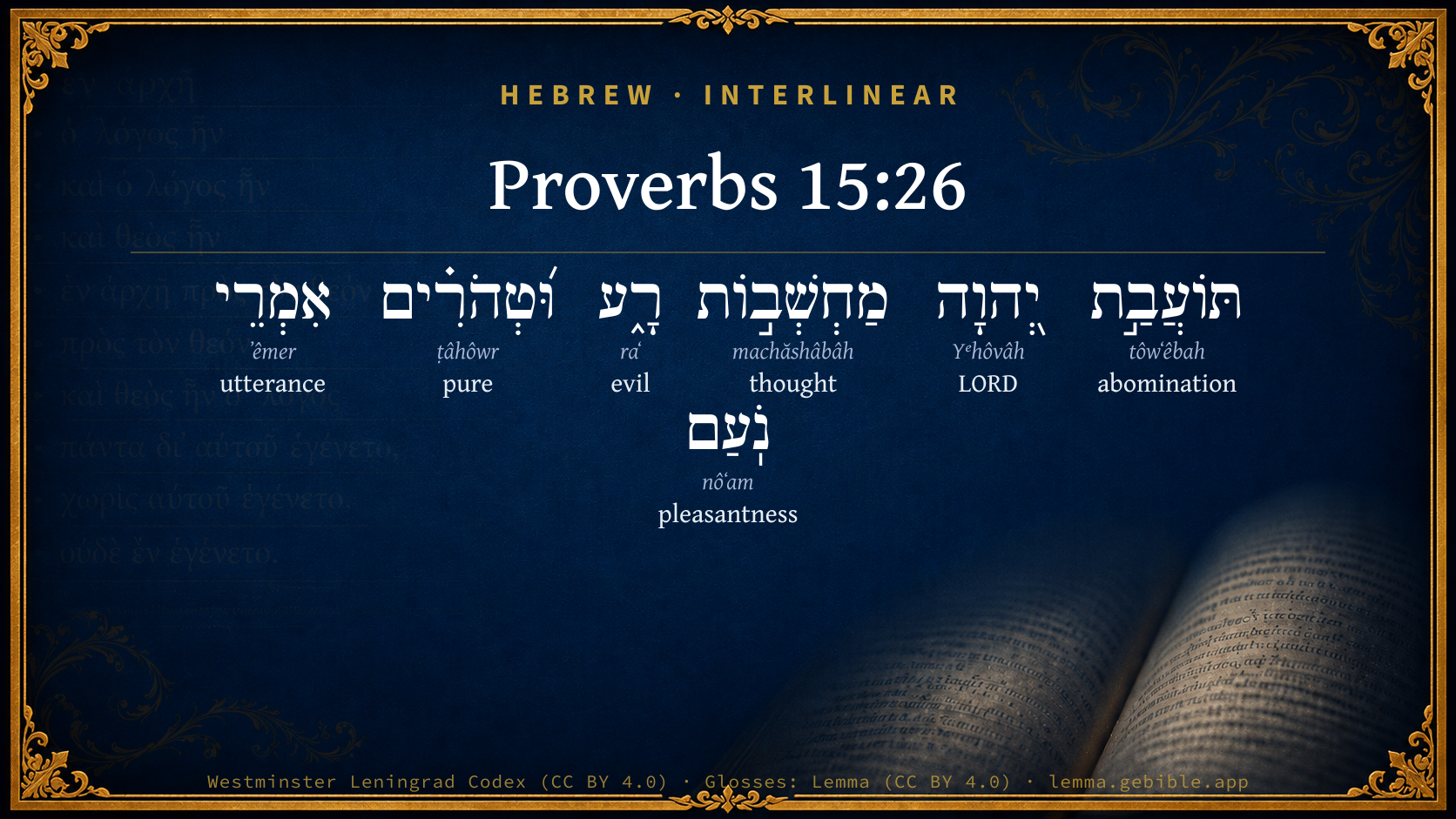
Proverbs 15:26

Hebrew (Westminster Leningrad Codex) Proverbs 15:26 appears in the Hebrew Old Testament. The text above is from the Westminster Leningrad Codex. Each word links to its Strong’s number, a concise gloss, and parsing drawn from the Open Scriptures Hebrew Bible morphology. Click any word for its full Brown-Driver-Briggs (BDB) entry.
Download image
Cite this verse

Proverbs 15:26 (World English Bible). Public Domain. Lemma interlinear Bible study tool, https://lemma.gebible.app/v/proverbs/15/26.

Show BibTeX & RIS
BibTeX
RIS
English Translation
Yahweh detests the thoughts of the wicked, But the thoughts of the pure are pleasing.
World English Bible · Public Domain
Download a study sheet

One document with this verse’s original text, its word-by-word gloss line, the meaning frame, cross-references with their text, attributed commentary, and full source and license credits — printable, and it pastes into notes with its structure intact.

This verse Autodidact and up

Study sheet (.html) Plain text (.txt)

A passage Seminary Student

Up to 50 verses in one chapter. A passage sheet keeps up to 6 commentary sources and 12 cross-references per verse, in the order this page ranks them, and says so on the sheet whenever that leaves anything out. Ask for a single verse and you get the Autodidact verse sheet above.

Everything on this page stays free to read, with no account — the sheet is a download of what is already on screen, not access to it.

Want to remove ads? Support Godless Engineer
Compare translations 3

The same verse in 3 English versions, stacked beneath the original-language interlinear above. Click any original word for its lexicon entry.

Each is an independent rendering of the whole verse — the interlinear is not word-aligned to these translations.

Highlighted words mark where these versions differ — a whole-verse word diff, not a word-by-word alignment.

  • World English Bible Public Domain
    Yahweh detests the thoughts of the wicked, But the thoughts of the pure are pleasing.
  • King James Version Public Domain
    The thoughts of the wicked are an abomination to the LORD: but the words of the pure are pleasant words.
  • unfoldingWord Literal Text CC BY-SA 4.0
    Evil thoughts an abomination to Yahweh, but words of pleasantness pure ones.

unfoldingWord Literal Text — © unfoldingWord, licensed CC BY-SA 4.0. Word-aligned USFM3 via Door43 (git.door43.org/unfoldingWord/en_ult).

Versions to compare (up to 4)

3 of 4 selected

Show all 18 translations

Every available English version of this verse, each an independent rendering of the whole verse.

  • World English Bible Public Domain
    Yahweh detests the thoughts of the wicked, But the thoughts of the pure are pleasing.
  • Berean Standard Bible Public Domain
    The LORD detests the thoughts of the wicked, but the words of the pure are pleasant to Him.
  • Majority Standard Bible Public Domain
    The LORD detests the thoughts of the wicked, but the words of the pure are pleasant to Him.
  • King James Version Public Domain
    The thoughts of the wicked are an abomination to the LORD: but the words of the pure are pleasant words.
  • American Standard Version (1901) Public Domain
    Evil devices are an abomination to Jehovah; But pleasant words `are' pure.
  • Revised Version (1885) Public Domain
    Evil devices are an abomination to the LORD: but pleasant words are pure.
  • Geneva Bible (1599) Public Domain
    The thoughts of ye wicked are abomination to the Lord: but the pure haue pleasant wordes.
  • Douay-Rheims (1899) Public Domain
    Evil thoughts are an abomination to the Lord: and pure words most beautiful shall be confirmed by him.
  • Young's Literal Translation Public Domain
    An abomination to Jehovah `are' thoughts of wickedness, And pure `are' sayings of pleasantness.
  • Literal Standard Version CC BY-SA 4.0
    Thoughts of wickedness [are] an abomination to YHWH, || And sayings of pleasantness [are] pure.
  • Unlocked Literal Bible CC BY-SA 4.0
    Yahweh hates the thoughts of wicked people, but the words of kindness are pure.
  • unfoldingWord Literal Text CC BY-SA 4.0
    Evil thoughts an abomination to Yahweh, but words of pleasantness pure ones.
  • Darby Bible Public Domain
    The thoughts of the evil [man] are an abomination to Jehovah; but pure words are pleasant.
  • World Messianic Bible Public Domain
    The LORD detests the thoughts of the wicked, but the thoughts of the pure are pleasing.
  • Webster's Bible Public Domain
    The thoughts of the wicked are an abomination to the LORD: but the words of the pure are pleasant words.
  • Free Bible Version CC BY-SA 4.0
    The Lord hates the thoughts of the wicked, but he honors the words of the pure.
  • Bible in Basic English Public Domain
    Evil designs are disgusting to the Lord, but the words of the clean-hearted are pleasing.
  • JPS Tanakh (1917) Public Domain
    The thoughts of wickedness are an abomination to the LORD; but words of pleasantness are pure.

Literal Standard Version (2020), Covenant Press — licensed CC BY-SA 4.0. Text via the HelloAO Bible API (eBible.org). Unlocked Literal Bible (unfoldingWord) — licensed CC BY-SA 4.0. Text via the HelloAO Bible API (eBible.org). unfoldingWord Literal Text — © unfoldingWord, licensed CC BY-SA 4.0. Word-aligned USFM3 via Door43 (git.door43.org/unfoldingWord/en_ult). Free Bible Version, Dr. Jonathan Gallagher — licensed CC BY-SA 4.0. Text via the HelloAO Bible API (eBible.org).

Word by word

More ways to search: Search by grammar → Find every occurrence → Compare this word →

Practice this passage: Drill this verse → Learn its vocabulary →

About this verse

These counts appear in no published source. They are computed here, from the morphology-tagged text and Lemma’s own curated glosses. What Lemma adds →

7
words
7
distinct lemmas
Wisdom
section

Notable vocabulary

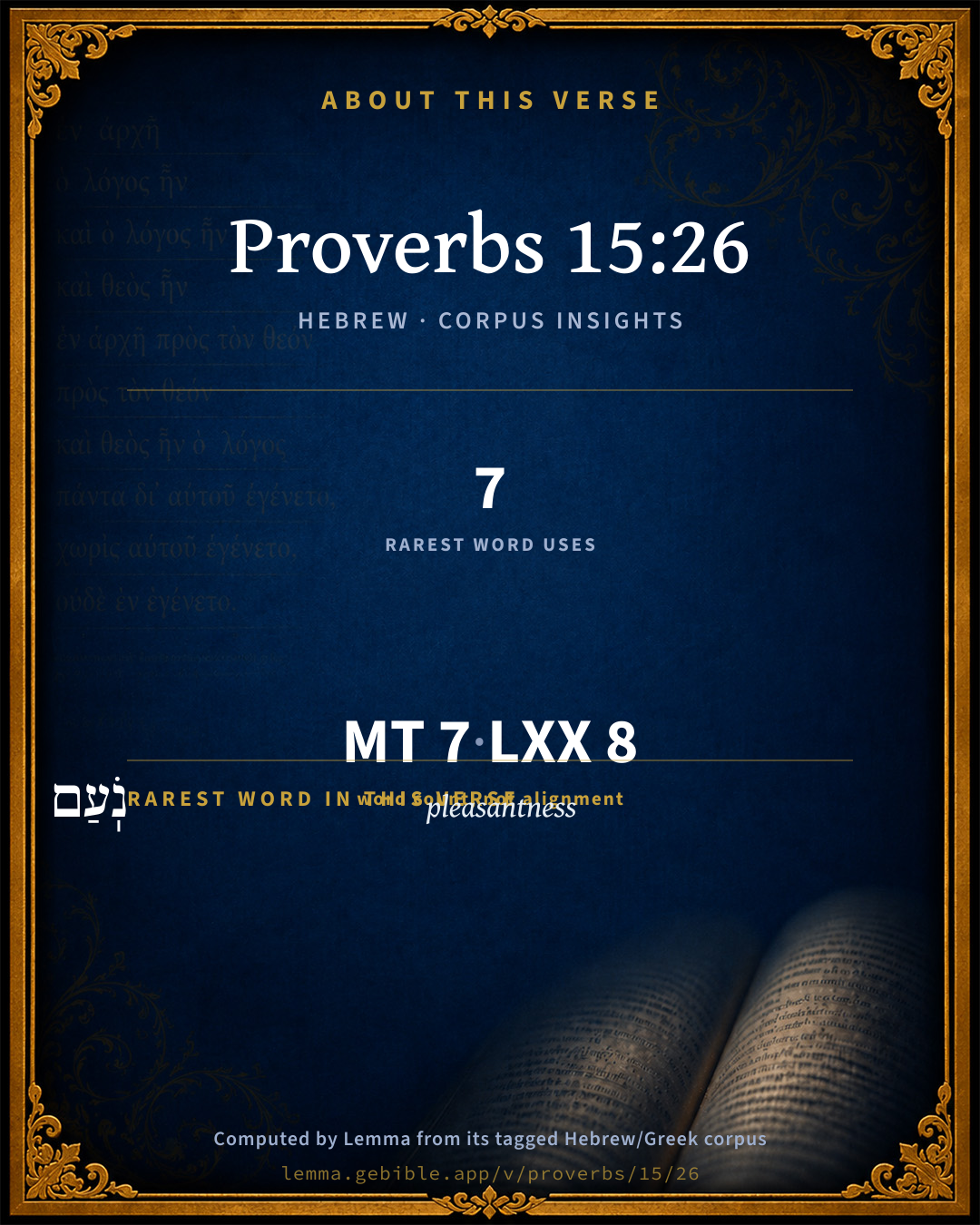
The rarest word here is נֹֽעַם pleasantness H5278 — appearing just 7 times in the whole Hebrew Bible.

Shared distinctive vocabulary

נֹֽעַם pleasantness H5278 occurs in 7 verses of the Hebrew Bible. Also found in:

Grammatical profile

  • 5 nouns
  • 2 adjectives

Hebrew & Septuagint length

In English translation the verse runs 15 words from the Hebrew and 18 from the Septuagint (LXX English) — closely comparable.

A rough comparison of the two English renderings, which tokenize alike — not a word-level alignment.

Word counts can differ between the Hebrew and the Greek without any difference in meaning — e.g. the Hebrew direct-object marker אֵת has no separate Greek word, and Greek often adds the article ὁ.

In the original languages it is 7 Hebrew tokens and 8 Greek tokens — but the two are counted differently (Hebrew bundles its prefixes and suffixes into one token; the Greek is in lemma form), so that isn’t a like-for-like length.

Cross-references

9

Topical passages linked to Proverbs 15:26 in the Treasury of Scripture Knowledge — connected by theme and wording, ordered by reader-vote popularity; previews shown in the World English Bible.

  • Proverbs 6:16–19 There are six things which Yahweh hates; Yes, seven which are an abomination to him:
  • Proverbs 15:23 Joy comes to a man with the reply of his mouth. How good is a word at the right time!
  • Jeremiah 4:14 Jerusalem, wash your heart from wickedness, that you may be saved. How long shall your evil thoughts lodge within you?
  • Matthew 12:34–37 You offspring of vipers, how can you, being evil, speak good things? For out of the abundance of the heart, the mouth speaks.
  • Psalms 19:14 Let the words of my mouth and the meditation of my heart Be acceptable in your sight, Yahweh, my rock, and my redeemer.
  • Psalms 37:30–31 The mouth of the righteous talks of wisdom. His tongue speaks justice.
  • Psalms 45:1 My heart overflows with a noble theme. I recite my verses for the king. My tongue is like the pen of a skillful writer.
  • Proverbs 24:9 The schemes of folly are sin. The mocker is detested by men.
  • Matthew 15:19 For out of the heart come forth evil thoughts, murders, adulteries, sexual sins, thefts, false testimony, and blasphemies.

Cross-references courtesy of OpenBible.info (CC BY 4.0).

Hebrew and Greek witnesses Masoretic Hebrew ↔ Greek Septuagint

The same verse in the two great witnesses to the Old Testament, shown verse-for-verse.

These are two independent witnesses, not word-aligned to each other, and the Septuagint is shown in lemma (dictionary) form.

Hebrew Proverbs 15:26 Masoretic · Westminster Leningrad Codex

תּוֹעֲבַ֣ת יְ֭הוָה מַחְשְׁב֣וֹת רָ֑ע וּ֝טְהֹרִ֗ים אִמְרֵי נֹֽעַם

Yahweh detests the thoughts of the wicked, But the thoughts of the pure are pleasing.

World English Bible · Public Domain

Greek LXX Proverbs 15:26 Septuagint · lemma form

βδέλυγμα κύριος λογισμός ἄδικος ἁγνός δέ ῥῆσις σεμνός

An unrighteous thought is abomination to the Lord; but the sayings of the pure are held in honor.

LXX2012 (modern English Septuagint) · Public Domain

On this verse, John Gill's Exposition discusses the Septuagint’s reading. Read the note in Commentary ↓

Hebrew: Westminster Leningrad Codex (CC BY 4.0). Greek: Septuagint (public domain); English from LXX2012 (modern English Septuagint) (Public Domain). How the Septuagint differs from the Hebrew →

Commentary

Notes on Proverbs 15:26 from classic Christian and Jewish commentators (each source and its license shown beneath its notes). The classic Christian expositions comment on the surrounding passage and are grouped to its opening verse, so a note may address several verses; the Jewish commentaries on the Tanakh (Rashi and others) are per-verse, so they appear only where the commentator wrote on this verse.

Lemma curates 59 commentaries, every one of them public domain or Creative Commons licensed, each selected and text-cleaned for this edition rather than reprinted as found. About our sources →

Trapp's Complete Commentary

John Trapp

Pro 15:26 The thoughts of the wicked [are] an abomination to the LORD: but [the words] of the pure [are] pleasant words.

Ver. 26. The thoughts of the wicked are abomination.] Let him not think to think at liberty. Thought is not free, as some fools would have it. To such God saith, "Hearken, O earth; behold I bring evil upon this people, even the fruit of their thoughts." {Jer 6:19} The very heathen could say, Fecit quisque quantum voluit, What evil a man wills he doth. And Incesta est et sine stupro quoe stuprum cupit. He that lusteth after a woman, hath lain with her in his heart. "If I regard iniquity in mine heart," saith David, "shall not God find this out, and for it reject my prayer?" {Psa 66:18} Kimchi, being soured with Pharisaical leaven, makes this strange sense of that text: If I regard iniquity only in my heart, so that it break not forth into outward act, the Lord will not hear me - that is, he will not hear so as to impute it or account it a sin. But was not this caedem Scripturarum facere, as Tertullian hath it, to murder the Scripture, or at least to set it on the rack, so as to make it speak what it never intended, to force it to go two miles when it would go but one.

But the words of the pure are pleasant words.] Such as God books up, {Mal 3:16} and makes hard shift to hear, as I may so say, for he "hearkens and hears" (ibid.). The rather because these pleasant words are the fruits and products of that law of grace within, that "good treasure," that habit of heavenly mindedness they have acquired. For though "the heart of the wicked be little worth," and as little set by, yet "the tongue of the just is as choice silver." {Pro 10:20} {See Trapp on "Pro 10:20"} He mints his words, and God lays them up as his riches, yea, looks upon them "as apples of gold in pictures of silver," {Pro 25:11} as gold put in a case of cut-work of silver, which is no less precious than pleasant. {Ecc 12:10} {See Trapp on "Ecc 12:10"}

John Trapp, A Commentary or Exposition upon All the Books of the Old and New Testament (1647–1656) — public domain. Text from a community e-Sword module.

Joseph Benson's Commentary

Pro 15:26. The thoughts of the wicked — Their evil intentions and affections, their wicked designs and contrivances, nay, their very thoughts and imaginations; are an abomination to the Lord — Are abhorred, and will be punished by him; but the words of the pure — Which discover and proceed from their thoughts, Mat 15:19; are pleasant words — Acceptable to God, the reverse of being an abomination to him.

Joseph Benson's Commentary on the Old and New Testaments (1811–1818) — public domain. Text from a community e-Sword module.

The Preacher's Complete Homiletical Commentary

Joseph S. Exell (gen. ed.)

CRITICAL NOTES.—

Pro_15:26. The words of the pure are pleasant, or “pure in His sight are pleasant words.

MAIN HOMILETICS OF Pro_15:26

WICKED THOUGHTS AND HOLY WORDS

I. A present power of the wicked man—he thinks. The ideas and purposes which fill his mind concerning himself, his fellow-men, and God, are the result of a mental process just as the potter’s vessel is the result of a certain manipulating process. His thoughts are the result of the exercise of a God-given power, just as the potter’s vessel is the result of a power which has been given to him by God. From the same source comes the power to think and the power to turn the wheel. But although the power to think comes from God, it rests with man as to what kind of thoughts shall be the outcome of that power. God holds him responsible for the use which he makes of the power given him. It would be useless for the potter to say that the vessel which leaves his hand took its form by chance—we hold him responsible for the shape which the clay assumes under his hands. And it is equally vain for a man to say that he has no power over his thoughts. God holds him guilty if he thinks thoughts of sin.

II. The thoughts of the wicked are abhorred by God.

1. Because of the harm they do to his own soul. If the body is held bound under the sway of a deadly malady it becomes weak and unable to fulfil the end of its creation, and if it continues long under its influence it dies. So soul-disease and moral death are the result of the rule of evil thoughts to the man who thinks them. He becomes incapable of fulfilling the high spiritual destiny for which God called him into being.

2. Because of the misery they inflict upon others. All the evil words and deeds that have ever been done in the world were once thoughts. While they were only thoughts the harm they inflicted was confined to the thinker of them, but as soon as they became words or deeds the moral poison spread, and others became sufferers from them. God hates whatever will increase the misery of his creatures, and therefore the thoughts of the wicked—those fruitful germs of sin and suffering—must be an abomination to Him.

3. Because they are utterly at variance with God’s thoughts and purposes. The thoughts of God towards the wicked themselves are opposed to the thoughts and purposes which they have concerning themselves. God’s thoughts towards them are “thoughts of peace and not of evil” (Jer_29:11). He desires that “the wicked forsake his way” and “return unto Him.” He declares that His thoughts even concerning sinners are as much higher than their thoughts concerning themselves as “the heavens are higher than the earth” (Isa_55:7-8). This is one ground of God’s quarrel with the thoughts of the wicked, that they cross His gracious plans for redeeming them. But—

III. The words of the pure are pleasing to God. Likeness of character draws men together—the pure delight in those who are pure, and the words of a pure man are pleasant to the ear of another man of purity. Pure men are like God in character, and He must find pleasure in those who reflect His own image, and who are one with Him in sympathy. Delighting in them, their words are pleasant unto Him. He delights in them when they take the form of prayer (See Homiletics on Pro_15:8, page 407). The “prayers of saints” are as sweet incense to Him (Rev_5:8; Rev_8:3). They are well-pleasing when they take the form of praise. He has commanded men to render honour where honour is due (Rom_13:7), and when it is rendered to Himself the most worthy to “receive honour and glory and blessing,” it is a most acceptable sacrifice (Lev_7:12; Heb_13:15). The words of the pure are pleasant to God when they are spoken to console and bless their fellow-creatures. (On this subject see Homiletics on chap. Pro_12:18, page 275.)

OUTLINES AND SUGGESTIVE COMMENTS

Pleasant words are pure. (See Critical Notes.) This is the Scripture ethics. If we desire to know whether “words are pure” (and, words here, for Eastern reasons, mean actions as well as words; nay, really mean the whole round of conduct; see Job_20:12; Isa_10:7), if we wish to know whether a man’s whole life is pure, all we have to ask is—Is it kind? It is the plans of mischief that are the abomination of Jehovah.—Miller.

How lightly do most men think of the responsibility of their thoughts! as if they were their own, and they might indulge them without restraint or evil. One substantial sin appals men, who quietly sleep under the mighty mass of thinking without God for months and years, without any apprehension of guilt. But thoughts are the seminal principles of sin.—Bridges.

“Words of pleasantness are pure”—the gracious words that seek to please, not wound, are to Him as a pure acceptable offering, the similitude being taken from the Jewish ritual, and the word “pure” used in a half ceremonial sense, as in Mal_1:11.—Plumptre.

The words of the pure are pleasant words. Such as God books up, and makes hard shift to hear, as I may so say; for He “hearkens and hears” (Mal_3:16).—Trapp.

God seeth that Himself is not in all the thoughts of the wicked, and what can it be but abomination to God where God is not? It is God in all things that is pleasing to Himself, and it is the absence of God in anything that makes it to be abominable. But as for the thoughts of the pure, they are words of pleasantness, wherein they sing and make melody in their hearts to the Lord. In them they sweetly converse to themselves, by them they heavenly converse with God. Pleasant they are to themselves by the joy they have in them, pleasant they are to God by the delight He taketh in them. The wicked, though alone, and though doing nothing, yet are doing wickedly; for even then their thoughts are working, and working so naughtily as to be an abomination to the Lord. There is no need of company to draw them into villany, they have always a rout of mischievous thoughts on hand to give them entertainment. And as great is the pleasure which themselves take in them, so great is the abomination which God hath of them.—Jermin.

The Preacher's Complete Homiletical Commentary (gen. ed. Joseph S. Exell; Funk & Wagnalls, c. 1892) — public domain (pre-1929). A full-Bible homiletical/sermon-outline anthology covering 65 of 66 books (2 John is absent from the source module). Text from a community e-Sword module.

Geneva Bible (1599)

Geneva Bible translators

That is, wholesome and profitable to the hearers.

Geneva Bible (1599) marginal notes — public domain. Text via Bolls.life.

Matthew Henry's Commentary

The former part of this verse speaks of thoughts, the latter of words, but they come all to one; for thoughts are words to God, and words are judged of by the thoughts from which they proceed, so that, 1. The thoughts and words of the wicked, which are, like themselves, wicked, which aim at mischief, and have some ill tendency or other, are an abomination to the Lord; he is displeased at them and will reckon for them. The thoughts of wicked men, for the most part, are such as God hates, and are an offence to him, who not only knows the heart and all that passes and repasses there, but requires the innermost and uppermost place in it. 2. The thoughts and words of the pure, being pure like themselves, clean, honest, and sincere, are pleasant words and pleasant thoughts, well-pleasing to the holy God, who delights in purity. It may be understood both of their devotions to God (the words of their mouth and the meditations of their heart, in prayer and praise, are acceptable to God, Psa 19:14; Psa 69:13) and of their discourses with men, tending to edification. Both are pleasant when they come from a pure, a purified, heart.

Matthew Henry's Commentary on the Whole Bible (1708–1710) — public domain (CC PDM 1.0). Text via the HelloAO Bible API.

Jamieson, Fausset & Brown

Robert Jamieson, A. R. Fausset & David Brown

are pleasant words--that is, pleasing to God (Pro 8:8-9).

Jamieson, Fausset & Brown — Commentary Critical and Explanatory on the Whole Bible (1871) — public domain (CC PDM 1.0). Text via the HelloAO Bible API.

Ellicott's Commentary for English Readers

(26) The thoughts of the wicked.—Rather, thoughts of evil, wicked designs.

But the words of the pure are pleasant words.—Rather, pleasant words (i.e., kindly meant, soothing words; comp. Pro_16:24) are pure in God’s sight; accepted by Him as coming from a well-meaning heart.

A Bible Commentary for English Readers, edited by Charles John Ellicott (1878–1897) — public domain. Text from a community e-Sword module.

The Cambridge Bible for Schools and Colleges

gen. ed. J. J. S. Perowne

26. thoughts of the wicked … pleasant words] Lit. devices of evil … words of pleasantness. The contrast is between these, and then further between the former, as “abomination to Jehovah,” and the latter as “pure,” and therefore acceptable to Him. There is possibly, as Maurer suggests, a sacrificial reference (“sensu Levitico”); comp. Pro_15:8 above and “a pure offering,” Mal_1:11.

The Cambridge Bible for Schools and Colleges (gen. ed. J. J. S. Perowne; Cambridge University Press, 1878–1918) — public domain. Text from a community e-Sword module.

John Gill's Exposition

The thoughts of the wicked are an abomination to the Lord,.... They are known unto the Lord, who is the searcher of the heart, and a discerner of the thoughts and intents of it; he knows they are vain and sinful, yea, that they are only evil, and that continually, and therefore are hateful and abominable to him; it may be rendered "the thoughts of evil", as by the Targum; or evil thoughts, as the Septuagint, Vulgate Latin, and the Oriental versions; but Aben Ezra interprets as we, the thoughts of a wicked man, which are never otherwise but evil; whereas in a good man, though there are many evil thoughts which are abominable to himself, yet there are some good thoughts, and which are pleasing to the Lord, as follows;

but the words of the pure are pleasant words; that is, unto the Lord; which are the same with their thoughts, and are the effect of them, and so stand opposed to the thoughts of the wicked; these, expressed either in a way of prayer or of praise, are sweet and pleasant, and acceptable unto God through Christ; as likewise their words and discourse in religious conversation, which also minister grace unto the hearer, and are very delightful and pleasing to saints; the words may be supplied thus, "but the thoughts of the pure", of such who are pure in heart, whose hearts are purified by faith in the blood of Christ, are "words of pleasantness", so Gersom; there is a language in thought which is known to a man's self, and by the Lord; there is the meditation or discourse of the heart, and this being about divine and spiritual things is pleasing to God; he hearkens to it, and writes a book of remembrance for them that fear him, and have thought on his name; see Psa 19:14.

John Gill's Exposition of the Whole Bible (1746–1763) — public domain (CC PDM 1.0). Text via the HelloAO Bible API.

Albert Barnes' Notes on the Bible

Some prefer the margin, and render, words of pleasantness are pure. Gracious words are to God as a pure acceptable offering, the similitude being taken from the Levitical ritual, and the word “pure” in half ceremonial sense (compare Mal 1:11).

Albert Barnes' Notes on the Bible (1834–1885) — public domain. Text from a community e-Sword/MySword module.

Haydock's Catholic Bible Commentary

Shall by, &c., is not added in Hebrew, &c., nor in several Latin manuscripts.

George Leo Haydock (1774–1849), Haydock's Catholic Family Bible and Commentary, 1859 edition — public domain. Excludes Psalms (Douay-Rheims chapter numbering differs from Protestant) and Deuterocanonical books (Catholic canon only).

Matthew Poole's English Annotations

The thoughts of the wicked; and much more their words, which express their thoughts; for thoughts are said to be free, and wicked men are seldom and but little concerned for the sins of their thoughts.

The words of the pure, which discover and proceed from their thoughts, Mat 15:19.

Pleasant; acceptable to God, which is opposed to abomination to him.

Matthew Poole's English Annotations on the Holy Bible (1683–1685) — public domain. Text from a community e-Sword/MySword module.

Whedon's Commentary on the Bible

Daniel D. Whedon

26. Thoughts of the wicked — Or, wicked devices, plans.

Words of the pure are pleasant — “Words of kindness are pure or gracious words.” So Conant and Zockler. The ideas are derived from the Hebrew ritual of things clean and unclean. The wicked and their devices are unclean, and an abomination to Jehovah; the righteous and their words are clean, and acceptable to him.

Daniel D. Whedon (gen. ed.), Commentary on the Old and New Testaments (1874–1909) — public domain. Text from a community e-Sword module.

The Pulpit Commentary

The thoughts of the wicked (or, evil devices) are an abomination to the Lord. Although the Decalogue, by forbidding coveting, showed that God"s Law touched the thought of the heart as well as the outward action, the idea here refers to wicked plans or designs, rather than emphatically to the secret movements of the mind. These have been noticed in ver. 11. But the words of the pure are pleasant words; literally, pure are words of pleasantness ; i.e. words of soothing, comforting tone are, not an abomination to the Lord, as are the devices of the wicked, but they are pure in a ceremonial sense, as it were, a pure and acceptable offering. Revised Version, pleasant words are pure. Vulgate, "Speech pure and pleasant is approved by him which is a pharaphrase of the clause. Septuagint, "The words of the pure are honoured (semnai )."

The Pulpit Commentary (1880–1919), ed. H.D.M. Spence-Jones & Joseph S. Exell — public domain. Text from a community e-Sword module.

John Wesley's Explanatory Notes

Pleasant - Acceptable to God.

John Wesley, Explanatory Notes Upon the Whole Bible (1754–1765) — public domain. Text via the GEBible commentary corpus.

Keil & Delitzsch

C. F. Keil & F. Delitzsch

26 An abomination to Jahve are evil thoughts;

But gracious words are to Him pure.

Not personally (Luther: the plans of the wicked) but neutrally is רע here meant as at Pro 2:14, and in אושׁת רע, Pro 6:24 (cf. Pers. merdi nı̂ku, man of good = good man), vid., Friedr. Philippi's Status Constr. p. 121. Thoughts which are of a bad kind and of a bad tendency, particularly (what the parallel member brings near) of a bad disposition and design against others, are an abomination to God; but, on the contrary, pure, viz., in His eyes, which cannot look upon iniquity (Hab 1:13), are the אמרי־נעם, words of compassion and of friendship toward men, which are (after 26a) the expression of such thoughts, thus sincere, benevolent words, the influence of which on the soul and body of him to whom they refer is described, Pro 16:24. The Syr., Targ., Symmachus, Theodotion, and the Venet. recognise in וּטהורים the pred., while, on the contrary, the lxx, Jerome, and Luther (who finally decided for the translation, "but the pure speak comfortably") regard it as subject. But that would be an attribution which exceeds the measure of possibility, and for which אמרים or דברי must be used; also the parallelism requires that טהורים correspond with 'תועבת ה. Hence also the reference of וטהורים to the judgment of God, which is determined after the motive of pure untainted law; that which proceeds from such, that and that only, is pure, pure in His sight, and thus also pure in itself.

Keil & Delitzsch — Biblical Commentary on the Old Testament (1861–1891) — public domain (CC PDM 1.0). Text via the HelloAO Bible API. (Old Testament only.)

Bridges on Proverbs

Charles Bridges

How lightly do most men think of the responsibility of their thoughts! as if they were their own, and they might indulge them without restraint or evil. One substantial sin appals men, who quietly sleep under the mighty mass of thinking without God for months and years, without any apprehension of guilt. But thoughts are the seminal principles of sin.†1 And as the cause virtually includes its effects; so do they contain, like the seed in its little body, all the after fruit. They are also the index of character. Watch their infinite variety; not so much those that are under the control of circumstances, or thrown up by the occasion, as the voluntary flow, following the habitual train of our associations. "For as a man thinketh in his heart, so is he." (Pro 23:7 .) Let the Christian yield himself up to the clear radiance of "the word, as a discerner of the thoughts and intents of the heart:"†2 and what a mass of vanity does only one day, one hour, bring to account! As to the wicked? "Evil thoughts" are the first bubbling of the corrupt fountain. (Mat 15:19 .) The tide of evil rolls on unceasingly in "thoughts of iniquity" (Isa 59:7 ), in order to give effect to the malevolent temper; dwelling on wickedness with complacency; pursuing it with determined purpose. What can such thoughts be, but an abomination to the LORD?

Very different is his mind towards his own people. The words of the pure, as the expression of their thoughts (Mat 12:34 . Psa 37:30-31 ), are pleasant words. How pleasant, is manifest from his inviting call to their intercourse with him (Pro 15:8 . Song of Son 2:14 ); yet more from the open reward prepared for them before the assembled world. "They that spake often one to another — and thought upon his name — they shall be mine, saith the LORD, in that day when I make up my jewels." (Mal 3:16-17 .)

Footnotes:

†1 Pro 24:9. Gen 6:5 . Even an Heathen accurately described them. AutocJonaV phgaV thV kakiaV. ’The indigenous fountains of evil.’ Plutarch. Moral — Again — ’If thou wouldest unlock the door of thine heart, thou wilt find a storehouse and treasury of evils diversified, and full of numberless passions.’ Ibid. ().

†2 Heb 4:12-13. kritikoV — a critic, censuring the errata with the most minute accuracy. ()

Charles Bridges, An Exposition of the Book of Proverbs (1846) — public domain. Text from a community e-Sword module.

Kretzmann's Popular Commentary

Paul E. Kretzmann

v. 26. The thoughts of the wicked are an abomination to the Lord, He loathes evil plans, He will not tolerate wicked purposes; but the words of the pure are pleasant words, literally, "but pure are words of pleasantness"; if untainted by hypocrisy, they are sweetly consoling, full of consolation for troubled souls, and therefore precious in the sight of Jehovah.

Paul E. Kretzmann, Popular Commentary of the Bible (1921–1924) — public domain. Text from a community e-Sword module.

Lesson kit

Teaching starters — assembled from the data on this page, not authored interpretation. Every prompt links to the verse data it draws on. Edit before teaching.

Proverbs, in the Wisdom, opens this verse with 7 words (7 distinct Hebrew lemmas). Its most distinctive word is nôʻam (“pleasantness”). A historical commentator’s framing appears above. Read the whole chapter for the surrounding context.

Discussion questions

  1. What does “pleasantness” (nôʻam) contribute to the verse as a whole?
  2. How does Psalms 27:4, which shares the word «pleasantness», read alongside this verse?
  3. These translations render this verse differently; the difference is in the English rendering, not the original. What questions does that raise?
  4. Compare how Trapp's Complete Commentary and Joseph Benson's Commentary read this verse. Where do they agree or differ?

Things to notice

Reading settings

Reading text

Shown beneath each verse's original-language words.

Old Testament
Old Testament edition

Read the OT as the Masoretic Hebrew (MT) or the Greek Septuagint (LXX).

English shown for the Greek Septuagint (in the Hebrew ↔ Greek comparison).

Comparing translations? Open the Compare panel on any verse page to stack up to four side by side.