Proverbs 30:33

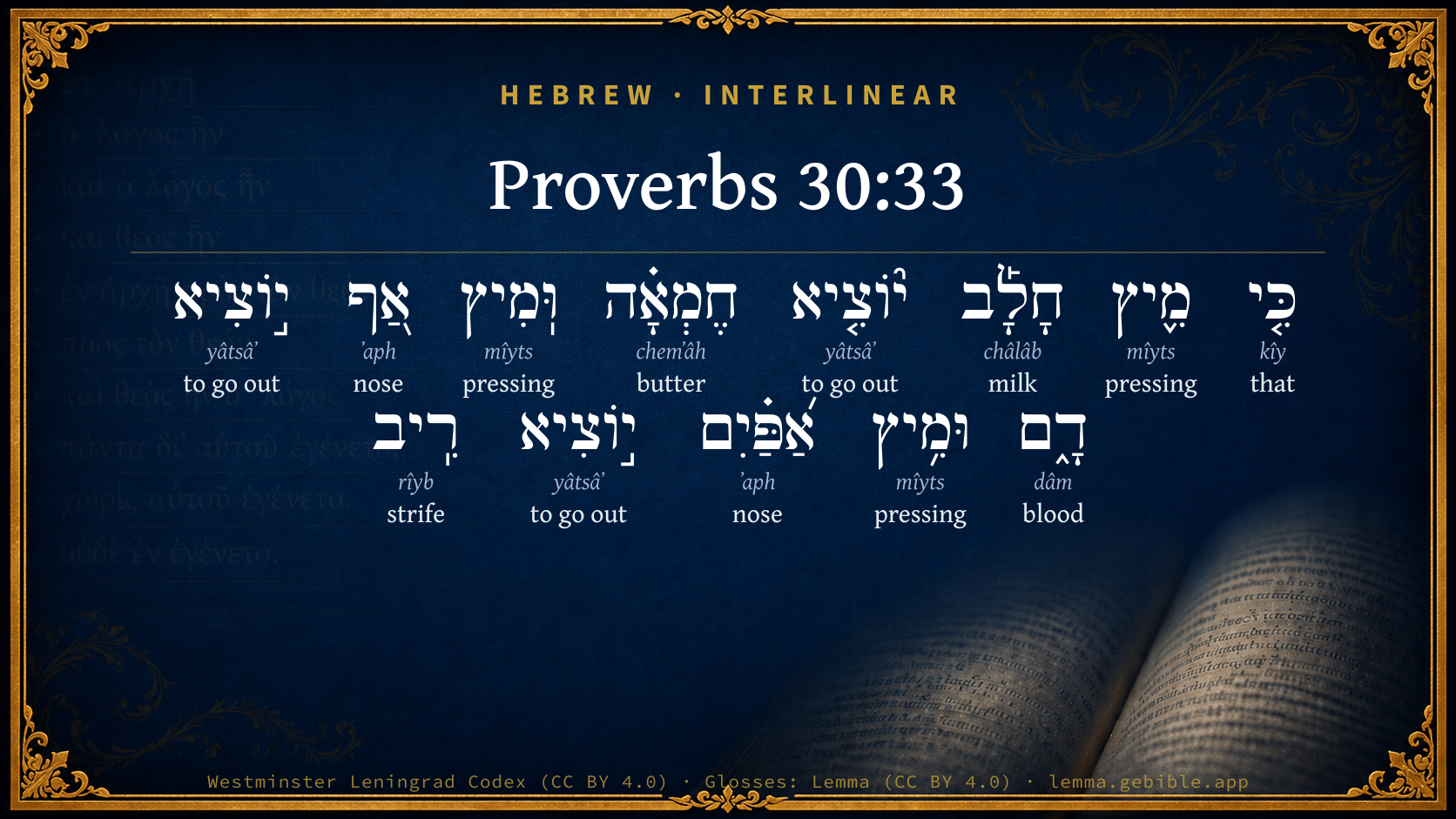
Hebrew (Westminster Leningrad Codex) Proverbs 30:33 appears in the Hebrew Old Testament. The text above is from the Westminster Leningrad Codex. Each word links to its Strong’s number, a concise gloss, and parsing drawn from the Open Scriptures Hebrew Bible morphology. Click any word for its full Brown-Driver-Briggs (BDB) entry.
Download image
Cite this verse

Proverbs 30:33 (World English Bible). Public Domain. Lemma interlinear Bible study tool, https://lemma.gebible.app/v/proverbs/30/33.

Show BibTeX & RIS
BibTeX
RIS
English Translation
For as the churning of milk brings forth butter, And the wringing of the nose brings forth blood; So the forcing of wrath brings forth strife."
World English Bible · Public Domain
Highlights
  • 1 first appearance in the Hebrew Bible
Full analysis ↓
Download a study sheet

One document with this verse’s original text, its word-by-word gloss line, the meaning frame, cross-references with their text, attributed commentary, and full source and license credits — printable, and it pastes into notes with its structure intact.

This verse Autodidact and up

Study sheet (.html) Plain text (.txt)

A passage Seminary Student

Up to 50 verses in one chapter. A passage sheet keeps up to 6 commentary sources and 12 cross-references per verse, in the order this page ranks them, and says so on the sheet whenever that leaves anything out. Ask for a single verse and you get the Autodidact verse sheet above.

Everything on this page stays free to read, with no account — the sheet is a download of what is already on screen, not access to it.

Want to remove ads? Support Godless Engineer
Compare translations 3

The same verse in 3 English versions, stacked beneath the original-language interlinear above. Click any original word for its lexicon entry.

Each is an independent rendering of the whole verse — the interlinear is not word-aligned to these translations.

Highlighted words mark where these versions differ — a whole-verse word diff, not a word-by-word alignment.

  • World English Bible Public Domain
    For as the churning of milk brings forth butter, And the wringing of the nose brings forth blood; So the forcing of wrath brings forth strife."
  • King James Version Public Domain
    Surely the churning of milk bringeth forth butter, and the wringing of the nose bringeth forth blood: so the forcing of wrath bringeth forth strife.
  • unfoldingWord Literal Text CC BY-SA 4.0
    For the squeezing of milk brings out butter, and the squeezing of the nose brings out blood, and the squeezing of nostrils brings out strife.”

unfoldingWord Literal Text — © unfoldingWord, licensed CC BY-SA 4.0. Word-aligned USFM3 via Door43 (git.door43.org/unfoldingWord/en_ult).

Versions to compare (up to 4)

3 of 4 selected

Show all 18 translations

Every available English version of this verse, each an independent rendering of the whole verse.

  • World English Bible Public Domain
    For as the churning of milk brings forth butter, And the wringing of the nose brings forth blood; So the forcing of wrath brings forth strife."
  • Berean Standard Bible Public Domain
    For as the churning of milk yields butter, and the twisting of the nose draws blood, so the stirring of anger brings forth strife.”
  • Majority Standard Bible Public Domain
    For as the churning of milk yields butter, and the twisting of the nose draws blood, so the stirring of anger brings forth strife.”
  • King James Version Public Domain
    Surely the churning of milk bringeth forth butter, and the wringing of the nose bringeth forth blood: so the forcing of wrath bringeth forth strife.
  • American Standard Version (1901) Public Domain
    For the churning of milk bringeth forth butter, And the wringing of the nose bringeth forth blood; So the forcing of wrath bringeth forth strife.
  • Revised Version (1885) Public Domain
    For the churning of milk bringeth forth butter, and the wringing of the nose bringeth forth blood: so the forcing of wrath bringeth forth strife.
  • Geneva Bible (1599) Public Domain
    When one churneth milke, he bringeth foorth butter: and he that wringeth his nose, causeth blood to come out: so he that forceth wrath, bringeth foorth strife.
  • Douay-Rheims (1899) Public Domain
    And he that strongly squeezeth the papa to bring out milk, straineth out butter: and he that violently bloweth his nose, bringeth out blood: and he that provoketh wrath bringeth forth strife.
  • Young's Literal Translation Public Domain
    For the churning of milk bringeth out butter, And the wringing of the nose bringeth out blood, And the forcing of anger bringeth out strife!
  • Literal Standard Version CC BY-SA 4.0
    For the churning of milk brings out butter, || And the wringing of the nose brings out blood, || And the forcing of anger brings out strife!
  • Unlocked Literal Bible CC BY-SA 4.0
    As churning milk makes butter and as one's nose will produce blood if it is twisted, so deeds done in anger produce conflict.
  • unfoldingWord Literal Text CC BY-SA 4.0
    For the squeezing of milk brings out butter, and the squeezing of the nose brings out blood, and the squeezing of nostrils brings out strife.”
  • Darby Bible Public Domain
    For the pressing of milk bringeth forth butter, and the pressing of the nose bringeth forth blood; and the pressing of anger bringeth forth strife.
  • World Messianic Bible Public Domain
    For as the churning of milk produces butter, and the wringing of the nose produces blood, so the forcing of wrath produces strife.”
  • Webster's Bible Public Domain
    Surely the churning of milk bringeth forth butter, and the wringing of the nose bringeth forth blood: so the forcing of wrath bringeth forth strife.
  • Free Bible Version CC BY-SA 4.0
    Just as churning milk produces butter, and twisting someone's nose makes it bleed, so stirring up anger causes arguments.
  • Bible in Basic English Public Domain
    The shaking of milk makes butter, and the twisting of the nose makes blood come: so the forcing of wrath is a cause of fighting.
  • JPS Tanakh (1917) Public Domain
    For the churning of milk bringeth forth curd, and the wringing of the nose bringeth forth blood; so the forcing of wrath bringeth forth strife.

Literal Standard Version (2020), Covenant Press — licensed CC BY-SA 4.0. Text via the HelloAO Bible API (eBible.org). Unlocked Literal Bible (unfoldingWord) — licensed CC BY-SA 4.0. Text via the HelloAO Bible API (eBible.org). unfoldingWord Literal Text — © unfoldingWord, licensed CC BY-SA 4.0. Word-aligned USFM3 via Door43 (git.door43.org/unfoldingWord/en_ult). Free Bible Version, Dr. Jonathan Gallagher — licensed CC BY-SA 4.0. Text via the HelloAO Bible API (eBible.org).

Word by word

More ways to search: Search by grammar → Find every occurrence → Compare this word →

Practice this passage: Drill this verse → Learn its vocabulary →

מִ֪יץ
mîyts
H4330
“pressing of”
Noun, Common, Masculine, Singular, Construct
Part of Speech
Noun
Type
Common
Gender
Masculine
Number
Singular
State
Construct
Full BDB Definition

Origin: from H4160

TWOT: 1192b

squeezing, pressing, wringing
  1. כִּ֤י kîy H3588 “that” Conjunction
  2. חָלָ֡ב châlâb H2461 “milk” Noun, Common, Masculine, Singular, Absolute
  3. י֘וֹצִ֤יא yâtsâʼ H3318 “to go out” Verb, Hiphil, Imperfect, 3rd Person, Masculine, Singular
  4. חֶמְאָ֗ה chemʼâh H2529 “butter” Noun, Common, Feminine, Singular, Absolute
  5. וּֽמִיץ mîyts H4330 “and · pressing of” Conjunction + Noun, Common, Masculine, Singular, Construct
  6. אַ֭ף ʼaph H639 “nose” Particle, Accusative
  7. י֣וֹצִיא yâtsâʼ H3318 “to go out” Verb, Hiphil, Imperfect, 3rd Person, Masculine, Singular
  8. דָ֑ם dâm H1818 “blood” Noun, Common, Masculine, Singular, Absolute
  9. וּמִ֥יץ mîyts H4330 “and · pressing” Conjunction + Noun, Common, Masculine, Singular, Absolute
  10. אַ֝פַּ֗יִם ʼaph H639 “nostrils” Noun, Common, Masculine, Dual, Absolute
  11. י֣וֹצִיא yâtsâʼ H3318 “to go out” Verb, Hiphil, Imperfect, 3rd Person, Masculine, Singular
  12. רִֽיב rîyb H7379 “strife” Noun, Common, Both, Singular, Absolute

About this verse

These counts appear in no published source. They are computed here, from the morphology-tagged text and Lemma’s own curated glosses. What Lemma adds →

13
words
8
distinct lemmas
Wisdom
section

Notable vocabulary

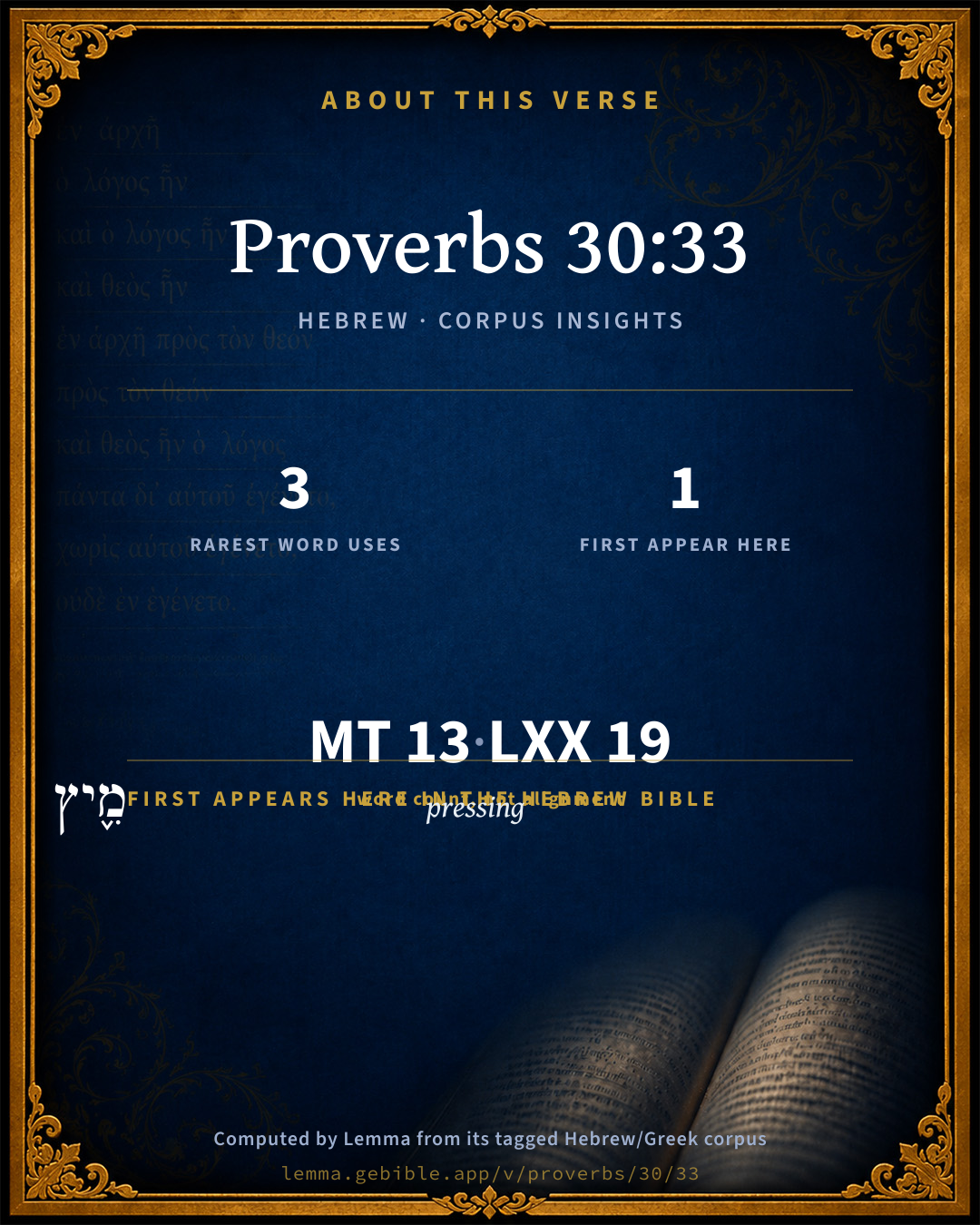
The rarest word here is מִ֪יץ pressing H4330 — appearing just 3 times in the whole Hebrew Bible.

First appearance in Scripture

This word makes its first canonical appearance in the Hebrew Bible here:

  • מִ֪יץ pressing H4330

Grammatical profile

  • 3 verbs
  • 8 nouns
  • 1 conjunction
  • 1 particle

Verb forms

  • י֘וֹצִ֤יא Hiphil · Imperfect
  • י֣וֹצִיא Hiphil · Imperfect
  • י֣וֹצִיא Hiphil · Imperfect

Repetition

Words recur within this verse — often emphatic in Hebrew:

  • מִ֪יץ pressing H4330 ×3
  • י֘וֹצִ֤יא to go out H3318 ×3
  • אַ֭ף nose H639 ×2

Hebrew & Septuagint length

In English translation the verse runs 26 words from the Hebrew and 31 from the Septuagint (LXX English) — closely comparable.

A rough comparison of the two English renderings, which tokenize alike — not a word-level alignment.

Word counts can differ between the Hebrew and the Greek without any difference in meaning — e.g. the Hebrew direct-object marker אֵת has no separate Greek word, and Greek often adds the article ὁ.

In the original languages it is 13 Hebrew tokens and 19 Greek tokens — but the two are counted differently (Hebrew bundles its prefixes and suffixes into one token; the Greek is in lemma form), so that isn’t a like-for-like length.

Cross-references

6

Topical passages linked to Proverbs 30:33 in the Treasury of Scripture Knowledge — connected by theme and wording, ordered by reader-vote popularity; previews shown in the World English Bible.

  • Proverbs 17:14 The beginning of strife is like breaching a dam, Therefore stop contention before quarreling breaks out.
  • Proverbs 29:22 An angry man stirs up strife, And a wrathful man abounds in sin.
  • Proverbs 28:25 One who is greedy stirs up strife; But one who trusts in Yahweh will prosper.
  • Proverbs 15:18 A wrathful man stirs up contention, But one who is slow to anger appeases strife.
  • Proverbs 16:28 A perverse man stirs up strife. A whisperer separates close friends.
  • Proverbs 26:21 As coals are to hot embers, And wood to fire, So is a contentious man to kindling strife.

Cross-references courtesy of OpenBible.info (CC BY 4.0).

Hebrew and Greek witnesses Masoretic Hebrew ↔ Greek Septuagint

The same verse in the two great witnesses to the Old Testament, shown verse-for-verse.

These are two independent witnesses, not word-aligned to each other, and the Septuagint is shown in lemma (dictionary) form.

Hebrew Proverbs 30:33 Masoretic · Westminster Leningrad Codex

כִּ֤י מִ֪יץ חָלָ֡ב י֘וֹצִ֤יא חֶמְאָ֗ה וּֽמִיץ אַ֭ף י֣וֹצִיא דָ֑ם וּמִ֥יץ אַ֝פַּ֗יִם י֣וֹצִיא רִֽיב

For as the churning of milk brings forth butter, And the wringing of the nose brings forth blood; So the forcing of wrath brings forth strife."

World English Bible · Public Domain

Greek LXX Proverbs 30:33 Septuagint · lemma form

ἀμέλγω γάλα καί εἰμί βούτυρον ἐάν δέ ἐκπιέζω μυκτήρ ἐκἔρχομαι αἷμα ἐάν δέ ἐκἔλκω λόγος ἐκἔρχομαι κρίσις καί μάχη

Milk out milk, and there shall be butter, and if you wing one's nostrils there shall come out blood: so if you extort words, there will come forth quarrels and strifes.

LXX2012 (modern English Septuagint) · Public Domain

On this verse, Adam Clarke's Commentary discusses the Septuagint’s reading. Read the note in Commentary ↓

Hebrew: Westminster Leningrad Codex (CC BY 4.0). Greek: Septuagint (public domain); English from LXX2012 (modern English Septuagint) (Public Domain). How the Septuagint differs from the Hebrew →

Commentary

Notes on Proverbs 30:33 from classic Christian and Jewish commentators (each source and its license shown beneath its notes). The classic Christian expositions comment on the surrounding passage and are grouped to its opening verse, so a note may address several verses; the Jewish commentaries on the Tanakh (Rashi and others) are per-verse, so they appear only where the commentator wrote on this verse.

Lemma curates 59 commentaries, every one of them public domain or Creative Commons licensed, each selected and text-cleaned for this edition rather than reprinted as found. About our sources →

Trapp's Complete Commentary

John Trapp

Pro 30:33 Surely the churning of milk bringeth forth butter, and the wringing of the nose bringeth forth blood: so the forcing of wrath bringeth forth strife.

Ver. 33. So the forcing of wrath.] Too much stirring in an offensive matter bringeth forth brawling, lawing, warring, fighting. Patientia laesa sit furor. The most patient person may be put beyond all patience if much provoked. Abner bare long with Asahel, but sped him at length. Abused mercy turns into fury. See Pro 15:1.

John Trapp, A Commentary or Exposition upon All the Books of the Old and New Testament (1647–1656) — public domain. Text from a community e-Sword module.

Joseph Benson's Commentary

Pro 30:33. Surely the churning of milk — This verse, which is connected with that preceding, is thus paraphrased by the last-mentioned author: “For from little things there is an easy progress unto greater. And just as you see milk is first pressed out of the cow’s udders, and then, being shaken in the churn, is forced into butter; and as the nose, being wrung, though at first it only purge itself, yet, if it be harder pressed, there comes out blood; even so words, passing to and fro, raise a heat, and that, if continued, stirs up anger, which frequently ends in broils and irreconcileable quarrels.”

Joseph Benson's Commentary on the Old and New Testaments (1811–1818) — public domain. Text from a community e-Sword module.

Jamieson, Fausset & Brown

Robert Jamieson, A. R. Fausset & David Brown

That is, strife--or other ills, as surely arise from devising evil as natural effects from natural causes.

Next: Proverbs Chapter 31

Jamieson, Fausset & Brown — Commentary Critical and Explanatory on the Whole Bible (1871) — public domain (CC PDM 1.0). Text via the HelloAO Bible API.

Adam Clarke's Commentary

Verse 33. And the wringing] Who hugeli snytith drawith out blood. - Old MS. Bible. This is well expressed in homely phrase. The Septuagint have, "draw the milk, and you may have butter; if you press the nostrils you may bring out blood; and if you draw out your discourse to a great length, you may have strife and contention." Avoid, therefore, all strong excitements and irritations. Coverdale's translation of this verse is very simple: "Whoso chyrneth mylck maketh butter; he that rubbeth his nose maketh it blede; and he that causeth wrath bryngeth forth strife."

Adam Clarke's Commentary on the Bible (1810–1826) — public domain. Text from a community e-Sword/MySword module.

Ellicott's Commentary for English Readers

(33) Surely the churning of milk bringeth forth butter. . . .—The same word is used in the Hebrew for the three which appear in the Authorised Version, “churning,” “wringing,” and “forcing.” The sense will be, “For (as) pressure on milk produces butter, and pressure on the nose produces blood, (so) pressure on wrath (violence towards a hot-tempered person) produces anger.” (Comp. Pro_15:1.)

A Bible Commentary for English Readers, edited by Charles John Ellicott (1878–1897) — public domain. Text from a community e-Sword module.

The Cambridge Bible for Schools and Colleges

gen. ed. J. J. S. Perowne

33. churning … wringing … forcing] The Heb. word, pressing, is the same in each case, but its shade of meaning varies with the process described.

The Cambridge Bible for Schools and Colleges (gen. ed. J. J. S. Perowne; Cambridge University Press, 1878–1918) — public domain. Text from a community e-Sword module.

John Gill's Exposition

Surely the churning of milk bringeth forth butter,.... Or the pressing of it. This is a thing well known and certain, that of milk, when pressed out of the udder, and put into a churn, and there is shook together, by a constant violent agitation or motion, called churning, butter is produced; and cheese is sometimes called pressed milk (y), and is pressed with the runnet, and by the hand also (z);

and the wringing of the nose bringeth forth blood: a too violent compression of it, or forcible blowing of it, in order to purge it from any impurity in it; instead of doing which it may break the tender skin, and bring forth blood, which may be of bad consequence;

so the forcing of wrath bringeth forth strife; irritating the passions of men, and provoking them by scurrilous and reproachful words to wrath and anger, produce contentions, feuds, and lawsuits, which are not soon and easily ended; and therefore such a conduct should be carefully avoided. The same word is used in the three clauses, and signifies pressing, squeezing, forcing.

(y) "Pressi copia lactis", Virgil. Bucolic. eclog. 1. v. 82. "Et lactia massa coacti", Ovid. Metamorph. l. 8. v. 666. (z) "Causem bubulum manu presssum", Sueton. in Octav. c. 76.

Next: Proverbs Chapter 31

John Gill's Exposition of the Whole Bible (1746–1763) — public domain (CC PDM 1.0). Text via the HelloAO Bible API.

Albert Barnes' Notes on the Bible

Churning ... wringing ... forcing - In the Hebrew text it is one and the same word. “The pressure of milk produces curds, the pressure of the nose produces blood, the pressure of wrath (i. e., brooding over and, as it were, condensing it) produces strife.”

Albert Barnes' Notes on the Bible (1834–1885) — public domain. Text from a community e-Sword/MySword module.

Haydock's Catholic Bible Commentary

And. Hebrew, "For he who presseth milk." (Calmet) --- Protestants, "Surely the churning of milk bringeth for butter," &c. (Haydock) --- Strife. Moderation is necessary, (Calmet) in all actions. (Worthington)

George Leo Haydock (1774–1849), Haydock's Catholic Family Bible and Commentary, 1859 edition — public domain. Excludes Psalms (Douay-Rheims chapter numbering differs from Protestant) and Deuterocanonical books (Catholic canon only).

Matthew Poole's English Annotations

The forcing of wrath; the stirring up of wrath, either,

1. In a man’s self towards others, by giving way to passion, or by fixing his thoughts upon those things which may inflame it. Or,

2. In others by reproaches, injuries, or any other provocations.

Bringeth forth strife; is the cause of many quarrels, and much mischief among men.

Matthew Poole's English Annotations on the Holy Bible (1683–1685) — public domain. Text from a community e-Sword/MySword module.

Whedon's Commentary on the Bible

Daniel D. Whedon

33. Churning of milk, etc. — Our excellent Authorized Version has here failed to give the spirit of the original. The same verbs occur in each clause of the verse, and should be translated accordingly. For as the pressing of milk bringeth forth cheese, (or whey,) and the pressing of the nose bringeth forth blood, so the pressing of anger bringeth forth strife. Miller translates the last clause: “So the pressing down of passion presses away strife.” He makes the apodosis of Pro_30:32, and of part of this.

Butter — חמאה, (hhemah,) is supposed to mean milk in general, sometimes curdled milk, curds, cheese; but Miller contends stoutly for whey.

The wringing of the nose — Thomson (Land and Book, vol. i, p. 373) describes the Oriental mode of churning to be by squeezing or pressing a leathern bag (the goatskin bottle of the East) containing the milk. This makes more apparent the meaning of the comparison in the last verse.

So end the חידות, (hhidhoth,) enigmas of Agur, “in the which are some things hard to be understood.” They have exercised the ingenuity of wise and learned men for ages. We can do little more than repeat their guesses, though, by comparing one with another, we may, perhaps, make a little advance. Among the more probable of these guesses are those of Dr. Miller, who allegorizes the whole book, and this part in particular. According to him, Pro_30:10-14 represent sin as progressive; Pro_30:15-16, as insatiable; Pro_30:18-29, as insidious; Pro_30:21-23, as intolerable; Pro_30:24-28, how to get rid of it; Pro_30:29-33, the practical application. Whether the learned doctor has hit the meaning of the wise man or not, he has given good sound doctrine, put in very forcible language. That the object of these Proverbs is, as Dr. Conant remarks, moral instruction, there can be little doubt. Hence the thought that they are simply an amusing play of the fancy is to be dismissed at once.

In the Septuagint Version this chapter is split up and scattered, a part in one place and a part in another. Pro_30:1-14 come in after Pro_24:22; the remainder after Proverbs 24:37. This is followed again by the first nine verses of chap. 31. Then come in chapters 25, 26, 27, 28, and 29; the book concluding with the remainder of chapter 31, Pro_30:10-31.

Daniel D. Whedon (gen. ed.), Commentary on the Old and New Testaments (1874–1909) — public domain. Text from a community e-Sword module.

The Pulpit Commentary

Surely the churning of milk bringeth forth butter. The same word, mits, is used for "churning," "wringing," and "forcing;" it means "pressure" in all the cases, though with a different application. At the present day milk is churned in the East by enclosing it in a leathern bottle, which is then suspended in the air and jerked to and fro till the butter is produced. This process could scarcely be called "pressure," though, possibly, the squeezing of the udder is meant, as the Septuagint and Vulgate take it. But most probably the reference is to cheese, the term used, chemah, being applied indifferently to curdled milk and cheese. To produce this substance, the curdled milk is put into little baskets of rush or palm leaves, tied closely, and then pressed under heavy stones. What the proverb says is that, as the pressure applied to milk produces cheese, and as pressure applied to the nose brings blood, so the pressure of wrath bringeth forth strife; the irritation and provocation of anger occasion quarrels and contentions. They say in Malabar, remarks Lane, "Anger is a stone cast into a wasp"s nest." Septuagint, "Press out milk, and there shall be butter; and if thou violently squeeze the nostrils, blood will come forth; and if thou draw forth words, there will come forth quarrels and strifes." It is the third clause which is important, and to which the others lead up; and the verse must be taken in connection with the preceding, as enforcing the duty of self-restraint and silence under certain circumstances. Some of the Fathers, commenting on the Vulgate rendering (Qui fortiter premit ubera ad eliciendum lac, exprimit butyrum; et qui vehementer emungit, elicit sanguinem), apply the passage to the handling of the Word of God. Thus St Gregory ("Moral.," 21:3), "Divine sentences require sometimes to be viewed externally, sometimes to be explored internally. For we "press the udder strongly" when we weigh with minute understanding the word of sacred revelation, by which way of pressing whilst we seek milk, we find butter, because, whilst we seek to be fed with but a little insight, we are anointed with the abundance of interior richness. Which, nevertheless, we ought neither to do too much, nor at all times, lest, while milk is sought for from the udder, there should follow blood. For very often, persons, whilst they sift the words of sacred revelation more than they ought, fall into a carnal apprehension. For "he draws forth blood who wringeth violently." Since that is rendered carnal which is perceived by an overgreat sifting of the spirit" (Oxford transl.).

The Pulpit Commentary (1880–1919), ed. H.D.M. Spence-Jones & Joseph S. Exell — public domain. Text from a community e-Sword module.

John Wesley's Explanatory Notes

The forcing - The stirring up of wrath, either in a man's self towards others, by giving way to passion; or in others by reproaches, or any other provocations. Bringeth forth - Is the cause of many quarrels.

John Wesley, Explanatory Notes Upon the Whole Bible (1754–1765) — public domain. Text via the GEBible commentary corpus.

Rashi

Rabbi Shlomo Yitzchaki (Rashi)

For pressing milk For, just as butter will come out by pressing milk and blood by pressing the nose too much, so will strife come out of pressing the nostrils of anger. pressing Heb. מיץ, pressing, preindre in Old French, as in (Jud. 6:38): “and wrung (וימץ) dew, etc.” And our Sages explained (Ber. 63b): If you were put to shame because of the words of Torah, by seeking and asking your doubts of your mentor, even if you appear to him as a fool without intelligence, you will ultimately be exalted; ואם זמות, but if you placed a muzzle on your mouth and muzzled it, and you did not ask him anything, your end will be that when they ask you a matter of halachah, you will put your hand to your mouth and you will be dumb, for you will not know to reply anything about it. Just as pressing milk gives out butter, so will pressing anger that your mentor is wroth with you for not understanding readily and you were put to shame because of it, eventually bring out of your mouth after a time many (רבות) halachoth and instructions.

Rashi on the Tanakh — English translations: “The Judaica Press complete Tanach with Rashi, translated by A. J. Rosenberg” (CC BY 4.0); “Pentateuch with Rashi's commentary by M. Rosenbaum and A.M. Silbermann, 1929-1934” (public domain); “The Metsudah Tanach series, Lakewood, N.J” (CC BY 4.0); and “The Book of Joshua, Metsudah Publications, 1997” (CC BY 4.0). Text via Sefaria.

Lesson kit

Teaching starters — assembled from the data on this page, not authored interpretation. Every prompt links to the verse data it draws on. Edit before teaching.

Proverbs, in the Wisdom, opens this verse with 13 words (8 distinct Hebrew lemmas). Its most distinctive word is mîyts (“pressing”). A historical commentator’s framing appears above. Read the whole chapter for the surrounding context.

Discussion questions

  1. What does “pressing” (mîyts) contribute to the verse as a whole?
  2. The word “pressing” first appears here in Scripture. What is being introduced at this debut?
  3. Proverbs 17:14 shares this passage’s theme. How do the two illuminate each other?
  4. “pressing” occurs 3× in this one verse. What is the effect of the repetition?
  5. These translations render this verse differently. What is at stake in choosing one wording over another?
  6. The verb «י֘וֹצִ֤יא» is Hiphil Imperfect. How does its form color the action?
  7. Reading how Trapp's Complete Commentary and Joseph Benson's Commentary read this verse, where do the two commentators agree and where do they part?

Things to notice

Reading settings

Reading text

Shown beneath each verse's original-language words.

Old Testament
Old Testament edition

Read the OT as the Masoretic Hebrew (MT) or the Greek Septuagint (LXX).

English shown for the Greek Septuagint (in the Hebrew ↔ Greek comparison).

Comparing translations? Open the Compare panel on any verse page to stack up to four side by side.