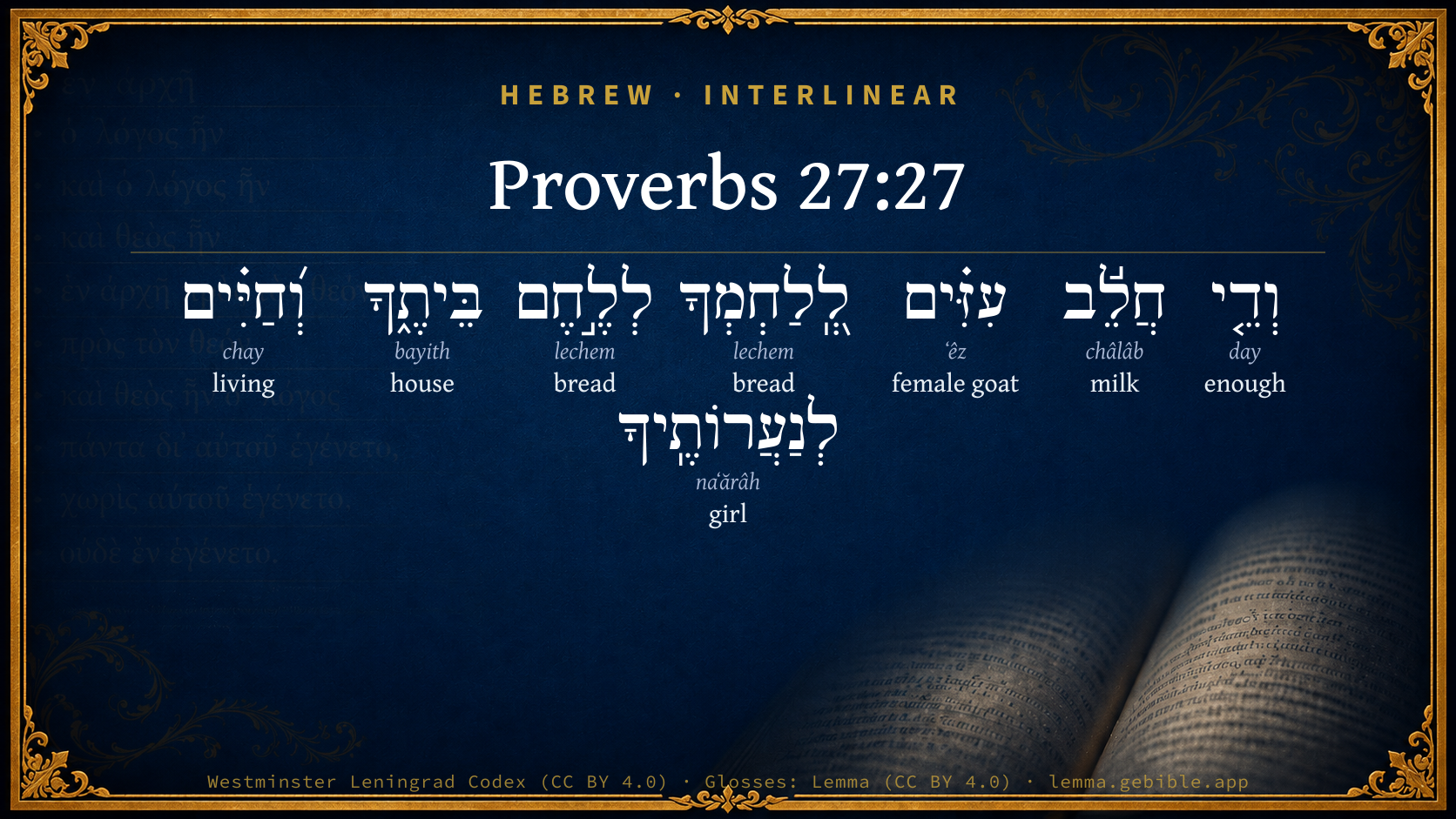
Proverbs 27:27

Hebrew (Westminster Leningrad Codex) Proverbs 27:27 appears in the Hebrew Old Testament. The text above is from the Westminster Leningrad Codex. Each word links to its Strong’s number, a concise gloss, and parsing drawn from the Open Scriptures Hebrew Bible morphology. Click any word for its full Brown-Driver-Briggs (BDB) entry.
Download image
Cite this verse

Proverbs 27:27 (World English Bible). Public Domain. Lemma interlinear Bible study tool, https://lemma.gebible.app/v/proverbs/27/27.

Show BibTeX & RIS
BibTeX
RIS
English Translation
There will be plenty of goats' milk for your food, For your family's food, And for the nourishment of your servant girls.
World English Bible · Public Domain
Download a study sheet

One document with this verse’s original text, its word-by-word gloss line, the meaning frame, cross-references with their text, attributed commentary, and full source and license credits — printable, and it pastes into notes with its structure intact.

This verse Autodidact and up

Study sheet (.html) Plain text (.txt)

A passage Seminary Student

Up to 50 verses in one chapter. A passage sheet keeps up to 6 commentary sources and 12 cross-references per verse, in the order this page ranks them, and says so on the sheet whenever that leaves anything out. Ask for a single verse and you get the Autodidact verse sheet above.

Everything on this page stays free to read, with no account — the sheet is a download of what is already on screen, not access to it.

Want to remove ads? Support Godless Engineer
Compare translations 3

The same verse in 3 English versions, stacked beneath the original-language interlinear above. Click any original word for its lexicon entry.

Each is an independent rendering of the whole verse — the interlinear is not word-aligned to these translations.

Highlighted words mark where these versions differ — a whole-verse word diff, not a word-by-word alignment.

  • World English Bible Public Domain
    There will be plenty of goats' milk for your food, For your family's food, And for the nourishment of your servant girls.
  • King James Version Public Domain
    And thou shalt have goats' milk enough for thy food, for the food of thy household, and for the maintenance for thy maidens.
  • unfoldingWord Literal Text CC BY-SA 4.0
    And enough milk of female goats for your food, for the food of your house, and life for your young women.

unfoldingWord Literal Text — © unfoldingWord, licensed CC BY-SA 4.0. Word-aligned USFM3 via Door43 (git.door43.org/unfoldingWord/en_ult).

Versions to compare (up to 4)

3 of 4 selected

Show all 18 translations

Every available English version of this verse, each an independent rendering of the whole verse.

  • World English Bible Public Domain
    There will be plenty of goats' milk for your food, For your family's food, And for the nourishment of your servant girls.
  • Berean Standard Bible Public Domain
    You will have plenty of goats’ milk to feed you—food for your household and nourishment for your maidservants.
  • Majority Standard Bible Public Domain
    You will have plenty of goats’ milk to feed you—food for your household and nourishment for your maidservants.
  • King James Version Public Domain
    And thou shalt have goats' milk enough for thy food, for the food of thy household, and for the maintenance for thy maidens.
  • American Standard Version (1901) Public Domain
    And `there will be' goats' milk enough for thy food, for the food of thy household, And maintenance for thy maidens.
  • Revised Version (1885) Public Domain
    And there will be goats’ milk enough for thy food, for the food of thy household; and maintenance for thy maidens.
  • Geneva Bible (1599) Public Domain
    And let the milke of the goates be sufficient for thy foode, for the foode of thy familie, and for the sustenance of thy maydes.
  • Douay-Rheims (1899) Public Domain
    Let the milk of the goats be enough for thy food, and for the necessities of thy house, and for maintenance for thy handmaids.
  • Young's Literal Translation Public Domain
    And a sufficiency of goats' milk `is' for thy bread, For bread to thy house, and life to thy damsels!
  • Literal Standard Version CC BY-SA 4.0
    And a sufficiency of goats’ milk [is] for your bread, || For bread to your house, and life to your girls!
  • Unlocked Literal Bible CC BY-SA 4.0
    There will be goats' milk for your food—the food for your household— and nourishment for your servant girls.
  • unfoldingWord Literal Text CC BY-SA 4.0
    And enough milk of female goats for your food, for the food of your house, and life for your young women.
  • Darby Bible Public Domain
    and there is goats' milk enough for thy food, for the food of thy household, and sustenance for thy maidens.
  • World Messianic Bible Public Domain
    There will be plenty of goats’ milk for your food, for your family’s food, and for the nourishment of your servant girls.
  • Webster's Bible Public Domain
    And thou shalt have goats milk enough for thy food, for the food of thy household, and for maintenance for thy maidens.
  • Free Bible Version CC BY-SA 4.0
    there'll be enough milk from your goats to feed you, your family, and your servant girls.
  • Bible in Basic English Public Domain
    There will be goats' milk enough for your food, and for the support of your servant-girls.
  • JPS Tanakh (1917) Public Domain
    And there will be goats' milk enough for thy food, for the food of thy household; and maintenance for thy maidens.

Literal Standard Version (2020), Covenant Press — licensed CC BY-SA 4.0. Text via the HelloAO Bible API (eBible.org). Unlocked Literal Bible (unfoldingWord) — licensed CC BY-SA 4.0. Text via the HelloAO Bible API (eBible.org). unfoldingWord Literal Text — © unfoldingWord, licensed CC BY-SA 4.0. Word-aligned USFM3 via Door43 (git.door43.org/unfoldingWord/en_ult). Free Bible Version, Dr. Jonathan Gallagher — licensed CC BY-SA 4.0. Text via the HelloAO Bible API (eBible.org).

Word by word

More ways to search: Search by grammar → Find every occurrence → Compare this word →

Practice this passage: Drill this verse → Learn its vocabulary →

וְדֵ֤י
day
H1767
“and · enough of”
Conjunction + Noun, Common, Masculine, Singular, Construct
Part of Speech
Conjunction + Noun
Type
Common
Gender
Masculine
Number
Singular
State
Construct
Full BDB Definition

Origin: of uncertain derivation

TWOT: 425

sufficiency, enough - enough - for, according to the abundance of, out of the abundance of, as often as
  1. חֲלֵ֬ב châlâb H2461 “milk of” Noun, Common, Masculine, Singular, Construct
  2. עִזִּ֗ים ʻêz H5795 “female goats” Noun, Common, Feminine, Plural, Absolute
  3. לְֽ֭לַחְמְךָ lechem H3899 “to/for · bread · your” Preposition + Noun, Common, Both, Singular, Construct + Suffix, Personal, 2nd Person, Masculine, Singular
  4. לְלֶ֣חֶם lechem H3899 “to/for · bread of” Preposition + Noun, Common, Both, Singular, Construct
  5. בֵּיתֶ֑ךָ bayith H1004 “house · your” Noun, Common, Masculine, Singular, Construct + Suffix, Personal, 2nd Person, Masculine, Singular
  6. וְ֝חַיִּ֗ים chay H2416 “and · living things” Conjunction + Noun, Common, Masculine, Plural, Absolute
  7. לְנַעֲרוֹתֶֽיךָ naʻărâh H5291 “to/for · girls · your” Preposition + Noun, Common, Feminine, Plural, Construct + Suffix, Personal, 2nd Person, Masculine, Singular

About this verse

These counts appear in no published source. They are computed here, from the morphology-tagged text and Lemma’s own curated glosses. What Lemma adds →

8
words
7
distinct lemmas
Wisdom
section

Shared distinctive vocabulary

וְדֵ֤י enough H1767 occurs in 35 verses of the Hebrew Bible. Also found in:

Grammatical profile

  • 8 nouns

Repetition

A word recurs within this verse — often emphatic in Hebrew:

  • לְֽ֭לַחְמְךָ bread H3899 ×2

Hebrew & Septuagint length

In English translation the verse runs 22 words from the Hebrew and 19 from the Septuagint (LXX English) — closely comparable.

A rough comparison of the two English renderings, which tokenize alike — not a word-level alignment.

Word counts can differ between the Hebrew and the Greek without any difference in meaning — e.g. the Hebrew direct-object marker אֵת has no separate Greek word, and Greek often adds the article ὁ.

Cross-references

2

Topical passages linked to Proverbs 27:27 in the Treasury of Scripture Knowledge — connected by theme and wording, ordered by reader-vote popularity; previews shown in the World English Bible.

  • Matthew 6:33 But seek first God's Kingdom, and his righteousness; and all these things will be given to you as well.
  • Proverbs 30:8–9 Remove far from me falsehood and lies. Give me neither poverty nor riches. Feed me with the food that is needful for me;

Cross-references courtesy of OpenBible.info (CC BY 4.0).

Hebrew and Greek witnesses Masoretic Hebrew ↔ Greek Septuagint

The same verse in the two great witnesses to the Old Testament, shown verse-for-verse.

These are two independent witnesses, not word-aligned to each other, and the Septuagint is shown in lemma (dictionary) form.

Hebrew Proverbs 27:27 Masoretic · Westminster Leningrad Codex

וְדֵ֤י חֲלֵ֬ב עִזִּ֗ים לְֽ֭לַחְמְךָ לְלֶ֣חֶם בֵּיתֶ֑ךָ וְ֝חַיִּ֗ים לְנַעֲרוֹתֶֽיךָ

There will be plenty of goats' milk for your food, For your family's food, And for the nourishment of your servant girls.

World English Bible · Public Domain

Greek LXX Proverbs 27:27 Septuagint · lemma form

υἱός παρά ἐγώ ἔχω ῥῆσις ἰσχυρός εἰς ὁ ζωή σύ καί εἰς ὁ ζωή σός θεράπων

My son, you have from me words very useful for your life, and for the life of your servants.

LXX2012 (modern English Septuagint) · Public Domain

On this verse, Haydock's Catholic Bible Commentary discusses the Septuagint’s reading. Read the note in Commentary ↓

Hebrew: Westminster Leningrad Codex (CC BY 4.0). Greek: Septuagint (public domain); English from LXX2012 (modern English Septuagint) (Public Domain). How the Septuagint differs from the Hebrew →

Commentary

Notes on Proverbs 27:27 from classic Christian and Jewish commentators (each source and its license shown beneath its notes). The classic Christian expositions comment on the surrounding passage and are grouped to its opening verse, so a note may address several verses; the Jewish commentaries on the Tanakh (Rashi and others) are per-verse, so they appear only where the commentator wrote on this verse.

Lemma curates 59 commentaries, every one of them public domain or Creative Commons licensed, each selected and text-cleaned for this edition rather than reprinted as found. About our sources →

Trapp's Complete Commentary

John Trapp

Pro 27:27 And [thou shalt have] goats’ milk enough for thy food, for the food of thy household, and [for] the maintenance for thy maidens.

Ver. 27. And thou shalt have goat’s milk enough.] And this was anciently accounted good cheer indeed. By goat’s milk understand all manner of white meat, as they call it; and see how sparingly they lived in those days, content with that they had at hand, and not running every hand’s while to the butcher’s or draper’s, as now. Or if the men, being harder wrought, had stronger meat sometimes, yet the maidens were well content with a more slender diet. Apelles painted a servant with his hands full of tools - to show that he should be work brittle; with broad shoulders - to bear hard usage; with hind’s feet - to run about his businesses; with ass’s ears, and his mouth shut - to signify that he should be swift to hear, slow to speak; lastly, with a lean belly - that he should be content with coarse fare, spare diet, &c.

John Trapp, A Commentary or Exposition upon All the Books of the Old and New Testament (1647–1656) — public domain. Text from a community e-Sword module.

Jamieson, Fausset & Brown

Robert Jamieson, A. R. Fausset & David Brown

household--literally, "house," the family (Act 16:15; Co1 1:16).

Next: Proverbs Chapter 28

Jamieson, Fausset & Brown — Commentary Critical and Explanatory on the Whole Bible (1871) — public domain (CC PDM 1.0). Text via the HelloAO Bible API.

Adam Clarke's Commentary

Verse 27. Goats' milk enough for thy food] ללחמך lelachmecha, "to thy bread;" for they ate the bread and supped the milk to assist mastication, and help deglutition. And it seems that bread, with goats' milk, was the general article of food for the master and his family; and for the servant maids who assisted in the household work, and performed the operations required in the dairy.

The reader who wishes to see these maxims detailed and illustrated at large, may consult the writers De Re Rustica, where he will find much curious information.

Adam Clarke's Commentary on the Bible (1810–1826) — public domain. Text from a community e-Sword/MySword module.

Ellicott's Commentary for English Readers

(27) For the maintenance for thy maidens, who tend the cattle.

A Bible Commentary for English Readers, edited by Charles John Ellicott (1878–1897) — public domain. Text from a community e-Sword module.

The Cambridge Bible for Schools and Colleges

gen. ed. J. J. S. Perowne

27. for the maintenance of] Rather, maintenance for, R.V.

The Cambridge Bible for Schools and Colleges (gen. ed. J. J. S. Perowne; Cambridge University Press, 1878–1918) — public domain. Text from a community e-Sword module.

Haydock's Catholic Bible Commentary

CHAPTER XXVII.

Milk. We cannot but admire such frugality. Septuagint are rather different; (Calmet) ver. 25., "Be careful of the grass of thy field....that thou mayst have lambs for thy clothing. Honour the field, that there may be lambs for thee. (27) Son, thou hast from me solid instructions for thy life, and for that of thy servants." (Haydock)

George Leo Haydock (1774–1849), Haydock's Catholic Family Bible and Commentary, 1859 edition — public domain. Excludes Psalms (Douay-Rheims chapter numbering differs from Protestant) and Deuterocanonical books (Catholic canon only).

Matthew Poole's English Annotations

Goats’ milk enough for thy food; or, if thou choosest rather to keep than to sell thy goats, the milk of them will serve thee for food to thyself, and to thy family. In ancient times men used a plain and simple diet, and neither knew nor used that curiosity and luxury in it which after-ages invented.

For thy maidens; who are named, because this nourishment was more proper for the weaker sex, whereas men required a stronger diet.

Matthew Poole's English Annotations on the Holy Bible (1683–1685) — public domain. Text from a community e-Sword/MySword module.

Whedon's Commentary on the Bible

Daniel D. Whedon

27. Maintenance — חיים, (hhayyim,) the means of livelihood — sustenance.

Maidens — Never wanting in a large household. Here, naturally, shepherdesses, milkmaids.

Daniel D. Whedon (gen. ed.), Commentary on the Old and New Testaments (1874–1909) — public domain. Text from a community e-Sword module.

The Pulpit Commentary

Goats" milk. Dr. Geikie ("Holy Land and Bible," 1:311) notes that in most parts of Palestine goats" milk in every form sour, sweet, thick, thin, warm, or cold makes, with eggs and bread, the main food of the people. And maintenance for thy maidens; who milk the goats, etc., and tend the cattle, and do the household work. There is no mention of the use of animal flesh as food. It was only on great occasions, as high festivals, or the presence of an honoured guest, that kids, lambs, and calves were killed and eaten. This picture of rural peace and plenty points to a time of security and prosperity, free alike from internal commotion and external danger. The famous passage in Cicero, "De Senect.," 15., on the pleasures and advantages of the agricultural life. will occur to all classical readers. So also Horace ("Epod.," 2), "Beatus ille qui procul negotiis," etc. The LXX makes short work of this verse, "My son, thou hast from me sayings mighty for thy life and for the life of thy servants."

The Pulpit Commentary (1880–1919), ed. H.D.M. Spence-Jones & Joseph S. Exell — public domain. Text from a community e-Sword module.

John Wesley's Explanatory Notes

Goat's milk - Or, if thou chusest rather to keep thy goats, the milk will serve thee for food to thyself and family. In ancient times men used a plain and simple diet.

John Wesley, Explanatory Notes Upon the Whole Bible (1754–1765) — public domain. Text via the GEBible commentary corpus.

Rashi

Rabbi Shlomo Yitzchaki (Rashi)

and enough for your sustenance.

For your food and the food of your household; you will have sufficient goat milk. This is the figure. The allegory is: the condition of your flocks The teacher who is appointed over the congregation is required to carry them in his bosom and to lead them slowly. For riches are not forever and thereby, he eats the fruit, and the principal remains.

When the hay is carried away When his laws are disseminated and the Torah is magnified through him, then these lambs will be his clothing, and the disciples shall be to him for a name and for raiment of glory and beauty.

Rashi on the Tanakh — English translations: “The Judaica Press complete Tanach with Rashi, translated by A. J. Rosenberg” (CC BY 4.0); “Pentateuch with Rashi's commentary by M. Rosenbaum and A.M. Silbermann, 1929-1934” (public domain); “The Metsudah Tanach series, Lakewood, N.J” (CC BY 4.0); and “The Book of Joshua, Metsudah Publications, 1997” (CC BY 4.0). Text via Sefaria.

Lesson kit

Teaching starters — assembled from the data on this page, not authored interpretation. Every prompt links to the verse data it draws on. Edit before teaching.

Proverbs, in the Wisdom, opens this verse with 8 words (7 distinct Hebrew lemmas). Its most distinctive word is day (“enough”). A historical commentator’s framing appears above. Read the whole chapter for the surrounding context.

Discussion questions

  1. How does “enough” (day) shape what this verse is saying?
  2. How does Exodus 36:5, which shares the word «enough», read alongside this verse?
  3. What does the repetition of “bread” (2× in this one verse) do in this verse?
  4. These translations render this verse differently. What is at stake in choosing one wording over another?
  5. Compare how Trapp's Complete Commentary and Jamieson, Fausset & Brown read this verse. Where do they agree or differ?

Things to notice

Reading settings

Reading text

Shown beneath each verse's original-language words.

Old Testament
Old Testament edition

Read the OT as the Masoretic Hebrew (MT) or the Greek Septuagint (LXX).

English shown for the Greek Septuagint (in the Hebrew ↔ Greek comparison).

Comparing translations? Open the Compare panel on any verse page to stack up to four side by side.