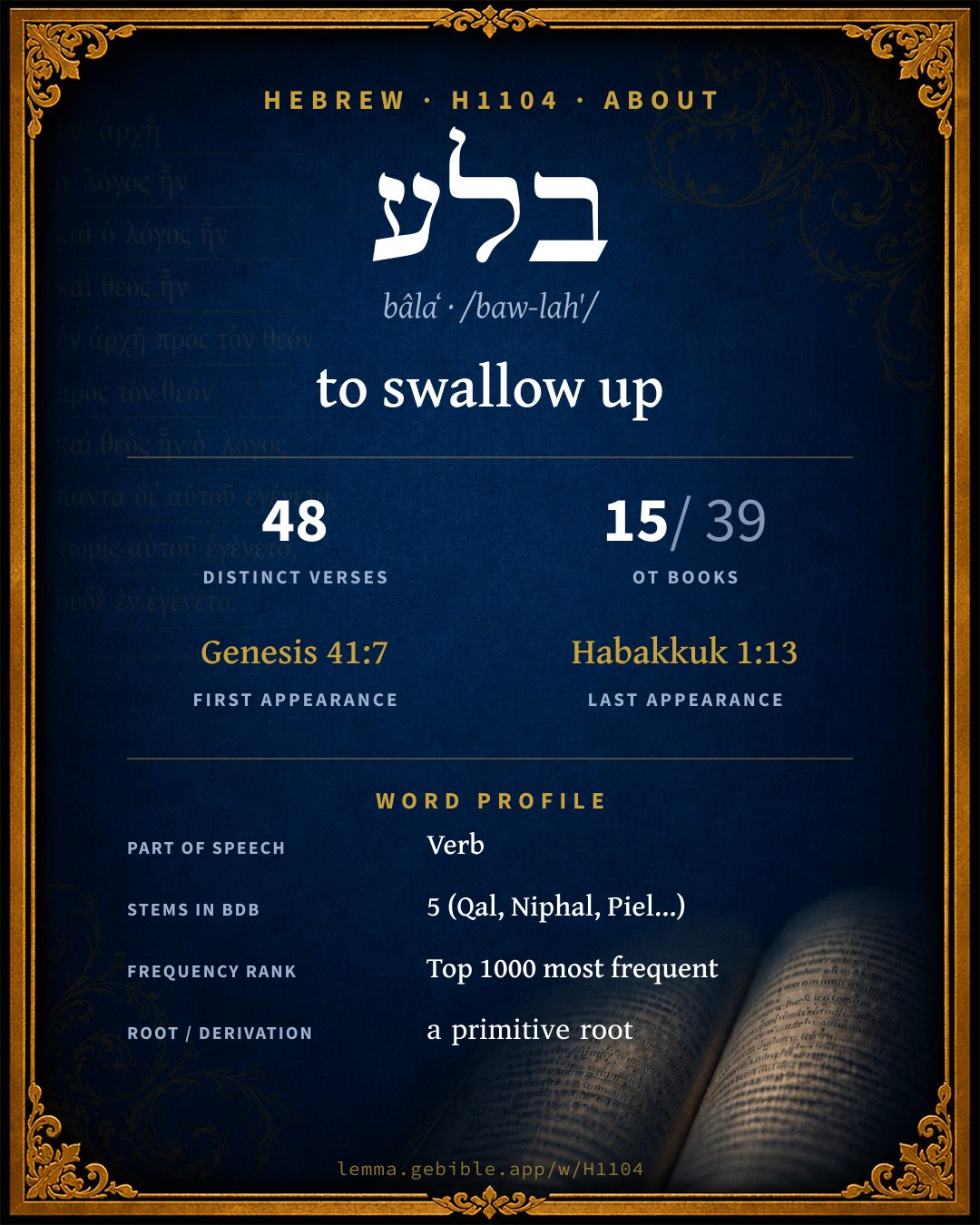
בָּלַע
to swallow up
‘to swallow up’ is one of 4 main senses fuller range ↓
Full lexicon entry — Brown-Driver-Briggs (BDB)
From Brown-Driver-Briggs (BDB)
Where this word appears
See every Piel verb in the Hebrew Bible →
Grammar key — what these labels mean
Part of speech
- Verb
- An action or state-of-being word.
Stem
- Piel
- An intensive or resultative active stem. Here: ‘swallow Nu 4’
- Qal
- The basic, simple active stem — the plain form of the verb (“he wrote”). Here: ‘swallow down’
- Pual
- The passive counterpart of the Piel.
- Niphal
- Usually the simple passive or reflexive of the Qal (“he was written”).
- Hithpael
- The reflexive or reciprocal stem (the subject acts on itself).
Form
- Perfect
- A completed action or state — Hebrew marks aspect (completeness) more than strict tense (“he wrote”).
- Sequential Imperfect
- An imperfect with prefixed waw — the standard past-narrative form (waw-consecutive imperfect).
- Infinitive Construct
- A bound verbal noun, frequently with prepositions (“to write / in writing”).
- Imperfect
- An incomplete, ongoing, or future action (“he will / would write”).
- Sequential Perfect
- A perfect with prefixed waw continuing a preceding imperfect or command (waw-consecutive perfect).
- Participle Passive
- A verbal adjective expressing action received (“written”).
- Participle Active
- A verbal adjective expressing ongoing or characteristic action (“writing / one who writes”).
- Imperative
- A direct command (“write!”).
- Cohortative
- A first-person volitional form expressing wish or resolve (“let me / let us write”).
- Jussive
- A third- or second-person volitional form expressing wish or command (“let him write”).
State
- Absolute
- The independent form of a noun, not bound to a following word.
- Construct
- A noun bound to a following noun in a possessive / “of” relationship (the construct chain).
Person
- 3rd Person
- The one spoken about (“he / she / it / they”).
- 1st Person
- The speaker (“I / we”).
- 2nd Person
- The one addressed (“you”).
Gender
- Masculine
- Grammatically masculine.
- Feminine
- Grammatically feminine.
- Common
- Either gender — not distinguished for this form.
Number
- Singular
- One.
- Plural
- More than one (in Hebrew, generally three or more).
Grammatical forms 29 distinct
- Verb, Piel, Perfect, 3rd Person, Masculine, Singular 4 times (8%)
- Verb, Qal, Sequential Imperfect, 3rd Person, Feminine, Singular 4 times (8%)
- Verb, Piel, Infinitive Construct 4 times (8%)
- Verb, Piel, Imperfect, 3rd Person, Masculine, Singular 4 times (8%)
- Verb, Qal, Perfect, 3rd Person, Masculine, Singular 3 times (6%)
- Verb, Qal, Sequential Imperfect, 3rd Person, Feminine, Plural 2 times (4%)
- Verb, Pual, Imperfect, 3rd Person, Masculine, Singular 2 times (4%)
- Verb, Piel, Imperfect, 1st Person, Common, Singular 2 times (4%)
+21 more forms (25 occurrences)
Parsed forms decoded from the imported morphology (morphhb / Westminster Leningrad Codex — WLC text public domain, morphhb tagging CC BY 4.0), counted across 50 parsed occurrences — not distinct verses.
Every verse where H1104 appears — 48 distinct verses across 15 books. Click any verse to open its interlinear word-by-word view. Verse text shown in the World English Bible for context — . Each verse’s Hebrew form is shown with its reference; the English is not keyword-highlighted, since the data carries no word-level English alignment. Use “Compare translations” on any verse to read it across multiple English versions. This concordance covers the Hebrew Bible; Septuagint (Greek Old Testament) occurrences are not indexed here.
Genesis 2 verses
- Genesis 41:7 וַ/תִּבְלַ֨עְנָה֙ conj + Qal wimpf 3fp The thin heads of grain swallowed up the seven healthy and full ears. Pharaoh awoke, and, behold, it was a dream.
- Genesis 41:24 וַ/תִּבְלַ֨עְןָ֙ conj + Qal wimpf 3fp The thin heads of grain swallowed up the seven good heads of grain. I told it to the magicians; but there was no one who could explain it to me."
Exodus 2 verses
Numbers 5 verses
- Numbers 4:20 כְּ/בַלַּ֥ע prep + Piel inf.cs but they shall not go in to see the sanctuary even for a moment, lest they die."
- Numbers 16:30 וּ/בָלְעָ֤ה conj + Qal wpf 3fs But if Yahweh make a new thing, and the ground open its mouth, and swallow them up, with all that appertain to them, and they go down alive into Sheol; then you shall understand that these men have despised Yahweh.
- Numbers 16:32 וַ/תִּבְלַ֥ע conj + Qal wimpf 3fs and the earth opened its mouth, and swallowed them up, and their households, and all the men who appertained to Korah, and all their goods.
- Numbers 16:34 תִּבְלָעֵ֖/נוּ Qal impf 3fs + sfx pers 1cp All Israel that were round about them fled at the cry of them; for they said, Lest the earth swallow us up.
- Numbers 26:10 וַ/תִּבְלַ֥ע conj + Qal wimpf 3fs and the earth opened its mouth, and swallowed them up together with Korah, when that company died; what time the fire devoured two hundred fifty men, and they became a sign.
Deuteronomy 1 verse
2 Samuel 3 verses
- 2 Samuel 17:16 יְבֻלַּ֣ע Pual impf 3ms Now therefore send quickly, and tell David, saying, Don't lodge this night at the fords of the wilderness, but by all means pass over; lest the king be swallowed up, and all the people who are with him.
- 2 Samuel 20:19 תְבַלַּ֖ע Piel impf 2ms I am of those who are peaceable and faithful in Israel: you seek to destroy a city and a mother in Israel: why will you swallow up the inheritance of Yahweh?
- 2 Samuel 20:20 אֲבַלַּ֖ע Piel impf 1cs Joab answered, Far be it, far be it from me, that I should swallow up or destroy.
Job 7 verses
- Job 2:3 לְ/בַלְּע֥/וֹ prep + Piel inf.cs + sfx pers 3ms Yahweh said to Satan, "Have you considered my servant Job? For there is none like him in the earth, a blameless and an upright man, one who fears God, and turns away from evil. He still maintains his integrity, although you incited me against him, to ruin him without cause."
- Job 7:19 בִּלְעִ֥/י Qal inf.cs + sfx pers 1cs How long will you not look away from me, Nor leave me alone until I swallow down my spittle?
- Job 8:18 יְבַלְּעֶ֥/נּוּ Piel impf 3ms + sfx pers 3ms If he is destroyed from his place, Then it shall deny him, saying, 'I have not seen you.'
- Job 10:8 וַֽ/תְּבַלְּעֵֽ/נִי conj + Piel wimpf 2ms + sfx pers 1cs 'Your hands have framed me and fashioned me altogether; Yet you destroy me.
- Job 20:15 בָּ֭לַע Qal pf 3ms He has swallowed down riches, and he shall vomit them up again. God will cast them out of his belly.
- Job 20:18 יִבְלָ֑ע Qal impf 3ms That for which he labored he shall restore, and shall not swallow it down; According to the substance that he has gotten, he shall not rejoice.
- Job 37:20 יְבֻלָּֽע Pual impf 3ms Shall it be told him that I would speak? Or should a man wish that he were swallowed up?
Psalms 7 verses
- Psalms 21:9 יְבַלְּעֵ֑/ם Piel impf 3ms + sfx pers 3mp You will make them as a fiery furnace in the time of your anger. Yahweh will swallow them up in his wrath. The fire shall devour them.
- Psalms 35:25 בִּֽלַּעֲנֽוּ/הוּ Piel pf 1cp + sfx pers 3ms Don't let them say in their heart, "Aha! That's the way we want it!" Don't let them say, "We have swallowed him up!"
- Psalms 55:9 בַּלַּ֣ע Piel impv 2ms Confuse them, Lord, and confound their language, For I have seen violence and strife in the city.
- Psalms 69:15 תִּבְלָעֵ֣/נִי Qal juss 3fs + sfx pers 1cs Don't let the flood waters overwhelm me, Neither let the deep swallow me up. Don't let the pit shut its mouth on me.
- Psalms 106:17 וַ/תִּבְלַ֣ע conj + Qal wimpf 3fs The earth opened and swallowed up Dathan, And covered the company of Abiram.
- Psalms 107:27 תִּתְבַּלָּֽע Hithpael impf 3fs They reel back and forth, and stagger like a drunken man, And are at their wits' end.
- Psalms 124:3 בְּלָע֑וּ/נוּ Qal pf 3cp + sfx pers 1cp Then they would have swallowed us up alive, When their wrath was kindled against us;
Proverbs 3 verses
- Proverbs 1:12 נִ֭בְלָעֵ/ם Qal coh 1cp + sfx pers 3mp Let's swallow them up alive like Sheol, And whole, like those who go down into the pit.
- Proverbs 19:28 יְבַלַּע Piel impf 3ms A corrupt witness mocks justice, And the mouth of the wicked gulps down iniquity.
- Proverbs 21:20 יְבַלְּעֶֽ/נּוּ Piel impf 3ms + sfx pers 3ms There is precious treasure and oil in the dwelling of the wise; But a foolish man swallows it up.
Ecclesiastes 1 verse
Isaiah 8 verses
- Isaiah 3:12 בִּלֵּֽעוּ Piel pf 3cp As for my people, children are their oppressors, And women rule over them. My people, those who lead you cause you to err, And destroy the way of your paths.
- Isaiah 9:16 מְבֻלָּעִֽים Pual ptcp.pass mp For those who lead this people cause them to err; and those who are led of them are destroyed.
- Isaiah 19:3 אֲבַלֵּ֑עַ Piel impf 1cs The spirit of Egypt shall fail in the midst of it; and I will destroy the counsel of it: and they shall seek to the idols, and to the charmers, and to those who have familiar spirits, and to the wizards.
- Isaiah 25:7 וּ/בִלַּע֙ conj + Piel wpf 3ms He will destroy in this mountain the surface of the covering that covers all peoples, and the veil that is spread over all nations.
- Isaiah 25:8 בִּלַּ֤ע Piel pf 3ms He has swallowed up death forever; and the Lord Yahweh will wipe away tears from off all faces; and the reproach of his people will he take away from off all the earth: for Yahweh has spoken it.
- Isaiah 28:4 יִבְלָעֶֽ/נָּה Qal impf 3ms + sfx pers 3fs and the fading flower of his glorious beauty, which is on the head of the fat valley, shall be as the first-ripe fig before the summer; which when he who looks on it sees, while it is yet in his hand he eats it up.
- Isaiah 28:7 נִבְלְע֣וּ Niphal pf 3cp Even these reel with wine, and stagger with strong drink; the priest and the prophet reel with strong drink, they are swallowed up of wine, they stagger with strong drink; they err in vision, they stumble in judgment.
- Isaiah 49:19 מְבַלְּעָֽיִ/ךְ Piel ptcp.act mp cs + sfx pers 2fs For, as for your waste and your desolate places, and your land that has been destroyed, surely now shall you be too small for the inhabitants, and those who swallowed you up shall be far away.
Jeremiah 1 verse
Lamentations 4 verses
- Lamentations 2:2 בִּלַּ֨ע Piel pf 3ms The Lord has swallowed up all the habitations of Jacob, and has not pitied: He has thrown down in his wrath the strongholds of the daughter of Judah; He has brought them down to the ground; he has profaned the kingdom and the princes of it.
- Lamentations 2:5 בִּלַּ֣ע בִּלַּע֙ Piel pf 3ms Piel pf 3ms The Lord is become as an enemy, he has swallowed up Israel; He has swallowed up all her palaces, he has destroyed his strongholds; He has multiplied in the daughter of Judah mourning and lamentation.
- Lamentations 2:8 מִ/בַּלֵּ֑עַ prep + Piel inf.cs Yahweh has purposed to destroy the wall of the daughter of Zion; He has stretched out the line, he has not withdrawn his hand from destroying; He has made the rampart and wall to lament; they languish together.
- Lamentations 2:16 בִּלָּ֑עְנוּ Piel pf 1cp All your enemies have opened their mouth wide against you; They hiss and gnash the teeth; they say, We have swallowed her up; Certainly this is the day that we looked for; we have found, we have seen it.
Hosea 2 verses
- Hosea 8:7 יִבְלָעֻֽ/הוּ Qal impf 3mp + sfx pers 3ms For they sow the wind, And they will reap the whirlwind. He has no standing grain. The stalk will yield no head. If it does yield, strangers will swallow it up.
- Hosea 8:8 נִבְלַ֖ע Niphal pf 3ms Israel is swallowed up. Now they are among the nations like a worthless thing.
Jonah 1 verse
Habakkuk 1 verse
About this entry
At a glance — auto-summarized from this page’s data, not written by a person. Every figure links to its source below. This summary describes the numbers; it doesn’t interpret them.
At its core, בלע (bâlaʻ) means “to swallow up.” Across 5 stems, its meaning turns on the binyan (Qal, Niphal). Spanning 48 verses in 15 books, it ranks among the moderately common words of the Hebrew Bible. It first appears in Genesis 41:7. Sharing its root, it stands alongside בלע and יבלעם. Dig into 48-verse concordance and the renderings breakdown below.
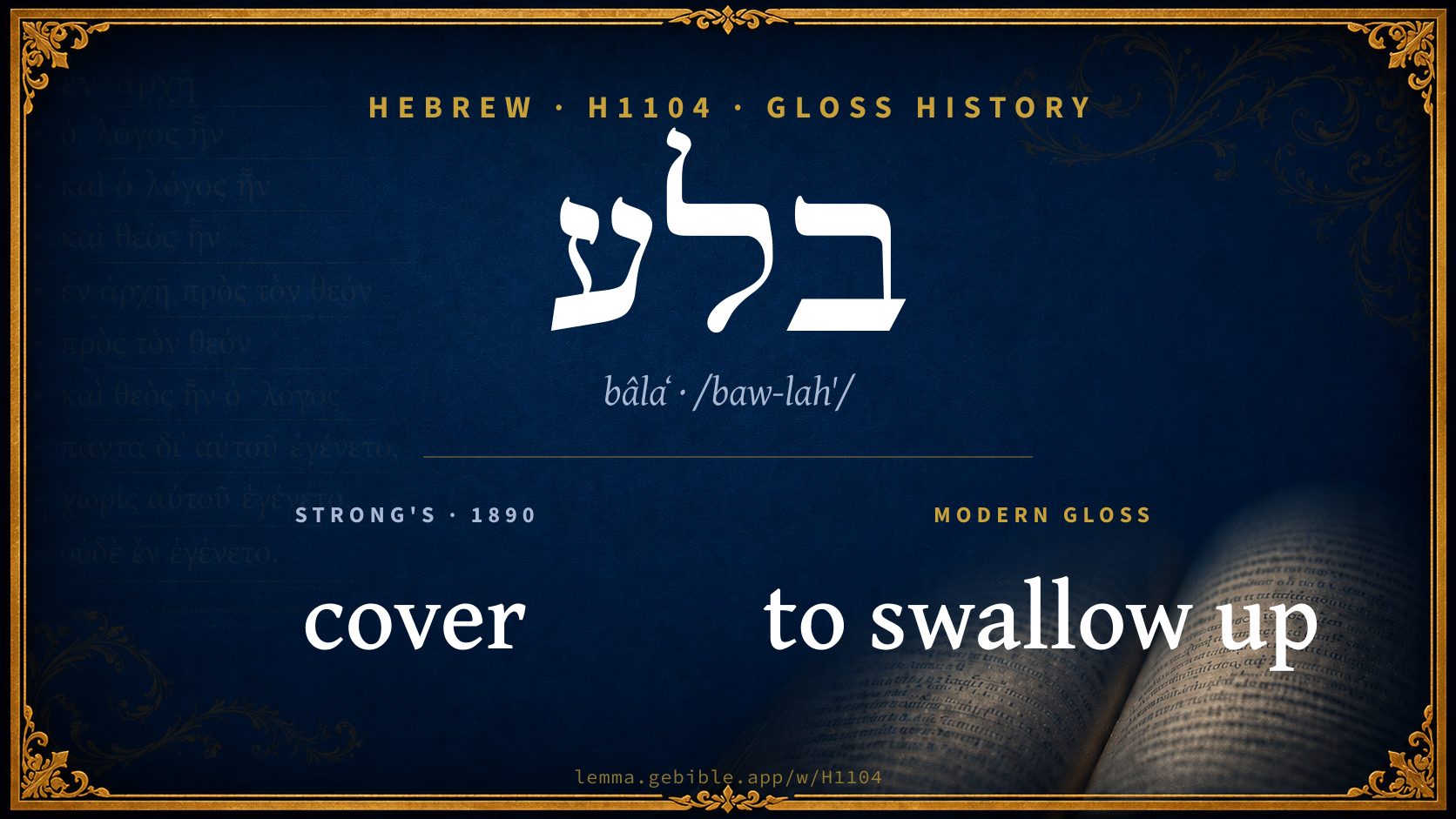
Gloss history
Strong's 1890 vs modern scholarship
About this word
Strong's H1104 catalogs a Hebrew word from the Hebrew Old Testament.
These counts are not copied from any lexicon or concordance. They are computed here, from the morphology-tagged Hebrew Old Testament. What Lemma adds →
- 48
- distinct verses
- The word appears in 48 distinct verses.
- 15 / 39
- OT books
- The word appears in 15 of 39 Old Testament books.
- #739
- by frequency
- Top 1000 most frequent Hebrew words (rank 739 of 8,640 Hebrew words by occurrence).
View all 48 occurrences in the concordance →
By section of the Old Testament
By traditional corpus
Conventional, traditional groupings — biblical authorship is debated, so this is a traditional corpus grouping, not an authorship claim. Each share is this word’s portion of its verses in that division of the Hebrew canon. Each figure is a share of the word’s 48 distinct verses.
- Writings (Ketuvim) 22 verses · 46%
- Prophets (Nevi'im) 16 verses · 33%
- Torah (Pentateuch) 10 verses · 21%
How translations render this word
Counts come from each version’s own published word-to-Strong’s tagging or interlinear alignment — an approximate guide to how each version renders this word, not a word-level alignment the data otherwise carries. Because each total is that version’s own tagged count, the per-version totals vary from one another and need not match the appearance or distinct-verse counts above. These counts may also differ from a printed concordance because Lemma counts each distinctly tagged rendering and does not collapse phrase taggings into a single head-word total. This is a fixed set of word-tagged versions (KJV, ASV, BSB, ULT) and does not change with the reading translation you choose elsewhere. Each version’s license is shown beside its name below (and on Sources).
- King James Version: Swallowed them up 3×, Destroy 2×, Devoured 2×
- American Standard Version: He hath swallowed up 3×, Swallowed them up 3×, Destroy 2×
- Berean Standard Bible: Swallowed 4×, He has swallowed up 2×, He will swallow up 2×
- unfoldingWord Literal Text: Swallowed 4×, Swallowed up 3×, And 2×
King James Version Public Domain
Renders H1104 across 49 tagged occurrences — most commonly:
Plus 36 renderings that appear only once — usually multi-word phrases or single function words the recovered tagging swept in, not distinct renderings.
American Standard Version Public Domain
Renders H1104 across 49 tagged occurrences — most commonly:
Plus 35 renderings that appear only once — usually multi-word phrases or single function words the recovered tagging swept in, not distinct renderings.
Berean Standard Bible Public Domain
Renders H1104 across 49 tagged occurrences — most commonly:
Plus 33 renderings that appear only once — usually multi-word phrases or single function words the recovered tagging swept in, not distinct renderings.
unfoldingWord Literal Text CC BY-SA 4.0
Renders H1104 across 62 tagged occurrences — most commonly:
Plus 43 renderings that appear only once — usually multi-word phrases or single function words the recovered tagging swept in, not distinct renderings.
12 senses and sub-senses in the full BDB
Hebrew verbs can shift meaning by stem (binyan): Qal is the basic action, Niphal is often passive or reflexive, Piel often intensifies or makes it factitive, and Hiphil is typically causative. The senses below are grouped under the stem BDB assigns to each. This entry also uses Pual (the passive of Piel) and Hithpael (reflexive or reciprocal).
What do BDB’s symbols mean?
BDB uses these scholarly abbreviations:
| Symbol | Meaning |
|---|---|
| 𝔊 | the Septuagint (the ancient Greek translation, LXX) |
| 𝔙 | the Vulgate (the Latin translation) |
| 𝔖 | the Syriac version (the Peshitta) |
| 𝔗 | the Targum (the Aramaic translation) |
| ψ | the Psalms |
| √ | root (the underlying root or stem) |
| ‖ | parallel passage (a synonymous or contrasted parallel) |
| † | the dagger: every passage where the word occurs is cited |
The 12 senses and sub-senses the full Brown-Driver-Briggs lexicon distinguishes for this word, in lexicon order (not ranked by frequency), with BDB’s own verbatim wording and sub-sense lettering. Shown in Hebrew script with BDB’s own scholarly abbreviations. The condensed entry is in the Lexicon Entry tab. See also the Forms in the corpus table below.
Qal
- Pf. בָּלַע Jb 20:15, sf. בְּלָעַנִי Je 51:34 (Qr, cf. 𝔊 Kt -נוּ); 3 fs. בָּֽלְעָה Nu 16:30; 3 pl. sf. בְּלָעוּנוּ ψ 124:3; Impf. יִבְלָ֑ע Jb 20:18, וַיִּבְלַע Ex 7:12, sf. יִבְלָעֶנָּה Is 28:4; 3 fs. וַתִּבְלַע Nu 16:32 + 2 times; sf. תִּבְלָעֵנִי ψ 69:16, תִּבְלָעֵנוּ Nu 16:34, וַתִּבְלָעֵם Dt 11:6, תִּבְלָעֵמוֹ Ex 15:12; 3 mpl. sf. יִבְלָעֻהוּ Ho 8:7; 3 fpl. וַתִּבְלַעְנָה Gn 41:7, וַתִּבְלַעְןָ Gn 41:24, 1 pl. sf. נִבְלָעֵם Pr 1:12; Inf. לִבְלֹעַ Jon 2:1; sf. בִּלְעִי Jb 7:19;— e.g. Job 20:15
- 1. swallow down, c. acc. Jb 7:19; Is 28:4, subj. דָּג Jon 2:1; subj. שִׁבֳּלִים Gn 41:7, 24; מַטֶּה Ex 7:12. e.g. Job 7:19
- 2. swallow up, engulf, subj. אֶרֶץ Ex 15:12; Nu 16:30, 32, 34; 26:10; Dt 11:6 ψ 106:17; fig. of greed Jb 20:15 (obj. חַיִל; opp. קיא vomit); of violence, extortion Pr 1:12 (כִּשְׁאוֹל); of devastation by enemy Ho 8:7; Je 51:34 ψ 124:3; overwhelming by calamity ψ 69:19 (subj. מצולה); of full enjoyment, profit Jb 20:18 (no obj.) e.g. Exodus 15:12
Niphal
- Pf. נִבְלַע Ho 8:8, נִבְלְעוּ Is 28:7;—swallowed up, i.e. devastated Ho 8:8; engulfed by wine (yet cf. Pi. Is 3:12) Is 28:7 (נ׳ מן־היין, ‖ שָׁגוּ בַשֵּׁכָר). e.g. Hosea 8:8
Piel
- Pf. בִּלַּע Is 25:8 + 3 times; וּבִלַּע consec. Is 25:7; 3 pl. בִּלֵּ֑עוּ Is 3:12; 1 pl. בִּלָּ֑עְנוּ La 2:16, sf. בִּלַּעֲנוּהוּ ψ 35:25; Impf. יְבַלַּע־ Pr 19:28, sf. 3 ms. יְבַלְּעֶנּוּ Jb 8:18; Pr 21:20; יְבַלְּעֵם ψ 21:10; 3 fs. sf. 3 ms. תְּבַלְּעֶנּוּ Ec 10:12; 2 ms. תְּבַלַּע 2 S 20:19, sf. וַתְּבַלְּעֵנִי Jb 10:8; 1 s. אֲבַלַּע 2 S 20:20, אֲבַלֵּ֑עַ Is 19:3; Imv. בַּלַּע ψ 55:10; Inf. בַּלַּע Nu 4:20; Hb 1:13, בַּלֵּ֑עַ La 2:8, sf. בַּלְּעוֹ Jb 2:3; Pt. sf. מְבַלְּעָ֑יִךְ Is 49:19;— e.g. Isaiah 25:8
- 1. swallow Nu 4:20 (כְּבַלַּע as a swallowing = for an instant); elsewhere e.g. Numbers 4:20
- 2. swallow up, engulf, usually c. acc.,
- a. fig. of destruction, ruin, Is 3:12 (obj. דֶּרֶךְ); (Ba from a √ II. בלע confound, cf. Di; v. also 9:15; 19:3; 28:7 ψ 55:10; 107:27); subj. י׳ La 2:2, 5(×2), 8; Jb 2:3; 10:8 ψ 21:10 (‖ אכל), Is 19:3 (obj. עֵצָה), i.e. confuse, confound; so ψ 55:10 בַּלַּע אֲדֹנָי פַּלַּג לְשׁוֹנָם confuse, Lord, divide their speech (cf. בלל Gn 11:7, 9 & v. De Che); subj. wicked men, enemies ψ 35:25; Is 49:19 cf. La 2:16 (abs.) Hb 1:13; obj. reflex. in sense Ec 10:12; = annihilate Is 25:7, 8; e.g. Isaiah 3:12
- b. lit. = destroy 2 S 20:19, 20 (‖ הִשְׁחִית); indef. subj. Jb 8:18 יב׳ ממקמו; e.g. 2 Samuel 20:19
- c. fig. for greedily (seize, adopt) practice Pr 19:28, for extravagance, squandering Pr 21:20. e.g. Proverbs 19:28
Pual
- Impf. יְבֻלַּע 2 S 17:16, יְבֻלָּ֑ע Jb 37:20; Pt. מְבֻלָּעִים Is 9:15;—be swallowed up, i.e. destroyed Jb 37:20; cf. פֶּן־יְבֻלַּע לַמֶּלֶךְ 2 S 17:16 (impers.) ruined Is 9:15 (yet cf. sub Pi.) e.g. 2 Samuel 17:16
Hithpael
- Impf. 3 fs. תִּתְבַּלָּ֑עψ 107:27 (subj. חכמה) their wisdom is all gone, ‘they are at their wit’s end’ (cf. sub Pi.) e.g. Psalms 107:27
Senses from the full Brown-Driver-Briggs lexicon (Brown, Driver, Briggs; Oxford 1906 — public domain), digitized via Sefaria, supplemented by the OpenScriptures HebrewLexicon (CC BY 4.0). Full attribution on Sources.
Word origin
vb. swallow down, swallow up, engulf (idea of quickness, suddenness) (NH id., Arabic بَلِعَ swallow, Ethiopic በልዐ eat, Aramaic בְּלַע ܒܠܰܥ; Assyrian belû, Pi. destroy ZimBP 27)—
— Brown-Driver-Briggs (Oxford 1906, public domain), digitized via Sefaria, supplemented by the OpenScriptures HebrewLexicon (CC BY 4.0). See Sources.
Origin: a primitive root
Jastrow Dictionary
A second Hebrew/Aramaic lexicon for comparison, covering Aramaic and post-biblical (Talmudic, Targumic, Midrashic) usage that the biblical-Hebrew BDB does not. Matched by lemma rather than by Strong’s number, so a lemma may carry more than one Jastrow headword (shown separately below), and the entries cover usage well beyond the Bible.
בָּלַע
- , v. בלל) to absorb, opp. פלט; to swallow, consume. Y. Shek. VI, 49ᶜ bot.… שהאור בּוֹלֵעַ בּוֹלַעַת … בּוֹלְעִין the flame absorbs a portion of the oil, and so do the wood and the kettle. Ḥull. 110ᵇ the liver when boiled with other meat פולטת ואינה ב׳ gives out (blood) but absorbs nothing from the other pieces. Y. Sabb. XIV, 14ᵈ top; Tosef. Sabb. XII (XIII), 9 but he may sip vinegar ובוֹלֵעַ and swallow it (opp. פלט to spit it out). Y. Ter. VIII, 45ᵇ bot. הלעוס כבָלוּעַ what is chewed is to be considered as swallowed. Ḥull. 71ᵃ טומאה בְלוּעָה an unclean object (food) that has been swallowed.—Snh. 110ᵃ הַבְּלוּעִין those (of the band of Korah) that were swallowed up. Kel. IX, 6, v. דָּֽרְבָן; a. fr.
- to be swallowed; with בין, to be absorbed, disappear. Sot. 36ᵇ; Tanḥ. Vayigg. 4; Yalk. Gen. 150 (interpret. the name Bela, Gen. XLVI, 21) שנ׳ בין האומות for he (Joseph) has disappeared among gentiles. Gen. R. s. 94; Yalk. l. c. שנבלע ממני he disappeared to me. e.g. Genesis 46:21
- to cause swallowing, to make absorb. Ex. R. s. 33 הִבְלַעְתָּ לקרה thou mad’st (the earth) swallow Korah. Ber. 24ᵇ מַבְלִיעוֹ בטליתו he hides the spittle in his cloak; Y. Sabb. VII, 10ᵇ top. Ḥull. 113ᵃ מַבְ׳ דם באברים causes the blood to remain in the meat (prevents it from flowing out).—Trnsf. to sell something in connection with other things, in a lump, in the bargain. Bekh. 31ᵇ מבליעו וכ׳ he sells it (the meat) in the bargain with the hide &c. B. Mets. 64ᵃ; B. Kam. 118ᵇ one who robs his neighbor וה׳ לו בחשבון and makes up for it implicitly on settling his accounts. V. הַבְלָעָה.
- to be swallowed up; to mingle with, v. supra Nif.—Part. מוּבְלַע. Ber. 31ᵇ מ׳ בין אנשים mixing with people, expl. לא ארוך וכ׳ neither very tall &c. (of average qualities). Erub. IV, 6 מ׳ ביניהן his property is enclosed between theirs (reaches into the limits of each). Y. ib. IV, 21ᵈ bot. עיירות המוּבְלָעוֹת inland-towns, opp. border-towns. Y. B. Bath. VII, 15ᶜᵈ מוּבְלָעִין בה fields which are enclosed by others belonging to the same estate.
- to be swallowed up, to disappear. Midr. Till. to Ps. XIX, beg. מִתְבַּלֵּעַ מן וכ׳ he disappears from the world (forfeits his life).
בְּלַע
- Targ. Ex. VII, 12; a. fr.—Ḥull. 111ᵃ כי היכי דפליט הדר ב׳ as it gives out, so does it again absorb; a. fr.—Part. pass. בְּלִיעַ, בְּלִיעָא. Ib. בליעא דמא filled with blood.—Snh. 110ᵃ בלועי דקרח, v. בְּלִיעֵי.— Trnsf. to receive blows (cmp. סָפַג). Men. 7ᵃ קולפי טאבי בַּלְעִי וכ׳ I received many blows at the hands of Ab. over &c. Arakh. 22ᵃ. Ber. 56ᵃ.—Targ. II, Esth. III, 7 בְּלִיעָן אינון בידי they are swallowed up (bound to be destroyed) by my hand. e.g. Esther 3:7
- , as h. Hif. Ḥull. 67ᵇ אַבְלַע לי let me swallow them (put them in my mouth). Men. 17ᵃ, v. infra. B. Mets. 64ᵃ וא׳ ליה בחשבון, v. preced. Hif.
- = as h. Nif.
- 1. to be swallowed up, to disappear. Targ. Y. Gen. XLVI, 21 אתב׳ מניה he was swallowed up (disappeared) from his side; v. preced. Targ. Josh. VI, 5 יתבלע וכ׳ shall sink into the ground beneath it; a. e.—Y. R. Hash. II, 58ᵃ bot. איתב׳ מן קומוי (the moon) disappeared from his sight.
- 2. to be given to eat; trnsf. to be taught. Ber. 24ᵇ הא מילתא אִבְלְעָא לי בי וכ׳ v. Rabb. D. S. a. l. note) this I have been taught in the school of R. &c.; (Men. 17ᵃ הא מילתא אבלע לי וכ׳ this has R. Ḥ. taught me).
בֶּלַע
- (preced.)
- 1. absorption, natural loss, leakage. B. Mets. III, 8 (40ᵃ) לוג ומחצה ב׳ a Log and a half is a reasonable leakage (absorbed by new vessels); a. e.
- 2. pr. n. m. (b. h.) Bela; v. בָּלַע a. בְּלִיעָה.
- 3. בֶּלַע or בַּלַּע (cmp. בְּלִי) a nothing, a mote. Tanḥ. Vayak. 7 (ref. to כְּבַלַּע Num. IV, 20) כב׳ הזה שהוא נופל בעין; (Num. R. s. 5 מן העין) as much as a mote which enters one’s eye. e.g. Numbers 4:20
בַּלָּע
- swallower, glutton. Num. R. s. 14; v. בְּלִיעָה. Snh. 105ᵃ, v. בִּלְעָם.
בְּלַע ²
- ch. m. (cmp. בֶּלַע) the thing swallowed, choking fit. Y. Ab. Zar. II, 40ᵈ אהן בלעה שרי in a choking attack it is allowed (to apply remedies on the Sabbath) Ib. הוה ליה בלע had a choking fit; Koh. R. to X, 5 הוה ליה חד בלעא. Ib. לאפקא בִלְעֵיה to get out what he had swallowed.
A Dictionary of the Targumim, the Talmud Babli and Yerushalmi, and the Midrashic Literature (Marcus Jastrow; London, Luzac, 1903) — Public Domain. Digitized via Sefaria. Digitized via Sefaria. Full attribution on Sources.
Forms in the corpus
The 49 distinct written forms H1104 takes in the Hebrew Bible, most frequent first — each parse links to that stem’s occurrences in the concordance. Hebrew forms include their vowel points and cantillation, so a single lemma takes many written forms.
Same root — word family
Other BDB entries built from the same root as H1104, grouped by Strong’s listed origin. These share a root / origin per the lexicon — not necessarily a shared meaning. Each links to that word’s own entry.
Derived from this word
Proper names from this root
People and places named from this root — a name, not an additional meaning of the word.
Compare all same-root words → 1 of the same-root words is a proper name (a person or place). They share a root, not necessarily a meaning.
Septuagint verse parallels
This word appears in 44 verses that also exist in the Greek Old Testament (Septuagint), out of the 48 Hebrew verses it occurs in. You can read those verses in Greek by switching the Old Testament edition to the Septuagint.
Read these verses in the Septuagint
- Genesis 41:7
- Exodus 7:12
- Numbers 4:20
- Deuteronomy 11:6
- 2 Samuel 17:16
- Job 2:3
- Psalms 21:9
- Proverbs 1:12
- Ecclesiastes 10:12
- Isaiah 3:12
- Jeremiah 51:34
- Lamentations 2:2
This is a verse-level parallel only — the same verses exist in both the Hebrew and Greek Old Testaments. No word-level Hebrew↔Greek correspondence is claimed: the data carries no such alignment, so no Greek word is shown as this Hebrew word’s translation. Coverage is not total — the Septuagint omits the deuterocanon and renumbers the Psalms, so some Hebrew verses have no direct Greek parallel.