
Psalms 35:25

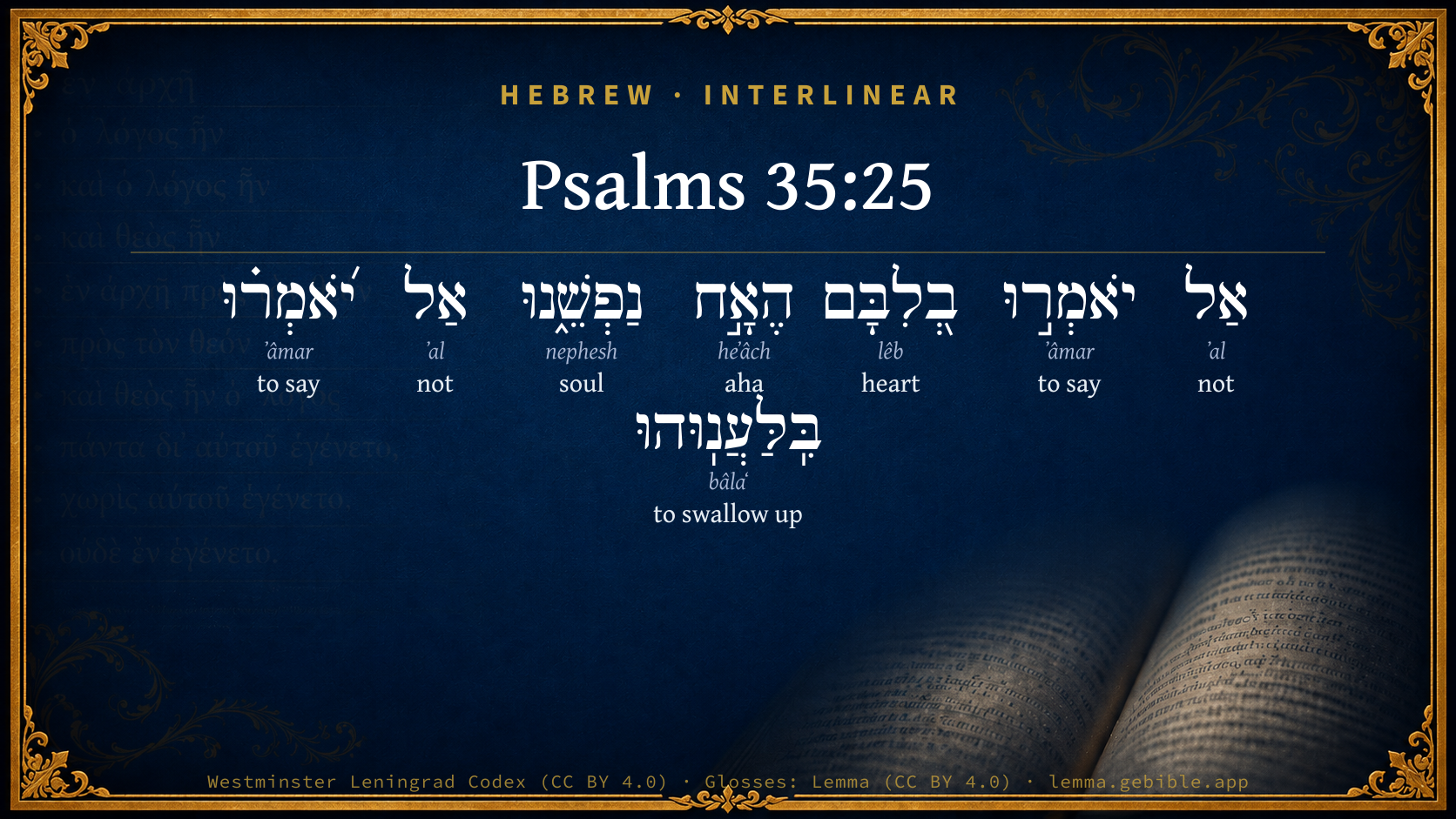
Hebrew (Westminster Leningrad Codex) Psalms 35:25 appears in the Hebrew Old Testament. The text above is from the Westminster Leningrad Codex. Each word links to its Strong’s number, a concise gloss, and parsing drawn from the Open Scriptures Hebrew Bible morphology. Click any word for its full Brown-Driver-Briggs (BDB) entry.
Download image
Cite this verse

Psalms 35:25 (World English Bible). Public Domain. Lemma interlinear Bible study tool, https://lemma.gebible.app/v/psalms/35/25.

Show BibTeX & RIS
BibTeX
RIS
English Translation
Don't let them say in their heart, "Aha! That's the way we want it!" Don't let them say, "We have swallowed him up!"
World English Bible · Public Domain
Download a study sheet

One document with this verse’s original text, its word-by-word gloss line, the meaning frame, cross-references with their text, attributed commentary, and full source and license credits — printable, and it pastes into notes with its structure intact.

This verse Autodidact and up

Study sheet (.html) Plain text (.txt)

A passage Seminary Student

Up to 50 verses in one chapter. A passage sheet keeps up to 6 commentary sources and 12 cross-references per verse, in the order this page ranks them, and says so on the sheet whenever that leaves anything out. Ask for a single verse and you get the Autodidact verse sheet above.

Everything on this page stays free to read, with no account — the sheet is a download of what is already on screen, not access to it.

Want to remove ads? Support Godless Engineer
Compare translations 3

The same verse in 3 English versions, stacked beneath the original-language interlinear above. Click any original word for its lexicon entry.

Each is an independent rendering of the whole verse — the interlinear is not word-aligned to these translations.

Highlighted words mark where these versions differ — a whole-verse word diff, not a word-by-word alignment.

  • World English Bible Public Domain
    Don't let them say in their heart, "Aha! That's the way we want it!" Don't let them say, "We have swallowed him up!"
  • King James Version Public Domain
    Let them not say in their hearts, Ah, so would we have it: let them not say, We have swallowed him up.
  • unfoldingWord Literal Text CC BY-SA 4.0
    Do not let them say in their heart, “Aha, our soul!” Do not let them say, “We have swallowed him up.”

unfoldingWord Literal Text — © unfoldingWord, licensed CC BY-SA 4.0. Word-aligned USFM3 via Door43 (git.door43.org/unfoldingWord/en_ult).

Versions to compare (up to 4)

3 of 4 selected

Show all 18 translations

Every available English version of this verse, each an independent rendering of the whole verse.

  • World English Bible Public Domain
    Don't let them say in their heart, "Aha! That's the way we want it!" Don't let them say, "We have swallowed him up!"
  • Berean Standard Bible Public Domain
    Let them not say in their hearts, “Aha, just what we wanted!” Let them not say, “We have swallowed him up!”
  • Majority Standard Bible Public Domain
    Let them not say in their hearts, “Aha, just what we wanted!” Let them not say, “We have swallowed him up!”
  • King James Version Public Domain
    Let them not say in their hearts, Ah, so would we have it: let them not say, We have swallowed him up.
  • American Standard Version (1901) Public Domain
    Let them not say in their heart, Aha, so would we have it: Let them not say, We have swallowed him up.
  • Revised Version (1885) Public Domain
    Let them not say in their heart, Aha, so would we have it: let them not say, We have swallowed him up.
  • Geneva Bible (1599) Public Domain
    Let them not say in their hearts, O our soule reioyce: neither let them say, We haue deuoured him.
  • Douay-Rheims (1899) Public Domain
    Let them not say in their hearts: It is well, it is well, to our mind: neither let them say: We have swallowed him up.
  • Young's Literal Translation Public Domain
    They do not say in their heart, `Aha, our desire.' They do not say, `We swallowed him up.'
  • Literal Standard Version CC BY-SA 4.0
    They do not say in their heart, “Aha, our desire.” They do not say, “We swallowed him up.”
  • Unlocked Literal Bible CC BY-SA 4.0
    Do not let them say in their heart, “Aha, we have what we wanted.” Do not let them say, “We have devoured him.”
  • unfoldingWord Literal Text CC BY-SA 4.0
    Do not let them say in their heart, “Aha, our soul!” Do not let them say, “We have swallowed him up.”
  • Darby Bible Public Domain
    Let them not say in their heart, Aha! so would we have it. Let them not say, We have swallowed him up.
  • World Messianic Bible Public Domain
    Don’t let them say in their heart, “Aha! That’s the way we want it!” Don’t let them say, “We have swallowed him up!”
  • Webster's Bible Public Domain
    Let them not say in their hearts, Ah, so would we have it: let them not say, We have swallowed him up.
  • Free Bible Version CC BY-SA 4.0
    Don't let them say to themselves, “Look! We got what we wanted!” Don't let them say, “We completely destroyed him!”
  • Bible in Basic English Public Domain
    Let them not say in their hearts, So we will have it: let them not say, We have put an end to him.
  • JPS Tanakh (1917) Public Domain
    Let them not say in their heart: 'Aha, we have our desire'; let them not say: 'We have swallowed him up.'

Literal Standard Version (2020), Covenant Press — licensed CC BY-SA 4.0. Text via the HelloAO Bible API (eBible.org). Unlocked Literal Bible (unfoldingWord) — licensed CC BY-SA 4.0. Text via the HelloAO Bible API (eBible.org). unfoldingWord Literal Text — © unfoldingWord, licensed CC BY-SA 4.0. Word-aligned USFM3 via Door43 (git.door43.org/unfoldingWord/en_ult). Free Bible Version, Dr. Jonathan Gallagher — licensed CC BY-SA 4.0. Text via the HelloAO Bible API (eBible.org).

Word by word

More ways to search: Search by grammar → Find every occurrence → Compare this word →

Practice this passage: Drill this verse → Learn its vocabulary →

About this verse

These counts appear in no published source. They are computed here, from the morphology-tagged text and Lemma’s own curated glosses. What Lemma adds →

8
words
6
distinct lemmas
Wisdom
section

Notable vocabulary

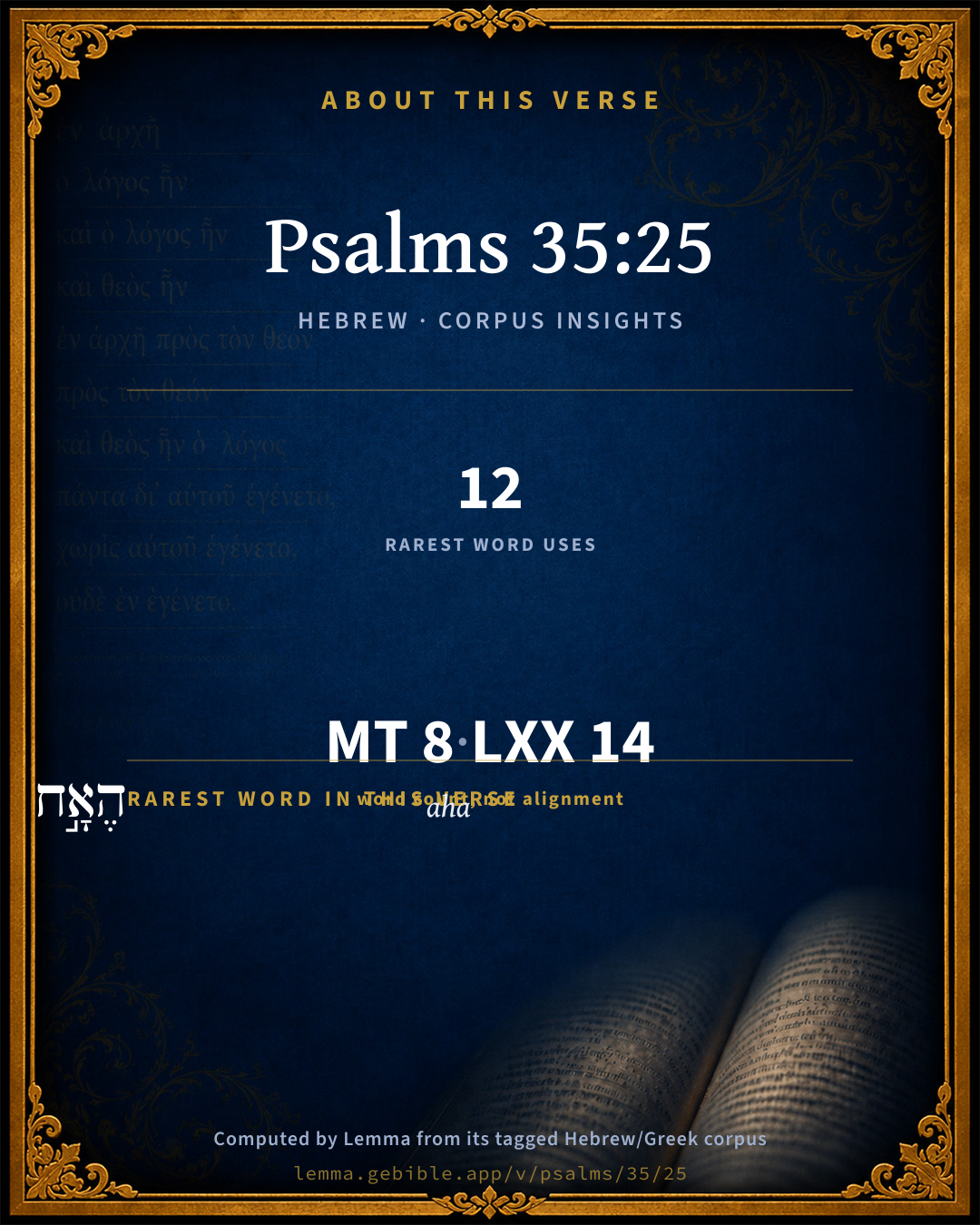
The rarest word here is הֶאָ֣ח aha H1889 — appearing just 12 times in the whole Hebrew Bible.

Shared distinctive vocabulary

הֶאָ֣ח aha H1889 occurs in 9 verses of the Hebrew Bible. Also found in:

Grammatical profile

  • 3 verbs
  • 2 nouns
  • 3 particles

Verb forms

  • יֹאמְר֣וּ Qal · Jussive
  • יֹ֝אמְר֗וּ Qal · Jussive
  • בִּֽלַּעֲנֽוּהוּ Piel · Perfect

Repetition

Words recur within this verse — often emphatic in Hebrew:

  • יֹאמְר֣וּ to say H559 ×2
  • אַל not H408 ×2

Hebrew & Septuagint length

In English translation the verse runs 23 words from the Hebrew and 23 from the Septuagint (LXX English) — the same length.

A rough comparison of the two English renderings, which tokenize alike — not a word-level alignment.

Word counts can differ between the Hebrew and the Greek without any difference in meaning — e.g. the Hebrew direct-object marker אֵת has no separate Greek word, and Greek often adds the article ὁ.

In the original languages it is 8 Hebrew tokens and 14 Greek tokens — but the two are counted differently (Hebrew bundles its prefixes and suffixes into one token; the Greek is in lemma form), so that isn’t a like-for-like length.

Cross-references

16

Topical passages linked to Psalms 35:25 in the Treasury of Scripture Knowledge — connected by theme and wording, ordered by reader-vote popularity; previews shown in the World English Bible.

  • Lamentations 2:16 All your enemies have opened their mouth wide against you; They hiss and gnash the teeth; they say, We have swallowed her up; Certainly this is the day that we looked for; we have found, we have seen it.
  • Psalms 124:3 Then they would have swallowed us up alive, When their wrath was kindled against us;
  • Matthew 27:43 He trusts in God. Let God deliver him now, if he wants him; for he said, 'I am the Son of God.'"
  • Exodus 15:9 The enemy said, 'I will pursue, I will overtake, I will divide the spoil. My desire shall be satisfied on them. I will draw my sword, my hand shall destroy them.'
  • 2 Samuel 20:19 I am of those who are peaceable and faithful in Israel: you seek to destroy a city and a mother in Israel: why will you swallow up the inheritance of Yahweh?
  • Job 1:5 It was so, when the days of their feasting had run their course, that Job sent and sanctified them, and rose up early in the morning, and offered burnt offerings according to the number of them all. For Job said, "It may be that my sons have sinned, and renounced God in their hearts." Thus did Job continually.
  • Psalms 27:12 Don't deliver me over to the desire of my adversaries, For false witnesses have risen up against me, Such as breathe out cruelty.
  • Psalms 28:3 Don't draw me away with the wicked, With the workers of iniquity who speak peace with their neighbors, But mischief is in their hearts.
  • Psalms 56:1–2 Be merciful to me, God, for man wants to swallow me up. All day long, he attacks and oppresses me.
  • Psalms 57:3 He will send from heaven, and save me, He rebukes the one who is pursuing me. Selah. God will send out his loving kindness and his truth.
  • Psalms 74:8 They said in their heart, "We will crush them completely." They have burned up all the places in the land where God was worshiped.
  • Psalms 140:8 Yahweh, don't grant the desires of the wicked. Don't let their evil plans succeed, or they will become proud. Selah.
  • Mark 2:6 But there were some of the scribes sitting there, and reasoning in their hearts,
  • Mark 2:8 Immediately Jesus, perceiving in his spirit that they so reasoned within themselves, said to them, "Why do you reason these things in your hearts?
  • 1 Corinthians 15:54 But when this corruptible will have put on incorruption, and this mortal will have put on immortality, then what is written will happen: "Death is swallowed up in victory."
  • Psalms 70:3 Let them be turned because of their shame Who say, "Aha! Aha!"

Cross-references courtesy of OpenBible.info (CC BY 4.0).

Hebrew and Greek witnesses Masoretic Hebrew ↔ Greek Septuagint

The same verse in the two great witnesses to the Old Testament, shown verse-for-verse.

You’re reading Greek Psalm 34 (Hebrew Psalm 35). The Septuagint counts the superscription, so verse numbers can differ from the Hebrew — chapter-level alignment, not verse-by-verse. Numbering follows Rahlfs.

These are two independent witnesses, not word-aligned to each other, and the Septuagint is shown in lemma (dictionary) form.

Hebrew Psalms 35:25 Masoretic · Westminster Leningrad Codex

אַל יֹאמְר֣וּ בְ֭לִבָּם הֶאָ֣ח נַפְשֵׁ֑נוּ אַל יֹ֝אמְר֗וּ בִּֽלַּעֲנֽוּהוּ

Don't let them say in their heart, "Aha! That's the way we want it!" Don't let them say, "We have swallowed him up!"

World English Bible · Public Domain

Greek LXX Greek Psalm 34:25 Septuagint · lemma form

μή εἶπον ἐν καρδία αὐτός εὖγε εὖγε ὁ ψυχή ἐγώ μηδέ εἶπον καταπίνω αὐτός

Let them not say in their hearts, Aha, aha, it is pleasing to our soul: neither let them say, We have devoured him.

LXX2012 (modern English Septuagint) · Public Domain

Hebrew: Westminster Leningrad Codex (CC BY 4.0). Greek: Septuagint (public domain); English from LXX2012 (modern English Septuagint) (Public Domain). How the Septuagint differs from the Hebrew →

Commentary

Notes on Psalms 35:25 from classic Christian and Jewish commentators (each source and its license shown beneath its notes). The classic Christian expositions comment on the surrounding passage and are grouped to its opening verse, so a note may address several verses; the Jewish commentaries on the Tanakh (Rashi and others) are per-verse, so they appear only where the commentator wrote on this verse.

Lemma curates 59 commentaries, every one of them public domain or Creative Commons licensed, each selected and text-cleaned for this edition rather than reprinted as found. About our sources →

Trapp's Complete Commentary

John Trapp

Psa 35:25 Let them not say in their hearts, Ah, so would we have it: let them not say, We have swallowed him up.

Ver. 25. Ah, so would we have it] Heb. Ah, ah, my soul; that is, our desire; we are voti compotes.

We have swallowed them up] As swine do swill or ravenous beasts their prey.

John Trapp, A Commentary or Exposition upon All the Books of the Old and New Testament (1647–1656) — public domain. Text from a community e-Sword module.

Joseph Benson's Commentary

Psa 35:25-27. Let them not say, Ah! so would we have it — Hebrew, Aha, our soul; an expression of mirth, as before, Psa 35:21, or, Aha, we have our wish, or desire. We have swallowed him up — David is now as low as we could wish him. Let them be brought to confusion together — As they gathered themselves together to deride and reproach me, so do thou gather them together to confound them; or, as יחדו, jachdav, may be rendered, in like manner, that is, one as well as another. Let the proud and great ones of them be disappointed and ashamed, as well as the meanest among them. That magnify themselves against me — That extol themselves, and their power, and look upon me with scorn and contempt. Let them be glad that favour my righteous cause — That wish well to it, although they want either strength or courage to plead it. Let them say, Let the Lord be magnified — That is, exalted and praised for his righteousness, truth, and goodness, manifested in my deliverance. The great design of my enemies is to magnify themselves, Psa 35:26, but my chief desire is that God should be magnified.

Joseph Benson's Commentary on the Old and New Testaments (1811–1818) — public domain. Text from a community e-Sword module.

J. A. Alexander on Psalms

Joseph Addison Alexander

25. (Psa 35:25) Let them not say in their heart, Aha, our soul (or our heart's desire)! Let them not say, We have swallowed him up! In their heart, not secretly, but cordially, not as opposed to saying so to others, but to mere profession. —Our heart's desire! an abbreviated exclamation prompted by strong feeling. "This is precisely what we have so long and so intensely wished for!" See above, on Psa 37:12. Let them not say, let them not have occasion so to ay; let not the events which befall me justify them in so saying.—Swallowed him up, utterly destroyed him. See above, on Psa 21:10 (9), and compare Lam 2:16, where the form of expression is no doubt copied from the verse before us.

Joseph Addison Alexander, The Psalms Translated and Explained (1850) — public domain. Text from a community e-Sword module.

Geneva Bible (1599)

Geneva Bible translators

Because we have that which we sought for, seeing he is destroyed.

Geneva Bible (1599) marginal notes — public domain. Text via Bolls.life.

Jamieson, Fausset & Brown

Robert Jamieson, A. R. Fausset & David Brown

swallowed him up--utterly destroyed him (Psa 21:9; Lam 2:16).

Jamieson, Fausset & Brown — Commentary Critical and Explanatory on the Whole Bible (1871) — public domain (CC PDM 1.0). Text via the HelloAO Bible API.

Adam Clarke's Commentary

Verse 25. Swallowed him up.] בלענוהו billaanuhu, we have gulped him down.

Adam Clarke's Commentary on the Bible (1810–1826) — public domain. Text from a community e-Sword/MySword module.

The Cambridge Bible for Schools and Colleges

gen. ed. J. J. S. Perowne

25. Ah, so would we have it] Lit. Aha, our desire!

We have swallowed him up] Destroying every trace of his existence. Cp. Psa_124:3; Pro_1:12; Lam_2:16.

The Cambridge Bible for Schools and Colleges (gen. ed. J. J. S. Perowne; Cambridge University Press, 1878–1918) — public domain. Text from a community e-Sword module.

John Gill's Exposition

Let them not say in their hearts, ah, so would we have it,.... Or we have what our souls wished for and desired: the sense of the petition is the same with Psa 27:12;

let them not say, we have swallowed him up; as roaring lions swallow down their prey, to which he had compared them, Psa 35:17; and as wicked men eat up the Lord's people as they eat bread, Psa 14:4.

John Gill's Exposition of the Whole Bible (1746–1763) — public domain (CC PDM 1.0). Text via the HelloAO Bible API.

Albert Barnes' Notes on the Bible

Let them not say in their hearts - Let them not congratulate themselves on the result; let them not feel that they have triumphed; let them not, under thy government, come off victorious in doing wrong.

Ah, so would we have it - Margin, as in Hebrew, “Ah, our soul.” That is, It is just as we thought it was; just as we desired it should be; that is exactly our mind in the case. God has permitted us to triumph, and he has showed that we are right in the matter. He has decided the thing in our favor, and it is just as it should be.

Let them not say, We have swallowed him up - See the notes at Psa 21:9. The meaning is, We have entirely destroyed him - as Korah, Dathan, and Abiram were destroyed by being swallowed up in the earth, Num 16:31-35. Compare Lam 2:16.

Albert Barnes' Notes on the Bible (1834–1885) — public domain. Text from a community e-Sword/MySword module.

Matthew Poole's English Annotations

Ah, so would we have it; Heb. Aha, our soul, i.e. Oh our soul crieth, Aha; an expression of mirth, as before, Psa 35:21. Or, Aha, we have our wish or desire, as the soul is taken, Psa 41:2. David is now as low as we could wish him.

Matthew Poole's English Annotations on the Holy Bible (1683–1685) — public domain. Text from a community e-Sword/MySword module.

The Treasury of David

Charles H. Spurgeon

Verse 25. ["Let them not say in their hearts, Ah, so would we have it: let them not say, We have swallowed him up."] Disappoint them of their prey when their mouths are ready to swallow it. Saints are too dear a morsel for the powers of evil; God will not give his sheep over to the wolfish jaws of persecutors. Just when they are tuning their pipes to celebrate their victory, they shall be made to laugh on the other side of their mouths. They are all too sure, and too boastful; they reckon without their host: little do they dream of the end which will be put to their scheming. Their bird shall be flown, and they themselves shall be in the trap. The prayer of this text is a promise. Even before the lips of the wicked can frame a speech of exultation, they shall be disappointed; their heart-speech shall be forestalled, their wishes frustrated, their knavish tricks exposed.

[Verse] 25. ["Let them not say we have swallowed him up."] And even if they could, like Jonah's whale;e, they would soon be sickened of their feast. A living child of God were more easily swallowed than digested by the malice of hell. [C. H. S.]

[Verse] 25. The ungodly man's delight, and the righteous, man's refuge.

Charles H. Spurgeon's The Treasury of David (1869–1885) — public domain. Psalms only. Text from a community e-Sword/MySword module.

The Pulpit Commentary

Let them not say in their hearts, Ah! so would we have it (comp. ver. 21); literally, ah! our soul, i.e. "our heart"s desire is accomplished; we have got our wish." Let them not say, We have swallowed him up; i.e. destroyed him, ruined him, brought him to an evil end. (comp. 2Sa_17:16)

The Pulpit Commentary (1880–1919), ed. H.D.M. Spence-Jones & Joseph S. Exell — public domain. Text from a community e-Sword module.

Keil & Delitzsch

C. F. Keil & F. Delitzsch

On the metonymical use of נפשׁ, like τὸ ὀρεκτικόν for ὄρεξις, vid., Psychol. S. 203 tr. p. 239. The climax of desire is to swallow David up, i.e., to overpower him and clear him out of the way so that there is not a trace of him left. בּלּענוּהוּ with ע before נ, as in Psa 132:6, and frequently; on the law of the vowels which applies to this, vid., Ewald, ֗60, a. שׂמחי רעתי is a short form of expression for רעתי שׂמחים (בּ) על. To put on shame and dishonour (Psa 109:29, cf. Ps 18), so that these entirely cover them, and their public external appearance corresponds with their innermost nature.

Keil & Delitzsch — Biblical Commentary on the Old Testament (1861–1891) — public domain (CC PDM 1.0). Text via the HelloAO Bible API. (Old Testament only.)

Lesson kit

Teaching starters — assembled from the data on this page, not authored interpretation. Every prompt links to the verse data it draws on. Edit before teaching.

Psalms, in the Wisdom, opens this verse with 8 words (6 distinct Hebrew lemmas). Its most distinctive word is heʼâch (“aha”). A historical commentator’s framing appears above. Read the whole chapter for the surrounding context.

Discussion questions

  1. The word heʼâch carries the sense “aha.” How does it shape the verse?
  2. How does Job 39:25, which shares the word «aha», read alongside this verse?
  3. What does the repetition of “to say” (2× in this one verse) do in this verse?
  4. These translations render this verse differently; the difference is in the English rendering, not the original. What questions does that raise?
  5. «יֹאמְר֣וּ» is a Qal Jussive verb. How does that grammatical form shape the action described?
  6. Compare how Trapp's Complete Commentary and Joseph Benson's Commentary read this verse. Where do they agree or differ?

Things to notice

Reading settings

Reading text

Shown beneath each verse's original-language words.

Old Testament
Old Testament edition

Read the OT as the Masoretic Hebrew (MT) or the Greek Septuagint (LXX).

English shown for the Greek Septuagint (in the Hebrew ↔ Greek comparison).

Comparing translations? Open the Compare panel on any verse page to stack up to four side by side.