
Proverbs 1:12

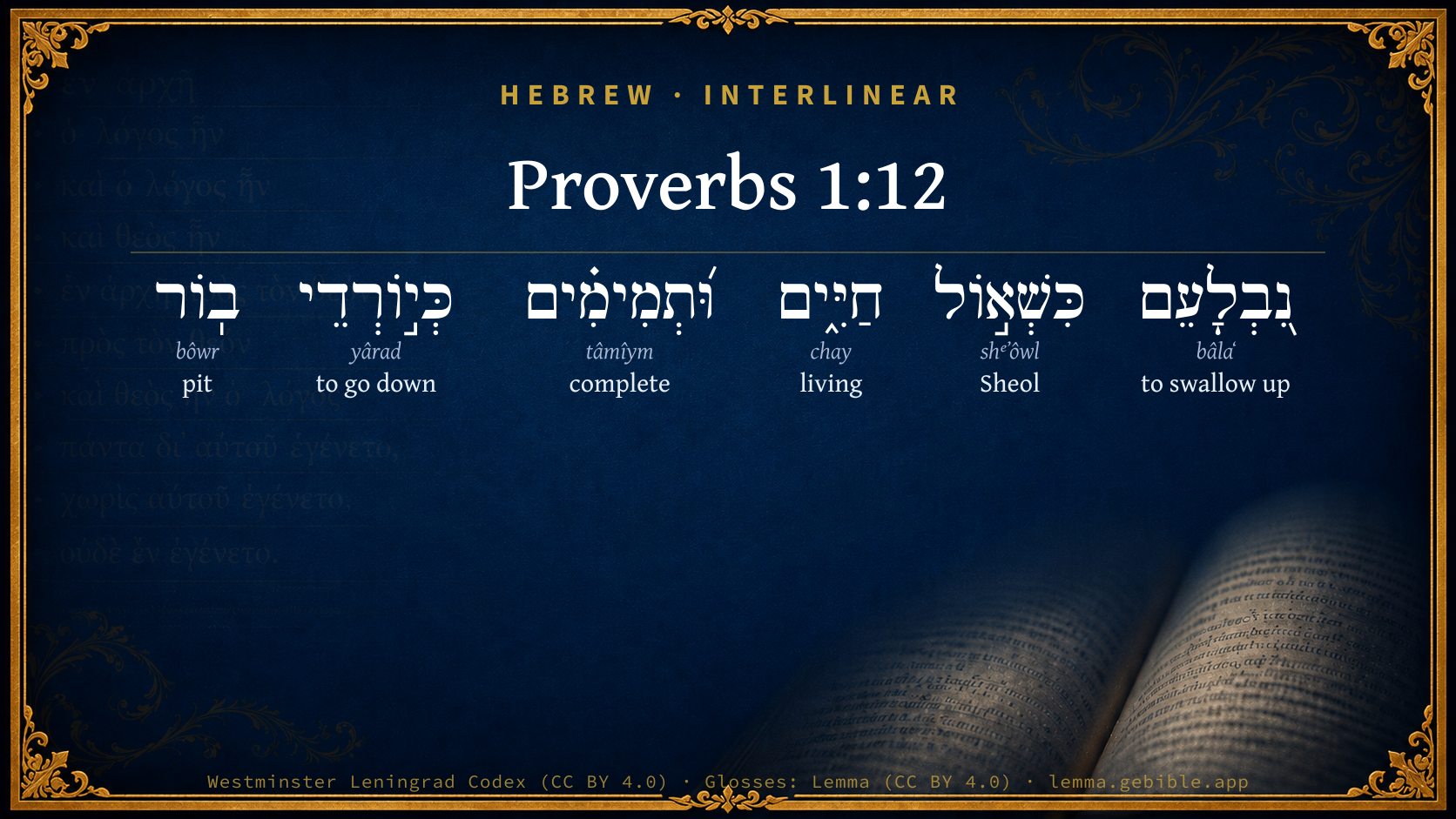
Hebrew (Westminster Leningrad Codex) Proverbs 1:12 appears in the Hebrew Old Testament. The text above is from the Westminster Leningrad Codex. Each word links to its Strong’s number, a concise gloss, and parsing drawn from the Open Scriptures Hebrew Bible morphology. Click any word for its full Brown-Driver-Briggs (BDB) entry.
Download image
Cite this verse

Proverbs 1:12 (World English Bible). Public Domain. Lemma interlinear Bible study tool, https://lemma.gebible.app/v/proverbs/1/12.

Show BibTeX & RIS
BibTeX
RIS
English Translation
Let's swallow them up alive like Sheol, And whole, like those who go down into the pit.
World English Bible · Public Domain
Download a study sheet

One document with this verse’s original text, its word-by-word gloss line, the meaning frame, cross-references with their text, attributed commentary, and full source and license credits — printable, and it pastes into notes with its structure intact.

This verse Autodidact and up

Study sheet (.html) Plain text (.txt)

A passage Seminary Student

Up to 50 verses in one chapter. A passage sheet keeps up to 6 commentary sources and 12 cross-references per verse, in the order this page ranks them, and says so on the sheet whenever that leaves anything out. Ask for a single verse and you get the Autodidact verse sheet above.

Everything on this page stays free to read, with no account — the sheet is a download of what is already on screen, not access to it.

Want to remove ads? Support Godless Engineer
Compare translations 3

The same verse in 3 English versions, stacked beneath the original-language interlinear above. Click any original word for its lexicon entry.

Each is an independent rendering of the whole verse — the interlinear is not word-aligned to these translations.

Highlighted words mark where these versions differ — a whole-verse word diff, not a word-by-word alignment.

  • World English Bible Public Domain
    Let's swallow them up alive like Sheol, And whole, like those who go down into the pit.
  • King James Version Public Domain
    Let us swallow them up alive as the grave; and whole, as those that go down into the pit:
  • unfoldingWord Literal Text CC BY-SA 4.0
    Let us swallow them, the living ones, like Sheol, and the whole ones like those going down to a pit.

unfoldingWord Literal Text — © unfoldingWord, licensed CC BY-SA 4.0. Word-aligned USFM3 via Door43 (git.door43.org/unfoldingWord/en_ult).

Versions to compare (up to 4)

3 of 4 selected

Show all 18 translations

Every available English version of this verse, each an independent rendering of the whole verse.

  • World English Bible Public Domain
    Let's swallow them up alive like Sheol, And whole, like those who go down into the pit.
  • Berean Standard Bible Public Domain
    let us swallow them alive like Sheol, and whole like those descending into the Pit.
  • Majority Standard Bible Public Domain
    let us swallow them alive like Sheol, and whole like those descending into the Pit.
  • King James Version Public Domain
    Let us swallow them up alive as the grave; and whole, as those that go down into the pit:
  • American Standard Version (1901) Public Domain
    Let us swallow them up alive as Sheol, And whole, as those that go down into the pit;
  • Revised Version (1885) Public Domain
    Let us swallow them up alive as Sheol, and whole, as those that go down into the pit;
  • Geneva Bible (1599) Public Domain
    We wil swallow them vp aliue like a graue euen whole, as those that goe downe into the pit:
  • Douay-Rheims (1899) Public Domain
    Let us swallow him up alive like hell, and whole as one that goeth down into the pit.
  • Young's Literal Translation Public Domain
    We swallow them as Sheol -- alive, And whole -- as those going down `to' the pit,
  • Literal Standard Version CC BY-SA 4.0
    We swallow them as Sheol—alive, || And whole—as those going down [to] the pit,
  • Unlocked Literal Bible CC BY-SA 4.0
    Let us swallow them up alive, like Sheol takes away those who are healthy, and make them like those who fall into the pit.
  • unfoldingWord Literal Text CC BY-SA 4.0
    Let us swallow them, the living ones, like Sheol, and the whole ones like those going down to a pit.
  • Darby Bible Public Domain
    let us swallow them up alive as Sheol, and whole, as those that go down into the pit;
  • World Messianic Bible Public Domain
    Let’s swallow them up alive like Sheol, and whole, like those who go down into the pit.
  • Webster's Bible Public Domain
    Let us swallow them up alive as the grave; and whole, as those that go down into the pit:
  • Free Bible Version CC BY-SA 4.0
    Let's bury them alive; let's put them in the grave while they're still healthy!
  • Bible in Basic English Public Domain
    Let us overcome them living, like the underworld, and in their strength, as those who go down to death;
  • JPS Tanakh (1917) Public Domain
    Let us swallow them up alive as the grave, and whole, as those that go down into the pit;

Literal Standard Version (2020), Covenant Press — licensed CC BY-SA 4.0. Text via the HelloAO Bible API (eBible.org). Unlocked Literal Bible (unfoldingWord) — licensed CC BY-SA 4.0. Text via the HelloAO Bible API (eBible.org). unfoldingWord Literal Text — © unfoldingWord, licensed CC BY-SA 4.0. Word-aligned USFM3 via Door43 (git.door43.org/unfoldingWord/en_ult). Free Bible Version, Dr. Jonathan Gallagher — licensed CC BY-SA 4.0. Text via the HelloAO Bible API (eBible.org).

Word by word

More ways to search: Search by grammar → Find every occurrence → Compare this word →

Practice this passage: Drill this verse → Learn its vocabulary →

About this verse

These counts appear in no published source. They are computed here, from the morphology-tagged text and Lemma’s own curated glosses. What Lemma adds →

6
words
6
distinct lemmas
Wisdom
section

Shared distinctive vocabulary

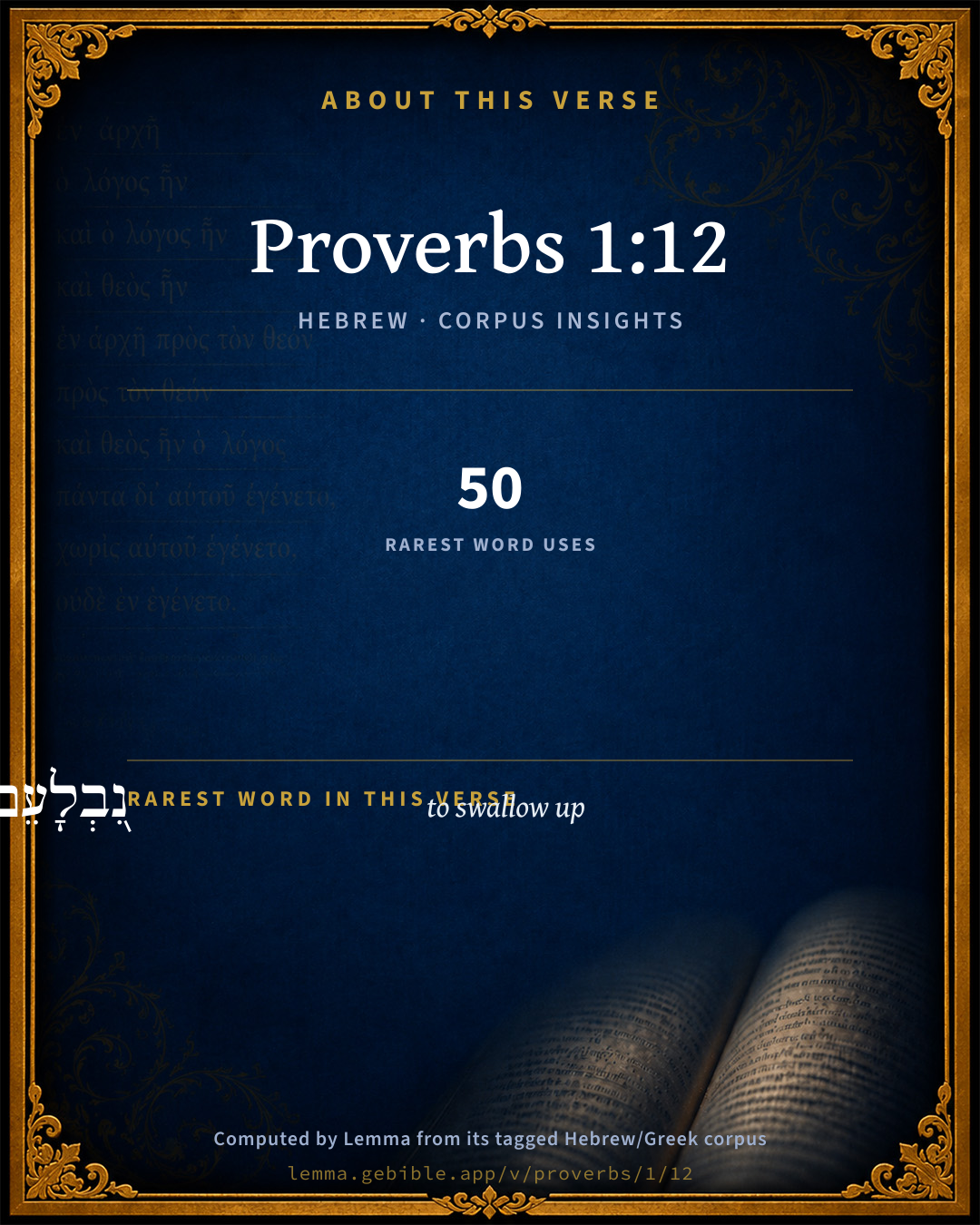
נִ֭בְלָעֵם to swallow up H1104 occurs in 48 verses of the Hebrew Bible. Also found in:

Grammatical profile

  • 2 verbs
  • 2 nouns
  • 2 adjectives

Verb forms

  • נִ֭בְלָעֵם Qal · Cohortative
  • כְּי֣וֹרְדֵי Qal · Participle Active

Hebrew & Septuagint length

In English translation the verse runs 17 words from the Hebrew and 18 from the Septuagint (LXX English) — closely comparable.

A rough comparison of the two English renderings, which tokenize alike — not a word-level alignment.

Word counts can differ between the Hebrew and the Greek without any difference in meaning — e.g. the Hebrew direct-object marker אֵת has no separate Greek word, and Greek often adds the article ὁ.

Cross-references

14

Topical passages linked to Proverbs 1:12 in the Treasury of Scripture Knowledge — connected by theme and wording, ordered by reader-vote popularity; previews shown in the World English Bible.

  • Psalms 28:1 To you, Yahweh, I call. My rock, don't be deaf to me; Lest, if you are silent to me, I would become like those who go down into the pit.
  • Psalms 124:3 Then they would have swallowed us up alive, When their wrath was kindled against us;
  • Romans 3:13 "Their throat is an open tomb. With their tongues they have used deceit." "The poison of vipers is under their lips;"
  • Numbers 16:30–33 But if Yahweh make a new thing, and the ground open its mouth, and swallow them up, with all that appertain to them, and they go down alive into Sheol; then you shall understand that these men have despised Yahweh.
  • Numbers 26:10 and the earth opened its mouth, and swallowed them up together with Korah, when that company died; what time the fire devoured two hundred fifty men, and they became a sign.
  • Psalms 5:9 For there is no faithfulness in their mouth. Their heart is destruction. Their throat is an open tomb. They flatter with their tongue.
  • Psalms 35:25 Don't let them say in their heart, "Aha! That's the way we want it!" Don't let them say, "We have swallowed him up!"
  • Psalms 56:1–2 Be merciful to me, God, for man wants to swallow me up. All day long, he attacks and oppresses me.
  • Psalms 57:3 He will send from heaven, and save me, He rebukes the one who is pursuing me. Selah. God will send out his loving kindness and his truth.
  • Psalms 143:7 Hurry to answer me, Yahweh. My spirit fails. Don't hide your face from me, So that I don't become like those who go down into the pit.
  • Jeremiah 51:34 Nebuchadrezzar the king of Babylon has devoured me, he has crushed me, he has made me an empty vessel, he has, like a monster, swallowed me up, he has filled his maw with my delicacies; he has cast me out.
  • Lamentations 2:5 The Lord is become as an enemy, he has swallowed up Israel; He has swallowed up all her palaces, he has destroyed his strongholds; He has multiplied in the daughter of Judah mourning and lamentation.
  • Lamentations 2:16 All your enemies have opened their mouth wide against you; They hiss and gnash the teeth; they say, We have swallowed her up; Certainly this is the day that we looked for; we have found, we have seen it.
  • Micah 3:2–3 You who hate the good, And love the evil; Who tear off their skin, And their flesh from off their bones;

Cross-references courtesy of OpenBible.info (CC BY 4.0).

Hebrew and Greek witnesses Masoretic Hebrew ↔ Greek Septuagint

The same verse in the two great witnesses to the Old Testament, shown verse-for-verse.

These are two independent witnesses, not word-aligned to each other, and the Septuagint is shown in lemma (dictionary) form.

Hebrew Proverbs 1:12 Masoretic · Westminster Leningrad Codex

נִ֭בְלָעֵם כִּשְׁא֣וֹל חַיִּ֑ים וּ֝תְמִימִ֗ים כְּי֣וֹרְדֵי בֽוֹר

Let's swallow them up alive like Sheol, And whole, like those who go down into the pit.

World English Bible · Public Domain

Greek LXX Proverbs 1:12 Septuagint · lemma form

καταπίνω δέ αὐτός ὥσπερ ᾅδης ζάω καί αἴρω αὐτός ὁ μνήμη ἐκ γῆ

and let us swallow him alive, as Hades would, and remove the memorial of him from the earth:

LXX2012 (modern English Septuagint) · Public Domain

On this verse, The Cambridge Bible for Schools and Colleges discusses the Septuagint’s reading. Read the note in Commentary ↓

Hebrew: Westminster Leningrad Codex (CC BY 4.0). Greek: Septuagint (public domain); English from LXX2012 (modern English Septuagint) (Public Domain). How the Septuagint differs from the Hebrew →

Commentary

Notes on Proverbs 1:12 from classic Christian and Jewish commentators (each source and its license shown beneath its notes). The classic Christian expositions comment on the surrounding passage and are grouped to its opening verse, so a note may address several verses; the Jewish commentaries on the Tanakh (Rashi and others) are per-verse, so they appear only where the commentator wrote on this verse.

Lemma curates 59 commentaries, every one of them public domain or Creative Commons licensed, each selected and text-cleaned for this edition rather than reprinted as found. About our sources →

Trapp's Complete Commentary

John Trapp

Pro 1:12 Let us swallow them up alive as the grave; and whole, as those that go down into the pit:

Ver. 12. Let us swallow them up alive.] As the devil doth. {1Pe 5:8 2Ti 2:26} Homo homini demon. The poor Indians have been heard to say, it had been better that their country had been given to the devils of hell than to the Spaniards; and that if the cruel Spaniards go to heaven when they die, they, for their parts, desire not to come there.

John Trapp, A Commentary or Exposition upon All the Books of the Old and New Testament (1647–1656) — public domain. Text from a community e-Sword module.

Tyndale Open Study Notes

Tyndale Open Resources

1:12 like the grave: Hebrew like Sheol. In the Old Testament, Sheol is the abode of the dead. It is not necessarily associated with punishment.

Tyndale Open Study Notes — © Tyndale Open Resources, licensed CC BY-SA 4.0. Text via the HelloAO Bible API.

Geneva Bible (1599)

Geneva Bible translators

As the grave is never satiated, so the avarice of the wicked and their cruelty hath none end.

Geneva Bible (1599) marginal notes — public domain. Text via Bolls.life.

Adam Clarke's Commentary

Verse 12. Let us swallow them up alive] Give them as hasty a death as if the earth were suddenly to swallow them up. This seems to refer to the destruction of a whole village. Let us destroy man, woman, and child; and then we may seize on and carry away the whole of their property, and the booty will be great.

Adam Clarke's Commentary on the Bible (1810–1826) — public domain. Text from a community e-Sword/MySword module.

Ellicott's Commentary for English Readers

(12) Alive.—Comp. the death of Dathan and Abiram (Num_16:30).

A Bible Commentary for English Readers, edited by Charles John Ellicott (1878–1897) — public domain. Text from a community e-Sword module.

The Cambridge Bible for Schools and Colleges

gen. ed. J. J. S. Perowne

12. the grave] or, Sheol, R.V. text, ᾅδης LXX., infernus Vulg.

whole] Some (as R.V. marg. even the perfect) give the Heb. word here the moral sense, which it has elsewhere. But both the parallelism and the force are better preserved by the rendering of A.V. and R.V. text. Let us make away with them in a moment in the full vigour of life, as though Hades should open her mouth and swallow them up (comp. Num_16:30; Num_16:33): yea, let us sweep them from the earth in perfect soundness, as completely as those who go down to the grave are swallowed up by it. The LXX. give a different turn (paraphrase, not translation) to the 2nd clause, ἄρωμεν αὐτοῦ τὴν μνήμην ἐκ γῆς, let us take away the remembrance of him from the earth, as though by whole they understood, wholly, leaving not the memory of him behind.

The Cambridge Bible for Schools and Colleges (gen. ed. J. J. S. Perowne; Cambridge University Press, 1878–1918) — public domain. Text from a community e-Sword module.

John Gill's Exposition

Let us swallow them up alive as the grave,.... The innocent person, and those that are with him, his servants; our gang is so numerous that we can very easily dispatch him and all his attendants, and bury them out of sight at once, as if they were swallowed up alive in a grave, and so no more to be seen or heard of; and consequently we shall be in the utmost safety and security, there being no traces of what is done, nor any left to make a relation of it, or to give any information of us, or to pursue us;

and whole, as those that go down into the pit; who though whole and in perfect health, shall in a moment be destroyed and cast into the pit, being first plundered of all the riches they have about them; for this swallowing them up alive and whole, which is an allusion to a beast of prey swallowing up another creature all at once, not only intends their cruelty in taking away life, but their rapaciousness in seizing upon their substance.

John Gill's Exposition of the Whole Bible (1746–1763) — public domain (CC PDM 1.0). Text via the HelloAO Bible API.

Albert Barnes' Notes on the Bible

i. e., “We will be as all-devouring as Sheol. The destruction of those we attack shall be as sudden as that of those who go down quickly into the pit.” Some render the latter clause, and upright men as those that go down to the pit. “Pit” here is a synonym for Sheol, the great cavernous depth, the shadow-world of the dead.

Albert Barnes' Notes on the Bible (1834–1885) — public domain. Text from a community e-Sword/MySword module.

Haydock's Catholic Bible Commentary

Pit. Grave, or hell, like Dathan, Numbers xvi. This shews the greatest rage, Job xxxi. 31.

George Leo Haydock (1774–1849), Haydock's Catholic Family Bible and Commentary, 1859 edition — public domain. Excludes Psalms (Douay-Rheims chapter numbering differs from Protestant) and Deuterocanonical books (Catholic canon only).

Matthew Poole's English Annotations

As the grave; which speedily covers and consumes dead bodies. See Psa 55:15; 124:3. We shall do our work quickly, easily, and without fear of discovery.

Into the pit; into some deep pit, into which a traveller falls unawares, and is utterly lost, and never discovered.

Matthew Poole's English Annotations on the Holy Bible (1683–1685) — public domain. Text from a community e-Sword/MySword module.

Whedon's Commentary on the Bible

Daniel D. Whedon

12. Swallow… as the grave — כשׁאול, (kishol,) “like hell,” hades, orcus, the underworld, a favourite expression of bloodthirsty men in all ages. (See Excursus on Sheol, p. 72.) The strong passions excited by even regular warfare in a good cause afford a temptation to, and, we are sorry to say, often an excuse for, shocking profanity. This is a prominent vice of military men; but it should be left to those who fight in a bad cause and for bad ends. The men here represented are as voracious as the grave. The idea of the verse is that of sudden and complete destruction. Some suppose there is an allusion to the case of Korah and his associates, (Num_16:31-33,) where the earth opened and swallowed them up, “and they went down alive into the pit.”

Daniel D. Whedon (gen. ed.), Commentary on the Old and New Testaments (1874–1909) — public domain. Text from a community e-Sword module.

The Pulpit Commentary

Let us swallow them up alive as the grave. A continuation of ver. 11, expanding the idea of bloodshed ending in murder, and showing the determination of the sinners to proceed to the most violent means to effect their covetous ends. The enticement here put before youth is the courage and boldness of their exploits (Wardlaw). The order of the words in the original is, "Let us swallow them up, as the grave, living," which sufficiently indicates the meaning of the passage. Alive; (khayyim), i.e. "the living," refers to the pronomiual suffix in (niv"laem), as in the Authorized Version and Zockler. (cf. Psa_55:15 Psa_124:3) Umbreit and Hitzig are grammatically incorrect in connecting lwOavKi (kish"ol) "as the grave," with "the living," and translating "like the pit (swallows) that which lives." The Ki (ki) with a substantive, as here in kish"ol, is a preposition, said not a conjunction (see Gesenius, "Lexicon"). It denotes a kind of resemblance, but does not introduce a coordinate sentence. The allusion is undoubtedly in the teacher"s mind to the fate of Korah and his company, (Num_16:30-33) and as in that case "the earth opened her mouth, and swallowed them up" in the flush of life, so here the robbers say that they will as suddenly and effectively destroy their victims, lB (dala); from which niv"laem, in a figurative sense, means "to destroy utterly" (Geseuius). The change from the singular, "the innocent" (yqinl, l"naki), to the plural in "let us swallow them up," is noticeable. Like the pit (lwOavKi, kish"ol); literally, like Sheol, or Hades, the great subterranean cavity or world of the dead. The all-devouring and insatiable character of sheol is described in Pro_27:20, where the Authorized Version translates "Hell (sheol) and destruction are never full," and again in Pro_30:15, where it (sheol, Authorized Version, "the grave") is classed with the four things that are never satisfied. Vulgate, infernus; LXX, adhv . And whole, as those that go down into the pit. The parallelism of ideas requires that the word "whole" ( tmimim) should be understood of those physically whole (see Mercerus, Delitzsch), and not in a moral sense, as the upright (Luther, Grief, Holden, Plumptre). The word is used in an ethical signification in Pro_2:21. Gesenius gives it the meaning of "safe, secure." Those that go down into the pit. (rwOb yderwOy, yorde vor); i.e. the dead. The phrase also occurs in Psa_28:1 Psa_30:4 Psa_88:4 Psa_143:7 Isa_38:18) The pit (rwOb, vor); or, the sepulchre, the receptacle of the dead, is here synonymous with sheol. The LXX substitutes for the latter part of the verse, Kai arwmen autou thmhn ek ghv , "And let us remove his memory from the earth." The robbers, by drawing a comparison between themselves and Hades and the grave, which consign to silence all who are put therein, imply their own security against detection. They will so utterly destroy their victims that none will be left to tell the tale (see Musset, in loc. ). This, we know, is a fancied, and at the best only a temporary, security.

The Pulpit Commentary (1880–1919), ed. H.D.M. Spence-Jones & Joseph S. Exell — public domain. Text from a community e-Sword module.

Scofield Reference Notes

C. I. Scofield

grave

Heb. "Sheol," (See Scofield "Hab 2:5").

The Scofield Reference Bible (1917 edition), notes by C. I. Scofield — public domain. Text from a community e-Sword module.

unfoldingWord translationNotes

Door43 World Missions Community

General Information:

Verses 12-14 end the imagined statement of the sinners who are trying to entice others to sin.

Let us swallow them up alive, like Sheol takes away those who are healthy

The sinners speak of murdering innocent people as if they were Sheol and they would take a living and healthy person down to the place where dead people go. (See: Metaphor)

Let us swallow ... like Sheol takes away

This speaks of the grave as if it were a person that swallows humans and takes them down to the place of the dead. (See: Personification)

like Sheol takes away those who are healthy

The wicked expect to destroy their victims in the same way Sheol, the place of the dead, takes away even healthy people.

make them like those who fall into the pit

Possible meanings are 1) this refers to travelers who fall into a deep hole where no one will ever find them or 2) here "pit" is another word that means Sheol or the place where dead people go.

Throw in your lot with us

This is an idiom. AT: "Join us" (See: Idiom)

we will all have one purse together

Here "purse" represents everything that they steal. AT: "we will equally share everything that we steal" (See: Metonymy)

purse

a bag for carrying money

translationWords

life

like

Hades

pit

house

unfoldingWord translationNotes — © Distant Shores Media and the Door43 World Missions Community, licensed CC BY-SA 4.0. Source: git.door43.org/Door43/en_tn.

Rashi

Rabbi Shlomo Yitzchaki (Rashi)

let us swallow them up The innocent when they are alive.

like the grave which swallows up the entire body.

and the whole ones Heb. ותמימים. This is not an expression of righteous men, but an expression of whole ones. Let us swallow them up when they are whole, like a man who descends into a pit when he is whole; i.e., when they are still wealthy, let us slay them and inherit their property.

Rashi on the Tanakh — English translations: “The Judaica Press complete Tanach with Rashi, translated by A. J. Rosenberg” (CC BY 4.0); “Pentateuch with Rashi's commentary by M. Rosenbaum and A.M. Silbermann, 1929-1934” (public domain); “The Metsudah Tanach series, Lakewood, N.J” (CC BY 4.0); and “The Book of Joshua, Metsudah Publications, 1997” (CC BY 4.0). Text via Sefaria.

Lesson kit

Teaching starters — assembled from the data on this page, not authored interpretation. Every prompt links to the verse data it draws on. Edit before teaching.

Proverbs, in the Wisdom, opens this verse with 6 words (6 distinct Hebrew lemmas). Its most distinctive word is bâlaʻ (“to swallow up”). A historical commentator’s framing appears above. Read the whole chapter for the surrounding context.

Discussion questions

  1. What does “to swallow up” (bâlaʻ) contribute to the verse as a whole?
  2. How does Genesis 41:7, which shares the word «to swallow up», read alongside this verse?
  3. These translations render this verse differently; the difference is in the English rendering, not the original. What questions does that raise?
  4. «נִ֭בְלָעֵם» is a Qal Cohortative verb. How does that grammatical form shape the action described?
  5. Compare how Trapp's Complete Commentary and Tyndale Open Study Notes read this verse. Where do they agree or differ?

Things to notice

Reading settings

Reading text

Shown beneath each verse's original-language words.

Old Testament
Old Testament edition

Read the OT as the Masoretic Hebrew (MT) or the Greek Septuagint (LXX).

English shown for the Greek Septuagint (in the Hebrew ↔ Greek comparison).

Comparing translations? Open the Compare panel on any verse page to stack up to four side by side.