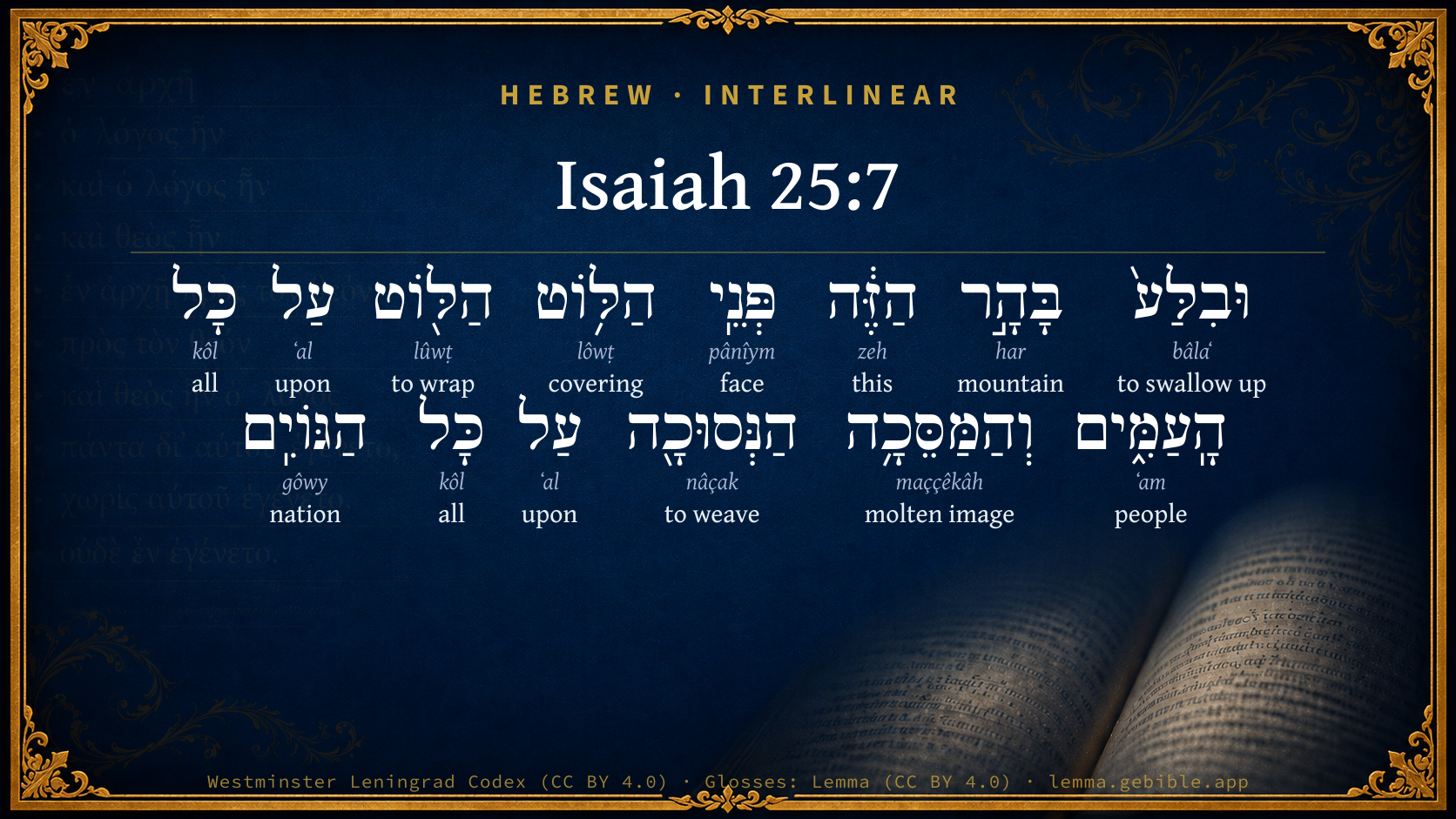
Isaiah 25:7

Hebrew (Westminster Leningrad Codex) Isaiah 25:7 appears in the Hebrew Old Testament. The text above is from the Westminster Leningrad Codex. Each word links to its Strong’s number, a concise gloss, and parsing drawn from the Open Scriptures Hebrew Bible morphology. Click any word for its full Brown-Driver-Briggs (BDB) entry.
Download image
Cite this verse

Isaiah 25:7 (World English Bible). Public Domain. Lemma interlinear Bible study tool, https://lemma.gebible.app/v/isaiah/25/7.

Show BibTeX & RIS
BibTeX
RIS
English Translation
He will destroy in this mountain the surface of the covering that covers all peoples, and the veil that is spread over all nations.
World English Bible · Public Domain
Highlights
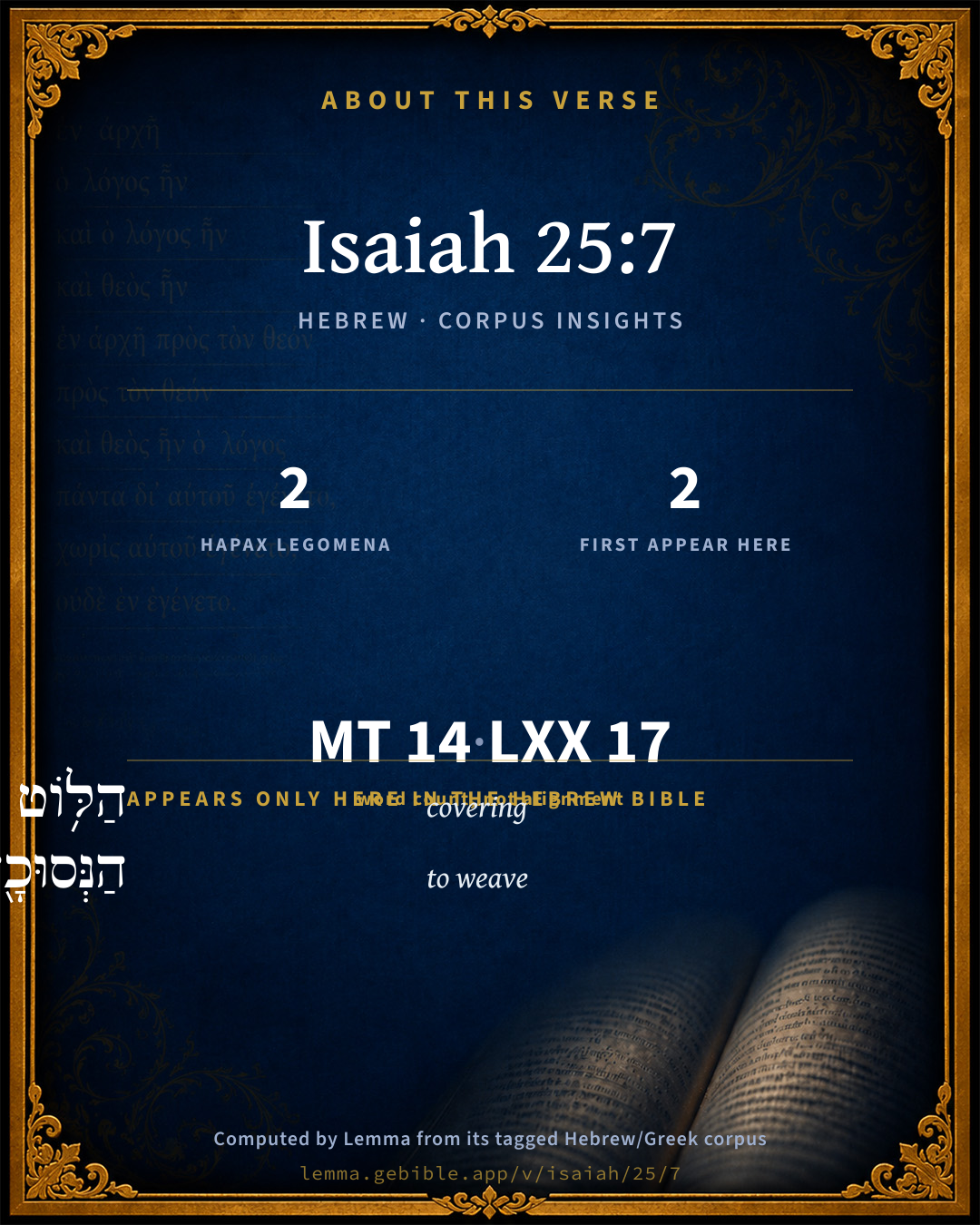
  • 2 hapax legomena — only here in the Hebrew Bible
  • 2 first appearances in the Hebrew Bible
Full analysis ↓
Download a study sheet

One document with this verse’s original text, its word-by-word gloss line, the meaning frame, cross-references with their text, attributed commentary, and full source and license credits — printable, and it pastes into notes with its structure intact.

This verse Autodidact and up

Study sheet (.html) Plain text (.txt)

A passage Seminary Student

Up to 50 verses in one chapter. A passage sheet keeps up to 6 commentary sources and 12 cross-references per verse, in the order this page ranks them, and says so on the sheet whenever that leaves anything out. Ask for a single verse and you get the Autodidact verse sheet above.

Everything on this page stays free to read, with no account — the sheet is a download of what is already on screen, not access to it.

Want to remove ads? Support Godless Engineer
Compare translations 3

The same verse in 3 English versions, stacked beneath the original-language interlinear above. Click any original word for its lexicon entry.

Each is an independent rendering of the whole verse — the interlinear is not word-aligned to these translations.

Highlighted words mark where these versions differ — a whole-verse word diff, not a word-by-word alignment.

  • World English Bible Public Domain
    He will destroy in this mountain the surface of the covering that covers all peoples, and the veil that is spread over all nations.
  • King James Version Public Domain
    And he will destroy in this mountain the face of the covering cast over all people, and the vail that is spread over all nations.
  • unfoldingWord Literal Text CC BY-SA 4.0
    And he will swallow up on this mountain the face of the covering covering over all of the peoples and the weaving woven over all of the nations:

unfoldingWord Literal Text — © unfoldingWord, licensed CC BY-SA 4.0. Word-aligned USFM3 via Door43 (git.door43.org/unfoldingWord/en_ult).

Versions to compare (up to 4)

3 of 4 selected

Show all 17 translations

Every available English version of this verse, each an independent rendering of the whole verse.

  • World English Bible Public Domain
    He will destroy in this mountain the surface of the covering that covers all peoples, and the veil that is spread over all nations.
  • Berean Standard Bible Public Domain
    On this mountain He will swallow up the shroud that enfolds all peoples, the sheet that covers all nations;
  • Majority Standard Bible Public Domain
    On this mountain He will swallow up the shroud that enfolds all peoples, the sheet that covers all nations;
  • King James Version Public Domain
    And he will destroy in this mountain the face of the covering cast over all people, and the vail that is spread over all nations.
  • American Standard Version (1901) Public Domain
    And he will destroy in this mountain the face of the covering that covereth all peoples, and the veil that is spread over all nations.
  • Revised Version (1885) Public Domain
    And he will destroy in this mountain the face of the covering that is cast over all peoples, and the veil that is spread over all nations.
  • Geneva Bible (1599) Public Domain
    And he will destroy in this mountaine the couering that couereth all people, and the vaile that is spread vpon all nations.
  • Young's Literal Translation Public Domain
    And swallowed up hath He in this mountain The face of the wrapping that is wrapped over all the peoples, And of the covering that is spread over all the nations.
  • Literal Standard Version CC BY-SA 4.0
    And He has swallowed up in this mountain || The face of the wrapping that is wrapped over all the peoples, || And of the covering that is spread over all the nations.
  • Unlocked Literal Bible CC BY-SA 4.0
    He will destroy on this mountain the covering over all peoples, the web woven over all the nations.
  • unfoldingWord Literal Text CC BY-SA 4.0
    And he will swallow up on this mountain the face of the covering covering over all of the peoples and the weaving woven over all of the nations:
  • Darby Bible Public Domain
    And he will destroy in this mountain the face of the veil which veileth all the peoples, and the covering that is spread over all the nations.
  • World Messianic Bible Public Domain
    He will destroy in this mountain the surface of the covering that covers all peoples, and the veil that is spread over all nations.
  • Webster's Bible Public Domain
    And he will destroy on this mountain the face of the covering cast over all people, and the vail that is spread over all nations.
  • Free Bible Version CC BY-SA 4.0
    On this mountain he will destroy the veil that covers all the nations, the sheet that is over everyone.
  • Bible in Basic English Public Domain
    And in this mountain he will put an end to the shade covering the face of all peoples, and the veil which is stretched over all nations.
  • JPS Tanakh (1917) Public Domain
    And He will destroy in this mountain the face of the covering that is cast over all peoples, and the veil that is spread over all nations.

Literal Standard Version (2020), Covenant Press — licensed CC BY-SA 4.0. Text via the HelloAO Bible API (eBible.org). Unlocked Literal Bible (unfoldingWord) — licensed CC BY-SA 4.0. Text via the HelloAO Bible API (eBible.org). unfoldingWord Literal Text — © unfoldingWord, licensed CC BY-SA 4.0. Word-aligned USFM3 via Door43 (git.door43.org/unfoldingWord/en_ult). Free Bible Version, Dr. Jonathan Gallagher — licensed CC BY-SA 4.0. Text via the HelloAO Bible API (eBible.org).

Word by word

More ways to search: Search by grammar → Find every occurrence → Compare this word →

Practice this passage: Drill this verse → Learn its vocabulary →

הַלּ֥וֹט
lôwṭ
H3875
“the · covering”
Particle, Definite Article + Verb, Qal, Participle Active, Masculine, Singular, Absolute
Part of Speech
Particle + Verb
Stem
Qal
Form
Participle Active
Gender
Masculine
Number
Singular
State
Absolute
Full BDB Definition

Origin: from H3874

TWOT: 1092b

covering, envelope
  1. וּבִלַּע֙ bâlaʻ H1104 “and · to swallow up” Conjunction + Verb, Piel, Sequential Perfect, 3rd Person, Masculine, Singular
  2. בָּהָ֣ר har H2022 “in/at the · mountain” Preposition, Determined + Noun, Common, Masculine, Singular, Absolute
  3. הַזֶּ֔ה zeh H2088 “the · this” Particle, Definite Article + Pronoun, Demonstrative, Masculine, Singular
  4. פְּנֵֽי pânîym H6440 “face(s) of” Noun, Common, Both, Plural, Construct
  5. הַלּ֖וֹט lûwṭ H3874 “the · wrapping” Particle, Definite Article + Verb, Qal, Participle Active, Masculine, Singular, Absolute
  6. עַל ʻal H5921 “upon” Preposition
  7. כָּל kôl H3605 “all of” Noun, Common, Masculine, Singular, Construct
  8. הָֽעַמִּ֑ים ʻam H5971 “the · peoples” Particle, Definite Article + Noun, Common, Masculine, Plural, Absolute
  9. וְהַמַּסֵּכָ֥ה maççêkâh H4541 “and · the · molten image” Conjunction + Particle, Definite Article + Noun, Common, Feminine, Singular, Absolute
  10. הַנְּסוּכָ֖ה nâçak H5259 “the · woven” Particle, Definite Article + Verb, Qal, Participle Passive, Feminine, Singular, Absolute
  11. עַל ʻal H5921 “upon” Preposition
  12. כָּל kôl H3605 “all of” Noun, Common, Masculine, Singular, Construct
  13. הַגּוֹיִֽם gôwy H1471 “the · nations” Particle, Definite Article + Noun, Common, Masculine, Plural, Absolute

About this verse

These counts appear in no published source. They are computed here, from the morphology-tagged text and Lemma’s own curated glosses. What Lemma adds →

14
words
12
distinct lemmas
Prophets
section

Notable vocabulary

2 hapax legomena — words that appear only here in the entire Hebrew Bible:

  • הַלּ֥וֹט covering H3875
  • הַנְּסוּכָ֖ה to weave H5259

First appearance in Scripture

These words make their first canonical appearance in the Hebrew Bible here:

  • הַלּ֥וֹט covering H3875
  • הַנְּסוּכָ֖ה to weave H5259

Shared distinctive vocabulary

הַלּ֖וֹט to wrap H3874 occurs in 3 verses of the Hebrew Bible. Also found in:

Grammatical profile

  • 4 verbs
  • 7 nouns
  • 1 pronoun
  • 2 prepositions

Verb forms

  • וּבִלַּע֙ Piel · Sequential Perfect
  • הַלּ֥וֹט Qal · Participle Active
  • הַלּ֖וֹט Qal · Participle Active
  • הַנְּסוּכָ֖ה Qal · Participle Passive

Repetition

Words recur within this verse — often emphatic in Hebrew:

Hebrew & Septuagint length

In English translation the verse runs 24 words from the Hebrew and 26 from the Septuagint (LXX English) — closely comparable.

A rough comparison of the two English renderings, which tokenize alike — not a word-level alignment.

Word counts can differ between the Hebrew and the Greek without any difference in meaning — e.g. the Hebrew direct-object marker אֵת has no separate Greek word, and Greek often adds the article ὁ.

In the original languages it is 14 Hebrew tokens and 17 Greek tokens — but the two are counted differently (Hebrew bundles its prefixes and suffixes into one token; the Greek is in lemma form), so that isn’t a like-for-like length.

Cross-references

11

Topical passages linked to Isaiah 25:7 in the Treasury of Scripture Knowledge — connected by theme and wording, ordered by reader-vote popularity; previews shown in the World English Bible.

  • Ephesians 4:18 being darkened in their understanding, alienated from the life of God, because of the ignorance that is in them, because of the hardening of their hearts;
  • Isaiah 60:1–3 Arise, shine; for your light is come, and the glory of Yahweh is risen on you.
  • Matthew 27:51 Behold, the veil of the temple was torn in two from the top to the bottom. The earth quaked and the rocks were split.
  • 2 Corinthians 3:13–18 and not as Moses, who put a veil on his face, that the children of Israel wouldn't look steadfastly on the end of that which was passing away.
  • Hebrews 10:19–21 Having therefore, brothers, boldness to enter into the holy place by the blood of Jesus,
  • Acts 17:30 The times of ignorance therefore God overlooked. But now he commands that all people everywhere should repent,
  • Ephesians 3:5–6 which in other generations was not made known to the children of men, as it has now been revealed to his holy apostles and prophets in the Spirit;
  • Ephesians 5:8 For you were once darkness, but are now light in the Lord. Walk as children of light,
  • Hebrews 9:24 For Christ hasn't entered into holy places made with hands, which are representations of the true, but into heaven itself, now to appear in the presence of God for us;
  • Luke 2:32 A light for revelation to the Gentiles, And the glory of your people Israel."
  • Hebrews 9:8 The Holy Spirit is indicating this, that the way into the Holy Place wasn't yet revealed while the first tabernacle was still standing;

Cross-references courtesy of OpenBible.info (CC BY 4.0).

Hebrew and Greek witnesses Masoretic Hebrew ↔ Greek Septuagint

The same verse in the two great witnesses to the Old Testament, shown verse-for-verse.

These are two independent witnesses, not word-aligned to each other, and the Septuagint is shown in lemma (dictionary) form.

Hebrew Isaiah 25:7 Masoretic · Westminster Leningrad Codex

וּבִלַּע֙ בָּהָ֣ר הַזֶּ֔ה פְּנֵֽי הַלּ֥וֹט הַלּ֖וֹט עַל כָּל הָֽעַמִּ֑ים וְהַמַּסֵּכָ֥ה הַנְּסוּכָ֖ה עַל כָּל הַגּוֹיִֽם

He will destroy in this mountain the surface of the covering that covers all peoples, and the veil that is spread over all nations.

World English Bible · Public Domain

Greek LXX Isaiah 25:7 Septuagint · lemma form

ἐν ὁ ὄρος οὗτος παραδίδωμι οὗτος πᾶς ὁ ἔθνος ὁ γάρ βουλή οὗτος ἐπί πᾶς ὁ ἔθνος

they shall anoint themselves with ointment in this mountain. Impart you all these things to the nations; for this is God's counsel upon all the nations.

LXX2012 (modern English Septuagint) · Public Domain

Hebrew: Westminster Leningrad Codex (CC BY 4.0). Greek: Septuagint (public domain); English from LXX2012 (modern English Septuagint) (Public Domain). How the Septuagint differs from the Hebrew →

Targum (Aramaic paraphrase)

1

The Targum is the ancient Jewish Aramaic paraphrase of the Hebrew Scriptures — an interpretive translation, not the Hebrew text itself. Onkelos (literal) and Pseudo-Jonathan (expansive) render the Torah, and Jonathan the Prophets. Coverage is partial: where no permissively-licensed English translation exists for a verse, only the Aramaic is shown. This is verse-level text, not a word-by-word alignment to the Hebrew.

  1. Targum Jonathan Prophets (Joshua–Malachi)
    וְיִסְתְּלַעֲמוּן בְּטוּרָא הָדֵין אַפֵּי רַבָּא דְרַב עַל כָּל עַמְמַיָא וְאַפֵּי מַלְכָּא דְשַׁלִיט עַל כָּל מַלְכְּוָתָא:

    The face of the prince, of the prince of all the people shall be destroyed; and the face of the king, of the ruler of all the kingdoms.

    Targum Jonathan — Aramaic: “Mikraot Gedolot” (public domain). English: “Sefaria Community Translation” (CC0 1.0 (public-domain dedication)); “London "Chaldee Paraphrase," 1871” (public domain). Text via Sefaria.

Commentary

Notes on Isaiah 25:7 from classic Christian and Jewish commentators (each source and its license shown beneath its notes). The classic Christian expositions comment on the surrounding passage and are grouped to its opening verse, so a note may address several verses; the Jewish commentaries on the Tanakh (Rashi and others) are per-verse, so they appear only where the commentator wrote on this verse.

Lemma curates 59 commentaries, every one of them public domain or Creative Commons licensed, each selected and text-cleaned for this edition rather than reprinted as found. About our sources →

Trapp's Complete Commentary

John Trapp

Isa 25:7 And he will destroy in this mountain the face of the covering cast over all people, and the vail that is spread over all nations.

Ver. 7. And he will destroy in this mountain, &c.] Absorbebit velum faciei, id est, faciem veli. Christ came "a light into the world, that whosoever believeth on him should not abide in darkness." {Joh 12:46} Faith freeth from blindness; we no sooner taste of the bread of life by faith, but the veil of ignorance, which naturally covereth all flesh, is torn; and men are suddenly brought "out of darkness into a marvellous light." {1Pe 2:9} This is the first eulogy and noble commendation of the doctrine of the gospel, light. There follow two more, viz., life and joy spiritual, {Isa 35:6} which is the life of that life. {Isa 25:8}

John Trapp, A Commentary or Exposition upon All the Books of the Old and New Testament (1647–1656) — public domain. Text from a community e-Sword module.

The Biblical Illustrator

Joseph S. Exell

Isa_25:7-8

And He will destroy in this mountain the face of the covering cast over an people

The removal of the covering

I.

THE GOSPEL DESTROYS THE COVERING WHICH HIDES THE TRUE NATURE OF MAN. The covering of sin has ever concealed the nature, the nobility of nature, the capabilities of nature, and the possibilities of nature in mankind. The covering is thick and coarse. Ignorance, brutality, discord, war, barbaric customs, plunder, and gross immoralities are the threads of the textile. They are so closely woven that the very features of human nature are hidden. Take off the covering. You have seen the earth when winter has possessed its vales, its forests, its gardens, and its fields. The frost has ploughed the ground. The sleet has destroyed every vestige of verdure. Even the ivy leaf is covered with the snow. Spring will destroy that covering, and life will shoot up from the roots to the highest boughs. So the advent of Christ introduced revivifying influences, and the true nature of man is discovered in kind words and deeds of goodness. Our forefathers never thought that nature had concealed such precious ores in the hearts of the mountains. A few years ago even we had no conception that down deep in the bosom of the earth wells of oil waited to be drawn to the surface. The covering has been taken away since, and these valuables have seen the light. Jesus Christ sunk shafts through the outward crust of sin, and brought forth precious ores to be smelted in the furnace of His love, moulded in His example, and circulated through the ages.

II. THE GOSPEL DESTROYS THE COVERING WHICH HIDES THE TRUE NATURE OF GOD. Communion with the source of peace was broken by the first shadow of guilt. Man in the dark is seized with fear Of the God who made him. This fear grows into dislike, and dislike into indifference, and indifference into defiance. The fool desireth in his heart that there might be no God, and the dislike grows into a positive refusal of entertaining God in his thoughts. But sin has not succeeded to remove all traces of God item the human mind. The sinner cannot altogether close his eyes and ears to those manifestations and voices which force the idea of God upon him. Under the covert of sin conceptions of Him are entertained at variance with His nature, and in opposition to His dealings. Christ came to reveal the Father. The power of reconciliation is in that word.

III. THE GOSPEL DESTROYS THE COVERING WHICH HIDES THE TRUE AFFINITY BETWEEN MAN AND MAN. Unto Him shall the gathering of the people be. The basis of the Church is union with the Father. We meet in Him befogs we meet in one another. National prejudice and society caste, family feuds and personal animosity will perish under the influence of the Cross; humanity will be raised into union with the Father, and God will be all and in all.

IV. THE GOSPEL WILL DESTROY THAT WHICH HIDES THE FUTURE. He will swallow up death in victory. It was a new declaration when One said, I am the resurrection and the life. (T. Davies, M. A.)

The Biblical Illustrator, edited by Joseph S. Exell (c. 1880s–1900s) — public domain. Text from a community e-Sword module.

MacLaren's Expositions of Holy Scripture

Alexander MacLaren

Isaiah

‘IN THIS MOUNTAIN’

THE VEIL OVER ALL NATIONS

Isa 25:7.

The previous chapter closes with a prediction of the reign of Jehovah in Mount Zion ‘before His elders’ in Glory. The allusion apparently is to the elders being summoned up to the Mount and seeing the Glory, ‘as the body of heaven in its clearness.’ The veil in this verse is probably a similar allusion to that which covered Moses’ face. It will then be an emblem of that which obscures for ‘all nations the face of God.’ And what is that but sin?

I. Sin veils God from men’s sight.

It is not the necessary inadequacy of the finite mind to conceive of the Infinite that most tragically hides God from us. That inadequacy is compatible with true and sufficient knowledge of Him. Nor is it ‘the veils of flesh and sense,’ as we often hear it said, that hide Him. But it is our sinful moral nature that darkens His face and dulls our eyes. ‘Knowledge’ of God, being knowledge of a Person, is not merely an intellectual process. It is much more truly acquaintance than comprehension; and as such, requires, as all acquaintance does, some foundation of sympathy and appreciation.

Every sin darkens the witness to God in ourselves, In a pure nature, conscience would perfectly reveal God; but we all know too sadly and intimately how it is gradually silenced, and fails to discriminate between what pleases and what displeases God. In a pure nature, the obedient Will would perfectly reveal God and the man’s dependence on Him. We all know how sin weakens that.

Every sin diminishes our power of seeing Him in His external Revelation. Every sin ruffles the surface of the soul, which is a mirror reflecting the light that streams from Creation, from Providence, from History. A mass of black rock flung into a still lake shatters the images of the girdling woods and the overarching sky.

Every sin bribes us to forget God. It becomes our interest, as we fancy, to shut Him out of our thoughts. Adam’s impulse is to carry his guilty secret with him into hiding among the trees of the garden. We cannot shake off His presence, but we can-and when we have sinned, we have but too good reason to exercise the power-we can dismiss the thought of Him. ‘They did not like to retain God in their knowledge.’

Individual sins may seem of small moment, but an opaque veil can be woven out of very fine thread.

II. To veil God from our sight is fatal.

We imagine that to forget Him leaves us undisturbed in following aims disapproved by Him, and we spend effort to secure that false peace by fierce absorption in other pursuits, and impatient shaking off of all that might wake our sleeping consciousness of Him.

But what unconscious self-murder that is, which we take such pains to achieve! To know God is life eternal; to lose Him from our sight is to condemn all that is best in our nature, all that is most conducive to blessedness, tranquillity, and strenuousness in our lives, to languish and die. Every creature separated from God is cut off from the fountain of life, and loses the life it drew from the fountain, of whatever kind that life is. And that in man which is most of kin with God languishes most when so cut off. And when we have blocked Him out from our field of vision, all that remains for us to look at suffers degradation, and becomes phantasmal, poor, unworthy to detain, and impotent to satisfy, our hungry vision.

III. The Veil is done away in Christ.

He shows us God, instead of our own false conceptions of Him, which are but distorted refractions of His true likeness. Only within the limits of Christ’s revelation is there knowledge of God, as distinguished from guesses, doubtful inferences, partial glimpses. Elsewhere, the greatest certitude as to Him is a ‘peradventure’; Jesus alone says ‘Verily, verily.’

Jesus makes us able to see God.

Jesus makes us delight in seeing Him.

All dread of the ‘steady whole of the Judge’s face’ is changed to the loving heart’s joy in seeing its Beloved.

IV. The Veil is wholly removed hereafter.

The prophecy from which the text is taken is obviously not yet fulfilled. It waits for the perfect condition of redeemed manhood in another life. But even then, the chief reason why the Christian is warranted in cherishing an unpresumptuous hope that he will know even as he is known is not that then he will have dropped the veil of flesh and sense, but that he will have dropped the thicker, more stifling covering of sin, and, being perfectly like God, will be able perfectly to gaze on Him, and, perfectly gazing on Him, will grow ever more perfectly like Him.

The choice for each of us is whether the veil will thicken till it darkens the Face altogether, and that is death; or whether it will thin away till the last filmy remnant is gone, and ‘we shall be like Him, for we shall see Him as He is.’

Alexander MacLaren, Expositions of Holy Scripture (1904–1910) — public domain. Text from a community e-Sword module.

Geneva Bible (1599)

Geneva Bible translators

Meaning, that ignorance and blindness, whereby we are kept back from Christ.

Geneva Bible (1599) marginal notes — public domain. Text via Bolls.life.

Jamieson, Fausset & Brown

Robert Jamieson, A. R. Fausset & David Brown

face of . . . covering--image from mourning, in which it was usual to cover the face with a veil (Sa2 15:30). "Face of covering," that is, the covering itself; as in Job 41:13, "the face of his garment," the garment itself. The covering or veil is the mist of ignorance as to a future state, and the way to eternal life, which enveloped the nations (Eph 4:18) and the unbelieving Jew (Co2 3:15). The Jew, however, is first to be converted before the conversion of "all nations"; for it is "in this mountain," namely, Zion, that the latter are to have the veil taken off (Psa 102:13, Psa 102:15-16, Psa 102:21-22; Rom 11:12).

Jamieson, Fausset & Brown — Commentary Critical and Explanatory on the Whole Bible (1871) — public domain (CC PDM 1.0). Text via the HelloAO Bible API.

Adam Clarke's Commentary

Verse 7. The face of the covering cast over all people - "The covering that covered the face of all the peoples"] MS. Bodl. reads על פני כל al peney chol. The word פני peney, face, has been removed from its right place into the line above, where it makes no sense; as Houbigant conjectured. "The face of the covering," &c. He will unveil all the Mosaic ritual, and show by his apostles that it referred to, and was accomplished in, the sacrificial offering of Jesus Christ.

Adam Clarke's Commentary on the Bible (1810–1826) — public domain. Text from a community e-Sword/MySword module.

Ellicott's Commentary for English Readers

(7) The face of the covering cast over all people . . .—To cover the face was, in the East, a sign of mourning for the dead (2Sa_19:4); and to destroy that covering is to overcome death, of which it is thus the symbol. With this there probably mingled another, though kindred, thought. The man whose face is thus covered cannot see the light, and the “covering” represents the veil (2Co_3:15) which hinders men from knowing God. The final victory of God includes a triumph over ignorance and sorrow, as well as over sin and death.

A Bible Commentary for English Readers, edited by Charles John Ellicott (1878–1897) — public domain. Text from a community e-Sword module.

The Cambridge Bible for Schools and Colleges

gen. ed. J. J. S. Perowne

7. the face of the covering … nations] More literally: the surface of the veil that veils all the peoples, and the covering that is woven over all the nations. The phrase “surface of the veil” is peculiar, but a similar expression is found in Job_41:13. It is probably to be explained as gen. of apposition—“the veil-surface.” The veil is not, as might be supposed, a symbol of spiritual blindness (2Co_3:14 ff.), but of sorrow; the figure being taken from the practice of covering the head in token of mourning (see 2Sa_15:30; 2Sa_19:4; Jer_14:3-4; Est_6:12). The prophet has already spoken of the profound wretchedness in which the world is plunged (ch. Isa_24:7-12).

The Cambridge Bible for Schools and Colleges (gen. ed. J. J. S. Perowne; Cambridge University Press, 1878–1918) — public domain. Text from a community e-Sword module.

John Gill's Exposition

And he will destroy in this mountain the face of the covering cast over all people,.... Or, "the covering of the face" (f); that which has covered the face of all people; that darkness which has been spread over them, partly by Mahomet, and his Alcoran, and partly by the pope of Rome, and his party; the covering of human doctrines and traditions seems chiefly intended, which now will be removed, as well as all Pagan and Mahometan darkness, through the clear ministration of the everlasting Gospel, which will be spread with power, and in its purity, throughout the whole world; see Isa 60:1 more especially this may respect the light and glory of the New Jerusalem state, in which Christ will be the light thereof, and the nations of them that are saved shall walk in it, and Satan will be bound a thousand years, that he may not deceive the nations any more, Rev 21:23.

and the veil that is spread over all nations; meaning the same as before; the veil or covering of darkness and ignorance, with which the nations are covered, either Papal, Pagan, and Mahometan; particularly, respect may be had to the veil that is upon the Jewish nation, which remains to this day, and will be taken off when it shall turn to the Lord, Co2 3:13 this may be said in allusion to the veil on Moses's face, when he spake to the people, Exo 34:33 as the former expression may be to the covering or wrapper about the face of dead men, Joh 11:44 for they that sit in spiritual darkness, are in the region of the shadow of death.

(f) "velum faciei", Piscator.

John Gill's Exposition of the Whole Bible (1746–1763) — public domain (CC PDM 1.0). Text via the HelloAO Bible API.

Albert Barnes' Notes on the Bible

And he will destroy - Hebrew, ‘He will swallow up,’ that is, he will abolish, remove, or take away.

In this mountain the face of the covering - In mount Zion, or in Jerusalem. This would be done in Jerusalem, or on the mountains of which Jerusalem was a part, where the great transactions of the plan of redemption would be accomplished. The word ‘face’ here is used as it is frequently among the Hebrews, where the face of a thing denotes its aspect. or appearance, and then the thing itself. Thus ‘the face of God’ is put for God himself; the ‘face of the earth’ for the earth itself; and the ‘face of the vail’ means the veil itself, or the appearance of the veil. To cover the head or the face was a common mode of expressing grief (see 2Sa 15:30; 2Sa 19:5; Est 6:12). It is probable that the expression here is taken from this custom, and the veil over the nations here is to be understood as expressive of the ignorance, superstition, crime, and wretchedness that covered the earth.

Albert Barnes' Notes on the Bible (1834–1885) — public domain. Text from a community e-Sword/MySword module.

Haydock's Catholic Bible Commentary

Tied. He will open their eyes to the truth of the gospel. They shall be no longer as criminals, expecting death, or mourning.

George Leo Haydock (1774–1849), Haydock's Catholic Family Bible and Commentary, 1859 edition — public domain. Excludes Psalms (Douay-Rheims chapter numbering differs from Protestant) and Deuterocanonical books (Catholic canon only).

Matthew Poole's English Annotations

The face of the covering; which is put either,

1. For the covering of the face, by an hypallage, as silver of shekels is put for shekels of silver, Lev 5:15; or,

2. For the covering or

veil, as the next clause expounds it; the word face being oft superfluously used in the Hebrew language, as Gen 1:2,29, and elsewhere. The veil; the veil of ignorance of God, and of the true religion, which then was upon the Gentiles, and now is upon the Jews, 2Co 3:14-16, which, like a veil, covers men’s eyes, and keeps them from discerning between things that differ. It may be also an allusion either to the veil which was put upon Moses’s face, Exo 34:33,34, or to the veil of the sanctuary, by which the persons without it were kept from the sight of the ark. This is a manifest prophecy concerning the illumination and conversion of the Gentiles.

Matthew Poole's English Annotations on the Holy Bible (1683–1685) — public domain. Text from a community e-Sword/MySword module.

The Pulpit Commentary

He will destroy... the face of the covering. According to some, the "covering cast ever all people" is death, and the second clause of the verse is a mere repetition of the first. But, though the heads of criminals were covered when they were led to execution, (Est_7:8) yet death itself is never elsewhere called a "covering." May not the prophet have in view that "veil" or "covering" of misconception and prejudice, whereof St. Paul speaks as lying "on the hearts of the Jewish nation," and preventing them from discerning the true sense of Scripture? (2Co_3:15) Certainly one of the great curses of humanity while here is its inability to see things as they really are its colored, distorted, prejudiced, views of life and death, of this world and the next, of self-interest, duty, happiness. This "veil" is certainly to be done away; for "now we see through a glass darkly, but then face to face; now we know in part, but then shall we know even as we are known". (2Co_13:12)

Spiritual veils.

Anything interposed between the eye and the object of vision may be called a veil; designed for the purpose of convenience or of modesty, the veil has often been the cause of unsightliness and inconvenience it has been abused almost as much as it has been used. In Scripture the word has a moral significance, indicating something which intercepts the truth, and blinds the soul to the will of God and to its own duty and interest.

I THE EXISTENCE OF SPIRITUAL VEILS. They are those of:

1. Credulity. Often the mind freely accepts all kinds of irrational, superstitious errors, which coat and cover the truth of God, rendering it invisible beneath a mass of error.

2. Prejudice. Men who act as did the Jews in our Lord"s time, determining beforehand and judging irrespective of the evidence before their eyes, making up their minds in advance of any facts or reasons which have to be alleged, are sure to miss their way. They cannot see through the veil of prejudice.

1. Intellectual pride: u nwillingness to believe anything which our finite faculties cannot comprehend; practical forgetfulness that the heavenly Father must have many more truths that we can only very dimly discern to

2. reveal to his children, than earthly fathers have to make intelligible to their sons.

3. Worldliness: allowing the interests, occupations, gratifications, of this world to assume a magnitude and importance to which they have no claim; and allowing the conventional maxims of society to pass current as heavenly truth, when they are only too often misleading and even deadly errors.

4. Passion. The false glare of passion hides from many souls the truth which otherwise they would see and by which they" would live.

II THEIR REMOVAL God "will destroy... the veil that is spread over all the nations.

1. It is a blessed fact, in the far future, which God will establish. By means he is now employing, and perhaps by ways and methods of which we may have no conception now, he will bring it to pass; the day will come when the nations shall walk in the light of the Lord; both Jew (2Co_3:16) and Gentile. (Isa_60:3)

2. We may contribute our share toward this happy issue: there are mental errors and spiritual delusions which we can help to expose, both by enlightening words and convincing action.

3. We are bound to make every effort to put away whatever veil may be over our own eyes. Unconscious spiritual blindness is sin. (see Joh_9:41) It may be in part a man"s misfortune, but it is partly his fault. There may be that which palliates it, but nothing will excuse it. We must betake ourselves to God. C. (Psa_139:23, Psa_139:24)

The Pulpit Commentary (1880–1919), ed. H.D.M. Spence-Jones & Joseph S. Exell — public domain. Text from a community e-Sword module.

John Wesley's Explanatory Notes

The face - The covering of the face. The veil - The ignorance of God, and of the true religion, which then was upon the Gentiles, and now is upon the Jews.

John Wesley, Explanatory Notes Upon the Whole Bible (1754–1765) — public domain. Text via the GEBible commentary corpus.

Keil & Delitzsch

C. F. Keil & F. Delitzsch

Although the feast is one earth, it is on an earth which has been transformed into heaven; for the party-wall between God and the world has fallen down: death is no more, and all tears are for ever wiped away. "And He casts away upon this mountain the veil that veiled over all peoples, and the covering that covered over all nations. He puts away death for ever; and the Lord Jehovah wipes the tear from every face; and He removes the shame of His people from the whole earth: for Jehovah hath spoken it." What Jehovah bestows is followed by what He puts away. The "veil" and "covering" (massēcâh, from nâsac = mâsâc, Isa 22:8, from sâcac, to weave, twist, and twist over = to cover) are not symbols of mourning and affliction, but of spiritual blindness, like the "veil" upon the heart of Israel mentioned in Co2 3:15. The penē hallōt (cf., Job 41:5) is the upper side of the veil, the side turned towards you, by which Jehovah takes hold of the veil to lift it up. The second hallōt stands for הלּט (Ges. 71, Anm. 1), and is written in this form, according to Isaiah's peculiar style (vid., Isa 4:6; Isa 7:11; Isa 8:6; Isa 22:13), merely for the sake of the sound, like the obscurer niphal forms in Isa 24:3. The only difference between the two nouns is this: in lōt the leading idea is that of the completeness of the covering, and in massēcâh that of its thickness. The removing of the veil, as well as of death, is called בּלּע, which we find applied to God in other passages, viz., Isa 19:3; Psa 21:10; Psa 55:10. Swallowing up is used elsewhere as equivalent to making a thing disappear, by taking it into one's self; but here, as in many other instances, the notion of receiving into one's self is dropped, and nothing remains but the idea of taking away, unless, indeed, abolishing of death may perhaps be regarded as taking it back into what hell shows to be the eternal principle of wrath out of which God called it forth. God will abolish death, so that there shall be no trace left of its former sway. Paul gives a free rendering of this passage in Co1 15:54, κατεπόθη ὁ θάνατος εἰς νῖκος (after the Aramaean netzach, vincere). The Syriac combines both ideas, that of the Targum and that of Paul: absorpta est mors per victoriam in sempiternum. But the abolition of death is not in itself the perfection of blessedness. There are sufferings which force out a sigh, even after death has come as a deliverance. But all these sufferings, whose ultimate ground is sin, Jehovah sweeps away. There is something very significant in the use of the expression דּמעה (a tear), which the Apocalypse renders πᾶν δάκρυον (Rev 21:4). Wherever there is a tear on any face whatever, Jehovah wipes it away; and if Jehovah wipes away, this must be done most thoroughly: He removes the cause with the outward symptom, the sin as well as the tear. It is self-evident that this applies to the church triumphant. The world has been judged, and what was salvable has been saved. There is therefore no more shame for the people of God. Over the whole earth there is no further place to be found for this; Jehovah has taken it away. The earth is therefore a holy dwelling-place for blessed men. The new Jerusalem is Jehovah's throne, but the whole earth is Jehovah's glorious kingdom. The prophet is here looking from just the same point of view as Paul in Co1 15:28, and John in the last page of the Apocalypse.

Keil & Delitzsch — Biblical Commentary on the Old Testament (1861–1891) — public domain (CC PDM 1.0). Text via the HelloAO Bible API. (Old Testament only.)

J. A. Alexander on Isaiah

Joseph Addison Alexander

“And He will swallow up (i.e., destroy) in this mountain the face of the veil, the veil upon all peoples, and the web, the (one) woven over all the nations.” The influence to go forth from this center shall dispel the darkness, both of ignorance and sorrow, which now broods over the world. The subject of the verb is Jehovah. By the face of the veil some understand the veil itself. Others suppose a metathesis for the veil of the face. Others, with more probability infer from the analogous expression in Job 41:13, that the veil or covering is here described as being the surface or upper side of the object covered. Most interpreters suppose an allusion to the practice of veiling the face as a sign of mourning, which agrees well with the next verse and is no doubt included, but the words seem also to express the idea of a veil upon the understanding. (See above, Isa 22:8).

Joseph Addison Alexander, The Prophecies of Isaiah (1846–1847; New York: Scribner, 1870–1878) — public domain. Text from a community e-Sword module.

Rashi

Rabbi Shlomo Yitzchaki (Rashi)

the covering The covering that covers all the people. Heb. הלוט, similar to “he wrapped his face” (I Kings 19:13), and to “behold, it is wrapped in a garment” (I Samuel 21:10).

and the kingdom (Heb. וְהַמַּסֵּכָה.) An expression of kingdom and ruling.

Rashi on the Tanakh — English translations: “The Judaica Press complete Tanach with Rashi, translated by A. J. Rosenberg” (CC BY 4.0); “Pentateuch with Rashi's commentary by M. Rosenbaum and A.M. Silbermann, 1929-1934” (public domain); “The Metsudah Tanach series, Lakewood, N.J” (CC BY 4.0); and “The Book of Joshua, Metsudah Publications, 1997” (CC BY 4.0). Text via Sefaria.

Ibn Ezra

Rabbi Abraham ibn Ezra

ובלע And he shall discover. Comp. כבלע when are discovered (Num. 4:20).

הלוט The covering. Comp. וילט and he wrapped (1 Kgs. 19:13); it is the same as the corresponding מכסה ═ מסכה covering; comp. והמסכה and the covering (28:20)

Ibn Ezra on the Tanakh — English translations: “Sefaria Community Translation” (CC0 1.0 (public-domain dedication)); “Yalkut, Sifsei Chachomim Chumash, Metsudah Publications, 2009” (CC BY 4.0); and “Commentary of Ibn Ezra on Isaiah - trans. by M. Friedlander, 1873” (public domain). Text via Sefaria.

Lesson kit

Teaching starters — assembled from the data on this page, not authored interpretation. Every prompt links to the verse data it draws on. Edit before teaching.

Isaiah, in the Prophets, opens this verse with 14 words (12 distinct Hebrew lemmas). Its most distinctive word is lôwṭ (“covering”). A historical commentator’s framing appears above. Read the whole chapter for the surrounding context.

Discussion questions

  1. How does “covering” (lôwṭ) shape what this verse is saying?
  2. 2 words here appear nowhere else in the Hebrew Bible. Why might the author reach for such rare wording?
  3. 2 words make their first appearance in Scripture here. What does this debut establish?
  4. How does 1 Samuel 21:9, which shares the word «to wrap», read alongside this verse?
  5. What does the repetition of “upon” (2× in this one verse) do in this verse?
  6. These translations render this verse differently. What is at stake in choosing one wording over another?
  7. «וּבִלַּע֙» is a Piel Sequential Perfect verb. How does that grammatical form shape the action described?
  8. Compare how Trapp's Complete Commentary and The Biblical Illustrator read this verse. Where do they agree or differ?

Things to notice

  • 2 words in this verse appear nowhere else in the Hebrew Bible.
  • 2 words make their first canonical appearance in Scripture here.
  • This verse counts 14 Hebrew ↔ 17 Greek words.
  • These translations choose different wording for 14 words in this verse.
  • “upon” occurs 2× in this single verse.

Reading settings

Reading text

Shown beneath each verse's original-language words.

Old Testament
Old Testament edition

Read the OT as the Masoretic Hebrew (MT) or the Greek Septuagint (LXX).

English shown for the Greek Septuagint (in the Hebrew ↔ Greek comparison).

Comparing translations? Open the Compare panel on any verse page to stack up to four side by side.