
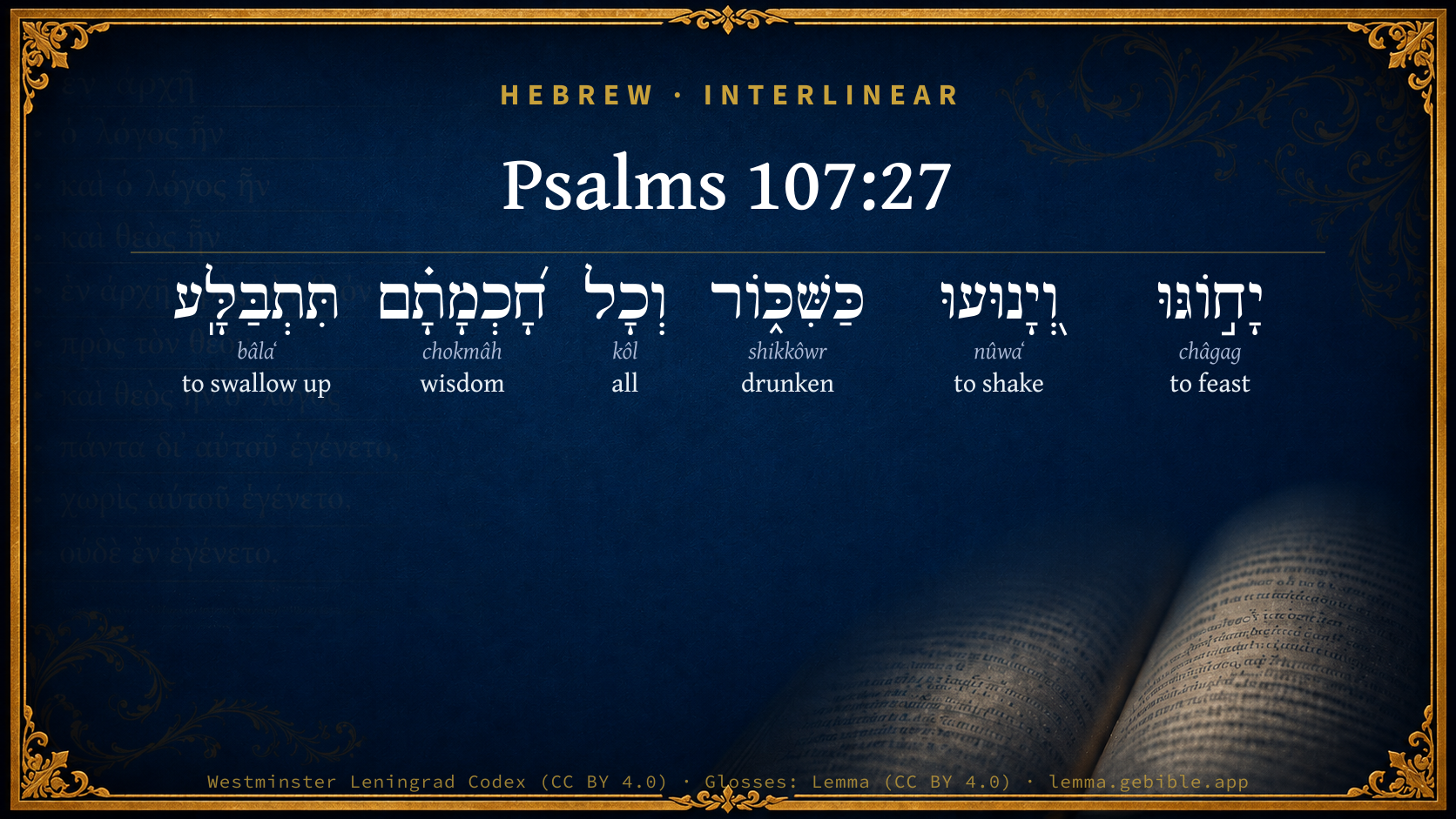
Psalms 107:27

Hebrew (Westminster Leningrad Codex) Psalms 107:27 appears in the Hebrew Old Testament. The text above is from the Westminster Leningrad Codex. Each word links to its Strong’s number, a concise gloss, and parsing drawn from the Open Scriptures Hebrew Bible morphology. Click any word for its full Brown-Driver-Briggs (BDB) entry.
Download image
Cite this verse

Psalms 107:27 (World English Bible). Public Domain. Lemma interlinear Bible study tool, https://lemma.gebible.app/v/psalms/107/27.

Show BibTeX & RIS
BibTeX
RIS
English Translation
They reel back and forth, and stagger like a drunken man, And are at their wits' end.
World English Bible · Public Domain
Download a study sheet

One document with this verse’s original text, its word-by-word gloss line, the meaning frame, cross-references with their text, attributed commentary, and full source and license credits — printable, and it pastes into notes with its structure intact.

This verse Autodidact and up

Study sheet (.html) Plain text (.txt)

A passage Seminary Student

Up to 50 verses in one chapter. A passage sheet keeps up to 6 commentary sources and 12 cross-references per verse, in the order this page ranks them, and says so on the sheet whenever that leaves anything out. Ask for a single verse and you get the Autodidact verse sheet above.

Everything on this page stays free to read, with no account — the sheet is a download of what is already on screen, not access to it.

Want to remove ads? Support Godless Engineer
Compare translations 3

The same verse in 3 English versions, stacked beneath the original-language interlinear above. Click any original word for its lexicon entry.

Each is an independent rendering of the whole verse — the interlinear is not word-aligned to these translations.

Highlighted words mark where these versions differ — a whole-verse word diff, not a word-by-word alignment.

  • World English Bible Public Domain
    They reel back and forth, and stagger like a drunken man, And are at their wits' end.
  • King James Version Public Domain
    They reel to and fro, and stagger like a drunken man, and are at their wit's end.
  • unfoldingWord Literal Text CC BY-SA 4.0
    They swayed and staggered as intoxicated and all their wisdom became confounded.

unfoldingWord Literal Text — © unfoldingWord, licensed CC BY-SA 4.0. Word-aligned USFM3 via Door43 (git.door43.org/unfoldingWord/en_ult).

Versions to compare (up to 4)

3 of 4 selected

Show all 18 translations

Every available English version of this verse, each an independent rendering of the whole verse.

  • World English Bible Public Domain
    They reel back and forth, and stagger like a drunken man, And are at their wits' end.
  • Berean Standard Bible Public Domain
    They reeled and staggered like drunkards, and all their skill was useless.
  • Majority Standard Bible Public Domain
    They reeled and staggered like drunkards, and all their skill was useless.
  • King James Version Public Domain
    They reel to and fro, and stagger like a drunken man, and are at their wit's end.
  • American Standard Version (1901) Public Domain
    They reel to and fro, and stagger like a drunken man, And are at their wits' end.
  • Revised Version (1885) Public Domain
    They reel to and fro, and stagger like a drunken man, and are at their wits’ end.
  • Geneva Bible (1599) Public Domain
    They are tossed to and from, and stagger like a drunken man, and all their cunning is gone.
  • Douay-Rheims (1899) Public Domain
    They were troubled, and reeled like a drunken man; and all their wisdom was swallowed up.
  • Young's Literal Translation Public Domain
    They reel to and fro, and move as a drunkard, And all their wisdom is swallowed up.
  • Literal Standard Version CC BY-SA 4.0
    They reel to and fro, and move as a drunkard, || And all their wisdom is swallowed up.
  • Unlocked Literal Bible CC BY-SA 4.0
    They swayed and staggered like drunkards and were at their wits' end.
  • unfoldingWord Literal Text CC BY-SA 4.0
    They swayed and staggered as intoxicated and all their wisdom became confounded.
  • Darby Bible Public Domain
    They reel to and fro, and stagger like a drunken man, and they are at their wits' end:
  • World Messianic Bible Public Domain
    They reel back and forth, and stagger like a drunken man, and are at their wits’ end.
  • Webster's Bible Public Domain
    They reel to and fro, and stagger like a drunken man, and are at their wit's end.
  • Free Bible Version CC BY-SA 4.0
    They staggered around, falling from side to side like drunks—all their seamanship skills were useless.
  • Bible in Basic English Public Domain
    They are turned here and there, rolling like a man who is full of wine; and all their wisdom comes to nothing.
  • JPS Tanakh (1917) Public Domain
    They reeled to and fro, and staggered like a drunken man, and all their wisdom was swallowed up —

Literal Standard Version (2020), Covenant Press — licensed CC BY-SA 4.0. Text via the HelloAO Bible API (eBible.org). Unlocked Literal Bible (unfoldingWord) — licensed CC BY-SA 4.0. Text via the HelloAO Bible API (eBible.org). unfoldingWord Literal Text — © unfoldingWord, licensed CC BY-SA 4.0. Word-aligned USFM3 via Door43 (git.door43.org/unfoldingWord/en_ult). Free Bible Version, Dr. Jonathan Gallagher — licensed CC BY-SA 4.0. Text via the HelloAO Bible API (eBible.org).

Word by word

More ways to search: Search by grammar → Find every occurrence → Compare this word →

Practice this passage: Drill this verse → Learn its vocabulary →

About this verse

These counts appear in no published source. They are computed here, from the morphology-tagged text and Lemma’s own curated glosses. What Lemma adds →

6
words
6
distinct lemmas
Wisdom
section

Notable vocabulary

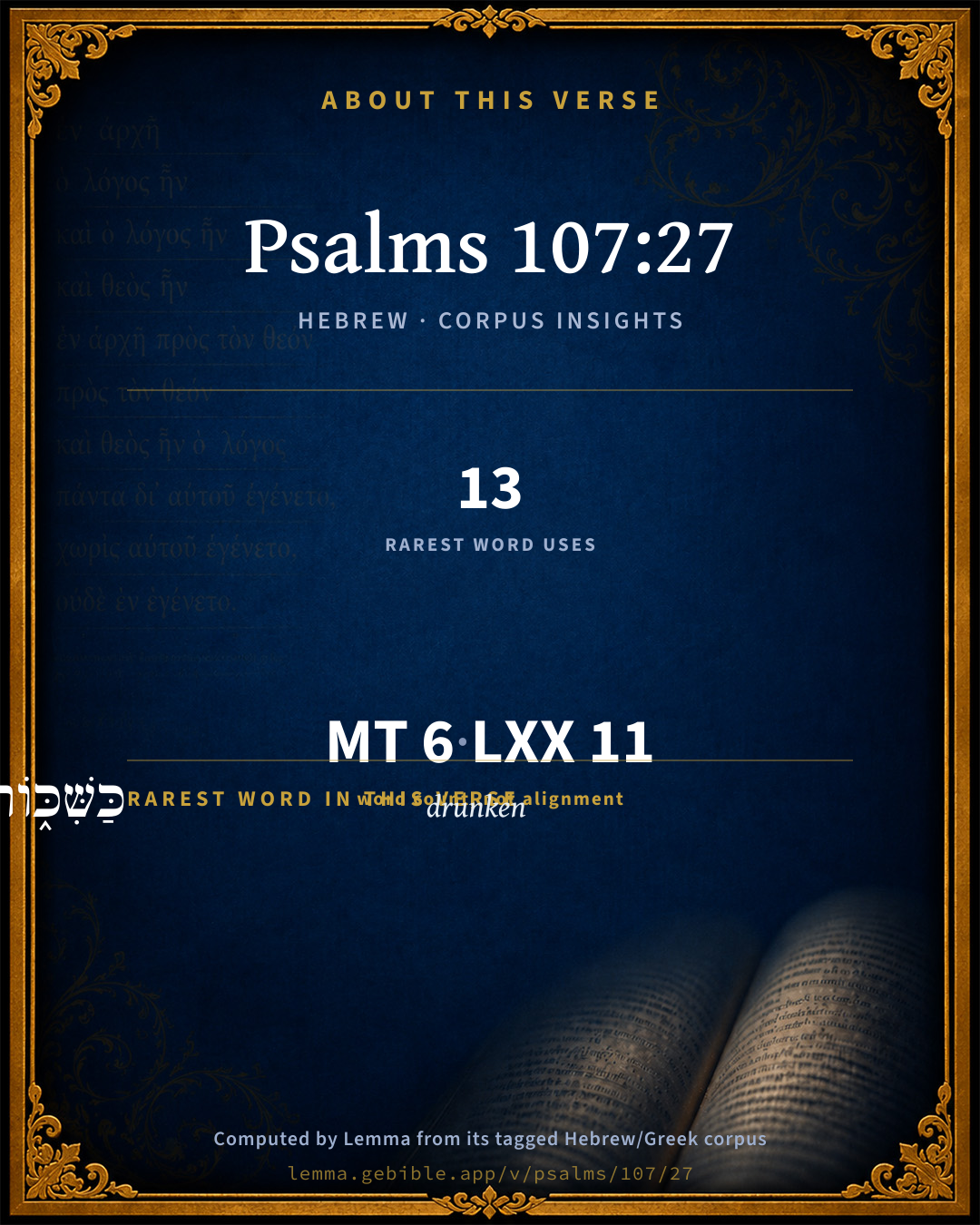
The rarest word here is כַּשִּׁכּ֑וֹר drunken H7910 — appearing just 13 times in the whole Hebrew Bible.

Shared distinctive vocabulary

כַּשִּׁכּ֑וֹר drunken H7910 occurs in 13 verses of the Hebrew Bible. Also found in:

Grammatical profile

  • 3 verbs
  • 2 nouns
  • 1 adjective

Verb forms

  • יָח֣וֹגּוּ Qal · Imperfect
  • וְ֭יָנוּעוּ Qal · Imperfect
  • תִּתְבַּלָּֽע Hithpael · Imperfect

Hebrew & Septuagint length

In English translation the verse runs 17 words from the Hebrew and 15 from the Septuagint (LXX English) — closely comparable.

A rough comparison of the two English renderings, which tokenize alike — not a word-level alignment.

Word counts can differ between the Hebrew and the Greek without any difference in meaning — e.g. the Hebrew direct-object marker אֵת has no separate Greek word, and Greek often adds the article ὁ.

In the original languages it is 6 Hebrew tokens and 11 Greek tokens — but the two are counted differently (Hebrew bundles its prefixes and suffixes into one token; the Greek is in lemma form), so that isn’t a like-for-like length.

Cross-references

7

Topical passages linked to Psalms 107:27 in the Treasury of Scripture Knowledge — connected by theme and wording, ordered by reader-vote popularity; previews shown in the World English Bible.

  • Job 12:25 They grope in the dark without light. He makes them stagger like a drunken man.
  • Isaiah 19:3 The spirit of Egypt shall fail in the midst of it; and I will destroy the counsel of it: and they shall seek to the idols, and to the charmers, and to those who have familiar spirits, and to the wizards.
  • Isaiah 19:14 Yahweh has mixed a spirit of perverseness in the midst of her; and they have caused Egypt to go astray in every work of it, as a drunken man staggers in his vomit.
  • Isaiah 29:9 Stay you and wonder; take your pleasure and be blind: they are drunken, but not with wine; they stagger, but not with strong drink.
  • Job 37:20 Shall it be told him that I would speak? Or should a man wish that he were swallowed up?
  • Isaiah 24:20 The earth shall stagger like a drunken man, and shall sway back and forth like a hammock; and the disobedience of it shall be heavy on it, and it shall fall, and not rise again.
  • Acts 27:15–20 When the ship was caught, and couldn't face the wind, we gave way to it, and were driven along.

Cross-references courtesy of OpenBible.info (CC BY 4.0).

Hebrew and Greek witnesses Masoretic Hebrew ↔ Greek Septuagint

The same verse in the two great witnesses to the Old Testament, shown verse-for-verse.

You’re reading Greek Psalm 106 (Hebrew Psalm 107). The Septuagint counts the superscription, so verse numbers can differ from the Hebrew — chapter-level alignment, not verse-by-verse. Numbering follows Rahlfs.

These are two independent witnesses, not word-aligned to each other, and the Septuagint is shown in lemma (dictionary) form.

Hebrew Psalms 107:27 Masoretic · Westminster Leningrad Codex

יָח֣וֹגּוּ וְ֭יָנוּעוּ כַּשִּׁכּ֑וֹר וְכָל חָ֝כְמָתָ֗ם תִּתְבַּלָּֽע

They reel back and forth, and stagger like a drunken man, And are at their wits' end.

World English Bible · Public Domain

Greek LXX Greek Psalm 106:27 Septuagint · lemma form

ταράσσω σαλεύω ὡς ὁ μεθύω καί πᾶς ὁ σοφία αὐτός καταπίνω

They are troubled, they stagger as a drunkard, and all their wisdom is swallowed up.

LXX2012 (modern English Septuagint) · Public Domain

Hebrew: Westminster Leningrad Codex (CC BY 4.0). Greek: Septuagint (public domain); English from LXX2012 (modern English Septuagint) (Public Domain). How the Septuagint differs from the Hebrew →

Commentary

Notes on Psalms 107:27 from classic Christian and Jewish commentators (each source and its license shown beneath its notes). The classic Christian expositions comment on the surrounding passage and are grouped to its opening verse, so a note may address several verses; the Jewish commentaries on the Tanakh (Rashi and others) are per-verse, so they appear only where the commentator wrote on this verse.

Lemma curates 59 commentaries, every one of them public domain or Creative Commons licensed, each selected and text-cleaned for this edition rather than reprinted as found. About our sources →

Trapp's Complete Commentary

John Trapp

Psa 107:27 They reel to and fro, and stagger like a drunken man, and are at their wits’ end.

Ver. 27. They reel to and fro, &c.] Natant nautae, et vacillant cerebro et pedibus.

And are at their wit’s end] All their skill and strength faileth them at once; they can do no more for their lives. Heb. All their wisdom is swallowed up; that is, the art of navigation is now to no use with them.

John Trapp, A Commentary or Exposition upon All the Books of the Old and New Testament (1647–1656) — public domain. Text from a community e-Sword module.

J. A. Alexander on Psalms

Joseph Addison Alexander

27. (Psa 107:27) They reel and stagger like a drunken (man), and all their wisdom is confounded. By wisdom we are here to understand reason, common sense, that which makes men rational and raises them above the brutes. This is plain from the comparison with drunkenness, the only point of which must be the loss of reason. The reeling and staggering may relate to the irregular and violent motion of a vessel in a storm, or, as the last clause does, to the mariners themselves. The last verb literally means is swallowed up, or retaining the reflexive form, still more strongly, swallows itself up. But see above, on the last word of Psa 107:26,

Joseph Addison Alexander, The Psalms Translated and Explained (1850) — public domain. Text from a community e-Sword module.

Geneva Bible (1599)

Geneva Bible translators

When their art and means fail them, they are compelled to confess that only God’s providence doth preserve them.

Geneva Bible (1599) marginal notes — public domain. Text via Bolls.life.

Ellicott's Commentary for English Readers

(27) Reel to and fro.—Or more exactly, spin round and round.

Are at their wit’s end.—An admirable paraphrase of the Hebrew, “all their wisdom swalloweth itself up.” The poet, from the expressions employed, is possibly writing under the influence of Psa_22:14; but he has evidently himself been to sea and experienced the dangers and discomforts he so graphically describes. Ovid (Trist. i. 2) has been quoted in illustration:

“Me miserum, quanti montes volvuntur aquarum

Jamjam tacturos sidera summa putes.

Quantæ diducto subsidunt æquore valles:

Jamjam tacturas Tartura nigra putes

Rector in incerto est, nec quid fugiatve petatve

Invenit: ambiguis ars stupet ipsa malis.”

See on this passage Addison in Spectator, No. 489.

A Bible Commentary for English Readers, edited by Charles John Ellicott (1878–1897) — public domain. Text from a community e-Sword module.

The Cambridge Bible for Schools and Colleges

gen. ed. J. J. S. Perowne

27. and are at their wit’s end] Lit. all their wisdom is swallowed up, or perhaps as in Psa_55:9, is confounded. Their skill in navigation entirely fails them. Cp. Isa_19:3. A striking parallel to the whole passage is to be found in Ovid, Tristia, l. 2. 19 ff.

Me miserum, quanti montes volvuntur aquarum!

Iam iam tacturos sidera summa putes.

Quantae diducto subsidunt aequore valles!

Iam iam tacturas Tartara nigra putes.

Rector in incerto est, nec quid fugiatve petatve

Invenit. Ambiguis ars stupet ipsa malis.

The Cambridge Bible for Schools and Colleges (gen. ed. J. J. S. Perowne; Cambridge University Press, 1878–1918) — public domain. Text from a community e-Sword module.

John Gill's Exposition

Then are they glad because they be quiet,.... The mariners are glad that the waves are quiet, and they free from danger, and at ease and in repose themselves.

So he bringeth them unto their desired haven; the port, city, border or tract of land (q), they are bound to; which they desire to be at, and eagerly look out for, and rejoice when arrived at it. This is all the Lord's work in providence: mariners too often take it to themselves, as if it was owing to their own skill and management that they have brought home the ship safe to the appointed port; but it is owing to the secret guidance and protection of divine Providence, which should be acknowledged. The late Mr. Hussey (r) thinks, that all this is not to be understood of seamen and naval affairs in common, but is a prophecy of what should befall the disciples of Christ, when on shipboard with him; who are the persons that went "down to the sea of Galilee" in a ship;

whose business in the great waters was fishing; when, by the will of God, there came down a "stormy wind", which "lifted up the waves" of the sea, so that the ship in which they were was filled with them, and in danger of being sunk; when they went up and down, as here described, and reeled as they went along on the deck, to awake their Master their hearts melting, and they at their wit's end through fear, when they saw such wonders, what no common mariner ever did; the Godman and Mediator rising and in a majestic manner rebuked the winds and waves, and caused a calm, and so brought them to the country of the Gadarenes, whither they were bound; see Luk 8:23. But it may be applied, in a more spiritual manner, to the people of God in common who are embarked in the cause of Christ, and in a church state, comparable to a ship, of which Christ is the master, governor, and pilot; and who are sailing through the tempestuous sea of this world, and are tossed with tempests in it; and have business to do here, not only of a civil, but of a spiritual nature and who not only see the wondrous works of creation and providence, but of grace and redemption; the deep things of God, the mysteries of his grace and love: and who sometimes are covered with the billows and waves of affliction, and in the utmost distress; which are all under the direction and at the command of God, to whom they apply for relief; and he commands a calm in their breasts, and causes their afflictions to cease, which produce joy and gladness in them; and at last they are brought safe to heaven, their desired haven, which they are bound unto, are seeking after, and desirous of; and where they are at entire rest, brought hither by the Lord himself.

(q) Vid. Kimchii Sepher Shorash. rad. (r) Warning from the Winds, p. 21-26.

John Gill's Exposition of the Whole Bible (1746–1763) — public domain (CC PDM 1.0). Text via the HelloAO Bible API.

Albert Barnes' Notes on the Bible

They reel to and fro - The word used here - חגג châgag - means to dance as in a circle; then, to reel, or be giddy as drunkards are.

And stagger ... - This word means to move to and fro; to waver; to vacillate; and it is then applied to a man who cannot walk steadily - a drunkard. So the vessel, with the mariners on board, seems to stagger and reel in the storm.

And are at their wit’s end - Margin, as in Hebrew, “All their wisdom is swallowed up.” That is, They have no skill to guide the vessel. All that has been done by the wisdom of naval architecture in constructing it, and all that has been derived from experience in navigating the ocean, seems now to be useless. They are at the mercy of the winds and waves; they are dependent wholly on God; they can now only cry to him to save them. Often this occurs in a storm at sea, when the most skillful and experienced seaman feels that he can do no more.

Albert Barnes' Notes on the Bible (1834–1885) — public domain. Text from a community e-Sword/MySword module.

Matthew Poole's English Annotations

Stagger like a drunken man; not so much from the giddiness of their heads, which is not usual in persons accustomed to the sea, as through the violent and various motions of the sea and the ship.

Matthew Poole's English Annotations on the Holy Bible (1683–1685) — public domain. Text from a community e-Sword/MySword module.

The Treasury of David

Charles H. Spurgeon

Ver. 27. They reel to and fro, and stagger like a drunken man. The violent motion of the vessel prevents their keeping their legs, and their fears drive them out of all power to use their brains, and therefore they look like intoxicated men.

And are at their wit's end. What more can they do? They have used every expedient known to navigation, but the ship is so strained and beaten about that they know not how to keep her afloat.

Here too the spiritual mariner's log agrees with that of the sailor on the sea. We have staggered frightfully! We could stand to nothing and hold by nothing. We knew not what to do, and could have done nothing if we had known it. We were as men distracted, and felt as if destruction itself would be better than our horrible state of suspense. As for wit and wisdom, they were clean washed out of us, we felt ourselves to be at a nonplus altogether.

Ver. 27. The awakened sinner staggered and nonplussed.

Psalms 107:28*

Charles H. Spurgeon's The Treasury of David (1869–1885) — public domain. Psalms only. Text from a community e-Sword/MySword module.

The Pulpit Commentary

They reel to and fro, and stagger like a drunken man. The oldest sailor "loses his sea-legs," and staggers about the deck like a landsman, or like one drunk. And are at their wit"s end; literally, as in the margin, and all theirwisdom is swallowed. But the English idiom of the Authorized Version is a very happy, one, and exactly expresses the writer"s meaning. All the seaman"s intelligence is at fault, and can suggest nothing.

The Pulpit Commentary (1880–1919), ed. H.D.M. Spence-Jones & Joseph S. Exell — public domain. Text from a community e-Sword module.

Rashi

Rabbi Shlomo Yitzchaki (Rashi)

They were frightened Heb. יחוגו. This is an expression of breaking. Similarly (Song 2:14): “in the clefts of (בחגוי) the rock”; and similarly (Isa. l9:17), “And the land of Judah will be to Egypt for a dread (לחגא).”

Rashi on the Tanakh — English translations: “The Judaica Press complete Tanach with Rashi, translated by A. J. Rosenberg” (CC BY 4.0); “Pentateuch with Rashi's commentary by M. Rosenbaum and A.M. Silbermann, 1929-1934” (public domain); “The Metsudah Tanach series, Lakewood, N.J” (CC BY 4.0); and “The Book of Joshua, Metsudah Publications, 1997” (CC BY 4.0). Text via Sefaria.

Lesson kit

Teaching starters — assembled from the data on this page, not authored interpretation. Every prompt links to the verse data it draws on. Edit before teaching.

Psalms, in the Wisdom, opens this verse with 6 words (6 distinct Hebrew lemmas). Its most distinctive word is shikkôwr (“drunken”). A historical commentator’s framing appears above. Read the whole chapter for the surrounding context.

Discussion questions

  1. What does “drunken” (shikkôwr) contribute to the verse as a whole?
  2. How does 1 Samuel 1:13, which shares the word «drunken», read alongside this verse?
  3. The translations on this page render this verse differently — a whole-verse word diff, not a word-by-word alignment. What might account for the different wordings?
  4. «יָח֣וֹגּוּ» is a Qal Imperfect verb. How does that grammatical form shape the action described?
  5. Compare how Trapp's Complete Commentary and J. A. Alexander on Psalms read this verse. Where do they agree or differ?

Things to notice

Reading settings

Reading text

Shown beneath each verse's original-language words.

Old Testament
Old Testament edition

Read the OT as the Masoretic Hebrew (MT) or the Greek Septuagint (LXX).

English shown for the Greek Septuagint (in the Hebrew ↔ Greek comparison).

Comparing translations? Open the Compare panel on any verse page to stack up to four side by side.