Psalms 69:15

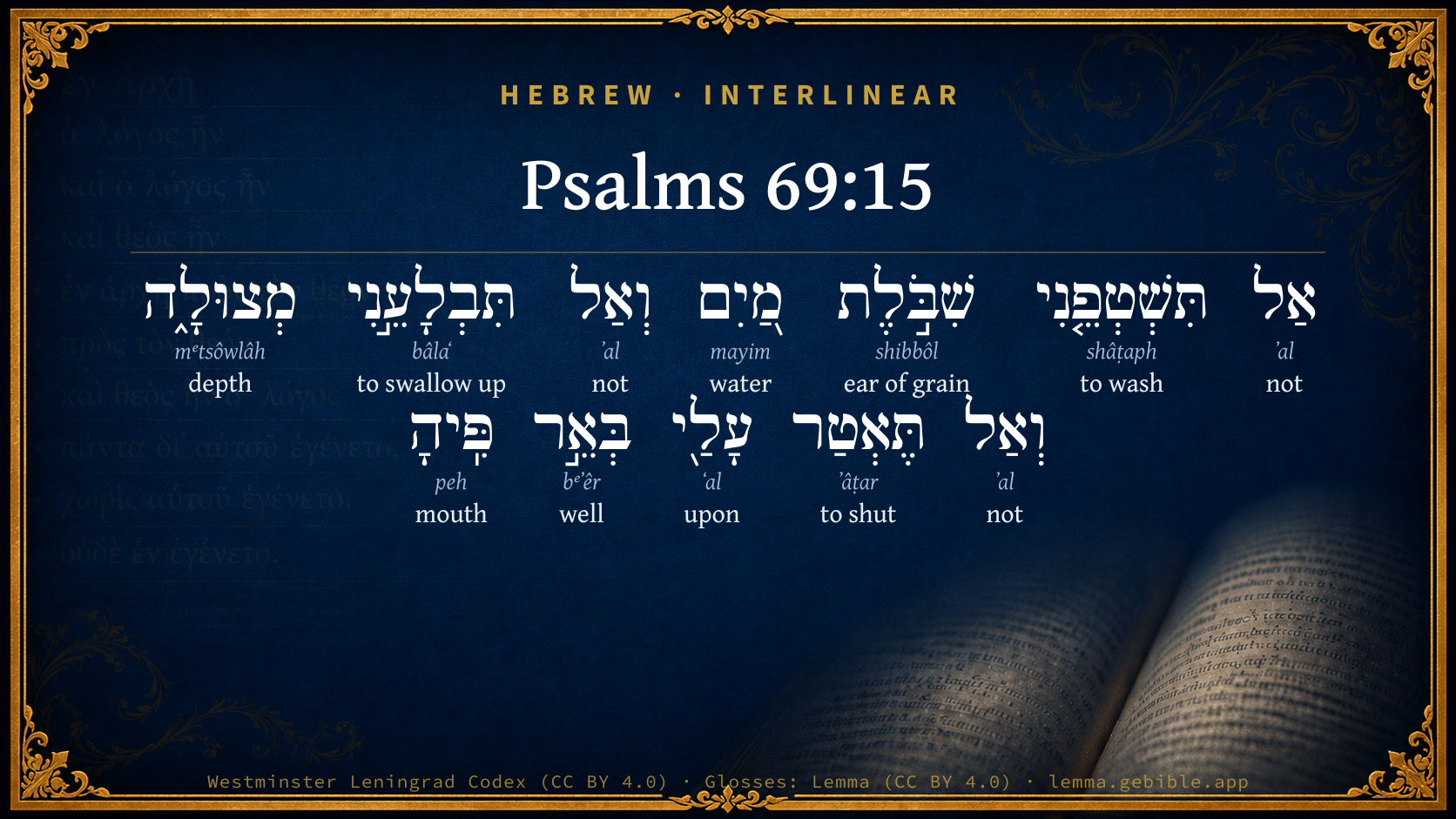
Hebrew (Westminster Leningrad Codex) Psalms 69:15 appears in the Hebrew Old Testament. The text above is from the Westminster Leningrad Codex. Each word links to its Strong’s number, a concise gloss, and parsing drawn from the Open Scriptures Hebrew Bible morphology. Click any word for its full Brown-Driver-Briggs (BDB) entry.
Download image
Cite this verse

Psalms 69:15 (World English Bible). Public Domain. Lemma interlinear Bible study tool, https://lemma.gebible.app/v/psalms/69/15.

Show BibTeX & RIS
BibTeX
RIS
English Translation
Don't let the flood waters overwhelm me, Neither let the deep swallow me up. Don't let the pit shut its mouth on me.
World English Bible · Public Domain
Highlights
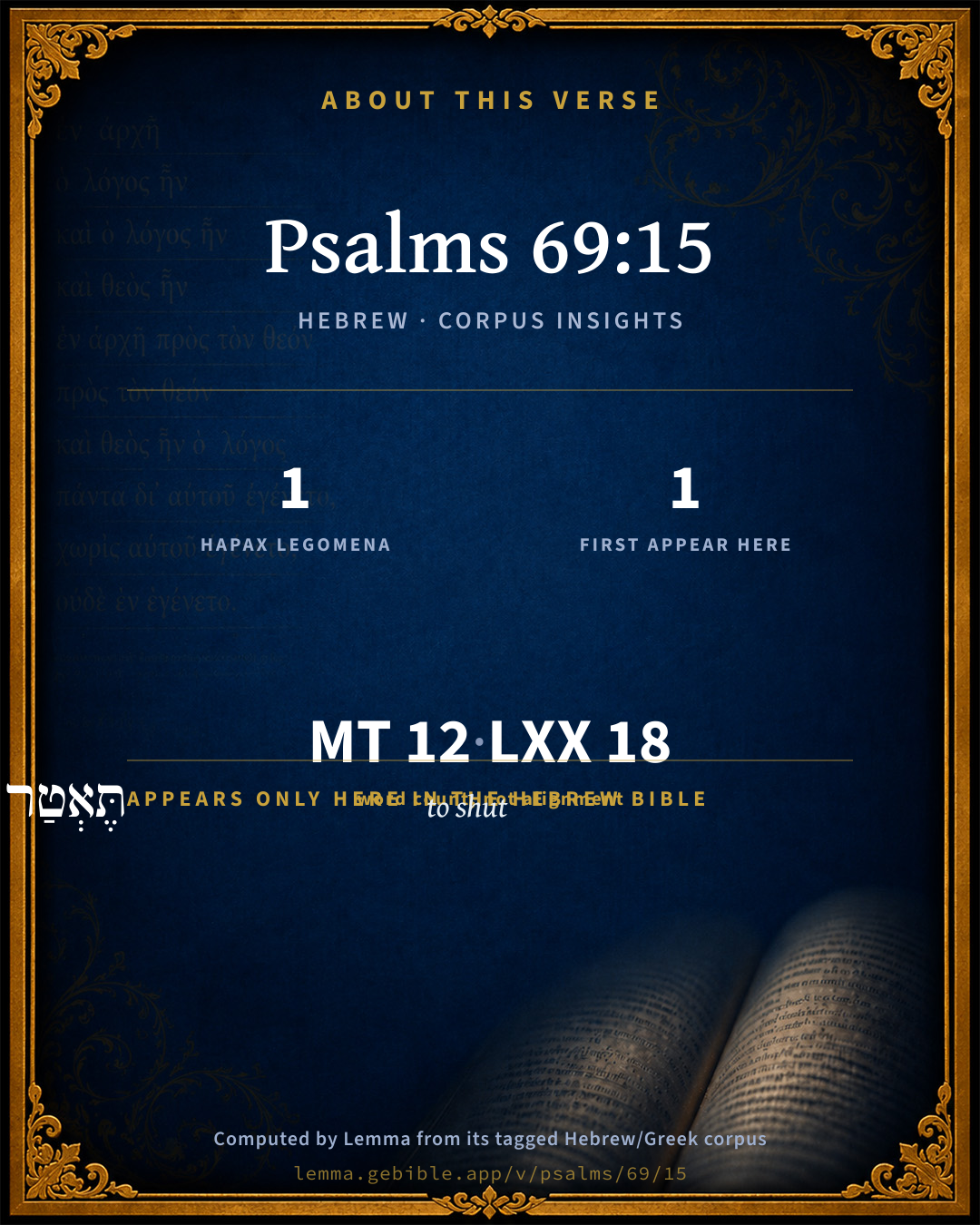
  • 1 hapax legomenon — only here in the Hebrew Bible
  • 1 first appearance in the Hebrew Bible
Full analysis ↓
Download a study sheet

One document with this verse’s original text, its word-by-word gloss line, the meaning frame, cross-references with their text, attributed commentary, and full source and license credits — printable, and it pastes into notes with its structure intact.

This verse Autodidact and up

Study sheet (.html) Plain text (.txt)

A passage Seminary Student

Up to 50 verses in one chapter. A passage sheet keeps up to 6 commentary sources and 12 cross-references per verse, in the order this page ranks them, and says so on the sheet whenever that leaves anything out. Ask for a single verse and you get the Autodidact verse sheet above.

Everything on this page stays free to read, with no account — the sheet is a download of what is already on screen, not access to it.

Want to remove ads? Support Godless Engineer
Compare translations 3

The same verse in 3 English versions, stacked beneath the original-language interlinear above. Click any original word for its lexicon entry.

Each is an independent rendering of the whole verse — the interlinear is not word-aligned to these translations.

Highlighted words mark where these versions differ — a whole-verse word diff, not a word-by-word alignment.

  • World English Bible Public Domain
    Don't let the flood waters overwhelm me, Neither let the deep swallow me up. Don't let the pit shut its mouth on me.
  • King James Version Public Domain
    Let not the waterflood overflow me, neither let the deep swallow me up, and let not the pit shut her mouth upon me.
  • unfoldingWord Literal Text CC BY-SA 4.0
    Let the flood of waters not overflow me, and let the deep not swallow me, and let the pit not close its mouth over me.

unfoldingWord Literal Text — © unfoldingWord, licensed CC BY-SA 4.0. Word-aligned USFM3 via Door43 (git.door43.org/unfoldingWord/en_ult).

Versions to compare (up to 4)

3 of 4 selected

Show all 18 translations

Every available English version of this verse, each an independent rendering of the whole verse.

  • World English Bible Public Domain
    Don't let the flood waters overwhelm me, Neither let the deep swallow me up. Don't let the pit shut its mouth on me.
  • Berean Standard Bible Public Domain
    Do not let the floods engulf me or the depths swallow me up; let not the Pit close its mouth over me.
  • Majority Standard Bible Public Domain
    Do not let the floods engulf me or the depths swallow me up; let not the Pit close its mouth over me.
  • King James Version Public Domain
    Let not the waterflood overflow me, neither let the deep swallow me up, and let not the pit shut her mouth upon me.
  • American Standard Version (1901) Public Domain
    Let not the waterflood overwhelm me, Neither let the deep shallow me up; And let not the pit shut its mouth upon me.
  • Revised Version (1885) Public Domain
    Let not the waterflood overwhelm me, neither let the deep swallow me up; and let not the pit shut her mouth upon me.
  • Geneva Bible (1599) Public Domain
    Let not the water flood drowne mee, neither let the deepe swallowe me vp: and let not the pit shut her mouth vpon me.
  • Douay-Rheims (1899) Public Domain
    Draw me out of the mire, that I may not stick fast: deliver me from them that hate me, and out of the deep waters.
  • Young's Literal Translation Public Domain
    Let not a flood of waters overflow me, Nor let the deep swallow me up, Nor let the pit shut her mouth upon me.
  • Literal Standard Version CC BY-SA 4.0
    Do not let a flood of waters overflow me, || Nor let the deep swallow me up, || Nor let the pit shut her mouth on me.
  • Unlocked Literal Bible CC BY-SA 4.0
    Do not let the floods of water overwhelm me, neither let the deep swallow me up. Do not let the pit shut its mouth on me.
  • unfoldingWord Literal Text CC BY-SA 4.0
    Let the flood of waters not overflow me, and let the deep not swallow me, and let the pit not close its mouth over me.
  • Darby Bible Public Domain
    Let not the flood of waters overflow me, neither let the deep swallow me up; and let not the pit shut its mouth upon me.
  • World Messianic Bible Public Domain
    Don’t let the flood waters overwhelm me, neither let the deep swallow me up. Don’t let the pit shut its mouth on me.
  • Webster's Bible Public Domain
    \\69:14\\Deliver me out of the mire, and let me not sink: let me be delivered from them that hate me, and out of the deep waters.
  • Free Bible Version CC BY-SA 4.0
    Don't let the flood waters wash over me. Don't let the deep waters pull me down. Don't let the grave close over me.
  • Bible in Basic English Public Domain
    Let me not be covered by the flowing waters; let not the deep waters go over my head, and let me not be shut up in the underworld.
  • JPS Tanakh (1917) Public Domain
    (69-16) Let not the waterflood overwhelm me, neither let the deep swallow me up; and let not the pit shut her mouth upon me.

Literal Standard Version (2020), Covenant Press — licensed CC BY-SA 4.0. Text via the HelloAO Bible API (eBible.org). Unlocked Literal Bible (unfoldingWord) — licensed CC BY-SA 4.0. Text via the HelloAO Bible API (eBible.org). unfoldingWord Literal Text — © unfoldingWord, licensed CC BY-SA 4.0. Word-aligned USFM3 via Door43 (git.door43.org/unfoldingWord/en_ult). Free Bible Version, Dr. Jonathan Gallagher — licensed CC BY-SA 4.0. Text via the HelloAO Bible API (eBible.org).

Word by word

More ways to search: Search by grammar → Find every occurrence → Compare this word →

Practice this passage: Drill this verse → Learn its vocabulary →

תֶּאְטַר
ʼâṭar
H332
“to shut”
Verb, Qal, Jussive, 3rd Person, Feminine, Singular
Part of Speech
Verb
Stem
Qal
Form
Jussive
Person
3rd Person
Gender
Feminine
Number
Singular
Full BDB Definition

Origin: a primitive root

TWOT: 74

(Qal) shut - to shut up, close, bind - close one's mouth
  1. אַל ʼal H408 “not” Particle, Negative
  2. תִּשְׁטְפֵ֤נִי shâṭaph H7857 “to wash · me” Verb, Qal, Jussive, 3rd Person, Feminine, Singular + Suffix, Personal, 1st Person, Common, Singular
  3. שִׁבֹּ֣לֶת shibbôl H7641 “ear of grain of” Noun, Common, Feminine, Singular, Construct
  4. מַ֭יִם mayim H4325 “water(s)” Noun, Common, Masculine, Plural, Absolute
  5. וְאַל ʼal H408 “and · not” Conjunction + Particle, Negative
  6. תִּבְלָעֵ֣נִי bâlaʻ H1104 “to swallow up · me” Verb, Qal, Jussive, 3rd Person, Feminine, Singular + Suffix, Personal, 1st Person, Common, Singular
  7. מְצוּלָ֑ה mᵉtsôwlâh H4688 “depth” Noun, Common, Feminine, Singular, Absolute
  8. וְאַל ʼal H408 “and · not” Conjunction + Particle, Negative
  9. עָלַ֖י ʻal H5921 “upon · me” Preposition + Suffix, Personal, 1st Person, Common, Singular
  10. בְּאֵ֣ר bᵉʼêr H875 “well” Noun, Common, Feminine, Singular, Absolute
  11. פִּֽיהָ peh H6310 “mouth · her” Noun, Common, Masculine, Singular, Construct + Suffix, Personal, 3rd Person, Feminine, Singular

About this verse

These counts appear in no published source. They are computed here, from the morphology-tagged text and Lemma’s own curated glosses. What Lemma adds →

12
words
10
distinct lemmas
Wisdom
section

Notable vocabulary

1 hapax legomenon — a word that appears only here in the entire Hebrew Bible:

  • תֶּאְטַר to shut H332

First appearance in Scripture

This word makes its first canonical appearance in the Hebrew Bible here:

  • תֶּאְטַר to shut H332

Shared distinctive vocabulary

מְצוּלָ֑ה depth H4688 occurs in 11 verses of the Hebrew Bible. Also found in:

Grammatical profile

  • 3 verbs
  • 5 nouns
  • 1 preposition
  • 3 particles

Verb forms

  • תִּשְׁטְפֵ֤נִי Qal · Jussive
  • תִּבְלָעֵ֣נִי Qal · Jussive
  • תֶּאְטַר Qal · Jussive

Repetition

A word recurs within this verse — often emphatic in Hebrew:

  • אַל not H408 ×3

Hebrew & Septuagint length

In English translation the verse runs 23 words from the Hebrew and 22 from the Septuagint (LXX English) — closely comparable.

A rough comparison of the two English renderings, which tokenize alike — not a word-level alignment.

Word counts can differ between the Hebrew and the Greek without any difference in meaning — e.g. the Hebrew direct-object marker אֵת has no separate Greek word, and Greek often adds the article ὁ.

In the original languages it is 12 Hebrew tokens and 18 Greek tokens — but the two are counted differently (Hebrew bundles its prefixes and suffixes into one token; the Greek is in lemma form), so that isn’t a like-for-like length.

Cross-references

10

Topical passages linked to Psalms 69:15 in the Treasury of Scripture Knowledge — connected by theme and wording, ordered by reader-vote popularity; previews shown in the World English Bible.

  • Revelation 12:15–16 The serpent spewed water out of his mouth after the woman like a river, that he might cause her to be carried away by the stream.
  • Psalms 16:10 For you will not leave my soul in Sheol, Neither will you allow your holy one to see corruption.
  • Isaiah 43:1–2 But now thus says Yahweh who created you, Jacob, and he who formed you, Israel: Don't be afraid, for I have redeemed you; I have called you by your name, you are mine.
  • Jonah 2:2–7 He said, "I called because of my affliction to Yahweh. He answered me. Out of the belly of Sheol I cried. You heard my voice.
  • Acts 2:24 whom God raised up, having freed him from the agony of death, because it was not possible that he should be held by it.
  • Numbers 16:33–34 So they, and all that appertained to them, went down alive into Sheol: and the earth closed on them, and they perished from among the assembly.
  • Psalms 88:4–6 I am counted among those who go down into the pit. I am like a man who has no help,
  • Psalms 124:4–5 Then the waters would have overwhelmed us, The stream would have gone over our soul;
  • Acts 2:31 he foreseeing this spoke about the resurrection of the Christ, that neither was his soul left in Hades, nor did his flesh see decay.
  • Matthew 12:40 For as Jonah was three days and three nights in the belly of the whale, so will the Son of Man be three days and three nights in the heart of the earth.

Cross-references courtesy of OpenBible.info (CC BY 4.0).

Hebrew and Greek witnesses Masoretic Hebrew ↔ Greek Septuagint

The same verse in the two great witnesses to the Old Testament, shown verse-for-verse.

You’re reading Greek Psalm 68 (Hebrew Psalm 69). The Septuagint counts the superscription, so verse numbers can differ from the Hebrew — chapter-level alignment, not verse-by-verse. Numbering follows Rahlfs.

These are two independent witnesses, not word-aligned to each other, and the Septuagint is shown in lemma (dictionary) form.

Hebrew Psalms 69:15 Masoretic · Westminster Leningrad Codex

אַל תִּשְׁטְפֵ֤נִי שִׁבֹּ֣לֶת מַ֭יִם וְאַל תִּבְלָעֵ֣נִי מְצוּלָ֑ה וְאַל תֶּאְטַר עָלַ֖י בְּאֵ֣ר פִּֽיהָ

Don't let the flood waters overwhelm me, Neither let the deep swallow me up. Don't let the pit shut its mouth on me.

World English Bible · Public Domain

Greek LXX Greek Psalm 68:15 Septuagint · lemma form

σώζω ἐγώ ἀπό πηλός ἵνα μή ἐνπήγνυμι ῥύομαι ἐκ ὁ μισέω ἐγώ καί ἐκ ὁ βάθος ὁ ὕδωρ

Let not the waterflood drown me, nor let the deep swallow me up; neither let the well shut its mouth upon me.

LXX2012 (modern English Septuagint) · Public Domain

Hebrew: Westminster Leningrad Codex (CC BY 4.0). Greek: Septuagint (public domain); English from LXX2012 (modern English Septuagint) (Public Domain). How the Septuagint differs from the Hebrew →

Commentary

Notes on Psalms 69:15 from classic Christian and Jewish commentators (each source and its license shown beneath its notes). The classic Christian expositions comment on the surrounding passage and are grouped to its opening verse, so a note may address several verses; the Jewish commentaries on the Tanakh (Rashi and others) are per-verse, so they appear only where the commentator wrote on this verse.

Lemma curates 59 commentaries, every one of them public domain or Creative Commons licensed, each selected and text-cleaned for this edition rather than reprinted as found. About our sources →

Trapp's Complete Commentary

John Trapp

Psa 69:15 Let not the waterflood overflow me, neither let the deep swallow me up, and let not the pit shut her mouth upon me.

Ver. 15. Let not the waterflood overflow me] See Psa 69:1.

Let not the pit shut] Leave me not helpless and hopeless.

Vivere spe facias qui moriturus eram.

John Trapp, A Commentary or Exposition upon All the Books of the Old and New Testament (1647–1656) — public domain. Text from a community e-Sword module.

J. A. Alexander on Psalms

Joseph Addison Alexander

16. (Psa 69:15). Let not the flood overwhelm me, and let not the deep swallow me, and let not the well (or pit) shut its mouth upon me. In the earnestness of his entreaty, he passes from the figure of a sea or stream to that of a well or cistern, the idea common to both being that of deep water.

Joseph Addison Alexander, The Psalms Translated and Explained (1850) — public domain. Text from a community e-Sword module.

Ellicott's Commentary for English Readers

(15) Pit.—Properly, well. A stone usually covered the wells (Gen_29:10), which explains the phrase, “shut her mouth.” Is this merely figurative; or have we here a reminiscence of some terrible crime, analogous to that of Cawnpore?

A Bible Commentary for English Readers, edited by Charles John Ellicott (1878–1897) — public domain. Text from a community e-Sword module.

John Gill's Exposition

Let not the water flood overflow me,.... The enemy, Satan, that came in like a flood upon him, with his whole posse of devils; or the wrath of God, which came upon him like a flood overwhelming him:

neither let the deep swallow me up: as Jonah by the whale, and Dathan and Abiram in the earth:

and let not the pit shut her mouth upon me; either the pit of hell; so the Targum interprets it: for Christ, when he endured the curses of the law, and the wrath of God, suffered the same for kind as the damned in hell; only the mouth of this pit could not be shut upon him, or he be continued under such wrath and curse: or else the pit of the grave, where his divine Father left him not, or suffered him to be so long in it as to see corruption; this pit was not shut upon him, but he was delivered out of it, and will die no more.

John Gill's Exposition of the Whole Bible (1746–1763) — public domain (CC PDM 1.0). Text via the HelloAO Bible API.

Albert Barnes' Notes on the Bible

Let not the waterflood overflow me - The stream; the volume of waters. The idea is that of a flood or stream rolling along, that threatened to drown him.

Neither let the deep swallow me up - The abyss; the deep waters.

And let not the pit shut her mouth upon me - In his anguish and distress he passes here from the idea of running streams, and deep waters, to that of a well, pit, or cavern - representing himself as “in” that pit, and praying that it might not be closed upon him, leaving him in darkness and in mire, from which he could not then escape. The general idea in all these expressions is the same - that of overwhelming calamities from which he prayed to be delivered.

Albert Barnes' Notes on the Bible (1834–1885) — public domain. Text from a community e-Sword/MySword module.

The Treasury of David

Charles H. Spurgeon

Ver. 15. Let not the waterflood overflow me. He continues to recapitulate the terms of his lament. He is willing to bear suffering, but entreats grace that it may not get the victory over him. He was heard in that he feared.

Neither let the deep swallow me up. As Jonah came forth again, so let me also arise from the abyss of woe; here also our Lord was heard, and so shall we be. Death itself must disgorge us.

Let not the pit shut her mouth upon me. When a great stone was rolled over the well, or pit, used as a dungeon, the prisoner was altogether enclosed, and forgotten like one on the oubliettes of the Bastille; this is an apt picture of the state of a man buried alive in grief and left without remedy; against this the great sufferer pleaded and was heard. He was baptised in agony but not drowned in it; the grave enclosed him, but before she could close her mouth he had burst his prison. It is said that truth lies in a well, but it is assuredly an open well, for it walks abroad in power; and so our great Substitute in the pit of woe and death was yet the Conqueror of death and hell. How appropriately may many of us use this prayer. We deserve to be swept away as with a flood, to be drowned in our sins, to be shut up in hell; let us, then, plead the merits of our Saviour, lest these things happen unto us.

Ver. 15. Faith in God giveth hope to be helped, and is half a deliverance before the full deliverance come; for the psalmist is now with his head above water, and not so afraid as when he began the Psalm. David Dickson.

Ver. 15. The pit. According to Dean Stanley, the word Beer here used is always rendered "well, "except in this and three other cases. When such wells no longer yielded a full supply of water they were used as prisons, no care being taken to cleanse out the mire remaining at the bottom. The Dean also tells us in the Appendix to his "Sinai and Palestine, "that "they have a broad margin of masonry round this mouth, and often a stone filling up the orifice." The rolling of this stone over the mouth of the well was the well's "shutting her mouth; "and the poor prisoner was, to all intents and purposes, buried alive. C. H. S.

Ver. 15. (last clause). A tremendous evil, our desert of it, our hope against it, our fear of it, and the reasons which secure us against it.

Psalms 69:16*

Charles H. Spurgeon's The Treasury of David (1869–1885) — public domain. Psalms only. Text from a community e-Sword/MySword module.

Whedon's Commentary on the Bible

Daniel D. Whedon

15. The pit shut her mouth upon me—David had used the figures of deep “waters” and of “mire” without bottom, and now he adds the horror of having the “mouth” of the “pit” into which he had sunk close upon him, thereby shutting out the last ray of hope. The allusion does not appear to be to Num_16:32. באר, (beer,) well, pit, may allude to the dangerous asphaltum pits, (Gen_14:10;) but as in David’s time such pits were rare, and not objects of common dread, we may take the word in its most common signification of well. Stanley says of the numerous vestiges of ancient wells in Palestine, that “they have a broad margin of masonry round the month, and often a stone filling up the orifice.” This covering the well’s mouth when a human person was within was a figure of burying alive, which the psalmist deprecated. See 2Sa_17:18-19

Daniel D. Whedon (gen. ed.), Commentary on the Old and New Testaments (1874–1909) — public domain. Text from a community e-Sword module.

The Pulpit Commentary

Let not the waterflood overflew me, neither let the deep swallow me up, and let not the pit shut her mouth upon me. The reference is still to vers. 1, 2; and the prayer is for deliverance from the dangers and entanglements there spoken of.

The Pulpit Commentary (1880–1919), ed. H.D.M. Spence-Jones & Joseph S. Exell — public domain. Text from a community e-Sword module.

Lesson kit

Teaching starters — assembled from the data on this page, not authored interpretation. Every prompt links to the verse data it draws on. Edit before teaching.

Psalms, in the Wisdom, opens this verse with 12 words (10 distinct Hebrew lemmas). Its most distinctive word is ʼâṭar (“to shut”). A historical commentator’s framing appears above. Read the whole chapter for the surrounding context.

Discussion questions

  1. How does “to shut” (ʼâṭar) shape what this verse is saying?
  2. 1 word here appears nowhere else in the Hebrew Bible. Why might the author reach for such rare wording?
  3. This is the first place “to shut” appears in Scripture (first appears here). What does its debut here establish?
  4. How does Exodus 15:5, which shares the word «depth», read alongside this verse?
  5. What does the repetition of “not” (3× in this one verse) do in this verse?
  6. These translations render this verse differently; the difference is in the English rendering, not the original. What questions does that raise?
  7. «תִּשְׁטְפֵ֤נִי» is a Qal Jussive verb. How does that grammatical form shape the action described?
  8. Compare how Trapp's Complete Commentary and J. A. Alexander on Psalms read this verse. Where do they agree or differ?

Things to notice

  • 1 word in this verse appears nowhere else in the Hebrew Bible.
  • 1 word makes its first canonical appearance in Scripture here.
  • This verse counts 12 Hebrew ↔ 18 Greek words.
  • These translations choose different wording for 12 words in this verse.
  • “not” occurs 3× in this single verse.

Reading settings

Reading text

Shown beneath each verse's original-language words.

Old Testament
Old Testament edition

Read the OT as the Masoretic Hebrew (MT) or the Greek Septuagint (LXX).

English shown for the Greek Septuagint (in the Hebrew ↔ Greek comparison).

Comparing translations? Open the Compare panel on any verse page to stack up to four side by side.