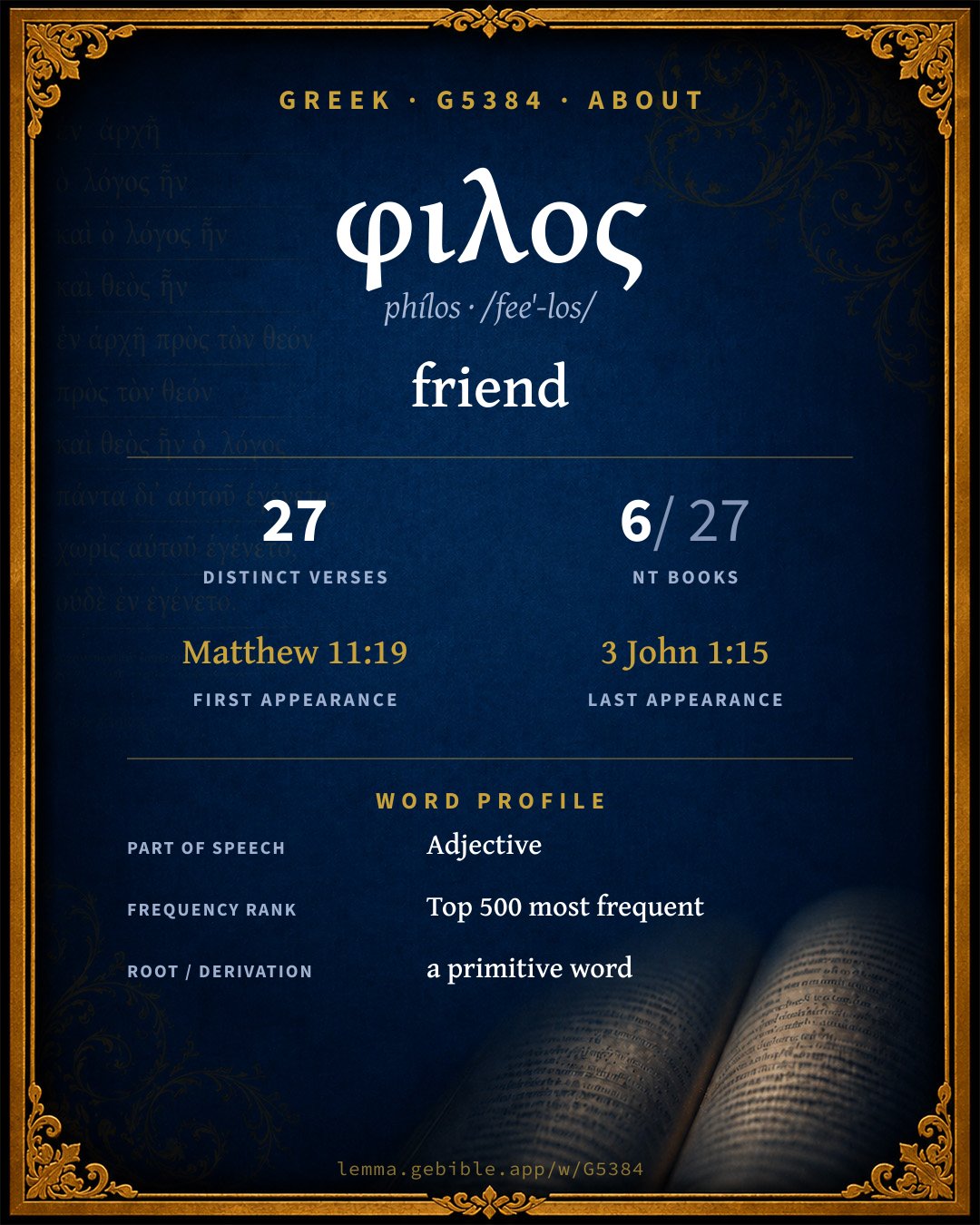
φίλος
friend
Full lexicon entry — Thayer's Greek Lexicon
From Thayer's Greek Lexicon
Where this word appears
See every Nominative-case word in the Greek New Testament →
Grammar key — what these labels mean
Part of speech
- Adjective
- A word that describes or qualifies a noun.
- Noun
- A naming word — a person, place, thing, or idea.
Case
- Accusative
- The case of the direct object and of extent.
- Nominative
- The case of the subject (and the predicate nominative).
- Genitive
- The case of source, possession, or “of” — answers “whose / from what.”
- Vocative
- The case of direct address (“O Lord”).
- Dative
- The case of the indirect object, means, or location — “to / for / with / in.”
Gender
- Masculine
- Grammatically masculine.
- Feminine
- Grammatically feminine.
Number
- Plural
- More than one.
- Singular
- One.
Grammatical forms
- Adjective, Accusative, Plural, Masculine 8 times (28%)
- Adjective, Nominative, Singular, Masculine 8 times (28%)
- Adjective, Nominative, Plural, Masculine 4 times (14%)
- Adjective, Genitive, Plural, Masculine 3 times (10%)
- Adjective, Accusative, Singular, Masculine 2 times (7%)
- Noun, Vocative, Singular, Masculine 2 times (7%)
- Adjective, Dative, Plural, Masculine 1 time (3%)
- Noun, Accusative, Plural, Feminine 1 time (3%)
Parsed forms decoded from the imported morphology (Robinson–Tischendorf, public domain), counted across 29 parsed occurrences — not distinct verses.
Every verse where G5384 appears — 27 distinct verses across 6 books. Click any verse to open its interlinear word-by-word view. Verse text shown in the World English Bible for context — . Each verse’s Greek form is shown with its reference; the English is not keyword-highlighted, since the data carries no word-level English alignment. Use “Compare translations” on any verse to read it across multiple English versions. This concordance covers the Greek New Testament; Septuagint (Greek Old Testament) occurrences of this word are not indexed here.
Matthew 1 verse
Luke 14 verses
- Luke 7:6 φίλους adj acc pl masc Jesus went with them. When he was now not far from the house, the centurion sent friends to him, saying to him, "Lord, don't trouble yourself, for I am not worthy for you to come under my roof.
- Luke 7:34 φίλος adj nom sg masc The Son of Man has come eating and drinking, and you say, 'Behold, a gluttonous man, and a drunkard; a friend of tax collectors and sinners!'
- Luke 11:5 φίλον φίλε adj acc sg masc n voc sg masc He said to them, "Which of you, if you go to a friend at midnight, and tell him, 'Friend, lend me three loaves of bread,
- Luke 11:6 φίλος adj nom sg masc for a friend of mine has come to me from a journey, and I have nothing to set before him,'
- Luke 11:8 φίλον adj acc sg masc I tell you, although he will not rise and give it to him because he is his friend, yet because of his persistence, he will get up and give him as many as he needs.
- Luke 12:4 φίλοις adj dat pl masc "I tell you, my friends, don't be afraid of those who kill the body, and after that have no more that they can do.
- Luke 14:10 φίλε n voc sg masc But when you are invited, go and sit in the lowest place, so that when he who invited you comes, he may tell you, 'Friend, move up higher.' Then you will be honored in the presence of all who sit at the table with you.
- Luke 14:12 φίλους adj acc pl masc He also said to the one who had invited him, "When you make a dinner or a supper, don't call your friends, nor your brothers, nor your kinsmen, nor rich neighbors, or perhaps they might also return the favor, and pay you back.
- Luke 15:6 φίλους adj acc pl masc When he comes home, he calls together his friends and his neighbors, saying to them, 'Rejoice with me, for I have found my sheep which was lost!'
- Luke 15:9 φίλας n acc pl fem When she has found it, she calls together her friends and neighbors, saying, 'Rejoice with me, for I have found the drachma which I had lost.'
- Luke 15:29 φίλων adj gen pl masc But he answered his father, 'Behold, these many years I have served you, and I never disobeyed a commandment of yours, but you never gave me a goat, that I might celebrate with my friends.
- Luke 16:9 φίλους adj acc pl masc I tell you, make for yourselves friends by means of unrighteous mammon, so that when you fail, they may receive you into the eternal tents.
- Luke 21:16 φίλων adj gen pl masc You will be handed over even by parents, brothers, relatives, and friends. Some of you they will cause to be put to death.
- Luke 23:12 φίλοι adj nom pl masc Herod and Pilate became friends with each other that very day, for before that they were enemies with each other.
John 6 verses
- John 3:29 φίλος adj nom sg masc He who has the bride is the bridegroom; but the friend of the bridegroom, who stands and hears him, rejoices greatly because of the bridegroom's voice. This, my joy, therefore is made full.
- John 11:11 φίλος adj nom sg masc He said these things, and after that, he said to them, "Our friend, Lazarus, has fallen asleep, but I am going so that I may awake him out of sleep."
- John 15:13 φίλων adj gen pl masc Greater love has no one than this, that someone lay down his life for his friends.
- John 15:14 φίλοι adj nom pl masc You are my friends, if you do whatever I command you.
- John 15:15 φίλους adj acc pl masc No longer do I call you servants, for the servant doesn't know what his lord does. But I have called you friends, for everything that I heard from my Father, I have made known to you.
- John 19:12 φίλος adj nom sg masc At this, Pilate was seeking to release him, but the Jews cried out, saying, "If you release this man, you aren't Caesar's friend! Everyone who makes himself a king speaks against Caesar!"
Acts 3 verses
- Acts 10:24 φίλους adj acc pl masc On the next day they entered into Caesarea. Cornelius was waiting for them, having called together his relatives and his near friends.
- Acts 19:31 φίλοι adj nom pl masc Certain also of the Asiarchs, being his friends, sent to him and begged him not to venture into the theater.
- Acts 27:3 φίλους adj acc pl masc The next day, we touched at Sidon. Julius treated Paul kindly, and gave him permission to go to his friends and refresh himself.
James 2 verses
- James 2:23 φίλος adj nom sg masc and the Scripture was fulfilled which says, "Abraham believed God, and it was accounted to him as righteousness;" and he was called the friend of God.
- James 4:4 φίλος adj nom sg masc You adulterers and adulteresses, don't you know that friendship with the world is enmity with God? Whoever therefore wants to be a friend of the world makes himself an enemy of God.
3 John 1 verse
About this entry
At a glance — auto-summarized from this page’s data, not written by a person. Every figure links to its source below. This summary describes the numbers; it doesn’t interpret them.
At its core, φιλος (phílos) means “friend.” Its uses cluster heavily in Luke (52% of all occurrences). With 27 verses in 6 books, it is a moderately common word in the Greek New Testament. First canonically at Matthew 11:19, it enters the text early. From the same root come φιλαγαθος, φιλαδελφος and φιλανδρος. Each statement above links to its evidence; the full detail follows below.
Gloss history
Strong's 1890 vs modern scholarship
About this word
Strong's G5384 catalogs a Greek word from the Greek New Testament.
These counts are not copied from any lexicon or concordance. They are computed here, from the morphology-tagged Greek New Testament. What Lemma adds →
- 27
- distinct verses
- The word appears in 27 distinct verses.
- 6 / 27
- NT books
- The word appears in 6 of 27 New Testament books.
- #471
- by frequency
- Top 500 most frequent Greek words (rank 471 of 5,347 Greek words by occurrence).
View all 27 occurrences in the concordance →
By section of the New Testament
By traditional corpus
Conventional, traditional groupings — biblical authorship is debated, so this is a traditional corpus grouping, not an authorship claim. Some books belong to more than one corpus (Luke is in both the Gospels and the Lukan corpus, and so on), so these shares overlap and need not total 100%. Each figure is a share of the word’s 27 distinct verses.
- Gospels 21 verses · 78%
- Lukan (Luke–Acts) 17 verses · 63%
- Johannine 7 verses · 26%
- General (Catholic) Epistles 3 verses · 11%
How translations render this word
Counts come from each version’s own published word-to-Strong’s tagging or interlinear alignment — an approximate guide to how each version renders this word, not a word-level alignment the data otherwise carries. Because each total is that version’s own tagged count, the per-version totals vary from one another and need not match the appearance or distinct-verse counts above. These counts may also differ from a printed concordance because Lemma counts each distinctly tagged rendering and does not collapse phrase taggings into a single head-word total. This is a fixed set of word-tagged versions (KJV, ASV, BSB, ULT) and does not change with the reading translation you choose elsewhere. Each version’s license is shown beside its name below (and on Sources).
- King James Version: Friends 17×, Friend 12×
- American Standard Version: Friends 17×, Friend 11×
- Berean Standard Bible: Friends 17×, Friend 11×
- unfoldingWord Literal Text: Friends 17×, Friend 12×
King James Version Public Domain
Renders G5384 across 29 tagged occurrences — most commonly:
American Standard Version Public Domain
Renders G5384 across 29 tagged occurrences — most commonly:
Plus 1 rendering that appears only once — usually multi-word phrases or single function words the recovered tagging swept in, not distinct renderings.
Berean Standard Bible Public Domain
Renders G5384 across 29 tagged occurrences — most commonly:
Plus 1 rendering that appears only once — usually multi-word phrases or single function words the recovered tagging swept in, not distinct renderings.
unfoldingWord Literal Text CC BY-SA 4.0
Renders G5384 across 29 tagged occurrences — most commonly:
Senses in Thayer's
The 1 sense Thayer's distinguishes for this word, in lexicon order (not ranked by frequency or importance). The full entry — with sub-senses — is in the Lexicon Entry tab.
- friend, to be friendly to one, wish him well
Word origin
Origin: a primitive word
Properly dear that is a friend ; actively fond that is friendly (still as a noun an associate neighbor etc.): - friend.
— Strong’s Exhaustive Concordance (1890), public domain.
Forms in the corpus
The 8 distinct written forms G5384 takes in the Greek New Testament, most frequent first — each parse links to that case’s occurrences in the concordance.
| Form | Parsing | Example | Uses |
|---|---|---|---|
| φίλος phílos | Adjective, Nominative, Singular, Masculine | Matthew 11:19 | 8 |
| φίλους phílous | Adjective, Accusative, Plural, Masculine | Luke 7:6 | 8 |
| φίλοι phíloi | Adjective, Nominative, Plural, Masculine | Luke 23:12 | 4 |
| φίλων phílōn | Adjective, Genitive, Plural, Masculine | Luke 15:29 | 3 |
| φίλε phíle | Noun, Vocative, Singular, Masculine | Luke 11:5 | 2 |
| φίλον phílon | Adjective, Accusative, Singular, Masculine | Luke 11:5 | 2 |
| φίλας phílas | Noun, Accusative, Plural, Feminine | Luke 15:9 | 1 |
| φίλοις phílois | Adjective, Dative, Plural, Masculine | Luke 12:4 | 1 |
Same root — word family
Other Thayer's entries built from the same root as G5384, grouped by Strong’s listed origin. These share a root / origin per the lexicon — not necessarily a shared meaning. Each links to that word’s own entry.
Derived from this word
- φιλαγαθος philágathos G5358 loving goodness
- φιλαδελφος philádelphos G5361 loving brother
- φιλανδρος phílandros G5362 loving husband
- φιλανθρωπως philanthrṓpōs G5364 humanely
- φιλαργυρος philárgyros G5366 money-loving
- φιλαυτος phílautos G5367 self-loving
- φιλεω philéō G5368 to love
- φιληδονος philḗdonos G5369 pleasure-loving
- φιλια philía G5373 friendship
- φιλονεικος philóneikos G5380 contentious
- φιλοξενος philóxenos G5382 hospitable
- φιλοπρωτευω philoprōteúō G5383 to desire first place
- φιλοσοφος philósophos G5386 philosopher
- φιλοστοργος philóstorgos G5387 affection
- φιλοτεκνος philóteknos G5388 loving children
- φιλοτιμεομαι philotiméomai G5389 to love honor
- φιλοφρων philóphrōn G5391 friendly
Proper names from this root
People and places named from this root — a name, not an additional meaning of the word.
- Φιλιππος Phílippos G5376 Philip
- φιλοθεος philótheos G5377 God-loving
- Φιλολογος Philólogos G5378 Philologus
Compare all same-root words → Showing 4 of 21 — not the complete family. 3 of the same-root words are proper names (people or places). They share a root, not necessarily a meaning.
Septuagint usage
The same Greek word φιλος appears 71 times in the Greek Old Testament (Septuagint), across 64 verses in 11 books.
- 71
- LXX occurrences
- Tagged occurrences of this Greek word in the Septuagint.
- 64
- verses
- Distinct Septuagint verses containing this word.
- 11 / 39
- OT books
- The word appears in 11 of the 39 Old Testament books.
Sample Septuagint occurrences
- Exodus 33:11 φίλος
- Deuteronomy 13:7 φίλος
- Judges 14:20 φίλος
- 1 Chronicles 27:33 φίλος
- Esther 1:3 φίλος
- Job 2:11 φίλος
- Psalms 37:12 φίλος
- Proverbs 3:29 φίλος
- Jeremiah 9:3 φίλος
- Daniel 3:91 φίλος
- Micah 7:5 φίλος
Septuagint occurrences (same lexeme)
Every verse where the same Strong’s number (G5384) appears in the Greek Septuagint — showing the first 50 of 64. Verse text shown in the World English Bible for context; the Greek form is the matched word — the English is not keyword-highlighted.
- Exodus 33:11 φίλος Yahweh spoke to Moses face to face, as a man speaks to his friend. He turned again into the camp, but his servant Joshua, the son of Nun, a young man, didn't depart out of the Tent.
- Deuteronomy 13:7 φίλος of the gods of the peoples who are round about you, near to you, or far off from you, from the one end of the earth even to the other end of the earth;
- Judges 14:20 φίλος But Samson's wife was [given] to his companion, whom he had used as his friend.
- Judges 15:2 φίλος Her father said, I most assuredly thought that you had utterly hated her; therefore I gave her to your companion: isn't her younger sister more beautiful than she? Please take her, instead.
- Judges 15:6 φίλος Then the Philistines said, Who has done this? They said, Samson, the son-in-law of the Timnite, because he has taken his wife, and given her to his companion. The Philistines came up, and burnt her and her father with fire.
- 1 Chronicles 27:33 φίλος Ahithophel was the king's counselor: and Hushai the Archite was the king's friend:
- Esther 1:3 φίλος in the third year of his reign, he made a feast to all his princes and his servants; the power of Persia and Media, the nobles and princes of the provinces, being before him;
- Esther 1:13 φίλος Then the king said to the wise men, who knew the times, (for so was the king's manner toward all who knew law and judgment;
- Esther 2:18 φίλος Then the king made a great feast to all his princes and his servants, even Esther's feast; and he made a release to the provinces, and gave gifts, according to the bounty of the king.
- Esther 3:1 φίλος After these things did king Ahasuerus promote Haman the son of Hammedatha the Agagite, and advanced him, and set his seat above all the princes who were with him.
- Esther 5:8 φίλος if I have found favor in the sight of the king, and if it please the king to grant my petition, and to perform my request, let the king and Haman come to the banquet that I shall prepare for them, and I will do tomorrow as the king has said.
- Esther 5:12 φίλος Haman said moreover, Yes, Esther the queen did let no man come in with the king to the banquet that she had prepared but myself; and tomorrow also am I invited by her together with the king.
- Esther 6:9 φίλος and let the clothing and the horse be delivered to the hand of one of the king's most noble princes, that they may array the man therewith whom the king delights to honor, and cause him to ride on horseback through the street of the city, and proclaim before him, Thus shall it be done to the man whom the king delights to honor.
- Esther 6:13 φίλος Haman recounted to Zeresh his wife and all his friends everything that had happened to him. Then his wise men and Zeresh his wife said to him, If Mordecai, before whom you have begun to fall, be of the seed of the Jews, you shall not prevail against him, but shall surely fall before him.
- Esther 9:22 φίλος as the days in which the Jews had rest from their enemies, and the month which was turned to them from sorrow to gladness, and from mourning into a good day; that they should make them days of feasting and gladness, and of sending portions one to another, and gifts to the needy.
- Job 2:11 φίλος Now when Job's three friends heard of all this evil that had come on him, they each came from his own place: Eliphaz the Temanite, Bildad the Shuhite, and Zophar the Naamathite, and they made an appointment together to come to sympathize with him and to comfort him.
- Job 6:27 φίλος Yes, you would even cast lots for the fatherless, And make merchandise of your friend.
- Job 19:13 φίλος "He has put my brothers far from me. My acquaintances are wholly estranged from me.
- Job 19:21 φίλος "Have pity on me, have pity on me, you my friends; For the hand of God has touched me.
- Job 32:1 φίλος So these three men ceased to answer Job, because he was righteous in his own eyes.
- Job 32:3 φίλος Also his wrath was kindled against his three friends, because they had found no answer, and yet had condemned Job.
- Job 35:4 φίλος I will answer you, And your companions with you.
- Job 36:33 φίλος The noise of it tells about him, And the cattle also concerning the storm that comes up.
- Job 42:7 φίλος It was so, that after Yahweh had spoken these words to Job, Yahweh said to Eliphaz the Temanite, "My wrath is kindled against you, and against your two friends; for you have not spoken of me the thing that is right, as my servant Job has.
- Job 42:10 φίλος Yahweh turned the captivity of Job, when he prayed for his friends. Yahweh gave Job twice as much as he had before.
- Job 42:17 φίλος So Job died, being old and full of days.
- Psalms 37:12 φίλος The wicked plots against the just, And gnashes at him with his teeth.
- Psalms 87:19 φίλος
- Psalms 138:17 φίλος
- Proverbs 3:29 φίλος Don't devise evil against your neighbor, Seeing he dwells securely by you.
- Proverbs 6:1 φίλος My son, if you have become collateral for your neighbor, If you have struck your hands in pledge for a stranger;
- Proverbs 6:3 φίλος Do this now, my son, and deliver yourself, Seeing you have come into the hand of your neighbor. Go, humble yourself. Press your plea with your neighbor.
- Proverbs 12:26 φίλος A righteous person is cautious in friendship, But the way of the wicked leads them astray.
- Proverbs 14:20 φίλος The poor person is shunned even by his own neighbor, But the rich person has many friends.
- Proverbs 15:28 φίλος The heart of the righteous weighs answers, But the mouth of the wicked gushes out evil.
- Proverbs 16:24 φίλος Pleasant words are a honeycomb, Sweet to the soul, and health to the bones.
- Proverbs 16:25 φίλος There is a way which seems right to a man, But in the end it leads to death.
- Proverbs 17:9 φίλος He who covers an offense promotes love; But he who repeats a matter separates best friends.
- Proverbs 17:17 φίλος A friend loves at all times; And a brother is born for adversity.
- Proverbs 17:18 φίλος A man void of understanding strikes hands, And becomes collateral in the presence of his neighbor.
- Proverbs 18:1 φίλος An unfriendly man pursues selfishness, And defies all sound judgment.
- Proverbs 19:4 φίλος Wealth adds many friends, But the poor is separated from his friend.
- Proverbs 22:24 φίλος Don't befriend a hot-tempered man, And don't associate with one who harbors anger:
- Proverbs 25:1 φίλος These also are proverbs of Solomon, which the men of Hezekiah king of Judah copied out.
- Proverbs 25:8 φίλος Don't be hasty in bringing charges to court. What will you do in the end when your neighbor shames you?
- Proverbs 25:10 φίλος Lest one who hears it put you to shame, And your bad reputation never depart.
- Proverbs 25:17 φίλος Let your foot be seldom in your neighbor's house, Lest he be weary of you, and hate you.
- Proverbs 25:18 φίλος A man who gives false testimony against his neighbor Is like a club, a sword, or a sharp arrow.
- Proverbs 26:19 φίλος Is the man who deceives his neighbor and says, "Am I not joking?"
- Proverbs 27:6 φίλος Faithful are the wounds of a friend; Although the kisses of an enemy are profuse.
These are occurrences of the same Greek lexeme (G5384) in the Septuagint — not a translation of any one Hebrew word. The store carries no word-level Hebrew↔Greek alignment, so no Hebrew original is asserted here. Counts come from the recovered LXX Strong's tagging — high-frequency vocabulary is well covered, while rare or late forms may be untagged — so they reflect tagged occurrences and may slightly undercount.