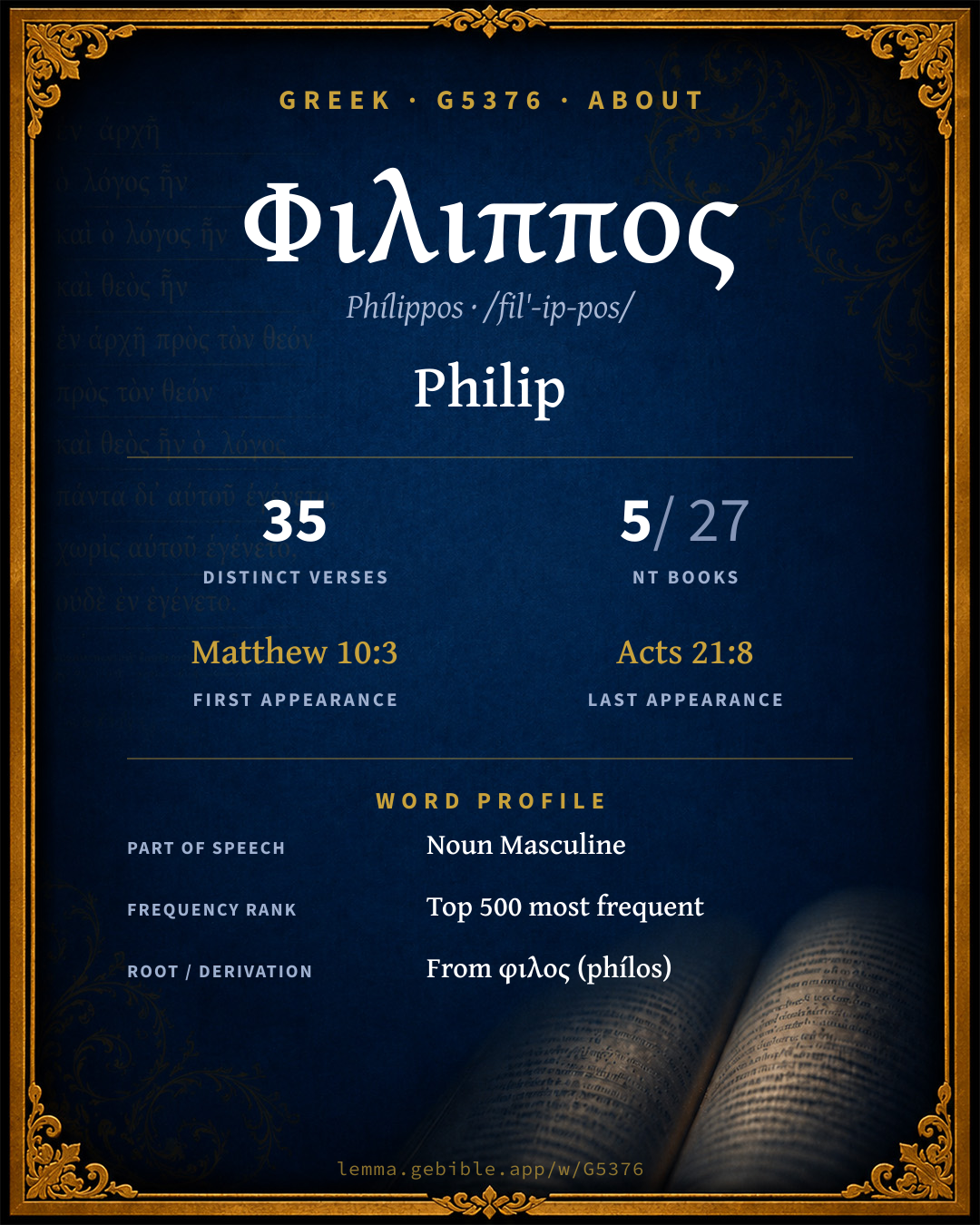
Φίλιππος
Philip
Thayer's lists 5 entries for ‘Philip’ fuller range ↓
Full lexicon entry — Thayer's Greek Lexicon
From Thayer's Greek Lexicon
Where this word appears
See every Nominative-case word in the Greek New Testament →
Grammar key — what these labels mean
Part of speech
- Noun
- A naming word — a person, place, thing, or idea.
Case
- Nominative
- The case of the subject (and the predicate nominative).
- Accusative
- The case of the direct object and of extent.
- Genitive
- The case of source, possession, or “of” — answers “whose / from what.”
- Dative
- The case of the indirect object, means, or location — “to / for / with / in.”
- Vocative
- The case of direct address (“O Lord”).
Gender
- Masculine
- Grammatically masculine.
Number
- Singular
- One.
Grammatical forms
- Noun, Nominative, Singular, Masculine 14 times (39%)
- Noun, Accusative, Singular, Masculine 9 times (25%)
- Noun, Genitive, Singular, Masculine 7 times (19%)
- Noun, Dative, Singular, Masculine 5 times (14%)
- Noun, Vocative, Singular, Masculine 1 time (3%)
Parsed forms decoded from the imported morphology (Robinson–Tischendorf, public domain), counted across 36 parsed occurrences — not distinct verses.
Every verse where G5376 appears — 35 distinct verses across 5 books. Click any verse to open its interlinear word-by-word view. Verse text shown in the World English Bible for context — . Each verse’s Greek form is shown with its reference; the English is not keyword-highlighted, since the data carries no word-level English alignment. Use “Compare translations” on any verse to read it across multiple English versions. This concordance covers the Greek New Testament; Septuagint (Greek Old Testament) occurrences of this word are not indexed here.
Matthew 3 verses
- Matthew 10:3 Φίλιππος n nom sg masc Philip; Bartholomew; Thomas; Matthew the tax collector; James the son of Alphaeus; and Lebbaeus, whose surname was Thaddaeus;
- Matthew 14:3 [Φιλίππου] n gen sg masc For Herod had laid hold of John, and bound him, and put him in prison for the sake of Herodias, his brother Philip's wife.
- Matthew 16:13 Φιλίππου n gen sg masc Now when Jesus came into the parts of Caesarea Philippi, he asked his disciples, saying, "Who do men say that I, the Son of Man, am?"
Mark 3 verses
- Mark 3:18 Φίλιππον n acc sg masc Andrew; Philip; Bartholomew; Matthew; Thomas; James, the son of Alphaeus; Thaddaeus; Simon the Zealot;
- Mark 6:17 Φιλίππου n gen sg masc For Herod himself had sent out and arrested John, and bound him in prison for the sake of Herodias, his brother Philip's wife, for he had married her.
- Mark 8:27 Φιλίππου n gen sg masc Jesus went out, with his disciples, into the villages of Caesarea Philippi. On the way he asked his disciples, "Who do men say that I am?"
Luke 2 verses
- Luke 3:1 Φιλίππου n gen sg masc Now in the fifteenth year of the reign of Tiberius Caesar, Pontius Pilate being governor of Judea, and Herod being tetrarch of Galilee, and his brother Philip tetrarch of the region of Ituraea and Trachonitis, and Lysanias tetrarch of Abilene,
- Luke 6:14 Φίλιππον n acc sg masc Simon, whom he also named Peter; Andrew, his brother; James; John; Philip; Bartholomew;
John 11 verses
- John 1:44 Φίλιππον n acc sg masc Now Philip was from Bethsaida, of the city of Andrew and Peter.
- John 1:45 Φίλιππος n nom sg masc Philip found Nathanael, and said to him, "We have found him, of whom Moses in the law, and the prophets, wrote: Jesus of Nazareth, the son of Joseph."
- John 1:46 Φίλιππος n nom sg masc Nathanael said to him, "Can any good thing come out of Nazareth?" Philip said to him, "Come and see."
- John 1:47 Φίλιππος n nom sg masc Jesus saw Nathanael coming to him, and said about him, "Behold, an Israelite indeed, in whom is no deceit!"
- John 1:49 Φίλιππον n acc sg masc Nathanael answered him, "Rabbi, you are the Son of God! You are King of Israel!"
- John 6:5 Φίλιππον n acc sg masc Jesus therefore lifting up his eyes, and seeing that a great multitude was coming to him, said to Philip, "Where are we to buy bread, that these may eat?"
- John 6:7 Φίλιππος n nom sg masc Philip answered him, "Two hundred denarii worth of bread is not sufficient for them, that everyone of them may receive a little."
- John 12:21 Φιλίππῳ n dat sg masc These, therefore, came to Philip, who was from Bethsaida of Galilee, and asked him, saying, "Sir, we want to see Jesus."
- John 12:22 Φίλιππος Φίλιππος n nom sg masc n nom sg masc Philip came and told Andrew, and in turn, Andrew came with Philip, and they told Jesus.
- John 14:8 Φίλιππος n nom sg masc Philip said to him, "Lord, show us the Father, and that will be enough for us."
- John 14:9 Φίλιππε n voc sg masc Jesus said to him, "Have I been with you such a long time, and do you not know me, Philip? He who has seen me has seen the Father. How do you say, 'Show us the Father?'
Acts 16 verses
- Acts 1:13 Φίλιππος n nom sg masc When they had come in, they went up into the upper room, where they were staying; that is Peter, John, James, Andrew, Philip, Thomas, Bartholomew, Matthew, James the son of Alphaeus, Simon the Zealot, and Judas the son of James.
- Acts 6:5 Φίλιππον n acc sg masc These words pleased the whole multitude. They chose Stephen, a man full of faith and of the Holy Spirit, Philip, Prochorus, Nicanor, Timon, Parmenas, and Nicolaus, a proselyte of Antioch;
- Acts 8:5 Φίλιππος n nom sg masc Philip went down to the city of Samaria, and proclaimed to them the Christ.
- Acts 8:6 Φιλίππου n gen sg masc The multitudes listened with one accord to the things that were spoken by Philip, when they heard and saw the signs which he did.
- Acts 8:12 Φιλίππῳ n dat sg masc But when they believed Philip preaching good news concerning the Kingdom of God and the name of Jesus Christ, they were baptized, both men and women.
- Acts 8:13 Φιλίππῳ n dat sg masc Simon himself also believed. Being baptized, he continued with Philip. Seeing signs and great miracles occuring, he was amazed.
- Acts 8:26 Φίλιππον n acc sg masc But an angel of the Lord spoke to Philip, saying, "Arise, and go toward the south to the way that goes down from Jerusalem to Gaza. This is a desert."
- Acts 8:29 Φιλίππῳ n dat sg masc The Spirit said to Philip, "Go near, and join yourself to this chariot."
- Acts 8:30 Φίλιππος n nom sg masc Philip ran to him, and heard him reading Isaiah the prophet, and said, "Do you understand what you are reading?"
- Acts 8:31 Φίλιππον n acc sg masc He said, "How can I, unless someone explains it to me?" He begged Philip to come up and sit with him.
- Acts 8:34 Φιλίππῳ n dat sg masc The eunuch answered Philip, "Who is the prophet talking about? About himself, or about someone else?"
- Acts 8:35 Φίλιππος n nom sg masc Philip opened his mouth, and beginning from this Scripture, preached to him Jesus.
- Acts 8:38 Φίλιππος n nom sg masc He commanded the chariot to stand still, and they both went down into the water, both Philip and the eunuch, and he baptized him.
- Acts 8:39 Φίλιππον n acc sg masc When they came up out of the water, the Spirit of the Lord caught Philip away, and the eunuch didn't see him any more, for he went on his way rejoicing.
- Acts 8:40 Φίλιππος n nom sg masc But Philip was found at Azotus. Passing through, he preached the Gospel to all the cities, until he came to Caesarea.
- Acts 21:8 Φιλίππου n gen sg masc On the next day, we, who were Paul's companions, departed, and came to Caesarea. We entered into the house of Philip the evangelist, who was one of the seven, and stayed with him.
About this entry
At a glance — auto-summarized from this page’s data, not written by a person. Every figure links to its source below. This summary describes the numbers; it doesn’t interpret them.
At its core, Φιλιππος (Phílippos) means “Philip.” It first appears in Matthew 10:3. It turns up in 35 verses across 5 books, a moderately common footprint. The word gravitates to Acts (46%), then John and Matthew. Dig into 35-verse concordance and the renderings breakdown below.
Gloss history
Strong's 1890 vs modern scholarship
About this word
Strong's G5376 catalogs a Greek word from the Greek New Testament.
These counts are not copied from any lexicon or concordance. They are computed here, from the morphology-tagged Greek New Testament. What Lemma adds →
- 35
- distinct verses
- The word appears in 35 distinct verses.
- 5 / 27
- NT books
- The word appears in 5 of 27 New Testament books.
- #406
- by frequency
- Top 500 most frequent Greek words (rank 406 of 5,347 Greek words by occurrence).
View all 35 occurrences in the concordance →
By section of the New Testament
By traditional corpus
Conventional, traditional groupings — biblical authorship is debated, so this is a traditional corpus grouping, not an authorship claim. Some books belong to more than one corpus (Luke is in both the Gospels and the Lukan corpus, and so on), so these shares overlap and need not total 100%. Each figure is a share of the word’s 35 distinct verses.
- Gospels 19 verses · 54%
- Lukan (Luke–Acts) 18 verses · 51%
- Johannine 11 verses · 31%
How translations render this word
Counts come from each version’s own published word-to-Strong’s tagging or interlinear alignment — an approximate guide to how each version renders this word, not a word-level alignment the data otherwise carries. Because each total is that version’s own tagged count, the per-version totals vary from one another and need not match the appearance or distinct-verse counts above. These counts may also differ from a printed concordance because Lemma counts each distinctly tagged rendering and does not collapse phrase taggings into a single head-word total. This is a fixed set of word-tagged versions (KJV, ASV, BSB, ULT) and does not change with the reading translation you choose elsewhere. Each version’s license is shown beside its name below (and on Sources).
- King James Version: Philip 32×, Philip's 3×, Philippi 2×
- American Standard Version: Philip 33×, Philippi 2×
- Berean Standard Bible: Philip 27×, Philip’s 3×, Philippi 2×
- unfoldingWord Literal Text: Philip 35×, Of 2×, Philippi 2×
King James Version Public Domain
Renders G5376 across 38 tagged occurrences — most commonly:
Plus 1 rendering that appears only once — usually multi-word phrases or single function words the recovered tagging swept in, not distinct renderings.
American Standard Version Public Domain
Renders G5376 across 37 tagged occurrences — most commonly:
Plus 2 renderings that appear only once — usually multi-word phrases or single function words the recovered tagging swept in, not distinct renderings.
Berean Standard Bible Public Domain
Renders G5376 across 34 tagged occurrences — most commonly:
Plus 2 renderings that appear only once — usually multi-word phrases or single function words the recovered tagging swept in, not distinct renderings. Not rendered by a distinct English word in 2 further occurrences.
unfoldingWord Literal Text CC BY-SA 4.0
Renders G5376 across 39 tagged occurrences — most commonly:
Senses in Thayer's
The 5 senses Thayer's distinguishes for this word, in lexicon order (not ranked by frequency or importance). The full entry — with sub-senses — is in the Lexicon Entry tab.
- Philip = "lover of horses"
- an apostle of Christ
- an evangelist and one of the seven deacons of the Jerusalem church
- tetrarch of Trachonitis…
- see 2542, Caesarea Philippi
Word origin
Derived from φιλος (phílos) (G5384) — friend.
Forms in the corpus
The 6 distinct written forms G5376 takes in the Greek New Testament, most frequent first — each parse links to that case’s occurrences in the concordance.
| Form | Parsing | Example | Uses |
|---|---|---|---|
| Φίλιππος Phílippos | Noun, Nominative, Singular, Masculine | Matthew 10:3 | 14 |
| Φίλιππον Phílippon | Noun, Accusative, Singular, Masculine | Mark 3:18 | 9 |
| Φιλίππου Philíppou | Noun, Genitive, Singular, Masculine | Matthew 16:13 | 6 |
| Φιλίππῳ Philíppō | Noun, Dative, Singular, Masculine | John 12:21 | 5 |
| [Φιλίππου] Philíppou | Noun, Genitive, Singular, Masculine | Matthew 14:3 | 1 |
| Φίλιππε Phílippe | Noun, Vocative, Singular, Masculine | John 14:9 | 1 |
Same root — word family
Other Thayer's entries built from the same root as G5376, grouped by Strong’s listed origin. These share a root / origin per the lexicon — not necessarily a shared meaning. Each links to that word’s own entry.
Derives from
Shares the same root
- φιλαγαθος philágathos G5358 loving goodness
- φιλαδελφος philádelphos G5361 loving brother
- φιλανδρος phílandros G5362 loving husband
- φιλανθρωπως philanthrṓpōs G5364 humanely
- φιλαργυρος philárgyros G5366 money-loving
- φιλαυτος phílautos G5367 self-loving
- φιλεω philéō G5368 to love
- φιληδονος philḗdonos G5369 pleasure-loving
- φιλια philía G5373 friendship
- φιλονεικος philóneikos G5380 contentious
- φιλοξενος philóxenos G5382 hospitable
- φιλοπρωτευω philoprōteúō G5383 to desire first place
- φιλοσοφος philósophos G5386 philosopher
- φιλοστοργος philóstorgos G5387 affection
- φιλοτεκνος philóteknos G5388 loving children
- φιλοτιμεομαι philotiméomai G5389 to love honor
- φιλοφρων philóphrōn G5391 friendly
Proper names from this root
People and places named from this root — a name, not an additional meaning of the word.
- φιλοθεος philótheos G5377 God-loving
- Φιλολογος Philólogos G5378 Philologus
- Φιλιπποι Phílippoi G5375 Philippi
Compare all same-root words → Showing 4 of 22 — not the complete family. 3 of the same-root words are proper names (people or places). They share a root, not necessarily a meaning.
Bible dictionary
Public-domain dictionary articles matched to this entry by name (Philip). A biblical name can be shared by more than one person or place, so an article may treat several.
Easton's Bible Dictionary · M. G. Easton, 1897
Lover of horses. (1.) One of the twelve apostles; a native of Bethsaida, "the city of Andrew and Peter" (John 1:44). He readily responded to the call of Jesus when first addressed to him (43), and forthwith brought Nathanael also to Jesus (45, 46). He seems to have held a prominent place among the apostles (Matt. 10:3; Mark 3:18; John 6:5-7; 12:21, 22; 14:8, 9; Acts 1:13). Of his later life nothing is certainly known. He is said to have preached in Phrygia, and to have met his death at Hierapolis.
(2.) One of the "seven" (Acts 6:5), called also "the evangelist" (21:8, 9). He was one of those who were "scattered abroad" by the persecution that arose on the death of Stephen. He went first to Samaria, where he laboured as an evangelist with much success (8:5-13). While he was there he received a divine command to proceed toward the south, along the road leading from Jerusalem to Gaza. These towns were connected by two roads. The one Philip was directed to take was that which led through Hebron, and thence through a district little inhabited, and hence called "desert." As he travelled along this road he was overtaken by a chariot in which sat a man of Ethiopia, the eunuch or chief officer of Queen Candace, who was at that moment reading, probably from the Septuagint version, a portion of the prophecies of Isaiah (53:6, 7). Philip entered into conversation with him, and expounded these verses, preaching to him the glad tidings of the Saviour. The eunuch received the message and believed, and was forthwith baptized, and then "went on his way rejoicing." Philip was instantly caught away by the Spirit after the baptism, and the eunuch saw him no more. He was next found at Azotus, whence he went forth in his evangelistic work till he came to Caesarea. He is not mentioned again for about twenty years, when he is still found at Caesarea (Acts 21:8) when Paul and his companions were on the way to Jerusalem. He then finally disappears from the page of history.
(3.) Mentioned only in connection with the imprisonment of John the Baptist (Matt. 14:3; Mark 6:17; Luke 3:19). He was the son of Herod the Great, and the first husband of Herodias, and the father of Salome. (See HEROD PHILIP I.)
(4.) The "tetrarch of Ituraea" (Luke 3:1); a son of Herod the Great, and brother of Herod Antipas. The city of Caesarea-Philippi was named partly after him (Matt. 16:13; Mark 8:27). (See HEROD PHILIP II.)
Smith's Bible Dictionary · William Smith, 1863
(lover of horses) the apostle was of Bethsaida, the city of Andrew and Peter, (John 1:44) and apparently was among the Galilean peasants of that district who flocked to hear the preaching of the Baptist. The manner in which St. John speaks of him indicates a previous friendship with the sons of Jona and Zebedee, and a consequent participation in their messianic hopes. The close union of the two in John 6 and 12 suggests that he may have owed to Andrew the first tidings that the hope had been fulfilled. The statement that Jesus found him (John 1:43) implies a previous seeking. In the lists of the twelve apostles, in the Synoptic Gospel, his name is as uniformly at the head of the second group of four as the name of Peter is at that of the first, (Matthew 10:3; Mark 5:18; Luke 6:14) and the facts recorded by St. John give the reason of this priority. Philip apparently was among the first company of disciples who were with the Lord at the commencement of his ministry at the marriage at Cana, on his first appearance as a prophet in Jerusalem, John 2. The first three Gospels tell us nothing more of him individually. St.John with his characteristic fullness of personal reminiscences, records a few significant utterances. (John 6:5-9; 12:20-22; 14:8) No other fact connected with the name of Philip is recorded in the Gospels. He is among the company of disciples at Jerusalem after the ascension (Acts 1:13) and on the day of Pentecost. After this all is uncertain and apocryphal, According tradition he preached in Phrygia, and died at Hierapolis.
Hitchcock's Bible Names Dictionary · Roswell D. Hitchcock, 1869
warlike; a lover of horses
Classic public-domain reference works; full attribution on Sources.