
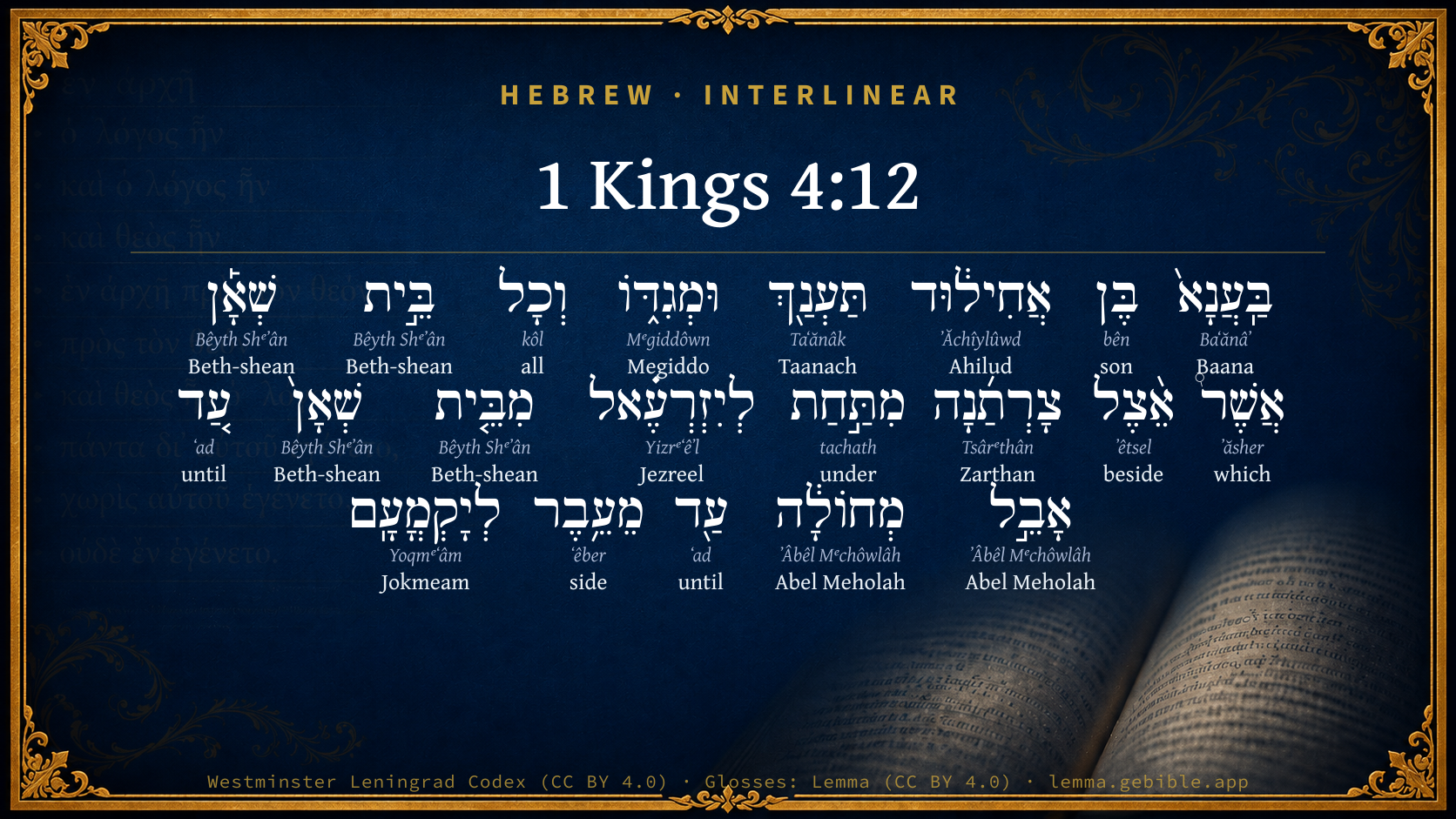
1 Kings 4:12

Hebrew (Westminster Leningrad Codex) 1 Kings 4:12 appears in the Hebrew Old Testament. The text above is from the Westminster Leningrad Codex. Each word links to its Strong’s number, a concise gloss, and parsing drawn from the Open Scriptures Hebrew Bible morphology. Click any word for its full Brown-Driver-Briggs (BDB) entry.
Download image
Cite this verse

1 Kings 4:12 (World English Bible). Public Domain. Lemma interlinear Bible study tool, https://lemma.gebible.app/v/1-kings/4/12.

Show BibTeX & RIS
BibTeX
RIS
English Translation
Baana the son of Ahilud, in Taanach and Megiddo, and all Beth-shean which is beside Zarethan, beneath Jezreel, from Beth-shean to Abel Meholah, as far as beyond Jokmeam;
World English Bible · Public Domain
Highlights
  • 2 first appearances in the Hebrew Bible
Full analysis ↓
Download a study sheet

One document with this verse’s original text, its word-by-word gloss line, the meaning frame, cross-references with their text, attributed commentary, and full source and license credits — printable, and it pastes into notes with its structure intact.

This verse Autodidact and up

Study sheet (.html) Plain text (.txt)

A passage Seminary Student

Up to 50 verses in one chapter. A passage sheet keeps up to 6 commentary sources and 12 cross-references per verse, in the order this page ranks them, and says so on the sheet whenever that leaves anything out. Ask for a single verse and you get the Autodidact verse sheet above.

Everything on this page stays free to read, with no account — the sheet is a download of what is already on screen, not access to it.

Want to remove ads? Support Godless Engineer
Compare translations 3

The same verse in 3 English versions, stacked beneath the original-language interlinear above. Click any original word for its lexicon entry.

Each is an independent rendering of the whole verse — the interlinear is not word-aligned to these translations.

Highlighted words mark where these versions differ — a whole-verse word diff, not a word-by-word alignment.

  • World English Bible Public Domain
    Baana the son of Ahilud, in Taanach and Megiddo, and all Beth-shean which is beside Zarethan, beneath Jezreel, from Beth-shean to Abel Meholah, as far as beyond Jokmeam;
  • King James Version Public Domain
    Baana the son of Ahilud; to him pertained Taanach and Megiddo, and all Bethshean, which is by Zartanah beneath Jezreel, from Bethshean to Abelmeholah, even unto the place that is beyond Jokneam:
  • unfoldingWord Literal Text CC BY-SA 4.0
    Baana, the son of Ahilud, in Taanach and Megiddo and all of Beth Shan that beside Zarethan from below Jezreel, from Beth Shan to Abel Meholah, as far as from the other side of Jokmeam.

unfoldingWord Literal Text — © unfoldingWord, licensed CC BY-SA 4.0. Word-aligned USFM3 via Door43 (git.door43.org/unfoldingWord/en_ult).

Versions to compare (up to 4)

3 of 4 selected

Show all 18 translations

Every available English version of this verse, each an independent rendering of the whole verse.

  • World English Bible Public Domain
    Baana the son of Ahilud, in Taanach and Megiddo, and all Beth-shean which is beside Zarethan, beneath Jezreel, from Beth-shean to Abel Meholah, as far as beyond Jokmeam;
  • Berean Standard Bible Public Domain
    Baana son of Ahilud in Taanach, in Megiddo, and in all of Beth-shean next to Zarethan below Jezreel, from Beth-shean to Abel-meholah and on past Jokmeam;
  • Majority Standard Bible Public Domain
    Baana son of Ahilud in Taanach, in Megiddo, and in all of Beth-shean next to Zarethan below Jezreel, from Beth-shean to Abel-meholah and on past Jokmeam;
  • King James Version Public Domain
    Baana the son of Ahilud; to him pertained Taanach and Megiddo, and all Bethshean, which is by Zartanah beneath Jezreel, from Bethshean to Abelmeholah, even unto the place that is beyond Jokneam:
  • American Standard Version (1901) Public Domain
    Baana the son of Ahilud, in Taanach and Megiddo, and all Beth-shean which is beside Zarethan, beneath Jezreel, from Beth-shean to Abel-meholah, as far as beyond Jokmeam;
  • Revised Version (1885) Public Domain
    Baana the son of Ahilud, in Taanach and Megiddo, and all Beth-shean which is beside Zarethan, beneath Jezreel, from Beth-shean to Abel-meholah, as far as beyond Jokmeam:
  • Geneva Bible (1599) Public Domain
    Baana the sonne of Ahilud in Taanach, and Megiddo, and in all Beth-shean, which is by Zartanah beneath Izreel, from Beth-shean to Abelmeholah, eue til beyond ouer against Iokmeam:
  • Douay-Rheims (1899) Public Domain
    Bana the son of Ahilud, who governed Thanac and Mageddo, and all Bethsan, which is by Sarthana beneath Jezrael, from Bethsan unto Abelmehula over against Jecmaan.
  • Young's Literal Translation Public Domain
    Baana Ben-Ahilud `hath' Taanach and Megiddo, and all Beth-Shean, which `is' by Zartanah beneath Jezreel, from Beth-Shean unto Abel-Meholah, unto beyond Jokneam.
  • Literal Standard Version CC BY-SA 4.0
    Baana Ben-Ahilud [has] Taanach and Megiddo, and all Beth-Shean, which [is] by Zartanah beneath Jezreel, from Beth-Shean to Abel-Meholah, to beyond Jokneam;
  • Unlocked Literal Bible CC BY-SA 4.0
    Baana son of Ahilud, in Taanach and Megiddo, and all Beth Shan that is beside Zarethan below Jezreel, from Beth Shan to Abel Meholah as far as the other side of Jokmeam;
  • unfoldingWord Literal Text CC BY-SA 4.0
    Baana, the son of Ahilud, in Taanach and Megiddo and all of Beth Shan that beside Zarethan from below Jezreel, from Beth Shan to Abel Meholah, as far as from the other side of Jokmeam.
  • Darby Bible Public Domain
    Baana the son of Ahilud had Taanach and Megiddo, and all Beth-shean, which is by Zaretan beneath Jizreel, from Beth-shean to Abel-Meholah, as far as beyond Jokneam.
  • World Messianic Bible Public Domain
    Baana the son of Ahilud, in Taanach and Megiddo, and all Beth Shean which is beside Zarethan, beneath Jezreel, from Beth Shean to Abel Meholah, as far as beyond Jokmeam;
  • Webster's Bible Public Domain
    Baana the son of Ahilud; to him pertained Taanach and Megiddo, and all Beth-shean, which is by Zartanah beneath Jezreel, from Beth-shean to Abel-meholah, even to the place that is beyond Jokneam:
  • Free Bible Version CC BY-SA 4.0
    Baana, son of Ahilud, in Taanach and Megiddo, the whole of Beth-shan near Zarethan below Jezreel, and from Beth-shan to Abel-meholah and across to Jokmeam;
  • Bible in Basic English Public Domain
    Baana, the son of Ahilud, in Taanach and Megiddo, and all Beth-shean which is by the side of Zarethan, under Jezreel, from Beth-shean to Abel-meholah, as far as the far side of Jokmeam;
  • JPS Tanakh (1917) Public Domain
    Baana the son of Ahilud, in Taanach and Megiddo, and all Beth-shean which is beside Zarethan, beneath Jezreel, from Beth-shean to Abel-meholah, as far as beyond Jokmeam;

Literal Standard Version (2020), Covenant Press — licensed CC BY-SA 4.0. Text via the HelloAO Bible API (eBible.org). Unlocked Literal Bible (unfoldingWord) — licensed CC BY-SA 4.0. Text via the HelloAO Bible API (eBible.org). unfoldingWord Literal Text — © unfoldingWord, licensed CC BY-SA 4.0. Word-aligned USFM3 via Door43 (git.door43.org/unfoldingWord/en_ult). Free Bible Version, Dr. Jonathan Gallagher — licensed CC BY-SA 4.0. Text via the HelloAO Bible API (eBible.org).

Word by word

More ways to search: Search by grammar → Find every occurrence → Compare this word →

Practice this passage: Drill this verse → Learn its vocabulary →

לְיָקְמֳעָֽם
Yoqmᵉʻâm
H3361
“to/for · Jokmeam”
Preposition + Noun, Proper
Part of Speech
Preposition + Noun
Type
Proper
Full BDB Definition

Origin: from H6965 and H5971

TWOT: None

Jokmeam = "gathered by the people" - a city of refuge in Ephraim given to the Kohathite Levites
  1. בַּֽעֲנָא֙ Baʻănâʼ H1195 “Baana” Noun, Proper
  2. בֶּן bên H1121 “son of” Noun, Common, Masculine, Singular, Construct
  3. אֲחִיל֔וּד ʼĂchîylûwd H286 “Ahilud” Noun, Proper
  4. תַּעְנַ֖ךְ Taʻănâk H8590 “Taanach” Noun, Proper
  5. וּמְגִדּ֑וֹ Mᵉgiddôwn H4023 “and · Megiddo” Conjunction + Noun, Proper
  6. וְכָל kôl H3605 “and · all of” Conjunction + Noun, Common, Masculine, Singular, Construct
  7. בֵּ֣ית Bêyth Shᵉʼân H1052 “Beth-shean” Noun, Proper
  8. שְׁאָ֡ן Bêyth Shᵉʼân H1052 “Beth-shean” Noun, Proper
  9. אֲשֶׁר֩ ʼăsher H834 “which” Particle, Relative
  10. אֵ֨צֶל ʼêtsel H681 “beside” Preposition
  11. צָרְתַ֜נָה Tsârᵉthân H6891 “Zarthan · toward” Noun, Proper + Suffix, Demonstrative
  12. מִתַּ֣חַת tachath H8478 “from · under” Preposition + Preposition
  13. לְיִזְרְעֶ֗אל Yizrᵉʻêʼl H3157 “to/for · Jezreel” Preposition + Noun, Proper
  14. מִבֵּ֤ית Bêyth Shᵉʼân H1052 “from · Beth-shean” Preposition + Noun, Proper
  15. שְׁאָן֙ Bêyth Shᵉʼân H1052 “Beth-shean” Noun, Proper
  16. עַ֚ד ʻad H5704 “until” Preposition
  17. אָבֵ֣ל ʼÂbêl Mᵉchôwlâh H65 “Abel Meholah” Noun, Proper
  18. מְחוֹלָ֔ה ʼÂbêl Mᵉchôwlâh H65 “Abel Meholah” Noun, Proper
  19. עַ֖ד ʻad H5704 “until” Preposition
  20. מֵעֵ֥בֶר ʻêber H5676 “from · side” Preposition + Noun, Common, Masculine, Singular, Absolute

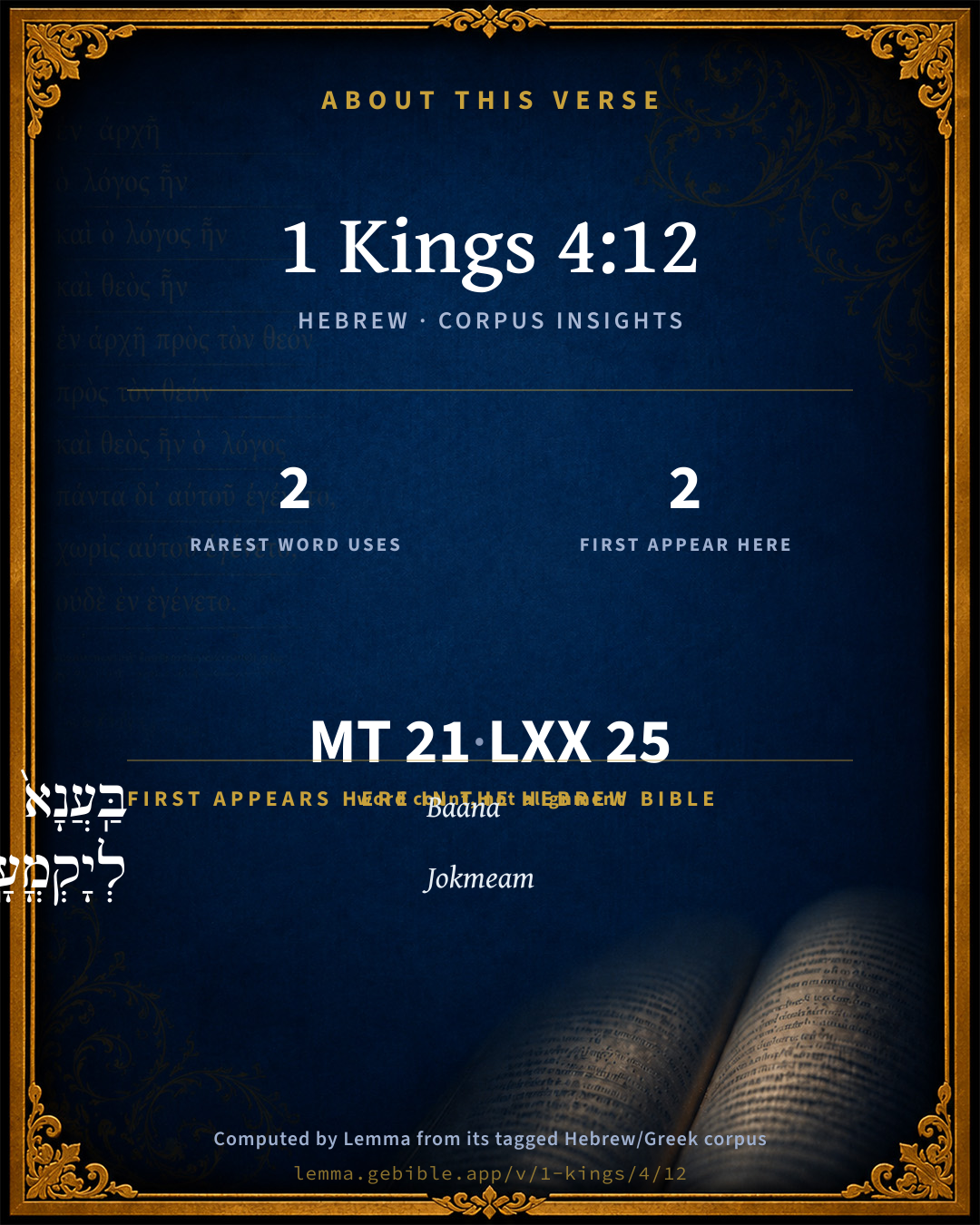
About this verse

These counts appear in no published source. They are computed here, from the morphology-tagged text and Lemma’s own curated glosses. What Lemma adds →

21
words
16
distinct lemmas
Historical
section

Notable vocabulary

The rarest word here is לְיָקְמֳעָֽם Jokmeam H3361 — appearing just 2 times in the whole Hebrew Bible.

First appearance in Scripture

These words make their first canonical appearance in the Hebrew Bible here:

  • בַּֽעֲנָא֙ Baana H1195
  • לְיָקְמֳעָֽם Jokmeam H3361

Shared distinctive vocabulary

לְיָקְמֳעָֽם Jokmeam H3361 occurs in 2 verses of the Hebrew Bible. Also found in:

Grammatical profile

  • 16 nouns
  • 4 prepositions
  • 1 particle

Repetition

Words recur within this verse — often emphatic in Hebrew:

  • בֵּ֣ית Beth-shean H1052 ×4
  • עַ֚ד until H5704 ×2
  • אָבֵ֣ל Abel Meholah H65 ×2

Hebrew & Septuagint length

In English translation the verse runs 28 words from the Hebrew and 35 from the Septuagint (LXX English) — closely comparable.

A rough comparison of the two English renderings, which tokenize alike — not a word-level alignment.

Word counts can differ between the Hebrew and the Greek without any difference in meaning — e.g. the Hebrew direct-object marker אֵת has no separate Greek word, and Greek often adds the article ὁ.

In the original languages it is 21 Hebrew tokens and 25 Greek tokens — but the two are counted differently (Hebrew bundles its prefixes and suffixes into one token; the Greek is in lemma form), so that isn’t a like-for-like length.

Cross-references

10

Topical passages linked to 1 Kings 4:12 in the Treasury of Scripture Knowledge — connected by theme and wording, ordered by reader-vote popularity; previews shown in the World English Bible.

  • Joshua 17:11 Manasseh had in Issachar and in Asher Beth-shean and its towns, and Ibleam and its towns, and the inhabitants of Dor and its towns, and the inhabitants of En-dor and its towns, and the inhabitants of Taanach and its towns, and the inhabitants of Megiddo and its towns, even the three heights.
  • Joshua 3:16 that the waters which came down from above stood, and rose up in one heap, a great way off, at Adam, the city that is beside Zarethan; and those that went down toward the sea of the Arabah, even the Salt Sea, were wholly cut off: and the people passed over right against Jericho.
  • Judges 5:19 The kings came and fought; Then fought the kings of Canaan. In Taanach by the waters of Megiddo: They took no gain of money.
  • 1 Kings 19:16 and Jehu the son of Nimshi shall you anoint to be king over Israel; and Elisha the son of Shaphat of Abel Meholah shall you anoint to be prophet in your room.
  • 1 Samuel 31:10 They put his armor in the house of the Ashtaroth; and they fastened his body to the wall of Beth-shan.
  • 1 Kings 7:46 In the plain of the Jordan did the king cast them, in the clay ground between Succoth and Zarethan.
  • 1 Kings 18:46 and the hand of Yahweh was on Elijah; and he girded up his loins, and ran before Ahab to the entrance of Jezreel.
  • 2 Kings 23:29–30 In his days Pharaoh Necoh king of Egypt went up against the king of Assyria to the river Euphrates: and king Josiah went against him; and [Pharaoh Necoh] killed him at Megiddo, when he had seen him.
  • 1 Chronicles 6:68 and Jokmeam with its suburbs, and Beth Horon with its suburbs,
  • 1 Samuel 31:12 all the valiant men arose, and went all night, and took the body of Saul and the bodies of his sons from the wall of Beth-shan; and they came to Jabesh, and burnt them there.

Cross-references courtesy of OpenBible.info (CC BY 4.0).

Hebrew and Greek witnesses Masoretic Hebrew ↔ Greek Septuagint

The same verse in the two great witnesses to the Old Testament, shown verse-for-verse.

These are two independent witnesses, not word-aligned to each other, and the Septuagint is shown in lemma (dictionary) form.

Hebrew 1 Kings 4:12 Masoretic · Westminster Leningrad Codex

בַּֽעֲנָא֙ בֶּן אֲחִיל֔וּד תַּעְנַ֖ךְ וּמְגִדּ֑וֹ וְכָל בֵּ֣ית שְׁאָ֡ן אֲשֶׁר֩ אֵ֨צֶל צָרְתַ֜נָה מִתַּ֣חַת לְיִזְרְעֶ֗אל מִבֵּ֤ית שְׁאָן֙ עַ֚ד אָבֵ֣ל מְחוֹלָ֔ה עַ֖ד מֵעֵ֥בֶר לְיָקְמֳעָֽם

Baana the son of Ahilud, in Taanach and Megiddo, and all Beth-shean which is beside Zarethan, beneath Jezreel, from Beth-shean to Abel Meholah, as far as beyond Jokmeam;

World English Bible · Public Domain

Greek LXX 1 Kings 4:12 Septuagint · lemma form

βακχα υἱός αχιλιδ θααναχ καί μεκεδω καί πᾶς ὁ οἶκος σαν ὁ παρά σεσαθαν ὑποκάτω ὁ εσραε καί ἐκ βαισαφουδ εβελμαωλα ἕως μαεβερ λουκαμ εἷς

Bana son of Achiluth had Ithaanach, and Mageddo, and his was the whole house of San which was by Sesathan below Esrae, and from Bethsan as far as Sabelmaula, as far as Maeber Lucam, one.

LXX2012 (modern English Septuagint) · Public Domain

On this verse, The Cambridge Bible for Schools and Colleges discusses the Septuagint’s reading. Read the note in Commentary ↓

Hebrew: Westminster Leningrad Codex (CC BY 4.0). Greek: Septuagint (public domain); English from LXX2012 (modern English Septuagint) (Public Domain). How the Septuagint differs from the Hebrew →

Targum (Aramaic paraphrase)

1

The Targum is the ancient Jewish Aramaic paraphrase of the Hebrew Scriptures — an interpretive translation, not the Hebrew text itself. Onkelos (literal) and Pseudo-Jonathan (expansive) render the Torah, and Jonathan the Prophets. Coverage is partial: where no permissively-licensed English translation exists for a verse, only the Aramaic is shown. This is verse-level text, not a word-by-word alignment to the Hebrew.

  1. Targum Jonathan Prophets (Joshua–Malachi)
    בַּעֲנָא בַּר אֲחִילוּד תַּעֲנָךְ וּמְגִידוֹ וְכָל בֵּית שְׁאָן דִי בִסְטַר צָרְתָנָה מִלְרַע לְיִזְרְעֶאל מִבֵּית שְׁאָן עַד מֵישַׁר מְחוֹלָה עַד מֵעִבַּר לְיָקְמְעָם:

    (no public-domain English translation for this verse)

    Targum Jonathan — Aramaic: “Mikraot Gedolot” (public domain). English: “Sefaria Community Translation” (CC0 1.0 (public-domain dedication)); “London "Chaldee Paraphrase," 1871” (public domain). Text via Sefaria.

Commentary

Notes on 1 Kings 4:12 from classic Christian and Jewish commentators (each source and its license shown beneath its notes). The classic Christian expositions comment on the surrounding passage and are grouped to its opening verse, so a note may address several verses; the Jewish commentaries on the Tanakh (Rashi and others) are per-verse, so they appear only where the commentator wrote on this verse.

Lemma curates 59 commentaries, every one of them public domain or Creative Commons licensed, each selected and text-cleaned for this edition rather than reprinted as found. About our sources →

Trapp's Complete Commentary

John Trapp

1Ki 4:12 Baana the son of Ahilud; [to him pertained] Taanach and Megiddo, and all Bethshean, which [is] by Zartanah beneath Jezreel, from Bethshean to Abelmeholah, [even] unto [the place that is] beyond Jokneam:

Ver. 12. Taanach and Megiddo.] These were in the tribe of Manasseh: he had also part of Issachar, and part of Zebulun; for in this business they shared out the land, not by tribes but districts, or provinces; that things might be equally carried.

John Trapp, A Commentary or Exposition upon All the Books of the Old and New Testament (1647–1656) — public domain. Text from a community e-Sword module.

Geneva Bible (1599)

Geneva Bible translators

Or, to the plain.

Geneva Bible (1599) marginal notes — public domain. Text via Bolls.life.

Ellicott's Commentary for English Readers

(12) The fifth division must have been large and important, including much of the great plain of Esdraelon or Jezreel, the garden and battle-field of Northern Palestine, and extending to the Jordan valley. Taanach, Megiddo, and Beth-shean are all named as Canaanitish cities not taken by Manasseh, but made tributary (Jos_17:11; Jdg_1:27). Taanach and Megiddo are referred to in the song of Deborah (Jdg_5:19). Megiddo is the place of the death of Ahaziah (2Ki_9:27) and the fall of Josiah (2Ki_23:29). Beth-shean is the city in which the body of Saul was exposed in triumph (1Sa_31:12). Abel-meholah, the birth-place of Elisha (1Ki_19:16), lies south of Beth-shean, and is mentioned in the record of the rout of the Midianites by Gideon (Jdg_7:22). Jokmeam (for such is the right reading) is a Levitical city in Ephraim (1Ch_6:68), apparently called Kibzaim in Jos_21:22, and must have been an outlying part of this division.

A Bible Commentary for English Readers, edited by Charles John Ellicott (1878–1897) — public domain. Text from a community e-Sword module.

The Cambridge Bible for Schools and Colleges

gen. ed. J. J. S. Perowne

12. Baana the son of Ahilud] Probably the brother of Jehoshaphat the recorder mentioned in 1Ki_4:3.

Taanach and Megiddo] These places are both inland to the east of Dor, Megiddo being a little north of Taanach which lies in the valley of Esdraelon. Cf. Jdg_5:19 ‘Taanach by the waters of Megiddo.’ Beth-shean is still further east nearer to the Jordan, and Zartanah is no doubt Zarethan or Zarthan (Jos_3:16), which must have been close to the Jordan. Abel-meholah is south from Beth-shean in the Jordan valley. The name Jokneam should be, on the authority both of Hebrew, Septuagint and Vulgate, written Jokmeam. This place is mentioned 1Ch_6:68, but in the parallel passage Jos_21:22 Kibzaim is given instead. In both passages the place is assigned as one of the Levitical cities in the tribe of Ephraim, which would suit entirely with the text of the present verse, as it would then be in the same district as Zarthan and Abel-meholah, whereas Jokneam lies to the north of the ridge of Carmel, not far from the coast of the Mediterranean. The scribe’s confusion between Jokmeam יקמעם and Kibzaim קבצים is not difficult to understand on looking at the forms in Hebrew.

Instead of the italics to him pertained at the beginning of this verse, it is simpler to substitute in, which stands in all the previous verses.

beneath Jezreel] implies that the place or district so described lay in the plain country stretching south of Jezreel. That city was built on a small height and looked south over the plain of Esdraelon.

The Cambridge Bible for Schools and Colleges (gen. ed. J. J. S. Perowne; Cambridge University Press, 1878–1918) — public domain. Text from a community e-Sword module.

John Gill's Exposition

The son of Geber in Ramothgilead,.... A city in the tribe of Gad, and was a city of refuge, Jos 20:8;

to him pertained the towns of Jair the son of Manasseh, which are in Gilead; of which see Num 32:41;

to him also pertained the region of Argob, which is in Bashan,

threescore great cities with walls, and brasen bars; called by Josephus (s) Ragaba, beyond Jordan; See Gill on Deu 3:4.

(s) Antiqu. l. 13. c. 15. sect. 5.

John Gill's Exposition of the Whole Bible (1746–1763) — public domain (CC PDM 1.0). Text via the HelloAO Bible API.

Albert Barnes' Notes on the Bible

On these cities see Jos 12:21; Jos 3:16; Jdg 7:22; Jos 21:22.

Albert Barnes' Notes on the Bible (1834–1885) — public domain. Text from a community e-Sword/MySword module.

Matthew Poole's English Annotations

Zartanah beneath Jezreel, which was in Issachar. And this seems added to distinguish it from that

Zartanah, Jos 3:16.

Matthew Poole's English Annotations on the Holy Bible (1683–1685) — public domain. Text from a community e-Sword/MySword module.

Whedon's Commentary on the Bible

Daniel D. Whedon

12. Taanach and Megiddo — In the great plain of Esdraelon. See on Jos_12:21; Jdg_5:19.

Beth-shean — The modern Beisan, between Mount Gilboa and the Jordan. See Jos_17:11.

Zartanah — This place has not been identified.

Beneath Jezreel — The city of Jezreel, which gave its name to the whole neighbouring valley, was on the site of the modern Zerin, near the western end of Mount Gilboa. See on Jos_19:18. Beneath Jezreel indicates that Beth-shean and its neighbouring towns lay lower than Jezreel, a fact confirmed by Robinson: “Zerin lies comparatively high, and commands a wide and noble view, extending down the broad low valley on the east to Beisan. We could here see the acropolis of Beisan lying much lower than Zerin; and from every account that place appears to be situated not far above the level of the Jordan valley.”

Abel-meholah — Perhaps the modern Khurbet-esh-Shuk, at the eastern end of Mount Gilboa.

Jokneam — The Hebrew is here Jok-meam, but probably a later corruption of Jokneam, called in Jos_12:22, Jokneam of Carmel, and identified by Dr. Robinson with the modern Tell Kaimon, which holds a conspicuous position on the Carmel range, “commanding the main pass from the western portion of Esdraelon to the more southern plain.” Baana’s district thus took in the great valley of Jezreel, and extended from Bethshean on the east to Jokneam on the west.

Daniel D. Whedon (gen. ed.), Commentary on the Old and New Testaments (1874–1909) — public domain. Text from a community e-Sword module.

The Pulpit Commentary

Baana, the son of Ahilud cf. ver. 3. Probably the recorder"s brother, to him pertained the original, true to its character as a list, omits these words, simply giving the name of the officer and then the towns of his district or province Taanach and Megiddo similarly associated, Jos_12:21; Jud_1:5:19 1:27. These towns, which became famous in later Jewish history (2Ki_23:29; 2Ch_35:22) lay at the foot of the E. spurs of Carmel, on the margin of the plain of Esdraelon. See Conder"s "Tent Work in Palestine," p. 67 and all Bethshean Jos_17:11, Jos_17:16; Jud 1:27. Otherwise Bethshan (1Sa_31:10, 1Sa_31:12; 2Sa_21:12) now Beisan. The LXX here translate the word oJ oikov San; elsewhere they write baiqsan or baiqsam, and inliv, Jud 1:27 explain h ejsti Skuqwn po hence its later name Scythopolis. Rawlinson, by an oversight, interprets the name to mean "house of the sun," which is the translation of Bethshemesh. Bethshan prob. means "house of rest." "The site of the town is on the brow of the descent by which the great plain of Esdraelon drops down to the level of the Ghor." The present writer was much struck (in 1861) by its situation. See Conder, pp. 233, 234. The text shows that it gave its name to the adjoining district, which is by Zartanah probably the Zaretan of Jos_3:16 and the Zarthan (same word in the Heb.) of 1Ki_7:46, which place is called Zeredathah in 2Ch_4:17, and is probably the Zererath of. Jud_1:7:22. (The variations in spelling are again to be noticed) Here Solomon cast the Temple vessels. By some it is identified with Kurn Sartabeh (but see quart. Stat. of Pal. Explor. Fund, July, 1874, and Conder, pp. 233, 234), a few miles below Bethshan. It is noticeable (in connexion with Jos_3:16) that at this point the Jordan valley narrows (Keil). It occupies high ground and commands an extensive view (Robinson) beneath or below Jezreel Wordsworth remarks that "Jezreel, now Zerin, is a lofty site." But the idea of "beneath" is not that of depression, but of geographical position=the district southeast of Jezreel from LXX and from. Bethshean to Abelmeholah lit. meadow of the dance. It lay ten miles south of Bethshean. It is mentioned in connexion with Zererath (Zaretan) in Jud_1:7:22, but is best known as the home of Elisha 1Ki_19:16 even unto the place that is beyond Heb. unto the other side of Jokneam. Properly, Jokmeam. Identified by the Survey (Conder, p. 68) with Tell Keimun. A Levitical town (1Ch_6:68) probably the same as Kibzaim (cf. Jos_21:22) Thisdistrict coincided practically with the tribe of Manasseh. It embraced a part (see ver. 17) of the fertile plain of Esdraelon and of the Jordan valley.

The Pulpit Commentary (1880–1919), ed. H.D.M. Spence-Jones & Joseph S. Exell — public domain. Text from a community e-Sword module.

Lesson kit

Teaching starters — assembled from the data on this page, not authored interpretation. Every prompt links to the verse data it draws on. Edit before teaching.

1 Kings, in the Historical, opens this verse with 21 words (16 distinct Hebrew lemmas). Its most distinctive word is Yoqmᵉʻâm (“Jokmeam”). A historical commentator’s framing appears above. Read the whole chapter for the surrounding context.

Discussion questions

  1. What does “Jokmeam” (Yoqmᵉʻâm) contribute to the verse as a whole?
  2. 2 words here appear for the first time in Scripture. What is being introduced at this debut?
  3. 1 Chronicles 6:68 shares the word «Jokmeam» with this verse. How do the two illuminate each other?
  4. “Beth-shean” occurs 4× in this one verse. What is the effect of the repetition?
  5. These translations render this verse differently; the difference is in the English rendering, not the original. What questions does that raise?
  6. Reading how Trapp's Complete Commentary and Geneva Bible (1599) read this verse, where do the two commentators agree and where do they part?

Things to notice

Reading settings

Reading text

Shown beneath each verse's original-language words.

Old Testament
Old Testament edition

Read the OT as the Masoretic Hebrew (MT) or the Greek Septuagint (LXX).

English shown for the Greek Septuagint (in the Hebrew ↔ Greek comparison).

Comparing translations? Open the Compare panel on any verse page to stack up to four side by side.