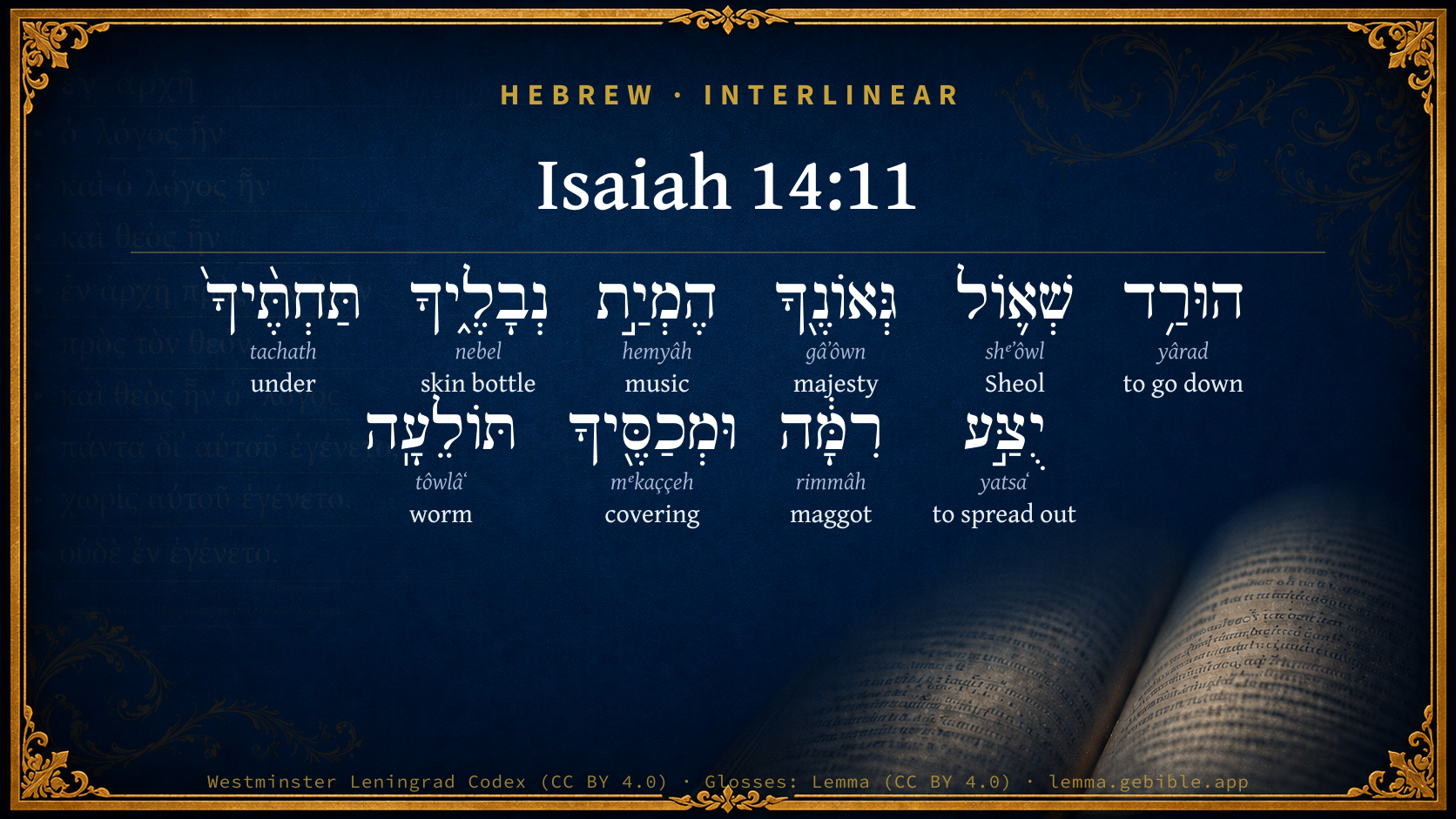
Isaiah 14:11

Hebrew (Westminster Leningrad Codex) Isaiah 14:11 appears in the Hebrew Old Testament. The text above is from the Westminster Leningrad Codex. Each word links to its Strong’s number, a concise gloss, and parsing drawn from the Open Scriptures Hebrew Bible morphology. Click any word for its full Brown-Driver-Briggs (BDB) entry.
Download image
Cite this verse

Isaiah 14:11 (World English Bible). Public Domain. Lemma interlinear Bible study tool, https://lemma.gebible.app/v/isaiah/14/11.

Show BibTeX & RIS
BibTeX
RIS
English Translation
Your pomp is brought down to Sheol, [and] the noise of your viols: the worm is spread under you, and worms cover you.
World English Bible · Public Domain
Highlights
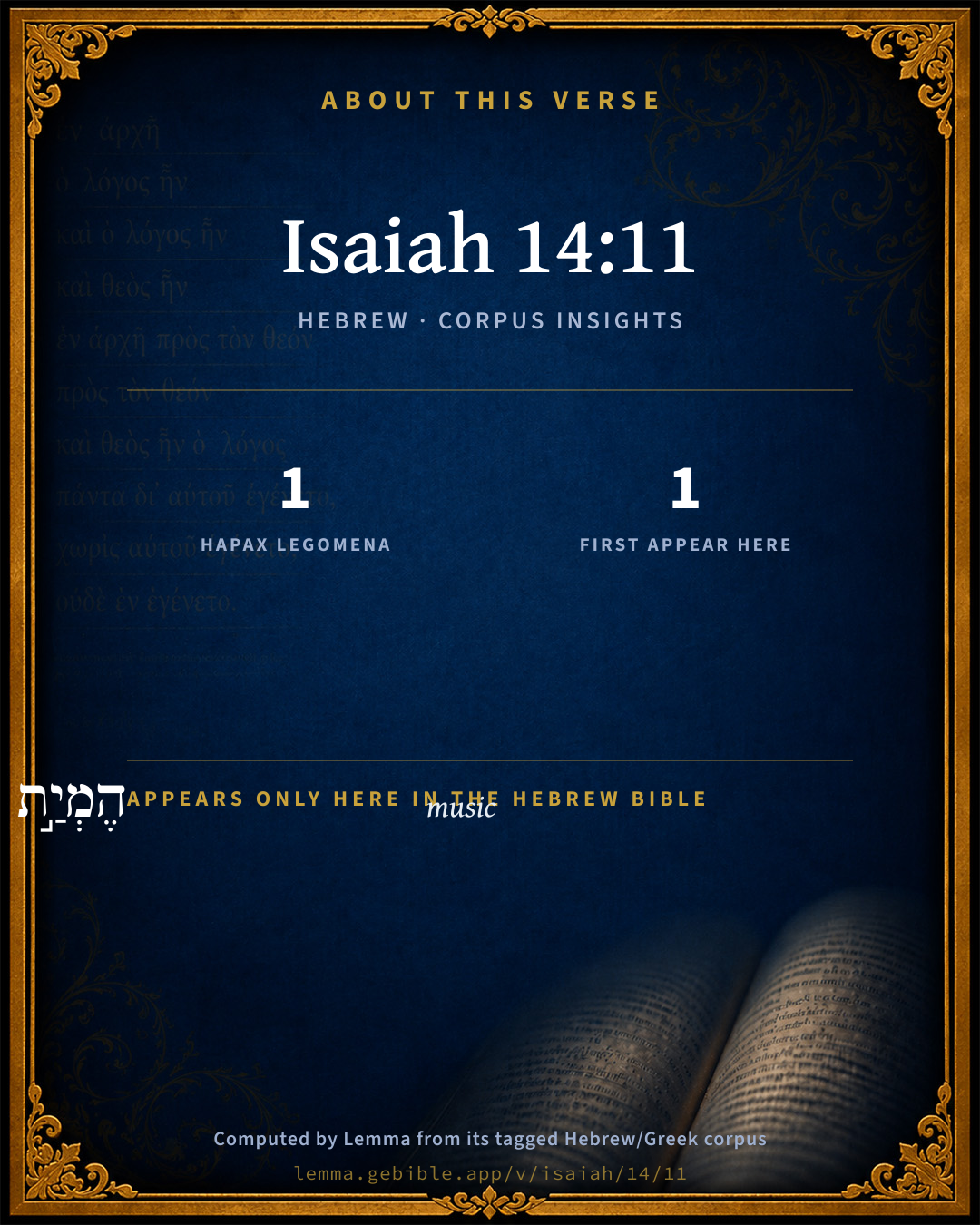
  • 1 hapax legomenon — only here in the Hebrew Bible
  • 1 first appearance in the Hebrew Bible
Full analysis ↓
Download a study sheet

One document with this verse’s original text, its word-by-word gloss line, the meaning frame, cross-references with their text, attributed commentary, and full source and license credits — printable, and it pastes into notes with its structure intact.

This verse Autodidact and up

Study sheet (.html) Plain text (.txt)

A passage Seminary Student

Up to 50 verses in one chapter. A passage sheet keeps up to 6 commentary sources and 12 cross-references per verse, in the order this page ranks them, and says so on the sheet whenever that leaves anything out. Ask for a single verse and you get the Autodidact verse sheet above.

Everything on this page stays free to read, with no account — the sheet is a download of what is already on screen, not access to it.

Want to remove ads? Support Godless Engineer
Compare translations 3

The same verse in 3 English versions, stacked beneath the original-language interlinear above. Click any original word for its lexicon entry.

Each is an independent rendering of the whole verse — the interlinear is not word-aligned to these translations.

Highlighted words mark where these versions differ — a whole-verse word diff, not a word-by-word alignment.

  • World English Bible Public Domain
    Your pomp is brought down to Sheol, [and] the noise of your viols: the worm is spread under you, and worms cover you.
  • King James Version Public Domain
    Thy pomp is brought down to the grave, and the noise of thy viols: the worm is spread under thee, and the worms cover thee.
  • unfoldingWord Literal Text CC BY-SA 4.0
    Your pride has been brought down to Sheol, the sound of your lyres. The maggot is spread beneath you, and the worm your covering. q1

unfoldingWord Literal Text — © unfoldingWord, licensed CC BY-SA 4.0. Word-aligned USFM3 via Door43 (git.door43.org/unfoldingWord/en_ult).

Versions to compare (up to 4)

3 of 4 selected

Show all 18 translations

Every available English version of this verse, each an independent rendering of the whole verse.

  • World English Bible Public Domain
    Your pomp is brought down to Sheol, [and] the noise of your viols: the worm is spread under you, and worms cover you.
  • Berean Standard Bible Public Domain
    Your pomp has been brought down to Sheol, along with the music of your harps. Maggots are your bed and worms your blanket.
  • Majority Standard Bible Public Domain
    Your pomp has been brought down to Sheol, along with the music of your harps. Maggots are your bed and worms your blanket.
  • King James Version Public Domain
    Thy pomp is brought down to the grave, and the noise of thy viols: the worm is spread under thee, and the worms cover thee.
  • American Standard Version (1901) Public Domain
    Thy pomp is brought down to Sheol, `and' the noise of thy viols: the worm is spread under thee, and worms cover thee.
  • Revised Version (1885) Public Domain
    Thy pomp is brought down to hell, and the noise of thy viols: the worm is spread under thee, and worms cover thee.
  • Geneva Bible (1599) Public Domain
    Thy pompe is brought downe to ye graue, and the sounde of thy violes: the worme is spred vnder thee, and the wormes couer thee.
  • Douay-Rheims (1899) Public Domain
    ,11Thy pride is brought down to hell, thy carcass is fallen down: under thee shall the moth be strewed, and worms shall be thy covering.
  • Young's Literal Translation Public Domain
    Brought down to Sheol hath been thine excellency, The noise of thy psaltery, Under thee spread out hath been the worm, Yea, covering thee is the worm.
  • Literal Standard Version CC BY-SA 4.0
    Your excellence has been brought down to Sheol, || The noise of your stringed instruments, || The worm has been spread out under you, || Indeed, the worm is covering you.
  • Unlocked Literal Bible CC BY-SA 4.0
    Your pomp has been brought down to Sheol with the sound of your string instruments. Maggots are spread under you, and worms cover you.'
  • unfoldingWord Literal Text CC BY-SA 4.0
    Your pride has been brought down to Sheol, the sound of your lyres. The maggot is spread beneath you, and the worm your covering. q1
  • Darby Bible Public Domain
    -- Thy pomp is brought down to Sheol, the noise of thy lyres: the maggot is spread under thee, and worms cover thee.
  • World Messianic Bible Public Domain
    Your pomp is brought down to Sheol, with the sound of your stringed instruments. Maggots are spread out under you, and worms cover you.
  • Webster's Bible Public Domain
    Thy pomp is brought down to the grave, and the noise of thy viols: the worm is spread under thee, and the worms cover thee.
  • Free Bible Version CC BY-SA 4.0
    Your pride is now buried with you in the grave, along with the harp music you loved. Maggots are the bed you lie on, and worms are your blanket.’
  • Bible in Basic English Public Domain
    Your pride has gone down into the underworld, and the noise of your instruments of music; the worms are under you, and your body is covered with them.
  • JPS Tanakh (1917) Public Domain
    Thy pomp is brought down to the nether-world, and the noise of thy psalteries; the maggot is spread under thee, and the worms cover thee.'

Literal Standard Version (2020), Covenant Press — licensed CC BY-SA 4.0. Text via the HelloAO Bible API (eBible.org). Unlocked Literal Bible (unfoldingWord) — licensed CC BY-SA 4.0. Text via the HelloAO Bible API (eBible.org). unfoldingWord Literal Text — © unfoldingWord, licensed CC BY-SA 4.0. Word-aligned USFM3 via Door43 (git.door43.org/unfoldingWord/en_ult). Free Bible Version, Dr. Jonathan Gallagher — licensed CC BY-SA 4.0. Text via the HelloAO Bible API (eBible.org).

Word by word

More ways to search: Search by grammar → Find every occurrence → Compare this word →

Practice this passage: Drill this verse → Learn its vocabulary →

הֶמְיַ֣ת
hemyâh
H1998
“music of”
Noun, Common, Feminine, Singular, Construct
Part of Speech
Noun
Type
Common
Gender
Feminine
Number
Singular
State
Construct
Full BDB Definition

Origin: from H1993

TWOT: 505b

sound, music (of instruments)
  1. הוּרַ֥ד yârad H3381 “to go down” Verb, Hophal, Perfect, 3rd Person, Masculine, Singular
  2. שְׁא֛וֹל shᵉʼôwl H7585 “Sheol” Noun, Proper
  3. גְּאוֹנֶ֖ךָ gâʼôwn H1347 “majesty · your” Noun, Common, Masculine, Singular, Construct + Suffix, Personal, 2nd Person, Masculine, Singular
  4. נְבָלֶ֑יךָ nebel H5035 “skin bottles · your” Noun, Common, Masculine, Plural, Construct + Suffix, Personal, 2nd Person, Masculine, Singular
  5. תַּחְתֶּ֨יךָ֙ tachath H8478 “under · you” Preposition + Suffix, Personal, 2nd Person, Masculine, Singular
  6. יֻצַּ֣ע yatsaʻ H3331 “to spread out” Verb, Hophal, Imperfect, 3rd Person, Masculine, Singular
  7. רִמָּ֔ה rimmâh H7415 “maggot” Noun, Common, Feminine, Singular, Absolute
  8. וּמְכַסֶּ֖יךָ mᵉkaççeh H4374 “and · covering · your” Conjunction + Noun, Common, Masculine, Singular, Construct + Suffix, Personal, 2nd Person, Masculine, Singular
  9. תּוֹלֵעָֽה tôwlâʻ H8438 “worm” Noun, Common, Feminine, Singular, Absolute

About this verse

These counts appear in no published source. They are computed here, from the morphology-tagged text and Lemma’s own curated glosses. What Lemma adds →

10
words
10
distinct lemmas
Prophets
section

Notable vocabulary

1 hapax legomenon — a word that appears only here in the entire Hebrew Bible:

  • הֶמְיַ֣ת music H1998

First appearance in Scripture

This word makes its first canonical appearance in the Hebrew Bible here:

  • הֶמְיַ֣ת music H1998

Shared distinctive vocabulary

יֻצַּ֣ע to spread out H3331 occurs in 4 verses of the Hebrew Bible. Also found in:

Grammatical profile

  • 2 verbs
  • 7 nouns
  • 1 preposition

Verb forms

  • הוּרַ֥ד Hophal · Perfect
  • יֻצַּ֣ע Hophal · Imperfect

Hebrew & Septuagint length

In English translation the verse runs 23 words from the Hebrew and 24 from the Septuagint (LXX English) — closely comparable.

A rough comparison of the two English renderings, which tokenize alike — not a word-level alignment.

Word counts can differ between the Hebrew and the Greek without any difference in meaning — e.g. the Hebrew direct-object marker אֵת has no separate Greek word, and Greek often adds the article ὁ.

Cross-references

13

Topical passages linked to Isaiah 14:11 in the Treasury of Scripture Knowledge — connected by theme and wording, ordered by reader-vote popularity; previews shown in the World English Bible.

  • Daniel 5:25–30 This is the writing that was inscribed: MENE, MENE, TEKEL, UPHARSIN.
  • Job 17:13–14 If I look for Sheol as my house, If I have spread my couch in the darkness,
  • Job 21:11–15 They send forth their little ones like a flock. Their children dance.
  • Job 24:19–20 Drought and heat consume the snow waters; So does Sheol those who have sinned.
  • Isaiah 21:4–5 My heart flutters, horror has frightened me; the twilight that I desired has been turned into trembling to me.
  • Isaiah 22:2 You that are full of shouting, a tumultuous city, a joyous town; your slain are not slain with the sword, neither are they dead in battle.
  • Isaiah 66:24 They shall go forth, and look on the dead bodies of the men who have transgressed against me: for their worm shall not die, neither shall their fire be quenched; and they shall be an abhorring to all flesh.
  • Ezekiel 26:13 I will cause the noise of your songs to cease; and the sound of your harps shall be no more heard.
  • Ezekiel 32:19–20 Whom do you pass in beauty? Go down, and be laid with the uncircumcised.
  • Daniel 5:1–4 Belshazzar the king made a great feast to a thousand of his lords, and drank wine before the thousand.
  • Amos 6:3–7 Those who put far away the evil day, And cause the seat of violence to come near;
  • Mark 9:43–48 If your hand causes you to stumble, cut it off. It is better for you to enter into life maimed, rather than having your two hands to go into Gehenna, into the unquenchable fire,
  • Revelation 18:11–19 The merchants of the earth weep and mourn over her, for no one buys their merchandise any more;

Cross-references courtesy of OpenBible.info (CC BY 4.0).

Hebrew and Greek witnesses Masoretic Hebrew ↔ Greek Septuagint

The same verse in the two great witnesses to the Old Testament, shown verse-for-verse.

These are two independent witnesses, not word-aligned to each other, and the Septuagint is shown in lemma (dictionary) form.

Hebrew Isaiah 14:11 Masoretic · Westminster Leningrad Codex

הוּרַ֥ד שְׁא֛וֹל גְּאוֹנֶ֖ךָ הֶמְיַ֣ת נְבָלֶ֑יךָ תַּחְתֶּ֨יךָ֙ יֻצַּ֣ע רִמָּ֔ה וּמְכַסֶּ֖יךָ תּוֹלֵעָֽה

Your pomp is brought down to Sheol, [and] the noise of your viols: the worm is spread under you, and worms cover you.

World English Bible · Public Domain

Greek LXX Isaiah 14:11 Septuagint · lemma form

καταβαίνω δέ εἰς ᾅδης ὁ δόξα σύ ὁ πολύς σύ εὐφροσύνη ὑποκάτω σύ στρώννυμι σῆψις καί ὁ κατακάλυμμα σύ σκώληξ

Your glory has come down to Hades, and your great mirth: under you they shall spread corruption, and the worm shall be your covering.

LXX2012 (modern English Septuagint) · Public Domain

On this verse, Adam Clarke's Commentary discusses the Septuagint’s reading. Read the note in Commentary ↓

Hebrew: Westminster Leningrad Codex (CC BY 4.0). Greek: Septuagint (public domain); English from LXX2012 (modern English Septuagint) (Public Domain). How the Septuagint differs from the Hebrew →

Targum (Aramaic paraphrase)

1

The Targum is the ancient Jewish Aramaic paraphrase of the Hebrew Scriptures — an interpretive translation, not the Hebrew text itself. Onkelos (literal) and Pseudo-Jonathan (expansive) render the Torah, and Jonathan the Prophets. Coverage is partial: where no permissively-licensed English translation exists for a verse, only the Aramaic is shown. This is verse-level text, not a word-by-word alignment to the Hebrew.

  1. Targum Jonathan Prophets (Joshua–Malachi)
    אִתְּחַת לִשְׁאוֹל יְקָרָךְ אִתְרְגוּשַׁת תּוּשְׁבְּחַת זְמָרָךְ תְּחוֹתָךְ יְשַׁווּן רִמָה וְעֵיל מִנָךְ רִיחֲשָׁא:

    Thy glory is brought down to the grave, the rattling noise of the songs of the musical instruments: the worm is spread under thee, and upon thee vermin.

    Targum Jonathan — Aramaic: “Mikraot Gedolot” (public domain). English: “Sefaria Community Translation” (CC0 1.0 (public-domain dedication)); “London "Chaldee Paraphrase," 1871” (public domain). Text via Sefaria.

Commentary

Notes on Isaiah 14:11 from classic Christian and Jewish commentators (each source and its license shown beneath its notes). The classic Christian expositions comment on the surrounding passage and are grouped to its opening verse, so a note may address several verses; the Jewish commentaries on the Tanakh (Rashi and others) are per-verse, so they appear only where the commentator wrote on this verse.

Lemma curates 59 commentaries, every one of them public domain or Creative Commons licensed, each selected and text-cleaned for this edition rather than reprinted as found. About our sources →

Trapp's Complete Commentary

John Trapp

Isa 14:11 Thy pomp is brought down to the grave, [and] the noise of thy viols: the worm is spread under thee, and the worms cover thee.

Ver. 11. Thy pomp is brought down to the grave.] Ipsaque iusta sepulta iacent, funeral rites, those dues of the dead, are wanting to thee. This was fulfilled in Belshazzar, slain at his impious feast, while he profaned the vessels of God’s house to quaff in to the honour of Shac, his drunken god, and had no doubt variety of music. {a} See Jer 51:39; Jer 51:41; Jer 51:47 Dan 5:1; Dan 5:30.

The worm is spread under thee, and worms cover thee.] Pro linteamine tinea sternitur: pro lodice vermes superimponuntur. For sheets thou hast maggots, and for a coverlet, worms; and this the rather because, whereas the Assyrian kings, as Strabo {b} testifieth, and the Babylonian kings, as Herodotus, {c} were wont to be embalmed after their death, that they might keep sweet, Belshazzar was not so {Isa 14:19-20}

{a} These feast days were called σακεαι ημηραι, like the Roman saturnalia.

{b} Lib. xv.

{c} Lib. i.

John Trapp, A Commentary or Exposition upon All the Books of the Old and New Testament (1647–1656) — public domain. Text from a community e-Sword module.

Whedon's Commentary on the Bible

Daniel D. Whedon

11. If so, the triumphal elegiac song begun at Isa_14:4 is here resumed; strong ethical sentiment, not thoughts of propriety as to condition or place, being dominant with the restored Jews, the chief actors in this scene.

Thy pomp — Thy pride.

Down to the grave — To the underworld. Isa_14:9.

Thy viols — The same word is in Isa_5:12, where see note. They are now a poor accompaniment to downcast pomp.

The worm — The idea is, as Kay puts it, “Beneath thee is spread the maggot for thy couch, and for coverlet is spread the worm,” not the vermilion derived from it. Lam_4:5. The original word for “worm” denotes the worm which gnaws grapes and other plants; (Deu_28:39; Jon_4:7;) also corpses, (Isa_66:24; Isa_14:11;) and is, according to Furst, the coccus worm, from which the scarlet or vermilion colour is produced. When used for the latter, as in several places in Leviticus, the adjunct word, שׁני, (shani,) the light-giving, is used with it. But both functions of this insect may be supposed to be here employed in poetic association in contrast.

Daniel D. Whedon (gen. ed.), Commentary on the Old and New Testaments (1874–1909) — public domain. Text from a community e-Sword module.

The Preacher's Complete Homiletical Commentary

Joseph S. Exell (gen. ed.)

THE CONTRASTS OF DEATH

Isa_14:11. Thy pomp is brought down to the grave.

We are perpetually reminded of the shortness and uncertainty of life (H. E. I.,1561). But these truths, so elementary, so familiar, so important, and so much forgotten, are most vividly brought before our minds when a prince is laid low. Then we see that only one thing is important, because only one thing is permanent, and that is character, by which our whole future is determined. Happy is he, whether peasant or prince, whose is the character of the regenerate, who possesses a good hope through grace; wretched is he, whether slave or monarch, who lives and dies without it. Reflect—

I. ON THE DEATH OF THE WICKED. Always solemn, but especially so when it is that of a wicked man who was prosperous. Everything succeeded with him; he had everything his heart wished for. But death came; broke up a whole system of being and com forts, without furnishing any equivalent for it; and introduced him to eternal perdition. Death obscures the glory of the prosperous transgressors, robs them of that in which they delighted, reduces their wealth to poverty, their honours to eternal shame, their happiness to eternal misery. What a transition—from the vanities of earth to the realities and retributions of the eternal world! from the flattery of their dependants to the presence of the Judge of all! You who are living only for earthly things, think of these things. (H. E. I., 1567–1569; P. D., 684, 741).

II. THE DEATH OF THE RIGHTEOUS.

1. The hour of terror, of consummate terror, to the wicked, is to the Christian the hour of peace, of hope, of joy. This arises from his union with Christ, the Conqueror of death. What will make a deathbed easy?—A broken league with sin, a good hope through grace, a lively faith in Christ (H. E. I., 1590–1593).

2. The hour that terminates the prosperous worldling’s glory, introduces the Christian to an eternal weight of glory (P. D., 669, 694, 757).

3. The hour that brings the sinner to the second death commences the perfectness of the Christian’s life (H. E. I., 1595–1600; P. D., 711).—Samuel Thodey.

THE CONQUEROR CONQUERED

Isa_14:11. Thy pomp is brought down to the grave.

One of the most effectual means of comforting the Church in times of oppression, is by predicting the downfall of her enemies. Here Babylon is doomed; her monarch, whose conquests had been so far-reaching, whose power had proved so irresistible, is represented as having met with a mightier than himself; as descending to the abode of the dead; as leaving behind him a body which, instead of being honoured with a royal funeral, has no other covering than the dust and the worms; and as being himself insulted by the astonished mockery of the meanest of those who had preceded him into the invisible world. His removal from the world has been as the cessation of a devastating hurricane, and the whole earth rejoices thereat; it re-echoes with songs of gladness that the dreaded victor has himself been vanquished. Well may the world rejoice that its crowned scourges are not immortal!

I. Let us recall some familiar truths concerning this conqueror of conquerors.

1. He assaults all ranks and all ages (H. E. I., 1536, 1537; P. D., 677, 700, 707, 751, 752). The world is an unwalled cemetery. Much of the dust we tread on once lived. What is the history of the world but the history of the reign of death? From Abel to the infant who died a moment ago, death has executed his commission without a single pause; sometimes in quiet forms, dust mingling with its native dust; sometimes on a grander scale, by battles, earthquakes, &c. There are a thousand doors out of life; they all stand open; and through some of them death will lead us all; for, like the Great Being whose servant he is, with him there is “no respect of persons” [1024]

2. He is not arrested in his career from any respect for the plans of men, however heroic and useful they may be. How powerful man often appears in his collective grandeur, binding the ocean in chains, controlling the elements, numbering the stars, building great cities which look like temples erected to Time and destined to outlast his reign, founding empires, and spreading himself out by commerce and enterprise to distant islands and continents; and he has always still greater projects behind. But while man plans, death receives his commission; the ground sinks beneath him, his power suddenly collapses. Few histories would be more instructive or impressive than that of the unfinished projects of men of might and genius, e.g., Cæsar and his proposed digest of law, Cuvier and his proposed compendium of science (Psa_146:4; H. E. I., 3266, 3273).

3. He determines all character. Passing to and fro, he finds character everywhere in the course of formation; suddenly he brings the process to an end, and with their character precisely in the state in which he found it, those whom he strikes down go into the eternal world. A certain fact, a solemn consideration this!

[1024] When I look upon the tombs of the great, every emotion of envy dies in me; when I read the epitaphs of the beautiful, every inordinate desire goes out; when I meet with the grief of parents on a tombstone, my heart melts with compassion; when I see the tombs of the parents themselves, I consider the vanity of grieving for those we must so quickly follow; when I see kings lying by those who deposed them, when I consider rival wits placed side by side, or the holy men who divided the world with their contests and disputes, I reflect with sorrow and astonishment on the little competitions, factions, and debates of mankind; when I read the several dates of some that died as yesterday, and some of six hundred years ago, I consider that great day when we shall all be contemporaries and make our appearance together.—Addison.

II. Let me remind you of the strange insensibility of mankind to the existence and operations of this power, from which none of us can escape, and which may so unexpectedly bring all our plans and purposes to an end. Few men give any practical heed to the fact that they are mortal (H. E. I., 1557–1565; P. D., 69). The conduct of mankind in neglecting the concerns of immortality, reverses all the elements of wisdom. Men bury themselves in the concerns of time, and forget that their consciences will have an awful resurrection in another world. This insensibility is the more unpardonable since God uses so many means to arouse and to instruct us. Reflect on the momentous character of life, its shortness, its grand purpose, its solemn issues; look to the grand vision beyond the shades of death.

III. In order that we may be delivered from this prevalent insensibility, let us recall some of the advantages arising from a frequent contemplation of, and a Scriptural preparation for, the approach of death.

1. Preparation for death quite changes its aspect. To a Christian it would be a dreadful thing not to die; his would be the case of a child who was never to come of age, of an exile who was never to go home (H. E. I., 1571–1578; P. D., 667, 669, 747).

2. Preparation for death exalts the character of life. It dispels much of the gloom of life; the bright prospect at the end irradiates all the intervening way.

3. In preparing for death we become imbued with the temper and the tastes of heaven (H. E. I., 1566, 2731–2737.)—Samuel Thodey.

The Preacher's Complete Homiletical Commentary (gen. ed. Joseph S. Exell; Funk & Wagnalls, c. 1892) — public domain (pre-1929). A full-Bible homiletical/sermon-outline anthology covering 65 of 66 books (2 John is absent from the source module). Text from a community e-Sword module.

Tyndale Open Study Notes

Tyndale Open Resources

14:11 Babylon’s might and power and the sound of the harp were ended, and its magnificence was destroyed (see also Rev 18:22). • Maggots and worms symbolized death and decomposition (Isa 66:24).

Tyndale Open Study Notes — © Tyndale Open Resources, licensed CC BY-SA 4.0. Text via the HelloAO Bible API.

Geneva Bible (1599)

Geneva Bible translators

Instead of thy costly carpets and coverings.

Geneva Bible (1599) marginal notes — public domain. Text via Bolls.life.

Jamieson, Fausset & Brown

Robert Jamieson, A. R. Fausset & David Brown

"Pomp" and music, the accompaniment of Babylon's former feastings (Isa 5:12; Isa 24:8), give place to the corruption and the stillness of the grave (Eze 32:27).

worm--that is bred in putridity.

worms--properly those from which the crimson dye is obtained. Appropriate here; instead of the crimson coverlet, over thee shall be "worms." Instead of the gorgeous couch, "under thee" shall be the maggot.

The language is so framed as to apply to the Babylonian king primarily, and at the same time to shadow forth through him, the great final enemy, the man of sin, Antichrist, of Daniel, St. Paul, and St. John; he alone shall fulfil exhaustively all the lineaments here given.

Jamieson, Fausset & Brown — Commentary Critical and Explanatory on the Whole Bible (1871) — public domain (CC PDM 1.0). Text via the HelloAO Bible API.

Adam Clarke's Commentary

Verse 11. Cover thee - "Thy covering."] Twenty-eight MSS. (ten ancient) of Kennicott's, thirty-nine of De Rossi's, twelve editions, with the Septuagint and Vulgate, read ומכסך umechassecha, in the singular number.

Adam Clarke's Commentary on the Bible (1810–1826) — public domain. Text from a community e-Sword/MySword module.

Ellicott's Commentary for English Readers

(11) Thy pomp is brought down to the grave. Literally, to Sheol, as in Isa_14:9. The “pomp” is the same as the “beauty” of Isa_13:19.

The noise of thy viols.—Perhaps harps, or cymbals, representing one of the prominent features of Babylonian culture (Dan_3:5). The singers see, as it were, all this kingly state mouldering in the grave, maggots and worms (the two words are different in the Hebrew) taking the place of the costly shawls and carpets on which the great king had been wont to rest.

A Bible Commentary for English Readers, edited by Charles John Ellicott (1878–1897) — public domain. Text from a community e-Sword module.

The Cambridge Bible for Schools and Colleges

gen. ed. J. J. S. Perowne

11. It is doubtful whether this verse continues the address of the shades. It certainly does not extend further.

For the grave read Sheol. the noise of thy viols] possibly indicating that the king had been cut down suddenly at a riotous feast (see Isa_21:5; Daniel 5).

the worm is spread under thee, and the worms cover thee] (The Heb. uses two distinct words for “worm.”) His lot is far worse than that of other potentates. No kingly throne is reserved for him in Sheol, but as one who has been denied honourable burial on earth (Isa_14:19) he is laid in the “recesses of the pit” (Isa_14:15) and makes his bed in corruption.

The Cambridge Bible for Schools and Colleges (gen. ed. J. J. S. Perowne; Cambridge University Press, 1878–1918) — public domain. Text from a community e-Sword module.

John Gill's Exposition

Thy pomp is brought down to the grave,.... Or "hell"; all the state and majesty in which he appeared, when sitting on the throne of his kingdom, with a glittering crown on his head, a sceptre in his hand, clad in the richest apparel, and attended by his princes and nobles with the utmost reverence and submission; all this, with much more, followed him to the regions of the dead, and there it left him; see Psa 49:17,

and the noise of thy viols; or musical instruments, even all of them, one being put for all; such as were used at festivals, and at times of joy and rejoicing, of which the Babylonians had many, and very probably were used at the feast by Belshazzar, when the city was taken, and he was slain; to which reference may be had in this place, Dan 3:5 compare with this Rev 18:16,

the worm is spread under thee, and the worms cover thee; who used to have rich carpets spread for him to tread upon, and stately canopies under which he sat, beds of down to lie upon, and the richest covering over him, and now, nothing but worms over him, and worms under him; or instead of being wrapped in gold and silk, and embalmed with the most precious spices, as the eastern kings used to be, he had not so much as a grave, but was cast out of that, as is after said, and so was liable to putrefaction, and to be covered with worms at once; worms in his bed, and worms in his bed clothes! See Job 21:26.

John Gill's Exposition of the Whole Bible (1746–1763) — public domain (CC PDM 1.0). Text via the HelloAO Bible API.

Albert Barnes' Notes on the Bible

Thy pomp - Thy magnificence (see the note at Isa 5:14).

The noise of thy viols - Instruments of music were often used in their feasts; and the meaning here is, that instead of being surrounded with splendor, and the instruments of music, the monarch was now brought down to the corruption and stillness of the grave. The instrument referred to by the word ‘viol’ (נבל nēbel, plur. נבלים nebalı̂ym, Greek νάβλα nabla, Latin nablium), was a stringed instrument usually with twelve strings, and played by the pecten or by the hand (see the notes and illustrations on Isa 5:12). Additional force is given by all these expressions if they are read, as Lowth reads them, as questions asked in suprise, and in a taunting manner, over the haughty king of Babylon - ‘Is thy pride then brought down to the grave?’ etc.

The worm - This word, in Hebrew (רמה rimmâh), denotes a worm that is found in putrid substances Exo 16:25; Job 7:5; Job 21:26.

Is spread under thee - Is become thy couch - instead of the gorgeous couch on which thou wert accustomed to repose.

And the worm - (תולעה tôlê‛âh) - the same word which occurs in Isa 1:18, and rendered there as “crimson” (see the note on that verse). This word is usually applied to the insect from which the crimson dye was obtained; but it is also applied to the worm which preys upon the dead Exo 16:20; Isa 66:24.

Cover thee - Instead of the splendid covering which was over thee when reposing on thy couch in thy palace. What could be more humiliating than this language? How striking the contrast between his present situation and that in which he reposed in Babylon! And yet this language is as applicable to all others as to that prond and haughty king. It is equally true of the great and mighty everywhere; of the rich, the frivolous, the beautiful, and the proud who lie on beds of down, that they will soon lie where worms shall be their couch and their covering. How ought this reflection to humble our pride! How should it lead us to be prepared for that hour when the grave shall be our bed; and when far away from the sound of the viol and the harp; from the sweet voice of friendship and the noise of revelry, we shall mingle with our native dust!

Albert Barnes' Notes on the Bible (1834–1885) — public domain. Text from a community e-Sword/MySword module.

Matthew Poole's English Annotations

Thy pomp is brought down to the grave; all thy glory is lost and buried with thee.

The noise of thy viols; all thy musical and melodious instruments, which were much used in Babylon, Dan 3:5,7,10, and were doubtless used in Belshazzar’s solemn feast, Dan 5:1, at which time the city was taken; to which possibly the prophet here alludes.

The worm is spread under thee, instead of those rich and stately carpets upon which thou didst frequently tread.

Matthew Poole's English Annotations on the Holy Bible (1683–1685) — public domain. Text from a community e-Sword/MySword module.

The Pulpit Commentary

The noise of thy viols. (On the fondness of the Babylonians for music, and the number and variety of their musical instruments, see Dan_3:7, Dan_3:10, etc.) The word here translated "viol" is more commonly rendered "psaltery." (On the probable character of the instrument intended, see note on Isa_5:12) The worm is spread under thee, etc.; rather, beneath thee is spread the maggot, and the worm covereth thee. The thought of the grave brings the thought of corruption with it. For cushion and for coverlet the royal corpse has only the loathsome creatures which come with putrescence. At this point the

The Pulpit Commentary (1880–1919), ed. H.D.M. Spence-Jones & Joseph S. Exell — public domain. Text from a community e-Sword module.

John Wesley's Explanatory Notes

Thy pomp - All thy glory is buried with thee. Viols - All thy musical instruments, which were much used in Babylon, and were doubtless used in Belshazzar's solemn feasts, Dan. v, 1, at which time the city was taken; to which possibly the prophet here alludes. The worm - Instead of those stately carpets upon which thou didst frequently tread.

John Wesley, Explanatory Notes Upon the Whole Bible (1754–1765) — public domain. Text via the GEBible commentary corpus.

Keil & Delitzsch

C. F. Keil & F. Delitzsch

"Thy pomp is cast down to the region of the dead, the noise of thy harps: maggots are spread under thee, and they that cover thee are worms." From the book of Daniel we learn the character of the Babylonian music; it abounded in instruments, some of which were foreign. Maggots and worms (a bitter sarcasm) now take the place of the costly artistic Babylonian rugs, which once formed the pillow and counterpane of the distinguished corpse. יצּע might be a third pers. hophal (Ges. 71); but here, between perfects, it is a third pers. pual, like yullad in Isa 9:5. Rimmâh, which is preceded by the verb in a masculine and to a certain extent an indifferent form (Ges. 147, a), is a collective name for small worms, in any mass of which the individual is lost in the swarm. The passage is continued with איך (on which, as a catchword of the mashal, see at Isa 1:21).

Keil & Delitzsch — Biblical Commentary on the Old Testament (1861–1891) — public domain (CC PDM 1.0). Text via the HelloAO Bible API. (Old Testament only.)

J. A. Alexander on Isaiah

Joseph Addison Alexander

“Down to the grave is brought thy pride (or pomp), the music of thy harps; under thee is spread the worm; thy covering is vermin.” The word harp is evidently put for musical instruments or music in general, and this for mirth and revelry. (See above, Isa 5:12). Some suppose an allusion to the practice of embalming; but the words seem naturally only to suggest the common end of all mankind, even the greatest not excepted. The imagery of the clause is vividly exhibited in Gill’s homely paraphrase — ‘nothing but worms over him and worms under him, worms his bed and worms his bed-clothes.’

Joseph Addison Alexander, The Prophecies of Isaiah (1846–1847; New York: Scribner, 1870–1878) — public domain. Text from a community e-Sword module.

Scofield Reference Notes

C. I. Scofield

grave Heb. "Sheol,"

(See Scofield "Hab 2:5")

The Scofield Reference Bible (1917 edition), notes by C. I. Scofield — public domain. Text from a community e-Sword module.

Rashi

Rabbi Shlomo Yitzchaki (Rashi)

the stirring of your psalteries The psalteries and harps that used to play before you. It is also possible to interpret, הֶמְיַת נְבָלֶיךָ as, the stirring of the wanton ones, who commit wanton acts, of your armies, and it seems to me that in the great Masorah, this was combined with (Amos 5:21) “The song of your psalteries,” in the aleph-beth of two meanings.

Rashi on the Tanakh — English translations: “The Judaica Press complete Tanach with Rashi, translated by A. J. Rosenberg” (CC BY 4.0); “Pentateuch with Rashi's commentary by M. Rosenbaum and A.M. Silbermann, 1929-1934” (public domain); “The Metsudah Tanach series, Lakewood, N.J” (CC BY 4.0); and “The Book of Joshua, Metsudah Publications, 1997” (CC BY 4.0). Text via Sefaria.

Ibn Ezra

Rabbi Abraham ibn Ezra

יצע Was spread. It is the past, like יֻלַּד was born (Gen. 35:26); or the future instead of the past.—As to the masculine form יצע (the subject רמה being feminine) compare לקח מהם קללה And of them a curse shall be taken up. (Jer. 29:22); this is a poetical license; the same freedom in the use of the gender is to be noticed in the Arabian language. Concerning the following ומכסך, which is participle masculine, the same remark is to be made.

Ibn Ezra on the Tanakh — English translations: “Sefaria Community Translation” (CC0 1.0 (public-domain dedication)); “Yalkut, Sifsei Chachomim Chumash, Metsudah Publications, 2009” (CC BY 4.0); and “Commentary of Ibn Ezra on Isaiah - trans. by M. Friedlander, 1873” (public domain). Text via Sefaria.

Lesson kit

Teaching starters — assembled from the data on this page, not authored interpretation. Every prompt links to the verse data it draws on. Edit before teaching.

Isaiah, in the Prophets, opens this verse with 10 words (10 distinct Hebrew lemmas). Its most distinctive word is hemyâh (“music”). A historical commentator’s framing appears above. Read the whole chapter for the surrounding context.

Discussion questions

  1. How does “music” (hemyâh) shape what this verse is saying?
  2. This verse holds 1 word here found nowhere else in the Hebrew Bible. What might the rare word draw attention to?
  3. The word “music” first appears here in Scripture. What is being introduced at this debut?
  4. Esther 4:3 shares the word «to spread out» with this verse. How do the two illuminate each other?
  5. The translations on this page render this verse differently — a whole-verse word diff, not a word-by-word alignment. What might account for the different wordings?
  6. The verb «הוּרַ֥ד» is Hophal Perfect. How does its form color the action?
  7. Reading how Trapp's Complete Commentary and Whedon's Commentary on the Bible read this verse, where do the two commentators agree and where do they part?

Things to notice

  • 1 word in this verse appears nowhere else in the Hebrew Bible.
  • 1 word makes its first canonical appearance in Scripture here.
  • These translations choose different wording for 18 words in this verse.
  • 10 distinct Hebrew lemmas span 10 words in this verse.

Reading settings

Reading text

Shown beneath each verse's original-language words.

Old Testament
Old Testament edition

Read the OT as the Masoretic Hebrew (MT) or the Greek Septuagint (LXX).

English shown for the Greek Septuagint (in the Hebrew ↔ Greek comparison).

Comparing translations? Open the Compare panel on any verse page to stack up to four side by side.