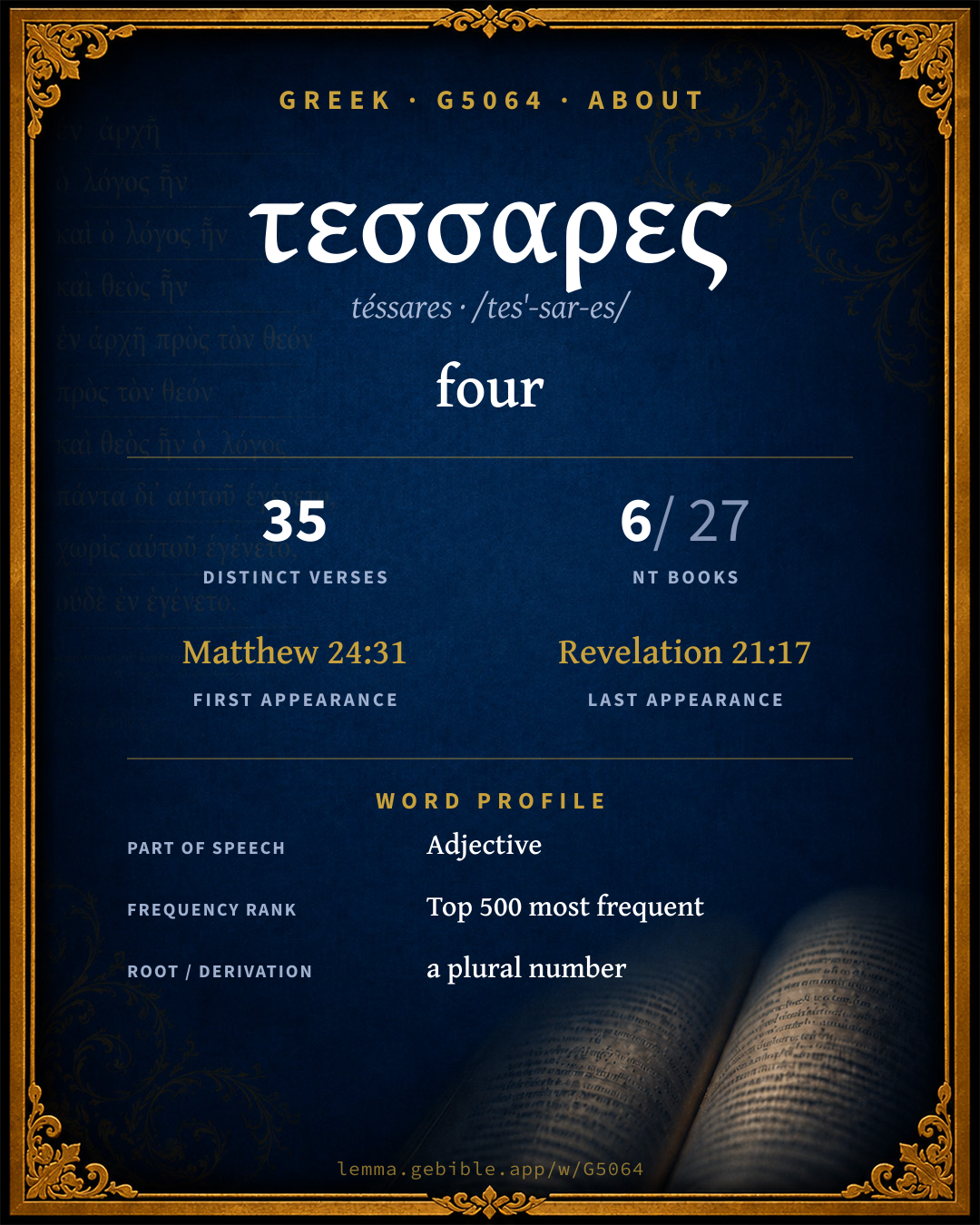
τεσσαρες
four
Full lexicon entry — Thayer's Greek Lexicon
From Thayer's Greek Lexicon
Where this word appears
See every Nominative-case word in the Greek New Testament →
Grammar key — what these labels mean
Part of speech
- Adjective
- A word that describes or qualifies a noun.
Case
- Genitive
- The case of source, possession, or “of” — answers “whose / from what.”
- Nominative
- The case of the subject (and the predicate nominative).
- Accusative
- The case of the direct object and of extent.
- Dative
- The case of the indirect object, means, or location — “to / for / with / in.”
Gender
- Neuter
- Grammatically neuter.
- Masculine
- Grammatically masculine.
- Feminine
- Grammatically feminine.
Number
- Plural
- More than one.
Grammatical forms 11 distinct
- Adjective, Genitive, Plural, Neuter 8 times (20%)
- Adjective, Nominative, Plural, Masculine 6 times (15%)
- Adjective, Accusative, Plural, Masculine 5 times (12%)
- Adjective, Nominative, Plural, Neuter 5 times (12%)
- Adjective, Genitive, Plural, Masculine 4 times (10%)
- Adjective, Nominative, Plural, Feminine 4 times (10%)
- Adjective, Accusative, Plural, Feminine 3 times (7%)
- Adjective, Dative, Plural, Feminine 3 times (7%)
+3 more forms (3 occurrences)
Parsed forms decoded from the imported morphology (Robinson–Tischendorf, public domain), counted across 41 parsed occurrences — not distinct verses.
Every verse where G5064 appears — 35 distinct verses across 6 books. Click any verse to open its interlinear word-by-word view. Verse text shown in the World English Bible for context — . Each verse’s Greek form is shown with its reference; the English is not keyword-highlighted, since the data carries no word-level English alignment. Use “Compare translations” on any verse to read it across multiple English versions. This concordance covers the Greek New Testament; Septuagint (Greek Old Testament) occurrences of this word are not indexed here.
Matthew 1 verse
Mark 2 verses
Luke 1 verse
John 2 verses
- John 11:17 τέσσαρας adj acc pl fem So when Jesus came, he found that he had been in the tomb four days already.
- John 19:23 τέσσαρα adj acc pl neut Then the soldiers, when they had crucified Jesus, took his garments and made four parts, to every soldier a part; and also the coat. Now the coat was without seam, woven from the top throughout.
Acts 6 verses
- Acts 10:11 τέσσαρσιν adj dat pl fem He saw heaven opened and a certain container descending to him, like a great sheet let down by four corners on the earth,
- Acts 11:5 τέσσαρσιν adj dat pl fem "I was in the city of Joppa praying, and in a trance I saw a vision: a certain container descending, like it was a great sheet let down from heaven by four corners. It came as far as me.
- Acts 12:4 τέσσαρσιν adj dat pl neut When he had arrested him, he put him in prison, and delivered him to four squads of four soldiers each to guard him, intending to bring him out to the people after the Passover.
- Acts 21:9 τέσσαρες adj nom pl fem Now this man had four virgin daughters who prophesied.
- Acts 21:23 τέσσαρες adj nom pl masc Therefore do what we tell you. We have four men who have taken a vow.
- Acts 27:29 τέσσαρας adj acc pl fem Fearing that we would run aground on rocky ground, they let go four anchors from the stern, and wished for daylight.
Revelation 23 verses
- Revelation 4:4 τέσσαρας τέσσαρας adj acc pl masc adj acc pl masc Around the throne were twenty-four thrones. On the thrones were twenty-four elders sitting, dressed in white garments, with crowns of gold on their heads.
- Revelation 4:6 τέσσερα adj nom pl neut Before the throne was something like a sea of glass, similar to crystal. In the midst of the throne, and around the throne were four living creatures full of eyes before and behind.
- Revelation 4:8 τέσσερα adj nom pl neut The four living creatures, each one of them having six wings, are full of eyes around about and within. They have no rest day and night, saying, "Holy, holy, holy, holy, holy, holy, holy, holy, holy is the Lord God, the Almighty, who was and who is and who is to come!"
- Revelation 4:10 τέσσαρες adj nom pl masc the twenty-four elders fall down before him who sits on the throne, and worship him who lives forever and ever, and throw their crowns before the throne, saying,
- Revelation 5:6 τεσσάρων adj gen pl neut I saw in the midst of the throne and of the four living creatures, and in the midst of the elders, a Lamb standing, as though it had been slain, having seven horns, and seven eyes, which are the seven Spirits of God, sent out into all the earth.
- Revelation 5:8 τέσσερα τέσσαρες adj nom pl neut adj nom pl masc Now when he had taken the book, the four living creatures and the twenty-four elders fell down before the Lamb, each one having a harp, and golden bowls full of incense, which are the prayers of the saints.
- Revelation 5:14 τέσσερα adj nom pl neut The four living creatures said, "Amen!" The elders fell down and worshiped.
- Revelation 6:1 τεσσάρων adj gen pl neut I saw that the Lamb opened one of the seven seals, and I heard one of the four living creatures saying, as with a voice of thunder, "Come and see!"
- Revelation 6:6 τεσσάρων adj gen pl neut I heard a voice in the midst of the four living creatures saying, "A choenix of wheat for a denarius, and three choenix of barley for a denarius! Don't damage the oil and the wine!"
- Revelation 7:1 τέσσαρας τέσσαρας τέσσαρας adj acc pl masc adj acc pl fem adj acc pl masc After this, I saw four angels standing at the four corners of the earth, holding the four winds of the earth, so that no wind would blow on the earth, or on the sea, or on any tree.
- Revelation 7:2 τέσσαρσιν adj dat pl masc I saw another angel ascend from the sunrise, having the seal of the living God. He cried with a loud voice to the four angels to whom it was given to harm the earth and the sea,
- Revelation 7:4 τέσσαρες adj nom pl fem I heard the number of those who were sealed, one hundred forty-four thousand, sealed out of every tribe of the children of Israel:
- Revelation 7:11 τεσσάρων adj gen pl neut All the angels were standing around the throne, the elders, and the four living creatures; and they fell on their faces before his throne, and worshiped God,
- Revelation 9:13 τεσσάρων adj gen pl neut The sixth angel sounded. I heard a voice from the horns of the golden altar which is before God,
- Revelation 9:14 τέσσαρας adj acc pl masc saying to the sixth angel who had one trumpet, "Free the four angels who are bound at the great river Euphrates!"
- Revelation 9:15 τέσσαρες adj nom pl masc The four angels were freed who had been prepared for that hour and day and month and year, so that they might kill one third of mankind.
- Revelation 11:16 τέσσαρες adj nom pl masc The twenty-four elders, who sit on their thrones before God's throne, fell on their faces and worshiped God,
- Revelation 14:1 τέσσαρες adj nom pl fem I saw, and behold, the Lamb standing on Mount Zion, and with him a number, one hundred forty-four thousand, having his name, and the name of his Father, written on their foreheads.
- Revelation 14:3 τεσσάρων τέσσαρες adj gen pl neut adj nom pl fem They sing a new song before the throne, and before the four living creatures and the elders. No one could learn the song except the one hundred forty-four thousand, those who had been redeemed out of the earth.
- Revelation 15:7 τεσσάρων adj gen pl neut One of the four living creatures gave to the seven angels seven golden bowls full of the wrath of God, who lives forever and ever.
- Revelation 19:4 τέσσαρες τέσσερα adj nom pl masc adj nom pl neut The twenty-four elders and the four living creatures fell down and worshiped God who sits on the throne, saying, "Amen! Hallelujah!"
- Revelation 20:8 τέσσαρσιν adj dat pl fem and he will come out to deceive the nations which are in the four corners of the earth, Gog and Magog, to gather them together to the war; the number of whom is as the sand of the sea.
- Revelation 21:17 τεσσάρων adj gen pl masc Its wall is one hundred forty-four cubits, by the measure of a man, that is, of an angel.
About this entry
At a glance — auto-summarized from this page’s data, not written by a person. Every figure links to its source below. This summary describes the numbers; it doesn’t interpret them.
The Greek adjective τεσσαρες centers on the idea of “four.” The word gravitates to Revelation (66%), then Acts and Mark. It turns up in 35 verses across 6 books, a moderately common footprint. Its earliest occurrence is Matthew 24:31. It shares a root with τεσσαρακοντα, τεσσαρεσκαιδεκατος and τεταρταιος. Dig into 35-verse concordance and the renderings breakdown below.
Gloss history
Strong's 1890 vs modern scholarship
About this word
Strong's G5064 catalogs a Greek word from the Greek New Testament.
These counts are not copied from any lexicon or concordance. They are computed here, from the morphology-tagged Greek New Testament. What Lemma adds →
- 35
- distinct verses
- The word appears in 35 distinct verses.
- 6 / 27
- NT books
- The word appears in 6 of 27 New Testament books.
- #364
- by frequency
- Top 500 most frequent Greek words (rank 364 of 5,347 Greek words by occurrence).
View all 35 occurrences in the concordance →
Most concentrated in
- Revelation 23 verses 66%
- Acts 6 verses 17%
- Mark 2 verses 6%
By section of the New Testament
By traditional corpus
Conventional, traditional groupings — biblical authorship is debated, so this is a traditional corpus grouping, not an authorship claim. Some books belong to more than one corpus (Luke is in both the Gospels and the Lukan corpus, and so on), so these shares overlap and need not total 100%. Each figure is a share of the word’s 35 distinct verses.
- Johannine 25 verses · 71%
- Revelation 23 verses · 66%
- Lukan (Luke–Acts) 7 verses · 20%
- Gospels 6 verses · 17%
How translations render this word
Counts come from each version’s own published word-to-Strong’s tagging or interlinear alignment — an approximate guide to how each version renders this word, not a word-level alignment the data otherwise carries. Because each total is that version’s own tagged count, the per-version totals vary from one another and need not match the appearance or distinct-verse counts above. These counts may also differ from a printed concordance because Lemma counts each distinctly tagged rendering and does not collapse phrase taggings into a single head-word total. This is a fixed set of word-tagged versions (KJV, ASV, BSB, ULT) and does not change with the reading translation you choose elsewhere. Each version’s license is shown beside its name below (and on Sources).
- King James Version: Four 40×, Were four 2×
- American Standard Version: Four 37×
- Berean Standard Bible: Four 30×
- unfoldingWord Literal Text: Four 28×
King James Version Public Domain
Renders G5064 across 42 tagged occurrences — most commonly:
American Standard Version Public Domain
Renders G5064 across 40 tagged occurrences — most commonly:
Plus 3 renderings that appear only once — usually multi-word phrases or single function words the recovered tagging swept in, not distinct renderings.
Berean Standard Bible Public Domain
Renders G5064 across 30 tagged occurrences — most commonly:
Not rendered by a distinct English word in 11 further occurrences.
unfoldingWord Literal Text CC BY-SA 4.0
Renders G5064 across 29 tagged occurrences — most commonly:
Plus 1 rendering that appears only once — usually multi-word phrases or single function words the recovered tagging swept in, not distinct renderings. Not rendered by a distinct English word in 11 further occurrences.
Senses in Thayer's
The 1 sense Thayer's distinguishes for this word, in lexicon order (not ranked by frequency or importance). The full entry — with sub-senses — is in the Lexicon Entry tab.
- four
Word origin
Origin: a plural number
Neuter and a plural number; four : - four.
— Strong’s Exhaustive Concordance (1890), public domain.
Forms in the corpus
The 6 distinct written forms G5064 takes in the Greek New Testament, most frequent first — each parse links to that case’s occurrences in the concordance.
| Form | Parsing | Example | Uses |
|---|---|---|---|
| τεσσάρων tessárōn | Adjective, Genitive, Plural, Neuter | Luke 2:37 | 12 |
| τέσσαρες téssares | Adjective, Nominative, Plural, Masculine | Acts 21:23 | 10 |
| τέσσαρας téssaras | Adjective, Accusative, Plural, Masculine | Revelation 4:4 | 8 |
| τέσσαρσιν téssarsin | Adjective, Dative, Plural, Feminine | Acts 10:11 | 5 |
| τέσσερα téssera | Adjective, Nominative, Plural, Neuter | Revelation 4:6 | 5 |
| τέσσαρα téssara | Adjective, Accusative, Plural, Neuter | John 19:23 | 1 |
Same root — word family
Other Thayer's entries built from the same root as G5064, grouped by Strong’s listed origin. These share a root / origin per the lexicon — not necessarily a shared meaning. Each links to that word’s own entry.
Derived from this word
- τεσσαρακοντα tessarákonta G5062 forty
- τεσσαρεσκαιδεκατος tessareskaidékatos G5065 fourteenth
- τεταρταιος tetartaîos G5066 fourth day
- τεταρτος tétartos G5067 fourth
- τετραγωνος tetrágōnos G5068 square
- τετραδιον tetrádion G5069 quaternion
- τετρακισχιλιοι tetrakischílioi G5070 four thousand
- τετρακοσιοι tetrakósioi G5071 four hundred
- τετραμηνον tetrámēnon G5072 four months
- τετραπλοος tetraplóos G5073 fourfold
- τετραπους tetrápous G5074 four-footed animal
- τετραρχης tetrárchēs G5076 tetrarch
- τραπεζα trápeza G5132 table
Compare all same-root words → Showing 4 of 14 — not the complete family. They share a root, not necessarily a meaning.
Septuagint usage
The same Greek word τεσσαρες appears 209 times in the Greek Old Testament (Septuagint), across 182 verses in 23 books.
- 209
- LXX occurrences
- Tagged occurrences of this Greek word in the Septuagint.
- 182
- verses
- Distinct Septuagint verses containing this word.
- 23 / 39
- OT books
- The word appears in 23 of the 39 Old Testament books.
Sample Septuagint occurrences
- Genesis 2:10 τέσσαρες
- Exodus 21:37 τέσσαρες
- Leviticus 11:20 τέσσαρες
- Numbers 1:25 τέσσαρες
- Deuteronomy 3:11 τέσσαρες
- Joshua 15:36 τέσσαρες
- Judges 9:34 τέσσαρες
- 1 Samuel 4:2 τέσσαρες
- 2 Samuel 21:20 τέσσαρες
- 1 Kings 7:3 τέσσαρες
- 2 Kings 7:3 τέσσαρες
- 1 Chronicles 3:5 τέσσαρες
Septuagint occurrences (same lexeme)
Every verse where the same Strong’s number (G5064) appears in the Greek Septuagint — showing the first 50 of 182. Verse text shown in the World English Bible for context; the Greek form is the matched word — the English is not keyword-highlighted.
- Genesis 2:10 τέσσαρες A river went out of Eden to water the garden; and from there it was parted, and became four heads.
- Genesis 11:16 τέσσαρες Eber lived thirty-four years, and became the father of Peleg.
- Genesis 14:9 τέσσαρες against Chedorlaomer king of Elam, and Tidal king of Goiim, and Amraphel king of Shinar, and Arioch king of Ellasar; four kings against the five.
- Genesis 31:41 τέσσαρες These twenty years have I been in your house. I served you fourteen years for your two daughters, and six years for your flock, and you have changed my wages ten times.
- Genesis 47:24 τέσσαρες It will happen at the harvests, that you shall give a fifth to Pharaoh, and four parts will be your own, for seed of the field, for your food, for them of your households, and for food for your little ones."
- Exodus 21:37 τέσσαρες
- Exodus 25:12 τέσσαρες You shall cast four rings of gold for it, and put them in its four feet. Two rings shall be on the one side of it, and two rings on the other side of it.
- Exodus 25:26 τέσσαρες You shall make four rings of gold for it, and put the rings in the four corners that are on its four feet.
- Exodus 25:34 τέσσαρες and in the lampstand four cups made like almond blossoms, its buds and its flowers;
- Exodus 25:35 τέσσαρες and a bud under two branches of one piece with it, and a bud under two branches of one piece with it, and a bud under two branches of one piece with it, for the six branches going out of the lampstand.
- Exodus 26:2 τέσσαρες The length of each curtain shall be twenty-eight cubits, and the breadth of each curtain four cubits: all the curtains shall have one measure.
- Exodus 26:8 τέσσαρες The length of each curtain shall be thirty cubits, and the breadth of each curtain four cubits: the eleven curtains shall have one measure.
- Exodus 26:32 τέσσαρες You shall hang it on four pillars of acacia overlaid with gold; their hooks shall be of gold, on four sockets of silver.
- Exodus 27:2 τέσσαρες You shall make its horns on its four corners; its horns shall be of one piece with it; and you shall overlay it with brass.
- Exodus 27:4 τέσσαρες You shall make a grating for it of network of brass: and on the net you shall make four brazen rings in its four corners.
- Exodus 27:16 τέσσαρες For the gate of the court shall be a screen of twenty cubits, of blue, and purple, and scarlet, and fine twined linen, the work of the embroiderer; their pillars four, and their sockets four.
- Exodus 37:2 τέσσαρες He overlaid it with pure gold inside and outside, and made a molding of gold for it round about.
- Exodus 37:4 τέσσαρες He made poles of acacia wood, and overlaid them with gold.
- Exodus 37:17 τέσσαρες He made the lampstand of pure gold. He made the lampstand of beaten work. Its base, its shaft, its cups, its buds, and its flowers were of one piece with it.
- Exodus 38:3 τέσσαρες He made all the vessels of the altar, the pots, the shovels, the basins, the flesh-hooks, and the fire pans. He made all its vessels of brass.
- Exodus 38:10 τέσσαρες their pillars were twenty, and their sockets twenty, of brass; the hooks of the pillars and their fillets were of silver.
- Exodus 38:24 τέσσαρες All the gold that was used for the work in all the work of the sanctuary, even the gold of the offering, was twenty-nine talents, and seven hundred thirty shekels, after the shekel of the sanctuary.
- Leviticus 11:20 τέσσαρες "'All flying insects that walk on all fours are an abomination to you.
- Leviticus 11:21 τέσσαρες Yet you may eat these: of all winged creeping things that go on all fours, which have legs above their feet, with which to hop on the earth.
- Leviticus 11:23 τέσσαρες But all winged creeping things which have four feet, are an abomination to you.
- Leviticus 11:27 τέσσαρες Whatever goes on its paws, among all animals that go on all fours, they are unclean to you. Whoever touches their carcass shall be unclean until the evening.
- Leviticus 11:42 τέσσαρες Whatever goes on its belly, and whatever goes on all fours, or whatever has many feet, even all creeping things that creep on the earth, them you shall not eat; for they are an abomination.
- Numbers 1:25 τέσσαρες those who were numbered of them, of the tribe of Gad, were forty-five thousand six hundred fifty.
- Numbers 1:27 τέσσαρες those who were numbered of them, of the tribe of Judah, were sixty-four thousand six hundred.
- Numbers 2:4 τέσσαρες His division, and those who were numbered of them, were seventy-four thousand six hundred.
- Numbers 2:6 τέσσαρες His division, and those who were numbered of it, were fifty-four thousand four hundred.
- Numbers 7:7 τέσσαρες He gave two wagons and four oxen to the sons of Gershon, according to their service:
- Numbers 7:8 τέσσαρες and he gave four wagons and eight oxen to the sons of Merari, according to their service, under the direction of Ithamar the son of Aaron the priest.
- Numbers 7:88 τέσσαρες and all the oxen for the sacrifice of peace offerings twenty-four bulls, the rams sixty, the male goats sixty, the male lambs a year old sixty. This was the dedication of the altar, after it was anointed.
- Numbers 17:14 τέσσαρες
- Numbers 25:9 τέσσαρες Those who died by the plague were twenty-four thousand.
- Numbers 26:21 τέσσαρες The sons of Perez were: of Hezron, the family of the Hezronites; of Hamul, the family of the Hamulites.
- Numbers 26:47 τέσσαρες These are the families of the sons of Asher according to those who were numbered of them, fifty-three thousand and four hundred.
- Numbers 29:13 τέσσαρες and you shall offer a burnt offering, an offering made by fire, of a sweet savor to Yahweh; thirteen young bulls, two rams, fourteen he-lambs a year old; they shall be without blemish;
- Numbers 29:15 τέσσαρες and a tenth part for every lamb of the fourteen lambs;
- Numbers 29:17 τέσσαρες On the second day [you shall offer] twelve young bulls, two rams, fourteen he-lambs a year old without blemish;
- Numbers 29:20 τέσσαρες On the third day eleven bulls, two rams, fourteen he-lambs a year old without blemish;
- Numbers 29:23 τέσσαρες On the fourth day ten bulls, two rams, fourteen he-lambs a year old without blemish;
- Numbers 29:26 τέσσαρες On the fifth day nine bulls, two rams, fourteen he-lambs a year old without blemish;
- Numbers 29:29 τέσσαρες On the sixth day eight bulls, two rams, fourteen he-lambs a year old without blemish;
- Numbers 29:32 τέσσαρες On the seventh day seven bulls, two rams, fourteen he-lambs a year old without blemish;
- Deuteronomy 3:11 τέσσαρες (For only Og king of Bashan remained of the remnant of the Rephaim; behold, his bedstead was a bedstead of iron; isn't it in Rabbah of the children of Ammon? nine cubits was the length of it, and four cubits the breadth of it, after the cubit of a man.)
- Deuteronomy 22:12 τέσσαρες You shall make you fringes on the four borders of your cloak, with which you cover yourself.
- Joshua 15:36 τέσσαρες and Shaaraim, and Adithaim, and Gederah, and Gederothaim; fourteen cities with their villages.
- Joshua 19:7 τέσσαρες Ain, Rimmon, and Ether, and Ashan; four cities with their villages:
These are occurrences of the same Greek lexeme (G5064) in the Septuagint — not a translation of any one Hebrew word. The store carries no word-level Hebrew↔Greek alignment, so no Hebrew original is asserted here. Counts come from the recovered LXX Strong's tagging — high-frequency vocabulary is well covered, while rare or late forms may be untagged — so they reflect tagged occurrences and may slightly undercount.