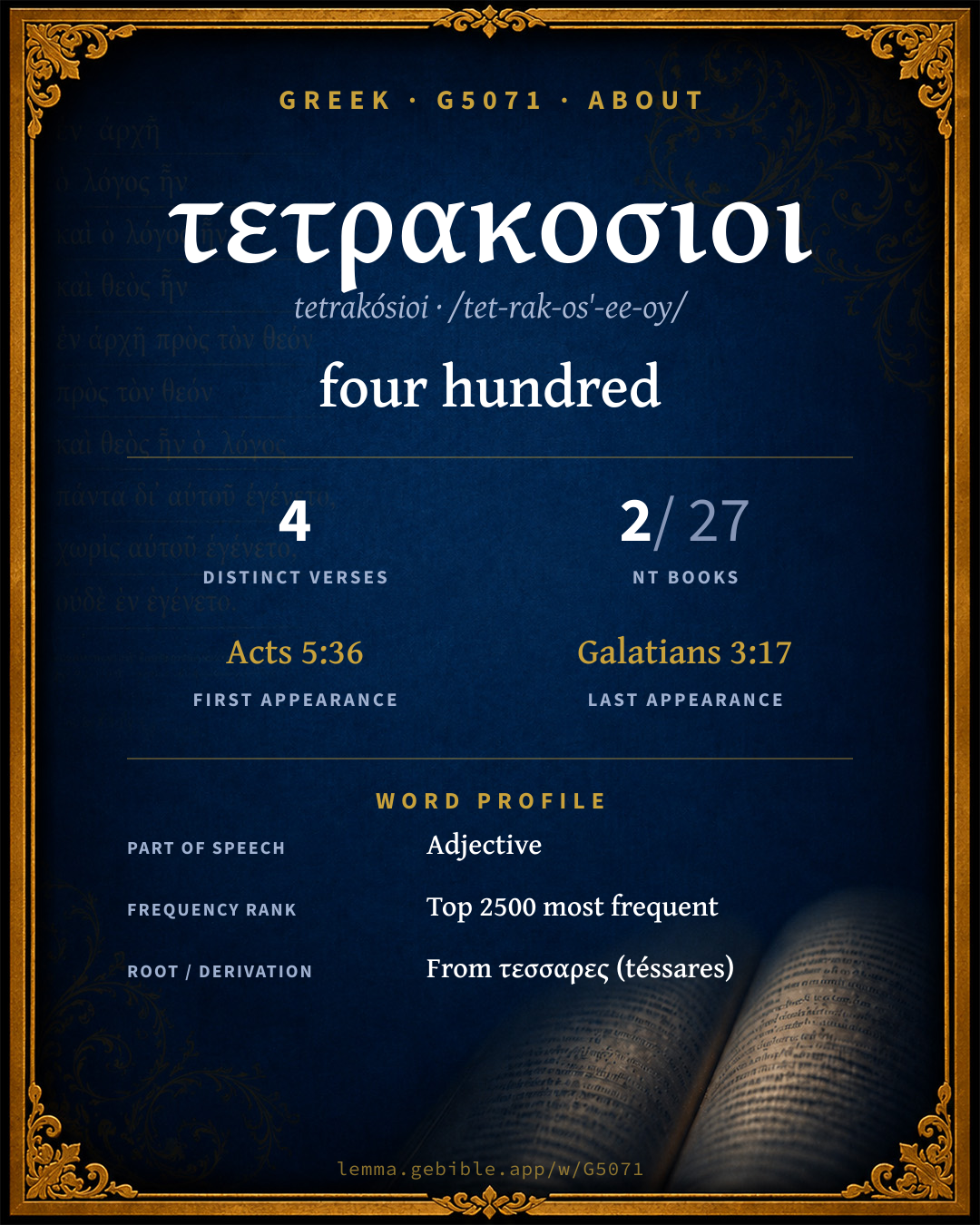
τετρακοσιοι
four hundred
Full lexicon entry — Thayer's Greek Lexicon
From Thayer's Greek Lexicon
Where this word appears
See every Accusative-case word in the Greek New Testament →
Grammar key — what these labels mean
Part of speech
- Adjective
- A word that describes or qualifies a noun.
Case
- Accusative
- The case of the direct object and of extent.
- Dative
- The case of the indirect object, means, or location — “to / for / with / in.”
- Genitive
- The case of source, possession, or “of” — answers “whose / from what.”
Gender
- Neuter
- Grammatically neuter.
- Masculine
- Grammatically masculine.
Number
- Plural
- More than one.
Grammatical forms
- Adjective, Accusative, Plural, Neuter 2 times (50%)
- Adjective, Dative, Plural, Neuter 1 time (25%)
- Adjective, Genitive, Plural, Masculine 1 time (25%)
Parsed forms decoded from the imported morphology (Robinson–Tischendorf, public domain), counted across 4 parsed occurrences — not distinct verses.
Every verse where G5071 appears — 4 distinct verses across 2 books. Click any verse to open its interlinear word-by-word view. Verse text shown in the World English Bible for context — . Each verse’s Greek form is shown with its reference; the English is not keyword-highlighted, since the data carries no word-level English alignment. Use “Compare translations” on any verse to read it across multiple English versions. This concordance covers the Greek New Testament; Septuagint (Greek Old Testament) occurrences of this word are not indexed here.
Acts 3 verses
- Acts 5:36 τετρακοσίων adj gen pl masc For before these days Theudas rose up, making himself out to be somebody; to whom a number of men, about four hundred, joined themselves: who was slain; and all, as many as obeyed him, were dispersed, and came to nothing.
- Acts 7:6 τετρακόσια adj acc pl neut God spoke in this way: that his seed would live as aliens in a strange land, and that they would be enslaved and mistreated for four hundred years.
- Acts 13:20 τετρακοσίοις adj dat pl neut After these things he gave them judges until Samuel the prophet.
Galatians 1 verse
About this entry
At a glance — auto-summarized from this page’s data, not written by a person. Every figure links to its source below. This summary describes the numbers; it doesn’t interpret them.
τετρακοσιοι (tetrakósioi) is a Greek adjective most often rendered “four hundred.” A scarce word — 4 verses in all of the Greek New Testament. It clusters heavily in Acts, which alone accounts for 75% of its uses. Debuting at Acts 5:36, it then recurs through the corpus. From the same root come τεσσαρες, τεσσαρακοντα and τεσσαρεσκαιδεκατος. For the data behind this summary, explore the sense tree and the renderings breakdown below.
Gloss history
Strong's 1890 vs modern scholarship
About this word
Strong's G5071 catalogs a Greek word from the Greek New Testament.
These counts are not copied from any lexicon or concordance. They are computed here, from the morphology-tagged Greek New Testament. What Lemma adds →
- 4
- distinct verses
- The word appears in 4 distinct verses.
- 2 / 27
- NT books
- The word appears in 2 of 27 New Testament books.
- #1,877
- by frequency
- Top 2500 most frequent Greek words (rank 1,877 of 5,347 Greek words by occurrence).
View all 4 occurrences in the concordance →
By traditional corpus
Conventional, traditional groupings — biblical authorship is debated, so this is a traditional corpus grouping, not an authorship claim. Some books belong to more than one corpus (Luke is in both the Gospels and the Lukan corpus, and so on), so these shares overlap and need not total 100%. Each figure is a share of the word’s 4 distinct verses.
- Lukan (Luke–Acts) 3 verses · 75%
- Pauline corpus 1 verse · 25%
How translations render this word
Counts come from each version’s own published word-to-Strong’s tagging or interlinear alignment — an approximate guide to how each version renders this word, not a word-level alignment the data otherwise carries. Because each total is that version’s own tagged count, the per-version totals vary from one another and need not match the appearance or distinct-verse counts above. These counts may also differ from a printed concordance because Lemma counts each distinctly tagged rendering and does not collapse phrase taggings into a single head-word total. This is a fixed set of word-tagged versions (KJV, ASV, BSB, ULT) and does not change with the reading translation you choose elsewhere. Each version’s license is shown beside its name below (and on Sources).
- King James Version: Four hundred 3×
- American Standard Version: Four hundred 3×
- Berean Standard Bible: Four hundred 2×
- unfoldingWord Literal Text: not separately translated
King James Version Public Domain
Renders G5071 across 4 tagged occurrences — most commonly:
Plus 1 rendering that appears only once — usually multi-word phrases or single function words the recovered tagging swept in, not distinct renderings.
American Standard Version Public Domain
Renders G5071 across 4 tagged occurrences — most commonly:
Plus 1 rendering that appears only once — usually multi-word phrases or single function words the recovered tagging swept in, not distinct renderings.
Berean Standard Bible Public Domain
Renders G5071 across 2 tagged occurrences — most commonly:
Not rendered by a distinct English word in 2 further occurrences.
unfoldingWord Literal Text CC BY-SA 4.0
Does not render G5071 with a distinct English word (not separately translated in its 4 tagged occurrences).
Senses in Thayer's
The 1 sense Thayer's distinguishes for this word, in lexicon order (not ranked by frequency or importance). The full entry — with sub-senses — is in the Lexicon Entry tab.
- four hundred
Word origin
Derived from τεσσαρες (téssares) (G5064) — four.
Forms in the corpus
The 3 distinct written forms G5071 takes in the Greek New Testament, most frequent first — each parse links to that case’s occurrences in the concordance.
| Form | Parsing | Example | Uses |
|---|---|---|---|
| τετρακόσια tetrakósia | Adjective, Accusative, Plural, Neuter | Acts 7:6 | 2 |
| τετρακοσίοις tetrakosíois | Adjective, Dative, Plural, Neuter | Acts 13:20 | 1 |
| τετρακοσίων tetrakosíōn | Adjective, Genitive, Plural, Masculine | Acts 5:36 | 1 |
Same root — word family
Other Thayer's entries built from the same root as G5071, grouped by Strong’s listed origin. These share a root / origin per the lexicon — not necessarily a shared meaning. Each links to that word’s own entry.
Derives from
Shares the same root
- τεσσαρακοντα tessarákonta G5062 forty
- τεσσαρεσκαιδεκατος tessareskaidékatos G5065 fourteenth
- τεταρταιος tetartaîos G5066 fourth day
- τεταρτος tétartos G5067 fourth
- τετραγωνος tetrágōnos G5068 square
- τετραδιον tetrádion G5069 quaternion
- τετρακισχιλιοι tetrakischílioi G5070 four thousand
- τετραμηνον tetrámēnon G5072 four months
- τετραπλοος tetraplóos G5073 fourfold
- τετραπους tetrápous G5074 four-footed animal
- τετραρχης tetrárchēs G5076 tetrarch
- τραπεζα trápeza G5132 table
Compare all same-root words → Showing 4 of 14 — not the complete family. They share a root, not necessarily a meaning.
Septuagint usage
The same Greek word τετρακοσιοι appears 54 times in the Greek Old Testament (Septuagint), across 52 verses in 10 books.
- 54
- LXX occurrences
- Tagged occurrences of this Greek word in the Septuagint.
- 52
- verses
- Distinct Septuagint verses containing this word.
- 10 / 39
- OT books
- The word appears in 10 of the 39 Old Testament books.
Sample Septuagint occurrences
- Genesis 11:13 τετρακόσιοι
- Exodus 12:40 τετρακόσιοι
- Numbers 1:27 τετρακόσιοι
- Judges 20:2 τετρακόσιοι
- 1 Samuel 15:4 τετρακόσιοι
- 1 Kings 7:28 τετρακόσιοι
- 2 Kings 14:13 τετρακόσιοι
- 1 Chronicles 21:5 τετρακόσιοι
- 2 Chronicles 1:14 τετρακόσιοι
- Ezra 1:11 τετρακόσιοι
Septuagint occurrences (same lexeme)
Every verse where the same Strong’s number (G5071) appears in the Greek Septuagint — showing the first 50 of 52. Verse text shown in the World English Bible for context; the Greek form is the matched word — the English is not keyword-highlighted.
- Genesis 11:13 τετρακόσιοι Arpachshad lived after he became the father of Shelah four hundred three years, and became the father of sons and daughters.
- Genesis 15:13 τετρακόσιοι He said to Abram, "Know for sure that your seed will live as foreigners in a land that is not theirs, and will serve them. They will afflict them four hundred years.
- Genesis 23:15 τετρακόσιοι "My lord, listen to me. What is a piece of land worth four hundred shekels of silver between me and you? Therefore bury your dead."
- Genesis 23:16 τετρακόσιοι Abraham listened to Ephron. Abraham weighed to Ephron the silver which he had named in the audience of the children of Heth, four hundred shekels of silver, according to the current merchants' standard.
- Genesis 32:7 τετρακόσιοι Then Jacob was greatly afraid and was distressed: and he divided the people who were with him, and the flocks, and the herds, and the camels, into two companies;
- Genesis 33:1 τετρακόσιοι Jacob lifted up his eyes, and looked, and, behold, Esau was coming, and with him four hundred men. He divided the children between Leah, Rachel, and to the two handmaids.
- Exodus 12:40 τετρακόσιοι Now the time that the children of Israel lived in Egypt was four hundred thirty years.
- Exodus 12:41 τετρακόσιοι It happened at the end of four hundred thirty years, even the same day it happened, that all the hosts of Yahweh went out from the land of Egypt.
- Numbers 1:27 τετρακόσιοι those who were numbered of them, of the tribe of Judah, were sixty-four thousand six hundred.
- Numbers 1:29 τετρακόσιοι those who were numbered of them, of the tribe of Issachar, were fifty-four thousand four hundred.
- Numbers 1:35 τετρακόσιοι those who were numbered of them, of the tribe of Manasseh, were thirty-two thousand two hundred.
- Numbers 1:43 τετρακόσιοι those who were numbered of them, of the tribe of Naphtali, were fifty-three thousand four hundred.
- Numbers 2:6 τετρακόσιοι His division, and those who were numbered of it, were fifty-four thousand four hundred.
- Numbers 2:8 τετρακόσιοι His division, and those who were numbered of it, were fifty-seven thousand four hundred.
- Numbers 2:9 τετρακόσιοι All who were numbered of the camp of Judah were one hundred eighty-six thousand four hundred, according to their divisions. They shall set out first.
- Numbers 2:16 τετρακόσιοι "All who were numbered of the camp of Reuben were one hundred fifty-one thousand four hundred fifty, according to their hosts. They shall set out second.
- Numbers 2:23 τετρακόσιοι His host, and those who were numbered of them, were thirty-five thousand four hundred.
- Numbers 2:30 τετρακόσιοι His division, and those who were numbered of them, were fifty-three thousand four hundred.
- Numbers 7:85 τετρακόσιοι each silver platter weighing one hundred thirty shekels, and each bowl seventy; all the silver of the vessels two thousand four hundred shekels, after the shekel of the sanctuary;
- Numbers 26:31 τετρακόσιοι and [of] Asriel, the family of the Asrielites; and [of] Shechem, the family of the Shechemites;
- Numbers 26:47 τετρακόσιοι These are the families of the sons of Asher according to those who were numbered of them, fifty-three thousand and four hundred.
- Numbers 26:50 τετρακόσιοι These are the families of Naphtali according to their families; and those who were numbered of them were forty-five thousand four hundred.
- Judges 20:2 τετρακόσιοι The chiefs of all the people, even of all the tribes of Israel, presented themselves in the assembly of the people of God, four hundred thousand footmen who drew sword.
- Judges 20:17 τετρακόσιοι The men of Israel, besides Benjamin, were numbered four hundred thousand men who drew sword: all these were men of war.
- Judges 21:12 τετρακόσιοι They found among the inhabitants of Jabesh Gilead four hundred young virgins, who had not known man by lying with him; and they brought them to the camp to Shiloh, which is in the land of Canaan.
- 1 Samuel 15:4 τετρακόσιοι Saul summoned the people, and numbered them in Telaim, two hundred thousand footmen, and ten thousand men of Judah.
- 1 Samuel 22:2 τετρακόσιοι Everyone who was in distress, and everyone who was in debt, and everyone who was discontented, gathered themselves to him; and he became captain over them: and there were with him about four hundred men.
- 1 Samuel 23:13 τετρακόσιοι Then David and his men, who were about six hundred, arose and departed out of Keilah, and went wherever they could go. It was told Saul that David was escaped from Keilah; and he gave up going there.
- 1 Samuel 25:13 τετρακόσιοι David said to his men, Gird you on every man his sword. They girded on every man his sword; and David also girded on his sword: and there went up after David about four hundred men; and two hundred abode by the baggage.
- 1 Samuel 27:2 τετρακόσιοι David arose, and passed over, he and the six hundred men who were with him, to Achish the son of Maoch, king of Gath.
- 1 Samuel 30:10 τετρακόσιοι But David pursued, he and four hundred men; for two hundred stayed behind, who were so faint that they couldn't go over the brook Besor.
- 1 Samuel 30:17 τετρακόσιοι David struck them from the twilight even to the evening of the next day: and there not a man of them escaped, except four hundred young men, who rode on camels and fled.
- 1 Kings 7:28 τετρακόσιοι The work of the bases was on this manner: they had panels; and there were panels between the ledges;
- 1 Kings 18:19 τετρακόσιοι Now therefore send, and gather to me all Israel to Mount Carmel, and the prophets of Baal four hundred fifty, and the prophets of the Asherah four hundred, who eat at Jezebel's table.
- 1 Kings 18:22 τετρακόσιοι Then Elijah said to the people, "I, even I only, am left a prophet of Yahweh; but Baal's prophets are four hundred fifty men.
- 1 Kings 22:6 τετρακόσιοι Then the king of Israel gathered the prophets together, about four hundred men, and said to them, Shall I go against Ramoth-gilead to battle, or shall I forbear? They said, Go up; for the Lord will deliver it into the hand of the king.
- 2 Kings 14:13 τετρακόσιοι Jehoash king of Israel took Amaziah king of Judah, the son of Jehoash the son of Ahaziah, at Beth-shemesh, and came to Jerusalem, and broke down the wall of Jerusalem from the gate of Ephraim to the corner gate, four hundred cubits.
- 2 Kings 15:25 τετρακόσιοι Pekah the son of Remaliah, his captain, conspired against him, and struck him in Samaria, in the castle of the king's house, with Argob and Arieh; and with him were fifty men of the Gileadites: and he killed him, and reigned in his place.
- 1 Chronicles 21:5 τετρακόσιοι Joab gave up the sum of the numbering of the people to David. All those of Israel were one million one hundred thousand men who drew sword: and in Judah were four hundred seventy thousand men who drew sword.
- 2 Chronicles 1:14 τετρακόσιοι Solomon gathered chariots and horsemen: and he had one thousand four hundred chariots, and twelve thousand horsemen, that he placed in the chariot cities, and with the king at Jerusalem.
- 2 Chronicles 4:13 τετρακόσιοι and the four hundred pomegranates for the two networks; two rows of pomegranates for each network, to cover the two bowls of the capitals that were on the pillars.
- 2 Chronicles 8:18 τετρακόσιοι Huram sent him by the hands of his servants ships, and servants who had knowledge of the sea; and they came with the servants of Solomon to Ophir, and fetched from there four hundred fifty talents of gold, and brought them to king Solomon.
- 2 Chronicles 13:3 τετρακόσιοι Abijah joined battle with an army of valiant men of war, even four hundred thousand chosen men: and Jeroboam set the battle in array against him with eight hundred thousand chosen men, who were mighty men of valor.
- 2 Chronicles 18:5 τετρακόσιοι Then the king of Israel gathered the prophets together, four hundred men, and said to them, Shall we go to Ramoth-gilead to battle, or shall I forbear? They said, Go up; for God will deliver it into the hand of the king.
- 2 Chronicles 25:23 τετρακόσιοι Joash king of Israel took Amaziah king of Judah, the son of Joash the son of Jehoahaz, at Beth-shemesh, and brought him to Jerusalem, and broke down the wall of Jerusalem from the gate of Ephraim to the corner gate, four hundred cubits.
- Ezra 1:11 τετρακόσιοι All the vessels of gold and of silver were five thousand and four hundred. All these did Sheshbazzar bring up, when they of the captivity were brought up from Babylon to Jerusalem.
- Ezra 2:15 τετρακόσιοι The children of Adin, four hundred fifty-four.
- Ezra 2:28 τετρακόσιοι The men of Bethel and Ai, two hundred twenty-three.
- Ezra 2:67 τετρακόσιοι their camels, four hundred thirty-five; [their] donkeys, six thousand seven hundred and twenty.
- Ezra 6:17 τετρακόσιοι They offered at the dedication of this house of God one hundred bulls, two hundred rams, four hundred lambs; and for a sin-offering for all Israel, twelve male goats, according to the number of the tribes of Israel.
These are occurrences of the same Greek lexeme (G5071) in the Septuagint — not a translation of any one Hebrew word. The store carries no word-level Hebrew↔Greek alignment, so no Hebrew original is asserted here. Counts come from the recovered LXX Strong's tagging — high-frequency vocabulary is well covered, while rare or late forms may be untagged — so they reflect tagged occurrences and may slightly undercount.