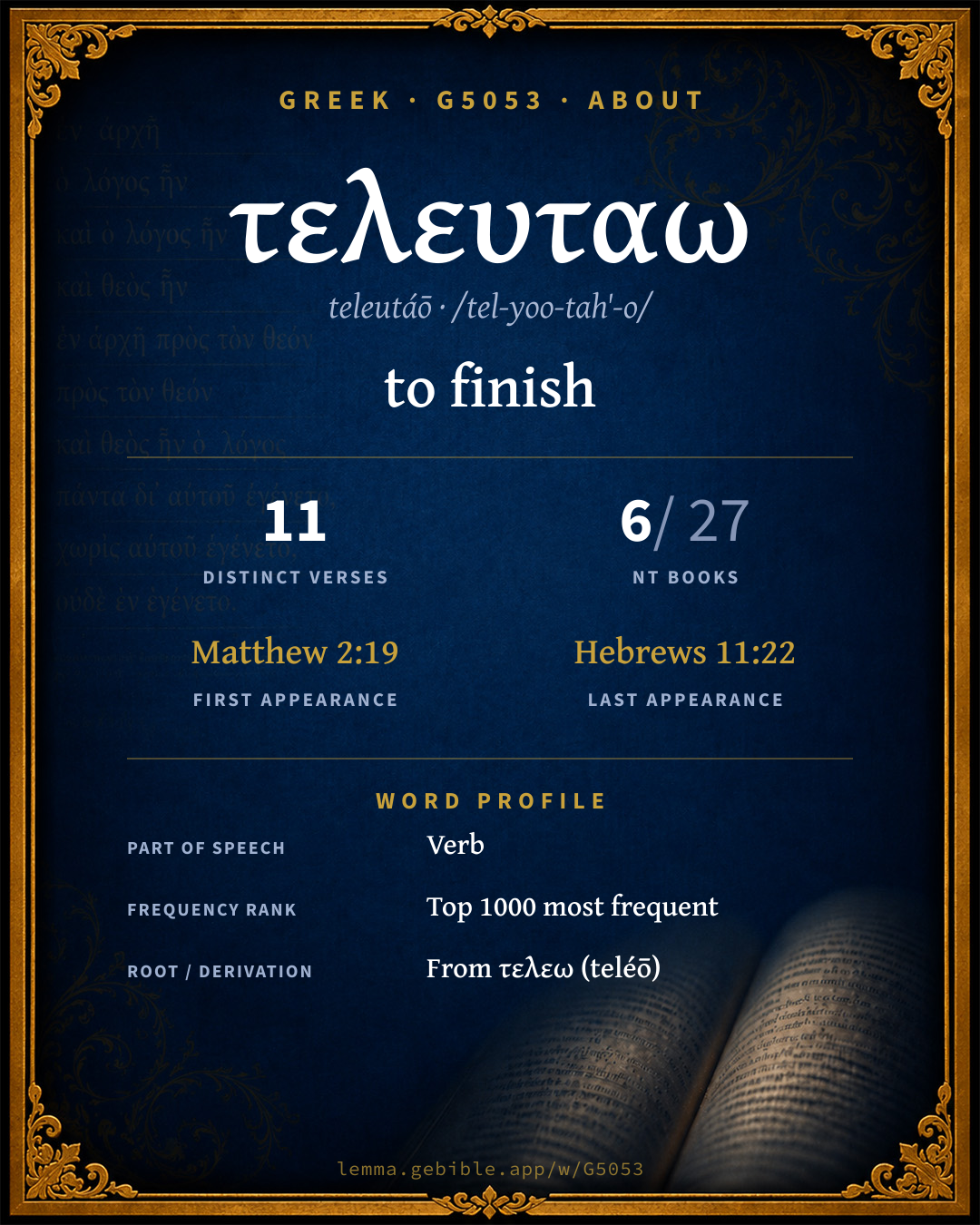
τελευτάω
to finish
‘to finish’ is one of 2 main senses fuller range ↓
Full lexicon entry — Thayer's Greek Lexicon
From Thayer's Greek Lexicon
Where this word appears
See every Aorist-tense verb in the Greek New Testament →
Grammar key — what these labels mean
Part of speech
- Verb
- An action or state-of-being word.
Tense
- Aorist
- Action viewed as a simple whole, without regard to duration — often past (perfective aspect).
- Present
- Ongoing or general action in present time (imperfective aspect).
- Perfect
- A completed past action with continuing present results.
Voice
- Active
- The subject performs the action.
Mood
- Indicative
- States a fact or asks a factual question (the mood of reality).
- Imperative
- Expresses a command or request.
- Participle
- A verbal adjective (“writing,” “having written”).
- Infinitive
- A verbal noun (“to write”), unmarked for person or number.
Case
- Genitive
- The case of source, possession, or “of” — answers “whose / from what.”
- Nominative
- The case of the subject (and the predicate nominative).
Person
- 3rd person
- The one spoken about (“he / she / it / they”).
Gender
- Masculine
- Grammatically masculine.
Number
- Singular
- One.
Every verse where G5053 appears in the Book of Matthew — 4 distinct verses. Click any verse to open its interlinear word-by-word view. Verse text shown in the World English Bible for context — . Each verse’s Greek form is shown with its reference; the English is not keyword-highlighted, since the data carries no word-level English alignment. Use “Compare translations” on any verse to read it across multiple English versions. This concordance covers the Greek New Testament; Septuagint (Greek Old Testament) occurrences of this word are not indexed here.
Matthew
- Matthew 2:19 Τελευτήσαντος aor act ptcp gen sg masc But when Herod was dead, behold, an angel of the Lord appeared in a dream to Joseph in Egypt, saying,
- Matthew 9:18 ἐτελεύτησεν aor act ind 3sg While he told these things to them, behold, a ruler came and worshiped him, saying, "My daughter has just died, but come and lay your hand on her, and she will live."
- Matthew 15:4 τελευτάτω pres act impv 3sg For God commanded, 'Honor your father and your mother,' and, 'He who speaks evil of father or mother, let him be put to death.'
- Matthew 22:25 ἐτελεύτησεν aor act ind 3sg Now there were with us seven brothers. The first married and died, and having no seed left his wife to his brother.
About this entry
At a glance — auto-summarized from this page’s data, not written by a person. Every figure links to its source below. This summary describes the numbers; it doesn’t interpret them.
The Greek verb τελευταω centers on the idea of “to finish.” Its earliest occurrence is Matthew 2:19. The Greek New Testament uses it across 11 verses — uncommon. Matthew dominates its distribution — 4 of 11 verses. Thayer's distinguishes 2 senses for it. For the data behind this summary, explore the sense tree and the renderings breakdown below.
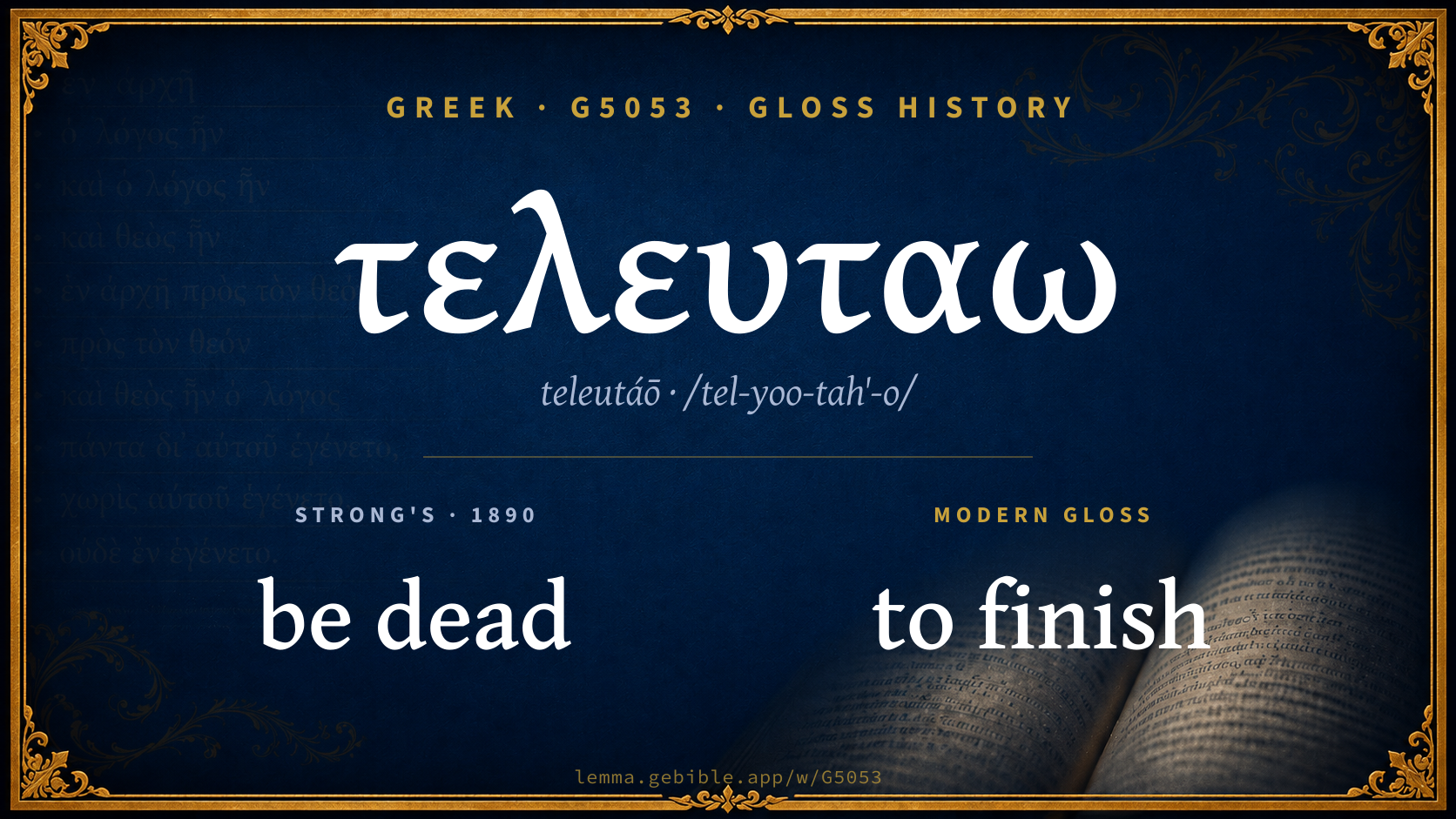
Gloss history
Strong's 1890 vs modern scholarship
About this word
Strong's G5053 catalogs a Greek word from the Greek New Testament.
These counts are not copied from any lexicon or concordance. They are computed here, from the morphology-tagged Greek New Testament. What Lemma adds →
- 11
- distinct verses
- The word appears in 11 distinct verses.
- 6 / 27
- NT books
- The word appears in 6 of 27 New Testament books.
- #978
- by frequency
- Top 1000 most frequent Greek words (rank 978 of 5,347 Greek words by occurrence).
View all 11 occurrences in the concordance →
By section of the New Testament
By traditional corpus
Conventional, traditional groupings — biblical authorship is debated, so this is a traditional corpus grouping, not an authorship claim. Some books belong to more than one corpus (Luke is in both the Gospels and the Lukan corpus, and so on), so these shares overlap and need not total 100%. Each figure is a share of the word’s 11 distinct verses.
- Gospels 8 verses · 73%
- Lukan (Luke–Acts) 3 verses · 27%
- Johannine 1 verse · 9%
- Hebrews 1 verse · 9%
How translations render this word
Counts come from each version’s own published word-to-Strong’s tagging or interlinear alignment — an approximate guide to how each version renders this word, not a word-level alignment the data otherwise carries. Because each total is that version’s own tagged count, the per-version totals vary from one another and need not match the appearance or distinct-verse counts above. These counts may also differ from a printed concordance because Lemma counts each distinctly tagged rendering and does not collapse phrase taggings into a single head-word total. This is a fixed set of word-tagged versions (KJV, ASV, BSB, ULT) and does not change with the reading translation you choose elsewhere. Each version’s license is shown beside its name below (and on Sources).
- King James Version: Dieth 3×, Dead 2×, Let him die 2×
- American Standard Version: Died 2×, Is 2×, Let him die 2×
- Berean Standard Bible: Died 4×, Must be put to death 2×
- unfoldingWord Literal Text: Died 4×, Does 3×, End 3×
King James Version Public Domain
Renders G5053 across 13 tagged occurrences — most commonly:
Plus 6 renderings that appear only once — usually multi-word phrases or single function words the recovered tagging swept in, not distinct renderings.
American Standard Version Public Domain
Renders G5053 across 13 tagged occurrences — most commonly:
Plus 7 renderings that appear only once — usually multi-word phrases or single function words the recovered tagging swept in, not distinct renderings.
Berean Standard Bible Public Domain
Renders G5053 across 11 tagged occurrences — most commonly:
Plus 5 renderings that appear only once — usually multi-word phrases or single function words the recovered tagging swept in, not distinct renderings.
unfoldingWord Literal Text CC BY-SA 4.0
Renders G5053 across 18 tagged occurrences — most commonly:
Plus 6 renderings that appear only once — usually multi-word phrases or single function words the recovered tagging swept in, not distinct renderings.
Senses in Thayer's
The 2 senses Thayer's distinguishes for this word, in lexicon order (not ranked by frequency or importance). The full entry — with sub-senses — is in the Lexicon Entry tab.
- to finish, bring to and end, close
- to have an end or close, come to an end
Word origin
Derived from τελεω (teléō) (G5055) — to finish.
Forms in the corpus
The 7 distinct written forms G5053 takes in the Greek New Testament, most frequent first — each parse links to that tense’s occurrences in the concordance.
| Form | Parsing | Example | Uses |
|---|---|---|---|
| ἐτελεύτησεν eteleútēsen | Verb, Aorist, Active, Indicative, 3rd person, Singular | Matthew 9:18 | 4 |
| τελευτάτω teleutátō | Verb, Present, Active, Imperative, 3rd person, Singular | Matthew 15:4 | 2 |
| Τελευτήσαντος Teleutḗsantos | Verb, Aorist, Active, Participle, Genitive, Singular, Masculine | Matthew 2:19 | 1 |
| τελευτᾶν teleutân | Verb, Present, Active, Infinitive | Luke 7:2 | 1 |
| τελευτᾷ teleutâ | Verb, Present, Active, Indicative, 3rd person, Singular | Mark 9:48 | 1 |
| τελευτῶν teleutō̂n | Verb, Present, Active, Participle, Nominative, Singular, Masculine | Hebrews 11:22 | 1 |
| τετελευτηκότος teteleutēkótos | Verb, Perfect, Active, Participle, Genitive, Singular, Masculine | John 11:39 | 1 |
Same root — word family
Other Thayer's entries built from the same root as G5053, grouped by Strong’s listed origin. These share a root / origin per the lexicon — not necessarily a shared meaning. Each links to that word’s own entry.
Derives from
Derived from this word
Compare all same-root words → They share a root, not necessarily a meaning.
Septuagint usage
The same Greek word τελευταω appears 71 times in the Greek Old Testament (Septuagint), across 68 verses in 15 books.
- 71
- LXX occurrences
- Tagged occurrences of this Greek word in the Septuagint.
- 68
- verses
- Distinct Septuagint verses containing this word.
- 15 / 39
- OT books
- The word appears in 15 of the 39 Old Testament books.
Sample Septuagint occurrences
- Genesis 6:17 τελευτάω
- Exodus 1:6 τελευτάω
- Leviticus 16:1 τελευτάω
- Numbers 3:4 τελευτάω
- Deuteronomy 17:5 τελευτάω
- Joshua 1:2 τελευτάω
- Judges 2:8 τελευτάω
- 1 Chronicles 29:28 τελευτάω
- 2 Chronicles 13:20 τελευτάω
- Job 1:19 τελευτάω
- Proverbs 5:23 τελευτάω
- Isaiah 66:24 τελευτάω
Septuagint occurrences (same lexeme)
Every verse where the same Strong’s number (G5053) appears in the Greek Septuagint — showing the first 50 of 68. Verse text shown in the World English Bible for context; the Greek form is the matched word — the English is not keyword-highlighted.
- Genesis 6:17 τελευτάω I, even, I do bring the flood of waters on this earth, to destroy all flesh having the breath of life from under the sky. Everything that is in the earth will die.
- Genesis 25:32 τελευτάω Esau said, "Behold, I am about to die. What good is the birthright to me?"
- Genesis 30:1 τελευτάω When Rachel saw that she bore Jacob no children, Rachel envied her sister. She said to Jacob, "Give me children, or else I will die."
- Genesis 44:31 τελευτάω it will happen, when he sees that the boy is no more, that he will die. Your servants will bring down the gray hairs of your servant, our father, with sorrow to Sheol.
- Genesis 50:16 τελευτάω They sent a message to Joseph, saying, "Your father commanded before he died, saying,
- Genesis 50:26 τελευτάω So Joseph died, being one hundred ten years old, and they embalmed him, and he was put in a coffin in Egypt.
- Exodus 1:6 τελευτάω Joseph died, as did all his brothers, and all that generation.
- Exodus 2:23 τελευτάω It happened in the course of those many days, that the king of Egypt died, and the children of Israel sighed because of the bondage, and they cried, and their cry came up to God because of the bondage.
- Exodus 4:19 τελευτάω Yahweh said to Moses in Midian, "Go, return into Egypt; for all the men who sought your life are dead."
- Exodus 7:18 τελευτάω The fish that are in the river shall die, and the river shall become foul; and the Egyptians shall loathe to drink water from the river."'"
- Exodus 7:21 τελευτάω The fish that were in the river died; and the river became foul, and the Egyptians couldn't drink water from the river; and the blood was throughout all the land of Egypt.
- Exodus 8:9 τελευτάω Moses said to Pharaoh, "I give you the honor of setting the time that I should pray for you, and for your servants, and for your people, that the frogs be destroyed from you and your houses, and remain in the river only."
- Exodus 9:4 τελευτάω Yahweh will make a distinction between the cattle of Israel and the cattle of Egypt; and there shall nothing die of all that belongs to the children of Israel."'"
- Exodus 9:6 τελευτάω Yahweh did that thing on the next day; and all the cattle of Egypt died, but of the cattle of the children of Israel, not one died.
- Exodus 9:7 τελευτάω Pharaoh sent, and, behold, there was not so much as one of the cattle of the Israelites dead. But the heart of Pharaoh was stubborn, and he didn't let the people go.
- Exodus 9:19 τελευτάω Now therefore command that all of your cattle and all that you have in the field be brought into shelter. Every man and animal that is found in the field, and isn't brought home, the hail shall come down on them, and they shall die."'"
- Exodus 11:5 τελευτάω and all the firstborn in the land of Egypt shall die, from the firstborn of Pharaoh who sits on his throne, even to the firstborn of the maid-servant who is behind the mill; and all the firstborn of cattle.
- Exodus 19:12 τελευτάω You shall set bounds to the people round about, saying, 'Be careful that you don't go up onto the mountain, or touch its border. Whoever touches the mountain shall be surely put to death.
- Exodus 21:16 τελευτάω "Anyone who kidnaps someone and sells him, or if he is found in his hand, he shall surely be put to death.
- Exodus 21:17 τελευτάω "Anyone who curses his father or his mother shall surely be put to death.
- Exodus 21:34 τελευτάω the owner of the pit shall make it good. He shall give money to its owner, and the dead animal shall be his.
- Exodus 21:35 τελευτάω "If one man's bull injures another's, so that it dies, then they shall sell the live bull, and divide its price; and they shall also divide the dead animal.
- Exodus 21:36 τελευτάω Or if it is known that the bull was in the habit of goring in the past, and its owner has not kept it in, he shall surely pay bull for bull, and the dead animal shall be his own.
- Exodus 22:9 τελευτάω For every matter of trespass, whether it be for ox, for donkey, for sheep, for clothing, or for any kind of lost thing, about which one says, 'This is mine,' the cause of both parties shall come before God. He whom God condemns shall pay double to his neighbor.
- Exodus 35:2 τελευτάω 'Six days shall work be done, but on the seventh day there shall be a holy day for you, a Sabbath of solemn rest to Yahweh: whoever does any work in it shall be put to death.
- Leviticus 16:1 τελευτάω Yahweh spoke to Moses, after the death of the two sons of Aaron, when they drew near before Yahweh, and died;
- Leviticus 21:11 τελευτάω neither shall he go in to any dead body, nor defile himself for his father, or for his mother;
- Leviticus 24:16 τελευτάω He who blasphemes the name of Yahweh, he shall surely be put to death; all the congregation shall certainly stone him: the foreigner as well as the native-born, when he blasphemes the Name, shall be put to death.
- Numbers 3:4 τελευτάω Nadab and Abihu died before Yahweh, when they offered strange fire before Yahweh, in the wilderness of Sinai, and they had no children. Eleazar and Ithamar ministered in the priest's office in the presence of Aaron their father.
- Numbers 6:6 τελευτάω "All the days that he separates himself to Yahweh he shall not go near a dead body.
- Numbers 20:1 τελευτάω The children of Israel, even the whole congregation, came into the wilderness of Zin in the first month: and the people abode in Kadesh; and Miriam died there, and was buried there.
- Numbers 35:16 τελευτάω But if he struck him with an instrument of iron, so that he died, he is a murderer: the murderer shall surely be put to death.
- Deuteronomy 17:5 τελευτάω then shall you bring forth that man or that woman, who has done this evil thing, to your gates, even the man or the woman; and you shall stone them to death with stones.
- Deuteronomy 25:6 τελευτάω It shall be, that the firstborn whom she bears shall succeed in the name of his brother who is dead, that his name not be blotted out of Israel.
- Deuteronomy 32:50 τελευτάω and die on the mountain where you go up, and be gathered to your people, as Aaron your brother died on Mount Hor, and was gathered to his people:
- Deuteronomy 34:5 τελευτάω So Moses the servant of Yahweh died there in the land of Moab, according to the word of Yahweh.
- Deuteronomy 34:7 τελευτάω Moses was one hundred twenty years old when he died: his eye was not dim, nor his natural force abated.
- Joshua 1:2 τελευτάω Moses my servant is dead; now therefore arise, go over this Jordan, you, and all this people, to the land which I do give to them, even to the children of Israel.
- Joshua 24:33 τελευτάω Eleazar the son of Aaron died; and they buried him in the hill of Phinehas his son, which was given him in the hill-country of Ephraim.
- Judges 2:8 τελευτάω Joshua the son of Nun, the servant of Yahweh, died, being one hundred ten years old.
- 1 Chronicles 29:28 τελευτάω He died in a good old age, full of days, riches, and honor: and Solomon his son reigned in his place.
- 2 Chronicles 13:20 τελευτάω Neither did Jeroboam recover strength again in the days of Abijah: and Yahweh struck him, and he died.
- 2 Chronicles 16:13 τελευτάω Asa slept with his fathers, and died in the one and fortieth year of his reign.
- 2 Chronicles 24:15 τελευτάω But Jehoiada grew old and was full of days, and he died; one hundred thirty years old was he when he died.
- Job 1:19 τελευτάω and, behold, there came a great wind from the wilderness, and struck the four corners of the house, and it fell on the young men, and they are dead. I alone have escaped to tell you."
- Job 2:9 τελευτάω Then his wife said to him, "Do you still maintain your integrity? Renounce God, and die."
- Job 3:11 τελευτάω "Why didn't I die from the womb? Why didn't I give up the spirit when my mother bore me?
- Job 12:2 τελευτάω "No doubt, but you are the people, And wisdom shall die with you.
- Job 14:8 τελευτάω Though the root of it grows old in the earth, And the stock of it dies in the ground;
- Job 14:10 τελευτάω But man dies, and is laid low. Yes, man gives up the spirit, and where is he?
These are occurrences of the same Greek lexeme (G5053) in the Septuagint — not a translation of any one Hebrew word. The store carries no word-level Hebrew↔Greek alignment, so no Hebrew original is asserted here. Counts come from the recovered LXX Strong's tagging — high-frequency vocabulary is well covered, while rare or late forms may be untagged — so they reflect tagged occurrences and may slightly undercount.