

Luke 7:2
Greek (Tischendorf 8th ed.) Luke 7:2 appears in the Greek New Testament. The text above is from the Tischendorf 8th edition. Each word links to its Strong’s number and a concise gloss. Click any word for its full Thayer’s Greek Lexicon entry.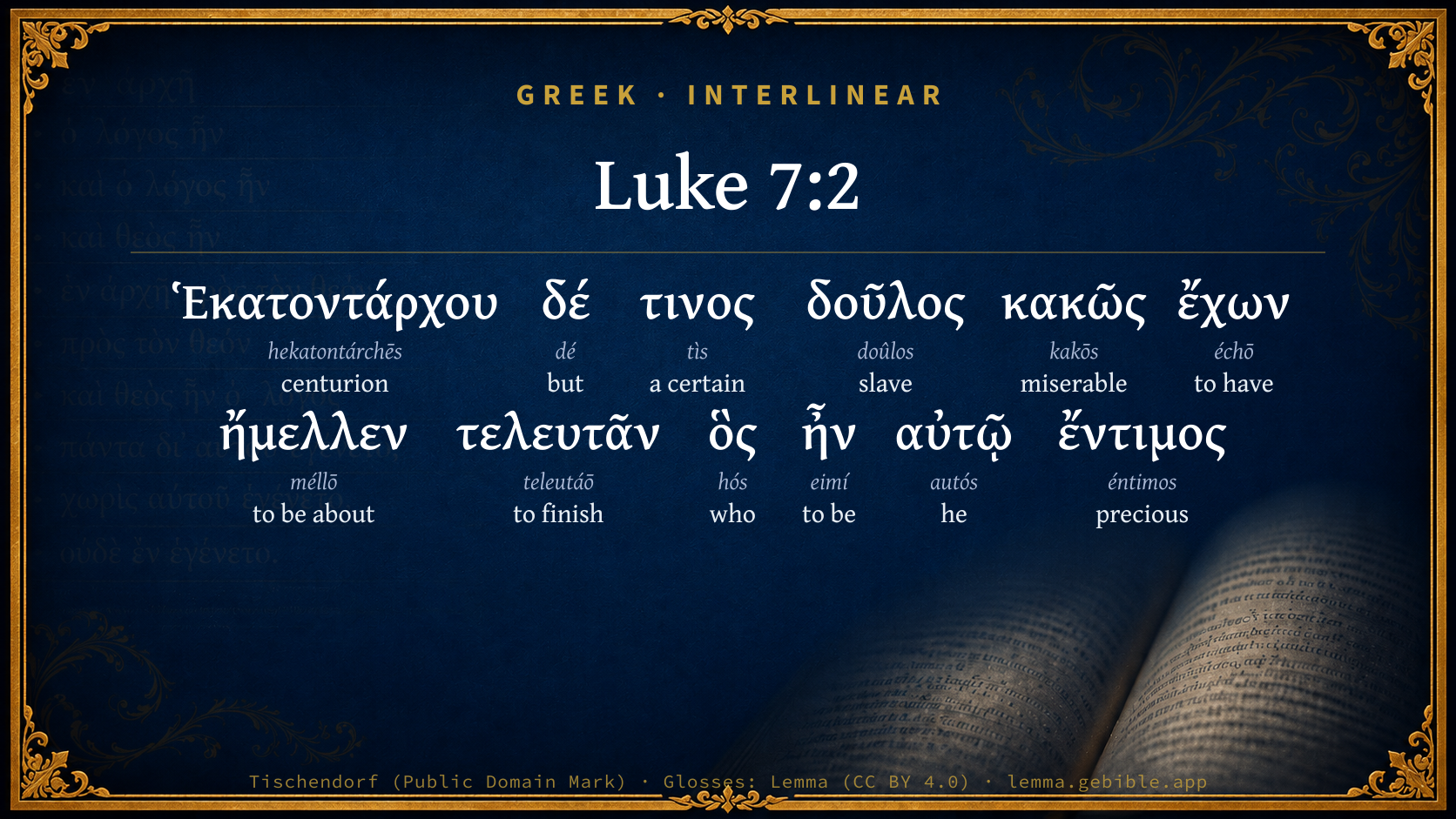
A certain centurion's servant, who was dear to him, was sick and at the point of death.
Download a study sheet
One document with this verse’s original text, its word-by-word gloss line, the meaning frame, cross-references with their text, attributed commentary, and full source and license credits — printable, and it pastes into notes with its structure intact.
This verse Autodidact and up
A passage Seminary Student
Up to 50 verses in one chapter. A passage sheet keeps up to 6 commentary sources and 12 cross-references per verse, in the order this page ranks them, and says so on the sheet whenever that leaves anything out. Ask for a single verse and you get the Autodidact verse sheet above.
Everything on this page stays free to read, with no account — the sheet is a download of what is already on screen, not access to it.
Compare translations 3
The same verse in 3 English versions, stacked beneath the original-language interlinear above. Click any original word for its lexicon entry.
Each is an independent rendering of the whole verse — the interlinear is not word-aligned to these translations.
Highlighted words mark where these versions differ — a whole-verse word diff, not a word-by-word alignment.
-
World English Bible Public Domain
A certain centurion's servant, who was dear to him, was sick and at the point of death.
-
King James Version Public Domain
And a certain centurion's servant, who was dear unto him, was sick, and ready to die.
-
unfoldingWord Literal Text CC BY-SA 4.0
And a certain servant of a centurion, who was highly regarded by him, being sick, was about to die.
unfoldingWord Literal Text — © unfoldingWord, licensed CC BY-SA 4.0. Word-aligned USFM3 via Door43 (git.door43.org/unfoldingWord/en_ult).
Show all 19 translations
Every available English version of this verse, each an independent rendering of the whole verse.
-
World English Bible Public Domain
A certain centurion's servant, who was dear to him, was sick and at the point of death.
-
Berean Standard Bible Public Domain
There a highly valued servant of a centurion was sick and about to die.
-
Majority Standard Bible Public Domain
There a highly valued servant of a centurion was sick and about to die.
-
King James Version Public Domain
And a certain centurion's servant, who was dear unto him, was sick, and ready to die.
-
American Standard Version (1901) Public Domain
And a certain centurion's servant, who was dear unto him, was sick and at the point of death.
-
Revised Version (1885) Public Domain
And a certain centurion’s servant, who was dear unto him, was sick and at the point of death.
-
Geneva Bible (1599) Public Domain
And a certaine Ceturions seruant was sicke and readie to die, which was deare vnto him.
-
Douay-Rheims (1899) Public Domain
And the servant of a certain centurion, who was dear to him, being sick, was ready to die.
-
Young's Literal Translation Public Domain
and a certain centurion's servant being ill, was about to die, who was much valued by him,
-
Literal Standard Version CC BY-SA 4.0
and a certain centurion’s servant being ill, was about to die, who was much valued by him,
-
Unlocked Literal Bible CC BY-SA 4.0
Now a centurion had a slave who was highly regarded by him, and he was sick and about to die.
-
unfoldingWord Literal Text CC BY-SA 4.0
And a certain servant of a centurion, who was highly regarded by him, being sick, was about to die.
-
Darby Bible Public Domain
And a certain centurion's bondman who was dear to him was ill and about to die;
-
World Messianic Bible Public Domain
A certain centurion’s servant, who was dear to him, was sick and at the point of death.
-
Webster's Bible Public Domain
And a certain centurion's servant, who was dear to him, was sick, and ready to die.
-
Free Bible Version CC BY-SA 4.0
A centurion lived there who had a servant he greatly valued who was sick and was about to die.
-
Bible in Basic English Public Domain
And a certain captain had a servant who was very dear to him; this servant was ill and near to death.
-
Text-Critical English NT CC BY 4.0
There a centurion's servant, who was highly regarded by his master, was sick and about to die.
-
Tyndale New Testament (1534) Public Domain
And a certayne Centurions seruaunte was sicke and redy to dye whom he made moche of.
Literal Standard Version (2020), Covenant Press — licensed CC BY-SA 4.0. Text via the HelloAO Bible API (eBible.org). Unlocked Literal Bible (unfoldingWord) — licensed CC BY-SA 4.0. Text via the HelloAO Bible API (eBible.org). unfoldingWord Literal Text — © unfoldingWord, licensed CC BY-SA 4.0. Word-aligned USFM3 via Door43 (git.door43.org/unfoldingWord/en_ult). Free Bible Version, Dr. Jonathan Gallagher — licensed CC BY-SA 4.0. Text via the HelloAO Bible API (eBible.org).
Word by word
More ways to search: Search by grammar → Find every occurrence → Compare this word →
Practice this passage: Drill this verse → Learn its vocabulary →
- Appears 5× in the Greek New Testament
- First appears here
- Part of Speech
- Adjective
- Case
- Nominative
- Number
- Singular
- Gender
- Masculine
Full Thayer's Definition
- Ἑκατοντάρχου hekatontárchēs G1543 “centurion” Noun, Genitive, Singular, Masculine
- δέ dé G1161 “but” Conjunction
- τινος tìs G5100 “a certain” Indefinite pronoun, Genitive, Singular, Masculine
- δοῦλος doûlos G1401 “slave” Noun, Nominative, Singular, Masculine
- κακῶς kakōs G2560 “miserable” Adverb
- ἔχων échō G2192 “to have” Verb, Present, Active, Participle, Nominative, Singular, Masculine
- ἤμελλεν méllō G3195 “to be about” Verb, Imperfect, Active, Indicative, 3rd person, Singular, Attic form
- τελευτᾶν teleutáō G5053 “to finish” Verb, Present, Active, Infinitive
- ὃς hós G3739 “who” Relative pronoun, Nominative, Singular, Masculine
- ἦν eimí G1510 “to be” Verb, Imperfect, Active, Indicative, 3rd person, Singular
- αὐτῷ autós G846 “he” Personal pronoun, Dative, Singular, Masculine
- ἔντιμος éntimos G1784 “precious” Adjective, Nominative, Singular, Masculine
About this verse
These counts appear in no published source. They are computed here, from the morphology-tagged text and Lemma’s own curated glosses. What Lemma adds →
- 12
- words
- 12
- distinct lemmas
- Gospels
- section
Notable vocabulary
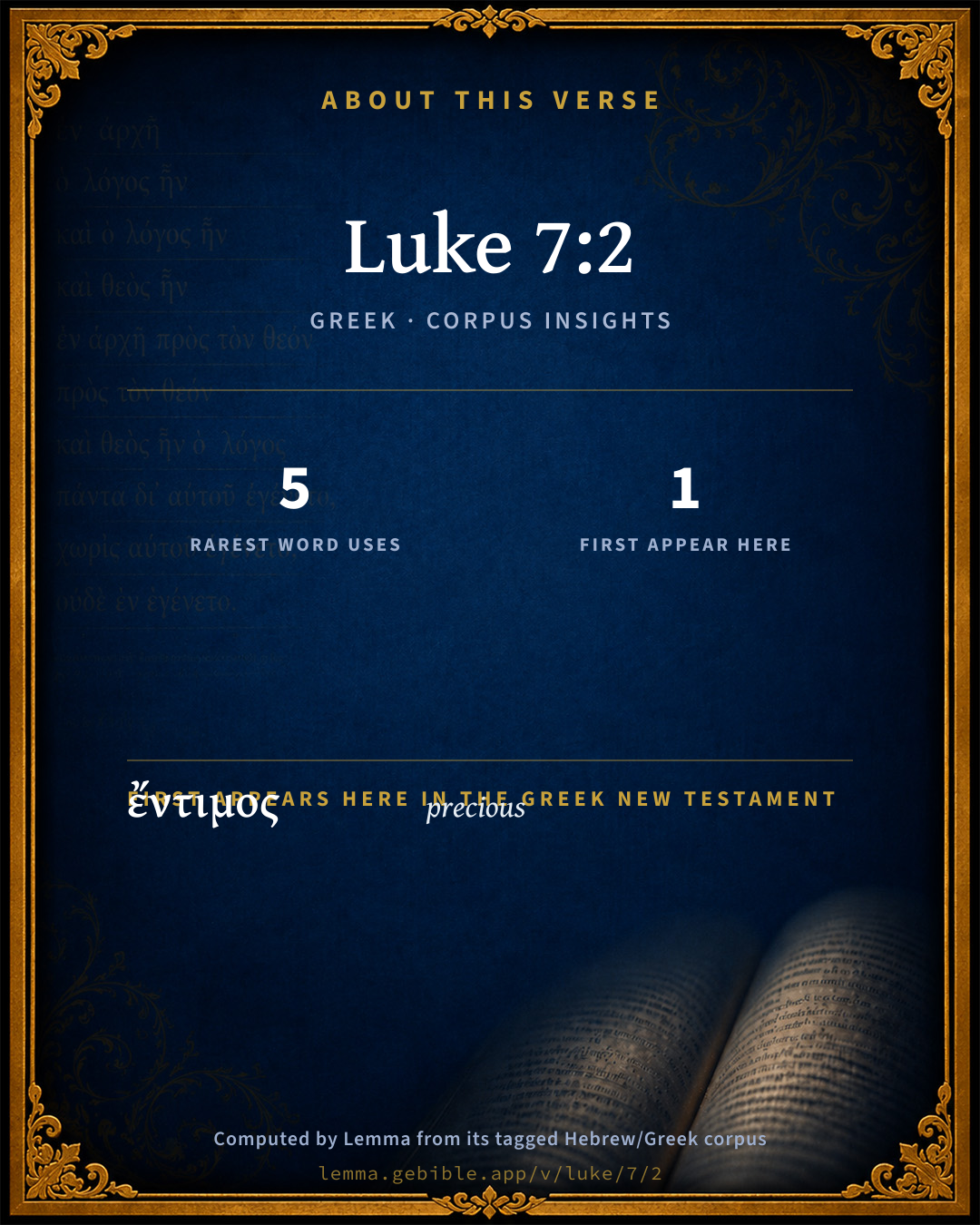
The rarest word here is ἔντιμος precious G1784 — appearing just 5 times in the whole Greek New Testament.
First appearance in Scripture
This word makes its first canonical appearance in the Greek New Testament here:
- ἔντιμος precious G1784
Shared distinctive vocabulary
ἔντιμος precious G1784 occurs in 5 verses of the Greek New Testament. Also found in:
Cross-references
21Topical passages linked to Luke 7:2 in the Treasury of Scripture Knowledge — connected by theme and wording, ordered by reader-vote popularity; previews shown in the World English Bible.
- Genesis 24:27 He said, "Blessed be Yahweh, the God of my master Abraham, who has not forsaken his loving kindness and his truth toward my master. As for me, Yahweh has led me in the way to the house of my master's relatives."
- 2 Kings 5:2–3 The Syrians had gone out in bands, and had brought away captive out of the land of Israel a little maiden; and she waited on Naaman's wife.
- John 4:46–47 Jesus came therefore again to Cana of Galilee, where he made the water into wine. There was a certain nobleman whose son was sick at Capernaum.
- Genesis 24:2–14 Abraham said to his servant, the elder of his house, who ruled over all that he had, "Please put your hand under my thigh.
- Genesis 24:35–49 Yahweh has blessed my master greatly. He has become great. He has given him flocks and herds, silver and gold, men-servants and maid-servants, and camels and donkeys.
- Genesis 35:8 Deborah, Rebekah's nurse, died, and she was buried below Bethel under the oak; and the name of it was called Allon Bacuth.
- Genesis 39:4–6 Joseph found favor in his sight. He ministered to him, and he made him overseer over his house, and all that he had he put into his hand.
- Job 31:5 "If I have walked with falsehood, And my foot has hurried to deceit
- Proverbs 29:21 He who pampers his servant from youth Will have him become a son in the end.
- Matthew 27:54 Now the centurion, and those who were with him watching Jesus, when they saw the earthquake, and the things that were done, feared exceedingly, saying, "Truly this was the Son of God."
- Luke 8:42 for he had an only daughter, about twelve years of age, and she was dying. But as he went, the multitudes pressed against him.
- Luke 23:47 When the centurion saw what was done, he glorified God, saying, "Certainly this was a righteous man."
- John 11:2–3 It was that Mary who had anointed the Lord with ointment, and wiped his feet with her hair, whose brother, Lazarus, was sick.
- Colossians 3:22–4:1 Servants, obey in all things those who are your masters according to the flesh, not just when they are looking, as men-pleasers, but in singleness of heart, fearing God.
- Acts 10:1 Now there was a certain man in Caesarea, Cornelius by name, a centurion of what was called the Italian Regiment,
- Acts 10:7 When the angel who spoke to him had departed, Cornelius called two of his household servants and a devout soldier of those who waited on him continually.
- Acts 22:26 When the centurion heard it, he went to the commanding officer and told him, "Watch what you are about to do, for this man is a Roman!"
- Acts 23:17 Paul summoned one of the centurions, and said, "Bring this young man to the commanding officer, for he has something to tell him."
- Acts 27:1 When it was determined that we should sail for Italy, they delivered Paul and certain other prisoners to a centurion named Julius, of the Augustan band.
- Acts 27:3 The next day, we touched at Sidon. Julius treated Paul kindly, and gave him permission to go to his friends and refresh himself.
- Acts 27:43 But the centurion, desiring to save Paul, stopped them from their purpose, and commanded that those who could swim should throw themselves overboard first to go toward the land;
Cross-references courtesy of OpenBible.info (CC BY 4.0).
Lesson kit
Teaching starters — assembled from the data on this page, not authored interpretation. Every prompt links to the verse data it draws on. Edit before teaching.
Luke, in the Gospels, opens this verse with 12 words (12 distinct Greek lemmas). Its most distinctive word is éntimos (“precious”). A historical commentator’s framing appears above. Read the whole chapter for the surrounding context.
Discussion questions
- How does “precious” (éntimos) shape what this verse is saying?
- The word “precious” first appears here in Scripture. What is being introduced at this debut?
- Luke 14:8 shares the word «precious» with this verse. How do the two illuminate each other?
- These translations render this verse differently; the difference is in the English rendering, not the original. What questions does that raise?
- Reading how Tyndale Open Study Notes and Bengel's Gnomon read this verse, where do the two commentators agree and where do they part?
Things to notice
- 1 word makes its first canonical appearance in Scripture here.
- These translations choose different wording for 11 words in this verse.
- 12 distinct Greek lemmas span 12 words in this verse.
Commentary
Notes on Luke 7:2 from classic Christian and Jewish commentators (each source and its license shown beneath its notes). The classic Christian expositions comment on the surrounding passage and are grouped to its opening verse, so a note may address several verses; the Jewish commentaries on the Tanakh (Rashi and others) are per-verse, so they appear only where the commentator wrote on this verse.
Lemma curates 59 commentaries, every one of them public domain or Creative Commons licensed, each selected and text-cleaned for this edition rather than reprinted as found. About our sources →
Tyndale Open Study Notes
Tyndale Open Resources
Tyndale Open Study Notes — © Tyndale Open Resources, licensed CC BY-SA 4.0. Text via the HelloAO Bible API.
Bengel's Gnomon
Johann Albrecht Bengel
Bengel's Gnomon of the New Testament — English translation (T&T Clark, Edinburgh, 1860) — public domain. Text from a community e-Sword module.
Expositor's Greek Testament
ed. W. Robertson Nicoll
The Expositor's Greek Testament, edited by W. Robertson Nicoll (1897–1910) — public domain. Text from a community e-Sword module.
Adam Clarke's Commentary
Adam Clarke's Commentary on the Bible (1810–1826) — public domain. Text from a community e-Sword/MySword module.
Ellicott's Commentary for English Readers
A Bible Commentary for English Readers, edited by Charles John Ellicott (1878–1897) — public domain. Text from a community e-Sword module.
The Cambridge Bible for Schools and Colleges
gen. ed. J. J. S. Perowne
The Cambridge Bible for Schools and Colleges (gen. ed. J. J. S. Perowne; Cambridge University Press, 1878–1918) — public domain. Text from a community e-Sword module.
John Gill's Exposition
John Gill's Exposition of the Whole Bible (1746–1763) — public domain (CC PDM 1.0). Text via the HelloAO Bible API.
Trapp's Complete Commentary
John Trapp
John Trapp, A Commentary or Exposition upon All the Books of the Old and New Testament (1647–1656) — public domain. Text from a community e-Sword module.
Albert Barnes' Notes on the Bible
Albert Barnes' Notes on the Bible (1834–1885) — public domain. Text from a community e-Sword/MySword module.
Haydock's Catholic Bible Commentary
George Leo Haydock (1774–1849), Haydock's Catholic Family Bible and Commentary, 1859 edition — public domain. Excludes Psalms (Douay-Rheims chapter numbering differs from Protestant) and Deuterocanonical books (Catholic canon only).
Whedon's Commentary on the Bible
Daniel D. Whedon
Daniel D. Whedon (gen. ed.), Commentary on the Old and New Testaments (1874–1909) — public domain. Text from a community e-Sword module.
The Pulpit Commentary
The Pulpit Commentary (1880–1919), ed. H.D.M. Spence-Jones & Joseph S. Exell — public domain. Text from a community e-Sword module.
unfoldingWord translationNotes
Door43 World Missions Community
unfoldingWord translationNotes — © Distant Shores Media and the Door43 World Missions Community, licensed CC BY-SA 4.0. Source: git.door43.org/Door43/en_tn.
Cambridge Greek Testament for Schools and Colleges
Cambridge Greek Testament for Schools and Colleges (Cambridge University Press, 1896; 21 vols, various authors incl. Carr, Maclear, Plummer, Farrar, Lumby, Moule, M. R. James, Simcox) — public domain. Text from a community e-Sword module.
International Critical Commentary
International Critical Commentary — older volumes (1896–1929), various authors — public domain. Text from a community e-Sword module.
Vincent's Word Studies in the New Testament
Marvin R. Vincent
Marvin R. Vincent, Word Studies in the New Testament (1887–1900) — public domain. Text from a community e-Sword/MySword module.