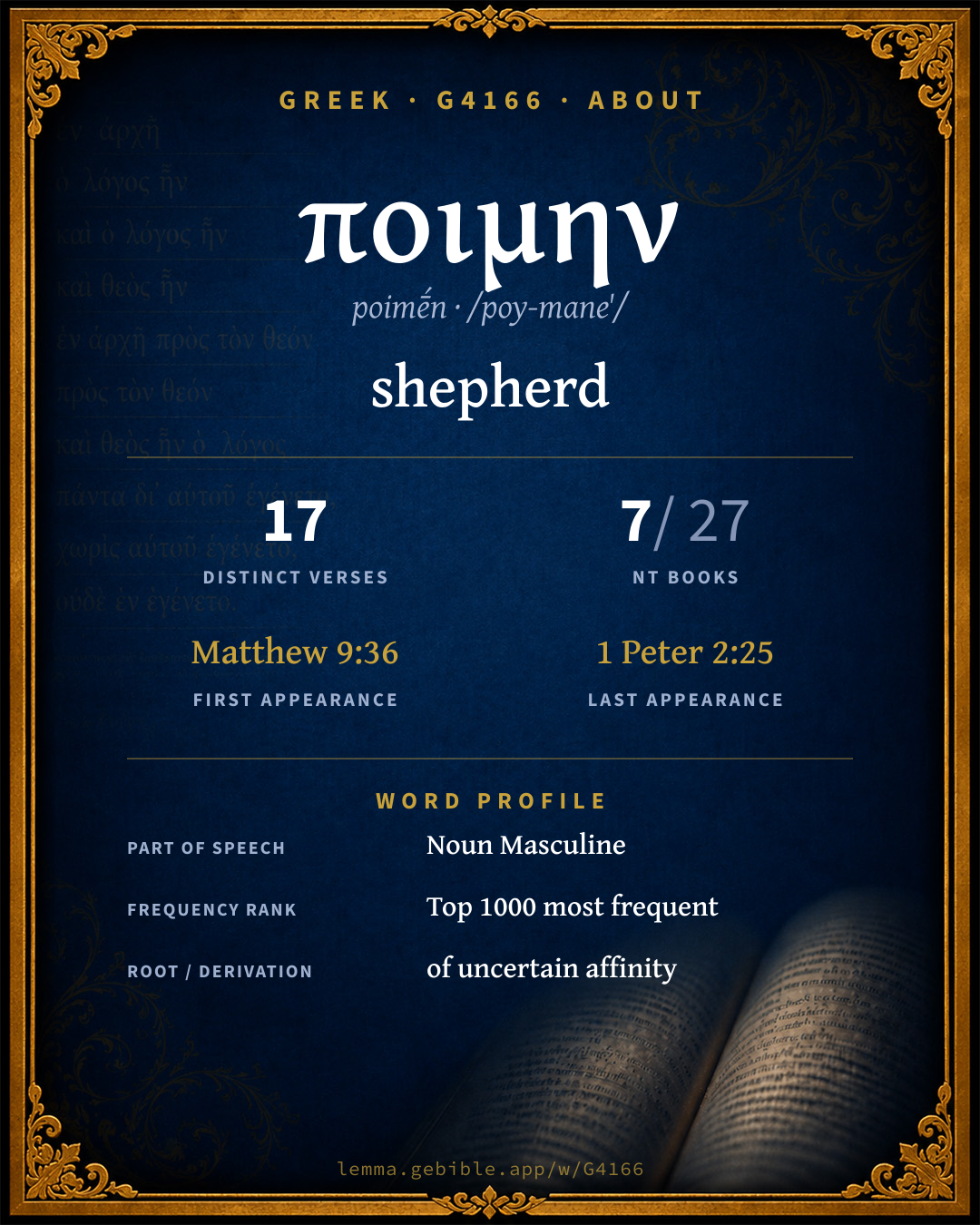
ποιμήν
shepherd
‘shepherd’ is one of 2 main senses fuller range ↓
Full lexicon entry — Thayer's Greek Lexicon
From Thayer's Greek Lexicon
Where this word appears
See every Accusative-case word in the Greek New Testament →
Grammar key — what these labels mean
Part of speech
- Noun
- A naming word — a person, place, thing, or idea.
Case
- Nominative
- The case of the subject (and the predicate nominative).
- Accusative
- The case of the direct object and of extent.
- Genitive
- The case of source, possession, or “of” — answers “whose / from what.”
Gender
- Masculine
- Grammatically masculine.
Number
- Singular
- One.
- Plural
- More than one.
Every verse where G4166 appears in the Book of Matthew — 3 distinct verses. Click any verse to open its interlinear word-by-word view. Verse text shown in the World English Bible for context — . Each verse’s Greek form is shown with its reference; the English is not keyword-highlighted, since the data carries no word-level English alignment. Use “Compare translations” on any verse to read it across multiple English versions. This concordance covers the Greek New Testament; Septuagint (Greek Old Testament) occurrences of this word are not indexed here.
Matthew
- Matthew 9:36 ποιμένα n acc sg masc But when he saw the multitudes, he was moved with compassion for them, because they were harassed and scattered, like sheep without a shepherd.
- Matthew 25:32 ποιμὴν n nom sg masc Before him all the nations will be gathered, and he will separate them one from another, as a shepherd separates the sheep from the goats.
- Matthew 26:31 ποιμένα n acc sg masc Then Jesus said to them, "All of you will be made to stumble because of me tonight, for it is written, 'I will strike the shepherd, and the sheep of the flock will be scattered.'
About this entry
At a glance — auto-summarized from this page’s data, not written by a person. Every figure links to its source below. This summary describes the numbers; it doesn’t interpret them.
The Greek noun ποιμην centers on the idea of “shepherd.” First canonically at Matthew 9:36, it enters the text early. It turns up in 17 verses across 7 books, an uncommon footprint. The word gravitates to John (29%), then Luke and Matthew. Lexicons map it across 2 senses. For the data behind this summary, explore the sense tree and the renderings breakdown below.
Gloss history
Strong's 1890 vs modern scholarship
About this word
Strong's G4166 catalogs a Greek word from the Greek New Testament.
These counts are not copied from any lexicon or concordance. They are computed here, from the morphology-tagged Greek New Testament. What Lemma adds →
- 17
- distinct verses
- The word appears in 17 distinct verses.
- 7 / 27
- NT books
- The word appears in 7 of 27 New Testament books.
- #664
- by frequency
- Top 1000 most frequent Greek words (rank 664 of 5,347 Greek words by occurrence).
View all 17 occurrences in the concordance →
By section of the New Testament
By traditional corpus
Conventional, traditional groupings — biblical authorship is debated, so this is a traditional corpus grouping, not an authorship claim. Some books belong to more than one corpus (Luke is in both the Gospels and the Lukan corpus, and so on), so these shares overlap and need not total 100%. Each figure is a share of the word’s 17 distinct verses.
- Gospels 14 verses · 82%
- Johannine 5 verses · 29%
- Lukan (Luke–Acts) 4 verses · 24%
- Pauline corpus 1 verse · 6%
- Hebrews 1 verse · 6%
- General (Catholic) Epistles 1 verse · 6%
How translations render this word
Counts come from each version’s own published word-to-Strong’s tagging or interlinear alignment — an approximate guide to how each version renders this word, not a word-level alignment the data otherwise carries. Because each total is that version’s own tagged count, the per-version totals vary from one another and need not match the appearance or distinct-verse counts above. These counts may also differ from a printed concordance because Lemma counts each distinctly tagged rendering and does not collapse phrase taggings into a single head-word total. This is a fixed set of word-tagged versions (KJV, ASV, BSB, ULT) and does not change with the reading translation you choose elsewhere. Each version’s license is shown beside its name below (and on Sources).
- King James Version: Shepherd 13×, Shepherds 3×
- American Standard Version: Shepherd 13×, Shepherds 3×, The 3×
- Berean Standard Bible: Shepherd 13×, Shepherds 4×
- unfoldingWord Literal Text: Shepherd 13×, Shepherds 4×
King James Version Public Domain
Renders G4166 across 17 tagged occurrences — most commonly:
Plus 1 rendering that appears only once — usually multi-word phrases or single function words the recovered tagging swept in, not distinct renderings. Not rendered by a distinct English word in 1 further occurrence.
American Standard Version Public Domain
Renders G4166 across 20 tagged occurrences — most commonly:
Plus 1 rendering that appears only once — usually multi-word phrases or single function words the recovered tagging swept in, not distinct renderings.
Berean Standard Bible Public Domain
Renders G4166 across 18 tagged occurrences — most commonly:
Plus 1 rendering that appears only once — usually multi-word phrases or single function words the recovered tagging swept in, not distinct renderings.
unfoldingWord Literal Text CC BY-SA 4.0
Renders G4166 across 18 tagged occurrences — most commonly:
Plus 1 rendering that appears only once — usually multi-word phrases or single function words the recovered tagging swept in, not distinct renderings.
Senses in Thayer's
The 2 senses Thayer's distinguishes for this word, in lexicon order (not ranked by frequency or importance). The full entry — with sub-senses — is in the Lexicon Entry tab.
- a herdsman, esp. a shepherd
- metaph.
Word origin
Origin: of uncertain affinity
Of uncertain affinity; a shepherd (literally or figuratively): - shepherd pastor.
— Strong’s Exhaustive Concordance (1890), public domain.
Forms in the corpus
The 6 distinct written forms G4166 takes in the Greek New Testament, most frequent first — each parse links to that case’s occurrences in the concordance.
| Form | Parsing | Example | Uses |
|---|---|---|---|
| ποιμένα poiména | Noun, Accusative, Singular, Masculine | Matthew 9:36 | 6 |
| ποιμὴν poimḕn | Noun, Nominative, Singular, Masculine | Matthew 25:32 | 4 |
| ποιμένες poiménes | Noun, Nominative, Plural, Masculine | Luke 2:8 | 3 |
| ποιμήν poimḗn | Noun, Nominative, Singular, Masculine | John 10:2 | 3 |
| ποιμένας poiménas | Noun, Accusative, Plural, Masculine | Ephesians 4:11 | 1 |
| ποιμένων poiménōn | Noun, Genitive, Plural, Masculine | Luke 2:18 | 1 |
Same root — word family
Other Thayer's entries built from the same root as G4166, grouped by Strong’s listed origin. These share a root / origin per the lexicon — not necessarily a shared meaning. Each links to that word’s own entry.
Derived from this word
Compare all same-root words → They share a root, not necessarily a meaning.
Septuagint usage
The same Greek word ποιμην appears 78 times in the Greek Old Testament (Septuagint), across 65 verses in 18 books.
- 78
- LXX occurrences
- Tagged occurrences of this Greek word in the Septuagint.
- 65
- verses
- Distinct Septuagint verses containing this word.
- 18 / 39
- OT books
- The word appears in 18 of the 39 Old Testament books.
Sample Septuagint occurrences
- Genesis 4:2 ποιμήν
- Exodus 2:17 ποιμήν
- Numbers 27:17 ποιμήν
- 1 Samuel 25:7 ποιμήν
- 2 Samuel 24:17 ποιμήν
- 1 Kings 22:17 ποιμήν
- 2 Kings 10:12 ποιμήν
- 2 Chronicles 18:16 ποιμήν
- Job 1:16 ποιμήν
- Ecclesiastes 12:11 ποιμήν
- Song of Solomon 1:8 ποιμήν
- Isaiah 13:20 ποιμήν
Septuagint occurrences (same lexeme)
Every verse where the same Strong’s number (G4166) appears in the Greek Septuagint — showing the first 50 of 65. Verse text shown in the World English Bible for context; the Greek form is the matched word — the English is not keyword-highlighted.
- Genesis 4:2 ποιμήν Again she gave birth, to Cain's brother Abel. Abel was a keeper of sheep, but Cain was a tiller of the ground.
- Genesis 13:7 ποιμήν There was a strife between the herdsmen of Abram's cattle and the herdsmen of Lot's cattle: and the Canaanite and the Perizzite lived then in the land.
- Genesis 13:8 ποιμήν Abram said to Lot, "Please, let there be no strife between me and you, and between my herdsmen and your herdsmen; for we are relatives.
- Genesis 26:20 ποιμήν The herdsmen of Gerar argued with Isaac's herdsmen, saying, "The water is ours." He called the name of the well Esek, because they contended with him.
- Genesis 29:8 ποιμήν They said, "We can't, until all the flocks are gathered together, and they roll the stone from the well's mouth. Then we water the sheep."
- Genesis 38:12 ποιμήν After many days, Shua's daughter, the wife of Judah, died. Judah was comforted, and went up to his sheep-shearers to Timnah, he and his friend Hirah, the Adullamite.
- Genesis 38:20 ποιμήν Judah sent the kid of the goats by the hand of his friend, the Adullamite, to receive the pledge from the woman's hand, but he didn't find her.
- Genesis 46:32 ποιμήν These men are shepherds, for they have been keepers of cattle, and they have brought their flocks, and their herds, and all that they have.'
- Genesis 46:34 ποιμήν that you shall say, 'Your servants have been keepers of cattle from our youth even until now, both we, and our fathers:' that you may dwell in the land of Goshen; for every shepherd is an abomination to the Egyptians."
- Genesis 47:3 ποιμήν Pharaoh said to his brothers, "What is your occupation?" They said to Pharaoh, "Your servants are shepherds, both we, and our fathers."
- Exodus 2:17 ποιμήν The shepherds came and drove them away; but Moses stood up and helped them, and watered their flock.
- Exodus 2:19 ποιμήν They said, "An Egyptian delivered us out of the hand of the shepherds, and moreover he drew water for us, and watered the flock."
- Numbers 27:17 ποιμήν who may go out before them, and who may come in before them, and who may lead them out, and who may bring them in; that the congregation of Yahweh not be as sheep which have no shepherd.
- 1 Samuel 25:7 ποιμήν Now I have heard that you have shearers: your shepherds have now been with us, and we did them no hurt, neither was there anything missing to them, all the while they were in Carmel.
- 2 Samuel 24:17 ποιμήν David spoke to Yahweh when he saw the angel who struck the people, and said, Behold, I have sinned, and I have done perversely; but these sheep, what have they done? Please let your hand be against me, and against my father's house.
- 1 Kings 22:17 ποιμήν He said, I saw all Israel scattered on the mountains, as sheep that have no shepherd: and Yahweh said, These have no master; let them return every man to his house in peace.
- 2 Kings 10:12 ποιμήν He arose and departed, and went to Samaria. As he was at the shearing-house of the shepherds in the way,
- 2 Chronicles 18:16 ποιμήν He said, I saw all Israel scattered on the mountains, as sheep that have no shepherd: and Yahweh said, These have no master; let them return every man to his house in peace.
- Job 1:16 ποιμήν While he was still speaking, there also came another, and said, "The fire of God has fallen from the sky, and has burned up the sheep and the servants, and consumed them, and I alone have escaped to tell you."
- Job 24:2 ποιμήν There are people who remove the landmarks. They violently take away flocks, and feed them.
- Ecclesiastes 12:11 ποιμήν The words of the wise are like goads; and like nails well fastened are words from the masters of assemblies, which are given from one shepherd.
- Song of Solomon 1:8 ποιμήν If you don't know, most beautiful among women, Follow the tracks of the sheep. Graze your young goats beside the shepherds' tents.
- Isaiah 13:20 ποιμήν It shall never be inhabited, neither shall it be lived in from generation to generation: neither shall the Arabian pitch tent there; neither shall shepherds make their flocks to lie down there.
- Isaiah 32:14 ποιμήν For the palace shall be forsaken; the populous city shall be deserted; the hill and the watch-tower shall be for dens forever, a joy of wild donkeys, a pasture of flocks;
- Isaiah 40:11 ποιμήν He will feed his flock like a shepherd, he will gather the lambs in his arm, and carry them in his bosom, [and] will gently lead those who have their young.
- Isaiah 63:11 ποιμήν Then he remembered the days of old, Moses [and] his people, [saying], Where is he who brought them up out of the sea with the shepherds of his flock? where is he who put his holy Spirit in the midst of them?
- Jeremiah 2:8 ποιμήν The priests didn't say, Where is Yahweh? and those who handle the law didn't know me: the rulers also transgressed against me, and the prophets prophesied by Baal, and walked after things that do not profit.
- Jeremiah 3:1 ποιμήν They say, If a man put away his wife, and she go from him, and become another man's, will he return to her again? Won't that land be greatly polluted? But you have played the prostitute with many lovers; yet return again to me, says Yahweh.
- Jeremiah 3:3 ποιμήν Therefore the showers have been withheld, and there has been no latter rain; yet you have a prostitute's forehead, you refused to be ashamed.
- Jeremiah 3:15 ποιμήν and I will give you shepherds according to my heart, who shall feed you with knowledge and understanding.
- Jeremiah 6:3 ποιμήν Shepherds with their flocks shall come to her; they shall pitch their tents against her round about; they shall feed everyone in his place.
- Jeremiah 10:21 ποιμήν For the shepherds are become brutish, and have not inquired of Yahweh: therefore they have not prospered, and all their flocks are scattered.
- Jeremiah 12:10 ποιμήν Many shepherds have destroyed my vineyard, they have trodden my portion under foot, they have made my pleasant portion a desolate wilderness.
- Jeremiah 22:22 ποιμήν The wind shall feed all your shepherds, and your lovers shall go into captivity: surely then shall you be ashamed and confounded for all your wickedness.
- Jeremiah 23:1 ποιμήν Woe to the shepherds who destroy and scatter the sheep of my pasture! says Yahweh.
- Jeremiah 23:4 ποιμήν I will set up shepherds over them, who shall feed them; and they shall fear no more, nor be dismayed, neither shall any be lacking, says Yahweh.
- Jeremiah 27:6 ποιμήν Now have I given all these lands into the hand of Nebuchadnezzar the king of Babylon, my servant; and the animals of the field also have I given him to serve him.
- Jeremiah 27:44 ποιμήν
- Jeremiah 28:23 ποιμήν
- Jeremiah 30:13 ποιμήν There is none to plead your cause, that you may be bound up: you have no healing medicines.
- Jeremiah 32:21 ποιμήν and brought forth your people Israel out of the land of Egypt with signs, and with wonders, and with a strong hand, and with an outstretched arm, and with great terror;
- Jeremiah 32:22 ποιμήν and gave them this land, which you did swear to their fathers to give them, a land flowing with milk and honey;
- Jeremiah 32:23 ποιμήν and they came in, and possessed it, but they didn't obey your voice, neither walked in your law; they have done nothing of all that you commanded them to do: therefore you have caused all this evil to come on them.
- Jeremiah 40:12 ποιμήν then all the Jews returned out of all places where they were driven, and came to the land of Judah, to Gedaliah, to Mizpah, and gathered wine and summer fruits very much.
- Jeremiah 50:12 ποιμήν your mother shall be utterly disappointed; she who bore you shall be confounded: behold, she shall be the least of the nations, a wilderness, a dry land, and a desert.
- Ezekiel 34:2 ποιμήν Son of man, prophesy against the shepherds of Israel, prophesy, and tell them, even to the shepherds, Thus says the Lord Yahweh: Woe to the shepherds of Israel who feed themselves! Shouldn't the shepherds feed the sheep?
- Ezekiel 34:5 ποιμήν They were scattered, because there was no shepherd; and they became food to all the animals of the field, and were scattered.
- Ezekiel 34:7 ποιμήν Therefore, you shepherds, hear the word of Yahweh:
- Ezekiel 34:8 ποιμήν As I live, says the Lord Yahweh, surely because my sheep became a prey, and my sheep became food to all the animals of the field, because there was no shepherd, neither did my shepherds search for my sheep, but the shepherds fed themselves, and didn't feed my sheep;
- Ezekiel 34:9 ποιμήν therefore, you shepherds, hear the word of Yahweh:
These are occurrences of the same Greek lexeme (G4166) in the Septuagint — not a translation of any one Hebrew word. The store carries no word-level Hebrew↔Greek alignment, so no Hebrew original is asserted here. Counts come from the recovered LXX Strong's tagging — high-frequency vocabulary is well covered, while rare or late forms may be untagged — so they reflect tagged occurrences and may slightly undercount.