
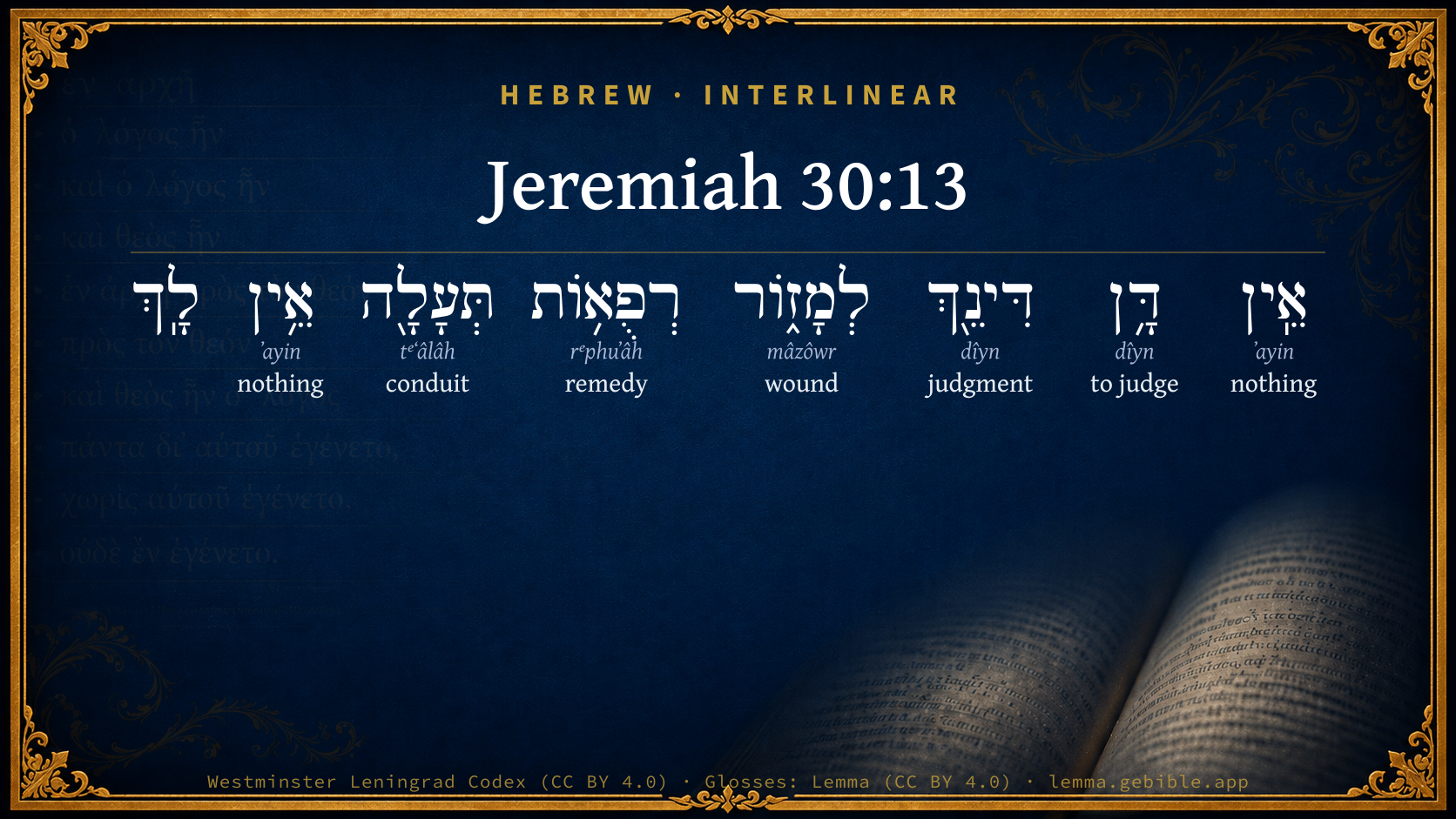
Jeremiah 30:13

Hebrew (Westminster Leningrad Codex) Jeremiah 30:13 appears in the Hebrew Old Testament. The text above is from the Westminster Leningrad Codex. Each word links to its Strong’s number, a concise gloss, and parsing drawn from the Open Scriptures Hebrew Bible morphology. Click any word for its full Brown-Driver-Briggs (BDB) entry.
Download image
Cite this verse

Jeremiah 30:13 (World English Bible). Public Domain. Lemma interlinear Bible study tool, https://lemma.gebible.app/v/jeremiah/30/13.

Show BibTeX & RIS
BibTeX
RIS
English Translation
There is none to plead your cause, that you may be bound up: you have no healing medicines.
World English Bible · Public Domain
Highlights
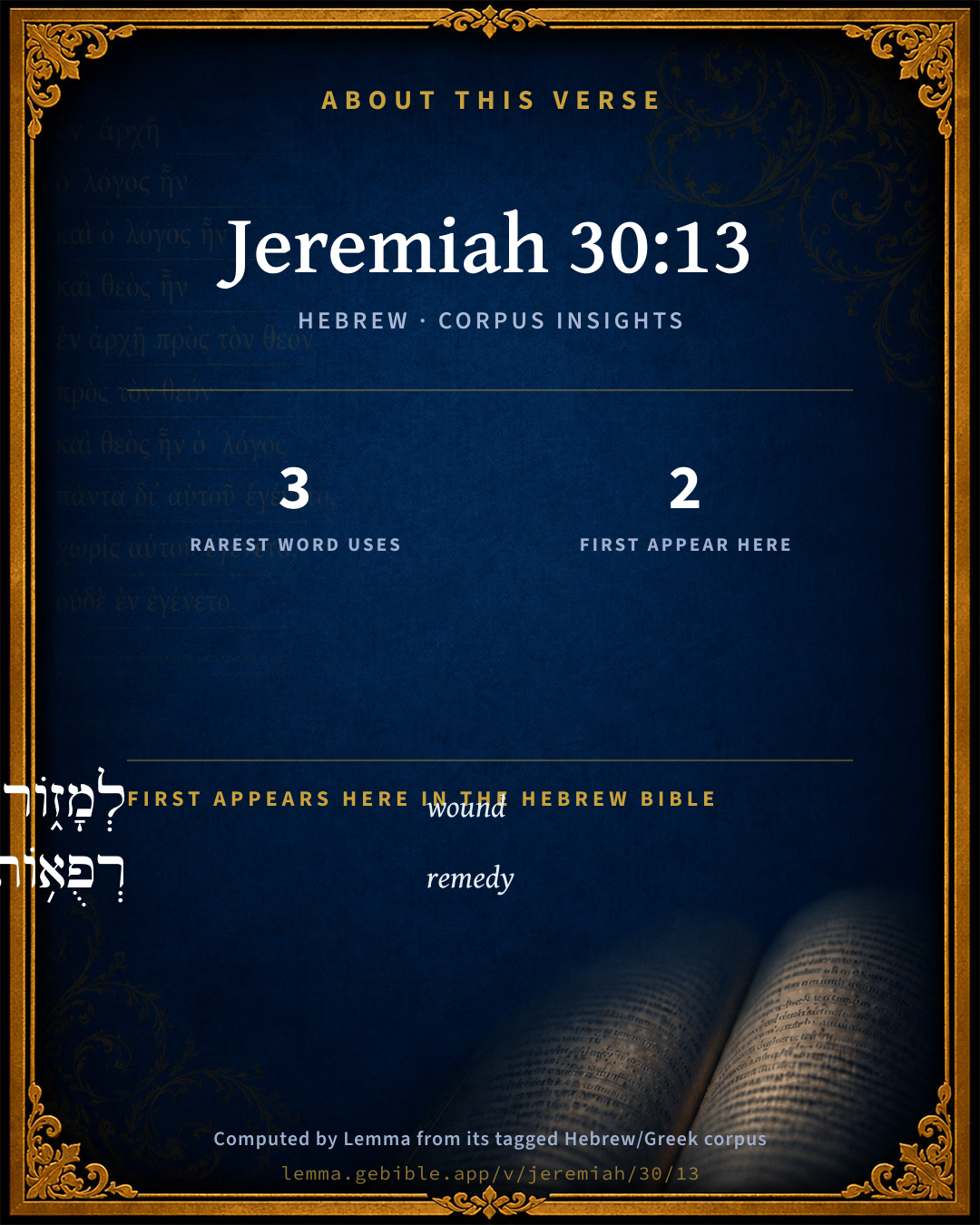
  • 2 first appearances in the Hebrew Bible
Full analysis ↓
Download a study sheet

One document with this verse’s original text, its word-by-word gloss line, the meaning frame, cross-references with their text, attributed commentary, and full source and license credits — printable, and it pastes into notes with its structure intact.

This verse Autodidact and up

Study sheet (.html) Plain text (.txt)

A passage Seminary Student

Up to 50 verses in one chapter. A passage sheet keeps up to 6 commentary sources and 12 cross-references per verse, in the order this page ranks them, and says so on the sheet whenever that leaves anything out. Ask for a single verse and you get the Autodidact verse sheet above.

Everything on this page stays free to read, with no account — the sheet is a download of what is already on screen, not access to it.

Want to remove ads? Support Godless Engineer
Compare translations 3

The same verse in 3 English versions, stacked beneath the original-language interlinear above. Click any original word for its lexicon entry.

Each is an independent rendering of the whole verse — the interlinear is not word-aligned to these translations.

Highlighted words mark where these versions differ — a whole-verse word diff, not a word-by-word alignment.

  • World English Bible Public Domain
    There is none to plead your cause, that you may be bound up: you have no healing medicines.
  • King James Version Public Domain
    There is none to plead thy cause, that thou mayest be bound up: thou hast no healing medicines.
  • unfoldingWord Literal Text CC BY-SA 4.0
    There is no one to plead your case; there is no remedy for your wound to heal you.

unfoldingWord Literal Text — © unfoldingWord, licensed CC BY-SA 4.0. Word-aligned USFM3 via Door43 (git.door43.org/unfoldingWord/en_ult).

Versions to compare (up to 4)

3 of 4 selected

Show all 18 translations

Every available English version of this verse, each an independent rendering of the whole verse.

  • World English Bible Public Domain
    There is none to plead your cause, that you may be bound up: you have no healing medicines.
  • Berean Standard Bible Public Domain
    There is no one to plead your cause, no remedy for your sores, no recovery for you.
  • Majority Standard Bible Public Domain
    There is no one to plead your cause, no remedy for your sores, no recovery for you.
  • King James Version Public Domain
    There is none to plead thy cause, that thou mayest be bound up: thou hast no healing medicines.
  • American Standard Version (1901) Public Domain
    There is none to plead thy cause, that thou mayest be bound up: thou hast no healing medicines.
  • Revised Version (1885) Public Domain
    There is none to plead thy cause, that thou mayest be bound up: thou hast no healing medicines.
  • Geneva Bible (1599) Public Domain
    There is none to iudge thy cause, or to lay a plaister: there are no medicines, nor help for thee.
  • Douay-Rheims (1899) Public Domain
    There is none to judge thy judgment to bind it up: thou hast no healing medicines.
  • Young's Literal Translation Public Domain
    There is none judging thy cause to bind up, Healing medicines there are none for thee.
  • Literal Standard Version CC BY-SA 4.0
    There is none judging your cause to bind up, || There are no healing medicines for you.
  • Unlocked Literal Bible CC BY-SA 4.0
    There is no one to plead your case; there is no remedy for your wound to heal you.
  • unfoldingWord Literal Text CC BY-SA 4.0
    There is no one to plead your case; there is no remedy for your wound to heal you.
  • Darby Bible Public Domain
    There is none to plead thy cause, to bind up [thy wound]; thou hast no healing medicines.
  • World Messianic Bible Public Domain
    There is no one to plead your cause, that you may be bound up. You have no healing medicines.
  • Webster's Bible Public Domain
    There is none to plead thy cause, that thou mayest be bound up: thou hast no healing medicines.
  • Free Bible Version CC BY-SA 4.0
    There's no one to take care of your case, no cure for your sores, no healing for you.
  • Bible in Basic English Public Domain
    There is no help for your wound, there is nothing to make you well.
  • JPS Tanakh (1917) Public Domain
    None deemeth of thy wound that it may be bound up; thou hast no healing medicines.

Literal Standard Version (2020), Covenant Press — licensed CC BY-SA 4.0. Text via the HelloAO Bible API (eBible.org). Unlocked Literal Bible (unfoldingWord) — licensed CC BY-SA 4.0. Text via the HelloAO Bible API (eBible.org). unfoldingWord Literal Text — © unfoldingWord, licensed CC BY-SA 4.0. Word-aligned USFM3 via Door43 (git.door43.org/unfoldingWord/en_ult). Free Bible Version, Dr. Jonathan Gallagher — licensed CC BY-SA 4.0. Text via the HelloAO Bible API (eBible.org).

Word by word

More ways to search: Search by grammar → Find every occurrence → Compare this word →

Practice this passage: Drill this verse → Learn its vocabulary →

About this verse

These counts appear in no published source. They are computed here, from the morphology-tagged text and Lemma’s own curated glosses. What Lemma adds →

8
words
6
distinct lemmas
Prophets
section

Notable vocabulary

The rarest word here is לְמָז֑וֹר wound H4205 — appearing just 3 times in the whole Hebrew Bible.

First appearance in Scripture

These words make their first canonical appearance in the Hebrew Bible here:

  • לְמָז֑וֹר wound H4205
  • רְפֻא֥וֹת remedy H7499

Shared distinctive vocabulary

לְמָז֑וֹר wound H4205 occurs in 2 verses of the Hebrew Bible. Also found in:

Grammatical profile

  • 1 verb
  • 4 nouns
  • 1 preposition
  • 2 particles

Verb forms

  • דָּ֥ן Qal · Participle Active

Repetition

A word recurs within this verse — often emphatic in Hebrew:

  • אֵֽין nothing H369 ×2

Cross-references

22

Topical passages linked to Jeremiah 30:13 in the Treasury of Scripture Knowledge — connected by theme and wording, ordered by reader-vote popularity; previews shown in the World English Bible.

  • Jeremiah 46:11 Go up into Gilead, and take balm, virgin daughter of Egypt: in vain do you use many medicines; there is no healing for you.
  • Jeremiah 8:22 Is there no balm in Gilead? is there no physician there? why then isn't the health of the daughter of my people recovered?
  • Jeremiah 30:17 For I will restore health to you, and I will heal you of your wounds, says Yahweh; because they have called you an outcast, [saying], It is Zion, whom no man seeks after.
  • Jeremiah 33:6 Behold, I will bring it health and cure, and I will cure them; and I will reveal to them abundance of peace and truth.
  • Exodus 15:26 and he said, "If you will diligently listen to the voice of Yahweh your God, and will do that which is right in his eyes, and will pay attention to his commandments, and keep all his statutes, I will put none of the diseases on you, which I have put on the Egyptians; for I am Yahweh who heals you."
  • Deuteronomy 32:39 See now that I, even I, am he, There is no god with me: I kill, and I make alive; I wound, and I heal; There is none who can deliver out of my hand.
  • Job 5:18 For he wounds, and binds up; He injures, and his hands make whole.
  • Job 34:29 When he gives quietness, who then can condemn? When he hides his face, who then can see him? Alike whether to a nation, or to a man:
  • Psalms 106:23 Therefore he said that he would destroy them, Had Moses, his chosen, not stood before him in the breach, To turn away his wrath, so that he wouldn't destroy them.
  • Psalms 142:4 Look on my right, and see; For there is no one who is concerned for me. Refuge has fled from me. No one cares for my soul.
  • Isaiah 1:6 From the sole of the foot even to the head there is no soundness in it: Wounds, welts, and open sores. They haven't been closed, neither bandaged, neither soothed with oil.
  • Isaiah 59:16 He saw that there was no man, and wondered that there was no intercessor: therefore his own arm brought salvation to him; and his righteousness, it upheld him.
  • Ezekiel 22:30 I sought for a man among them, who should build up the wall, and stand in the gap before me for the land, that I should not destroy it; but I found none.
  • Hosea 6:1 "Come, and let us return to Yahweh; For he has torn us to pieces, And he will heal us; He has injured us, And he will bind up our wounds.
  • Hosea 14:4 "I will heal their waywardness. I will love them freely; For my anger is turned away from him.
  • Nahum 3:19 There is no healing your wound, for your injury is fatal. All who hear the report of you clap their hands over you; for who hasn't felt your endless cruelty?
  • Luke 10:30–34 Jesus answered, "A certain man was going down from Jerusalem to Jericho, and he fell among robbers, who both stripped him and beat him, and departed, leaving him half dead.
  • 1 Timothy 2:5–6 For there is one God, and one mediator between God and men, the man Christ Jesus,
  • 1 Peter 2:24 who his own self bore our sins in his body on the tree, that we, having died to sins, might live to righteousness; by whose stripes you were healed.
  • 1 John 2:1 My little children, I write these things to you so that you may not sin. If anyone sins, we have a Counselor with the Father, Jesus Christ, the righteous.
  • Jeremiah 14:19 Have you utterly rejected Judah? has your soul loathed Zion? why have you struck us, and there is no healing for us? We looked for peace, but no good came; and for a time of healing, and, behold, dismay!
  • Jeremiah 17:14 Heal me, O Yahweh, and I shall be healed; save me, and I shall be saved: for you are my praise.

Cross-references courtesy of OpenBible.info (CC BY 4.0).

Hebrew and Greek witnesses Masoretic Hebrew ↔ Greek Septuagint

The same verse in the two great witnesses to the Old Testament, shown verse-for-verse.

These are two independent witnesses, not word-aligned to each other, and the Septuagint is shown in lemma (dictionary) form.

Hebrew Jeremiah 30:13 Masoretic · Westminster Leningrad Codex

אֵֽין דָּ֥ן דִּינֵ֖ךְ לְמָז֑וֹר רְפֻא֥וֹת תְּעָלָ֖ה אֵ֥ין לָֽךְ

There is none to plead your cause, that you may be bound up: you have no healing medicines.

World English Bible · Public Domain

Greek LXX Structure differs

In the Septuagint, Jeremiah is about an eighth shorter than the Hebrew and arranges its material differently — the Oracles Against the Nations (Hebrew chapters 46–51) appear in the middle of the Greek book, after 25:13. Because the chapter and verse boundaries do not line up, a verse-for-verse comparison with the Hebrew is not shown.

A verse-for-verse comparison isn’t shown here because the chapters and verses don’t line up. Switch to the LXX edition with the MT / LXX toggle above to read the Greek directly.

Hebrew: Westminster Leningrad Codex (CC BY 4.0). Greek: Septuagint (public domain); English from a public-domain English Septuagint. How the Septuagint differs from the Hebrew →

Targum (Aramaic paraphrase)

1

The Targum is the ancient Jewish Aramaic paraphrase of the Hebrew Scriptures — an interpretive translation, not the Hebrew text itself. Onkelos (literal) and Pseudo-Jonathan (expansive) render the Torah, and Jonathan the Prophets. Coverage is partial: where no permissively-licensed English translation exists for a verse, only the Aramaic is shown. This is verse-level text, not a word-by-word alignment to the Hebrew.

  1. Targum Jonathan Prophets (Joshua–Malachi)
    לֵית דְדָאִין דִינִיךְ לְרַחָמָא עֲלִיךְ אָסוּ לָא סְלֵיקַת לִיךְ:

    (no public-domain English translation for this verse)

    Targum Jonathan — Aramaic: “Mikraot Gedolot” (public domain). English: “Sefaria Community Translation” (CC0 1.0 (public-domain dedication)); “London "Chaldee Paraphrase," 1871” (public domain). Text via Sefaria.

Commentary

Notes on Jeremiah 30:13 from classic Christian and Jewish commentators (each source and its license shown beneath its notes). The classic Christian expositions comment on the surrounding passage and are grouped to its opening verse, so a note may address several verses; the Jewish commentaries on the Tanakh (Rashi and others) are per-verse, so they appear only where the commentator wrote on this verse.

Lemma curates 59 commentaries, every one of them public domain or Creative Commons licensed, each selected and text-cleaned for this edition rather than reprinted as found. About our sources →

Trapp's Complete Commentary

John Trapp

Jer 30:13 [There is] none to plead thy cause, that thou mayest be bound up: thou hast no healing medicines.

Ver. 13. There is none to plead thy cause.] Thou art friendless.

That thou mayest be bound up.] Thou art helpless.

John Trapp, A Commentary or Exposition upon All the Books of the Old and New Testament (1647–1656) — public domain. Text from a community e-Sword module.

Jamieson, Fausset & Brown

Robert Jamieson, A. R. Fausset & David Brown

none to plead--a new image from a court of justice.

bound up--namely, with the bandages applied to tie up a wound.

no healing medicines--literally, "medicines of healing," or else applications, (literally, "ascensions") of medicaments.

Jamieson, Fausset & Brown — Commentary Critical and Explanatory on the Whole Bible (1871) — public domain (CC PDM 1.0). Text via the HelloAO Bible API.

Adam Clarke's Commentary

Verse 13. There is none to plead thy cause] All thy friends and allies have forsaken thee.

Adam Clarke's Commentary on the Bible (1810–1826) — public domain. Text from a community e-Sword/MySword module.

John Calvin's Commentaries

The Prophet speaks first without a figure, then he illustrates the simple truth by a metaphor. He says that there was no one to undertake the cause of the people; as though he had said, that they were destitute of every aid. This was, indeed, in a measure already evident; but so supine was the security of the people, that they daily formed for themselves some new hopes. Then Jeremiah declared what had already in part happened and was still impending; and thus he proved the folly of the people, who still flattered themselves while they were involved in evils almost without a remedy. “Thou seest,” he says, “that there is no one to stretch forth a hand to thee, or who is ready to help thee; and yet thou thinkest that thou wilt soon be free: whence is this vain expectation?” He then comes to a metaphor, There is no one to apply medicine for thy healing In one sentence he includes the whole first chapter of Isaiah, who handles the subject, but explains more fully his meaning. There is, however, nothing obscure when the Prophet says that there was no one to heal the evils of the people.

We must ever bear in mind his object, that is, that the people were too easily deceived, when they hoped to return shortly to their own country. But we may hence gather a general truth, — that men never understand the favor of God until they are subdued by many and severe reproofs: for they always shun God’s judgment, and then they become blind to their own sins, and foolishly flatter themselves. And, further, when they only in words confess that they have sinned, they think that they have done abundantly enough. They ought therefore to be urged to the practice and duty of repentance. It afterwards follows —

John Calvin's Commentaries (1540-1563) — public domain. Text from the Calvin Translation Society English edition (1840s-50s) via the Christian Classics Ethereal Library (ccel.org). Calvin's coverage is partial (roughly two-thirds of the Bible); uncommented books and verses are honest gaps, never fabricated. The 19th-century editor's footnotes and remarks are omitted so the notes are faithfully Calvin's own voice.

Ellicott's Commentary for English Readers

(13) There is none to plead thy cause . . .—The words bring before us two images of extremest misery—the criminal who, standing before the dread judgment-seat, has no advocate, the plague-stricken sufferer who has no physician. The word is that used of Josiah in Jer_22:16. There, and commonly elsewhere, it is translated “judge.” The second part of the sentence is better rendered, with a different punctuation, by Thou hast no healing medicines for binding up. It continues the symbolism of Jer_30:12, and reproduces that of Isa_1:6. There, and in Isa_38:21, Hos_5:13, and probably in Pro_3:8, we have indications of the prominence given to external applications such as plasters, bandages, and the like, in the Eastern treatment of disease.

A Bible Commentary for English Readers, edited by Charles John Ellicott (1878–1897) — public domain. Text from a community e-Sword module.

The Cambridge Bible for Schools and Colleges

gen. ed. J. J. S. Perowne

13. In the same v. the people of God appears both as defendant in a suit at law, and as one suffering from a wound which cannot be staunched.

There is none to plead thy cause] Thine enemies at present are having it all their own way, as they arraign thee for thy sins before the bar of God’s justice.

that thou mayest be bound up] rather, as mg. for thy wound thou hast no medicines nor plaister. “Wound” is lit. a compressed (i.e. bound up) thing. Cp. Hos_5:13 twice; Oba_1:7 mg.

medicines] plaister, lit. that which goes up (on the wound).

The Cambridge Bible for Schools and Colleges (gen. ed. J. J. S. Perowne; Cambridge University Press, 1878–1918) — public domain. Text from a community e-Sword module.

John Gill's Exposition

There is none to plead thy cause, that thou mayest be bound up,.... None that will give themselves the trouble to look into their wound to judge of it; to consult, and reason, and debate about the nature of it; and what methods are most advisable to take for the healing and binding of it up: or, as others, "for the compression" (w) of it; the squeezing out the corrupt matter, in order to bring it to a cure:

thou hast no healing medicines; either of thine own, or of others, preparing for thee: the design of all these expressions is to show the helpless and hopeless state of the people of Israel, before their call, conversion, and restoration; by which it will appear to be the Lord's work, and his only; and since he was able to do it, and would do it, therefore Jacob and Israel had no reason to be afraid and dismayed, though their case might seem desperate.

(w) "compressioni", Junius & Tremellius; "ad compressionem", Gataker.

John Gill's Exposition of the Whole Bible (1746–1763) — public domain (CC PDM 1.0). Text via the HelloAO Bible API.

Albert Barnes' Notes on the Bible

That thou mayest be bound up - Others put a stop after “cause,” and translate, For binding thy wound, healing plaster thou hast none.

Albert Barnes' Notes on the Bible (1834–1885) — public domain. Text from a community e-Sword/MySword module.

Haydock's Catholic Bible Commentary

Up. There is none to judge thy cause, or to be thy physician. (Calmet)

George Leo Haydock (1774–1849), Haydock's Catholic Family Bible and Commentary, 1859 edition — public domain. Excludes Psalms (Douay-Rheims chapter numbering differs from Protestant) and Deuterocanonical books (Catholic canon only).

Matthew Poole's English Annotations

Concerning the general design of the prophet in these words, all interpreters seem agreed that the prophet’s scope is to bring their uneasy thoughts to a rest, and make them rest satisfied with the providence of God; for there was no resistance of the will of God, which he metaphorically expresseth under the notion of one miserably and incurably wounded, whom no physician or surgeon could heal, and for whom there was no effectual plaster: but concerning the particular sense of the Hebrew words much is critically said, which I conceive not my work to repeat, nor is it of much moment to us to know whether the word more properly signifies

healing medicines, or courses of cure, or plasters; those who are curious may read sufficiently about it in the English Annotations upon the text. It may be more material to consider whether the prophet’s meaning be, there was none would do it, or there was none could do it, or there was none should do it, that is, whom God would admit at present to do it; as he elsewhere saith, though Noah, Daniel, and Job, and though Moses and Samuel, stood before him, they should save none but their own souls. The prophet’s design doubtless was to satisfy this people that there was no present remedy for them but patience: though some would in charity plead for them, and though their false prophets might promise a cure; yet in very deed God would admit now of no plea for them, and all means that could be used for their more speedy restoration would prove no healing medicines, but like medicines that make the patients worse, and irritate instead of allaying the distemper.

Matthew Poole's English Annotations on the Holy Bible (1683–1685) — public domain. Text from a community e-Sword/MySword module.

John Wesley's Explanatory Notes

No medicine - The prophet's design was to convince them, that there was no present remedy, but patience, though their false prophets might promise a cure.

John Wesley, Explanatory Notes Upon the Whole Bible (1754–1765) — public domain. Text via the GEBible commentary corpus.

Rashi

Rabbi Shlomo Yitzchaki (Rashi)

to be healed cure. No one thinks that you will have salvation.

healing a cure, an expression of availing.

Rashi on the Tanakh — English translations: “The Judaica Press complete Tanach with Rashi, translated by A. J. Rosenberg” (CC BY 4.0); “Pentateuch with Rashi's commentary by M. Rosenbaum and A.M. Silbermann, 1929-1934” (public domain); “The Metsudah Tanach series, Lakewood, N.J” (CC BY 4.0); and “The Book of Joshua, Metsudah Publications, 1997” (CC BY 4.0). Text via Sefaria.

Lesson kit

Teaching starters — assembled from the data on this page, not authored interpretation. Every prompt links to the verse data it draws on. Edit before teaching.

Jeremiah, in the Prophets, opens this verse with 8 words (6 distinct Hebrew lemmas). Its most distinctive word is mâzôwr (“wound”). A historical commentator’s framing appears above. Read the whole chapter for the surrounding context.

Discussion questions

  1. How does “wound” (mâzôwr) shape what this verse is saying?
  2. 2 words here appear for the first time in Scripture. What is being introduced at this debut?
  3. Hosea 5:13 shares the word «wound» with this verse. How do the two illuminate each other?
  4. “nothing” occurs 2× in this one verse. What is the effect of the repetition?
  5. The translations on this page render this verse differently — a whole-verse word diff, not a word-by-word alignment. What might account for the different wordings?
  6. The verb «דָּ֥ן» is Qal Participle Active. How does its form color the action?
  7. Reading how Trapp's Complete Commentary and Jamieson, Fausset & Brown read this verse, where do the two commentators agree and where do they part?

Things to notice

  • 2 words make their first canonical appearance in Scripture here.
  • These translations choose different wording for 15 words in this verse.
  • “nothing” occurs 2× in this single verse.
  • 6 distinct Hebrew lemmas span 8 words in this verse.

Reading settings

Reading text

Shown beneath each verse's original-language words.

Old Testament
Old Testament edition

Read the OT as the Masoretic Hebrew (MT) or the Greek Septuagint (LXX).

English shown for the Greek Septuagint (in the Hebrew ↔ Greek comparison).

Comparing translations? Open the Compare panel on any verse page to stack up to four side by side.