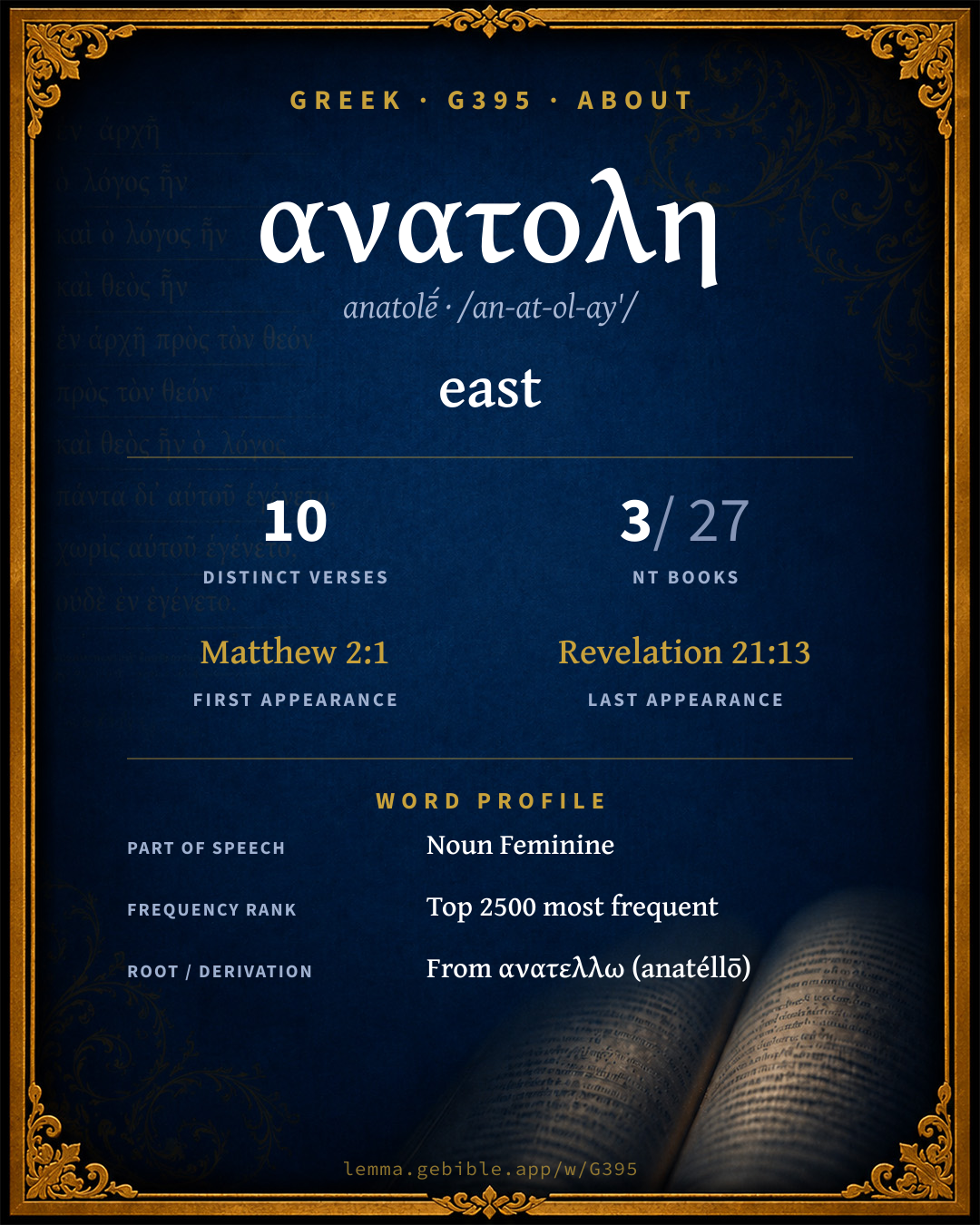
ἀνατολή
east
‘east’ is one of 2 main senses fuller range ↓
Full lexicon entry — Thayer's Greek Lexicon
From Thayer's Greek Lexicon
Where this word appears
See every Genitive-case word in the Greek New Testament →
Grammar key — what these labels mean
Part of speech
- Noun
- A naming word — a person, place, thing, or idea.
Case
- Genitive
- The case of source, possession, or “of” — answers “whose / from what.”
- Dative
- The case of the indirect object, means, or location — “to / for / with / in.”
- Nominative
- The case of the subject (and the predicate nominative).
Gender
- Feminine
- Grammatically feminine.
Number
- Plural
- More than one.
- Singular
- One.
2 verses where G395 appears in the Dative case in the Book of Matthew. Filtered view — show all forms. Click any verse to open its interlinear word-by-word view. Verse text shown in the World English Bible for context — . Each verse’s Greek form is shown with its reference; the English is not keyword-highlighted, since the data carries no word-level English alignment. Use “Compare translations” on any verse to read it across multiple English versions. This concordance covers the Greek New Testament; Septuagint (Greek Old Testament) occurrences of this word are not indexed here.
Matthew
- Matthew 2:2 ἀνατολῇ n dat sg fem "Where is he who is born King of the Jews? For we saw his star in the east, and have come to worship him."
- Matthew 2:9 ἀνατολῇ n dat sg fem They, having heard the king, went their way; and behold, the star, which they saw in the east, went before them, until it came and stood over where the young child was.
About this entry
At a glance — auto-summarized from this page’s data, not written by a person. Every figure links to its source below. This summary describes the numbers; it doesn’t interpret them.
“east” is the headline sense of the Greek noun ανατολη (anatolḗ). It clusters heavily in Matthew, which alone accounts for 50% of its uses. With 10 verses in 3 books, it is an uncommon word in the Greek New Testament. Scripture first uses it in Matthew 2:1. Catalogued under 2 senses, its meaning is not single-sense. The sections below give every sense, occurrence, and version rendering.
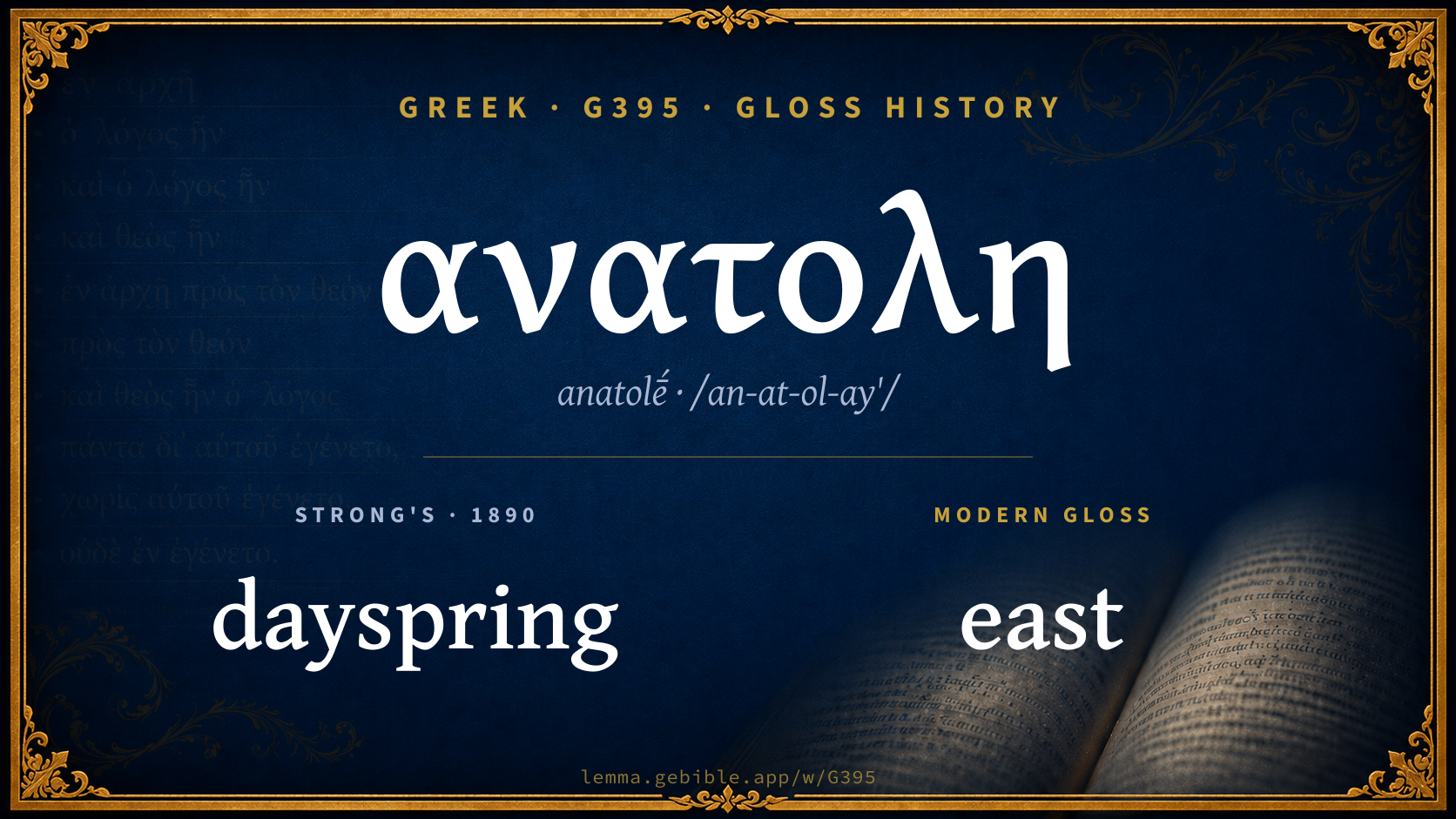
Gloss history
Strong's 1890 vs modern scholarship
About this word
Strong's G395 catalogs a Greek word from the Greek New Testament.
These counts are not copied from any lexicon or concordance. They are computed here, from the morphology-tagged Greek New Testament. What Lemma adds →
- 10
- distinct verses
- The word appears in 10 distinct verses.
- 3 / 27
- NT books
- The word appears in 3 of 27 New Testament books.
- #1,056
- by frequency
- Top 2500 most frequent Greek words (rank 1,056 of 5,347 Greek words by occurrence).
View all 10 occurrences in the concordance →
Most concentrated in
- Matthew 5 verses 50%
- Revelation 3 verses 30%
- Luke 2 verses 20%
By section of the New Testament
By traditional corpus
Conventional, traditional groupings — biblical authorship is debated, so this is a traditional corpus grouping, not an authorship claim. Some books belong to more than one corpus (Luke is in both the Gospels and the Lukan corpus, and so on), so these shares overlap and need not total 100%. Each figure is a share of the word’s 10 distinct verses.
- Gospels 7 verses · 70%
- Johannine 3 verses · 30%
- Revelation 3 verses · 30%
- Lukan (Luke–Acts) 2 verses · 20%
How translations render this word
Counts come from each version’s own published word-to-Strong’s tagging or interlinear alignment — an approximate guide to how each version renders this word, not a word-level alignment the data otherwise carries. Because each total is that version’s own tagged count, the per-version totals vary from one another and need not match the appearance or distinct-verse counts above. These counts may also differ from a printed concordance because Lemma counts each distinctly tagged rendering and does not collapse phrase taggings into a single head-word total. This is a fixed set of word-tagged versions (KJV, ASV, BSB, ULT) and does not change with the reading translation you choose elsewhere. Each version’s license is shown beside its name below (and on Sources).
- King James Version: East 9×
- American Standard Version: East 7×, Sunrising 2×
- Berean Standard Bible: East 9×
- unfoldingWord Literal Text: East 7×, Rising 2×
King James Version Public Domain
Renders G395 across 10 tagged occurrences — most commonly:
Plus 1 rendering that appears only once — usually multi-word phrases or single function words the recovered tagging swept in, not distinct renderings.
American Standard Version Public Domain
Renders G395 across 10 tagged occurrences — most commonly:
Plus 1 rendering that appears only once — usually multi-word phrases or single function words the recovered tagging swept in, not distinct renderings.
Berean Standard Bible Public Domain
Renders G395 across 10 tagged occurrences — most commonly:
Plus 1 rendering that appears only once — usually multi-word phrases or single function words the recovered tagging swept in, not distinct renderings.
unfoldingWord Literal Text CC BY-SA 4.0
Renders G395 across 10 tagged occurrences — most commonly:
Plus 1 rendering that appears only once — usually multi-word phrases or single function words the recovered tagging swept in, not distinct renderings.
Senses in Thayer's
The 2 senses Thayer's distinguishes for this word, in lexicon order (not ranked by frequency or importance). The full entry — with sub-senses — is in the Lexicon Entry tab.
- a rising (of the sun and stars)
- the east (the direction of the sun's rising)
Word origin
Derived from ανατελλω (anatéllō) (G393) — to bring forth.
From G393 ; a rising of light that is dawn (figuratively); by implication the east (also in plural): - dayspring east rising.
— Strong’s Exhaustive Concordance (1890), public domain.
Forms in the corpus
The 4 distinct written forms G395 takes in the Greek New Testament, most frequent first — each parse links to that case’s occurrences in the concordance.
| Form | Parsing | Example | Uses |
|---|---|---|---|
| ἀνατολῶν anatolō̂n | Noun, Genitive, Plural, Feminine | Matthew 2:1 | 4 |
| ἀνατολῆς anatolē̂s | Noun, Genitive, Singular, Feminine | Revelation 7:2 | 3 |
| ἀνατολῇ anatolē̂ | Noun, Dative, Singular, Feminine | Matthew 2:2 | 2 |
| ἀνατολὴ anatolḕ | Noun, Nominative, Singular, Feminine | Luke 1:78 | 1 |
Septuagint usage
The same Greek word ανατολη appears 167 times in the Greek Old Testament (Septuagint), across 154 verses in 21 books.
- 167
- LXX occurrences
- Tagged occurrences of this Greek word in the Septuagint.
- 154
- verses
- Distinct Septuagint verses containing this word.
- 21 / 39
- OT books
- The word appears in 21 of the 39 Old Testament books.
Sample Septuagint occurrences
- Genesis 2:8 ἀνατολή
- Exodus 37:11 ἀνατολή
- Leviticus 1:16 ἀνατολή
- Numbers 2:3 ἀνατολή
- Deuteronomy 3:17 ἀνατολή
- Joshua 1:15 ἀνατολή
- Judges 6:3 ἀνατολή
- 1 Kings 7:13 ἀνατολή
- 2 Kings 10:33 ἀνατολή
- 1 Chronicles 4:39 ἀνατολή
- 2 Chronicles 4:4 ἀνατολή
- Ezra 13:26 ἀνατολή
Septuagint occurrences (same lexeme)
Every verse where the same Strong’s number (G395) appears in the Greek Septuagint — showing the first 50 of 154. Verse text shown in the World English Bible for context; the Greek form is the matched word — the English is not keyword-highlighted.
- Genesis 2:8 ἀνατολή Yahweh God planted a garden eastward, in Eden, and there he put the man whom he had formed.
- Genesis 10:30 ἀνατολή Their dwelling was from Mesha, as you go toward Sephar, the mountain of the east.
- Genesis 11:2 ἀνατολή It happened, as they traveled east, that they found a plain in the land of Shinar; and they lived there.
- Genesis 12:8 ἀνατολή He left from there to the mountain on the east of Bethel, and pitched his tent, having Bethel on the west, and Ai on the east. There he built an altar to Yahweh, and called on the name of Yahweh.
- Genesis 13:11 ἀνατολή So Lot chose the Plain of the Jordan for himself. Lot traveled east, and they separated themselves the one from the other.
- Genesis 13:14 ἀνατολή Yahweh said to Abram, after Lot was separated from him, "Now, lift up your eyes, and look from the place where you are, northward and southward and eastward and westward,
- Genesis 25:6 ἀνατολή but to the sons of the concubines who Abraham had, Abraham gave gifts. He sent them away from Isaac his son, while he yet lived, eastward, to the east country.
- Genesis 28:14 ἀνατολή Your seed will be as the dust of the earth, and you will spread abroad to the west, and to the east, and to the north, and to the south. In you and in your seed will all the families of the earth be blessed.
- Genesis 29:1 ἀνατολή Then Jacob went on his journey, and came to the land of the children of the east.
- Exodus 37:11 ἀνατολή He overlaid it with pure gold, and made a gold molding around it.
- Leviticus 1:16 ἀνατολή and he shall take away its crop with its filth, and cast it beside the altar on the east part, in the place of the ashes.
- Leviticus 16:14 ἀνατολή He shall take some of the blood of the bull, and sprinkle it with his finger on the mercy seat on the east; and before the mercy seat he shall sprinkle some of the blood with his finger seven times.
- Numbers 2:3 ἀνατολή Those who encamp on the east side toward the sunrise shall be of the standard of the camp of Judah, according to their divisions: and the prince of the children of Judah shall be Nahshon the son of Amminadab.
- Numbers 3:38 ἀνατολή Those who encamp before the tabernacle eastward, in front of the Tent of Meeting toward the sunrise, shall be Moses, and Aaron and his sons, keeping the charge of the sanctuary for the charge of the children of Israel. The stranger who comes near shall be put to death.
- Numbers 10:5 ἀνατολή When you blow an alarm, the camps that lie on the east side shall take their journey.
- Numbers 21:11 ἀνατολή They traveled from Oboth, and encamped at Iyeabarim, in the wilderness which is before Moab, toward the sunrise.
- Numbers 23:7 ἀνατολή He took up his parable, and said, From Aram has Balak brought me, The king of Moab from the mountains of the East: Come, curse me Jacob, Come, defy Israel.
- Numbers 32:19 ἀνατολή For we will not inherit with them on the other side of the Jordan, and forward; because our inheritance is fallen to us on this side of the Jordan eastward.
- Numbers 34:3 ἀνατολή then your south quarter shall be from the wilderness of Zin along by the side of Edom, and your south border shall be from the end of the Salt Sea eastward;
- Numbers 34:10 ἀνατολή You shall mark out your east border from Hazar Enan to Shepham;
- Numbers 34:11 ἀνατολή and the border shall go down from Shepham to Riblah, on the east side of Ain; and the border shall go down, and shall reach to the side of the sea of Chinnereth eastward;
- Numbers 34:15 ἀνατολή the two tribes and the half-tribe have received their inheritance beyond the Jordan at Jericho eastward, toward the sunrise.
- Numbers 35:5 ἀνατολή You shall measure outside of the city for the east side two thousand cubits, and for the south side two thousand cubits, and for the west side two thousand cubits, and for the north side two thousand cubits, the city being in the midst. This shall be to them the suburbs of the cities.
- Deuteronomy 3:17 ἀνατολή the Arabah also, and the Jordan and the border [of it], from Chinnereth even to the sea of the Arabah, the Salt Sea, under the slopes of Pisgah eastward.
- Deuteronomy 3:27 ἀνατολή Go up to the top of Pisgah, and lift up your eyes westward, and northward, and southward, and eastward, and see with your eyes: for you shall not go over this Jordan.
- Deuteronomy 4:41 ἀνατολή Then Moses set apart three cities beyond the Jordan toward the sunrise;
- Deuteronomy 4:47 ἀνατολή They took his land in possession, and the land of Og king of Bashan, the two kings of the Amorites, who were beyond the Jordan toward the sunrise;
- Deuteronomy 4:49 ἀνατολή and all the Arabah beyond the Jordan eastward, even to the sea of the Arabah, under the slopes of Pisgah.
- Joshua 1:15 ἀνατολή until Yahweh have given your brothers rest, as [he has given] you, and they also have possessed the land which Yahweh your God gives them: then you shall return to the land of your possession, and possess it, which Moses the servant of Yahweh gave you beyond the Jordan toward the sunrise.
- Joshua 4:19 ἀνατολή The people came up out of the Jordan on the tenth day of the first month, and encamped in Gilgal, on the east border of Jericho.
- Joshua 8:11 ἀνατολή All the people, [even] the [men of] war who were with him, went up, and drew near, and came before the city, and encamped on the north side of Ai: now there was a valley between him and Ai.
- Joshua 11:3 ἀνατολή to the Canaanite on the east and on the west, and the Amorite, and the Hittite, and the Perizzite, and the Jebusite in the hill-country, and the Hivite under Hermon in the land of Mizpah.
- Joshua 11:8 ἀνατολή Yahweh delivered them into the hand of Israel, and they struck them, and chased them to great Sidon, and to Misrephoth Maim, and to the valley of Mizpeh eastward; and they struck them, until they left them none remaining.
- Joshua 12:1 ἀνατολή Now these are the kings of the land, whom the children of Israel struck, and possessed their land beyond the Jordan toward the sunrise, from the valley of the Arnon to Mount Hermon, and all the Arabah eastward:
- Joshua 12:3 ἀνατολή and the Arabah to the sea of Chinneroth, eastward, and to the sea of the Arabah, even the Salt Sea, eastward, the way to Beth-jeshimoth; and on the south, under the slopes of Pisgah:
- Joshua 13:5 ἀνατολή and the land of the Gebalites, and all Lebanon, toward the sunrise, from Baal Gad under Mount Hermon to the entrance of Hamath;
- Joshua 13:8 ἀνατολή With him the Reubenites and the Gadites received their inheritance, which Moses gave them, beyond the Jordan eastward, even as Moses the servant of Yahweh gave them:
- Joshua 13:27 ἀνατολή and in the valley, Beth Haram, and Beth Nimrah, and Succoth, and Zaphon, the rest of the kingdom of Sihon king of Heshbon, the Jordan and the border [of it], to the uttermost part of the sea of Chinnereth beyond the Jordan eastward.
- Joshua 13:32 ἀνατολή These are the inheritances which Moses distributed in the plains of Moab, beyond the Jordan at Jericho, eastward.
- Joshua 15:5 ἀνατολή The east border was the Salt Sea, even to the end of the Jordan. The border of the north quarter was from the bay of the sea at the end of the Jordan;
- Joshua 16:1 ἀνατολή The lot came out for the children of Joseph from the Jordan at Jericho, at the waters of Jericho on the east, even the wilderness, going up from Jericho through the hill-country to Bethel;
- Joshua 16:5 ἀνατολή The border of the children of Ephraim according to their families was [thus]: the border of their inheritance eastward was Ataroth Addar, to Beth Horon the upper;
- Joshua 16:6 ἀνατολή and the border went out westward at Michmethath on the north; and the border turned about eastward to Taanath Shiloh, and passed along it on the east of Janoah;
- Joshua 17:10 ἀνατολή southward it was Ephraim's, and northward it was Manasseh's, and the sea was his border; and they reached to Asher on the north, and to Issachar on the east.
- Joshua 18:7 ἀνατολή For the Levites have no portion among you; for the priesthood of Yahweh is their inheritance: and Gad and Reuben and the half-tribe of Manasseh have received their inheritance beyond the Jordan eastward, which Moses the servant of Yahweh gave them.
- Joshua 18:20 ἀνατολή The Jordan was the border of it on the east quarter. This was the inheritance of the children of Benjamin, by the borders of it round about, according to their families.
- Joshua 19:12 ἀνατολή and it turned from Sarid eastward toward the sunrise to the border of Chisloth Tabor; and it went out to Daberath, and went up to Japhia;
- Joshua 19:13 ἀνατολή and from there it passed along eastward to Gath Hepher, to Eth-kazin; and it went out at Rimmon which stretches to Neah;
- Joshua 19:27 ἀνατολή and it turned toward the sunrise to Beth Dagon, and reached to Zebulun, and to the valley of Iphtah El northward to Beth Emek and Neiel; and it went out to Cabul on the left hand,
- Joshua 19:34 ἀνατολή and the border turned westward to Aznoth Tabor, and went out from there to Hukkok; and it reached to Zebulun on the south, and reached to Asher on the west, and to Judah at the Jordan toward the sunrise.
These are occurrences of the same Greek lexeme (G395) in the Septuagint — not a translation of any one Hebrew word. The store carries no word-level Hebrew↔Greek alignment, so no Hebrew original is asserted here. Counts come from the recovered LXX Strong's tagging — high-frequency vocabulary is well covered, while rare or late forms may be untagged — so they reflect tagged occurrences and may slightly undercount.