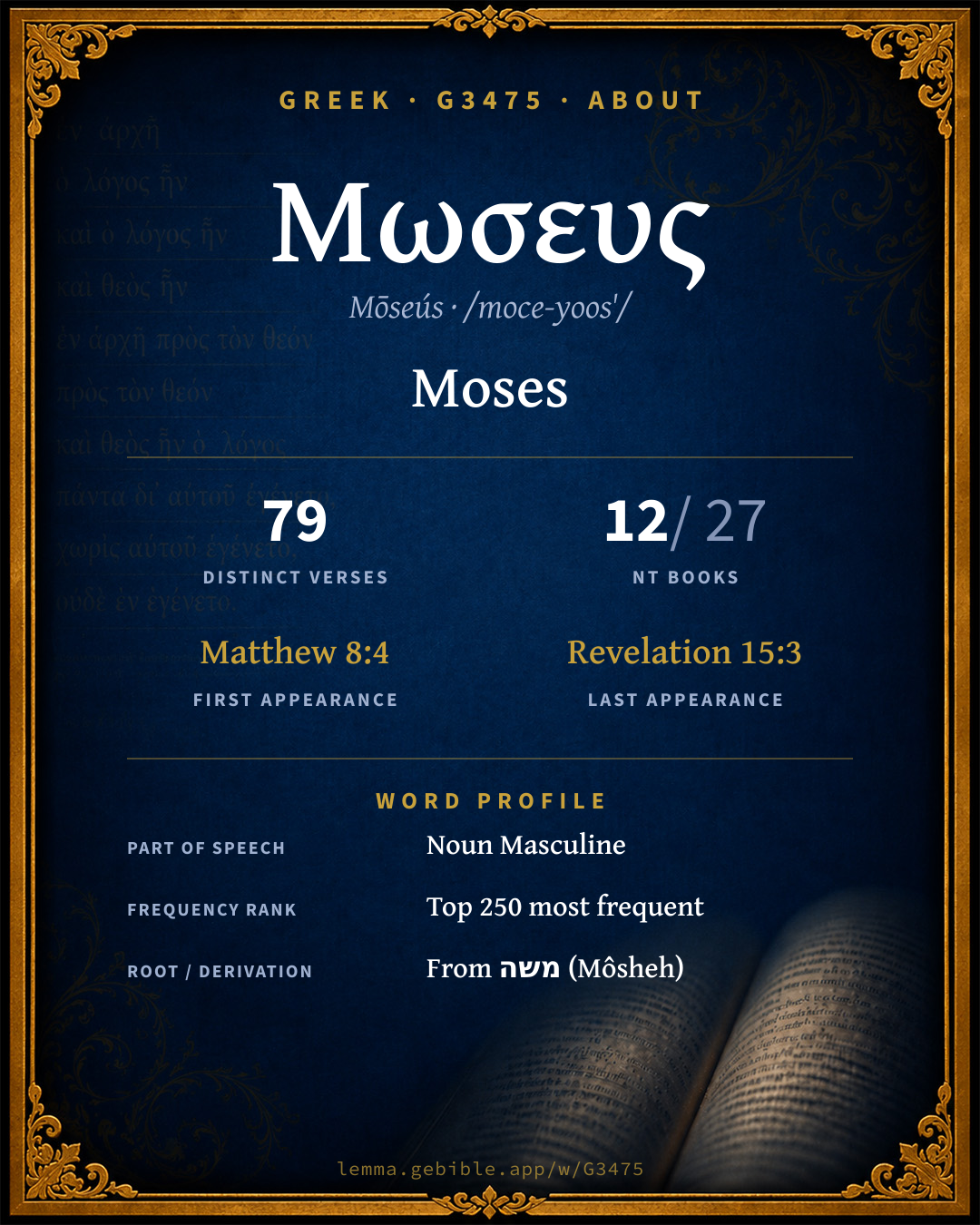
Μωσευς
Moses
Thayer's lists 2 entries for ‘Moses’ fuller range ↓
Full lexicon entry — Thayer's Greek Lexicon
From Thayer's Greek Lexicon
Where this word appears
See every Nominative-case word in the Greek New Testament →
Grammar key — what these labels mean
Part of speech
- Noun
- A naming word — a person, place, thing, or idea.
Case
- Nominative
- The case of the subject (and the predicate nominative).
- Genitive
- The case of source, possession, or “of” — answers “whose / from what.”
- Dative
- The case of the indirect object, means, or location — “to / for / with / in.”
- Accusative
- The case of the direct object and of extent.
Gender
- Masculine
- Grammatically masculine.
Number
- Singular
- One.
7 verses where G3475 appears in the Nominative case in the Book of Hebrews. Filtered view — show all forms. Click any verse to open its interlinear word-by-word view. Verse text shown in the World English Bible for context — . Each verse’s Greek form is shown with its reference; the English is not keyword-highlighted, since the data carries no word-level English alignment. Use “Compare translations” on any verse to read it across multiple English versions. This concordance covers the Greek New Testament; Septuagint (Greek Old Testament) occurrences of this word are not indexed here.
Hebrews
- Hebrews 3:2 Μωϋσῆς n nom sg masc who was faithful to him who appointed him, as also was Moses in all his house.
- Hebrews 3:5 Μωϋσῆς n nom sg masc Moses indeed was faithful in all his house as a servant, for a testimony of those things which were afterward to be spoken,
- Hebrews 7:14 Μωϋσῆς n nom sg masc For it is evident that our Lord has sprung out of Judah, about which tribe Moses spoke nothing concerning priesthood.
- Hebrews 8:5 Μωϋσῆς n nom sg masc who serve a copy and shadow of the heavenly things, even as Moses was warned by God when he was about to make the tabernacle, for he said, "See, you shall make everything according to the pattern that was shown to you on the mountain."
- Hebrews 11:23 Μωϋσῆς n nom sg masc By faith, Moses, when he was born, was hidden for three months by his parents, because they saw that he was a beautiful child, and they were not afraid of the king's commandment.
- Hebrews 11:24 Μωϋσῆς n nom sg masc By faith, Moses, when he had grown up, refused to be called the son of Pharaoh's daughter,
- Hebrews 12:21 Μωϋσῆς n nom sg masc and so fearful was the appearance, that Moses said, "I am terrified and trembling."
About this entry
At a glance — auto-summarized from this page’s data, not written by a person. Every figure links to its source below. This summary describes the numbers; it doesn’t interpret them.
The Greek name Μωσευς centers on the idea of “Moses.” First canonically at Matthew 8:4, it enters the text early. It turns up in 79 verses across 12 books, a moderately common footprint. Dig into 79-verse concordance and the renderings breakdown below.
Gloss history
Strong's 1890 vs modern scholarship
About this word
Strong's G3475 catalogs a Greek word from the Greek New Testament.
These counts are not copied from any lexicon or concordance. They are computed here, from the morphology-tagged Greek New Testament. What Lemma adds →
- 79
- distinct verses
- The word appears in 79 distinct verses.
- 12 / 27
- NT books
- The word appears in 12 of 27 New Testament books.
- #211
- by frequency
- Top 250 most frequent Greek words (rank 211 of 5,347 Greek words by occurrence).
View all 79 occurrences in the concordance →
By section of the New Testament
By traditional corpus
Conventional, traditional groupings — biblical authorship is debated, so this is a traditional corpus grouping, not an authorship claim. Some books belong to more than one corpus (Luke is in both the Gospels and the Lukan corpus, and so on), so these shares overlap and need not total 100%. Each figure is a share of the word’s 79 distinct verses.
- Gospels 37 verses · 47%
- Lukan (Luke–Acts) 29 verses · 37%
- Johannine 13 verses · 16%
- Hebrews 11 verses · 14%
- Pauline corpus 10 verses · 13%
- General (Catholic) Epistles 1 verse · 1%
- Revelation 1 verse · 1%
How translations render this word
Counts come from each version’s own published word-to-Strong’s tagging or interlinear alignment — an approximate guide to how each version renders this word, not a word-level alignment the data otherwise carries. Because each total is that version’s own tagged count, the per-version totals vary from one another and need not match the appearance or distinct-verse counts above. These counts may also differ from a printed concordance because Lemma counts each distinctly tagged rendering and does not collapse phrase taggings into a single head-word total. This is a fixed set of word-tagged versions (KJV, ASV, BSB, ULT) and does not change with the reading translation you choose elsewhere. Each version’s license is shown beside its name below (and on Sources).
- King James Version: Moses 75×, Moses' 3×, Did moses 2×
- American Standard Version: Moses 78×
- Berean Standard Bible: Moses 76×, Did moses 2×
- unfoldingWord Literal Text: Moses 80×
King James Version Public Domain
Renders G3475 across 80 tagged occurrences — most commonly:
American Standard Version Public Domain
Renders G3475 across 80 tagged occurrences — most commonly:
Plus 2 renderings that appear only once — usually multi-word phrases or single function words the recovered tagging swept in, not distinct renderings.
Berean Standard Bible Public Domain
Renders G3475 across 79 tagged occurrences — most commonly:
Plus 1 rendering that appears only once — usually multi-word phrases or single function words the recovered tagging swept in, not distinct renderings. Not rendered by a distinct English word in 1 further occurrence.
unfoldingWord Literal Text CC BY-SA 4.0
Renders G3475 across 80 tagged occurrences — most commonly:
Senses in Thayer's
The 2 senses Thayer's distinguishes for this word, in lexicon order (not ranked by frequency or importance). The full entry — with sub-senses — is in the Lexicon Entry tab.
- Moses = "drawing out"
- the legislator of the Jewish people and in a certain sense the founder of the Jewish religion. He wrote the first five…
Word origin
Derived from משה (Môsheh) (H4872) — Moses.
Of hebrew origin [ H4872 ]; Moseus Moses or Mouses (that is Mosheh ) the hebrew lawgiver : - Moses.
— Strong’s Exhaustive Concordance (1890), public domain.
Forms in the corpus
The 6 distinct written forms G3475 takes in the Greek New Testament, most frequent first — each parse links to that case’s occurrences in the concordance.
| Form | Parsing | Example | Uses |
|---|---|---|---|
| Μωϋσῆς Mōÿsē̂s | Noun, Nominative, Singular, Masculine | Matthew 8:4 | 43 |
| Μωϋσέως Mōÿséōs | Noun, Genitive, Singular, Masculine | Matthew 23:2 | 23 |
| Μωϋσεῖ Mōÿseî | Noun, Dative, Singular, Masculine | Matthew 17:4 | 8 |
| Μωϋσῆν Mōÿsē̂n | Noun, Accusative, Singular, Masculine | Acts 6:11 | 4 |
| Μωϋσέα Mōÿséa | Noun, Accusative, Singular, Masculine | Luke 16:29 | 1 |
| Μωϋσῇ Mōÿsē̂ | Noun, Dative, Singular, Masculine | Acts 7:44 | 1 |
Same root — word family
Other Thayer's entries built from the same root as G3475, grouped by Strong’s listed origin. These share a root / origin per the lexicon — not necessarily a shared meaning. Each links to that word’s own entry.
Derives from
Proper names from this root
People and places named from this root — a name, not an additional meaning of the word.
Compare all same-root words → 2 of the same-root words are proper names (people or places). They share a root, not necessarily a meaning.
Bible dictionary
Public-domain dictionary articles matched to this entry by name (Moses). A biblical name can be shared by more than one person or place, so an article may treat several.
Easton's Bible Dictionary · M. G. Easton, 1897
Drawn (or Egypt. mesu, "son;" hence Rameses, royal son). On the invitation of Pharaoh (Gen. 45:17-25), Jacob and his sons went down into Egypt. This immigration took place probably about 350 years before the birth of Moses. Some centuries before Joseph, Egypt had been conquered by a pastoral Semitic race from Asia, the Hyksos, who brought into cruel subjection the native Egyptians, who were an African race. Jacob and his retinue were accustomed to a shepherd's life, and on their arrival in Egypt were received with favour by the king, who assigned them the "best of the land", the land of Goshen, to dwell in. The Hyksos or "shepherd" king who thus showed favour to Joseph and his family was in all probability the Pharaoh Apopi (or Apopis).
Thus favoured, the Israelites began to "multiply exceedingly" (Gen. 47:27), and extended to the west and south. At length the supremacy of the Hyksos came to an end. The descendants of Jacob were allowed to retain their possession of Goshen undisturbed, but after the death of Joseph their position was not so favourable. The Egyptians began to despise them, and the period of their "affliction" (Gen. 15:13) commenced. They were sorely oppressed. They continued, however, to increase in numbers, and "the land was filled with them" (Ex. 1:7). The native Egyptians regarded them with suspicion, so that they felt all the hardship of a struggle for existence.
In process of time "a king [probably Seti I.] arose who knew not Joseph" (Ex. 1:8). (See PHARAOH.) The circumstances of the country were such that this king thought it necessary to weaken his Israelite subjects by oppressing them, and by degrees reducing their number. They were accordingly made public slaves, and were employed in connection with his numerous buildings, especially in the erection of store-cities, temples, and palaces. The children of Israel were made to serve with rigour. Their lives were made bitter with hard bondage, and "all their service, wherein they made them serve, was with rigour" (Ex. 1:13, 14). But this cruel oppression had not the result expected of reducing their number. On the contrary, "the more the Egyptians afflicted them, the more they multiplied and grew" (Ex. 1:12).
The king next tried, through a compact secretly made with the guild of midwives, to bring about the destruction of all the Hebrew male children that might be born. But the king's wish was not rigorously enforced; the male children were spared by the midwives, so that "the people multiplied" more than ever. Thus baffled, the king issued a public proclamation calling on the people to put to death all the Hebrew male children by casting them into the river (Ex. 1:22). But neither by this edict was the king's purpose effected.
One of the Hebrew households into which this cruel edict of the king brought great alarm was that of Amram, of the family of the Kohathites (Ex. 6:16-20), who with his wife Jochebed and two children, Miriam, a girl of perhaps fifteen years of age, and Aaron, a boy of three years, resided in or near Memphis, the capital city of that time. In this quiet home a male child was born (B.C. 1571). His mother concealed him in the house for three months from the knowledge of the civic authorities. But when the task of concealment became difficult, Jochebed contrived to bring her child under the notice of the daughter of the king by constructing for him an ark of bulrushes, which she laid among the flags which grew on the edge of the river at the spot where the princess was wont to come down and bathe. Her plan was successful. The king's daughter "saw the child; and behold the child wept." The princess (see PHARAOH'S DAUGHTER ) sent Miriam, who was standing by, to fetch a nurse. She went and brought the mother of the child, to whom the princess said, "Take this child away, and nurse it for me, and I will give thee thy wages." Thus Jochebed's child, whom the princess called "Moses", i.e., "Saved from the water" (Ex. 2:10), was ultimately restored to her.
As soon as the natural time for weaning the child had come, he was transferred from the humble abode of his father to the royal palace, where he was brought up as the adopted son of the princess, his mother probably accompanying him and caring still for him. He grew up amid all the grandeur and excitement of the Egyptian court, maintaining, however, probably a constant fellowship with his mother, which was of the highest importance as to his religious belief and his interest in his "brethren." His education would doubtless be carefully attended to, and he would enjoy all the advantages of training both as to his body and his mind. He at length became "learned in all the wisdom of the Egyptians" (Acts 7:22). Egypt had then two chief seats of learning, or universities, at one of which, probably that of Heliopolis, his education was completed. Moses, being now about twenty years of age, spent over twenty more before he came into prominence in Bible history. These twenty years were probably spent in military service. There is a tradition recorded by Josephus that he took a lead in the war which was then waged between Egypt and Ethiopia, in which he gained renown as a skilful general, and became "mighty in deeds" (Acts 7:22).
After the termination of the war in Ethiopia, Moses returned to the Egyptian court, where he might reasonably have expected to be loaded with honours and enriched with wealth. But "beneath the smooth current of his life hitherto, a life of alternate luxury at the court and comparative hardness in the camp and in the discharge of his military duties, there had lurked from childhood to youth, and from youth to manhood, a secret discontent, perhaps a secret ambition. Moses, amid all his Egyptian surroundings, had never forgotten, had never wished to forget, that he was a Hebrew." He now resolved to make himself acquainted with the condition of his countrymen, and "went out unto his brethren, and looked upon their burdens" (Ex. 2:11). This tour of inspection revealed to him the cruel oppression and bondage under which they everywhere groaned, and could not fail to press on him the serious consideration of his duty regarding them. The time had arrived for his making common cause with them, that he might thereby help to break their yoke of bondage. He made his choice accordingly (Heb. 11:25-27), assured that God would bless his resolution for the welfare of his people. He now left the palace of the king and took up his abode, probably in his father's house, as one of the Hebrew people who had for forty years been suffering cruel wrong at the hands of the Egyptians.
He could not remain indifferent to the state of things around him, and going out one day among the people, his indignation was roused against an Egyptian who was maltreating a Hebrew. He rashly lifted up his hand and slew the Egyptian, and hid his body in the sand. Next day he went out again and found two Hebrews striving together. He speedily found that the deed of the previous day was known. It reached the ears of Pharaoh (the "great Rameses," Rameses II.), who "sought to slay Moses" (Ex. 2:15). Moved by fear, Moses fled from Egypt, and betook himself to the land of Midian, the southern part of the peninsula of Sinai, probably by much the same route as that by which, forty years afterwards, he led the Israelites to Sinai. He was providentially led to find a new home with the family of Reuel, where he remained for forty years (Acts 7:30), under training unconsciously for his great life's work.
Suddenly the angel of the Lord appeared to him in the burning bush (Ex. 3), and commissioned him to go down to Egypt and "bring forth the children of Israel" out of bondage. He was at first unwilling to go, but at length he was obedient to the heavenly vision, and left the land of Midian (4:18-26). On the way he was met by Aaron (q.v.) and the elders of Israel (27-31). He and Aaron had a hard task before them; but the Lord was with them (ch. 7-12), and the ransomed host went forth in triumph. (See EXODUS.) After an eventful journey to and fro in the wilderness, we see them at length encamped in the plains of Moab, ready to cross over the Jordan into the Promised Land. There Moses addressed the assembled elders (Deut. 1:1-4; 5:1-26:19; 27:11-30:20), and gives the people his last counsels, and then rehearses the great song (Deut. 32), clothing in fitting words the deep emotions of his heart at such a time, and in review of such a marvellous history as that in which he had acted so conspicious a part. Then, after blessing the tribes
(33), he ascends to "the mountain of Nebo (q.v.), to the top of Pisgah, that is over against Jericho" (34:1), and from thence he surveys the land. "Jehovah shewed him all the land of Gilead, unto Dan, and all Naphtali, and the land of Ephraim, and Manasseh, and all the land of Judah, unto the utmost sea, and the south, and the plain of the valley of Jericho, the city of palm trees, unto Zoar" (Deut. 34:2-3), the magnificient inheritance of the tribes of whom he had been so long the leader; and there he died, being one hundred and twenty years old, according to the word of the Lord, and was buried by the Lord "in a valley in the land of Moab, over against Beth-peor" (34:6). The people mourned for him during thirty days.
Thus died "Moses the man of God" (Deut. 33:1; Josh. 14:6). He was distinguished for his meekness and patience and firmness, and "he endured as seeing him who is invisible." "There arose not a prophet since in Israel like unto Moses, whom the Lord knew face to face, in all the signs and the wonders, which the Lord sent him to do in the land of Egypt to Pharaoh, and to all his servants, and to all his land, and in all that mighty hand, and in all the great terror which Moses shewed in the sight of all Israel" (Deut. 34:10-12).
The name of Moses occurs frequently in the Psalms and Prophets as the chief of the prophets.
In the New Testament he is referred to as the representative of the law and as a type of Christ (John 1:17; 2 Cor. 3:13-18; Heb. 3:5, 6). Moses is the only character in the Old Testament to whom Christ likens himself (John 5:46; comp. Deut. 18:15, 18, 19; Acts 7:37). In Heb. 3:1-19 this likeness to Moses is set forth in various particulars.
In Jude 1:9 mention is made of a contention between Michael and the devil about the body of Moses. This dispute is supposed to have had reference to the concealment of the body of Moses so as to prevent idolatry.
Smith's Bible Dictionary · William Smith, 1863
(Heb. Mosheh, "drawn," i.e. from the water; in the Coptic it means "saved from the water"), the legislator of the Jewish people, and in a certain sense the founder of the Jewish religion. The immediate pedigree of Moses is as follows: Levi was the father of: Gershon-- Kohath-- Merari Kohath was the father of: Amram = Jochebed Amram = Jochebed was the father of: Hur = Miriam-- Aaron = Elisheba-- Moses = Zipporah Aaron = Elisheba was the father of: Nadab-- Abihu-- Eleazar-- Ithamar Eleazar was the father of: Phineas Moses = Zipporah was the father of: Gershom-- Eliezer Gershom was the father of: Jonathan The history of Moses naturally divides itself into three periods of 40 years each. Moses was born at Goshen, In Egypt, B.C. 1571. The story of his birth is thoroughly Egyptian in its scene. His mother made extraordinary efforts for his preservation from the general destruction of the male children of Israel. For three months the child was concealed in the house. Then his mother placed him in a small boat or basket of papyrus, closed against the water by bitumen. This was placed among the aquatic vegetation by the side of one of the canals of the Nile. The sister lingered to watch her brother's fate. The Egyptian princess, who, tradition says, was a childless wife, came down to bathe in the sacred river. Her attendant slaves followed her. She saw the basket in the flags, and despatched divers, who brought it. It was opened, and the cry of the child moved the princess to compassion. She determined to rear it as her own. The sister was at hand to recommend a Hebrew nurse, the child's own mother. here was the first part of Moses' training,--a training at home in the true religion, in faith in God, in the promises to his nation, in the life of a saint,--a training which he never forgot, even amid the splendors and gilded sin of Pharaoh's court. The child was adopted by the princess. From this time for many years Moses must be considered as an Egyptian. In the Pentateuch this period is a blank, but in the New Testament he is represented as "learned in all the wisdom of the Egyptians," and as "mighty in words and deeds." (Acts 7:22) this was the second part of Moses' training. The second period of Moses' life began when he was forty years old. Seeing the sufferings of his people, Moses determined to go to them as their helper, and made his great life-choice, "choosing rather to suffer affliction with the people of God than to enjoy the pleasures of sin for a season; esteeming the reproach of Christ greater riches than the treasures in Egypt." (Hebrews 11:25,26) Seeing an Israelite suffering the bastinado from an Egyptian, and thinking that they were alone, he slew the Egyptian, and buried the corpse in the sand. But the people soon showed themselves unfitted as yet to obtain their freedom, nor was Moses yet fitted to be their leader. He was compelled to leave Egypt when the slaying of the Egyptian became known, and he fled to the land of Midian, in the southern and southeastern part of the Sinai peninsula. There was a famous well ("the well,") (Exodus 2:15) surrounded by tanks for the watering of the flocks of the Bedouin herdsmen. By this well the fugitive seated himself and watched the gathering of the sheep. There were the Arabian shepherds, and there were also seven maidens, whom the shepherds rudely drove away from the water. The chivalrous spirit which had already broken forth in behalf of his oppressed countrymen broke forth again in behalf of the distressed maidens. They returned unusually soon to their father, Jethro, and told him of their adventure. Moses, who up to this time had been "an Egyptian," (Exodus 2:19) now became for a time an Arabian. He married Zipporah, daughter of his host, to whom he also became the slave and shepherd. (Exodus 2:21; 3:1) Here for forty years Moses communed with God and with nature, escaping from the false ideas taught him in Egypt, and sifting out the truths that were there. This was the third process of his training for his work; and from this training he learned infinitely more than from Egypt. Stanely well says, after enumerating what the Israelites derived from Egypt, that the contrast was always greater than the likeness. This process was completed when God met him on Horeb, appearing in a burning bush, and, communicating with him, appointed him to be the leader and deliverer of his people. Now begins the third period of forty years in Moses' life. He meets Aaron, his next younger brother, whom God permitted to be the spokesman, and together they return to Goshen in Egypt. From this time the history of Moses is the history of Israel for the next forty years. Aaron spoke and acted for Moses, and was the permanent inheritor of the sacred staff of power. But Moses was the inspiring soul behind. he is incontestably the chief personage of the history, in a sense in which no one else is described before or since. He was led into a closer communion with the invisible world than was vouchsafed to any other in the Old Testament. There are two main characters in which he appears--as a leader and as a prophet. (1) As a leader, his life divides itself into the three epochs--the march to Sinai; the march from Sinai to Kadesh; and the conquest of the transjordanic kingdoms. On approaching Palestine the office of the leader becomes blended with that of the general or the conqueror. By Moses the spies were sent to explore the country. Against his advice took place the first disastrous battle at hormah. To his guidance is ascribed the circuitous route by which the nation approached Palestine from the east, and to his generalship the two successful campaigns in which Sihon and Og were defeated. The narrative is told so briefly that we are in danger of forgetting that at this last stage of his life Moses must have been as much a conqueror and victorious soldier as was Joshua. (2) His character as a prophet is, from the nature of the case, more distinctly brought out. He is the first as he is the greatest example of a prophet in the Old Testament. His brother and sister were both endowed with prophetic gifts. The seventy elders, and Eldad and Medad also, all "prophesied." (Numbers 11:25-27) But Moses rose high above all these. With him the divine revelations were made "mouth to mouth." (Numbers 12:8) Of the special modes of this more direct communication, four great examples are given, corresponding to four critical epochs in his historical career. (a) The appearance of the divine presence in the flaming acacia tree. (Exodus 3:2-6) (b) In the giving of the law from Mount Sinai, the outward form of the revelation was a thick darkness as of a thunder-cloud, out of which proceeded a voice. (Exodus 19:19; 20:21) on two occasions he is described as having penetrated within the darkness. (Exodus 24:18; 34:28) (c) It was nearly at the close of these communications in the mountains of Sinai that an especial revelation of God was made to him personally. (Exodus 33:21,22; 34:5,6,7) God passed before him. (d) The fourth mode of divine manifestation was that which is described as beginning at this juncture, and which was maintained with more or less continuity through the rest of his career. (Exodus 33:7) It was the communication with God in the tabernacle from out the pillar of cloud and fire. There is another form of Moses' prophetic gift, viz., the poetical form of composition which characterizes the Jewish prophecy generally. These poetical utterances are--
+ "The song which Moses and the children of Israel sung" (after the passage of the Red Sea). (Exodus 15:1-19) + A fragment of the war-song against Amalek. (Exodus 17:16) + A fragment of lyrical burst of indignation. (Exodus 32:18) + The fragments of war-songs, probably from either him or his immediate prophetic followers, in (Numbers 21:14,15,27-30) preserved in the "book of the wars of Jehovah," (Numbers 21:14) and the address to the well. ch. (Numbers 21:14) and the address to the well. ch. (Numbers 21:16,17,18) + The song of Moses, (32:1-43) setting forth the greatness and the failings of Israel. + The blessing of Moses on the tribes, (33:1-29) + The 90th Psalm, "A prayer of Moses, the man of God." The title, like all the titles of the psalms, is of doubtful authority, and the psalm has often been referred to a later author. Character .--The prophetic office of Moses can only be fully considered in connection with his whole character and appearance. (Hosea 12:13) He was in a sense peculiar to himself the founder and representative of his people; and in accordance with this complete identification of himself with his nation is the only strong personal trait which we are able to gather from his history. (Numbers 12:3) The word "meek" is hardly an adequate reading of the Hebrew term, which should be rather "much enduring." It represents what we should now designate by the word "disinterested." All that is told of him indicates a withdrawal of himself, a preference of the cause of his nation to his own interests, which makes him the most complete example of Jewish patriotism. (He was especially a man of prayer and of faith, of wisdom, courage and patience.) In exact conformity with his life is the account of his end. The book of Deuteronomy describes, and is, the long last farewell of the prophet to his people. This takes place on the first day of the eleventh month of the fortieth year of the wanderings, in the plains of Moab. (1:3,5) Moses is described as 120 years of age, but with his sight and his freshness of strength unabated. (34:7) Joshua is appointed his successor. The law is written out and ordered to be deposited in the ark. ch. 31. The song and the blessing of the tribes conclude the farewell. chs. 32,33. And then comes the mysterious close. He is told that he is to see the good land beyond the Jordan, but not to possess it himself. He ascends the mount of Pisgah and stands on Nebo, one of its summits, and surveys the four great masses of Palestine west of the Jordan, so far as it can be discerned from that height. The view has passes into a proverb for all nations. "So Moses the servant of Jehovah died there in the land of Moab, according to the word of Jehovah. And he buried him in a 'ravine' in the land of Moab, 'before' Beth-peor: but no man knoweth of his sepulchre unto this day... And the children of Israel wept for Moses in the plains of Moab thirty days." (34:5,6,8) This is all that is said in the sacred record. (This burial was thus hidden probably-- (1) To preserve his grave from idolatrous worship or superstitious reverence; and (2) Because it may be that God did not intend to leave his body to corruption, but to prepare it, as he did the body of Elijah, so that Moses could in his spiritual body meet Christ, together with Elijah, on the mount of transfiguration.) Moses is spoken of as a likeness of Christ; and as this is a point of view which has been almost lost in the Church, compared with the more familiar comparisons of Christ to Adam, David, Joshua, and yet has as firm a basis in fact as any of them, it may be well to draw it out in detail.
(1) Moses is, as it would seem, the only character of the Old Testament to whom Christ expressly likens himself: "Moses wrote of me." (John 5:46) It suggests three main points of likeness: (a) Christ was, like Moses, the great prophet of the people--the last, as Moses was the first. (b) Christ, like Moses, is a lawgiver: "Him shall ye hear." (c) Christ, like Moses, was a prophet out of the midst of the nation, "from their brethren." As Moses was the entire representative of his people, feeling for them more than for himself, absorbed in their interests, hopes and fears, so, with reverence be it said, was Christ. (2) In (Hebrews 3:1-19; 12:24-29; Acts 7:37) Christ is described, though more obscurely, as the Moses of the new dispensation--as the apostle or messenger or mediator of God to the people--as the controller and leader of the flock or household of God. (3) The details of their lives are sometimes, though not often, compared. (Acts 7:24-28; 35) In (Jude 1:9) is an allusion to an altercation between Michael and Satan over the body of Moses. It probably refers to a lost apocryphal book, mentioned by Origen, called the "Ascension" or "Assumption of Moses." Respecting the books of Moses, see Pentateuch, The.
Hitchcock's Bible Names Dictionary · Roswell D. Hitchcock, 1869
taken out; drawn forth
Classic public-domain reference works; full attribution on Sources.
Septuagint usage
The same Greek word Μωσευς appears 780 times in the Greek Old Testament (Septuagint), across 706 verses in 17 books.
- 780
- LXX occurrences
- Tagged occurrences of this Greek word in the Septuagint.
- 706
- verses
- Distinct Septuagint verses containing this word.
- 17 / 39
- OT books
- The word appears in 17 of the 39 Old Testament books.
Sample Septuagint occurrences
- Exodus 2:10 μωυσῆς
- Leviticus 1:1 μωυσῆς
- Numbers 1:1 μωυσῆς
- Deuteronomy 1:1 μωυσῆς
- Joshua 1:1 μωυσῆς
- Judges 1:16 μωυσῆς
- 1 Samuel 12:6 μωυσῆς
- 1 Kings 2:3 μωυσής
- 2 Kings 14:6 μωυσῆς
- 1 Chronicles 5:29 μωυσῆς
- 2 Chronicles 1:3 μωυσῆς
- Ezra 3:2 μωυσῆς
Septuagint occurrences (same lexeme)
Every verse where the same Strong’s number (G3475) appears in the Greek Septuagint — showing the first 50 of 706. Verse text shown in the World English Bible for context; the Greek form is the matched word — the English is not keyword-highlighted.
- Exodus 2:10 μωυσῆς The child grew, and she brought him to Pharaoh's daughter, and he became her son. She named him Moses, and said, "Because I drew him out of the water."
- Exodus 2:11 μωυσῆς It happened in those days, when Moses had grown up, that he went out to his brothers, and looked at their burdens. He saw an Egyptian striking a Hebrew, one of his brothers.
- Exodus 2:14 μωυσῆς He said, "Who made you a prince and a judge over us? Do you plan to kill me, as you killed the Egyptian?" Moses was afraid, and said, "Surely this thing is known."
- Exodus 2:15 μωυσῆς Now when Pharaoh heard this thing, he sought to kill Moses. But Moses fled from the face of Pharaoh, and lived in the land of Midian, and he sat down by a well.
- Exodus 2:17 μωυσῆς The shepherds came and drove them away; but Moses stood up and helped them, and watered their flock.
- Exodus 2:21 μωυσῆς Moses was content to dwell with the man. He gave Moses Zipporah, his daughter.
- Exodus 2:22 μωυσῆς She bore a son, and he named him Gershom, for he said, "I have lived as a foreigner in a foreign land."
- Exodus 3:1 μωυσῆς Now Moses was keeping the flock of Jethro, his father-in-law, the priest of Midian, and he led the flock to the back of the wilderness, and came to God's mountain, to Horeb.
- Exodus 3:3 μωυσῆς Moses said, I will turn aside now, and see this great sight, why the bush is not burnt.
- Exodus 3:4 μωυσῆς When Yahweh saw that he turned aside to see, God called to him out of the midst of the bush, and said, "Moses! Moses!" He said, "Here I am."
- Exodus 3:6 μωυσῆς Moreover he said, "I am the God of your father, the God of Abraham, the God of Isaac, and the God of Jacob." Moses hid his face; for he was afraid to look at God.
- Exodus 3:7 μωυσῆς Yahweh said, "I have surely seen the affliction of my people who are in Egypt, and have heard their cry because of their taskmasters, for I know their sorrows.
- Exodus 3:11 μωυσῆς Moses said to God, "Who am I, that I should go to Pharaoh, and that I should bring forth the children of Israel out of Egypt?"
- Exodus 3:12 μωυσῆς He said, "Certainly I will be with you. This will be the token to you, that I have sent you: when you have brought forth the people out of Egypt, you shall serve God on this mountain."
- Exodus 3:13 μωυσῆς Moses said to God, "Behold, when I come to the children of Israel, and tell them, 'The God of your fathers has sent me to you;' and they ask me, 'What is his name?' What should I tell them?"
- Exodus 3:14 μωυσῆς God said to Moses, "I AM WHO I AM," and he said, "You shall tell the children of Israel this: "I AM has sent me to you."
- Exodus 3:15 μωυσῆς God said moreover to Moses, "You shall tell the children of Israel this, 'Yahweh, the God of your fathers, the God of Abraham, the God of Isaac, and the God of Jacob, has sent me to you.' This is my name forever, and this is my memorial to all generations.
- Exodus 4:1 μωυσῆς Moses answered, "But, behold, they will not believe me, nor listen to my voice; for they will say, 'Yahweh has not appeared to you.'"
- Exodus 4:3 μωυσῆς He said, "Throw it on the ground." He threw it on the ground, and it became a snake; and Moses ran away from it.
- Exodus 4:4 μωυσῆς Yahweh said to Moses, "Put forth your hand, and take it by the tail." He put forth his hand, and laid hold of it, and it became a rod in his hand.
- Exodus 4:10 μωυσῆς Moses said to Yahweh, "Oh, Lord, I am not eloquent, neither before now, nor since you have spoken to your servant; for I am slow of speech, and of a slow tongue."
- Exodus 4:11 μωυσῆς Yahweh said to him, "Who made man's mouth? Or who makes one mute, or deaf, or seeing, or blind? Isn't it I, Yahweh?
- Exodus 4:13 μωυσῆς He said, "Oh, Lord, please send someone else."
- Exodus 4:14 μωυσῆς The anger of Yahweh was kindled against Moses, and he said, "What about Aaron, your brother, the Levite? I know that he can speak well. Also, behold, he comes forth to meet you. When he sees you, he will be glad in his heart.
- Exodus 4:18 μωυσῆς Moses went and returned to Jethro his father-in-law, and said to him, "Please let me go and return to my brothers who are in Egypt, and see whether they are still alive." Jethro said to Moses, "Go in peace."
- Exodus 4:19 μωυσῆς Yahweh said to Moses in Midian, "Go, return into Egypt; for all the men who sought your life are dead."
- Exodus 4:20 μωυσῆς Moses took his wife and his sons, and set them on a donkey, and he returned to the land of Egypt. Moses took God's rod in his hand.
- Exodus 4:21 μωυσῆς Yahweh said to Moses, "When you go back into Egypt, see that you do before Pharaoh all the wonders which I have put in your hand, but I will harden his heart and he will not let the people go.
- Exodus 4:27 μωυσῆς Yahweh said to Aaron, "Go into the wilderness to meet Moses." He went, and met him on God's mountain, and kissed him.
- Exodus 4:28 μωυσῆς Moses told Aaron all the words of Yahweh with which he had sent him, and all the signs with which he had charged him.
- Exodus 4:29 μωυσῆς Moses and Aaron went and gathered together all the elders of the children of Israel.
- Exodus 4:30 μωυσῆς Aaron spoke all the words which Yahweh had spoken to Moses, and did the signs in the sight of the people.
- Exodus 5:1 μωυσῆς Afterward Moses and Aaron came, and said to Pharaoh, "This is what Yahweh, the God of Israel, says, 'Let my people go, that they may hold a feast to me in the wilderness.'"
- Exodus 5:4 μωυσῆς The king of Egypt said to them, "Why do you, Moses and Aaron, take the people from their work? Get back to your burdens!"
- Exodus 5:20 μωυσῆς They met Moses and Aaron, who stood in the way, as they came forth from Pharaoh:
- Exodus 5:22 μωυσῆς Moses returned to Yahweh, and said, "Lord, why have you brought trouble on this people? Why is it that you have sent me?
- Exodus 6:1 μωυσῆς Yahweh said to Moses, "Now you shall see what I will do to Pharaoh, for by a strong hand he shall let them go, and by a strong hand he shall drive them out of his land."
- Exodus 6:2 μωυσῆς God spoke to Moses, and said to him, "I am Yahweh;
- Exodus 6:9 μωυσῆς Moses spoke so to the children of Israel, but they didn't listen to Moses for anguish of spirit, and for cruel bondage.
- Exodus 6:10 μωυσῆς Yahweh spoke to Moses, saying,
- Exodus 6:12 μωυσῆς Moses spoke before Yahweh, saying, "Behold, the children of Israel haven't listened to me. How then shall Pharaoh listen to me, who am of uncircumcised lips?"
- Exodus 6:13 μωυσῆς Yahweh spoke to Moses and to Aaron, and gave them a charge to the children of Israel, and to Pharaoh king of Egypt, to bring the children of Israel out of the land of Egypt.
- Exodus 6:20 μωυσῆς Amram took Jochebed his father's sister to himself as wife; and she bore him Aaron and Moses: and the years of the life of Amram were a hundred and thirty-seven years.
- Exodus 6:26 μωυσῆς These are that Aaron and Moses, to whom Yahweh said, "Bring out the children of Israel from the land of Egypt according to their hosts."
- Exodus 6:27 μωυσῆς These are those who spoke to Pharaoh king of Egypt, to bring out the children of Israel from Egypt. These are that Moses and Aaron.
- Exodus 6:28 μωυσῆς It happened on the day when Yahweh spoke to Moses in the land of Egypt,
- Exodus 6:29 μωυσῆς that Yahweh spoke to Moses, saying, "I am Yahweh. Speak to Pharaoh king of Egypt all that I speak to you."
- Exodus 6:30 μωυσῆς Moses said before Yahweh, "Behold, I am of uncircumcised lips, and how shall Pharaoh listen to me?"
- Exodus 7:1 μωυσῆς Yahweh said to Moses, "Behold, I have made you as God to Pharaoh; and Aaron your brother shall be your prophet.
- Exodus 7:6 μωυσῆς Moses and Aaron did so. As Yahweh commanded them, so they did.
These are occurrences of the same Greek lexeme (G3475) in the Septuagint — not a translation of any one Hebrew word. The store carries no word-level Hebrew↔Greek alignment, so no Hebrew original is asserted here. Counts come from the recovered LXX Strong's tagging — high-frequency vocabulary is well covered, while rare or late forms may be untagged — so they reflect tagged occurrences and may slightly undercount.