
Exodus 6:28

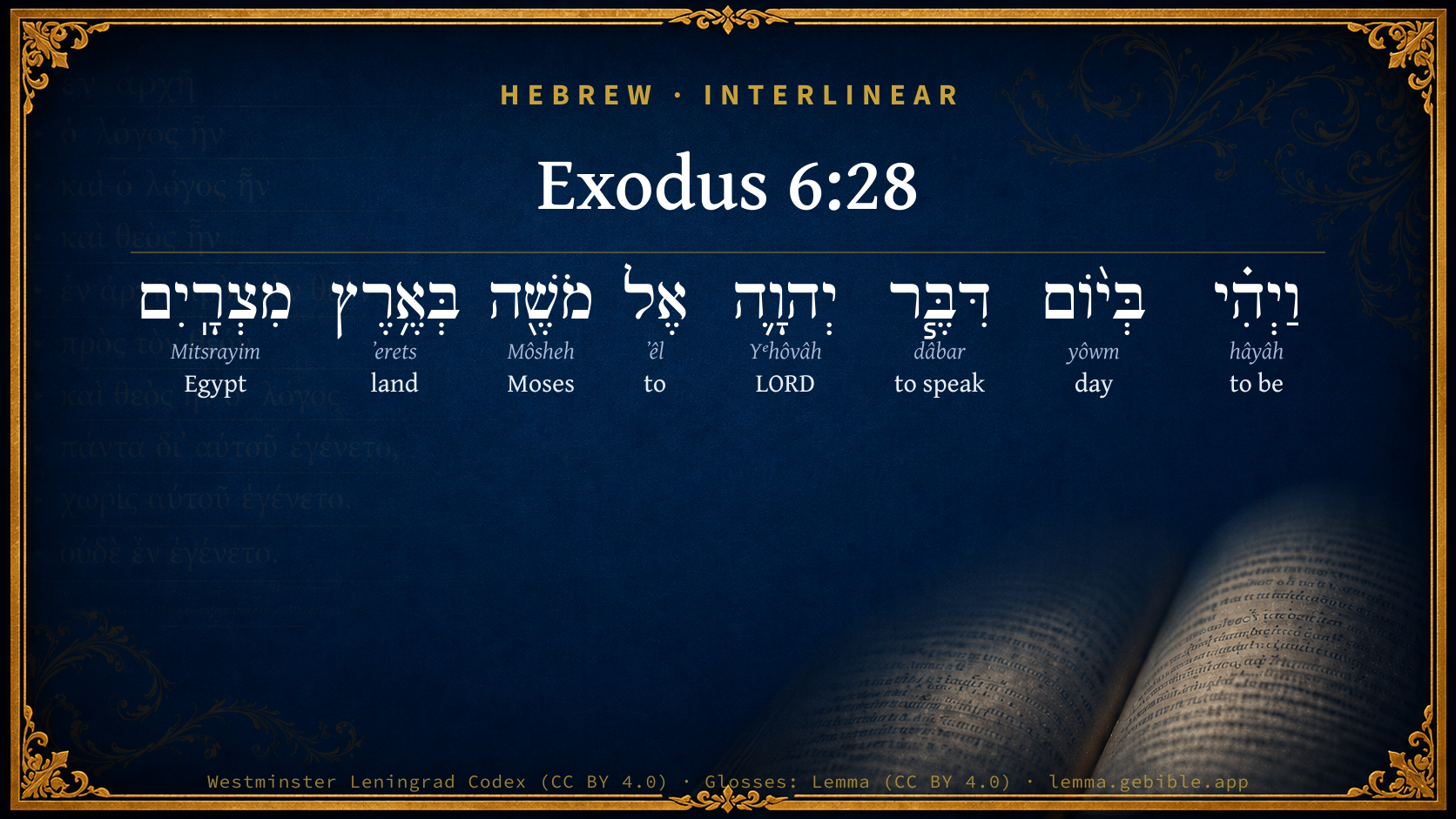
Hebrew (Westminster Leningrad Codex) Exodus 6:28 appears in the Hebrew Old Testament. The text above is from the Westminster Leningrad Codex. Each word links to its Strong’s number, a concise gloss, and parsing drawn from the Open Scriptures Hebrew Bible morphology. Click any word for its full Brown-Driver-Briggs (BDB) entry.
Download image
Cite this verse

Exodus 6:28 (World English Bible). Public Domain. Lemma interlinear Bible study tool, https://lemma.gebible.app/v/exodus/6/28.

Show BibTeX & RIS
BibTeX
RIS
English Translation
It happened on the day when Yahweh spoke to Moses in the land of Egypt,
World English Bible · Public Domain
Download a study sheet

One document with this verse’s original text, its word-by-word gloss line, the meaning frame, cross-references with their text, attributed commentary, and full source and license credits — printable, and it pastes into notes with its structure intact.

This verse Autodidact and up

Study sheet (.html) Plain text (.txt)

A passage Seminary Student

Up to 50 verses in one chapter. A passage sheet keeps up to 6 commentary sources and 12 cross-references per verse, in the order this page ranks them, and says so on the sheet whenever that leaves anything out. Ask for a single verse and you get the Autodidact verse sheet above.

Everything on this page stays free to read, with no account — the sheet is a download of what is already on screen, not access to it.

Want to remove ads? Support Godless Engineer
Compare translations 3

The same verse in 3 English versions, stacked beneath the original-language interlinear above. Click any original word for its lexicon entry.

Each is an independent rendering of the whole verse — the interlinear is not word-aligned to these translations.

Highlighted words mark where these versions differ — a whole-verse word diff, not a word-by-word alignment.

  • World English Bible Public Domain
    It happened on the day when Yahweh spoke to Moses in the land of Egypt,
  • King James Version Public Domain
    And it came to pass on the day when the LORD spake unto Moses in the land of Egypt,
  • unfoldingWord Literal Text CC BY-SA 4.0
    And it happened on a day that Yahweh spoke to Moses in the land of Egypt,

unfoldingWord Literal Text — © unfoldingWord, licensed CC BY-SA 4.0. Word-aligned USFM3 via Door43 (git.door43.org/unfoldingWord/en_ult).

Versions to compare (up to 4)

3 of 4 selected

Show all 18 translations

Every available English version of this verse, each an independent rendering of the whole verse.

  • World English Bible Public Domain
    It happened on the day when Yahweh spoke to Moses in the land of Egypt,
  • Berean Standard Bible Public Domain
    Now on the day that the LORD spoke to Moses in Egypt,
  • Majority Standard Bible Public Domain
    Now on the day that the LORD spoke to Moses in Egypt,
  • King James Version Public Domain
    And it came to pass on the day when the LORD spake unto Moses in the land of Egypt,
  • American Standard Version (1901) Public Domain
    And it came to pass on the day when Jehovah spake unto Moses in the land of Egypt,
  • Revised Version (1885) Public Domain
    And it came to pass on the day when the LORD spake unto Moses in the land of Egypt,
  • Geneva Bible (1599) Public Domain
    And at that time when the Lord spake vnto Moses in the land of Egypt,
  • Douay-Rheims (1899) Public Domain
    In the day when the Lord spoke to Moses in the land of Egypt.
  • Young's Literal Translation Public Domain
    And it cometh to pass in the day of Jehovah's speaking unto Moses in the land of Egypt,
  • Literal Standard Version CC BY-SA 4.0
    And it comes to pass in the day of YHWH’s speaking to Moses in the land of Egypt,
  • Unlocked Literal Bible CC BY-SA 4.0
    When Yahweh spoke to Moses in the land of Egypt,
  • unfoldingWord Literal Text CC BY-SA 4.0
    And it happened on a day that Yahweh spoke to Moses in the land of Egypt,
  • Darby Bible Public Domain
    And it came to pass on the day when Jehovah spoke to Moses in the land of Egypt,
  • World Messianic Bible Public Domain
    On the day when the LORD spoke to Moses in the land of Egypt,
  • Webster's Bible Public Domain
    And it came to pass, on the day when the LORD spoke to Moses in the land of Egypt,
  • Free Bible Version CC BY-SA 4.0
    When the Lord spoke to Moses in Egypt,
  • Bible in Basic English Public Domain
    And on the day when the word of the Lord came to Moses in the land of Egypt,
  • JPS Tanakh (1917) Public Domain
    And it came to pass on the day when the LORD spoke unto Moses in the land of Egypt,

Literal Standard Version (2020), Covenant Press — licensed CC BY-SA 4.0. Text via the HelloAO Bible API (eBible.org). Unlocked Literal Bible (unfoldingWord) — licensed CC BY-SA 4.0. Text via the HelloAO Bible API (eBible.org). unfoldingWord Literal Text — © unfoldingWord, licensed CC BY-SA 4.0. Word-aligned USFM3 via Door43 (git.door43.org/unfoldingWord/en_ult). Free Bible Version, Dr. Jonathan Gallagher — licensed CC BY-SA 4.0. Text via the HelloAO Bible API (eBible.org).

Word by word

More ways to search: Search by grammar → Find every occurrence → Compare this word →

Practice this passage: Drill this verse → Learn its vocabulary →

About this verse

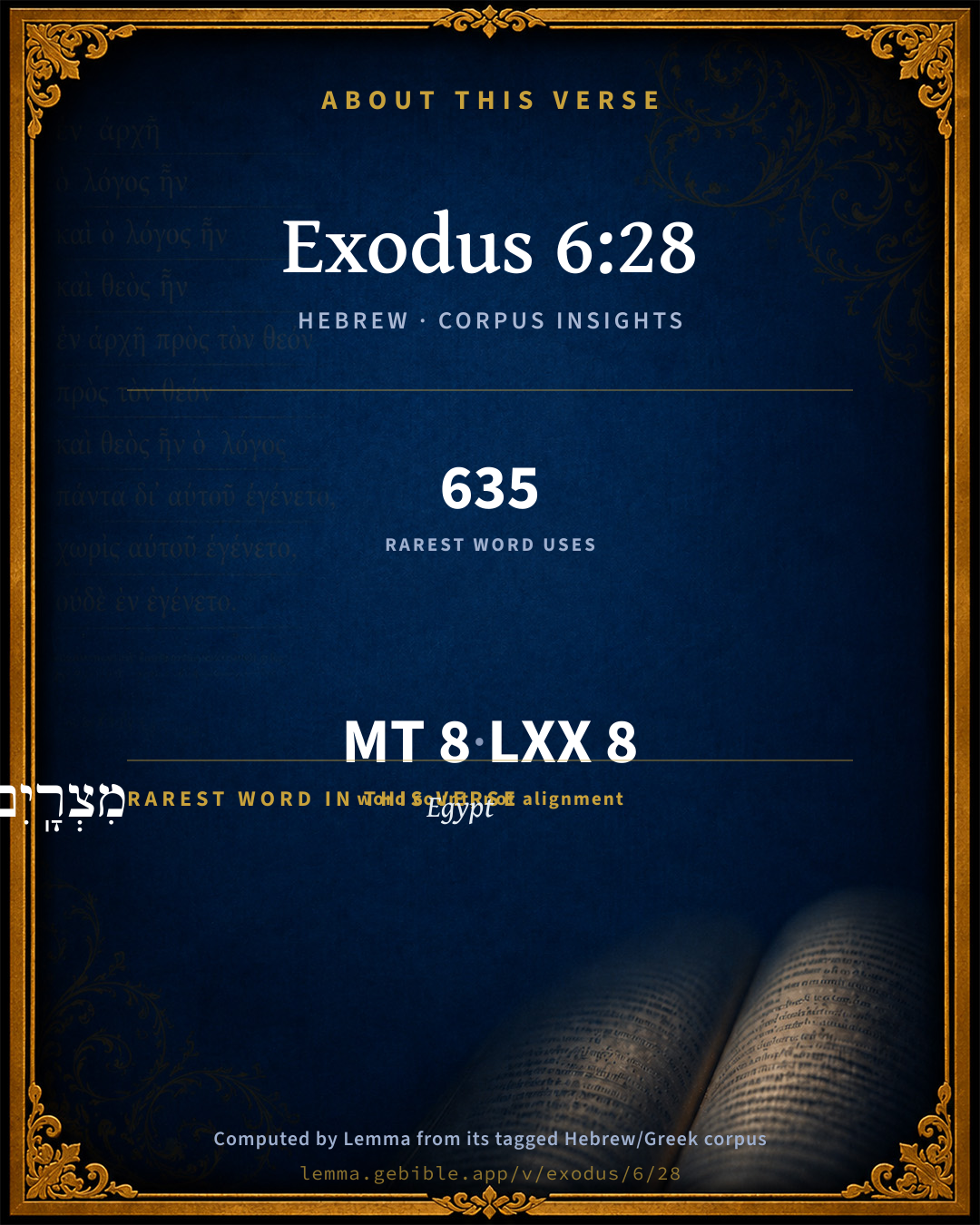
These counts appear in no published source. They are computed here, from the morphology-tagged text and Lemma’s own curated glosses. What Lemma adds →

8
words
8
distinct lemmas
Pentateuch
section

Grammatical profile

  • 2 verbs
  • 5 nouns
  • 1 preposition

Verb forms

  • וַיְהִ֗י Qal · Sequential Imperfect
  • דִּבֶּ֧ר Piel · Perfect

Hebrew & Septuagint length

In English translation the verse runs 15 words from the Hebrew and 15 from the Septuagint (LXX English) — the same length.

A rough comparison of the two English renderings, which tokenize alike — not a word-level alignment.

Word counts can differ between the Hebrew and the Greek without any difference in meaning — e.g. the Hebrew direct-object marker אֵת has no separate Greek word, and Greek often adds the article ὁ.

In the original languages it is 8 Hebrew tokens and 8 Greek tokens — but the two are counted differently (Hebrew bundles its prefixes and suffixes into one token; the Greek is in lemma form), so that isn’t a like-for-like length.

Hebrew and Greek witnesses Masoretic Hebrew ↔ Greek Septuagint

The same verse in the two great witnesses to the Old Testament, shown verse-for-verse.

These are two independent witnesses, not word-aligned to each other, and the Septuagint is shown in lemma (dictionary) form.

Hebrew Exodus 6:28 Masoretic · Westminster Leningrad Codex

וַיְהִ֗י בְּי֨וֹם דִּבֶּ֧ר יְהוָ֛ה אֶל מֹשֶׁ֖ה בְּאֶ֥רֶץ מִצְרָֽיִם

It happened on the day when Yahweh spoke to Moses in the land of Egypt,

World English Bible · Public Domain

Greek LXX Exodus 6:28 Septuagint · lemma form

ὅς ἡμέρα λαλέω κύριος μωυσῆς ἐν γῆ αἴγυπτος

in the day in which the Lord spoke to Moses in the land of Egypt;

LXX2012 (modern English Septuagint) · Public Domain

On this verse, The Annotated Bible discusses the Septuagint’s reading. Read the note in Commentary ↓

Hebrew: Westminster Leningrad Codex (CC BY 4.0). Greek: Septuagint (public domain); English from LXX2012 (modern English Septuagint) (Public Domain). How the Septuagint differs from the Hebrew →

Targum (Aramaic paraphrase)

2

The Targum is the ancient Jewish Aramaic paraphrase of the Hebrew Scriptures — an interpretive translation, not the Hebrew text itself. Onkelos (literal) and Pseudo-Jonathan (expansive) render the Torah, and Jonathan the Prophets. Coverage is partial: where no permissively-licensed English translation exists for a verse, only the Aramaic is shown. This is verse-level text, not a word-by-word alignment to the Hebrew.

  1. Targum Onkelos Torah (Genesis–Deuteronomy)
    וַהֲוָה בְּיוֹמָא דְמַלִיל יְיָ עִם משֶׁה בְּאַרְעָא דְמִצְרָיִם:

    (no public-domain English translation for this verse)

    Targum Onkelos — Aramaic: “Onkelos Genesis” (public domain); “Onkelos Exodus” (public domain); “Onkelos Leviticus” (public domain); “Onkelos Numbers” (public domain); “Onkelos Deuteronomy” (public domain). English: “Sefaria Community Translation” (CC0 1.0 (public-domain dedication)); “J.W. Etheridge. The Targums of Onkelos and Jonathan Ben Uzziel on the Pentateuch. London: Longmans, Green, 1862” (public domain). Text via Sefaria.

  2. Targum Pseudo-Jonathan Torah (Genesis–Deuteronomy)
    וַהֲוָה בְּיוֹמָא דְמַלֵיל יְיָ עִם משֶׁה בְּאַרְעָא דְמִצְרַיִם הֲוָה אַהֲרן מָצִית אוּדְנֵיהּ וְשָׁמַע מַה דְמַלֵיל עִמֵיהּ

    And it was in the day when the Lord spake with Mosheh in the land of Mizraim, that Aharon gave a listening ear, and heard what He spake with him.

    Targum Pseudo-Jonathan — Aramaic: “Targum Jonathan on Genesis” (public domain); “Targum Jonathan on Exodus” (public domain); “Targum Jonathan on Leviticus” (public domain); “Targum Jonathan on Numbers” (public domain); “Targum Jonathan on Deuteronomy” (public domain). English: “The Targum of Jonathan ben Uzziel, trans. J. W. Etheridge, London, 1862” (public domain). Text via Sefaria.

Commentary

Notes on Exodus 6:28 from classic Christian and Jewish commentators (each source and its license shown beneath its notes). The classic Christian expositions comment on the surrounding passage and are grouped to its opening verse, so a note may address several verses; the Jewish commentaries on the Tanakh (Rashi and others) are per-verse, so they appear only where the commentator wrote on this verse.

Lemma curates 59 commentaries, every one of them public domain or Creative Commons licensed, each selected and text-cleaned for this edition rather than reprinted as found. About our sources →

Whedon's Commentary on the Bible

Daniel D. Whedon

28-30. These three verses properly belong to the next chapter, which should have commenced with Exo_6:28. The Lord (JEHOVAH) spake unto Moses in the land of Egypt,… saying, I am the Lord (JEHOVAH). This is in distinction from that first revelation in the land of Midian, (chap. 3,) when the Memorial Name was first proclaimed.

RESUMPTION OF THE NARRATIVE AND RECAPITULATION, Exo_6:28 to Exo_7:7.

The foregoing genealogical digression may be regarded as an expansion of Exo_6:13, giving a brief, clear family history of “that Aaron and Moses” who now undertake this weighty charge. The narrative now returns to the incident of Exo_6:12, and repeats the circumstances under which Moses again plead that he was of uncircumcised lips. In Exo_4:10, he urged this as a reason why he was disqualified to go to his brethren; now he feels it a sore hinderance when bid to go to Pharaoh.

Daniel D. Whedon (gen. ed.), Commentary on the Old and New Testaments (1874–1909) — public domain. Text from a community e-Sword module.

Keil & Delitzsch

C. F. Keil & F. Delitzsch

In Exo 6:28-30 the thread of the history, which was broken off at Exo 6:12, is again resumed. דּבּר בּיום, on the day, i.e., at the time, when God spake. יום is the construct state before an entire clause, which is governed by it without a relative particle, as in Lev 7:35; Sa1 25:15 (vid., Ewald, 286i).

Keil & Delitzsch — Biblical Commentary on the Old Testament (1861–1891) — public domain (CC PDM 1.0). Text via the HelloAO Bible API. (Old Testament only.)

The Annotated Bible

Arno C. Gaebelein

CHAPTERS 6:28-7:13 The Renewed Commission and Before Pharaoh Again

1. Renewed commission and renewed hesitation (Exo 6:28-30)

2. Jehovah’s instructions (Exo 7:1-9)

3. Before Pharaoh and the sign of the rod (Exo 7:10-13)

Once more Moses received his commission, and again he hesitated on account of his poor speech. After all the gracious words Jehovah had spoken he pleads again his weakness. It shows what the unbelieving heart is. Twice Jehovah said that Moses should be a god. A god to Aaron (Exo 4:16) and a god to Pharaoh (Exo 7:1). He received divine authority and power over Pharaoh, while he was to his spokesman Aaron a god, because the word he uttered to him to communicate to Pharaoh was the word of the Lord. “And I will harden Pharaoh’s heart.” This was stated before in Exo 4:21. Eighteen times we read of the hardening of Pharaoh’s heart. However, different words are used in the Hebrew to show an important distinction. One means to “make firm” or “strong.” The other, “to make stubborn.” These two words show Pharaoh’s hardening of his own heart and God’s hardening after he continued in his wicked way. After it is five times declared that Pharaoh hardened his heart, then God began His hardening and made Pharaoh’s heart stubborn. Pharaoh hardened himself, then God hardened him. Pharaoh had his opportunities and as he refused and continued in unbelief, God made him stubborn. God hardens as a judicial act because man refuses His Word. God never hardens first nor compels a man to be an unbeliever. A solemn warning is contained in this. Thousands harden their hearts now, and ere long apostate Christendom will be hardened by God without remedy (2Th 2:1-17).

Moses’ age was 80 years and Aaron’s 83 when they spoke to Pharaoh. They are before the monarch to show a miracle. Moses did not use his rod as before the elders of Israel , but it was Aaron’s rod which was cast down and became a serpent. There is likewise another word used for serpent. In Exo 4:3, it is nachash, the same word as in Gen 3:1-24. But the word used in Exo 7:1-25 is thanin, which the Septuagint translates dragon. This does not show that there were two different records, but that the two events have a different significance. Aaron’s rod, which later blossomed, is the type of the resurrection of the Lord Jesus, the mighty victor over Satan, sin and death. Aaron’s rod swallowing the rods of the magicians of Egypt seems to indicate the complete triumph of Jehovah over him who has the power of death.

The question is, was the action of the magicians a real miracle or produced by juggling? Snake charming was carried on in ancient Egypt . However, these magicians were the instruments of Satan, who manifested his power through them. What they did were “lying wonders.” The names of two of these endued with demoniacal powers are given in 2Ti 3:8, Jannes and Jambres. Such manifestation of demon power is found today in spiritualism and will be fully revealed during the days of Antichrist at the end of this age (2Th 2:9-12). Pharaoh’s heart was hardened (literal translation) because he wilfully rejected the sign given.

Arno C. Gaebelein, The Annotated Bible (1913–1922) — public domain. Text from a community e-Sword module.

Adam Clarke's Commentary

Verse 28. And it came to pass] Here the seventh chapter should commence, as there is a complete ending of the sixth with Ex 6:27, and the 30th verse of this chapter is intimately connected with the 1st verse of the succeeding.

THE principal subjects in this chapter have been so amply considered in the notes, that little of importance remains to be done. On the nature of a covenant (See Clarke on Ex 6:4.) ample information may be obtained by referring to Ge 6:18, and Ge 15:9-18, which places the reader will do well to consult.

Supposing Moses to have really laboured under some defect in speech, we may consider it as wisely designed to be a sort of counterbalance to his other excellences: at least this is an ordinary procedure of Divine Providence; personal accomplishments are counterbalanced by mental defects, and mental imperfections often by personal accomplishments. Thus the head cannot say to the foot, I have no need of thee. And God does all this in great wisdom, to hide pride from man, and that no flesh may glory in his presence. To be contented with our formation, endowments, and external circumstances, requires not only much submission to the providence of God, but also much of the mind of Christ. On the other hand, should we feel vanity because of some personal or mental accomplishment, we have only to take a view of our whole to find sufficient cause of humiliation; and after all, the meek and gentle spirit only is, in the sight of God, of great price.

Adam Clarke's Commentary on the Bible (1810–1826) — public domain. Text from a community e-Sword/MySword module.

Ellicott's Commentary for English Readers

THE SECOND MESSAGE TO PHARAOH (resumed).

(28-30) These verses are most closely connected with Exodus 7. They are a recapitulation of main points in Exodus 6, rendered necessary by the long parenthesis (Exo_6:14-27), and serve to unite Exodus 7 with the previous narrative. They contain no new information.

A Bible Commentary for English Readers, edited by Charles John Ellicott (1878–1897) — public domain. Text from a community e-Sword module.

The Cambridge Bible for Schools and Colleges

gen. ed. J. J. S. Perowne

28–30. The stream of the narrative here, after its interruption by v. 13, and the genealogy, vv. 14–27, is resumed, v. 29 recapitulating the beginning and end of God’s words to Moses, vv. 2 and 11, and v. 30 repeating Moses’ objection in v. 12. Ch. Exo_7:1-5 is thus really the sequel, and answer, to Exo_6:12.

The Cambridge Bible for Schools and Colleges (gen. ed. J. J. S. Perowne; Cambridge University Press, 1878–1918) — public domain. Text from a community e-Sword module.

Albert Barnes' Notes on the Bible

This and the following verses belong to the next chapter. They mark distinctly the beginning of a subdivision of the narrative.

Albert Barnes' Notes on the Bible (1834–1885) — public domain. Text from a community e-Sword/MySword module.

The Pulpit Commentary

Vers. 28-30. The remainder of this chapter is scarcely more than a recapitulation. The author, or compiler, having interposed his genealogical section, has to take up the narrative from verse 12, where he broke off, and does so by almost repeating the words of verses 10-12. The only important addition is the insertion of the words am the Lord" (ver. 29), and the only important variation, the substitution of "Speak thou unto Pharaoh all that I say unto thee (ibid.), for "Speak unto Pharaoh that he let the children of Israel go out of his land" (ver. 11).

The Pulpit Commentary (1880–1919), ed. H.D.M. Spence-Jones & Joseph S. Exell — public domain. Text from a community e-Sword module.

Kretzmann's Popular Commentary

Paul E. Kretzmann

The Lord Again Commissions Moses

v. 28. And it came to pass on the day when the Lord spake unto Moses in the land of Egypt,

v. 29. that the Lord spake unto Moses, saying, I am the Lord; speak thou unto Pharaoh, king of Egypt, all that I say unto thee. The narrative is here resumed with another emphatic commission of the Lord, in which He bids Moses transmit His exact words to Pharaoh.

v. 30. And Moses said before the Lord, Behold, I am of uncircumcised lips, and how shall Pharaoh hearken unto me? It is the same objection as in verse 12, declaring his complete unfitness for the task which the Lord had laid upon him. When the Lord calls, His servants should at all times heed His call with all eagerness and not consult with flesh and blood.

Paul E. Kretzmann, Popular Commentary of the Bible (1921–1924) — public domain. Text from a community e-Sword module.

unfoldingWord translationNotes

Door43 World Missions Community

I am not good ... why will Pharaoh listen to me?

Moses asks this question hoping to change God's mind. This rhetorical question can be translated as as statement. AT: "I am not good ... Pharaoh will certainly not listen to me!" (See: Rhetorical Question)

translationWords

Yahweh

unfoldingWord translationNotes — © Distant Shores Media and the Door43 World Missions Community, licensed CC BY-SA 4.0. Source: git.door43.org/Door43/en_tn.

Rashi

Rabbi Shlomo Yitzchaki (Rashi)

And it came to pass on the day that the Lord spoke unto Moses in the land of Egypt: [This is connected with the following verse]

Rashi on the Tanakh — English translations: “The Judaica Press complete Tanach with Rashi, translated by A. J. Rosenberg” (CC BY 4.0); “Pentateuch with Rashi's commentary by M. Rosenbaum and A.M. Silbermann, 1929-1934” (public domain); “The Metsudah Tanach series, Lakewood, N.J” (CC BY 4.0); and “The Book of Joshua, Metsudah Publications, 1997” (CC BY 4.0). Text via Sefaria.

Ramban (Nachmanides)

Rabbi Moshe ben Nachman (Ramban / Nachmanides)

AND IT CAME TO PASS ON THE DAY WHEN THE ETERNAL SPOKE UNTO MOSES IN THE LAND OF EGYPT. It is possible to explain that the verse refers to the one above. …. Ramban finds this difficult to accept since the plain meaning would seem to indicate that Verses 29-30 constitute an independent section not connected with the preceding verse. Therefore he interprets Verse 28 as being connected with the preceding verse, as explained in the text. Scripture is thus stating: “And it came to pass that it was they — [Moses and Aaron] — who spoke to Pharaoh, king of Egypt at the time when the Eternal spoke unto Moses in the land of Egypt.” For since Scripture said, These are that Aaron and Moses, to whom the Eternal said: Bring out the children of Israel from the land of Egypt, it might have appeared that the communication came to both of them equally. Therefore it now explains [in Verse 28] that the communication came to Moses, and the command to bring them forth from Egypt was to both of them. This is why Scripture closed the chapter [of the genealogy of Moses and Aaron with this subject].

Ramban (Nachmanides) on the Tanakh — English translation: “Commentary on the Torah by Ramban (Nachmanides). Translated and annotated by Charles B. Chavel. New York, Shilo Pub. House, 1971-1976” (CC BY 4.0). Text via Sefaria.

Lesson kit

Teaching starters — assembled from the data on this page, not authored interpretation. Every prompt links to the verse data it draws on. Edit before teaching.

Exodus, in the Pentateuch, opens this verse with 8 words (8 distinct Hebrew lemmas). Its most distinctive word is Mitsrayim (“Egypt”). A historical commentator’s framing appears above. Read the whole chapter for the surrounding context.

Discussion questions

  1. How does “Egypt” (Mitsrayim) shape what this verse is saying?
  2. The translations on this page render this verse differently — a whole-verse word diff, not a word-by-word alignment. What might account for the different wordings?
  3. The verb «וַיְהִ֗י» is Qal Sequential Imperfect. How does its form color the action?
  4. Reading how Whedon's Commentary on the Bible and Keil & Delitzsch read this verse, where do the two commentators agree and where do they part?

Things to notice

Reading settings

Reading text

Shown beneath each verse's original-language words.

Old Testament
Old Testament edition

Read the OT as the Masoretic Hebrew (MT) or the Greek Septuagint (LXX).

English shown for the Greek Septuagint (in the Hebrew ↔ Greek comparison).

Comparing translations? Open the Compare panel on any verse page to stack up to four side by side.