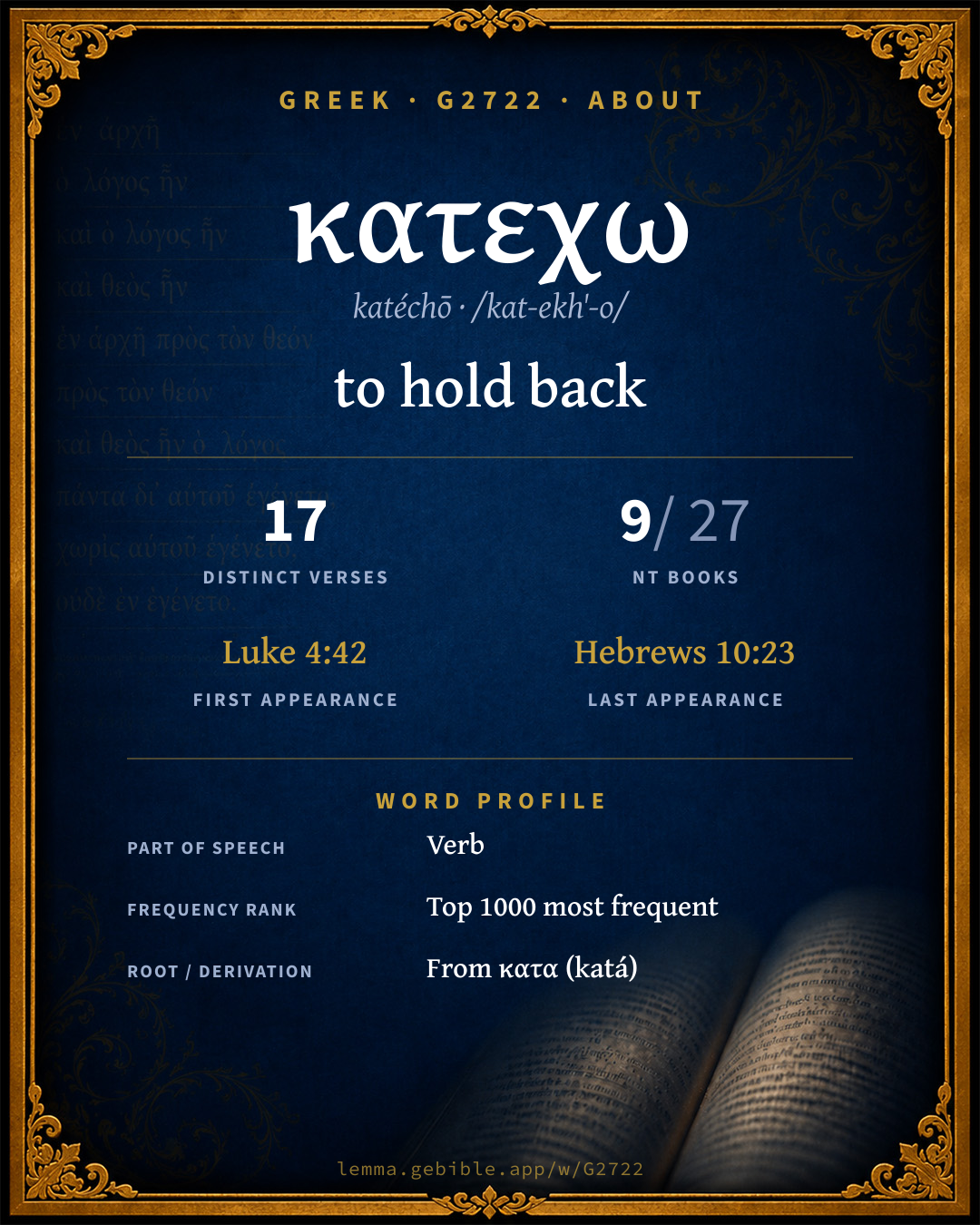
κατέχω
to hold back
also: detain, retain fuller range ↓
Full lexicon entry — Thayer's Greek Lexicon
From Thayer's Greek Lexicon
Where this word appears
See every Present-tense verb in the Greek New Testament →
Grammar key — what these labels mean
Part of speech
- Verb
- An action or state-of-being word.
Tense
- Aorist
- Action viewed as a simple whole, without regard to duration — often past (perfective aspect).
- Imperfect
- Continuous or repeated action in past time (“was writing”).
- Present
- Ongoing or general action in present time (imperfective aspect).
Voice
- Active
- The subject performs the action.
- Passive
- The subject receives the action.
Mood
- Subjunctive
- Expresses probability, purpose, or possibility (the mood of contingency).
- Indicative
- States a fact or asks a factual question (the mood of reality).
- Infinitive
- A verbal noun (“to write”), unmarked for person or number.
- Participle
- A verbal adjective (“writing,” “having written”).
- Imperative
- Expresses a command or request.
Case
- Nominative
- The case of the subject (and the predicate nominative).
- Accusative
- The case of the direct object and of extent.
- Genitive
- The case of source, possession, or “of” — answers “whose / from what.”
Person
- 1st person
- The speaker (“I / we”).
- 3rd person
- The one spoken about (“he / she / it / they”).
- 2nd person
- The one addressed (“you”).
Gender
- Masculine
- Grammatically masculine.
- Neuter
- Grammatically neuter.
Number
- Plural
- More than one.
- Singular
- One.
Grammatical forms 12 distinct
- Verb, Aorist, Active, Subjunctive, 1st person, Plural 2 times (12%)
- Verb, Imperfect, Active, Indicative, 3rd person, Plural 2 times (12%)
- Verb, Present, Active, Indicative, 2nd person, Plural 2 times (12%)
- Verb, Present, Active, Infinitive 2 times (12%)
- Verb, Present, Active, Participle, Nominative, Plural, Masculine 2 times (12%)
- Verb, Imperfect, Passive, Indicative, 1st person, Plural 1 time (6%)
- Verb, Present, Active, Indicative, 3rd person, Plural 1 time (6%)
- Verb, Present, Active, Imperative, 2nd person, Plural 1 time (6%)
+4 more forms (4 occurrences)
Parsed forms decoded from the imported morphology (Robinson–Tischendorf, public domain), counted across 17 parsed occurrences — not distinct verses.
Every verse where G2722 appears — 17 distinct verses across 9 books. Click any verse to open its interlinear word-by-word view. Verse text shown in the World English Bible for context — . Each verse’s Greek form is shown with its reference; the English is not keyword-highlighted, since the data carries no word-level English alignment. Use “Compare translations” on any verse to read it across multiple English versions. This concordance covers the Greek New Testament; Septuagint (Greek Old Testament) occurrences of this word are not indexed here.
Luke 3 verses
- Luke 4:42 κατεῖχον impf act ind 3pl When it was day, he departed and went into an uninhabited place, and the multitudes looked for him, and came to him, and held on to him, so that he wouldn't go away from them.
- Luke 8:15 κατέχουσιν pres act ind 3pl That in the good ground, these are such as in an honest and good heart, having heard the word, hold it tightly, and bring forth fruit with patience.
- Luke 14:9 κατέχειν pres act inf and he who invited both of you would come and tell you, 'Make room for this person.' Then you would begin, with shame, to take the lowest place.
Acts 1 verse
Romans 2 verses
- Romans 1:18 κατεχόντων pres act ptcp gen pl masc For the wrath of God is revealed from heaven against all ungodliness and unrighteousness of men, who suppress the truth in unrighteousness,
- Romans 7:6 κατειχόμεθα impf pass ind 1pl But now we have been discharged from the law, having died to that in which we were held; so that we serve in newness of the spirit, and not in oldness of the letter.
1 Corinthians 3 verses
- 1 Corinthians 7:30 κατέχοντες pres act ptcp nom pl masc and those who weep, as though they didn't weep; and those who rejoice, as though they didn't rejoice; and those who buy, as though they didn't possess;
- 1 Corinthians 11:2 κατέχετε pres act ind 2pl Now I praise you, brothers, that you remember me in all things, and hold firm the traditions, even as I delivered them to you.
- 1 Corinthians 15:2 κατέχετε pres act ind 2pl by which also you are saved, if you hold firmly the word which I preached to you--unless you believed in vain.
2 Corinthians 1 verse
1 Thessalonians 1 verse
2 Thessalonians 2 verses
- 2 Thessalonians 2:6 κατέχον pres act ptcp acc sg neut Now you know what is restraining him, to the end that he may be revealed in his own season.
- 2 Thessalonians 2:7 κατέχων pres act ptcp nom sg masc For the mystery of lawlessness already works. Only there is one who restrains now, until he is taken out of the way.
Philemon 1 verse
Hebrews 3 verses
- Hebrews 3:6 κατάσχωμεν aor act subj 1pl but Christ is faithful as a Son over his house; whose house we are, if we hold fast our confidence and the glorying of our hope firm to the end.
- Hebrews 3:14 κατάσχωμεν aor act subj 1pl For we have become partakers of Christ, if we hold fast the beginning of our confidence firm to the end:
- Hebrews 10:23 κατέχωμεν pres act subj 1pl let us hold fast the confession of our hope unyieldingly. For he who promised is faithful.
About this entry
At a glance — auto-summarized from this page’s data, not written by a person. Every figure links to its source below. This summary describes the numbers; it doesn’t interpret them.
“to hold back” is the headline sense of the Greek verb κατεχω (katéchō). First canonically at Luke 4:42, it enters the text early. With 17 verses in 9 books, it is an uncommon word in the Greek New Testament. Lexicons map it across 2 senses — beyond “to hold back” it also covers “detain” and “retain”. It clusters with κατα, καθα and καθαιρεω under a shared root. See the sense tree, 17-verse concordance, and the renderings breakdown below.
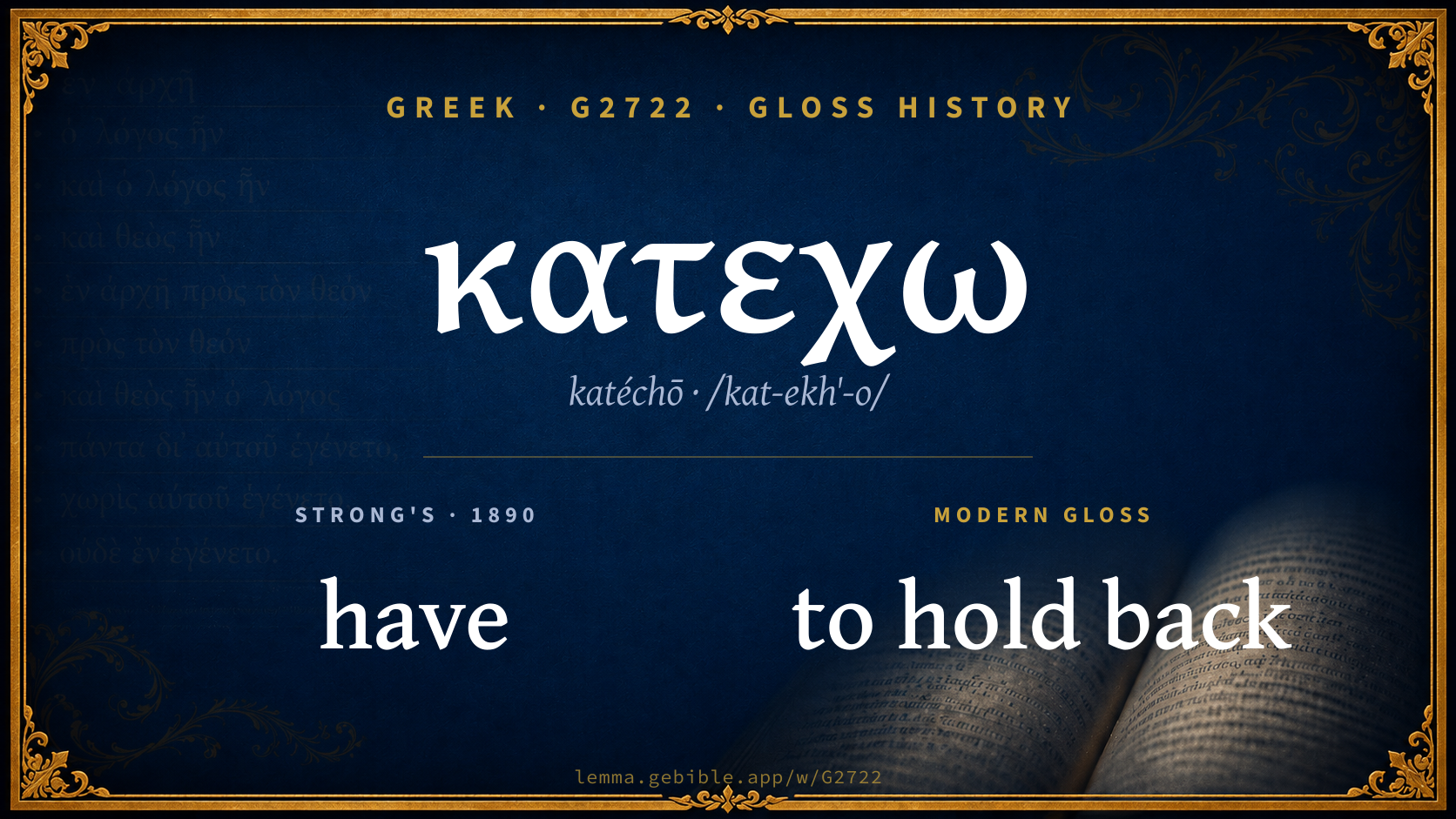
Gloss history
Strong's 1890 vs modern scholarship
About this word
Strong's G2722 catalogs a Greek word from the Greek New Testament.
These counts are not copied from any lexicon or concordance. They are computed here, from the morphology-tagged Greek New Testament. What Lemma adds →
- 17
- distinct verses
- The word appears in 17 distinct verses.
- 9 / 27
- NT books
- The word appears in 9 of 27 New Testament books.
- #697
- by frequency
- Top 1000 most frequent Greek words (rank 697 of 5,347 Greek words by occurrence).
View all 17 occurrences in the concordance →
Most concentrated in
- Luke 3 verses 18%
- 1 Corinthians 3 verses 18%
- Hebrews 3 verses 18%
By section of the New Testament
By traditional corpus
Conventional, traditional groupings — biblical authorship is debated, so this is a traditional corpus grouping, not an authorship claim. Some books belong to more than one corpus (Luke is in both the Gospels and the Lukan corpus, and so on), so these shares overlap and need not total 100%. Each figure is a share of the word’s 17 distinct verses.
- Pauline corpus 10 verses · 59%
- Lukan (Luke–Acts) 4 verses · 24%
- Gospels 3 verses · 18%
- Hebrews 3 verses · 18%
How translations render this word
Counts come from each version’s own published word-to-Strong’s tagging or interlinear alignment — an approximate guide to how each version renders this word, not a word-level alignment the data otherwise carries. Because each total is that version’s own tagged count, the per-version totals vary from one another and need not match the appearance or distinct-verse counts above. These counts may also differ from a printed concordance because Lemma counts each distinctly tagged rendering and does not collapse phrase taggings into a single head-word total. This is a fixed set of word-tagged versions (KJV, ASV, BSB, ULT) and does not change with the reading translation you choose elsewhere. Each version’s license is shown beside its name below (and on Sources).
- King James Version: Keep 2×
- American Standard Version: Hold fast 3×, Restraineth 2×, Take 2×
- Berean Standard Bible: Bound us 1×, Cling to 1×, Hold fast 1×
- unfoldingWord Literal Text: Him 2×, Possessing 2×, Restraining 2×
King James Version Public Domain
Renders G2722 across 19 tagged occurrences — most commonly:
Plus 17 renderings that appear only once — usually multi-word phrases or single function words the recovered tagging swept in, not distinct renderings.
American Standard Version Public Domain
Renders G2722 across 19 tagged occurrences — most commonly:
Plus 12 renderings that appear only once — usually multi-word phrases or single function words the recovered tagging swept in, not distinct renderings.
Berean Standard Bible Public Domain
Renders G2722 across 17 tagged occurrences — most commonly:
Plus other, less common renderings.
unfoldingWord Literal Text CC BY-SA 4.0
Renders G2722 across 20 tagged occurrences — most commonly:
Plus 12 renderings that appear only once — usually multi-word phrases or single function words the recovered tagging swept in, not distinct renderings.
Senses in Thayer's
The 2 senses Thayer's distinguishes for this word, in lexicon order (not ranked by frequency or importance). The full entry — with sub-senses — is in the Lexicon Entry tab.
- to hold back, detain, retain
- to get possession of, take
Word origin
Derived from κατα (katá) (G2596) — down.
Forms in the corpus
The 11 distinct written forms G2722 takes in the Greek New Testament, most frequent first — each parse links to that tense’s occurrences in the concordance.
Same root — word family
Other Thayer's entries built from the same root as G2722, grouped by Strong’s listed origin. These share a root / origin per the lexicon — not necessarily a shared meaning. Each links to that word’s own entry.
Derives from
Shares the same root
- καθα kathá G2505 according as
- καθαιρεω kathairéō G2507 to tear down
- καθαπτω katháptō G2510 to fasten down
- καθεδρα kathédra G2515 seat
- καθεζομαι kathézomai G2516 to sit down
- καθεξης kathexēs G2517 in order
- καθευδω katheúdō G2518 to fall asleep
- καθηγητης kathēgētḗs G2519 guide
- καθηκω kathḗkō G2520 to come down
- καθημαι káthēmai G2521 to sit down
- καθημερινος kathēmerinós G2522 daily
- καθιημι kathíēmi G2524 to send down
- καθιστημι kathístēmi G2525 to place
- καθο kathó G2526 according to what
- καθολου kathólou G2527 wholly
- καθοπλιζω kathoplízō G2528 to arm
- καθοραω kathoráō G2529 to see clearly
- καθοτι kathóti G2530 according to what
- καθως kathṓs G2531 according as
- καμμυω kammýō G2576 to close eyes
- καταβαινω katabaínō G2597 to descend
- καταβαλλω katabállō G2598 to cast down
- καταβαρεω katabaréō G2599 to weigh down
- καταβιβαζω katabibázō G2601 to bring down
+103 more words share this root (not shown).
Derived from this word
Compare all same-root words → Showing 4 of 130 — not the complete family. They share a root, not necessarily a meaning.
Septuagint usage
The same Greek word κατεχω appears 44 times in the Greek Old Testament (Septuagint), across 41 verses in 19 books.
- 44
- LXX occurrences
- Tagged occurrences of this Greek word in the Septuagint.
- 41
- verses
- Distinct Septuagint verses containing this word.
- 19 / 39
- OT books
- The word appears in 19 of the 39 Old Testament books.
Sample Septuagint occurrences
- Genesis 22:13 καταἔχω
- Exodus 32:13 καταἔχω
- Joshua 1:11 καταἔχω
- Judges 13:15 καταἔχω
- Ruth 1:13 καταἔχω
- 2 Samuel 1:9 καταἔχω
- 1 Kings 1:51 καταἔχω
- 2 Kings 12:13 καταἔχω
- 1 Chronicles 13:9 καταἔχω
- 2 Chronicles 15:8 καταἔχω
- Ezra 13:4 καταἔχω
- Job 15:24 καταἔχω
Septuagint occurrences (same lexeme)
Every verse where the same Strong’s number (G2722) appears in the Greek Septuagint. Verse text shown in the World English Bible for context; the Greek form is the matched word — the English is not keyword-highlighted.
- Genesis 22:13 καταἔχω Abraham lifted up his eyes, and looked, and saw that behind him was a ram caught in the thicket by his horns. Abraham went and took the ram, and offered him up for a burnt offering instead of his son.
- Genesis 24:56 καταἔχω He said to them, "Don't hinder me, seeing Yahweh has prospered my way. Send me away that I may go to my master."
- Genesis 39:20 καταἔχω Joseph's master took him, and put him into the prison, the place where the king's prisoners were bound, and he was there in custody.
- Genesis 42:19 καταἔχω If you are honest men, then let one of your brothers be bound in your prison-house; but you go, carry grain for the famine of your houses.
- Exodus 32:13 καταἔχω Remember Abraham, Isaac, and Israel, your servants, to whom you swore by your own self, and said to them, 'I will multiply your seed as the stars of the sky, and all this land that I have spoken of I will give to your seed, and they shall inherit it forever.'"
- Joshua 1:11 καταἔχω Pass through the midst of the camp, and command the people, saying, Prepare food; for within three days you are to pass over this Jordan, to go in to possess the land, which Yahweh your God gives you to possess it.
- Judges 13:15 καταἔχω Manoah said to the angel of Yahweh, I pray you, let us detain you, that we may make ready a kid for you.
- Judges 13:16 καταἔχω The angel of Yahweh said to Manoah, Though you detain me, I won't eat of your bread; and if you will make ready a burnt offering, you must offer it to Yahweh. For Manoah didn't know that he was the angel of Yahweh.
- Judges 19:4 καταἔχω His father-in-law, the young lady's father, retained him; and he abode with him three days: so they ate and drink, and lodged there.
- Ruth 1:13 καταἔχω would you therefore wait until they were grown? would you therefore stay from having husbands? nay, my daughters, for it grieves me much for your sakes, for the hand of Yahweh is gone forth against me.
- 2 Samuel 1:9 καταἔχω He said to me, Stand, I pray you, beside me, and kill me; for anguish has taken hold of me, because my life is yet whole in me.
- 2 Samuel 2:21 καταἔχω Abner said to him, Turn you aside to your right hand or to your left, and lay you hold on one of the young men, and take you his armor. But Asahel would not turn aside from following him.
- 2 Samuel 4:10 καταἔχω when one told me, saying, Behold, Saul is dead, thinking to have brought good news, I took hold of him, and killed him in Ziklag, which was the reward I gave him for his news.
- 2 Samuel 6:6 καταἔχω When they came to the threshing floor of Nacon, Uzzah put forth [his hand] to the ark of God, and took hold of it; for the oxen stumbled.
- 1 Kings 1:51 καταἔχω It was told Solomon, saying, Behold, Adonijah fears king Solomon; for, behold, he has laid hold on the horns of the altar, saying, Let king Solomon swear to me first that he will not kill his servant with the sword.
- 1 Kings 2:28 καταἔχω The news came to Joab; for Joab had turned after Adonijah, though he didn't turn after Absalom. Joab fled to the Tent of Yahweh, and caught hold on the horns of the altar.
- 1 Kings 2:29 καταἔχω It was told king Solomon, Joab is fled to the Tent of Yahweh, and, behold, he is by the altar. Then Solomon sent Benaiah the son of Jehoiada, saying, Go, fall on him.
- 2 Kings 12:13 καταἔχω But there were not made for the house of Yahweh cups of silver, snuffers, basins, trumpets, any vessels of gold, or vessels of silver, of the money that was brought into the house of Yahweh;
- 1 Chronicles 13:9 καταἔχω When they came to the threshing floor of Chidon, Uzza put forth his hand to hold the ark; for the oxen stumbled.
- 2 Chronicles 15:8 καταἔχω When Asa heard these words, and the prophecy of Oded the prophet, he took courage, and put away the abominations out of all the land of Judah and Benjamin, and out of the cities which he had taken from the hill-country of Ephraim; and he renewed the altar of Yahweh, that was before the porch of Yahweh.
- Ezra 13:4 καταἔχω
- Ezra 13:5 καταἔχω
- Job 15:24 καταἔχω Distress and anguish make him afraid; They prevail against him, as a king ready to the battle.
- Job 23:9 καταἔχω He works to the north, but I can't see him; He turns south, but I can't catch a glimpse of him.
- Job 27:17 καταἔχω He may prepare it, but the just shall put it on, And the innocent shall divide the silver.
- Job 34:14 καταἔχω If he set his heart on himself, If he gathered to himself his spirit and his breath;
- Psalms 68:37 καταἔχω
- Psalms 72:12 καταἔχω For he will deliver the needy when he cries; The poor, who has no helper.
- Psalms 118:53 καταἔχω
- Psalms 138:10 καταἔχω
- Proverbs 18:22 καταἔχω Whoever finds a wife finds a good thing, And obtains favor of Yahweh.
- Proverbs 19:15 καταἔχω Slothfulness casts into a deep sleep. The idle soul shall suffer hunger.
- Song of Solomon 3:8 καταἔχω They all handle the sword, and are expert in war. Every man has his sword on his thigh, Because of fear in the night.
- Isaiah 40:22 καταἔχω [It is] he who sits above the circle of the earth, and the inhabitants of it are as grasshoppers; who stretches out the heavens as a curtain, and spreads them out as a tent to dwell in;
- Jeremiah 6:24 καταἔχω We have heard the report of it; our hands wax feeble: anguish has taken hold of us, [and] pangs as of a woman in travail.
- Jeremiah 13:21 καταἔχω What will you say, when he shall set over you as head those whom you have yourself taught to be friends to you? shall not sorrows take hold of you, as of a woman in travail?
- Jeremiah 27:16 καταἔχω Also I spoke to the priests and to all this people, saying, Thus says Yahweh: Don't listen to the words of your prophets who prophesy to you, saying, Behold, the vessels of Yahweh's house shall now shortly be brought again from Babylon; for they prophesy a lie to you.
- Jeremiah 37:6 καταἔχω Then came the word of Yahweh to the prophet Jeremiah, saying,
- Ezekiel 33:24 καταἔχω Son of man, they who inhabit those waste places in the land of Israel speak, saying, Abraham was one, and he inherited the land: but we are many; the land is given us for inheritance.
- Daniel 7:18 καταἔχω But the saints of the Most High shall receive the kingdom, and possess the kingdom forever, even forever and ever.
- Daniel 7:22 καταἔχω until the ancient of days came, and judgment was given to the saints of the Most High, and the time came that the saints possessed the kingdom.
These are occurrences of the same Greek lexeme (G2722) in the Septuagint — not a translation of any one Hebrew word. The store carries no word-level Hebrew↔Greek alignment, so no Hebrew original is asserted here. Counts come from the recovered LXX Strong's tagging — high-frequency vocabulary is well covered, while rare or late forms may be untagged — so they reflect tagged occurrences and may slightly undercount.