
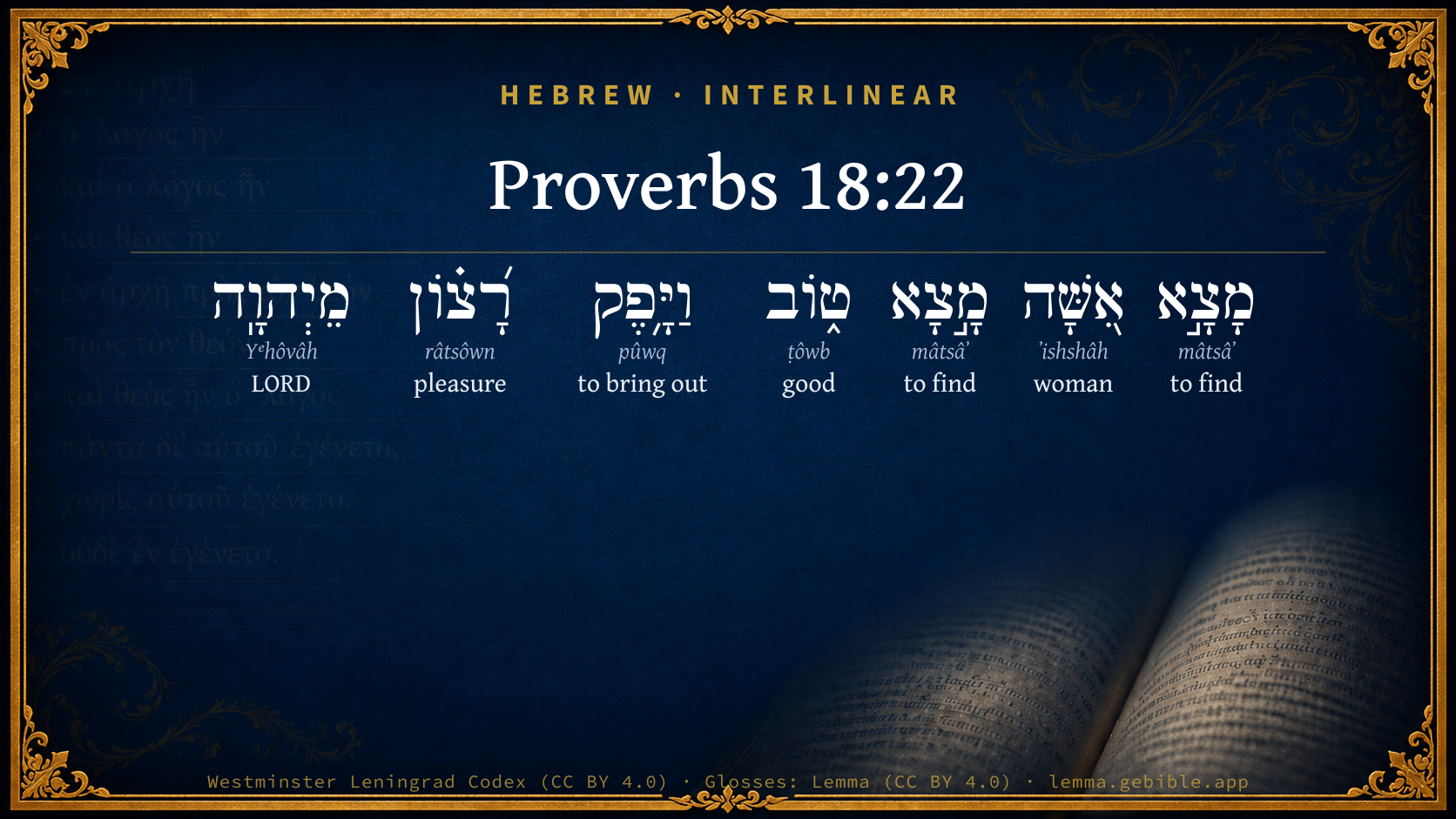
Proverbs 18:22

Hebrew (Westminster Leningrad Codex) Proverbs 18:22 appears in the Hebrew Old Testament. The text above is from the Westminster Leningrad Codex. Each word links to its Strong’s number, a concise gloss, and parsing drawn from the Open Scriptures Hebrew Bible morphology. Click any word for its full Brown-Driver-Briggs (BDB) entry.
Download image
Cite this verse

Proverbs 18:22 (World English Bible). Public Domain. Lemma interlinear Bible study tool, https://lemma.gebible.app/v/proverbs/18/22.

Show BibTeX & RIS
BibTeX
RIS
English Translation
Whoever finds a wife finds a good thing, And obtains favor of Yahweh.
World English Bible · Public Domain
Download a study sheet

One document with this verse’s original text, its word-by-word gloss line, the meaning frame, cross-references with their text, attributed commentary, and full source and license credits — printable, and it pastes into notes with its structure intact.

This verse Autodidact and up

Study sheet (.html) Plain text (.txt)

A passage Seminary Student

Up to 50 verses in one chapter. A passage sheet keeps up to 6 commentary sources and 12 cross-references per verse, in the order this page ranks them, and says so on the sheet whenever that leaves anything out. Ask for a single verse and you get the Autodidact verse sheet above.

Everything on this page stays free to read, with no account — the sheet is a download of what is already on screen, not access to it.

Want to remove ads? Support Godless Engineer
Compare translations 3

The same verse in 3 English versions, stacked beneath the original-language interlinear above. Click any original word for its lexicon entry.

Each is an independent rendering of the whole verse — the interlinear is not word-aligned to these translations.

Highlighted words mark where these versions differ — a whole-verse word diff, not a word-by-word alignment.

  • World English Bible Public Domain
    Whoever finds a wife finds a good thing, And obtains favor of Yahweh.
  • King James Version Public Domain
    Whoso findeth a wife findeth a good thing, and obtaineth favour of the LORD.
  • unfoldingWord Literal Text CC BY-SA 4.0
    He who finds a wife finds good, and he obtains favor from Yahweh.

unfoldingWord Literal Text — © unfoldingWord, licensed CC BY-SA 4.0. Word-aligned USFM3 via Door43 (git.door43.org/unfoldingWord/en_ult).

Versions to compare (up to 4)

3 of 4 selected

Show all 18 translations

Every available English version of this verse, each an independent rendering of the whole verse.

  • World English Bible Public Domain
    Whoever finds a wife finds a good thing, And obtains favor of Yahweh.
  • Berean Standard Bible Public Domain
    He who finds a wife finds a good thing and obtains favor from the LORD.
  • Majority Standard Bible Public Domain
    He who finds a wife finds a good thing and obtains favor from the LORD.
  • King James Version Public Domain
    Whoso findeth a wife findeth a good thing, and obtaineth favour of the LORD.
  • American Standard Version (1901) Public Domain
    Whoso findeth a wife findeth a good thing, And obtaineth favor of Jehovah.
  • Revised Version (1885) Public Domain
    Whoso findeth a wife findeth a good thing, and obtaineth favour of the LORD.
  • Geneva Bible (1599) Public Domain
    He that findeth a wife, findeth a good thing, and receiueth fauour of the Lord.
  • Douay-Rheims (1899) Public Domain
    He that hath found a good wife, hath found a good thing, and shall receive a pleasure from the Lord. He that driveth away a good wife, driveth away a good thing: but he that keepeth an adulteress, is foolish and wicked.
  • Young's Literal Translation Public Domain
    `Whoso' hath found a wife hath found good, And bringeth out good-will from Jehovah.
  • Literal Standard Version CC BY-SA 4.0
    [Whoever] has found a wife has found good, || And brings out goodwill from YHWH.
  • Unlocked Literal Bible CC BY-SA 4.0
    He who finds a wife finds a good thing and receives favor from Yahweh.
  • unfoldingWord Literal Text CC BY-SA 4.0
    He who finds a wife finds good, and he obtains favor from Yahweh.
  • Darby Bible Public Domain
    Whoso hath found a wife hath found a good thing, and hath obtained favour from Jehovah.
  • World Messianic Bible Public Domain
    Whoever finds a wife finds a good thing, and obtains favor of the LORD.
  • Webster's Bible Public Domain
    Whoever findeth a wife findeth a good thing, and obtaineth favor from the LORD.
  • Free Bible Version CC BY-SA 4.0
    If you find a wife, that's great, and you'll be blessed by the Lord.
  • Bible in Basic English Public Domain
    Whoever gets a wife gets a good thing, and has the approval of the Lord.
  • JPS Tanakh (1917) Public Domain
    Whoso findeth a wife findeth a great good, and obtaineth favour of the LORD.

Literal Standard Version (2020), Covenant Press — licensed CC BY-SA 4.0. Text via the HelloAO Bible API (eBible.org). Unlocked Literal Bible (unfoldingWord) — licensed CC BY-SA 4.0. Text via the HelloAO Bible API (eBible.org). unfoldingWord Literal Text — © unfoldingWord, licensed CC BY-SA 4.0. Word-aligned USFM3 via Door43 (git.door43.org/unfoldingWord/en_ult). Free Bible Version, Dr. Jonathan Gallagher — licensed CC BY-SA 4.0. Text via the HelloAO Bible API (eBible.org).

Word by word

More ways to search: Search by grammar → Find every occurrence → Compare this word →

Practice this passage: Drill this verse → Learn its vocabulary →

וַיָּ֥פֶק
pûwq
H6329
“and · to bring out”
Conjunction + Verb, Hiphil, Sequential Imperfect, 3rd Person, Masculine, Singular
Part of Speech
Conjunction + Verb
Stem
Hiphil
Form
Sequential Imperfect
Person
3rd Person
Gender
Masculine
Number
Singular
Full BDB Definition

Origin: a primitive root [identical with H6328 through the idea of dropping out

TWOT: 1748

to bring out, furnish, promote, go out, issue - (Hiphil) - to produce, furnish - to bring out, elicit, obtain, cause to come out from - to promote - to cause to go out to
  1. מָצָ֣א mâtsâʼ H4672 “to find” Verb, Qal, Perfect, 3rd Person, Masculine, Singular
  2. אִ֭שָּׁה ʼishshâh H802 “woman” Noun, Common, Feminine, Singular, Absolute
  3. מָ֣צָא mâtsâʼ H4672 “to find” Verb, Qal, Perfect, 3rd Person, Masculine, Singular
  4. ט֑וֹב ṭôwb H2896 “good” Adjective, Adjective, Masculine, Singular, Absolute
  5. רָ֝צ֗וֹן râtsôwn H7522 “pleasure” Noun, Common, Masculine, Singular, Absolute
  6. מֵיְהוָֽה Yᵉhôvâh H3068 “from · LORD” Preposition + Noun, Proper

About this verse

These counts appear in no published source. They are computed here, from the morphology-tagged text and Lemma’s own curated glosses. What Lemma adds →

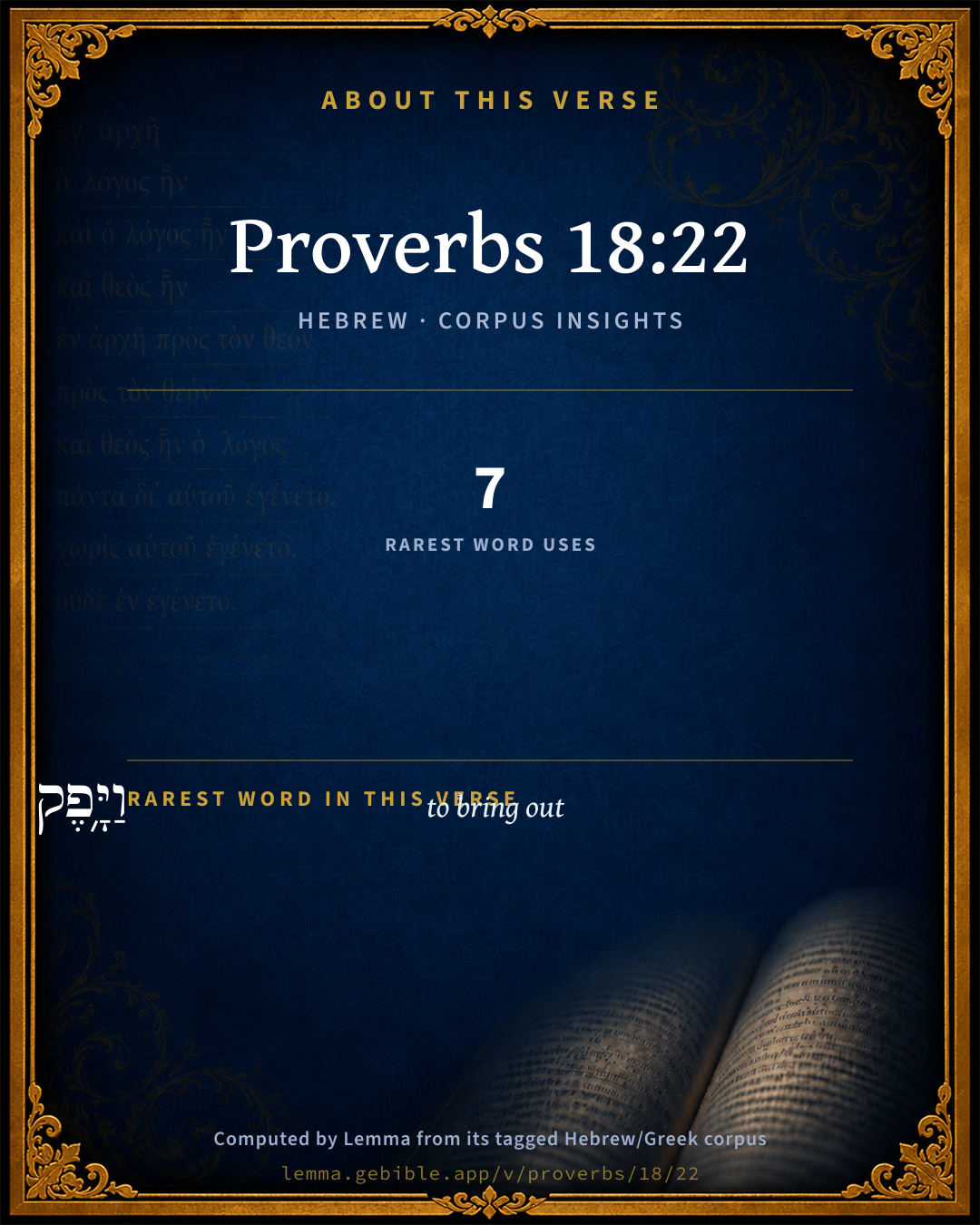
7
words
6
distinct lemmas
Wisdom
section

Notable vocabulary

The rarest word here is וַיָּ֥פֶק to bring out H6329 — appearing just 7 times in the whole Hebrew Bible.

Shared distinctive vocabulary

וַיָּ֥פֶק to bring out H6329 occurs in 7 verses of the Hebrew Bible. Also found in:

Grammatical profile

  • 3 verbs
  • 3 nouns
  • 1 adjective

Verb forms

  • מָצָ֣א Qal · Perfect
  • מָ֣צָא Qal · Perfect
  • וַיָּ֥פֶק Hiphil · Sequential Imperfect

Repetition

A word recurs within this verse — often emphatic in Hebrew:

  • מָצָ֣א to find H4672 ×2

Hebrew & Septuagint length

In English translation the verse runs 13 words from the Hebrew and 38 from the Septuagint (LXX English) — the Septuagint runs noticeably longer here. See the side-by-side →

A rough comparison of the two English renderings, which tokenize alike — not a word-level alignment.

Word counts can differ between the Hebrew and the Greek without any difference in meaning — e.g. the Hebrew direct-object marker אֵת has no separate Greek word, and Greek often adds the article ὁ.

Cross-references

13

Topical passages linked to Proverbs 18:22 in the Treasury of Scripture Knowledge — connected by theme and wording, ordered by reader-vote popularity; previews shown in the World English Bible.

  • Proverbs 19:14 House and riches are an inheritance from fathers, But a prudent wife is from Yahweh.
  • Proverbs 31:10–31 Who can find a worthy woman? For her price is far above rubies.
  • Proverbs 12:4 A worthy woman is the crown of her husband, But a disgraceful wife is as rottenness in his bones.
  • Ecclesiastes 9:9 Live joyfully with the wife whom you love all the days of your life of vanity, which he has given you under the sun, all your days of vanity: for that is your portion in life, and in your labor in which you labor under the sun.
  • 1 Corinthians 7:2 But, because of sexual immoralities, let each man have his own wife, and let each woman have her own husband.
  • Genesis 2:18 Yahweh God said, "It is not good that the man should be alone; I will make him a helper suitable for him."
  • Proverbs 5:15–23 Drink water out of your own cistern, Running water out of your own well.
  • Proverbs 8:35 For whoever finds me, finds life, And will obtain favor from Yahweh.
  • Hosea 12:12 Jacob fled into the country of Aram, And Israel served to get a wife, And for a wife he tended flocks and herds.
  • Genesis 29:20–21 Jacob served seven years for Rachel. They seemed to him but a few days, for the love he had for her.
  • Proverbs 3:4 So you will find favor, And good understanding in the sight of God and man.
  • Genesis 24:67 Isaac brought her into his mother Sarah's tent, and took Rebekah, and she became his wife. He loved her. Isaac was comforted after his mother's death.
  • Genesis 29:28 Jacob did so, and fulfilled her week. He gave him Rachel his daughter as wife.

Cross-references courtesy of OpenBible.info (CC BY 4.0).

Hebrew and Greek witnesses Masoretic Hebrew ↔ Greek Septuagint

The same verse in the two great witnesses to the Old Testament, shown verse-for-verse.

Here the Septuagint runs noticeably longer than the Hebrew — LXX2012 (modern English Septuagint) 38 words vs World English Bible 13. A rough length comparison of the two English translations, not a word-level alignment — read both below.

These are two independent witnesses, not word-aligned to each other, and the Septuagint is shown in lemma (dictionary) form.

Hebrew Proverbs 18:22 Masoretic · Westminster Leningrad Codex

מָצָ֣א אִ֭שָּׁה מָ֣צָא ט֑וֹב וַיָּ֥פֶק רָ֝צ֗וֹן מֵיְהוָֽה

Whoever finds a wife finds a good thing, And obtains favor of Yahweh.

World English Bible · Public Domain

Greek LXX Proverbs 18:22 Septuagint · lemma form

ὅς εὑρίσκω γυνή ἀγαθός εὑρίσκω χάρις λαμβάνω δέ παρά θεός ἱλαρότης ὅς ἐκβάλλω γυνή ἀγαθός ἐκβάλλω ὁ ἀγαθός ὁ δέ καταἔχω μοιχαλίς ἄφρων καί ἀσεβής

He that has found a good wife has found favours, and has received gladness from God. He that puts away a good wife, puts away a good thing, and he that keeps an adulteress is foolish and ungodly.

LXX2012 (modern English Septuagint) · Public Domain

On this verse, Joseph Benson's Commentary discusses the Septuagint’s reading. Read the note in Commentary ↓

Hebrew: Westminster Leningrad Codex (CC BY 4.0). Greek: Septuagint (public domain); English from LXX2012 (modern English Septuagint) (Public Domain). How the Septuagint differs from the Hebrew →

Commentary

Notes on Proverbs 18:22 from classic Christian and Jewish commentators (each source and its license shown beneath its notes). The classic Christian expositions comment on the surrounding passage and are grouped to its opening verse, so a note may address several verses; the Jewish commentaries on the Tanakh (Rashi and others) are per-verse, so they appear only where the commentator wrote on this verse.

Lemma curates 59 commentaries, every one of them public domain or Creative Commons licensed, each selected and text-cleaned for this edition rather than reprinted as found. About our sources →

Trapp's Complete Commentary

John Trapp

Pro 18:22 [Whoso] findeth a wife findeth a good [thing], and obtaineth favour of the LORD.

Ver. 22. Whoso findeth a wife, &c.] Whoso, after much seeking, by prayer to God, and his own utmost industry - as {Gen 24:1-9} Isaac went forth to pray, and his servant went forth to seek - findeth a fit and faithful yoke fellow - called here "a wife," that is, "a good wife," as Ecc 7:1. A name is put for a good name, and as Isa 1:18, wool is put for white wool: every married woman is not a wife; a bad woman is but the shadow of a wife; {a} according to Lamech’s second wife’s name, Zillah. "He findeth a good thing," a singular blessing, and such as should draw from him abundance of thanks. He may well say, as they were wont to do at Athens when they were married, εφυτον κακον, ευρον αμεινον. I have left a worse condition, and found a better. {b} If any be the worse for a wife, for a good wife especially, it is from his own corrupt heart, that, like a toad, turns all it takes into rank poison.

{a} Hilbah: id est, umbra ipsius, quomodo. - Menander, φιλου σκιαν dixit.

{b} Zenodo. Prov.

John Trapp, A Commentary or Exposition upon All the Books of the Old and New Testament (1647–1656) — public domain. Text from a community e-Sword module.

The Biblical Illustrator

Joseph S. Exell

Pro_18:22

Whoso findeth a wife findeth a good thing, and obtaineth favour of the Lord.

A happy marriage

At the outset these words strike two thoughts on our attention.

1. That celibacy is not the best mode of social life. Solomon means to say that it is a good thing to have a wife. Even in the state of innocence it was not good for man to be alone. Celibate, says Bishop Taylor, like the fly in the heart of an apple, dwells in perpetual sweetness, but sits alone, and is confined and dies in singularity; but marriage, like the useful bee, builds a house and gathers sweetness from every flower, and labours and unites into societies and republics, and sends out colonies and feeds the world with delicacies, and obeys their king and keeps order, and exercises many virtues, and promotes the interests of mankind, and is that state of good things to which God hath designed the present constitution of the world.

2. That monogamy is the true marriage. Solomon does not say, He that findeth wives, but He that findeth a wife. Though Solomon had many wives, he nowhere justified plurality. Duality appears everywhere, and throughout the universe is necessary. The text in its completeness teaches--

I. That a good wife is a good thing. Of a good wife, of course, the writer must be supposed to speak, for a bad wife is a bad thing. Manoah found a good thing in his wife (Jdg_3:13). The patriarch of Uz does not seem to have found a good thing in his (Job_2:9-10). A good wife must be--

1. A good woman. A woman of chaste loves, incorruptible virtues, and godly sympathies and aims.

2. A suitable companion. A good woman would not be a good wife to all men. There must be a mutual fitness, a fitness of temperament, taste, habits, culture, associations.

II. A good wife is a divine gift. Obtaineth favour of the Lord. All good things are His gifts. Young men, be cautious of your choice of a companion for life. When Themistocles was to marry his daughter, there were two suitors, the one rich and a fool, and the other wise but not rich; and being asked which of the two he had rather his daughter should have, he answered, I had rather she should marry a man without money than money without a man. The best of marriage is in the man or woman, not in the means or the money. (D. Thomas, D. D.)

The Biblical Illustrator, edited by Joseph S. Exell (c. 1880s–1900s) — public domain. Text from a community e-Sword module.

Joseph Benson's Commentary

Pro 18:22. Whoso findeth a wife — A good wife; one that deserves the name, and performs the duty of that relation. Thus Houbigant interprets it after many of the versions: see Pro 19:14. Findeth a good thing — A singular blessing; and obtaineth favour of the Lord — Obtaineth her, not by his own wisdom, or art, or endeavours, merely or chiefly, but by God’s good providence toward him, which orders that and all other events as it pleases him. The LXX. and Vulgate read at the end of this verse, “He that putteth away a good wife, putteth away a good thing; but he who retains an adulteress is foolish and wicked.”

Joseph Benson's Commentary on the Old and New Testaments (1811–1818) — public domain. Text from a community e-Sword module.

The Preacher's Complete Homiletical Commentary

Joseph S. Exell (gen. ed.)

MAIN HOMILETICS OF Pro_18:22

A TWOFOLD GOOD

I. Polygamy cannot be recommended by those who have practised it. A thousand counterfeit coins, even if they pass as genuine for a time, are nothing worth in comparison with one real golden sovereign. Both may bear the image and superscription of the king, but the one is an insult to the name it bears while the other has a right to be imprinted with the royal name. The author of this proverb was a polygamist—his great experience qualified him to give an opinion upon the subject—but we do not here find him dwelling upon the satisfaction of the harem, but upon the blessedness of a wife. He was fully conscious of the fact that a real partner of his life—one woman to be a help-meet for him according to the Divine intention—would have added much more to his real welfare than the thousand counterfeits to whom it was an insult to God to give the name of wives. More than once he bears testimony to the blessedness of marriage in the true sense of the word, but we never find him praising the practice which was so great a curse to his own life. In this proverb he indirectly condemns himself and warns others by his own example. A vessel that has gone to pieces upon the rocks may still be used to prevent others from sharing her fate. The broken timbers may serve to light a beacon fire which may warn other vessels to take another course. Polygamy was the rock upon which Solomon shipwrecked his social happiness and much more (1Ki_11:3), and he seems here and elsewhere to warn his descendants not to follow in his footsteps in this respect and conform to the custom of the heathen monarchs by whom they were surrounded.

II. Monogamy brings a double portion—a good thing and the Divine favour. The favour of a good parent is a thing prized highly by a dutiful child, and enhances the value of every other blessing. The favour of a good king is in itself a fortune which few men would despise. The favour of God is a fortune for a period which extends beyond that named in the marriage vow, it is a fortune which no creature can afford to despise, and a blessing which those who know Him prize before all things in earth or heaven. When a man enters into the marriage relation according to the Divine intention—making a woman his wife in the true sense of the word—he not only adds to his own comfort and consults his own interest, but he does that which is pleasing to God—he takes a step upon which he can fearlessly ask for the Divine blessing.

OUTLINES AND SUGGESTIVE COMMENTS

“Findeth” implies the rarity of the thing obtained (Ecc_7:27-28), and the need of circumspection in the search. Blind passion is not to make the selection at random.—Fausset.

The married who is truly Christian knows that, even though sometimes things are badly matched, still his marriage relation is well pleasing to God as His creation and ordinance, and what he therein does or endures, passes as done or suffered for God.—Luther.

There is a secular and a spiritual in every proverb. These two are not apart, but flow easily into each other. Secularly, a wife is the highest treasure. It is a vapid distinction to say a good wife, and the Bible many a time hurries on without any such distinction (comp. ch. Pro_4:3). A bad “wife” is no “wife” at all. A wife is the holiest of all relations; in this world the most powerful for good.… A good marriage is a means of grace, … of course any relation that is near and potent is covered by the passage.—Miller.

I shall always endeavour to make choice of such a woman for my spouse who hath first made choice of Christ as a spouse for herself; that none may be made one flesh with me who is not made one spirit with Christ my Saviour. For I look upon the image of Christ as the best mark of beauty I can behold in her, and the grace of God as the best portion I can receive with her.—Bp. Reynolds.

The Preacher's Complete Homiletical Commentary (gen. ed. Joseph S. Exell; Funk & Wagnalls, c. 1892) — public domain (pre-1929). A full-Bible homiletical/sermon-outline anthology covering 65 of 66 books (2 John is absent from the source module). Text from a community e-Sword module.

Geneva Bible (1599)

Geneva Bible translators

He that is joined with a virtuous woman in marriage, is blessed of the Lord, as Prov. 19:14.

Geneva Bible (1599) marginal notes — public domain. Text via Bolls.life.

Matthew Henry's Commentary

Note, 1. A good wife is a great blessing to a man. He that finds a wife (that is, a wife indeed; a bad wife does not deserve to be called by a name of so much honour), that finds a help meet for him (that is a wife in the original acceptation of the word), that sought such a one with care and prayer and has found what he sought, he has found a good thing, a jewel of great value, a rare jewel; he has found that which will not only contribute more than any thing to his comfort in this life, but will forward him in the way to heaven. 2. God is to be acknowledged in it with thankfulness; it is a token of his favour, and a happy pledge of further favours; it is a sign that God delights in a man to do him good and has mercy in store for him; for this, therefore, God must be sought unto.

Matthew Henry's Commentary on the Whole Bible (1708–1710) — public domain (CC PDM 1.0). Text via the HelloAO Bible API.

Jamieson, Fausset & Brown

Robert Jamieson, A. R. Fausset & David Brown

The old versions supply "good" before the "wife," as the last clause and Pro 19:14 imply (compare Pro 31:10).

Jamieson, Fausset & Brown — Commentary Critical and Explanatory on the Whole Bible (1871) — public domain (CC PDM 1.0). Text via the HelloAO Bible API.

Adam Clarke's Commentary

Verse 22. Whoso findeth a wife findeth a good thing] Marriage, with all its troubles and embarrassments, is a blessing from God; and there are few cases where a wife of any sort is not better than none, because celibacy is an evil; for God himself hath said, "It is not good for man to be alone." None of the versions, except the Chaldee, are pleased with the naked simplicity of the Hebrew text, hence they all add good: "He that findeth a GOOD wife findeth a good thing;" and most people, who have not deeply considered the subject, think the assertion, without this qualification, is absurd. Some copies of the Targum, and apparently one of Kennicott's MSS., have the addition טובה tobah, good; but this would be an authority too slender to justify changing the Hebrew text; yet Houbigant, Kennicott, and other able critics argue for it. The Septuagint is not satisfied without an addition: "But he who puts away a good wife, puts away a good thing: and he that retains an adulteress, is a fool and wicked." In this addition the Vulgate, Syriac, and Arabic, agree with the Septuagint. The Hebrew text as it stands, teaches a general doctrine by a simple but general proposition: "He that findeth a wife findeth a good thing." So St. Paul: "Marriage is honourable in all." Had the world been left, in this respect, to the unbridled propensities of man, in what a horrible state would society have been - if indeed society could have existed, or civilization have taken place - if marriage had not obtained among men! As to good wives and bad wives, they are relatively so, in general; and most of them that have been bad afterwards, have been good at first; and we well know the best things may deteriorate, and the world generally allows that where there are matrimonial contentions, there are faults on both sides.

Adam Clarke's Commentary on the Bible (1810–1826) — public domain. Text from a community e-Sword/MySword module.

Ellicott's Commentary for English Readers

(22) Whoso findeth a wife . . .—One who deserves the name of wife, as the one described in Pro_31:10, sqq.

A Bible Commentary for English Readers, edited by Charles John Ellicott (1878–1897) — public domain. Text from a community e-Sword module.

The Cambridge Bible for Schools and Colleges

gen. ed. J. J. S. Perowne

22. Compare:

“Happy is the husband of a good wife;

And the number of his days shall be twofold.

A brave woman rejoiceth her husband;

And he shall fulfil his years in peace.

A good wife is a good portion:

She shall be given in the portion of such as fear the Lord.”

Sir_26:1-3.

The Cambridge Bible for Schools and Colleges (gen. ed. J. J. S. Perowne; Cambridge University Press, 1878–1918) — public domain. Text from a community e-Sword module.

John Gill's Exposition

Whoso findeth a wife,.... A good one; so the Septuagint, Vulgate Latin, Syriac, and Arabic versions, supply it; and so the Targum, though it leaves out the word good in the last clause; and no other can be meant, even a good natured one, wise, prudent, careful, and industrious; a proper helpmeet, a virtuous woman, as in Pro 31:10; whoso seeks after such an one, and finds one, especially one that has the grace of God, which he should seek after among his friends, and by their assistance, and by prayer to God:

findeth a good thing; that will be good for him, both upon a civil and spiritual account; the Septuagint version adds,

"he that casts out a good wife casts out good things, but he that retains a whore is foolish and ungodly;''

which is followed by the Vulgate Latin, Syriac, and Arabic versions, but is not in the Hebrew text. Jarchi interprets it of the law in a mystic sense, but, according to the literal sense, of a good wife;

and obtaineth favour of the Lord; it is from the Lord, and under his direction and guidance in seeking, that he finds a good wife; and which he ought to esteem as a favour from the Lord, and as an evidence of his favour to him, and may encourage himself to hope for others of him (z) Hesiod says, a man cannot obtain anything better than a good wife.

(z) Opera & Dies, l. 2. v. 323.

John Gill's Exposition of the Whole Bible (1746–1763) — public domain (CC PDM 1.0). Text via the HelloAO Bible API.

Albert Barnes' Notes on the Bible

The sense seems to require, “Whoso findeth a good wife,” as in some Chaldee manuscripts; but the proverb writer may be looking at marriage in its ideal aspect, and sees in every such union the hands of God joining together man and woman for their mutual good. The Septuagint adds “He who casts out a good wife, casts away that which is good: but he that keepeth an adulteress is foolish and ungodly.”

Albert Barnes' Notes on the Bible (1834–1885) — public domain. Text from a community e-Sword/MySword module.

Haydock's Catholic Bible Commentary

Good wife. Good is not in Hebrew, but should be understood, as it is expressed in the Complutensian (Calmet) and Alexandrian Septuagint. (Haydock) --- He that, &c., occurs not in Hebrew, Sixtus V, &c. But it is found in Septuagint and Arabic. The Syriac omits the last sentence. --- Wicked. St. Augustine had frequently asserted that a divorce was only of counsel: but this he retracted, when he reflected on this text. (Retractions i. 19.) --- The Hebrews, Athenians, and Romans, followed the same practice with adulteresses. (Selden, Ux. iii. 16.; Dem. in Neæram, &c.) --- Hermas (past. i. 4.) prescribes that the penitent shall be received again, but not often. In cae of divorce, the fathers still permit not a second marriage, that the parties may be reconciled. They enjoin the husband to put away only such as are incorrigible. (St. Augustine, Adul. ii. 3.) (Calmet)

George Leo Haydock (1774–1849), Haydock's Catholic Family Bible and Commentary, 1859 edition — public domain. Excludes Psalms (Douay-Rheims chapter numbering differs from Protestant) and Deuterocanonical books (Catholic canon only).

Matthew Poole's English Annotations

A wife; either,

1. Simply a wife; for a wife, though she be not the best of her kind, is to be esteemed a blessing, being useful both for society of life, Gen 2:18, and for the mitigation of a man’s cares and troubles, and for the prevention of sins. Or,

2. Good wife; one that deserves the name and performs the duty of that relation; a wise and worthy wife, as this word may seem to imply, being deduced from the Hebrew word isch, which sometimes notes a man of eminency. And this limitation and explication of the word may be gathered both from the following commendations, which would hardly be given to a bad wife, and from the usage of Scripture, in which this ellipsis is frequent, as a path or way is put for a good path or way, Psa 119:1; Pro 15:10, an answer for a good answer, Pro 15:23, a king for a good king, Pro 16:10; 29:4, a name for a good name, Pro 22:1; Ecc 7:1, &c.

A good thing; a singular blessing.

Obtaineth favour of the Lord; obtaineth her not by his own wit, or art, or diligence, but by God’s good providence towards him, which ordereth that and all other events as it pleaseth him.

Matthew Poole's English Annotations on the Holy Bible (1683–1685) — public domain. Text from a community e-Sword/MySword module.

Whedon's Commentary on the Bible

Daniel D. Whedon

22. Whose findeth a wife — The versions and interpreters generally supply the word good before wife. But others assert that this makes it a mere truism. Dr. A. Clarke thinks that almost any kind of a wife, if properly treated, is better than none. The text states a general and true doctrine in a simple proposition. Still, it must be admitted that a good wife may be considered a special blessing from Jehovah. Conant renders: “He found a wife — he found good, and obtained favour from Jehovah.” The Septuagint adds another proverb: “He that puts away a good wife puts away a good thing; and he that keeps an adulteress is foolish and ungodly.”

Daniel D. Whedon (gen. ed.), Commentary on the Old and New Testaments (1874–1909) — public domain. Text from a community e-Sword module.

The Pulpit Commentary

Whoso findeth a wife findeth a good thing. A good wife is meant (as the Septuagint has it, gunaika agayhn ; mulierem bonam, Vulgate), a virtuous, prudent helpmate, as in Pro_12:4 Pro_19:14; and Pro_19:3. The epithet is omitted, because the moralist is thinking of the ideal wife, the one whoso union is blessed, who alone deserves the holy name of wife. Thus in ver. 4 we had the ideal man spoken of. Septuagint, eure caritav ," findeth graces," viz. peace, union, plenty, ruder. (see a different Ecc_7:26-28) And obtaineth favour of the Lord; (Pro_8:35 Pro_12:2) or, hath obtained, (Pro_3:13) as shown by the consort whom God has given him. Ratson, "good will," "favour," is rendered by the Septuagint ilarothta , and by the Vulgate, jucunditatem, "cheerfulness," "joyousness". (see on Pro_19:12) Ecc 26:1, etc., "Blessed is the man that hath a good wife, for the number of his days shall be double. A virtuous (andreia ) woman rejoiceth her husband, and he shall fulfil the years of his life in peace. A good wife is a good portion which shall be given in the portion of them that fear the Lord." "A good wife," says the Talmud. "is a good gift; she shall be given to a man that feareth God." And again, "God did not make woman from man"s head, that she should not rule over him; nor from his feet, that she should not be his slave; but from his side, that she should be near his heart" (Dukes, p. 69). A Greek gnome runs Gunh dikaza tou biou swthria ..

The Septuagint and Vulgate here introduce a paragraph which is not in the Hebrew, and only partly in the Syriac. It seems to be a further explanation of the statement in the text, founded on the practice prevalent at the time when the Septuagint Version was composed, which appears to have made divorce a recognized necessity in the case of adultery: "He who casteth away a good a wife casteth away good things; but he who retaineth an adulteress is a fool and impious." The advice of Siracides concerning a wicked wife is austere: "If she go not as thou wouldest have her, cut her off from thy flesh" (Ecc 25:26). Nothing is here said about the marriage of divorced persons; but the absolute indissolubility of the marriage bond was never held among the Jews, a certain laxity being allowed because of the hardness of their heart. (Mat_5:32 Mat_19:8, etc.) The original intently of the marriage contract was re-established by Christ.

The blessedness of true marriage.

The Bible does not regard marriage as "a failure," nor does it treat celibacy as a more saintly condition. Even St. Paul, who does not seem to have been a married man, and who is thought by some to undervalue marriage, gives to it an eulogium in describing the union of husband and wife as a copy of the mystical union of Christ and his Church. (Eph_5:22-32)

I THE BLESSEDNESS OF MARRIAGE.

1. The companionship of love. The creation of woman is ascribed to the need of this. "And the Lord God said, It is not good that the man should be alone". (Gen_2:18) In a true marriage a man"s wife is his best friend. Fellowship of soul makes the union more than a mere contract of external relationship. Now, this fellowship is greatly needed for solace amid the cares of life, and strength to face its difficulties. The wife is able to give it to her husband, and the husband to the wife, as no persons in the outer circle of social relationship can hope to offer it.

2. Mutual helpfulness. In the narrative of the creation, God says, concerning Adam, "I will make him a help meet for him". (Gen_2:18) Woman is degraded when she is treated as a toy of idle hours, to amuse in the drawing room, but not to take her share in the serious concerns of life. No true woman would desire so idle a position. The wife who understands the Christian calling will aim at ministering to her husband in all ways of helpfulness that are within her power, but chiefly in helping his higher life; and the duty of the husband towards the wife will be similar.

3. Variety of ministration. The wife is not the counterpart of the husband, but the complement. Human nature is completed in the union of the two.

Therefore it is not the part of women to imitate men, nor is inferiority to be assigned to women because they differ from men. The rich, fall, perfect human life is attained by the blending of differences.

II THE SECRET OF THIS BLESSEDNESS. No ideal of human life can be more beautiful than that of the happy home. The serious question is how it shall be realized.

1. By adaptation. Every woman is not suitable for every man. Hasty courtships may lead to miserable marriages. So serious a matter as the choice of a companion for life is not to be lightly undertaken if there is to be any hope of its issuing in happiness.

2. By sympathy. There must be mutual confidence between husband and wife if the marriage is to be one of true and lasting blessedness. The Oriental cruelty of imprisonment in the harem, and the Western cruelty of degradation in domestic drudgery, are both fatal to the idea of marriage. Whatever be their position in the social scale, it is possible for husbands and wives to share one another"s interests and enlarge one another"s lives by conceding the fullest mutual confidence.

3. By self-sacrifice. Selfishness is fatal to marriage. Love must learn to give, to suffer, to endure. The happiness is most complete when each seeks it chiefly for the other.

4. By religion. The true marriage must be ratified in heaven. Its happiness may be wrecked on so many hidden rocks that it is not safe to venture on to the unknown sea without the assurance that God is guiding the voyage.

Vers. 22-24. Love in different relations.

I CONJUGAL LOVE. (Ver. 22) The blessing of a good wife. "Young men"s mistresses; companions for middle age; and old men"s nurses" (Lord Bacon). On the choice of a with none but a recluse or a pedant would pretend to lay down infallible precepts or counsels. But every man who has been happy in the married relation will recognize his happiness as among the chiefest of blessings from above. It is indeed a good that is found, cannot be inherited nor deserved.

II COMPASSION. (Ver. 23) Here, as so often, the duty is suggested by means of a dark picture of the opposite, of its neglect. The rich man who "against the houseless stranger shuts the door," or who, like Dives, fares luxuriously while Lazarus lies in sores at his gate, these revolt the heart and may more move the conscience than declamations on the positive duty.

When chilled by the coldness and severity of selfish man, let the poor and afflicted turn to the "God of all compassion," and to the revelation of him in the "good Samaritan," in Jesus Christ.

III FRIENDSHIP. (Ver. 24)

1. The spurious friendship. The more correct rendering of the first half of the verse seems to be, "a man of many companions will prove himself to be worthless." Mere agreeableness may be a surface quality, may spring more from variety than anything else, will soon wear out, cannot be counted on. Number counts for little in friendship.

2. The genuine friendship. More tenacious than the mere natural love of kindred, because founded on the affinity of soul with soul. All the purest types of earthly affection and friendship are but hints of the eternal love of him who calls the soul into espousal, friendship, and eternal communion with himself. J.

The Pulpit Commentary (1880–1919), ed. H.D.M. Spence-Jones & Joseph S. Exell — public domain. Text from a community e-Sword module.

John Wesley's Explanatory Notes

A wise - A good wife; one that deserves the name, and performs the duty of that relation. favour - Obtains her not by his own diligence, but by God's good providence.

John Wesley, Explanatory Notes Upon the Whole Bible (1754–1765) — public domain. Text via the GEBible commentary corpus.

Bridges on Proverbs

Charles Bridges

22 Whoso findeth a wife findeth a good thing,†a and obtaineth favour of the LORD.

This is obviously to be taken with limitation. Manoah found a good thing in his wife. (Jdg 13:23 .) So did not Job. (Job 2:9-10 .) Some find "a crown to their head;" others, "rottenness to their bones." (Pro 12:4 .) That which alone deserves the name is indeed a good thing. If in a state of innocence "it was not good for a man to be alone" (Gen 2:18 ); much more in a world of care and trouble "two are better than one" for mutual support, helpfulness, and sympathy.†1 The good thing implies godliness, and fitness. Godliness is found, when the man marries "only in the Lord" (1Co 7:39 ), and only one, who is the Lord’s. ’I wish’ — said pious Bishop Hall, ’that Manoah could speak so loud, that all our Israelites might hear him — "Is there never a woman among the daughters of thy brethren, or among all God’s people, that thou goest to take a wife of the uncircumcised Philistines?" If religion be any other than a cipher, how dare we not regard it in our most important choice? Is she a fair Philistine? Why is not the deformity of the soul more powerful to dissuade us, than the beauty of the face to allure us?’†2

There may however be godliness on both sides, without that mutual fitness which makes the woman "a helpmeet for the man." The good thing is, when he honours her, not as the wisest or the holiest of woman, but as the person, whom God saw to be the best and fittest for himself in the whole world, a comfort for life, a help for heaven.†3 Thus she becomes the one object of his undivided heart. Mutual faith is plighted in the Lord. Such a communion spiritualizes his affections, and elevates him from earth to heaven.

But how is this good thing found? Isaac found it, where every Christian looks for his blessing, as an answer to prayer. (Gen 24:1-67 .) A man’s choice for his own indulgence will bring a curse upon himself and his family. (2Ch 18:1-2 ; 2Ch 21:1-6 .) "Choose thou mine inheritance for me" (Psa 47:4 ) — is the cry and confidence of the child of God. Then truly will he obtain the gift, not as the result of fortune, or as the proof of his own good discernment; but, as Adam received his wife, "from the Lord" (Pro 19:14 ), a token of his special favour.

Footnotes:

†a Dr. Kennicott elaborately insists upon supplying the distinctive limitation from the reading of the LXX Vulgate, and some old Chaldee paraphrase. (Second Dissertation on the Hebrew Text, pp. 189-192.) But, the general term, frequently used by the wise man for the obvious limitation, sufficiently explains his meaning, Pro 15:10; Pro 16:10; Pro 22:1; Pro 29:4. Ecc 7:28. The LXX adds — ’He that casteth out a wife, casteth out good things: but he that retaineth a strange woman is foolish and ungodly.’

†1 Ecc 4:9-10. See the Marriage Service.

†2 Contemplations, x. 3. Bp. Beveridge’s Resolution is well worth recording — ’I shall always endeavour to make choice of such a woman for my spouse, who hath first made choice of Christ as a spouse for herself; that none may be made one flesh with me, who is not made one spirit with Christ my Savior. For I look upon the image of Christ as the best mark of beauty I can behold in her, and the grace of God as the best portion I can receive with her. These are excellences, which, though not visible to our carnal eyes, are nevertheless agreeable to a spiritual heart; and such as all wise and good men cannot choose but be enamoured with. For my own part, they seem to me such necessary qualifications, that my heart trembles at the thoughts of ever having a wife without them.’ Resol. ii.

†3 Luk 1:6. See the beautiful picture. Pro 31:10-31 . Compare also Sir 26:1-3, Sir 26:13-16 ; Sir 36:24 .

Charles Bridges, An Exposition of the Book of Proverbs (1846) — public domain. Text from a community e-Sword module.

Kretzmann's Popular Commentary

Paul E. Kretzmann

v. 22. Whoso findeth a wife, the words implying an earnest and wise search, findeth a goad thing, for a virtuous wife is a true helpmeet for man, and obtaineth favor of the Lord, for such a wife is abundant evidence of the Lord’ s merciful kindness and truly belongs in the Fourth Petition.

Paul E. Kretzmann, Popular Commentary of the Bible (1921–1924) — public domain. Text from a community e-Sword module.

Rashi

Rabbi Shlomo Yitzchaki (Rashi)

He who has found a wife has found good He who has found the Torah; and according to its apparent meaning, a good wife.

and has obtained favor And has obtained. This is its simple meaning. Another explanation: A man who found a wife and found good, has obtained favor. That man obtains favor from the Holy One, blessed be He. [This is in the name of] Rabbi Joseph Kara.

Rashi on the Tanakh — English translations: “The Judaica Press complete Tanach with Rashi, translated by A. J. Rosenberg” (CC BY 4.0); “Pentateuch with Rashi's commentary by M. Rosenbaum and A.M. Silbermann, 1929-1934” (public domain); “The Metsudah Tanach series, Lakewood, N.J” (CC BY 4.0); and “The Book of Joshua, Metsudah Publications, 1997” (CC BY 4.0). Text via Sefaria.

Lesson kit

Teaching starters — assembled from the data on this page, not authored interpretation. Every prompt links to the verse data it draws on. Edit before teaching.

Proverbs, in the Wisdom, opens this verse with 7 words (6 distinct Hebrew lemmas). Its most distinctive word is pûwq (“to bring out”). The Greek Septuagint runs longer here. A historical commentator’s framing appears above. Read the whole chapter for the surrounding context.

Discussion questions

  1. How does “to bring out” (pûwq) shape what this verse is saying?
  2. Psalms 140:8 shares the word «to bring out» with this verse. How do the two illuminate each other?
  3. “to find” occurs 2× in this one verse. What is the effect of the repetition?
  4. Compared with the Hebrew, the Septuagint runs longer here. What questions does that raise?
  5. These translations render this verse differently. What is at stake in choosing one wording over another?
  6. The verb «מָצָ֣א» is Qal Perfect. How does its form color the action?
  7. Reading how Trapp's Complete Commentary and The Biblical Illustrator read this verse, where do the two commentators agree and where do they part?

Things to notice

Reading settings

Reading text

Shown beneath each verse's original-language words.

Old Testament
Old Testament edition

Read the OT as the Masoretic Hebrew (MT) or the Greek Septuagint (LXX).

English shown for the Greek Septuagint (in the Hebrew ↔ Greek comparison).

Comparing translations? Open the Compare panel on any verse page to stack up to four side by side.