
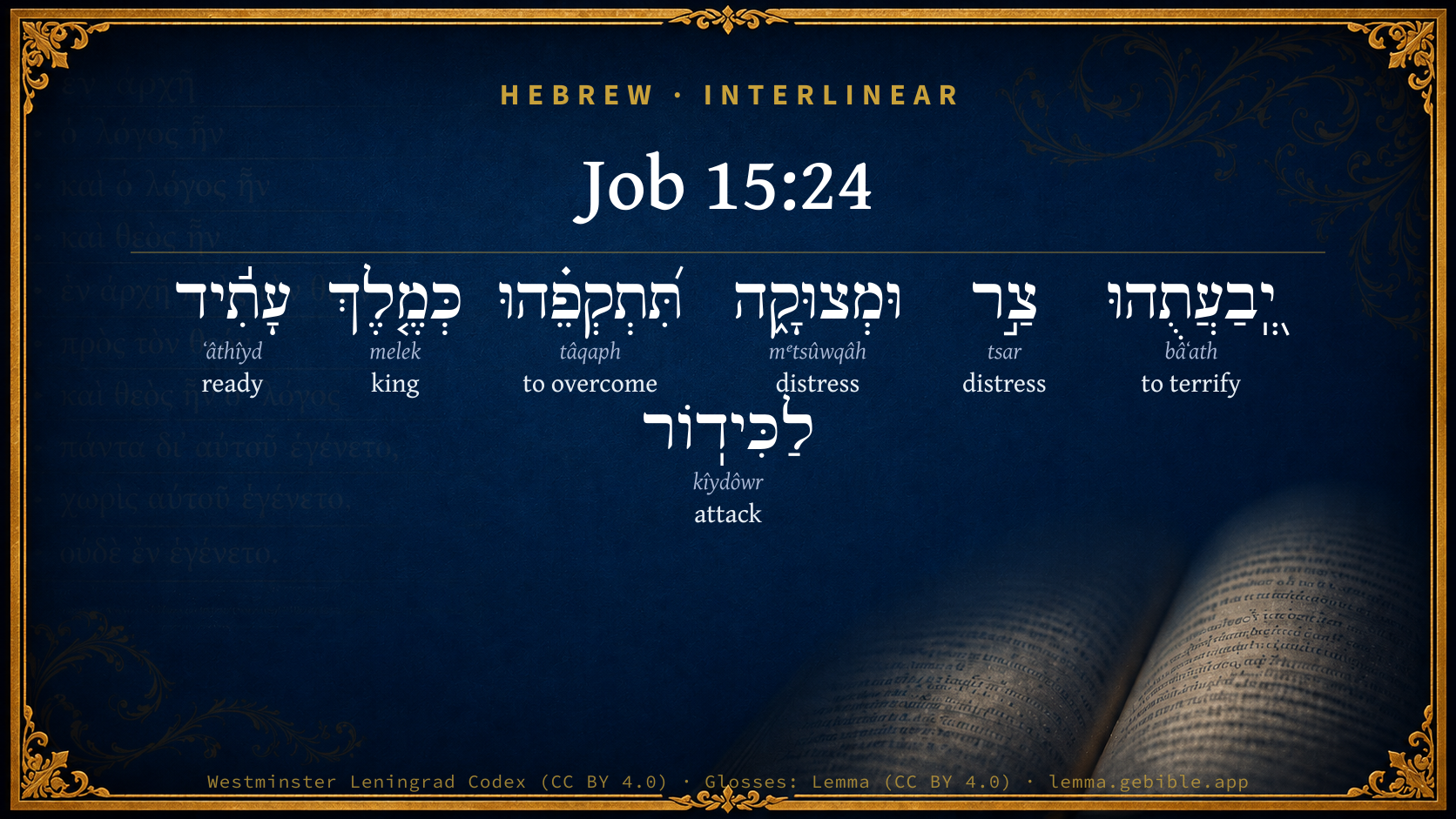
Job 15:24

Hebrew (Westminster Leningrad Codex) Job 15:24 appears in the Hebrew Old Testament. The text above is from the Westminster Leningrad Codex. Each word links to its Strong’s number, a concise gloss, and parsing drawn from the Open Scriptures Hebrew Bible morphology. Click any word for its full Brown-Driver-Briggs (BDB) entry.
Download image
Cite this verse

Job 15:24 (World English Bible). Public Domain. Lemma interlinear Bible study tool, https://lemma.gebible.app/v/job/15/24.

Show BibTeX & RIS
BibTeX
RIS
English Translation
Distress and anguish make him afraid; They prevail against him, as a king ready to the battle.
World English Bible · Public Domain
Highlights
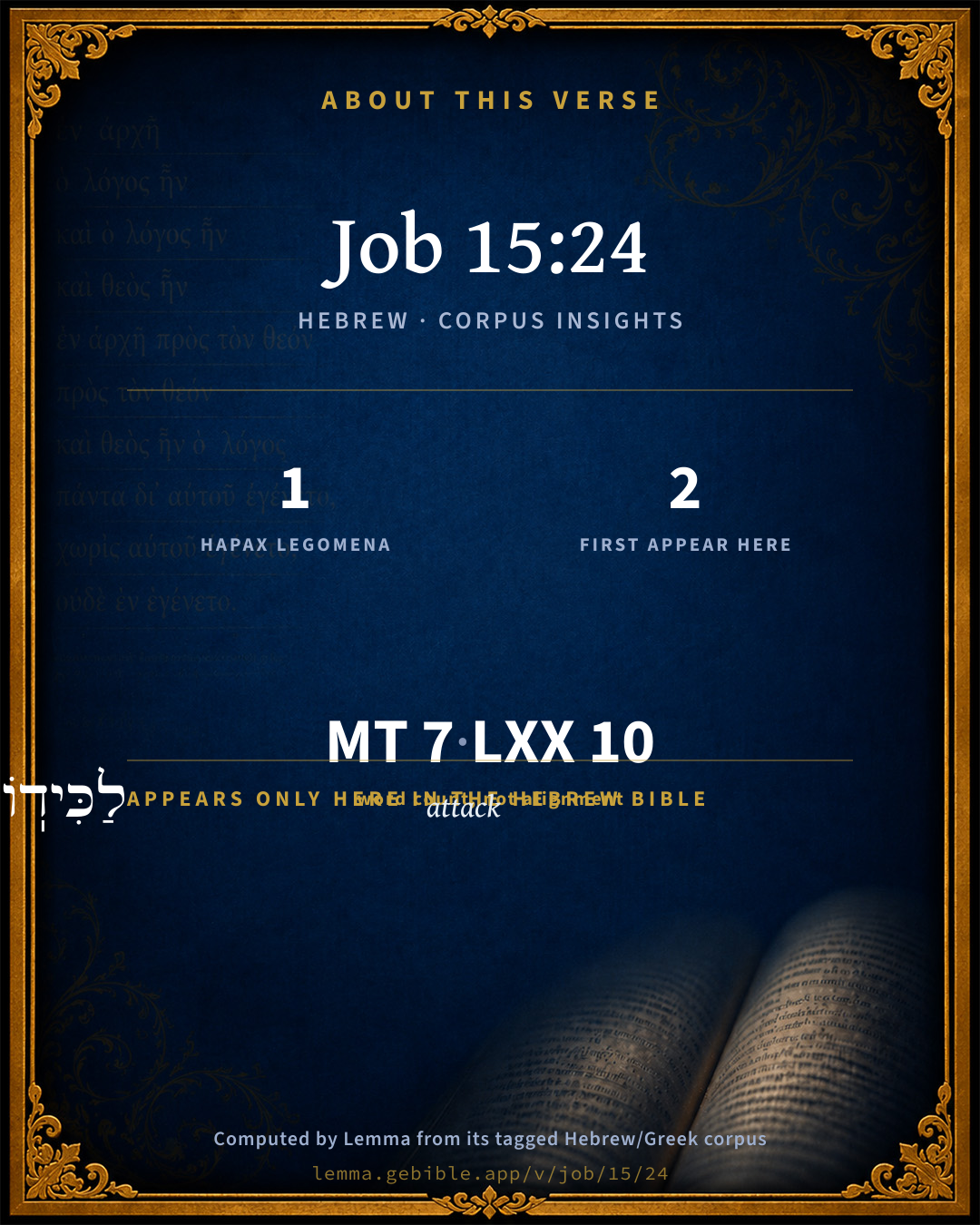
  • 1 hapax legomenon — only here in the Hebrew Bible
  • 2 first appearances in the Hebrew Bible
Full analysis ↓
Download a study sheet

One document with this verse’s original text, its word-by-word gloss line, the meaning frame, cross-references with their text, attributed commentary, and full source and license credits — printable, and it pastes into notes with its structure intact.

This verse Autodidact and up

Study sheet (.html) Plain text (.txt)

A passage Seminary Student

Up to 50 verses in one chapter. A passage sheet keeps up to 6 commentary sources and 12 cross-references per verse, in the order this page ranks them, and says so on the sheet whenever that leaves anything out. Ask for a single verse and you get the Autodidact verse sheet above.

Everything on this page stays free to read, with no account — the sheet is a download of what is already on screen, not access to it.

Want to remove ads? Support Godless Engineer
Compare translations 3

The same verse in 3 English versions, stacked beneath the original-language interlinear above. Click any original word for its lexicon entry.

Each is an independent rendering of the whole verse — the interlinear is not word-aligned to these translations.

Highlighted words mark where these versions differ — a whole-verse word diff, not a word-by-word alignment.

  • World English Bible Public Domain
    Distress and anguish make him afraid; They prevail against him, as a king ready to the battle.
  • King James Version Public Domain
    Trouble and anguish shall make him afraid; they shall prevail against him, as a king ready to the battle.
  • unfoldingWord Literal Text CC BY-SA 4.0
    Distress and anguish terrify him; it overpowers him like a king ready for battle,

unfoldingWord Literal Text — © unfoldingWord, licensed CC BY-SA 4.0. Word-aligned USFM3 via Door43 (git.door43.org/unfoldingWord/en_ult).

Versions to compare (up to 4)

3 of 4 selected

Show all 18 translations

Every available English version of this verse, each an independent rendering of the whole verse.

  • World English Bible Public Domain
    Distress and anguish make him afraid; They prevail against him, as a king ready to the battle.
  • Berean Standard Bible Public Domain
    Distress and anguish terrify him, overwhelming him like a king poised to attack.
  • Majority Standard Bible Public Domain
    Distress and anguish terrify him, overwhelming him like a king poised to attack.
  • King James Version Public Domain
    Trouble and anguish shall make him afraid; they shall prevail against him, as a king ready to the battle.
  • American Standard Version (1901) Public Domain
    Distress and anguish make him afraid; They prevail against him, as a king ready to the battle.
  • Revised Version (1885) Public Domain
    Distress and anguish make him afraid; they prevail against him, as a king ready to the battle:
  • Geneva Bible (1599) Public Domain
    Affliction and anguish shall make him afraide: they shall preuaile against him as a King readie to the battell.
  • Douay-Rheims (1899) Public Domain
    Tribulation shall terrify him, and distress shall surround him, as a king that is prepared for the battle.
  • Young's Literal Translation Public Domain
    Terrify him do adversity and distress, They prevail over him As a king ready for a boaster.
  • Literal Standard Version CC BY-SA 4.0
    Adversity and distress terrify him, || They prevail over him as a king ready for a boaster.
  • Unlocked Literal Bible CC BY-SA 4.0
    Distress and anguish make him afraid; they prevail against him, as a king ready for battle.
  • unfoldingWord Literal Text CC BY-SA 4.0
    Distress and anguish terrify him; it overpowers him like a king ready for battle,
  • Darby Bible Public Domain
    Distress and anguish make him afraid; they prevail against him, as a king ready for the battle.
  • World Messianic Bible Public Domain
    Distress and anguish make him afraid. They prevail against him, as a king ready to the battle.
  • Webster's Bible Public Domain
    Trouble and anguish shall make him afraid; they shall prevail against him, as a king ready to the battle.
  • Free Bible Version CC BY-SA 4.0
    Misery and torment overwhelm them like a king preparing for battle.
  • Bible in Basic English Public Domain
    He is greatly in fear of the dark day, trouble and pain overcome him:
  • JPS Tanakh (1917) Public Domain
    Distress and anguish overwhelm him; they prevail against him, as a king ready to the battle.

Literal Standard Version (2020), Covenant Press — licensed CC BY-SA 4.0. Text via the HelloAO Bible API (eBible.org). Unlocked Literal Bible (unfoldingWord) — licensed CC BY-SA 4.0. Text via the HelloAO Bible API (eBible.org). unfoldingWord Literal Text — © unfoldingWord, licensed CC BY-SA 4.0. Word-aligned USFM3 via Door43 (git.door43.org/unfoldingWord/en_ult). Free Bible Version, Dr. Jonathan Gallagher — licensed CC BY-SA 4.0. Text via the HelloAO Bible API (eBible.org).

Word by word

More ways to search: Search by grammar → Find every occurrence → Compare this word →

Practice this passage: Drill this verse → Learn its vocabulary →

About this verse

These counts appear in no published source. They are computed here, from the morphology-tagged text and Lemma’s own curated glosses. What Lemma adds →

7
words
7
distinct lemmas
Wisdom
section

Notable vocabulary

1 hapax legomenon — a word that appears only here in the entire Hebrew Bible:

  • לַכִּידֽוֹר attack H3593

First appearance in Scripture

These words make their first canonical appearance in the Hebrew Bible here:

  • וּמְצוּקָ֑ה distress H4691
  • לַכִּידֽוֹר attack H3593

Shared distinctive vocabulary

תִּ֝תְקְפֵ֗הוּ to overcome H8630 occurs in 4 verses of the Hebrew Bible. Also found in:

Grammatical profile

  • 2 verbs
  • 3 nouns
  • 2 adjectives

Verb forms

  • יְֽ֭בַעֲתֻהוּ Piel · Imperfect
  • תִּ֝תְקְפֵ֗הוּ Qal · Imperfect

Hebrew & Septuagint length

In English translation the verse runs 17 words from the Hebrew and 18 from the Septuagint (LXX English) — closely comparable.

A rough comparison of the two English renderings, which tokenize alike — not a word-level alignment.

Word counts can differ between the Hebrew and the Greek without any difference in meaning — e.g. the Hebrew direct-object marker אֵת has no separate Greek word, and Greek often adds the article ὁ.

In the original languages it is 7 Hebrew tokens and 10 Greek tokens — but the two are counted differently (Hebrew bundles its prefixes and suffixes into one token; the Greek is in lemma form), so that isn’t a like-for-like length.

Cross-references

8

Topical passages linked to Job 15:24 in the Treasury of Scripture Knowledge — connected by theme and wording, ordered by reader-vote popularity; previews shown in the World English Bible.

  • Proverbs 6:11 So your poverty will come as a robber, And your scarcity as an armed man.
  • Proverbs 24:34 So shall your poverty come as a robber, And your want as an armed man.
  • Job 6:2–4 "Oh that my anguish were weighed, And all my calamity laid in the balances!
  • Psalms 119:143 Trouble and anguish have taken hold of me. Your commandments are my delight.
  • Proverbs 1:27 When calamity overtakes you like a storm, When your disaster comes on like a whirlwind; When distress and anguish come on you.
  • Isaiah 13:3 I have commanded my consecrated ones, yes, I have called my mighty men for my anger, even my proudly exulting ones.
  • Matthew 26:37–38 He took with him Peter and the two sons of Zebedee, and began to be sorrowful and severely troubled.
  • Romans 2:9 oppression and anguish, on every soul of man who works evil, on the Jew first, and also on the Greek.

Cross-references courtesy of OpenBible.info (CC BY 4.0).

Hebrew and Greek witnesses Masoretic Hebrew ↔ Greek Septuagint

The same verse in the two great witnesses to the Old Testament, shown verse-for-verse.

These are two independent witnesses, not word-aligned to each other, and the Septuagint is shown in lemma (dictionary) form.

Hebrew Job 15:24 Masoretic · Westminster Leningrad Codex

יְֽ֭בַעֲתֻהוּ צַ֣ר וּמְצוּקָ֑ה תִּ֝תְקְפֵ֗הוּ כְּמֶ֤לֶךְ עָתִ֬יד לַכִּידֽוֹר

Distress and anguish make him afraid; They prevail against him, as a king ready to the battle.

World English Bible · Public Domain

Greek LXX Job 15:24 Septuagint · lemma form

ἀνάγκη δέ καί θλῖψις αὐτός καταἔχω ὥσπερ στρατηγός πρωτοστάτης πίπτω

Distress also and anguish shall come upon him: he shall fall as a captain in the first rank.

LXX2012 (modern English Septuagint) · Public Domain

Hebrew: Westminster Leningrad Codex (CC BY 4.0). Greek: Septuagint (public domain); English from LXX2012 (modern English Septuagint) (Public Domain). How the Septuagint differs from the Hebrew →

Commentary

Notes on Job 15:24 from classic Christian and Jewish commentators (each source and its license shown beneath its notes). The classic Christian expositions comment on the surrounding passage and are grouped to its opening verse, so a note may address several verses; the Jewish commentaries on the Tanakh (Rashi and others) are per-verse, so they appear only where the commentator wrote on this verse.

Lemma curates 59 commentaries, every one of them public domain or Creative Commons licensed, each selected and text-cleaned for this edition rather than reprinted as found. About our sources →

Trapp's Complete Commentary

John Trapp

Job 15:24 Trouble and anguish shall make him afraid; they shall prevail against him, as a king ready to the battle.

Ver. 24. Trouble and anguish shall make him afraid] Or scare him, not only out of his comforts, but out of his wits and senses too, as it did Charles the Great, Cardinal of Lorrain (Meutis inops moritur). See Deu 28:34. Tullus Hostilius, the third king of Romans, deriding the religion of his predecessor Numa, as that which did emasculate men’s minds, was afterwards so terrified, that he set up and worshipped two new gods, viz. Pavorem et Pallorem, trouble and anguish, which he had perpetually present with him, as Lactantius reporteth. What a pitiful agony Vitellius the emperor was in when Vespasian’s army marched toward Rome, is notably set forth by Dio in his Life (Eμπλεκτως ανω και κατω εφερετο ωσπερ εν κλυδωνι). Not long after that, at the sack of Jerusalem, some Jews killed themselves, lest they should fall into the hands of Vespasian’s soldiers.

Hic rogo; non furor est, ne moriare, mori?

They shall prevail against him] Or, begirt him, as a king is surrounded, in peace by his guard, in war by his army. Or, they shall destroy him, as a king ready to the battle doth his enemies’ forces, which he routeth and ruineth. Fear hath a deadly force upon feeble spirits; neither is it any wonder that they ring their bells backward when things begin once to be on fire.

John Trapp, A Commentary or Exposition upon All the Books of the Old and New Testament (1647–1656) — public domain. Text from a community e-Sword module.

Joseph Benson's Commentary

Job 15:24. Trouble and anguish shall make him afraid — When trouble comes, instead of trusting and hoping, and comforting himself in God, as good men do in such cases, 1Sa 30:6, he is full of torment, dreading the issue of it, and concluding it will end in his utter ruin, as he has great reason to do. They shall prevail against him — Though he would fain shake off his fears, and uses many expedients to free himself from them, he is not able; they overpower him, as a king ready to the battle — With forces too strong to be resisted. He that would keep his peace must keep a good conscience.

Joseph Benson's Commentary on the Old and New Testaments (1811–1818) — public domain. Text from a community e-Sword module.

Geneva Bible (1599)

Geneva Bible translators

He showeth what weapons God useth against the wicked, which lift up themselves against him, to wit, terror of conscience, and outward afflictions.

Geneva Bible (1599) marginal notes — public domain. Text via Bolls.life.

Jamieson, Fausset & Brown

Robert Jamieson, A. R. Fausset & David Brown

prevail--break upon him suddenly and terribly, as a king, &c. (Pro 6:11).

Jamieson, Fausset & Brown — Commentary Critical and Explanatory on the Whole Bible (1871) — public domain (CC PDM 1.0). Text via the HelloAO Bible API.

Adam Clarke's Commentary

Verse 24. Trouble and anguish shall make him afraid] He shall be in continual fear of death; being now brought down by adversity, and stripped of all the goods which he had got by oppression, his life is a mark for the meanest assassin.

As a king ready to the battle.] The acts of his wickedness and oppression are as numerous as the troops he commands; and when he comes to meet his enemy in the field, he is not only deserted but slain by his troops. How true are the words of the poet: -

Ad generum Cereris sine caede et vulnere pauci

Descendunt reges, et sicca morte tyranni.

Juv. Sat., ver. 112.

"For few usurpers to the shades descend

By a dry death, or with a quiet end."

Adam Clarke's Commentary on the Bible (1810–1826) — public domain. Text from a community e-Sword/MySword module.

Ellicott's Commentary for English Readers

(24) As a king ready to the battle.—Or, They prevail against him like a king: he is destined to be like a ball (comp. Isa_22:18), the tennis-ball of calamity.

A Bible Commentary for English Readers, edited by Charles John Ellicott (1878–1897) — public domain. Text from a community e-Sword module.

The Cambridge Bible for Schools and Colleges

gen. ed. J. J. S. Perowne

24. shall make him afraid] Rather, make him afraid.

ready to the battle] Fully prepared and therefore irresistible.

The Cambridge Bible for Schools and Colleges (gen. ed. J. J. S. Perowne; Cambridge University Press, 1878–1918) — public domain. Text from a community e-Sword module.

John Gill's Exposition

For he stretched out his hand against God,.... Being an hater of him, an enemy to him, yea, enmity itself against him; an enemy in his mind, which appears by his wicked works, which are so many acts of hostility against God; all sins are against God, his nature, his will, his law, and all his remonstrances, exhortations, cautions, and instructions; but some are more daring and impudent than others, or are committed in a more open, bold, and audacious manner, as were those committed by the inhabitants of Sodom, and those who are similar to them; especially such as strike at the being of God and his perfections, his providence and government of the world; and such as deny these may most truly be said to stretch out their hands against God, and strike at him: and this may regard not only sins committed against the light of nature and the law of God, but against the evangelic revelation, the doctrines of the Gospel, and the ordinances of it; for such who deny the one, and reject the other, openly oppose themselves to God, and expose themselves to his wrath and vengeance; for of how much sorer punishment shall such be thought worthy, who trample Christ and his blood under foot, despise and disobey his Gospel:

and strengtheneth himself against the Almighty; by hardening his heart against him as Pharaoh did; by putting on a bold and brazen countenance, by setting his mouth against God in heaven, and suffering, his tongue to walk through the earth, fearing neither God nor man; by entering into a friendship with the world, and making alliances with the enemies of God, even by making a covenant with death, and an agreement with hell; all which is egregious folly and madness: for a sinful man to oppose himself to God is to set briers and thorns to a consuming fire; for a weak feeble creature to set himself against the Almighty, who can crush him in a moment, and send him down to hell, is the height of folly; let the potsherds strive with the potsherds of the earth, but not man with his Maker; who ever strengthened or hardened himself against him, and prospered?

John Gill's Exposition of the Whole Bible (1746–1763) — public domain (CC PDM 1.0). Text via the HelloAO Bible API.

Albert Barnes' Notes on the Bible

As a king ready to the battle - Fully prepared for a battle; whom it would be vain to attempt to resist. So mighty would be the combined forces of trouble and anguish against him, that it would be vain to attempt to oppose them.

Albert Barnes' Notes on the Bible (1834–1885) — public domain. Text from a community e-Sword/MySword module.

Matthew Poole's English Annotations

i.e. When trouble comes, instead of trusting, and hoping, and comforting himself in God, as good men do in such cases, as 1Sa 30:6, he is full of torment and dread of the issue of it, and concludes it will end in his utter ruin, as he hath great reason to do.

Ready to the battle; or, prepared or furnished; or, disposed with his army round about him, as this word seems to signify.

Matthew Poole's English Annotations on the Holy Bible (1683–1685) — public domain. Text from a community e-Sword/MySword module.

Whedon's Commentary on the Bible

Daniel D. Whedon

24. Trouble and anguish — These are personified as leaders of a formidable force of troubles. They loom forth, kings armed for the battle.

Daniel D. Whedon (gen. ed.), Commentary on the Old and New Testaments (1874–1909) — public domain. Text from a community e-Sword module.

The Pulpit Commentary

Trouble and anguish shall make him afraid; they shall prevail against him, as a king ready to the battle. Eliphaz seems covertly to allude to Job"s misfortunes, which came against him with such force, and crushed him as a mighty king crushes his foes in battle.

The Pulpit Commentary (1880–1919), ed. H.D.M. Spence-Jones & Joseph S. Exell — public domain. Text from a community e-Sword module.

Rashi

Rabbi Shlomo Yitzchaki (Rashi)

it overpowers him The anguish is stronger than him and it will prevail over him.

like a king destined for the inferno Heb. לכידור. I have not found anything similar to it, but it may be interpreted by means of the interchangeable letters, “resh” with “dalet,” like (Gen. 10:3), “Ashkenaz and Riphath” in the Torah, and in Chronicles (I, 1:6): “Ashkenaz and Diphath;” and similarly (Gen. 10: 4). “Kittim and Dodanim” Here too, לַכִּידוֹר is equivalent to לַכִּידוֹד, to the king who is destined to burn (ליקוד) in the fire of Gehinnom; i.e., Sennacherib, about whom the prophet prophesied (Isa. 30: 33): “For Tophteh has been set up from yesterday, that too has been prepared for the king,” to burn his legions; (Isa. 10:16), “a burning shall burn.” Similar to this (below 41:11), “sparks of (כידודי) fire go forth”; either brands or flames.

Rashi on the Tanakh — English translations: “The Judaica Press complete Tanach with Rashi, translated by A. J. Rosenberg” (CC BY 4.0); “Pentateuch with Rashi's commentary by M. Rosenbaum and A.M. Silbermann, 1929-1934” (public domain); “The Metsudah Tanach series, Lakewood, N.J” (CC BY 4.0); and “The Book of Joshua, Metsudah Publications, 1997” (CC BY 4.0). Text via Sefaria.

Lesson kit

Teaching starters — assembled from the data on this page, not authored interpretation. Every prompt links to the verse data it draws on. Edit before teaching.

Job, in the Wisdom, opens this verse with 7 words (7 distinct Hebrew lemmas). Its most distinctive word is kîydôwr (“attack”). A historical commentator’s framing appears above. Read the whole chapter for the surrounding context.

Discussion questions

  1. What does “attack” (kîydôwr) contribute to the verse as a whole?
  2. 1 word here appears nowhere else in the Hebrew Bible. Why might the author reach for such rare wording?
  3. 2 words make their first appearance in Scripture here. What does this debut establish?
  4. How does Job 14:20, which shares the word «to overcome», read alongside this verse?
  5. These translations render this verse differently. What is at stake in choosing one wording over another?
  6. «יְֽ֭בַעֲתֻהוּ» is a Piel Imperfect verb. How does that grammatical form shape the action described?
  7. Compare how Trapp's Complete Commentary and Joseph Benson's Commentary read this verse. Where do they agree or differ?

Things to notice

Reading settings

Reading text

Shown beneath each verse's original-language words.

Old Testament
Old Testament edition

Read the OT as the Masoretic Hebrew (MT) or the Greek Septuagint (LXX).

English shown for the Greek Septuagint (in the Hebrew ↔ Greek comparison).

Comparing translations? Open the Compare panel on any verse page to stack up to four side by side.