
Acts 27:40

Greek (Tischendorf 8th ed.) Acts 27:40 appears in the Greek New Testament. The text above is from the Tischendorf 8th edition. Each word links to its Strong’s number and a concise gloss. Click any word for its full Thayer’s Greek Lexicon entry.
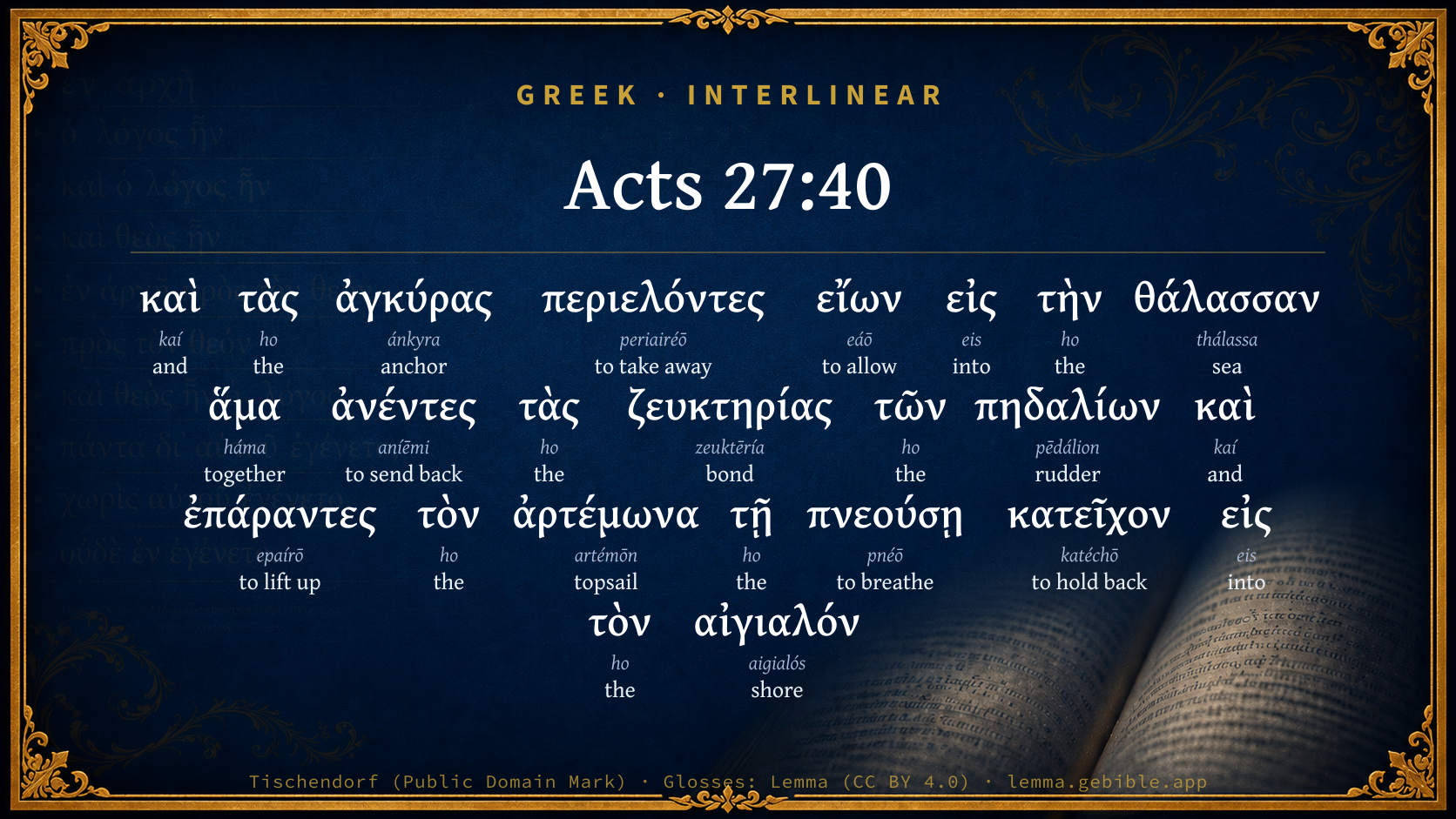
Download image
Cite this verse

Acts 27:40 (World English Bible). Public Domain. Lemma interlinear Bible study tool, https://lemma.gebible.app/v/acts/27/40.

Show BibTeX & RIS
BibTeX
RIS
English Translation
Casting off the anchors, they left them in the sea, at the same time untying the rudder ropes. Hoisting up the foresail to the wind, they made for the beach.
World English Bible · Public Domain
Highlights
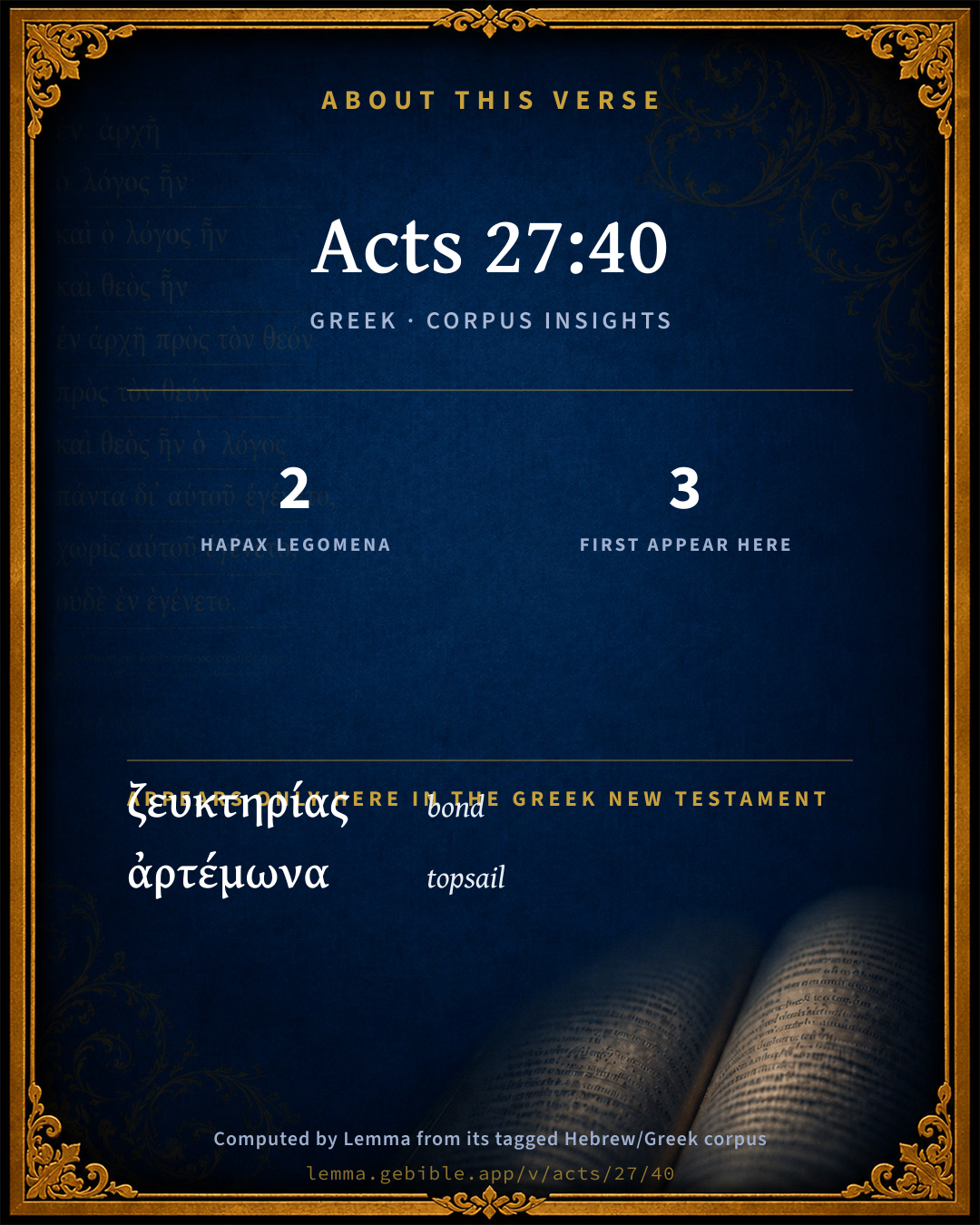
  • 2 hapax legomena — only here in the Greek New Testament
  • 3 first appearances in the Greek New Testament
Full analysis ↓
Download a study sheet

One document with this verse’s original text, its word-by-word gloss line, the meaning frame, cross-references with their text, attributed commentary, and full source and license credits — printable, and it pastes into notes with its structure intact.

This verse Autodidact and up

Study sheet (.html) Plain text (.txt)

A passage Seminary Student

Up to 50 verses in one chapter. A passage sheet keeps up to 6 commentary sources and 12 cross-references per verse, in the order this page ranks them, and says so on the sheet whenever that leaves anything out. Ask for a single verse and you get the Autodidact verse sheet above.

Everything on this page stays free to read, with no account — the sheet is a download of what is already on screen, not access to it.

Want to remove ads? Support Godless Engineer
Compare translations 3

The same verse in 3 English versions, stacked beneath the original-language interlinear above. Click any original word for its lexicon entry.

Each is an independent rendering of the whole verse — the interlinear is not word-aligned to these translations.

Highlighted words mark where these versions differ — a whole-verse word diff, not a word-by-word alignment.

  • World English Bible Public Domain
    Casting off the anchors, they left them in the sea, at the same time untying the rudder ropes. Hoisting up the foresail to the wind, they made for the beach.
  • King James Version Public Domain
    And when they had taken up the anchors, they committed themselves unto the sea, and loosed the rudder bands, and hoised up the mainsail to the wind, and made toward shore.
  • unfoldingWord Literal Text CC BY-SA 4.0
    And having cut loose the anchors, they left them in the sea. At the same time, having loosened the bands of the rudders and having raised the topsail to the wind, they were heading to the beach.

unfoldingWord Literal Text — © unfoldingWord, licensed CC BY-SA 4.0. Word-aligned USFM3 via Door43 (git.door43.org/unfoldingWord/en_ult).

Versions to compare (up to 4)

3 of 4 selected

Show all 19 translations

Every available English version of this verse, each an independent rendering of the whole verse.

  • World English Bible Public Domain
    Casting off the anchors, they left them in the sea, at the same time untying the rudder ropes. Hoisting up the foresail to the wind, they made for the beach.
  • Berean Standard Bible Public Domain
    Cutting away the anchors, they left them in the sea as they loosened the ropes that held the rudders. Then they hoisted the foresail to the wind and made for the beach.
  • Majority Standard Bible Public Domain
    Cutting away the anchors, they left them in the sea as they loosened the ropes that held the rudders. Then they hoisted the foresail to the wind and made for the beach.
  • King James Version Public Domain
    And when they had taken up the anchors, they committed themselves unto the sea, and loosed the rudder bands, and hoised up the mainsail to the wind, and made toward shore.
  • American Standard Version (1901) Public Domain
    And casting off the anchors, they left them in the sea, at the same time loosing the bands of the rudders; and hoisting up the foresail to the wind, they made for the beach.
  • Revised Version (1885) Public Domain
    And casting off the anchors, they left them in the sea, at the same time loosing the bands of the rudders; and hoisting up the foresail to the wind, they made for the beach.
  • Geneva Bible (1599) Public Domain
    So when they had taken vp the ankers, they committed the ship vnto the sea, and loosed the rudder bonds, and hoised vp the maine saile to the winde, and drewe to the shore.
  • Douay-Rheims (1899) Public Domain
    And when they had taken up the anchors, they committed themselves to the sea, loosing withal the rudder bands; and hoisting up the mainsail to the wind, they made towards shore.
  • Young's Literal Translation Public Domain
    and the anchors having taken up, they were committing `it' to the sea, at the same time -- having loosed the bands of the rudders, and having hoisted up the mainsail to the wind -- they were making for the shore,
  • Literal Standard Version CC BY-SA 4.0
    and having taken up the anchors, they were committing [it] to the sea, at the same time—having loosed the bands of the rudders, and having hoisted up the foresail to the wind—they were making for the shore,
  • Unlocked Literal Bible CC BY-SA 4.0
    So they cut loose the anchors and left them in the sea. At the same time they loosed the ropes of the rudders and raised the foresail to the wind; and so they headed to the beach.
  • unfoldingWord Literal Text CC BY-SA 4.0
    And having cut loose the anchors, they left them in the sea. At the same time, having loosened the bands of the rudders and having raised the topsail to the wind, they were heading to the beach.
  • Darby Bible Public Domain
    and, having cast off the anchors, they left [them] in the sea, at the same time loosening the lashings of the rudders, and hoisting the foresail to the wind, they made for the strand.
  • World Messianic Bible Public Domain
    Casting off the anchors, they left them in the sea, at the same time untying the rudder ropes. Hoisting up the foresail to the wind, they made for the beach.
  • Webster's Bible Public Domain
    And when they had taken up the anchors, they committed themselves to the sea, and loosed the rudder bands, and hoisted the mainsail to the wind, and made towards the shore.
  • Free Bible Version CC BY-SA 4.0
    So they cut the anchor ropes, leaving the anchors in the sea. At the same time they untied the ropes holding the rudders, raised the foresail to the wind, and made for the beach.
  • Bible in Basic English Public Domain
    So cutting away the hooks, and letting them go into the sea, and freeing the cords of the guiding-blades, and lifting up the sail to the wind, they went in the direction of the inlet.
  • Text-Critical English NT CC BY 4.0
    So they cut away the anchors and left them in the sea, at the same time loosening the bands of the rudders. Then they hoisted the foresail up into the blowing wind and made for the beach.
  • Tyndale New Testament (1534) Public Domain
    And when they had taken vp the ancres they comytted them selves vnto the see and lowsed the rudder bondes and hoysed vp the mayne sayle to the wynde and drue to londe.

Literal Standard Version (2020), Covenant Press — licensed CC BY-SA 4.0. Text via the HelloAO Bible API (eBible.org). Unlocked Literal Bible (unfoldingWord) — licensed CC BY-SA 4.0. Text via the HelloAO Bible API (eBible.org). unfoldingWord Literal Text — © unfoldingWord, licensed CC BY-SA 4.0. Word-aligned USFM3 via Door43 (git.door43.org/unfoldingWord/en_ult). Free Bible Version, Dr. Jonathan Gallagher — licensed CC BY-SA 4.0. Text via the HelloAO Bible API (eBible.org).

Word by word

More ways to search: Search by grammar → Find every occurrence → Compare this word →

Practice this passage: Drill this verse → Learn its vocabulary →

ζευκτηρίας
zeuktēría
G2202
“bond”
Noun, Accusative, Plural, Feminine
Part of Speech
Noun
Case
Accusative
Number
Plural
Gender
Feminine
Full Thayer's Definition

Origin: from a derivative (at the second stage) from the same as G2218

TDNT: None

1. a band, fastening
  1. καὶ kaí G2532 “and” Conjunction
  2. τὰς ho G3588 “the” Article, Accusative, Plural, Feminine
  3. ἀγκύρας ánkyra G45 “anchor” Noun, Accusative, Plural, Feminine
  4. περιελόντες periairéō G4014 “to take away” Verb, Aorist, Active, Participle, Nominative, Plural, Masculine
  5. εἴων eáō G1439 “to allow” Verb, Imperfect, Active, Indicative, 3rd person, Plural
  6. εἰς eis G1519 “into” Preposition
  7. τὴν ho G3588 “the” Article, Accusative, Singular, Feminine
  8. θάλασσαν thálassa G2281 “sea” Noun, Accusative, Singular, Feminine
  9. ἅμα háma G260 “together” Adverb
  10. ἀνέντες aníēmi G447 “to send back” Verb, Aorist, Active, Participle, Nominative, Plural, Masculine
  11. τὰς ho G3588 “the” Article, Accusative, Plural, Feminine
  12. τῶν ho G3588 “the” Article, Genitive, Plural, Neuter
  13. πηδαλίων pēdálion G4079 “rudder” Noun, Genitive, Plural, Neuter
  14. καὶ kaí G2532 “and” Conjunction
  15. ἐπάραντες epaírō G1869 “to lift up” Verb, Aorist, Active, Participle, Nominative, Plural, Masculine
  16. τὸν ho G3588 “the” Article, Accusative, Singular, Masculine
  17. ἀρτέμωνα artémōn G736 “topsail” Noun, Accusative, Singular, Masculine
  18. τῇ ho G3588 “the” Article, Dative, Singular, Feminine
  19. πνεούσῃ pnéō G4154 “to breathe” Verb, Present, Active, Participle, Dative, Singular, Feminine
  20. κατεῖχον katéchō G2722 “to hold back” Verb, Imperfect, Active, Indicative, 3rd person, Plural
  21. εἰς eis G1519 “into” Preposition
  22. τὸν ho G3588 “the” Article, Accusative, Singular, Masculine
  23. αἰγιαλόν aigialós G123 “shore” Noun, Accusative, Singular, Masculine

About this verse

These counts appear in no published source. They are computed here, from the morphology-tagged text and Lemma’s own curated glosses. What Lemma adds →

24
words
16
distinct lemmas
Acts
section

Notable vocabulary

2 hapax legomena — words that appear only here in the entire Greek New Testament:

  • ζευκτηρίας bond G2202
  • ἀρτέμωνα topsail G736

First appearance in Scripture

These words make their first canonical appearance in the Greek New Testament here:

  • ζευκτηρίας bond G2202
  • πηδαλίων rudder G4079
  • ἀρτέμωνα topsail G736

Shared distinctive vocabulary

πηδαλίων rudder G4079 occurs in 2 verses of the Greek New Testament. Also found in:
Repetition

Words recur within this verse:

Cross-references

2

Topical passages linked to Acts 27:40 in the Treasury of Scripture Knowledge — connected by theme and wording, ordered by reader-vote popularity; previews shown in the World English Bible.

  • Isaiah 33:23 Your rigging is untied; they could not strengthen the foot of their mast, they could not spread the sail: then was the prey of a great spoil divided; the lame took the prey.
  • Acts 27:29–30 Fearing that we would run aground on rocky ground, they let go four anchors from the stern, and wished for daylight.

Cross-references courtesy of OpenBible.info (CC BY 4.0).

Commentary

Notes on Acts 27:40 from classic Christian and Jewish commentators (each source and its license shown beneath its notes). The classic Christian expositions comment on the surrounding passage and are grouped to its opening verse, so a note may address several verses; the Jewish commentaries on the Tanakh (Rashi and others) are per-verse, so they appear only where the commentator wrote on this verse.

Lemma curates 59 commentaries, every one of them public domain or Creative Commons licensed, each selected and text-cleaned for this edition rather than reprinted as found. About our sources →

Bengel's Gnomon

Johann Albrecht Bengel

Act 27:40. Εἴως, they committed, let go) viz. the ship, and themselves with it.—τὰς ζευκτηρίας τῶν πηδαλίων) “The rudders are attached to the ship by certain bands. When these are loosened, then the rudders go down much into the waters, and by their weight keep back the ship, so as not to be upset by the winds.”—Grotius.—τὸν ἀρτέμονα) “The artemon is that smaller sail which is wont to be attached to larger sails, whence also it takes its name” [Th. ἀρτάω, I hang to, fasten to].—Gyrald. de Navig., T. I. Op., f. 604, where he refutes many errors concerning the artemon.—τῇ πνεούσῃ) viz. αὔρᾳ. This is construed in the Ablative with the verb κατεῖχον, as the old Engl. Vers. [but authorised Engl. Vers., “They hoised up the mainsail to the wind”] and Heinsius. It was by the sail, not by the oars, that they were now aiming to reach the shore.

Bengel's Gnomon of the New Testament — English translation (T&T Clark, Edinburgh, 1860) — public domain. Text from a community e-Sword module.

Meyer's Critical & Exegetical Commentary

Heinrich August Wilhelm Meyer

Act_27:40. A vivid description of the stirring activity now put forth in making every effort to reach the shore. 1. They cut the (four) anchors round about (περιελόντες), and let them fall into the sea, in order neither to lose time nor to burden the ship with their weight. 2. At the same time they loosened the bands, with which they had fastened the rudders to the ship in order to secure them while the ship lay at anchor from the violence of the waves, for the purpose of now using them in moving on. 3. They spread the top-sail before the wind, and thus took their course (κατεῖχον) for the beach (εἰς τὸν αἰγιαλόν).

εἴων] is to be referred to the ἀγκύρας, which they let go by cutting, so that they fell into the sea. Arbitrarily, following the Vulgate (committebant se), Luther, Beza, Grotius take it as εἴων τὸ πλοῖον ἰέναι εἰς τὴν θάλασσαν.

That τῶν πηδαλίων is not to be taken for the singular, but that larger ships had two rudders (Aelian, V. H. ix. 40) managed by one steersman, see Smith, p. 9, also Scheffer, de milit. nav. ii. 5; Boeckh, Urkunden, p. 125.

ὁ ἀρτέμων] not elsewhere occurring in Greek writers as part of a ship, is most probably explained of the top-gallant-sail placed high on the mast. See especially Scheffer, de milit. nav. ii. 5; Forcellini, Thes. I. p. 231. Labeo in Jabolen. Dig. lib. 1. tit. 16, leg. 242, points to this view: Malum navis esse partem, artemonem autem non esse, Labeo ait, in which words he objects to the confounding of the artemon with the mast: the mast constituted an integral part of the ship, but the artemon did not, because it was fastened to the mast. Luthers translation: mast [Segelbaum], is therefore certainly incorrect. Grotius, Heumann, Rosenmüller, and others, including Smith, explain it of the small sail at the prow of the ship. In this they assume that the mast had already been lowered; but this is entirely arbitrary, as Luke, although he relates every particular so expressly, has never mentioned this (comp. on Act_27:17). Besides, we cannot see why this sail should not have been called by its technical name δόλων, Polyb. xvi. 15. 2; Diod. xx. 61; Pollux, i. 91; Liv. xxxvi. 44, xxxvii. 30; Isidor. Orig. Act_19:3; Procop. Bell. Vandal. i. 17. Hadrianus, Junius, Alberti, Wolf, and de Wette understand the mizzen-sail at the stern, which indeed bears that name in the present day (Italian, artimone; French, voile dartimon; see Baysius, de re nav. p. 121), but for this ἐπίδρομου, Pollux i. 91, is well known to be the old technical name.

τῇ πνεούσῃ] sc. αὔρᾳ, has raised itself quite to the position of a substantive. See examples in Bos, Ell., ed. Schaefer, pp. 32, 40. The dative indicates the reference; they hoisted up the sail for the breeze, so that the wind now swelled it from behind. For examples of ἐπαίρειν, for hoisting up and thereby expanding the sail, and for κατέχειν, to steer towards, see Kypke, II. p. 144.

Meyer — Critical and Exegetical Commentary on the New Testament — English translation by Peter Christie, edited by Frederick Crombie (T&T Clark, 1880) — public domain. Text from a community e-Sword module.

Expositor's Greek Testament

ed. W. Robertson Nicoll

Act 27:40 . καὶ τὰς ἀγκ . περιελόντες : “and casting off the anchors,” R.V., cf. Act 27:20 for the same verb, so that the meaning cannot be as A.V., following Vulgate, “having taken up”; in fact it is the very reverse. The sailors loosed the cables of the anchors which were fastened within the ship, that they might fall off into the sea (Blass); Breusing and Vars compare Xen., Hell. , xvi., 21, τὰς ἀγκύρας ἀποκόπτοντες = τὰ σχοινία τῶν ἀγκυρῶν . εἴων εἰς τὴν θάλασσαν : “they left them (the anchors) in the sea,” R.V., relinquebant , Blass; so Breusing, Vars, Goerne, as against A.V., and Vulgate, committebant se , or Luther’s rendering (Beza and Grotius), εἴων τὸ πλοῖον ἰέναι εἰς τὴν θάλασσαν . Grimm-Thayer renders “they let down into the sea,” i.e. , abandoned, which gives better the force of εἰς than regarding it simply as = ἐν . ἅμα : “at the same time,” R.V., “simul laxantes,” Vulgate, “loosing withal,” Rhem., but in no other E.V [422] ( Speaker’s Commentary ). τὰς ζευκτ . τῶν πηδαλίων : the bands of the rudders, the fastenings of the rudders, i.e. , the two paddle-rudders with which Greek and Roman ships were supplied, one on each quarter, C. and H. and J. Smith, p. 183, 4th edition, these rudders had been lifted from the water and lashed up while the ship was anchored by the stern (see Breusing’s description, p. 98, cf. Eur., Hel. , 1536: πηδάλια ζεύγλαισι παρακαθίετο ), but the rudders were wanted when the ship again got under weigh. τῇ πνεούσῃ , sc. αὔρᾳ . ἐπάραντες : technical word for spreading out the sail, opposite to ὑφίεσθαι . κατεῖχον εἰς τὸν αἰγ .: “they made for the beach,” R.V., in order to land, cf. Xen., Hell. , ii., 1, 29; others take it as meaning to check the ship’s headway, but better, to hold or head the ship, Herod., vii. 59, 188, so Grimm-Thayer, sub v., sc. τὴν ναῦν , whilst others take the verb intransitively as above in R.V. τὸν ἀρτέμονα : “the foresail,” R.V., Ramsay, J. Smith. The word has been interpreted by various writers as meaning nearly every sail which a vessel carries. If the interpretation of Act 27:17 is correct, it could not mean the mainsail as A.V. Others apply it to the stern-sail, which bears the name to-day (Italian, artimone ; French, voile d’artimon ), but to set this sail would have been the most foolish thing they could have done, so Vars, Breusing. The word is found only here for the foresail, and its meaning is fixed by the fact that no other sail could be so well used by sailors under the circumstances, see Breusing, p. 79, J. Smith, pp. 141 and 193 ff., 4th edit. In his edition, 1899, Wendt thinks it probable that the sail here meant is otherwise called δόλων , but see J. Smith, p. 200, 4th edit. In his former edition he preferred to interpret it of the topsail (Meyer, Weiss, Zöckler, Baumgarten), but Breusing, p. xii., points out that only in the sixteenth century were topsails introduced; see also Vars, p. 93.

[422] English Version.

The Expositor's Greek Testament, edited by W. Robertson Nicoll (1897–1910) — public domain. Text from a community e-Sword module.

Jamieson, Fausset & Brown

Robert Jamieson, A. R. Fausset & David Brown

taken up the anchors, they committed themselves to the sea--The Margin is here evidently right, "cut the anchors (away), they left them in the sea."

loosed the rudder bands--Ancient ships were steered by two large paddles, one on each quarter. When anchored by the stern in a gale, it would be necessary to lift them out of the water and secure them by lashings or rudder bands, and to loose these when the ship was again got under way [SMITH].

hoised up the mainsail--her, "the foresail," the best possible sail that be set in the circumstances. How necessary must the crew have been to execute all these movements, and how obvious the foresight which made their stay indispensable to the safety of all on board (see on Act 27:31)!

Jamieson, Fausset & Brown — Commentary Critical and Explanatory on the Whole Bible (1871) — public domain (CC PDM 1.0). Text via the HelloAO Bible API.

Adam Clarke's Commentary

Verse 40. Taken up the anchors] Weighed all the anchors that they had cast out of the stern. Some think the meaning of the word is, they slipped their cables; and so left the anchors in the sea. This opinion is expressed in the margin.

Loosed the rudder bands] Or, the bands of the rudders; for large vessels in ancient times had two or more rudders, one at the side, and another at the stern, and sometimes one at the prow. The bands, ζευκτηριας, were some kind of fastenings, by which the rudders were hoisted some way out of the water; for, as they could be of no use in the storm, and, should there come fair weather, the vessel could not do without them, this was a prudent way of securing them from being broken to pieces by the agitation of the waves. These bands being loosed, the rudders would fall down into their proper places, and serve to steer the vessel into the creek which they now had in view.

Hoisted up the mainsail] αρτεμονα is not the mainsail, (which would have been quite improper on such an occasion,) but the jib, or triangular sail which is suspended from the foremast to the bowspirit; with this they might hope both to steer and carry in the ship.

Adam Clarke's Commentary on the Bible (1810–1826) — public domain. Text from a community e-Sword/MySword module.

Ellicott's Commentary for English Readers

(40) And when they had taken up the anchors.—Better, And when they had cleared away (or, cut off) the anchors, they let them go into the sea. It is obvious that nothing would have been gained at such a juncture by encumbering the ship, which they were anxious to lighten as much as possible, with the weight of the four anchors. The meaning given above is accordingly more in harmony with the facts of the case as well as with the Greek, which does not warrant the insertion of the pronoun in “they committed themselves.”

Loosed the rudder bands.—This was the necessary sequel to the previous operation. While the ship was anchored the two large paddle-like rudders with which ancient ships were furnished, were lifted up out of the water and lashed with ropes to the ship’s side. When the ship was got under way again, and the rudders were wanted, the bands had to be loosed, and the rudders fell into the water.

And hoised up the mainsail to the wind.—The Greek term so rendered (artemôn) is still found in Italian (artimone) and French for the largest sail of a ship. In the structure of ancient ships, however, this was the foresail, not, as with us, the mainsail. The word for wind is strictly the participle, the (breeze) that was blowing. The change of word seems to imply that there was a lull in the fury of the gale.

Made toward shore.—More accurately, were making for the beach, that which had been described in Act_27:39.

A Bible Commentary for English Readers, edited by Charles John Ellicott (1878–1897) — public domain. Text from a community e-Sword module.

The Cambridge Bible for Schools and Colleges

gen. ed. J. J. S. Perowne

40. And when they had taken up the anchors] The verb in the original implies that they cast loose all the anchors round about the stern of the vessel where they had laid them out. So the R. V. rightly gives “And casting off the anchors.” When they had thrown overboard a load of corn, they would have no wish to encumber themselves with the weight of the anchors or to take the trouble of hauling them up.

they committed themselves unto the sea] The italics of the A. V. shew that “themselves” is unrepresented in the original. It is far better to refer the verb to the anchors already mentioned, and render (with R. V.) “they left them in the sea.”

and loosed the rudder bands] The original has an adverb which is feebly represented by the conjunction of the A. V. Read (as R. V.) “at the same time loosing,” &c. The rudders, of which the ancient ships had two, had been made fast, and raised out of the water, when the anchors were laid out in the stern. Now that an attempt is to be made to steer the ship toward the beach they are let down again into the water.

and hoised up the mainsail] The Gk. Word “artemon” here used, was in old times the name given to the “foresail” of the vessel, and so it should be rendered here. Cognate words are now employed for the larger sails of vessels in the Mediterranean, but the “foresail” was all they here had left.

toward shore] i.e. toward this beach, which seemed a suitable place where they might try to land.

The Cambridge Bible for Schools and Colleges (gen. ed. J. J. S. Perowne; Cambridge University Press, 1878–1918) — public domain. Text from a community e-Sword module.

John Gill's Exposition

And falling into a place where two seas met,.... An "isthmus", on each side of which the sea ran; and which the inhabitants of Malta, as Beza says, show to this day, and call it, "la Cala de San Paulo", or the Descent of Saint Paul. The meeting of these two seas might occasion a great rippling in the sea like to a large eddy, or counter tide; and here might be a sand on which

they ran the ship aground; for this place where the two seas met, as the same annotator observes, could not be the shore itself; for otherwise, to what purpose should they cast themselves into the sea, as they afterwards did, if the head of the ship struck upon the shore, and stuck fast there? but must rather mean a shelf of sand, opposite, or near the entrance into the bay, and where the shipwreck was.

And the fore part stuck fast, and remained unmovable; so that there was no getting her off:

but the hinder part was broken by the violence of the waves; that is, the stern; by which means there were boards and broken pieces for the company to get ashore upon.

John Gill's Exposition of the Whole Bible (1746–1763) — public domain (CC PDM 1.0). Text via the HelloAO Bible API.

Trapp's Complete Commentary

John Trapp

40 And when they had taken up the anchors, they committed themselves unto the sea, and loosed the rudder bands, and hoised up the mainsail to the wind, and made toward shore.

Ver. 40. Hoised up the mainsail] Which before they had struck by reason of the violence of the storm. If God afflict, we must carry our sail accordingly, Rth 1:20.

John Trapp, A Commentary or Exposition upon All the Books of the Old and New Testament (1647–1656) — public domain. Text from a community e-Sword module.

Albert Barnes' Notes on the Bible

Had taken up the anchors - The four anchors with which they had moored the ship, Act 27:29. See the margin. The expression may mean that they slipped or cut their cables, and that thus they left the anchors in the sea. This is the most probable interpretation.

And loosed the rudder bands - The rudder, in navigation, is that by which a ship is steered. It is that part of the helm which consists of a piece of timber, broad at the bottom, which enters the water, and is attached by hinges to the stern-post on which it turns (Webster). But what was the precise form of the rudder among the ancients is not certainly known. Sometimes a vessel might be steered by oars. Most ships appear to have had a rudder at the prow as well as at the stern. In some instances, also, they had them on the sides. The word used here in the Greek is in the plural τῶν πηδαλίον tōn pēdalion, and it is evident that they had in this ship more than one rudder. The bands mentioned here were probably the cords or fastenings by which the rudder could be made secure to the sides of the ship, or could be raised up out of the water in a violent storm, to prevent its being carried away. And as, in the tempest, the rudders had become useless Act 27:15, Act 27:17, they were probably either raised out of the water, or made fast. Now that the storm was past, and they could be used again, they were loosed, and they endeavored to direct the vessel into port.

The mainsail - ἀρτέμωνα artemōna. There have been various explanations of this word. Luther translates it as “the mast.” Erasmus: “the yards.” Grotius, who supposes that the mainmast had been cast away Act 27:17, thinks that this must mean “the foremast” or “the bowsprit.” The word usually means the “mainsail.” The Syriac and Arabic understand it of a “small sail,” that was hoisted for a temporary purpose. Mr. Smith, in his work on this voyage of Paul, supposes that it was “the foresail.” Others translate it “a jib.” “The mainsail (foresail) being hoisted showed good judgment, though the distance was so small, as it would not only enable them to steer more correctly than without it, but would press the ship farther on upon the land, and thus enable them the more easily to get to the shore” (Penrose).

Albert Barnes' Notes on the Bible (1834–1885) — public domain. Text from a community e-Sword/MySword module.

Haydock's Catholic Bible Commentary

Loosing also the rudderbands. Some ships are said heretofore to have had two rudders: and this ship perhaps had tow, unless here the plural number be put for the singular, which is not uncommon in the style of the Scriptures. --- And hoisting up the main-sail. The word in the text may signify any sail, either the main, or mizen-sail, which latter by the event was more than sufficient. (Witham)

George Leo Haydock (1774–1849), Haydock's Catholic Family Bible and Commentary, 1859 edition — public domain. Excludes Psalms (Douay-Rheims chapter numbering differs from Protestant) and Deuterocanonical books (Catholic canon only).

Matthew Poole's English Annotations

Loosed the rudder bands; rudders is in the plural number put for the singular: or rather, in those times they having two rudders, (as by several passages amongst the ancients do appear), they were both loosed, that now they might use them to direct the ship to the best advantage in making the shore, they having been tied whilst they were adrift, or at anchor.

Hoised up the mainsail, which they had let down, or struck, Act 27:17, and now, that they might make some use of the winds, to get nigher to the shore, they hoisted up. As God doth instruct the ploughman, Isa 28:26, so he teacheth the mariner, and every one in their calling.

Matthew Poole's English Annotations on the Holy Bible (1683–1685) — public domain. Text from a community e-Sword/MySword module.

Whedon's Commentary on the Bible

Daniel D. Whedon

40. Loosed the rudder bands—The modern rudder, suspended by hinges, and swayed with a single handle, was unknown to the ancients. Their rudders were rather paddles, one on each side of the stern, which were bound up when they let the ship drift, and now loosed again when they purposed to steer to their point.

Mainsail—The word αρτεμων has been a very doubtful one among scholars. But sailors say that none but the foresail, a small sail at the bow, would serve the present purpose of pulling the ship to the given point. The three performances of taking up anchors, letting down rudders, and hoisting foresail, were doubtless achieved simultaneously and rapidly.

Daniel D. Whedon (gen. ed.), Commentary on the Old and New Testaments (1874–1909) — public domain. Text from a community e-Sword module.

The Pulpit Commentary

Casting off for when they had taken up, A.V.; they left them in the sea for they committed themselves unto the sea, A.V.; at the same time loosing the bands of the rudders for and loosed the rudder bands, A.V.; hoisting for hoised, A.V.; foresail for mainsail, A.V.; for the beach for toward shore, A.V.. This verse, so obscure before, has been made intelligible by the masterly labors of Smith, of Jordan Hill. We will first explain the separate words. Casting off (perielontev). The verb perriairew occurs in ver. 20; in 2Co_3:16; and in Heb_10:11; and in all those passages is rendered taken away." So also in the LXX, where it is of frequent use, it means take away," put away," remove," and the like. In classical Greek it means to take away," "take off," "strip off." Here, then, applied to the anchors which were firmly embedded in the very strong clay at the bottom of the sea off Koura Point, perielo) tarav means "putting away" or "casting off" the anchors by cutting the cables which fastened them to the ship, and, as it follows, leaving them in the sea, or, more literally, giving them up, dismissing them into the sea (eiwn eijv thlassan); comp. Act_5:38. Loosing the bands of the rudders. "The ships of the Greeks and Romans, like those of the early Northmen were not steered by a single rudder, but by two paddle-rudders" (Howson, p. 310. See too an illustration from an ancient painting found at Herculaneum, in which the two paddle-rudders are very distinctly seen, at p. 346; and another illustration in Lewin, vol. it. p. 204, showing the two rudders and the foresail). These paddle-rudders had been hoisted up and lashed, lest they should foul the anchors at the stern. But now, when the free use of them was absolutely necessary to steer the ship toward the beach, they unloosed the lashings, i.e. "the bands of the rudders," and at the same time they hoisted up the foresail. The foresail; tomona, a word found only here in this sense, but used in Vitruvius for a "pulley," and so explained in Ducange. But artimon was till recently used in Venice and Genoa as the name of the large sail of a vessel. In the Middle Ages artimonium was the "foremast," mat de prone; but it was also used of the foresail," Velum naris breve, quod quia melius levari potest, in summo periculo extenditur" (Ducange). They hoisted the foresail both to give them sufficient way to run on to the beach, and to give precision to their steering. (For a further account of the ajrtemwn, or foresail, see Smith, of Jordan Hill.)

The Pulpit Commentary (1880–1919), ed. H.D.M. Spence-Jones & Joseph S. Exell — public domain. Text from a community e-Sword module.

John Wesley's Explanatory Notes

Loosing the rudder bands - Their ships had frequently two rudders, one on each side. were fastened while they let the ship drive; but were now loosened, when they had need of them to steer her into the creek.

John Wesley, Explanatory Notes Upon the Whole Bible (1754–1765) — public domain. Text via the GEBible commentary corpus.

Scofield Reference Notes

C. I. Scofield

taken up

Or, cut the anchors, they left them in the sea, etc.

The Scofield Reference Bible (1917 edition), notes by C. I. Scofield — public domain. Text from a community e-Sword module.

Godbey's Commentary on the New Testament

William B. Godbey

40. “Knocking off the anchors they left them in the sea; at the same time loosing the bands of the rudders and raising up the main sail for the wind, they made toward the shore.

William B. Godbey, Commentary on the New Testament (1896–1900) — public domain. Text from a community e-Sword module.

McGarvey & Pendleton's Commentaries

J. W. McGarvey

See notes on verse 39

J. W. McGarvey (with Philip Y. Pendleton), Commentaries on the New Testament (The Fourfold Gospel, 1914; Acts; and the epistles) — public domain. Text from a community e-Sword/MySword module.

Cambridge Greek Testament for Schools and Colleges

40. καὶ τὰς ἀγκύρας περιελόντες, and casting off the anchors. περιαιρέω indicates that they now cast loose all the anchors round about the stern of the vessel, where they had before laid them out. When they had thrown overboard a load of corn, there was no likelihood that they would trouble themselves with the weight of four anchors and the labour of hauling them up. So ‘taken up’ (of A.V.) gives a wrong idea.

εἴων εἰς τὴν θάλασσαν, they left them in the sea, i.e. the anchors. They had now no use for them, so they let them go.

ἅμα ἀνέντες τὰς ζευκτηρίας τῶν πηδαλίων, at the same time loosing the rudder bands.

ζευκτηρία is found nowhere else but in this place. The rudders, of which the ancient ships had two (thus accounting for the plural number, πηδαλίων), had at first been made fast and raised out of the water, when the anchors were laid out in the stern. Now that an attempt is to be made to steer the ship toward the beach they are let down again into the sea.

καὶ ἐπάραντες τὸν ἀρτέμωνα, and having hoisted the foresail. ἀρτέμων was in old times the name given to the foresail. Cognate words are now employed as names of the larger sails of vessels in the Mediterranean. But here the foresail was all they had left. Cf. Smith’s Voyage and Shipwreck of St Paul, pp. 102, 153, seqq.

τῇ πνεούσῃ, to the wind. The noun to be supplied is αὔρᾳ.

εἰς τὸν αἰγιαλόν, towards the beach, where they had resolved after consultation to try to land.

Cambridge Greek Testament for Schools and Colleges (Cambridge University Press, 1896; 21 vols, various authors incl. Carr, Maclear, Plummer, Farrar, Lumby, Moule, M. R. James, Simcox) — public domain. Text from a community e-Sword module.

Alford’s Greek Testament

Henry Alford

40.] (1) They cut away all four anchors (the περι may allude to the cutting round each cable in order to sever it, or to the going round and cutting all four), and left them in the sea (εἰς τ. θάλ. ‘in the sea, into which they had been cast’). This they did to save time, and not to encumber the waterlogged ship with their additional weight. (2) They let loose the ropes which tied up the rudders. “Ancient ships were steered by two large paddles, one on each quarter. When anchored by the stern in a gale, it would be necessary to lift them out of the water, and secure them by lashings or rudder bands, and to loose these bands when the ship was again got under way.” Smith, p. 101. (3) They raised (ἐπαίρειν, ‘to raise up,’ contrary to κατέχειν, ‘to haul down,’ a sail) their ἀρτέμων to the wind. It would be impossible in the limits of a note to give any abstract of the long and careful reasoning by which Mr. Smith has made it appear that the ‘artemon’ was the foresail of the ancient ships. I will only notice from him, that the rendering ‘mainsail’ in our E. V. was probably a mistaken translation from Bayfius or De Baif, the earliest of the modern writers ‘de re navali,’ and perhaps the only one extant when the translation was made: he says, “est autem artemon velum majus navis, ut in Actis Apost. xxvii … etenim etiam nunc nomen Veneti vulgo retinent et artemon vocant.” These words, ‘velum majus,’ they rendered by mainsail; whereas the largest sail of the Venetian ships at the time was the foresail. The French ‘artimon,’ even now in use, means the sail at the stern (mizen). But this is no clue to the ancient meaning, any more than is our word mizen to the meaning of the French misaine, which is the foresail.

The usual technical name of the foresail was δόλων, that of the mizen, ἐπίδρομος. See on the whole question, Smith’s Dissertation on the Ships of the Ancients, appended to his Voyage and Shipwreck of St. Paul. Mr. Pusey informs me that Syr. translates ἀρτέμωνα by ‘armnon parvum’ (armnon being its word for σκεῦος, ver. 17), and syr. in a note says that ἀρτέμων is “a small armnon at the ship’s head.”

τῇ πνεούσῃ] scil. αὔρᾳ. Dat. commodi;—for the wind (to fill);—or (according to Meyer and De Wette) of direction,—to the wind, (4) They made for the beach. The expression, κατέχειν (ναῦν or νηῒ) εἰς … for “to steer to land,” is not uncommon in the classics: cf. examples in Wetst. It seems to get this meaning by a pregnant construction, “to keep the ship (or, to keep one’s course in the ship) in hand (and direct it) towards.…”

Henry Alford, The Greek Testament (1849–1861) — public domain. Text from a community e-Sword module.

Vincent's Word Studies in the New Testament

Marvin R. Vincent

Taken up [περιελοντες] . Wrong. The word means to remove, and refers here to cutting the anchor - cables, or casting off, as Rev.

Committed themselves [ειων] . Wrong. The reference is to the anchors. Rev., correctly, left them in the sea.

Rudder bands [ζευκτηριας των πηδαλιων] . Lit., the bands of the rudders. The larger ships had two rudders, like broad oars or paddles, joined together by a pole, and managed by one steersman. They could be pulled up and fastened with hands to the ship; as was done in this case, probably to avoid fouling the anchors when they were cast out of the stern. The bands were now loosened, in order that the ship might be driven forward.

Mainsail [αρτεμωνα] . Only here in New Testament. Probably the foresail. So Rev.

Made toward [κατειχον] . Lit., held; bore down for.

Marvin R. Vincent, Word Studies in the New Testament (1887–1900) — public domain. Text from a community e-Sword/MySword module.

Lesson kit

Teaching starters — assembled from the data on this page, not authored interpretation. Every prompt links to the verse data it draws on. Edit before teaching.

Acts, in the Acts, opens this verse with 24 words (16 distinct Greek lemmas). Its most distinctive word is zeuktēría (“bond”). A historical commentator’s framing appears above. Read the whole chapter for the surrounding context.

Discussion questions

  1. How does “bond” (zeuktēría) shape what this verse is saying?
  2. This verse holds 2 words here found nowhere else in the Greek New Testament. What might the rare words draw attention to?
  3. 3 words here appear for the first time in Scripture. What is being introduced at this debut?
  4. James 3:4 shares the word «rudder» with this verse. How do the two illuminate each other?
  5. “into” occurs 2× in this one verse. What is the effect of the repetition?
  6. These translations render this verse differently; the difference is in the English rendering, not the original. What questions does that raise?
  7. Reading how Bengel's Gnomon and Meyer's Critical & Exegetical Commentary read this verse, where do the two commentators agree and where do they part?

Things to notice

  • 2 words in this verse appear nowhere else in the Greek New Testament.
  • 3 words make their first canonical appearance in Scripture here.
  • These translations choose different wording for 32 words in this verse.
  • “into” occurs 2× in this single verse.
  • 16 distinct Greek lemmas span 24 words in this verse.

Reading settings

Reading text

Shown beneath each verse's original-language words.

Old Testament
Old Testament edition

Read the OT as the Masoretic Hebrew (MT) or the Greek Septuagint (LXX).

English shown for the Greek Septuagint (in the Hebrew ↔ Greek comparison).

Comparing translations? Open the Compare panel on any verse page to stack up to four side by side.