
Jeremiah 6:26

Hebrew (Westminster Leningrad Codex) Jeremiah 6:26 appears in the Hebrew Old Testament. The text above is from the Westminster Leningrad Codex. Each word links to its Strong’s number, a concise gloss, and parsing drawn from the Open Scriptures Hebrew Bible morphology. Click any word for its full Brown-Driver-Briggs (BDB) entry.
Download image
Cite this verse

Jeremiah 6:26 (World English Bible). Public Domain. Lemma interlinear Bible study tool, https://lemma.gebible.app/v/jeremiah/6/26.

Show BibTeX & RIS
BibTeX
RIS
English Translation
Daughter of my people, gird you with sackcloth, and wallow yourself in ashes: make you mourning, as for an only son, most bitter lamentation; for the destroyer shall suddenly come on us.
World English Bible · Public Domain
Highlights
  • 2 first appearances in the Hebrew Bible
Full analysis ↓
Download a study sheet

One document with this verse’s original text, its word-by-word gloss line, the meaning frame, cross-references with their text, attributed commentary, and full source and license credits — printable, and it pastes into notes with its structure intact.

This verse Autodidact and up

Study sheet (.html) Plain text (.txt)

A passage Seminary Student

Up to 50 verses in one chapter. A passage sheet keeps up to 6 commentary sources and 12 cross-references per verse, in the order this page ranks them, and says so on the sheet whenever that leaves anything out. Ask for a single verse and you get the Autodidact verse sheet above.

Everything on this page stays free to read, with no account — the sheet is a download of what is already on screen, not access to it.

Want to remove ads? Support Godless Engineer
Compare translations 3

The same verse in 3 English versions, stacked beneath the original-language interlinear above. Click any original word for its lexicon entry.

Each is an independent rendering of the whole verse — the interlinear is not word-aligned to these translations.

Highlighted words mark where these versions differ — a whole-verse word diff, not a word-by-word alignment.

  • World English Bible Public Domain
    Daughter of my people, gird you with sackcloth, and wallow yourself in ashes: make you mourning, as for an only son, most bitter lamentation; for the destroyer shall suddenly come on us.
  • King James Version Public Domain
    O daughter of my people, gird thee with sackcloth, and wallow thyself in ashes: make thee mourning, as for an only son, most bitter lamentation: for the spoiler shall suddenly come upon us.
  • unfoldingWord Literal Text CC BY-SA 4.0
    Daughter of my people, gird yourself sackcloth and roll about in ash; make mourning for yourself an only son a lamentation of bitterness, for suddenly the destroyer will come upon us. ts\*

unfoldingWord Literal Text — © unfoldingWord, licensed CC BY-SA 4.0. Word-aligned USFM3 via Door43 (git.door43.org/unfoldingWord/en_ult).

Versions to compare (up to 4)

3 of 4 selected

Show all 18 translations

Every available English version of this verse, each an independent rendering of the whole verse.

  • World English Bible Public Domain
    Daughter of my people, gird you with sackcloth, and wallow yourself in ashes: make you mourning, as for an only son, most bitter lamentation; for the destroyer shall suddenly come on us.
  • Berean Standard Bible Public Domain
    O daughter of my people, dress yourselves in sackcloth and roll in ashes. Mourn with bitter wailing, as you would for an only son, for suddenly the destroyer will come upon us.
  • Majority Standard Bible Public Domain
    O daughter of my people, dress yourselves in sackcloth and roll in ashes. Mourn with bitter wailing, as you would for an only son, for suddenly the destroyer will come upon us.
  • King James Version Public Domain
    O daughter of my people, gird thee with sackcloth, and wallow thyself in ashes: make thee mourning, as for an only son, most bitter lamentation: for the spoiler shall suddenly come upon us.
  • American Standard Version (1901) Public Domain
    O daughter of my people, gird thee with sackcloth, and wallow thyself in ashes: make thee mourning, as for an only son, most bitter lamentation; for the destroyer shall suddenly come upon us.
  • Revised Version (1885) Public Domain
    O daughter of my people, gird thee with sackcloth, and wallow thyself in ashes: make thee mourning, as for an only son, most bitter lamentation; for the spoiler shall suddenly come upon us.
  • Geneva Bible (1599) Public Domain
    O daughter of my people, girde thee with sackecloth, and wallowe thy selfe in the ashes: make lamentation, and bitter mourning as for thine onely sonne: for the destroier shall suddenly come vpon vs.
  • Douay-Rheims (1899) Public Domain
    Gird thee with sackcloth, O daughter of my people, and sprinkle thee with ashes: make thee mourning as for an only son, a bitter lamentation, because the destroyer shall suddenly come upon us.
  • Young's Literal Translation Public Domain
    O daughter of My people, Gird on sackcloth, and roll thyself in ashes, The mourning of an only one make for thee, A lamentation most bitter, For suddenly come doth the spoiler against us.
  • Literal Standard Version CC BY-SA 4.0
    O daughter of my people, || Gird on sackcloth, || And roll yourself in ashes, || Make mourning [as for] an only one, || A most bitter lamentation, || For the spoiler suddenly comes against us.
  • Unlocked Literal Bible CC BY-SA 4.0
    Daughter of my people, put on sackcloth and roll in ashes; mourn with painful sobs as for an only son, for the destroyer will suddenly come upon us.
  • unfoldingWord Literal Text CC BY-SA 4.0
    Daughter of my people, gird yourself sackcloth and roll about in ash; make mourning for yourself an only son a lamentation of bitterness, for suddenly the destroyer will come upon us. ts\*
  • Darby Bible Public Domain
    Daughter of my people, gird thee with sackcloth, and roll thyself in ashes: make mourning, [as] for an only son -- bitter lamentation; for the spoiler cometh suddenly upon us.
  • World Messianic Bible Public Domain
    Daughter of my people, clothe yourself with sackcloth, and wallow in ashes! Mourn, as for an only son, most bitter lamentation, for the destroyer will suddenly come on us.
  • Webster's Bible Public Domain
    O daughter of my people, gird thee with sackcloth, and wallow thyself in ashes: make thee mourning, as for an only son, most bitter lamentation: for the spoiler shall suddenly come upon us.
  • Free Bible Version CC BY-SA 4.0
    Oh my people, put on sackcloth and roll around in ashes. Mourn and cry bitterly like you would for an only son, because the destroyer will come down on you suddenly.
  • Bible in Basic English Public Domain
    O daughter of my people, put on haircloth, rolling yourself in the dust: give yourself to sorrow, as for an only son, with most bitter cries of grief; for he who makes waste will come on us suddenly.
  • JPS Tanakh (1917) Public Domain
    O daughter of my people, gird thee with sackcloth, and wallow thyself in ashes; make thee mourning, as for an only son, most bitter lamentation; for the spoiler shall suddenly come upon us.

Literal Standard Version (2020), Covenant Press — licensed CC BY-SA 4.0. Text via the HelloAO Bible API (eBible.org). Unlocked Literal Bible (unfoldingWord) — licensed CC BY-SA 4.0. Text via the HelloAO Bible API (eBible.org). unfoldingWord Literal Text — © unfoldingWord, licensed CC BY-SA 4.0. Word-aligned USFM3 via Door43 (git.door43.org/unfoldingWord/en_ult). Free Bible Version, Dr. Jonathan Gallagher — licensed CC BY-SA 4.0. Text via the HelloAO Bible API (eBible.org).

Word by word

More ways to search: Search by grammar → Find every occurrence → Compare this word →

Practice this passage: Drill this verse → Learn its vocabulary →

תַּמְרוּרִ֑ים
tamrûwr
H8563
“bitterness”
Noun, Common, Masculine, Plural, Absolute
Part of Speech
Noun
Type
Common
Gender
Masculine
Number
Plural
State
Absolute
Full BDB Definition

Origin: from H4843

TWOT: 1248 L

bitterness
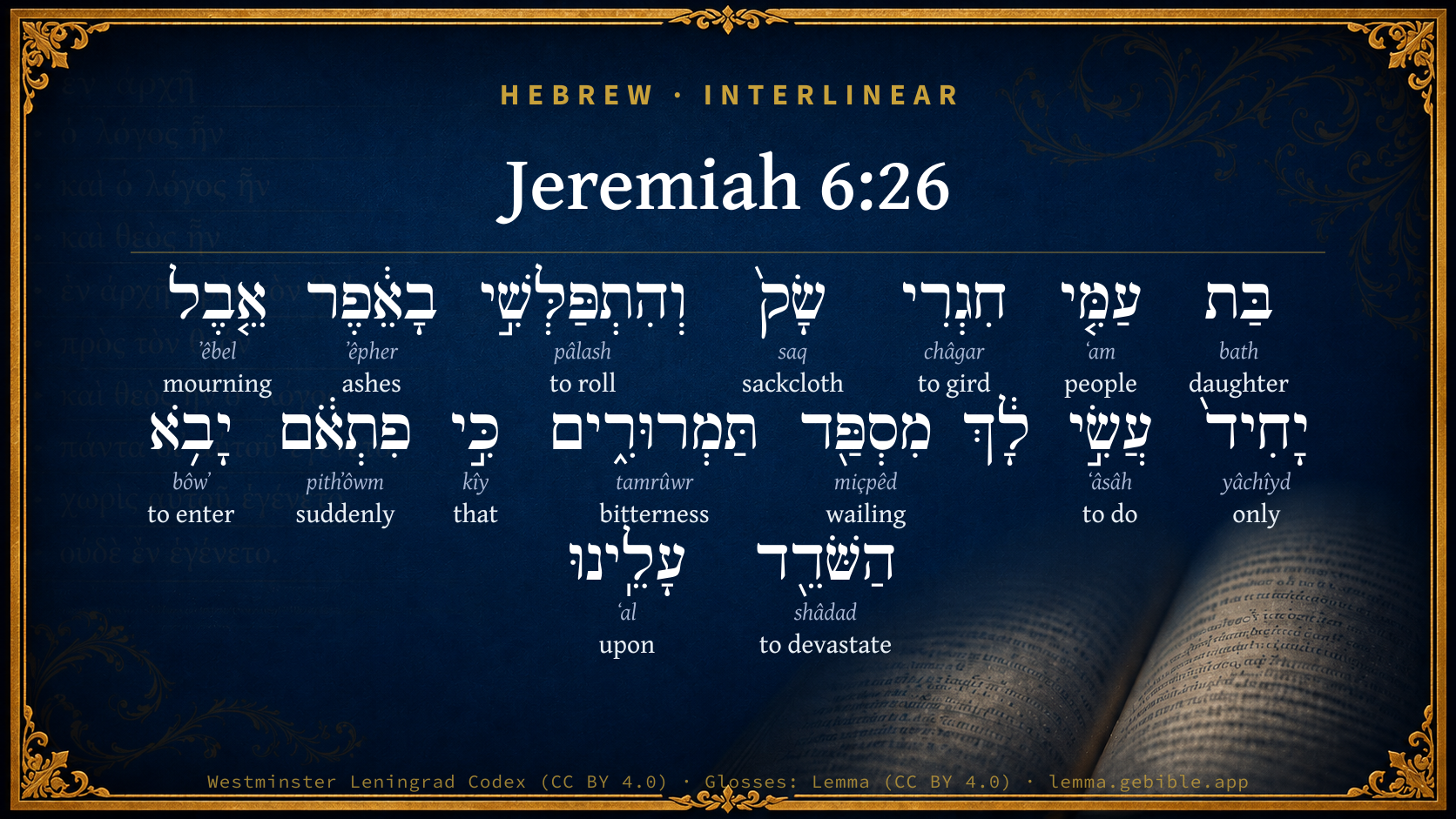
  1. בַּת bath H1323 “daughter of” Noun, Common, Feminine, Singular, Construct
  2. עַמִּ֤י ʻam H5971 “people · my” Noun, Common, Masculine, Singular, Construct + Suffix, Personal, 1st Person, Common, Singular
  3. חִגְרִי châgar H2296 “gird” Verb, Qal, Imperative, 2nd Person, Feminine, Singular
  4. שָׂק֙ saq H8242 “sackcloth” Noun, Common, Masculine, Singular, Absolute
  5. וְהִתְפַּלְּשִׁ֣י pâlash H6428 “and · to roll” Verb, Hithpael, Imperative, 2nd Person, Feminine, Singular
  6. בָאֵ֔פֶר ʼêpher H665 “in/at the · ashes” Preposition, Determined + Noun, Common, Masculine, Singular, Absolute
  7. אֵ֤בֶל ʼêbel H60 “mourning” Noun, Common, Masculine, Singular, Absolute
  8. יָחִיד֙ yâchîyd H3173 “only” Adjective, Adjective, Masculine, Singular, Absolute
  9. עֲשִׂ֣י ʻâsâh H6213 “do” Verb, Qal, Imperative, 2nd Person, Feminine, Singular
  10. מִסְפַּ֖ד miçpêd H4553 “wailing of” Noun, Common, Masculine, Singular, Construct
  11. כִּ֣י kîy H3588 “that” Conjunction
  12. פִתְאֹ֔ם pithʼôwm H6597 “suddenly” Adverb
  13. יָבֹ֥א bôwʼ H935 “to enter” Verb, Qal, Imperfect, 3rd Person, Masculine, Singular
  14. הַשֹּׁדֵ֖ד shâdad H7703 “the · devastating” Particle, Definite Article + Verb, Qal, Participle Active, Masculine, Singular, Absolute
  15. עָלֵֽינוּ ʻal H5921 “upon · us” Preposition + Suffix, Personal, 1st Person, Common, Plural

About this verse

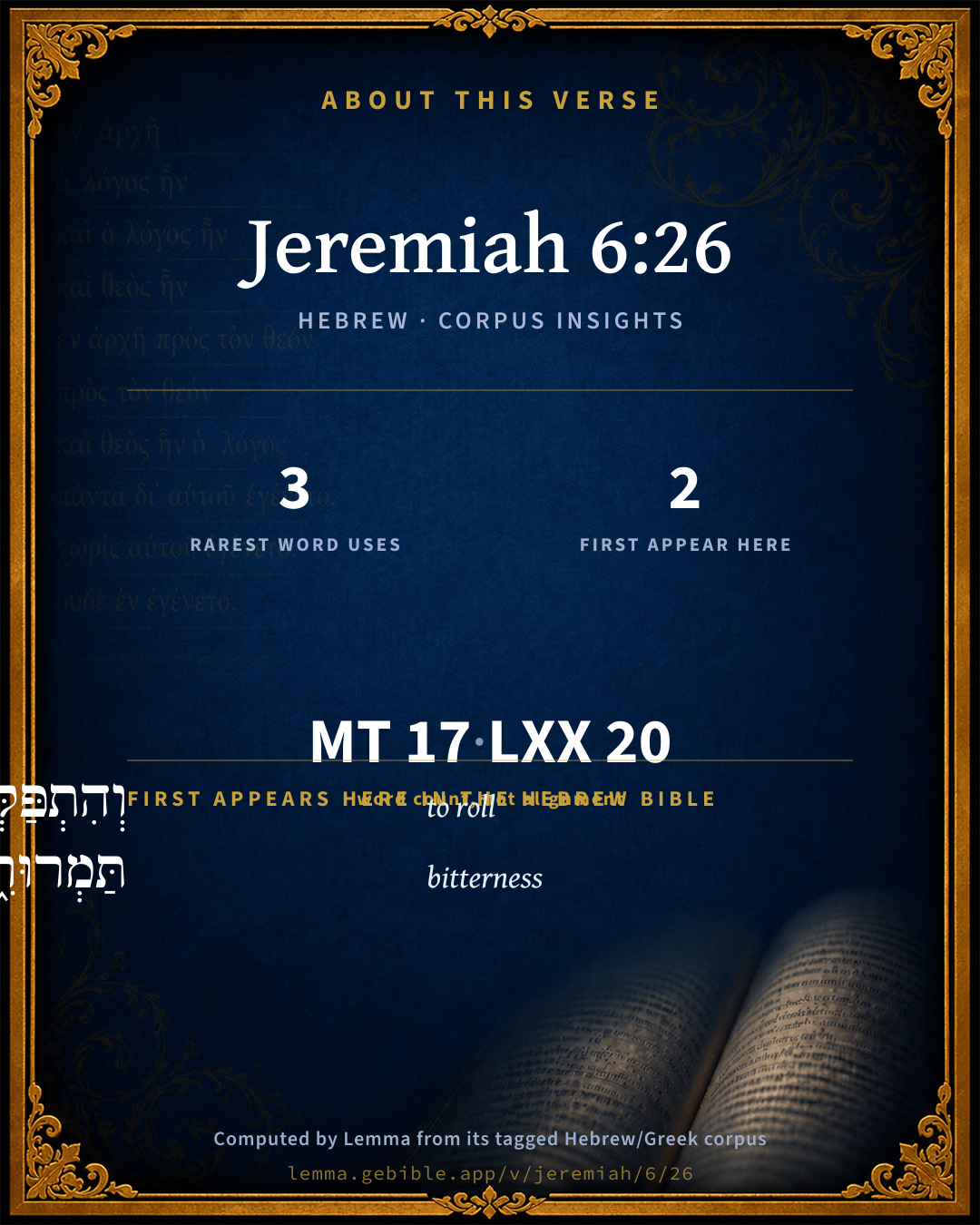
These counts appear in no published source. They are computed here, from the morphology-tagged text and Lemma’s own curated glosses. What Lemma adds →

17
words
16
distinct lemmas
Prophets
section

Notable vocabulary

The rarest word here is תַּמְרוּרִ֑ים bitterness H8563 — appearing just 3 times in the whole Hebrew Bible.

First appearance in Scripture

These words make their first canonical appearance in the Hebrew Bible here:

  • וְהִתְפַּלְּשִׁ֣י to roll H6428
  • תַּמְרוּרִ֑ים bitterness H8563

Shared distinctive vocabulary

תַּמְרוּרִ֑ים bitterness H8563 occurs in 3 verses of the Hebrew Bible. Also found in:

Grammatical profile

  • 5 verbs
  • 7 nouns
  • 1 adjective
  • 2 prepositions
  • 1 conjunction
  • 1 adverb

Verb forms

  • חִגְרִי Qal · Imperative
  • וְהִתְפַּלְּשִׁ֣י Hithpael · Imperative
  • עֲשִׂ֣י Qal · Imperative
  • יָבֹ֥א Qal · Imperfect
  • הַשֹּׁדֵ֖ד Qal · Participle Active

Hebrew & Septuagint length

In the original languages it is 17 Hebrew tokens and 20 Greek tokens — but the two are counted differently (Hebrew bundles its prefixes and suffixes into one token; the Greek is in lemma form), so that isn’t a like-for-like length.

Cross-references

32

Topical passages linked to Jeremiah 6:26 in the Treasury of Scripture Knowledge — connected by theme and wording, ordered by reader-vote popularity; previews shown in the World English Bible.

  • Jeremiah 4:8 For this gird you with sackcloth, lament and wail; for the fierce anger of Yahweh hasn't turned back from us.
  • Zechariah 12:10 I will pour on the house of David, and on the inhabitants of Jerusalem, the spirit of grace and of supplication; and they will look to me whom they have pierced; and they shall mourn for him, as one mourns for his only son, and will grieve bitterly for him, as one grieves for his firstborn.
  • Isaiah 22:4 Therefore said I, Look away from me, I will weep bitterly; don't labor to comfort me for the destruction of the daughter of my people.
  • Isaiah 22:12 In that day did the Lord, Yahweh of Hosts, call to weeping, and to mourning, and to baldness, and to girding with sackcloth:
  • Isaiah 30:13 therefore this iniquity shall be to you as a breach ready to fall, swelling out in a high wall, whose breaking comes suddenly in an instant.
  • Isaiah 32:11 Tremble, you women who are at ease; be troubled, you careless ones; strip yourselves, and make yourselves naked, and gird [sackcloth] on your loins.
  • Jeremiah 4:11 At that time shall it be said to this people and to Jerusalem, A hot wind from the bare heights in the wilderness toward the daughter of my people, not to winnow, nor to cleanse;
  • Jeremiah 4:20 Destruction on destruction is cried; for the whole land is laid waste: suddenly are my tents destroyed, [and] my curtains in a moment.
  • Jeremiah 6:14 They have healed also the hurt of my people slightly, saying, Peace, peace; when there is no peace.
  • Jeremiah 8:19 Behold, the voice of the cry of the daughter of my people from a land that is very far off: isn't Yahweh in Zion? Isn't her King in her? Why have they provoked me to anger with their engraved images, and with foreign vanities?
  • Jeremiah 8:21–9:1 For the hurt of the daughter of my people am I hurt: I mourn; dismay has taken hold on me.
  • Jeremiah 9:10 For the mountains will I take up a weeping and wailing, and for the pastures of the wilderness a lamentation, because they are burned up, so that none passes through; neither can men hear the voice of the cattle; both the birds of the sky and the animals are fled, they are gone.
  • Jeremiah 9:17–22 Thus says Yahweh of Hosts, Consider you, and call for the mourning women, that they may come; and send for the skillful women, that they may come:
  • Jeremiah 12:12 Destroyers are come on all the bare heights in the wilderness; for the sword of Yahweh devours from the one end of the land even to the other end of the land: no flesh has peace.
  • Jeremiah 13:17 But if you will not hear it, my soul shall weep in secret for [your] pride; and my eye shall weep sore, and run down with tears, because Yahweh's flock is taken captive.
  • Jeremiah 14:17 You shall say this word to them, Let my eyes run down with tears night and day, and let them not cease; for the virgin daughter of my people is broken with a great breach, with a very grievous wound.
  • Jeremiah 15:8 Their widows are increased to me above the sand of the seas; I have brought on them against the mother of the young men a destroyer at noonday: I have caused anguish and terrors to fall on her suddenly.
  • Jeremiah 25:33–34 The slain of Yahweh shall be at that day from one end of the earth even to the other end of the earth: they shall not be lamented, neither gathered, nor buried; they shall be dung on the surface of the ground.
  • Lamentations 1:2 She weeps sore in the night, and her tears are on her cheeks; Among all her lovers she has none to comfort her: All her friends have dealt treacherously with her; they are become her enemies.
  • Lamentations 1:16 For these things I weep; my eye, my eye runs down with water; Because the comforter who should refresh my soul is far from me: My children are desolate, because the enemy has prevailed.
  • Lamentations 2:11 My eyes do fail with tears, my heart is troubled; My liver is poured on the earth, because of the destruction of the daughter of my people, Because the young children and the infants swoon in the streets of the city.
  • Lamentations 3:48 My eye runs down with streams of water, for the destruction of the daughter of my people.
  • Lamentations 4:3 Even the jackals draw out the breast, they give suck to their young ones: The daughter of my people is become cruel, like the ostriches in the wilderness.
  • Lamentations 4:6 For the iniquity of the daughter of my people is greater than the sin of Sodom, That was overthrown as in a moment, and no hands were laid on her.
  • Lamentations 4:10 The hands of the pitiful women have boiled their own children; They were their food in the destruction of the daughter of my people.
  • Ezekiel 7:16–18 But those of those who escape shall escape, and shall be on the mountains like doves of the valleys, all of them moaning, every one in his iniquity.
  • Ezekiel 27:30–31 and shall cause their voice to be heard over you, and shall cry bitterly, and shall cast up dust on their heads, they shall wallow themselves in the ashes:
  • Amos 8:10 I will turn your feasts into mourning, And all your songs into lamentation; And I will make you wear sackcloth on all your bodies, And baldness on every head. I will make it like the mourning for an only son, And the end of it like a bitter day.
  • Micah 1:8–10 For this I will lament and wail; I will go stripped and naked; I will howl like the jackals, And moan like the daughters of owls.
  • Luke 7:12 Now when he drew near to the gate of the city, behold, one who was dead was carried out, the only son of his mother, and she was a widow. Many people of the city were with her.
  • James 4:9 Lament, mourn, and weep. Let your laughter be turned to mourning, and your joy to gloom.
  • James 5:1 Come now, you rich, weep and howl for your miseries that are coming on you.

Cross-references courtesy of OpenBible.info (CC BY 4.0).

Hebrew and Greek witnesses Masoretic Hebrew ↔ Greek Septuagint

The same verse in the two great witnesses to the Old Testament, shown verse-for-verse.

These are two independent witnesses, not word-aligned to each other, and the Septuagint is shown in lemma (dictionary) form.

Hebrew Jeremiah 6:26 Masoretic · Westminster Leningrad Codex

בַּת עַמִּ֤י חִגְרִי שָׂק֙ וְהִתְפַּלְּשִׁ֣י בָאֵ֔פֶר אֵ֤בֶל יָחִיד֙ עֲשִׂ֣י לָ֔ךְ מִסְפַּ֖ד תַּמְרוּרִ֑ים כִּ֣י פִתְאֹ֔ם יָבֹ֥א הַשֹּׁדֵ֖ד עָלֵֽינוּ

Daughter of my people, gird you with sackcloth, and wallow yourself in ashes: make you mourning, as for an only son, most bitter lamentation; for the destroyer shall suddenly come on us.

World English Bible · Public Domain

Greek LXX Structure differs

In the Septuagint, Jeremiah is about an eighth shorter than the Hebrew and arranges its material differently — the Oracles Against the Nations (Hebrew chapters 46–51) appear in the middle of the Greek book, after 25:13. Because the chapter and verse boundaries do not line up, a verse-for-verse comparison with the Hebrew is not shown.

A verse-for-verse comparison isn’t shown here because the chapters and verses don’t line up. Switch to the LXX edition with the MT / LXX toggle above to read the Greek directly.

On this verse, The Cambridge Bible for Schools and Colleges discusses the Septuagint’s reading. Read the note in Commentary ↓

Hebrew: Westminster Leningrad Codex (CC BY 4.0). Greek: Septuagint (public domain); English from a public-domain English Septuagint. How the Septuagint differs from the Hebrew →

Targum (Aramaic paraphrase)

1

The Targum is the ancient Jewish Aramaic paraphrase of the Hebrew Scriptures — an interpretive translation, not the Hebrew text itself. Onkelos (literal) and Pseudo-Jonathan (expansive) render the Torah, and Jonathan the Prophets. Coverage is partial: where no permissively-licensed English translation exists for a verse, only the Aramaic is shown. This is verse-level text, not a word-by-word alignment to the Hebrew.

  1. Targum Jonathan Prophets (Joshua–Malachi)
    כְּנִשְׁתָּא דְעַמִי אֱסָרוּ סַקִין וְחָפוּ רֵישְׁכוֹן בְּקִטְמָא אֵבֶל כְּיָחִיד עֲבִידוּ לְכוֹן מִסְפֵּיד בִּמְרַר אֲרֵי בִּתְּכֵּיף יֵיתוּן בְּזוֹזִין עֲלָנָא:

    (no public-domain English translation for this verse)

    Targum Jonathan — Aramaic: “Mikraot Gedolot” (public domain). English: “Sefaria Community Translation” (CC0 1.0 (public-domain dedication)); “London "Chaldee Paraphrase," 1871” (public domain). Text via Sefaria.

Commentary

Notes on Jeremiah 6:26 from classic Christian and Jewish commentators (each source and its license shown beneath its notes). The classic Christian expositions comment on the surrounding passage and are grouped to its opening verse, so a note may address several verses; the Jewish commentaries on the Tanakh (Rashi and others) are per-verse, so they appear only where the commentator wrote on this verse.

Lemma curates 59 commentaries, every one of them public domain or Creative Commons licensed, each selected and text-cleaned for this edition rather than reprinted as found. About our sources →

Trapp's Complete Commentary

John Trapp

Jer 6:26 O daughter of my people, gird [thee] with sackcloth, and wallow thyself in ashes: make thee mourning, [as for] an only son, most bitter lamentation: for the spoiler shall suddenly come upon us.

Ver. 26. Gird thee with sackcloth, and wallow thyself in ashes.] The very heathens do so when in danger of a merciless enemy: Veniam irarum coelestium poscentes, saith Livy, {a} seeking the pardon of their sins and the favour of their gods.

{a} Lib iii.

John Trapp, A Commentary or Exposition upon All the Books of the Old and New Testament (1647–1656) — public domain. Text from a community e-Sword module.

Tyndale Open Study Notes

Tyndale Open Resources

6:26 Jeremiah advised the people to put on burlap and sit among the ashes to show remorse for their sin and to beg for God’s mercy (Isa 58:5; Amos 8:10; Jon 3:6; Mic 1:10).

Tyndale Open Study Notes — © Tyndale Open Resources, licensed CC BY-SA 4.0. Text via the HelloAO Bible API.

Jamieson, Fausset & Brown

Robert Jamieson, A. R. Fausset & David Brown

wallow . . . in ashes-- (Jer 25:34; Mic 1:10). As they usually in mourning only "cast ashes on the head," wallowing in them means something more, namely, so entirely to cover one's self with ashes as to be like one who had rolled in them (Eze 27:30).

as for an only son-- (Amo 8:10; Zac 12:10).

lamentation--literally, "lamentation expressed by beating the breast."

Jamieson, Fausset & Brown — Commentary Critical and Explanatory on the Whole Bible (1871) — public domain (CC PDM 1.0). Text via the HelloAO Bible API.

John Calvin's Commentaries

The Prophet seems to use more words than necessary; for in a clear matter he appears to extend his discourse too far: but we must consider the design which has been mentioned; for he could not rouse the Jews without urging the matter on them with great vehemence. Known and sufficiently common is the term, “daughter of my people, “as applied to the whole community. Daughter of my people, he says, be thou girded with sackcloth, and roll thyself in the dust It is doubtful whether the Prophet exhorts them to repent, or whether he denounces mourning on the irreclaimable and the hopeless; for ashes and sackcloth are often mentioned, when there is no hope of conversion or of repentance. However, if this view be approved, I will not object, that is, that the Prophet still makes the trial, whether the Jews would return to a sane mind.

Make thee a mourning, he says, as for an only-begotten Thus the Hebrews speak of the greatest and bitterest mourning: for when any one loses an only son, he grieves far more for his death than if he had many children; for when some remain, some comfort still remains; but when one is wholly bereaved, a greater grief, as I have said, is felt by parents. For this reason the Hebrews call it a mourning for an only son, when things are in a hopeless state. He afterwards adds, the mourning of bitternesses, signifying the same thing; because suddenly shall come upon us the waster

If repentance be thought to be intended here, we know that sackcloth and ashes are, of themselves, of no account before God, but that they were formerly evidences of repentance when God’s wrath was humbly deprecated; and hence the prophets often designated the thing signified by the sign. We must yet remember what Joel says, that hearts, and not garments, are to be rent. (Joel 2:13.) But the prophets assume this principle as granted, that we are not to deal falsely with God, but with sincerity. Then by sackcloth and ashes they did not understand false protestations, as it is said, but real manifestations of what they felt, when really and from the heart they sought God’s mercy. But as the Prophet seems here to assume the character of a herald, denouncing war, I know not whether repentance is what is here meant. So then I rather understand him as saying, that nothing but extreme mourning remained for the Jews: and hence he says, that destroyers would suddenly come upon them; for they had for many years so misused the forbearance of God, that they thought that they could sin with impunity. As, then, they had long indulged this false confidence, the Prophet made use of this word, “suddenly,” פתאם, petam He adds —

John Calvin's Commentaries (1540-1563) — public domain. Text from the Calvin Translation Society English edition (1840s-50s) via the Christian Classics Ethereal Library (ccel.org). Calvin's coverage is partial (roughly two-thirds of the Bible); uncommented books and verses are honest gaps, never fabricated. The 19th-century editor's footnotes and remarks are omitted so the notes are faithfully Calvin's own voice.

Ellicott's Commentary for English Readers

(26) Wallow thyself in ashes.—So in Jer_25:34; Eze_27:30. The ordinary sign of mourning was to sprinkle dust or ashes on the head (2Sa_1:2; 2Sa_13:19; Jos_7:6). This, as in Jer_25:34; Mic_1:10; Job_2:8, indicated more utter wretchedness and prostration. The English verb belongs to the class of those which were once used reflexively, and have now come to be intransitive. “Endeavour” supplies another example.

A Bible Commentary for English Readers, edited by Charles John Ellicott (1878–1897) — public domain. Text from a community e-Sword module.

The Cambridge Bible for Schools and Colleges

gen. ed. J. J. S. Perowne

26. daughter of my people] collective, as in Jer_4:11.

wallow thyself in] more probably, sprinkle thyself with (so LXX), though the meaning of the Hebrew root is doubtful in all its occurrences (Jer_25:34; Eze_27:30; Mic_1:10).

as for an only son] The importance attributed by the Jews to the possession of children involved special anguish when there was no one left to perpetuate the family. Cp. Jer_22:30; Amo_8:10; Zec_12:10.

The Cambridge Bible for Schools and Colleges (gen. ed. J. J. S. Perowne; Cambridge University Press, 1878–1918) — public domain. Text from a community e-Sword module.

John Gill's Exposition

O daughter of my people, gird thee with sackcloth,.... Either as a token of repentance for sin; so the king of Nineveh and his subjects did, to show their repentance, Jon 3:6 or as a sign of mourning, for the calamities coming on them, Gen 37:34.

and wallow thyself in ashes; or roll thyself in them, as a token of the same. The Targum is,

"cover your heads with ashes.''

Make thee mourning as for an only son; which of all is the most bitter: and therefore it is added,

most bitter lamentation; see Zac 12:10.

For the spoiler shall suddenly come upon us; namely, Nebuchadnezzar, that would spoil their cities, towns, villages, and houses, and them of all their wealth and substance, and carry it away.

John Gill's Exposition of the Whole Bible (1746–1763) — public domain (CC PDM 1.0). Text via the HelloAO Bible API.

Albert Barnes' Notes on the Bible

Wallow thyself in ashes - Violent distress is accustomed to find relief in eccentric actions, and thus the wallowing in ashes shows that Jerusalem’s grief is unbearable.

The spoiler - Nebuchadnezzar.

Albert Barnes' Notes on the Bible (1834–1885) — public domain. Text from a community e-Sword/MySword module.

Haydock's Catholic Bible Commentary

Only son. Let thy grief be extraordinary, Amos viii. 10., and Zacharias xii. 10.

George Leo Haydock (1774–1849), Haydock's Catholic Family Bible and Commentary, 1859 edition — public domain. Excludes Psalms (Douay-Rheims chapter numbering differs from Protestant) and Deuterocanonical books (Catholic canon only).

Matthew Poole's English Annotations

O daughter of my people, i.e. O my people, that art beloved as a daughter.

Gird thee with sackcloth, and wallow thyself in ashes: he calls upon them to mourning in the deepest manner wherein they can express it, girding with sackcloth, close mourning, Jer 4:8, wallowing in ashes, Jer 25:34; Mic 1:10, lying low in humiliation, and prostrating themselves before him: he further describes the nature of it in the following expression, such as is for the death of a child, a son, an only son, Amo 8:10; and then seems to sum it up in this bitter,

most bitter lamentation, Heb. wailing of bitternesses, noting the highest degrees of lamentation; he seems to want words to express it. See Jer 9:17,18. And it is likely the prophet doth not so designedly exhort them to repent, as rather describe the state of persons in a lost and despairing condition. For here the prophet takes upon himself thee person of one denouncing war; and sackcloth and ashes is often mentioned where there is net hope of conversion or repentance.

The spoiler; the king of Babylon and his army, Jer 4:8.

Matthew Poole's English Annotations on the Holy Bible (1683–1685) — public domain. Text from a community e-Sword/MySword module.

Whedon's Commentary on the Bible

Daniel D. Whedon

26. Wallow thyself in ashes — Rather, Besprinkle with ashes, as an expression of abandonment to sorrow. There is cause for mourning as for an only son. The destruction is utter.

Daniel D. Whedon (gen. ed.), Commentary on the Old and New Testaments (1874–1909) — public domain. Text from a community e-Sword module.

The Pulpit Commentary

Wallow thyself in ashes; rather, sprinkle thyself with ashes, a sign of mourning. (2Sa_13:19; so Mic_1:10) Mourning, as for an only son. The Septuagint renders penyov agaphtou . (comp. Gen_22:2, where in like manner the Septuagint renders, not "thine only son," but "thy beloved son Possibly this was to avoid a supposition which might have occurred to some readers (it has, in fact, occurred to several modern critics) that the "only son" was Adonis, who was certainly "mourned for" by some of the Israelites under the name of Thammuz, (Eze_8:14) and whose Phoenician name is given by Philo of Byblus as Ieoud (i.e. probably Yakhidh, only begotten, the word used by Jeremiah; comp. Bhrouy , equivalent to Berith). M. Renan found a vestige of the ancient festival of Adonis at Djebeil (the Phoenician Gebal) even at the present day. There would be nothing singular in the adoption of a common popular phrase by the prophet, in spite of its reference to a heathen custom, (Job_3:8) and the view in question gives additional force to the passage. But the ordinary explanation is perfectly tenable and more obvious. The phrase, "mourning or, "lamentation for an only begotten one," occurs again in Amo_8:10 Zec_12:10. In the last-mentioned passage it is parallel with "bitter weeping for a firstborn."

The Pulpit Commentary (1880–1919), ed. H.D.M. Spence-Jones & Joseph S. Exell — public domain. Text from a community e-Sword module.

John Wesley's Explanatory Notes

Gird thee - The prophet calls upon them to mourn in the deepest manner.

John Wesley, Explanatory Notes Upon the Whole Bible (1754–1765) — public domain. Text via the GEBible commentary corpus.

Keil & Delitzsch

C. F. Keil & F. Delitzsch

Sorest affliction will seize the inhabitants of Jerusalem. As to "daughter of my people," cf. Jer 4:11; on "gird thee with sackcloth," cf. Jer 4:8. To bestrew the head with ashes is a mode of expressing the greatest affliction; cf. Eze 27:30; Mic 1:10. אבל as in Amo 8:10; Zac 12:10.

The closing verses of this discourse (Jer 6:27-30) are regarded by Hitz. as a meditation upon the results of his labours. "He was to try the people, and he found it to be evil." But in this he neglects the connection of these verses with the preceding. From the conclusion of Jer 6:30, "Jahveh hath rejected them," we may see that they stand connected in matter with the threatening of the spoiler; and the fact is put beyond a doubt when we compare together the greater subdivisions of the present discourse. The Jer 6:27-30 correspond in substance with the view given in Jer 5:30-31 of the moral character of the people. As that statement shows the reasons for the threatening that God must take vengeance on such a people (Jer 5:29), so what is said in the verses before us explain why it is threatened that a people approaching from the north will execute judgment without mercy on the daughter of Zion. For these verses do not tell us only the results of the prophet's past labours, but they at the same time indicate that his further efforts will be without effect. The people is like copper and iron, unproductive of either gold or silver; and so the smelting process is in vain. The illustration and the thing illustrated are not strictly discriminated in the statement. בּחון is adject. verb. with active force: he that tries metal, that by smelting separates the slag from the gold and silver ore; cf. Zac 13:9; Job 23:10. מבצר creates a difficulty, and is very variously understood. The ancient comm. have interpreted it, according to Jer 1:18, as either in a fortress, or as a fortress. So the Chald., changing בחון for בחור: electum dedi te in populo meo, in urbe munita forti. Jerome: datur propheta populo incredulo probator robustus, quod ebraice dicitur מבצר, quod vel munitum juxta Aquil., vel clausum atque circumdatum juxta Symm. et lxx sonat. The extant text of the lxx has ἐν λαοῖς δεδοκιμασμένοις. Following the usage of the language, we are justified only in taking מבצר as apposition to בּחון, or to the suffix in נתתּיך; in which case Luther's connection of it with עמּי, "among my people, which is so hard," will appear to be impossible. But again, it has been objected, not without reason, that the reference of "fortress" to Jeremiah is here opposed to the context, while in Jer 1:18 it falls well in with it; consequently other interpretations have been attempted. Gaab, Maur., Hitz., have taken note of the fact that בּצר occurs in Job 36:19, like בּצר in the signification of gold; they take מבצר as a contraction for מן בצר, and expound: without gold, i.e., although then was there no gold, to try for which was thy task. To this view Graf has objected: the testing would be wholly purposeless, if it was already declared beforehand that there was no noble metal in the people. But this objection is not conclusive; for the testing could only have as its aim to exhibit the real character of the people, so as to bring home to the people's apprehension what was already well known to God. These are weightier considerations: 1. We cannot make sure of the meaning gold-ore for בּצר by means of Job 36:19, since the interpretation there is open to dispute; and בּצר, Job 22:24, does not properly mean gold, but unworked ore, though in its connection with the context we must understand virgin gold and silver ore in its natural condition. Here, accordingly, we would be entitled to translate only: without virgin ore, native metal. 2. The choice of a word so unusual is singular, and the connection of מבצר with עמּי htiw is still very harsh. Yet less satisfactory is the emendation defended by J. D. Mich., Dahl, Ew., and Graf, מבצּר: "for a trier have I made thee among my people, for a separater;" for בּצר has in Heb. only the meaning cut off and fortify, and the Pi. occurs in Isa 22:10 and Jer 51:53 in the latter meaning, whereas the signif. separate, discriminate, can be maintained neither from Hebrew nor Arabic usage. The case being so, it seems to us that the interpretation acc. to Jer 1:18 has most to be said for it: To be a trier have I set thee amid my people "as a strong tower;" and to this Ges., Dietr. in Lex. s.v., adhere.

Keil & Delitzsch — Biblical Commentary on the Old Testament (1861–1891) — public domain (CC PDM 1.0). Text via the HelloAO Bible API. (Old Testament only.)

Rashi

Rabbi Shlomo Yitzchaki (Rashi)

and roll Heb. והתפלשי.

a mourning [as] for an only child A mourning for an only son; one who has only one son and he dies.

a bitter lamentation Heb. מספד תמרורים. Since it is the construct state, it is vowelized מספד with a ‘pattah,’ and it is not vowelized מספד with a ‘tzere.’

upon us So to speak, upon Me and upon you.

Rashi on the Tanakh — English translations: “The Judaica Press complete Tanach with Rashi, translated by A. J. Rosenberg” (CC BY 4.0); “Pentateuch with Rashi's commentary by M. Rosenbaum and A.M. Silbermann, 1929-1934” (public domain); “The Metsudah Tanach series, Lakewood, N.J” (CC BY 4.0); and “The Book of Joshua, Metsudah Publications, 1997” (CC BY 4.0). Text via Sefaria.

Lesson kit

Teaching starters — assembled from the data on this page, not authored interpretation. Every prompt links to the verse data it draws on. Edit before teaching.

Jeremiah, in the Prophets, opens this verse with 17 words (16 distinct Hebrew lemmas). Its most distinctive word is tamrûwr (“bitterness”). A historical commentator’s framing appears above. Read the whole chapter for the surrounding context.

Discussion questions

  1. What does “bitterness” (tamrûwr) contribute to the verse as a whole?
  2. 2 words make their first appearance in Scripture here. What does this debut establish?
  3. How does Jeremiah 31:15, which shares the word «bitterness», read alongside this verse?
  4. The translations on this page render this verse differently — a whole-verse word diff, not a word-by-word alignment. What might account for the different wordings?
  5. «חִגְרִי» is a Qal Imperative verb. How does that grammatical form shape the action described?
  6. Compare how Trapp's Complete Commentary and Tyndale Open Study Notes read this verse. Where do they agree or differ?

Things to notice

Reading settings

Reading text

Shown beneath each verse's original-language words.

Old Testament
Old Testament edition

Read the OT as the Masoretic Hebrew (MT) or the Greek Septuagint (LXX).

English shown for the Greek Septuagint (in the Hebrew ↔ Greek comparison).

Comparing translations? Open the Compare panel on any verse page to stack up to four side by side.