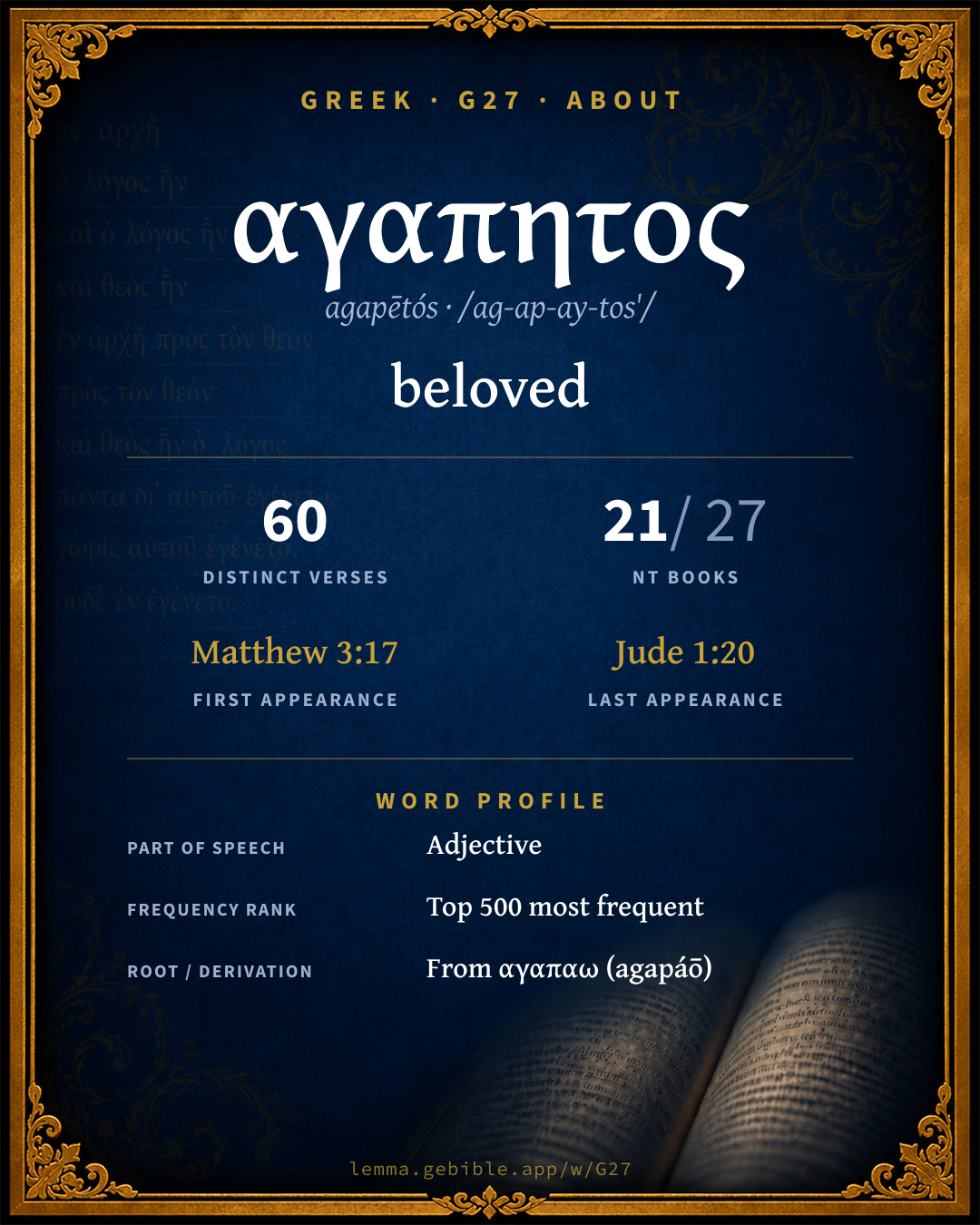
ἀγαπητός
beloved
Full lexicon entry — Thayer's Greek Lexicon
From Thayer's Greek Lexicon
Where this word appears
See every Accusative-case word in the Greek New Testament →
Grammar key — what these labels mean
Part of speech
- Adjective
- A word that describes or qualifies a noun.
Case
- Vocative
- The case of direct address (“O Lord”).
- Nominative
- The case of the subject (and the predicate nominative).
- Accusative
- The case of the direct object and of extent.
- Dative
- The case of the indirect object, means, or location — “to / for / with / in.”
- Genitive
- The case of source, possession, or “of” — answers “whose / from what.”
Gender
- Masculine
- Grammatically masculine.
- Neuter
- Grammatically neuter.
- Feminine
- Grammatically feminine.
Number
- Plural
- More than one.
- Singular
- One.
Every verse where G27 appears in the Book of Romans — 7 distinct verses. Click any verse to open its interlinear word-by-word view. Verse text shown in the World English Bible for context — . Each verse’s Greek form is shown with its reference; the English is not keyword-highlighted, since the data carries no word-level English alignment. Use “Compare translations” on any verse to read it across multiple English versions. This concordance covers the Greek New Testament; Septuagint (Greek Old Testament) occurrences of this word are not indexed here.
Romans
- Romans 1:7 ἀγαπητοῖς adj dat pl masc to all who are in Rome, beloved of God, called to be saints: Grace to you and peace from God our Father and the Lord Jesus Christ.
- Romans 11:28 ἀγαπητοὶ adj nom pl masc Concerning the Gospel, they are enemies for your sake. But concerning the election, they are beloved for the fathers' sake.
- Romans 12:19 ἀγαπητοί adj voc pl masc Don't seek revenge yourselves, beloved, but give place to God's wrath. For it is written, "Vengeance belongs to me; I will repay, says the Lord."
- Romans 16:5 ἀγαπητόν adj acc sg masc Greet the assembly that is in their house. Greet Epaenetus, my beloved, who is the first fruits of Achaia to Christ.
- Romans 16:8 ἀγαπητόν adj acc sg masc Greet Amplias, my beloved in the Lord.
- Romans 16:9 ἀγαπητόν adj acc sg masc Greet Urbanus, our fellow worker in Christ, and Stachys, my beloved.
- Romans 16:12 ἀγαπητήν adj acc sg fem Greet Tryphaena and Tryphosa, who labor in the Lord. Greet Persis, the beloved, who labored much in the Lord.
About this entry
At a glance — auto-summarized from this page’s data, not written by a person. Every figure links to its source below. This summary describes the numbers; it doesn’t interpret them.
The Greek adjective αγαπητος centers on the idea of “beloved.” Its earliest occurrence is Matthew 3:17. It turns up in 60 verses across 21 books, a moderately common footprint. It shares a root with αγαπαω and αγαπη. For the data behind this summary, explore the sense tree and the renderings breakdown below.
Gloss history
Strong's 1890 vs modern scholarship
About this word
Strong's G27 catalogs a Greek word from the Greek New Testament.
These counts are not copied from any lexicon or concordance. They are computed here, from the morphology-tagged Greek New Testament. What Lemma adds →
- 60
- distinct verses
- The word appears in 60 distinct verses.
- 21 / 27
- NT books
- The word appears in 21 of 27 New Testament books.
- #267
- by frequency
- Top 500 most frequent Greek words (rank 267 of 5,347 Greek words by occurrence).
View all 60 occurrences in the concordance →
By section of the New Testament
By traditional corpus
Conventional, traditional groupings — biblical authorship is debated, so this is a traditional corpus grouping, not an authorship claim. Some books belong to more than one corpus (Luke is in both the Gospels and the Lukan corpus, and so on), so these shares overlap and need not total 100%. Each figure is a share of the word’s 60 distinct verses.
- Pauline corpus 26 verses · 43%
- General (Catholic) Epistles 24 verses · 40%
- Johannine 10 verses · 17%
- Gospels 8 verses · 13%
- Lukan (Luke–Acts) 3 verses · 5%
- Hebrews 1 verse · 2%
How translations render this word
Counts come from each version’s own published word-to-Strong’s tagging or interlinear alignment — an approximate guide to how each version renders this word, not a word-level alignment the data otherwise carries. Because each total is that version’s own tagged count, the per-version totals vary from one another and need not match the appearance or distinct-verse counts above. These counts may also differ from a printed concordance because Lemma counts each distinctly tagged rendering and does not collapse phrase taggings into a single head-word total. This is a fixed set of word-tagged versions (KJV, ASV, BSB, ULT) and does not change with the reading translation you choose elsewhere. Each version’s license is shown beside its name below (and on Sources).
- King James Version: Beloved 45×, Dearly beloved 9×, Dear 3×
- American Standard Version: Beloved 58×, To 2×
- Berean Standard Bible: Beloved 58×
- unfoldingWord Literal Text: Beloved 49×, Beloved ones 11×
King James Version Public Domain
Renders G27 across 62 tagged occurrences — most commonly:
Plus 2 renderings that appear only once — usually multi-word phrases or single function words the recovered tagging swept in, not distinct renderings.
American Standard Version Public Domain
Renders G27 across 63 tagged occurrences — most commonly:
Plus 3 renderings that appear only once — usually multi-word phrases or single function words the recovered tagging swept in, not distinct renderings.
Berean Standard Bible Public Domain
Renders G27 across 61 tagged occurrences — most commonly:
Plus 3 renderings that appear only once — usually multi-word phrases or single function words the recovered tagging swept in, not distinct renderings.
unfoldingWord Literal Text CC BY-SA 4.0
Renders G27 across 61 tagged occurrences — most commonly:
Plus 1 rendering that appears only once — usually multi-word phrases or single function words the recovered tagging swept in, not distinct renderings.
Senses in Thayer's
The 1 sense Thayer's distinguishes for this word, in lexicon order (not ranked by frequency or importance). The full entry — with sub-senses — is in the Lexicon Entry tab.
- beloved, esteemed, dear, favourite, worthy of love
Word origin
Derived from αγαπαω (agapáō) (G25) — to love.
From G25 ; beloved : - (dearly well) beloved dear.
— Strong’s Exhaustive Concordance (1890), public domain.
Forms in the corpus
The 14 distinct written forms G27 takes in the Greek New Testament, most frequent first — each parse links to that case’s occurrences in the concordance.
Same root — word family
Other Thayer's entries built from the same root as G27, grouped by Strong’s listed origin. These share a root / origin per the lexicon — not necessarily a shared meaning. Each links to that word’s own entry.
Derives from
Shares the same root
Compare all same-root words → They share a root, not necessarily a meaning.
Septuagint usage
The same Greek word αγαπητος appears 16 times in the Greek Old Testament (Septuagint), across 16 verses in 6 books.
- 16
- LXX occurrences
- Tagged occurrences of this Greek word in the Septuagint.
- 16
- verses
- Distinct Septuagint verses containing this word.
- 6 / 39
- OT books
- The word appears in 6 of the 39 Old Testament books.
Sample Septuagint occurrences
- Genesis 22:2 ἀγαπητός
- Psalms 37:21 ἀγαπητός
- Isaiah 26:17 ἀγαπητός
- Jeremiah 6:26 ἀγαπητός
- Amos 8:10 ἀγαπητός
- Zechariah 12:10 ἀγαπητός
Septuagint occurrences (same lexeme)
Every verse where the same Strong’s number (G27) appears in the Greek Septuagint. Verse text shown in the World English Bible for context; the Greek form is the matched word — the English is not keyword-highlighted.
- Genesis 22:2 ἀγαπητός He said, "Now take your son, your only son, whom you love, even Isaac, and go into the land of Moriah. Offer him there for a burnt offering on one of the mountains which I will tell you of."
- Genesis 22:12 ἀγαπητός He said, "Don't lay your hand on the boy, neither do anything to him. For now I know that you fear God, seeing you have not withheld your son, your only son, from me."
- Genesis 22:16 ἀγαπητός and said, "I have sworn by myself, says Yahweh, because you have done this thing, and have not withheld your son, your only son,
- Psalms 37:21 ἀγαπητός The wicked borrow, and don't pay back, But the righteous give generously.
- Psalms 44:1 ἀγαπητός We have heard with our ears, God; Our fathers have told us, What work you did in their days, In the days of old.
- Psalms 59:7 ἀγαπητός Behold, they spew with their mouth. Swords are in their lips, "For," they say, "who hears us?"
- Psalms 67:13 ἀγαπητός
- Psalms 83:2 ἀγαπητός For, behold, your enemies are stirred up. Those who hate you have lifted up their heads.
- Psalms 107:7 ἀγαπητός He led them also by a straight way, That they might go to a city to live in.
- Psalms 126:2 ἀγαπητός Then our mouth was filled with laughter, And our tongue with singing. Then they said among the nations, "Yahweh has done great things for them."
- Isaiah 26:17 ἀγαπητός Like as a woman with child, who draws near the time of her delivery, is in pain and cries out in her pangs; so we have been before you, Yahweh.
- Jeremiah 6:26 ἀγαπητός Daughter of my people, gird you with sackcloth, and wallow yourself in ashes: make you mourning, as for an only son, most bitter lamentation; for the destroyer shall suddenly come on us.
- Jeremiah 38:20 ἀγαπητός But Jeremiah said, They shall not deliver you. Obey, I beg you, the voice of Yahweh, in that which I speak to you: so it shall be well with you, and your soul shall live.
- Amos 8:10 ἀγαπητός I will turn your feasts into mourning, And all your songs into lamentation; And I will make you wear sackcloth on all your bodies, And baldness on every head. I will make it like the mourning for an only son, And the end of it like a bitter day.
- Zechariah 12:10 ἀγαπητός I will pour on the house of David, and on the inhabitants of Jerusalem, the spirit of grace and of supplication; and they will look to me whom they have pierced; and they shall mourn for him, as one mourns for his only son, and will grieve bitterly for him, as one grieves for his firstborn.
- Zechariah 13:6 ἀγαπητός One will say to him, 'What are these wounds between your arms?' Then he will answer, 'Those with which I was wounded in the house of my friends.'
These are occurrences of the same Greek lexeme (G27) in the Septuagint — not a translation of any one Hebrew word. The store carries no word-level Hebrew↔Greek alignment, so no Hebrew original is asserted here. Counts come from the recovered LXX Strong's tagging — high-frequency vocabulary is well covered, while rare or late forms may be untagged — so they reflect tagged occurrences and may slightly undercount.